Showing posts with label Five Leaves Publications. Show all posts

Monday, 8 December 2025

Review by Karen Powell-Curtis of "Poems of a Nottingham Lace-Runner" by Mary Bailey


Mary Bailey published her pamphlet of thirteen poems in 1826 to raise money to support her nine children. Her poems offer an insight into the world of working-class women in the 1820s and, in particular, Mary Bailey’s life. John Goodridge’s introduction to this revised edition offers context to the poems in terms of time, place and social class.

Lace-runners were employed to embroider patterns onto lace, and in "Petition to the British Fair" Bailey writes: "How hard have we work’d, and our eyes how we’ve strain’d, / When those beautiful flowers we run." Later in the poem, we discover this work isn’t rewarded as well as it should be: 

          How pleasant’s the task, whenever we’re ask’d,
                 To work hard to beautify you;
          Then I’m sure you will own, with candour, unmask’d,
                 Good food and good clothing’s our due; 

          But the price is so low, that, sad to relate, 
                 We cannot these blessings obtain.

Bailey never views her nine children as a burden in spite of her poverty. "To a Lady who desired me to pray for the death of my youngest child" is her response to the woman who made this heartless suggestion. Her love for her children is clear in the lines "Her innocent smile shall my troubles beguile, / And make poverty light as a feather." In the final stanza she comments "lady, forbear to advise, / Till a mother’s affections you feel." In "The Author to Her Infant Twins," she expresses similar sentiments: "Welcome, dear little strangers, welcome here, / Altho’ to keen adversity you’ve come."

"The Locust" is addressed to her daughters and carries the message they should never be cruel. This poem gives us a strong sense of Bailey’s character. She is horrified to discover two young girls playing with "a poor little locust, pierc’d through with a pin." She tells them:

           To a nice school you go, where a lady doth teach,
                  And you much finer feelings should learn;
          But, I’m better than you, though my frock’s common blue,
                  While my heart doth such cruelty spurn. 

Bailey may have published her poems to meet an immediate financial need but two hundred years later they are still relevant.


About the reviewer
Karen Powell-Curtis has a PhD in Creative Writing from the University of Leicester. Her poetry has been published in various anthologies and magazines. 

Friday, 28 November 2025

Review by Karen Powell-Curtis of "Familiar Phantoms" by Sue Forrester


Sue Forrester’s debut pamphlet, Familiar Phantoms, transports us across time and place, from England to Africa and Asia. We tend to think of phantoms in terms of people, but Sue Forrester writes of places as if they too are phantoms. 

Her poems are rich with sensory details. In "Lamping with Lizard" we hear the "rustles, chirps and clicks" of Africa after dark and, by torchlight, we see "Iridescent bulbous beetles." We experience the fragrances of the "verandah scented with citronella" in "Small World," and the "jasmine blooms" in "The Scent of War." The poem "Cooking with Mother" offers taste and touch through the "production / of eighty doughnuts for the tea tent."

Forrester uses the power of objects to evoke the phantoms in her poems, and to link the past to the present. For example, in "One September Day," the Registrar’s fountain pen triggers a memory of a "21st birthday gift from Aunt Win," and simultaneously creates a new memory as she "Writes in the book, the forever book, / in the forever ink" to register a birth.

A "silver and black obsidian butterfly brooch" brings to mind another aunt in "And Apple Pie." In this prose poem, it is the absence of a particular object, a "silver-trimmed barrel" from which the aunt "dispensed chocolate biscuits" which represents the unique relationship between the niece and her aunt. Forrester writes, "And I mourn that biscuit barrel, swept away in a heartless house clearance, her daughters knowing only their mother, not my aunt."

"Needlecraft" is full of details revealing the love between a family. The central item in this poem is a knitting needle which has been repurposed to check "the lemon cake is done." The needle is the "survivor of the pair I used / when my big sister taught me to knit." This prompts the memory of sitting "on the little chair, / Daddy made for me," watching "my sister make a buttonholed loop / on the pot holder I’d knitted for Mum."

We gain a sense of a life through recollections involving cars in "My Brother’s Car." The poem ends with the moving description of the brother telling "a crowded chapel how he got to know / our father under a car" with "oil dripping onto their heads and hands: / a malodorous unction, full of grace."

The phantoms in Sue Forrester’s pamphlet are sensitively summoned but her poems never slip into sentimentality.


About the reviewer
Karen Powell-Curtis has a PhD in Creative Writing from the University of Leicester. Her poetry has been published in various anthologies and magazines. 

Tuesday, 18 November 2025

Review by Rennie Parker of "Poems of a Nottingham Lace-Runner" by Mary Bailey, with an Introduction by John Goodridge


How pleasant to make the acquaintance of Mary Bailey, a lace worker ("Lace Runner") from the great industrial city of Nottingham. For here is her pamphlet, her only one, since she was dead by her mid-thirties; but available at last thanks to the combined efforts of researchers plus Five Leaves Press.

Bailey is adept at ballad metre, but this should not be surprising, as mill hands and fieldworkers alike would improve their monotonous hours by singing. It’s possible that she had popular tunes in mind when composing her verse:

          You ladies of Britain, we most humbly address
               And hope you will take it in hand,
           And at once condescend on poor Runners to think,
               When dress’d at your glasses you stand.
  
There is ample evidence of the love she feels for her children, with none of that reserve which members of the upper classes were meant to show; she works hard and gets about, rebuking mean girls and enjoying the small wins of everyday life on the breadline. I like the sound of this person; the Baileys appear like the numerous and chaotic family next door but where their priorities are in the right order. 

Moreover, it’s important to know that literature was not only available to her but a realistic means of survival at the time. Literature was not an add-on or a hobby; it was part of the work she could do and where she might expect some benefits from that production, whether in sales, patronage, or as a springboard for a career. She knows what is popular at the time: there are moral instructions, appeals, an epitaph - but I find the most engaging piece is her verse letter, meant for her family in Staffordshire:

          Dear brother and sister the packet is come
          To let you both know we are safely got home:
          And, in this epistle I’m happy to say 
          My dear little Ellinor slept all the way …

The book was produced by subscription, same as the model used by today’s online publishers such as Unbounders; her patrons are listed at the back, numbering 90 in total with the vast majority of them being female - none of that idle sitting in drawing rooms for these ladies -  and it’s probably significant that Bailey’s two editions happened in the same decade as her vastly more popular compatriot, John Clare (who was only fifty miles away by stagecoach at the time).

As an insight into one woman’s life and experience, it’s beautiful; here is an authentic voice from those times, showing how a literate working woman thought and felt in the 1820s. Only the usual word of warning for any production like this: she is of course a supplicant, asking favours of the gatekeepers and upper class folk who could determine how she lived or died, or whether the literature should continue at all.


About the reviewer
Rennie Parker is a poet living in the East Midlands, and she is mostly published by Shoestring Press. Her latest collection Balloons and Stripey Trousers, a nightmare journey into the toxic workplace, came out earlier this year. She works in FE and blogs occasionally here. She is also on Twitter/X and Bluesky.


Monday, 17 November 2025

Review by Rachael Clyne of "The Postcolonial Flâneuse" by Ramisha Rafique


I am attracted by flânerie, the random wander in cityscape, and was intrigued by the postcolonial aspect. While I anticipated the gauntlet of sharp political comment, I found myself immersed in Rafique’s gentle reflections on gender, race and religion as she tours street cafes. As a Muslim woman she already disrupts the white male origins of the genre.

From lockdown in Nottingham to Paris and Marseille, from Istanbul and Syria she offers vignettes. She wants to be part of the flow, rather than a labelled stereotype: "She has become part of / the mass. She is him, and her, / and them." Rafique vividly engages our senses with "Café Soundtrack" – music, chatter, accents, clink of cups, adding visual notes – a man fiddling with his ring, a passerby’s cloud breath. 

One minute we are on a Nottingham street, the next we are in Paris where statues of past empire become sleeping places for the current homeless. "For Those Lost in The Kashmiri Diaspora" concerns her own heritage and continuing impact of a region divided by the British then recolonised by Pakistan and India. The book covers many themes: conversing with God through a foreign language, social decline in the face of climate change and the joys of girl-chat setting their world to rights over coffee and cake.  A museum visit hints at how its art treasures reflect colonial tastes and cultural plunder. 

With the poet’s light touch we are offered a smorgasbord of tastes, customs and meditations, that stimulate food for thought. She eventually takes us into her familiar comfort zones, e.g. "Arab Quarter, Marseille," where her uncovered head is disapproved of by an older woman and she is comforted by "the fusion of black tea leaves, mint, and sugar." All in all, this is a pamphlet well written and worth reading.


About the reviewer
Rachael Clyne is a retired psychotherapist. Her prizewinning first collection Singing at the Bone Tree (Indigo Dreams) concerns eco-issues. Her pamphlet, Girl Golem (4Word) and her latest collection, You’ll Never Be Anyone Else (Seren Books), explore themes of identity and otherness, including migrant heritage, LGBTQ+ and relationships.    


Monday, 30 June 2025

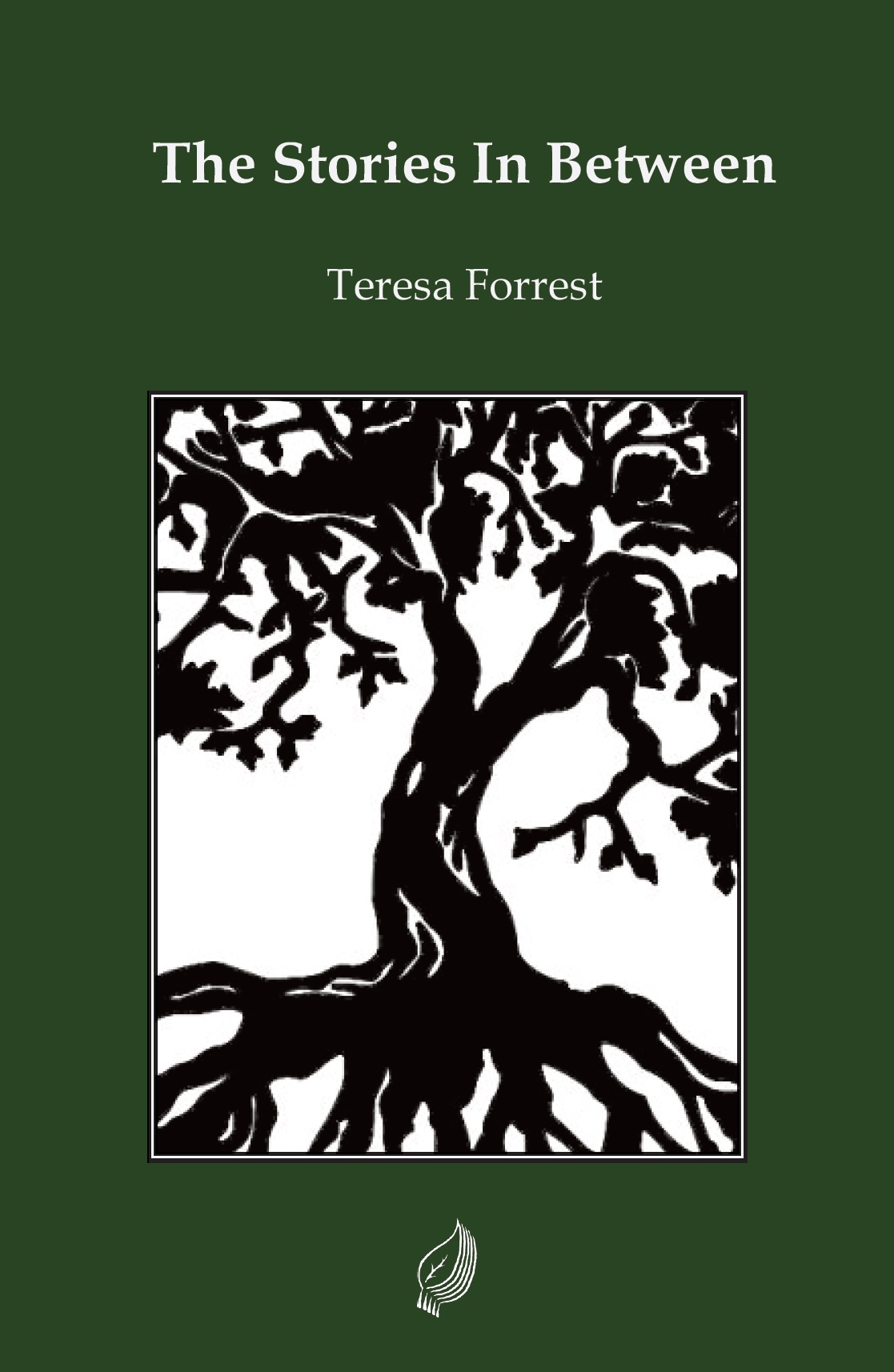
Review by Julie Gardner of "The Stories in Between" by Teresa Forrest


There are twenty-five short poems in this pamphlet; the longest is twenty-four lines. They are written in deceptively simple language - deceptive because, despite their accessibility, the poems, rooted in real people and the landscape around them, are profound and deeply moving. They reward the reader who pays close attention. 

In the first poem, "Almost Home," a mother addresses her child:

  I, your mother, am formed from folklore,
  spit and cabbage. When I made you,
  I hadn’t finished making me. I am so rough
  around the edges.

The shortest poem and one of my favourites (it is impossible to choose just one) is "In Balerin Village." The first two lines focus on a domestic appliance, "The fat-bellied range in my granny’s house" which "works hard / to warm us." But the description of the range is also suggestive of the character of its owner, "Get too close and it warns us with a scalding tongue." 

The poetic skill here is subtle – the rhyming of warm and warn, the connection between scalding and scolding. There is humour too, "Pans hiss with home grown / and, once, a cockerel that had crowed too early for her liking." The reader can be in no doubt that this grandmother is a strong and energetic character, summarized in the fifth line of this short poem which stays with the domestic imagery, "Always the kettle whistles to her tune." But the poem is not confined to the kitchen and the grandmother cannot be contained within its lines, the final two of which expand horizons, speaking volumes about the tender relationship between the narrator and her grandmother and hinting at the stories in between: "Each morning she gives me an orange, / a small globe that feels like the world."

There are other stories. "Pillow Talk" charts the gradual disintegration of a couple’s relationship from "that first moment / of easy laughter, / pillow talk between kisses." There’s the woman who lives "on the Tenth Floor of the High Rise" who has "painted her room the colours of the sun." There’s "Mrs Ritchie" who "carries her anger in a handbag, / worn-out crocodile skin, used to have matching shoes."  

The narrative voice remains consistent throughout the collection, compassionate, observant, respectful and with an Irish lilt. This is an exceptional debut pamphlet and I look forward to reading more from this talented poet.


About the reviewer
Julie Gardner is studying towards a PhD at Nottingham Trent University, focussing on Silence and Voice in the poetry of Vicki Feaver and her contemporaries. He poetry pamphlet Remembering was published by Five Leaves Publishers in 2024.

You can read a review of Remembering on Everybody's Reviewing here. 


Thursday, 5 December 2024

Review by Jonathan Wilkins of "New Uses for a Wand" by Fiona Theokritoff


Fiona Theokritoff has a wonderful way with words that beguile, enchant, and beg for answers to so many questions. Science, myth and fancy intertwine in her poetic world, a world of warrior queens and sad aspiring mothers who mourn their loss, searching for an answer to their quest for motherhood. Then there are the shoes of all types and fashions, old and used, newly formed, hidden in walls, each with a fascinating tale to tell. 

A world of wonder is brought to us in perfectly curated poems in all shapes and sizes that show Fiona Theokritoff’s talent for words. From the Big Bang to Brian Cox, the pamphlet takes us on adventures in science, asking questions, demanding we investigate further as all good word-detectives should. Unknown words and phrases pique our interest, demand that we look further, her words drawing us into mysteries that we must unravel. Then there are poems of dancing, and motherhood: at last motherhood is achieved, the beauty of the child juxtaposed with the tawdriness of real life. 

We end with a mother’s death. A child was carried, a child was born, and "Cartographer" truly maps the matrilineal life of a family where the mother's flame is passed on to the new matriarch. Life goes on as it does, and words go on too, demonstrating the completeness of the family - completeness in just ninety words. In the words, we read of dreams and reality, past, present and yes, future - a future where words mean everything, where cultures clash, where dreams are dreamt and reality is faced. Indeed, the beauty of Fiona Theokritoff’s New Uses for a Wand is that her poetry allows us space as readers to magic up our own reality.

And finally: a huge shout out to Five Leaves who are introducing us to so many wonderful poets through their positive recognition of talent.


About the reviewer
Jonathan Wilkins is 68. He is married to the gorgeous Annie with two wonderful sons. He was a teacher for twenty years, a Waterstones’ bookseller and coached women’s basketball for over thirty years before taking up writing seriously. Nowadays he takes notes for students with Special Needs at Leicester and Warwick Universities. He has had a work commissioned by the UK Arts Council and several pieces published traditionally as well as on-line. He has had poems in magazines and anthologies, art galleries, studios, museums and at Huddersfield Railway Station. He loves writing poetry. For his MA, he wrote a crime novel, Utrecht Snow. He followed it up with Utrecht Rain, and is now writing a third part. He is currently writing a crime series, Poppy Knows Best, set at the end of the Great War and into the early 1920s.

You can read more about New Uses for a Wand by Fiona Theokritoff on Creative Writing at Leicester here. 

Wednesday, 6 November 2024

Review by James Nash of "Remembering" by Julie Gardner


This is a tender and moving collection celebrating and memorialising two lives, the poet’s mother and her own husband, but succeeding, as all good poetry does, in finding universal truths about our common humanity and shared experience of loss.

Deftly constructing a history for her mother who died at forty-seven, and recording the emptiness after her husband’s death, these are quiet but truthful poems that bind us into the ordinary, but somehow extraordinary, emotional textures of human lives, and show us how we survive in the aftermath of tragedy.

This is from ‘Moving On’:

          After the van had gone
          I mopped the kitchen floor
          then went upstairs, stood awhile,
          as empty as the house itself.

Julie Gardener is a fine poet, content to let her readers ‘join up the dots’ if you like, but also happy to acknowledge the influence of other poets like Grace Nichols and Jacob Polley. She is playful in terms of form in ‘Rondo,’ riffing on nursery rhyme (a motif which appears in several of these poems), but ultimately what we have in this fine collection is a poet using simple and gracefully chosen words to explore the territory of memory and grief. The almost Wordsworthian reliance on everyday language gives these poems an emotional reach and power that is refreshing and unusual.

This is from ‘For Arthur’:

          Widow sounds so sad and slow
          and I am neither, though I will
          forever wish you here.

The photograph on the front cover of the poet’s mother is blurred; the poems inside reclaim the misty lives of those who have gone before, mother and husband, and prove again and again that art can construct great memorials. The gift of this brilliant collection is that it allows us to connect to our own loss and mourning, our own ‘remembering’ if you like.


About the reviewer
James Nash is a poet based in Leeds. He often writes in the sonnet form and his next collection, Notes of Your Music, will be published by Valley Press.