
Showing posts with label Fly on the wall. Show all posts

Thursday, 10 February 2022

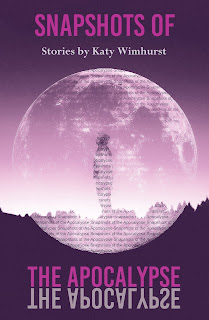
Review by Sharon Eckman of "Snapshots of the Apocalypse" by Katy Wimhurst


Katy Wimhurst’s new collection of short stories is a dark, witty look at a world at once recognisable and skewed. 

The title tells you pretty much where you’re headed, but although each story takes you in that dystopian direction, the beauty is in the detail. Wimhurst’s ideas are fabulously inventive . In the title story, a post-Apocalyptic London features rains named after former Prime Minsters – Thatcher, Blair, Rashford (if only) and ‘the worst was Johnson – deceptively lightweight but soaked you through and through.’

I particularly enjoyed ‘Haunted by Paradise,’ a sensual take on the expulsion from the Garden of Eden – this modern Eve grows an enchanted garden in her flat, stealing plants from the local park armed with a ‘surreptitious trowel and large bag.’

In ‘The Job Lottery,’ the female protagonist, who we only know as Miss Fisher, attends the malign EnCorp’s Job Lottery – billed as a Festival – to try and get herself a decent job. ‘EnCorp wishes you a Good Lottery – Seize the Moment!’ This story has echoes of Huxley’s Brave New World with its Prozac candyfloss, PsychoBliss Drops and – my favourite – the Public Penance Trampoline where you are sent to bounce up and down shouting your penance through a loudhailer for alleged crimes against the state.

All of Wimhurst’s protagonists are lost in some way, mostly living solitary, lonely lives, often with a failed relationship in the background. The stories contain a yearning for hope despite the dystopian scenarios, but, for me, some ended rather abruptly. I also found some of the parallels with our current concerns – refugees, the climate emergency - a little too on the nose, but Wimhurst creates believable characters in wild scenarios and her prose is full of drily funny one liners. Highly recommended.


About the reviewer
Sharon Eckman is an actor, singer and writer. Winner of the Time Out Travel Writer of the Year, she has been longlisted twice for the Fish Memoir Prize, shortlisted for Words & Women Prose competition and the Jerwood/Arvon Mentorship Scheme. Short fiction has appeared in Shooter Lit, Words & Women: 3, 100 Voices: An Anthology, 100 Voices for 100 Years and New Flash Fiction Review. She is currently working on a novel and has just completed her first short film. Her website is here. 

Friday, 29 October 2021

Review by Matt Nunn of "Sin Is Due to Open in a Room Above Kitty's" by Morag Anderson


The title of this slender debut chapbook gives off a whiff of seduction and promised delight, and whilst it is not sin that Morag Anderson is serving up in these thirty-three brief pages dripping with senses and emotions, she very much seduces with calm, concise writing amongst all the storms that are erupting and bashing her characters around. This fully stocked cast of, one assumes, dramatis personae seems to be constantly enduring things that happened to them, rather than possessing the agency to control the things that happen. Yet endure they always seem to do, despite themselves on occasion, emerging triumphant and in full poetic voice ready to sing of these forbearances and victories.

These are poems where nothing much seems to happen on the surface, yet when they intrude, like slow gentle ripples, into the consciousness of the reader, they explode and clout you about the senses, announcing their business as they do, showering the reader with shards of insight into the modern condition.

Whilst initially you may have some sympathy for the titular character of “Last supper with Sarah,” it is a poem that seduces and wraps itself around you until you get to the denouement when you discover that Sarah is almost certainly a much-deserving recipient of the punishment being meted out to her.

For days after my first read of these poems, my head was full of echoes of Morag Anderson’s poems that I just couldn’t shake, each wave full of poetry that I had enjoyed and needed to mull over. She also owns that super-power, that electrical surge in her nib, that can re-cast the apparently mundane into something of fascination worthy of interest and celebration. I’m not sure there is a better compliment for a book, or for a poet.


About the reviewer
Matt Nunn is the author of five poetry collections, the latest of which is St. Judes College Reject (RedSox Press). He works as a freelance writing tutor, writing coach, editor and writer and teaches Creative Writing at Solihull College and has performed his work on TV, radio and a million different venues, to audiences big and small, enthusiastic and indifferent, for over 25 years. He’s still amazed at how he gets away with it all.


Thursday, 26 August 2021

Review by Simon Elson of "Fauna" by David Hartley


I didn't know that books like Fauna by David Hartley were published any more. I mean that in a positive manner. It is a collection of dystopian/sci-fi style stories. I thought books of short stories had almost stopped being published altogether, especially of the genre in this collection. I’m so glad that I was wrong. I read each story with fervour. As well as the sci-fi leaning, all the stories have an animal or insect subject matter, hence the title.

Some have a distinct ending, others are perhaps little ambiguous, prompting further thought before turning the page to read the next. The finest compliment I can offer is that although they are set in the twenty-first century (and some, the future) they reminded me of the golden age of this genre, the 1950s and 60s, and are comparable to the short stories of Phillip K Dick and John Wyndham.  

Without too many spoilers, some of the highlights for me were the ferryman of the Styx accepting an unusual passenger with an even more unusual cargo, a man hunting shadow animals - is he hunting shadow animals because all the real animals have been hunted already, or to protect the few that are living? - a fishing trawler netting a regal catch, horses in a barn as part of a time-slip, and a story about foxes that could have been written by the master of English horror, James Herbert.

For me, though, the standout story is ‘Betamorphosis.’ A young Cockroach is shunned by his family after being forced to take part in an experiment and thinks he is … now, that would be a major spoiler. Poignancy, family feuds and some laugh-out-loud moments are all crammed in to a short story about an insect.

In my opinion, this single story would be reason enough to buy the volume. I will certainly be seeking out more works by David Hartley.


About the reviewer
Simon Elson is a Freelance Features Writer. His articles  have appeared in numerous national magazines including Best of British, Derbyshire Life and Writing Magazine. He also writes for the popular cycling website Veloballs.com and has been a guest blogger on The Huffington Post. 


Saturday, 3 April 2021

Review by Julian Edge of "Muscle and Mouth" by Louise Finnigan


Muscle and Mouth, by Louise Finnigan, is one of a series of short-story books from Manchester’s Fly on the Wall Press. Jade, the narrator, speaks out of a life transition familiar to generations of working-class adolescents.  

You have discovered you are good at those things school wants from you. You realise that opportunities are opening up for a more exciting life than you, or your family, or your friends have been used to. Then comes recognition of the price demanded: you are expected to switch allegiance, to free yourself from the inferior habits and values of those from among whom you will be allowed to ascend. You feel the anger, the nascent determination to demonstrate that you can clear all the hurdles set in front of you and still you will not betray old loyalties. You struggle with the lingering acknowledgment that there will be loss and that, although you could turn back, you will not.  

The steel core of the story and the key to its intense sense of authenticity lie in Finnigan’s command of the various discourses that she deploys. Domestic exchanges between daughter and mother, constrained interactions with an evaluating teacher, ironic banter with peer-group members who Jade is about to record and offer up as data in her A-Level assignment, data which she then dispassionately analyses with appropriate use of academic terminology and reference to the sociolinguistic literature. All of these are convincingly enclosed in a narrative scarred by eye-wincing violence and illuminated by a poetic sensitivity that takes in the superficial ‘wafting smells of chip-pan and spliff’ as well as the deep sense of an underappreciated land ‘dark with energy’ that ‘throbs through us when we shout or laugh or fuck.’ 

I feel not only spoken to, but also spoken for. With admiration and thanks.


About the reviewer
Julian Edge has a background in English language teacher education and in Person-Centred Counselling. He has published a number of professional and academic books and two novels, Satisfaction in Times of Anger (2017) and Blindsided (2020). He hopes to see his third novel, Loving Country, appear this year.

Sunday, 7 June 2020

Review by Lauren M. Foster of "Dinner in the Fields" by Attracta Fahy


There is something of the wild about Attracta Fahy’s first poetry collection, Dinner in the Fields. It draws frequently on pantheist mythology, much of it, unsurprisingly, Celtic. This is, however, no wistful new-age collection. Through the use of ancient archetypes Fahy explores what it means to be a woman in the twenty-first century. In the first poem, 'The Woman in Waterside House,' we hear the voice of a woman experiencing domestic violence: the reader is left with little doubt of the poet’s intention to address difficult themes. In the final stanza of 'The Woman in Waterside House,' Fahy states: 

          Easier to pretend my life 
          is full, than to face the shame 
          in your eyes, mine, 
          and the shame of the world, 
          when you are a woman with a fist over your face. 

The poems in Dinner in the Fields span the author’s lifetime: from her childhood memories of living on a farm next to a graveyard in rural Galway, to her bidding her son farewell as he leaves home to move 6,000 miles away. The past is connected to the present through sky, stone, earth, flora, fauna, and the ancestors are as much in attendance as the poet herself. In the poem 'Our Sleeping Women,' Fahy writes: 

          Old graves sloped down
          from our farm. As a child
          I played house, tea sets
          on tombs, innocent, 
          listening to spirits. 
          Daughters left to work
          with duty not to themselves,
          but others who cared little
          for the objects they’d become.

Fahy is not afraid to experiment in form: the poem 'Wintering Swans' spreads over two pages like swans flying in formation. There is gentle humour too, in poems such as 'A Diagnosis / My Daughter Speaks': 'my daughter tells me I need / to see a doctor. I may even have Alzheimer’s / … / ‘What age can you get Parkinson’s?’ / After half hour in the kitchen. // ‘Can I get a lift to my friend’s house? / We’re having a sleepover.’

Dinner in the Fields illustrates the idea that women are closer to nature, violence and sex, but is also a celebration of renewal. I read this collection before I went to bed one night and lay for over an hour thinking about the poems. I look forward to reading more of Attracta Fahy’s work in the future.


About the reviewer
Lauren M. Foster is a poet and graduate of the MA Creative Writing at University of Leicester. 

Wednesday, 20 May 2020

Interview with Thomas McColl


Thomas McColl lives in London, and currently works at the House of Commons, having previously worked in bookselling. He's had poems published in magazines such as Envoi, Iota, Prole, Atrium, Rising and Ink, Sweat and Tears, and in anthologies by Eyewear, Hearing Eye and Shoestring Press. His first collection of poetry, Being With Me Will Help You Learn, was published in 2016 by Listen Softly London Press, and his second collection, Grenade Genie, is out now with Fly on the Wall Press. His website is https://thomasmccoll.wordpress.com/


Interviewed by Matt Nunn

MN: How have you arrived at this point? Is this your first collection?  What is your writing history, have you been around for a while, or have you suddenly caught the poetry bug and unleashed yourself upon the public?

TM: I seem to have arrived at this point via a circuitous route, having taken a few wrong turns along the way – but, one way or another, I guess it could be said I’ve been around a while. At any rate, I’m now 49 and living in London, and my first publication was when I was 17 and still living in Birmingham – a poem in the West Midlands Arts magazine, People to People, for which I was paid the princely sum (at the time) of £10 – and things went downhill from there for quite a few years. I kept writing – short stories as well as poems – but couldn’t get any placed in magazines. 

Then I began to concentrate solely on poetry and, by the mid to late 90s, was starting to get poems published in reputable magazines such as Rising, The Big Spoon, The Affectionate Punch and Purple Patch, and in 2000 I published a 20-page pamphlet called The Beast in the Bag with Poetry Monthly Press, which received favourable reviews in magazines like Iota, Fire and The Frogmore Papers. 

After that, there was another long period of drought – partly caused by me switching to writing novels and short stories and, though the novels never got placed, the short stories, over the past 10 years, have been published in many print and online magazines, such as Liars’ League, Bare Fiction and Smoke: A London Peculiar. I’ve also been more consistent with performing live – getting myself out there, in terms of reading both short stories and poetry, and getting featured at festivals such as Newham Word Festival, Wolverhampton Arts Festival, Winchester Fest and the Faversham Fringe – and I’ve now had two collections of poetry published, one in 2016 by Listen Softly London Press, called Being With Me Will Help You Learn, and now, in 2020, my second, called Grenade Genie, with Fly on the Wall Press. 

Being With Me Will Help You Learn was quite eclectic, a kind of greatest hits of my best poems from the past 20 years, whereas Grenade Genie is definitely a much more deliberate, focussed collection – which, I guess, leads quite nicely on to the next question …

MN: Whilst there is no narrative arc linking the poems together into a narrative whole, there is nonetheless a unifying feel to the collection; all the poems seem to belong together and in their own way collate into a whole. Did you plan the book as one collection from the start, or did you write the poems individually and found you eventually had a collection with a theme?

TM: I did write the poems individually, but I guess I was starting to write more and more poems which were definitely more political and trying to make sense of the world we’re in, and I soon discovered along the way that a fair number of the poems I’d been writing could form the basis of a broadly themed, cohesive collection. 

At any rate, over the past couple of years, there’d been this fairly firmed-up manuscript called Grenade Genie (even if the poems, and the order they were in, kept changing – and, at one point, the name of the collection changed as well). However, it was only pretty much just before I submitted to Fly on the Wall, that I came up with the subtitle, '25 Brief Studies of the Cursed, Coerced, Combative and Corrupted,' and split the manuscript into those corresponding four sections.

MN: There’s also very much a sense in the collection that it is about someone battling against the odds through a darkened city. Is that deliberate? And is it all written in the voice of a single person? If, so, who, or is it you, or at least a version of you? Or is it a collection of disparate voices, all trying to make sense of their times and surroundings?

TM: There is definitely some of me in all the poems, in terms of experience or viewpoint, or both. The one poem that’s completely autobiographical is ‘Nightclubbing in Brum, 1988,’ whereas the other poems contain some of me in them but ultimately represent different voices, in varying situations. 

At the same time, I think it is true that all these disparate voices do represent someone: the voice of, as you say, ‘someone battling against the odds through a darkened city.’ One of the main themes, or main points made in Grenade Genie is that, ultimately, everyone and everything is expendable – but while this knowledge can generate either a sense of hopelessness or the nothing-to-lose strength to rail against it, one strength of poetry is that even if only the former gets expressed, the latter is automatically achieved. 

Basically, what I’m trying to say with this collection is that sometimes you just have to go for it and do something – make a stand – even if the situation really is hopeless. For instance, in the title poem, someone possessing genius but requiring the spark has little choice but to pull the pin on a live grenade in order to release the genie inside that will grant him his wish. The explosion kills him, and all his atoms (which form into lesser versions of himself) then get the credit instead of him. But, at the same time, by pulling the pin, he wipes out the establishment that’s blocking all progress. 

MN: Nightclubbing in Brum, 1988. Why did we bother, when nights were as abysmal as how you describe them in the poem? (I was there too, and they were!)

TM: You're right to say 'Why did we bother?' I mean, there really was 'F--k all else to do,' but even so ... 

However, it remains the case that what makes for a crap night out – or, indeed, what makes for any crap experience at all – can often make for a good poem, and while I think the poem ‘Nightclubbing in Brum, 1988’ will resonate with anyone of a certain age from Birmingham, I think people from anywhere, and of any generation, will recognise the frustrations expressed in the poem of being a teen and finding, at 18, that being an adult, and being able to do adult things, isn’t all that it’s cracked up to be.

As it happens, the nightclub that’s referenced, ‘Snobs,’ is still going strong, and when the Black Country-based online magazine, Arts Foundry, published my poem, and I tweeted about it, Snobs retweeted it to all their followers, which was cool.

MN: You name T.S. Eliot and 'The Wasteland' specifically in the poem 'The greatest poem of the 20th century,' and his presence certainly stalks the rest of the collection, but who else is in there, who are your other influences?

TM: Thank you, and while I didn’t have specific poets in mind as influences when I wrote this book, my first poetry influences were Stevie Smith and Roger McGough, and I think their influence is always in there, somewhere, in my writing.

At school, we studied the Penguin Education book, Worlds: Seven Modern Poets, and one of the poets was Adrian Mitchell who, out of the seven poets, I took to the most, as his poetry was straightforward, direct and easily understood, but at the same time sophisticated, rich with metaphor, satirical, funny and very profound – and it does feel as if he’s in there too, in my book, as he certainly had an effect on me. 
  
MN: And if 'The Wasteland' is the greatest poem of the 20th century, which is the second?

TM: ‘Howl’ by Allen Ginsberg.

MN: When they come to tot such things up in December 2099, do you think it will be decided that indeed you did write the worst poem of the 21st century?!

TM: Well, in 2001 there was a poem I had published in a very obscure magazine which I hope will never be found, for if it ever is found, it will certainly be in the running.

MN: Do you still work in a bank?

TM: No. I swapped banking for bookselling in 2001 which, though it meant a cut in my salary of two-thirds, was one of the best things I’ve ever done. 

As mentioned in my poem, ‘Nightclubbing in Brum, 1988’, I worked for Lloyds Bank in Birmingham (from 1988 to 1990). I then moved down to London to study History, got a 2:1, then drifted into banking again, as I’d worked part-time with Midland Bank throughout my studies, processing cheques, and, staying with them, by 2000 had risen up to be a Credit Control Relationship Manager for various German banks. However, my new girlfriend at this time, Firoza (who I’m still with), had become a bookseller at Books etc – and, knowing this was what I wanted to do instead, I joined Books etc as well, eventually becoming assistant manager at their Broadgate Circle branch. 

Anyway, I’d have stayed in bookselling, but once Amazon came along, Books etc’s days were numbered, so I had to go elsewhere and got a job at the Parliamentary Bookshop and, from there, ended up in the Palace of Westminster itself, working at the Vote Office. At the start of the current lockdown, I had to still go into work to assist with the remaining stages of the Coronavirus Bill’s passage through Parliament, but at the time of writing, I’m working from home.

MN: This is a book set very much in a city, or maybe more accurately 'The City.' You reference both London and Birmingham, and yet the feeling you get from reading the book is that actually the city you’re talking about is not either, but a state of mind. Is any city regardless just a state of mind anyway? And as a writer are you only ever merely re-interpreting this state of mind, rather than writing about the actual and physical?

TM: I think you’re right: the city – or at least any major city – is definitely a state of mind, and there’ll be so many similarities between London, Moscow, Tehran, Delhi, Beijing and Lagos, even if they all have very different cultures and systems, and in lots of ways, I do just want to represent that state of mind engendered by these places – that attitude and outlook. 

Having said that, I do enjoy referencing London, and I love London – even in my first week of living in the capital, I knew I’d never return to Birmingham – and because I’ve spent pretty much all my adult life in London, and was born there too, it’s London rather than Birmingham that’s always been referenced in any of my collections, and mainly in this one too – except for the one exception that is ‘Nightclubbing in Brum, 1988,’ which I enjoyed writing, so maybe I should write about Birmingham more, as the UK’s second city in the 1970s/80s provides a rich seam for any poet, if truth be told.

MN: You mention living in both Birmingham and London, the two biggest cities in the country. Are you a writer specifically of the urban and the city? Have you ever lived anywhere else, and if so did it affect your writing? Also, do you think if you ever lived in the countryside, would you be able to write in the same style, or would you write in a different fashion about different topics?

TM: Yes, my writing is very urban – and one reason for that is the fact I’ve only ever lived in London and Birmingham (I was actually born in London, in Hammersmith, but my parents moved up to Birmingham when I was two, and I moved back down when I was twenty) – so I think, by this point in my life, if I lived in the countryside, I’d still be a writer specifically of the urban and the city. Of course, I’m saying that without having actually done it, and everyone is affected and influenced by their surroundings, so I wouldn’t be surprised if living in the countryside did have some effect. Who knows, maybe I’d turn into some rural, rustic writer overnight – the new Ted Hughes.

MN: Where next with your writing?

TM: I intend to promote this book well into next year – and, in view of the current crisis, I think that’ll be absolutely necessary. Before the lockdown happened, I’d had my first ‘tour’ lined up, including a headline slot at Whisky & Words in Birmingham, a book signing at the Book Corner bookshop as part of the Saltburn Folk Festival, and a one-hour performance slot at the Leamington Poetry Festival! Those dates stretched from May through to August, so maybe some will still happen, as planned – but, in any event, I’m in for the long haul, as I always have been, and I believe in this book, and I’m very lucky to have a publisher who believes in it too, and I’m very glad to have had the opportunity to talk about it here on Everybody’s Reviewing. Thank you! 

Saturday, 16 May 2020

Review by Matt Nunn of "Alcoholic Betty" by Elisabeth Horan


It would be easy to say that Elisabeth Horan is just another reincarnation of Sylvia Plath and Anne Sexton, and there’s truth in such a claim, but that would be doing this bold, new American poet an injustice, for she is more than just a carbon copy rising to say pale cover versions from the graves of the greats who have gone before her. She is influenced, yes, but she, as all the best poets do, has taken her inheritance and twisted, mangled and sculptured it into a definite new voice, her own. One that once encountered shan’t be easily forgotten.

Alcoholic Betty is an unflinching, yes another  hoary old cliché from the book of reviewing tropes, journey through a thick blackened world of miscellaneous liquids both spilled and imbibed, addiction and collapsing mental health, a long dark night of the soul replayed on a daily, grinding loop over many years.

At times it does feel your faculties and senses are wading through a thickening soup of terror, and if it ever feels tough, keep going, think how Horan herself must have felt living out these nightmares for real, and also head to the end, where glimmers of light and hope will bathe you, both in humane relief that Horan has made it through not unscathed presumably, but certainly unbroken, but also that she survived to write these poems, these hymns covered in every sickly liquid imaginable that by being here represent a hope and victory, not just for the act of writing, but for living through it all.

From what passes on these pages, and to quote the title of probably my favourite poem in the collection - though to be fair there are many candidates - it may be a stretch for the poet herself to be penning a poem entitled “I love Elisabeth Horan Volume 3” any time soon; still, after reading this book it may well be a poem I myself may scribble. It is certainly a sentiment I feel after this emotional and linguistic tour-de-force.


About the reviewer
Matt Nunn is the author of 5 poetry collections, the latest of which is St. Judes College reject (RedSox Press). He works as a freelance writing tutor, writing coach, editor and writer and teaches Creative Writing at Solihull College and has performed his work on TV, radio and a million different venues, to audiences big and small, enthusiastic and indifferent, for over 25 years. He’s still amazed at how he gets away with it all.