Showing posts with label Indigo Dreams Publishing. Show all posts

Thursday, 10 September 2026

Review by Jessica Mookherjee of "Darling Blue" by Sarah James


Darling Blue is a poetry collection that creates its own world. We follow a woman through galleries and paintings, gradually discovering who she is and what she is doing in this world of art galleries, secret trysts and obsession with a man whom she names Blue. Paintings become ways of understanding what she cannot understand directly. We begin, as she does, to search for Blue everywhere.

Halfway through the first section of Sarah James’s Darling Blue, I realised I had been reading it wrongly. I had been judging the poems one by one: some I admired, others seemed more conventional, accomplished ekphrastic poems. But suddenly I found myself wanting urgently to know what happened next. I was reading a poetry collection as if it were a novel. And that was when I understood: the collection is the poem.

James is particularly good at allowing later poems to alter the experience of her earlier ones. The book is a palimpsest: meanings are written over but never completely erased. Walter Crane’s Neptune’s Horses recurs throughout. Initially its untameable horse offers an exhilarating image of freedom. Later, after the narrator admits that she failed to escape Blue’s grip, the same image cannot mean quite the same thing. By the time she becomes "More Than Neptune’s Horse," we’ve travelled too far with her to accept untameability quite at face value. In that way, the collection itself becomes an artwork.

The narrator repeatedly understands herself, only to understand herself differently several poems later. She leaves her younger self behind, then acknowledges: "I am no longer her, / and yet, part of her is still me."

Looking is one of the collection’s central actions. James’s narrator doesn’t passively describe paintings; she interferes with them. She wonders what their women are really thinking and questions the stories art history has given them. In If they looked more closely, Waterhouse’s Juliet is no longer necessarily dreaming of Romeo. Her blue necklace can be "clutched / and fingered," but beneath it is the woman’s own "unquenchable" redness. Gradually a colour grammar develops. Blue is the lover, but also something unknowable; red belongs increasingly to the narrator, full of body and appetite.

As we read the book, it begins to teach us how to read it. It’s an elegant lesson in what a whole collection can do, rather than simply being a series of competent or excellent poems. Darling Blue gives us ekphrasis, yes, but as an act of creating a woman’s inner life: we want the paintings to decode her. Then there are prose-poem heartbreaks when reality crashes in, and the epistolary poems addressed to Blue. These three registers - ekphrasis, prose poem and epistolary - become part of the narrator’s own construction. 

I came to trust the narrator’s contradictions. She stops writing to Blue, then writes another letter. They feel less like unreliability than the ordinary instability of the stories we make about our lives.

Another theme is power. The power relations are complicated. Blue has the wife, home and public life, while the narrator receives fragments: hotel rooms, disappearing messages, postcards from paintings they have seen together. In one of the saddest passages, she arranges those postcards in her flat: "A collage of our time / together, without us in it."

Yet she is not simply Blue’s victim. She looks at him, anatomises him, makes him into material. "In my head now, at least, I make him my muse instead," she says in the poem "Questions."

There are revelations about who she is which make the construction of the collection suddenly feel inevitable. I don’t want to give too much away, but her relationship with art is more than that of an interested observer. Meaning accumulates in the spaces between artworks. The collection is also an exhibition, and we walk through it with her.

The later poems deepen the book considerably. Blue begins to disappear. Blank space appears, and so do a son and another man. In "A father," love consists of wiping noses, holding sick bowls, scrubbing vomit and helping with homework: not romantic spectacle but attention and repetition. In "Unstoppable," the narrator turns from paintings "behind glass / and framed with dead wood" towards her living son, whose eyes contain "whole worlds / which haven’t yet been painted."

But James doesn’t make domesticity the cure for dangerous passion. In "Before something burns or bursts," after John Collier’s Priestess of Delphi, the woman is again incandescent, surrounded by red, suspended in "all / possible futures." By now the intensity that once seemed to belong to Blue looks as though it may always have belonged to the narrator herself.

Near the end, "Restoration" gives us the narrator at her most knowing. Paintings fade; restoration uncovers details but cannot return an artwork to its original state. "Some loves can live on, undamaged, beyond their initial context,” she concludes, “but it takes more than just a shared passion."

In the final poem, "My last unsent letter," Blue is summer sky, lake and sea, shared now with the man with whom the narrator has made another life. But I don’t entirely believe her, and I don’t think the collection requires me to. "I still carry a small flame of you with me," she admits. Even the title "My last unsent letter" makes "last" feel provisional. Which of us has been left untouched by the people we have loved?

Then comes one of the book’s most satisfying returns. Up close, blue is "distance’s illusion." The sea that Neptune’s Horse appeared to drink at the beginning was never something that could be swallowed or possessed.

So Blue does not disappear. Nor does the woman who wanted him.

I finished the book thinking about the whole thing rather than individual poems: about what had happened to me as a reader while moving through its paintings, and how differently I understood the first pages by the time I reached the last. The collection is the poem. And it is a very good one.


About the reviewer
Jessica Mookherjee is the author of three poetry collections with Nine Arches Press, Flood, Tigress (shortlisted for Ledbury Prize) and Notes from a Shipwreck. Her fourth collection Universe is an Animal is due for publication in November 2026 with Nine Arches Press. She’s also the author of Desire Lines (Broken Sleep Books). She works in public health and lives in Kent. 

Saturday, 7 December 2024

Review by Rachael Clyne of "Janus" by Catherine Ayres


This is a thoughtful and beautifully crafted collection. Like Janus, Catherine faces both directions as she dips into memories. The months are in order, while the years skip back and forth. In her title poem, "January 2015 - a new sofa arrives":

          What might happen, never did.
          My heart’s a holloway, a healed wound
          but January’s naked on the lawn –

In February 2014, the narrator visits a Louise Bourgeois exhibition in "Spider" – a skilful villanelle circling around Bourgeois’ giant spider sculptures in her attempt to heal childhood trauma by "weaving her woman’s body into art." Ayres shifts from classic form to sharp imagery in "Ignoring Alicia":

          If I were you
          I’d have swollen eyes,
    a flick knife fringe

In March 2020 lockdown: "streetlights weep like snowdrops." Ayres delivers groceries to her mother who is gradually revealed behind the garage door, like Darth Vader wearing Sketchers. In May, she is a mother in a witty prose poem in Geordie dialect,  when her kids are berated by a neighbour for "hoying clemmies" (throwing stones). The poet then deftly shifts to June and a childhood friend in "Odbods," describing their bedrooms, "like conches, delicate and full of whispers." 

Ayres's poetry is grounded in love of landscape. September has descriptions of Gateshead’s "Dunston Staithes," and Ambleside’s "Dove Crag." October 2019 brings a recurrence of breast cancer and a second mastectomy, followed by a clifftop walk to a castle, where there is "no turning back from your wind-sucked gate, the grimace of its antlered mask." As we move through different spaces of her life, we glimpse it through Ayres' eyes. The book ends on Christmas Eve 2014 with "The single woman and the lights," as she untangles the mess of lights (and marriage breakup), then "slow dances" them round her tree. This is a book of courage, tenderness and subtlety.


About the reviewer
Rachael Clyne from Glastonbury is widely published in journals. Now retired, Rachael was a professional actor, then psychotherapist. Her prizewinning collection, Singing at the Bone Tree (Indigo Dreams 2014), concerns our lost connection with nature. Her pamphlet, Girl Golem (4word.org 2018), explores her Jewish migrant heritage. Her latest collection, You’ll Never Be Anyone Else (Seren 2023), is a journey of reconciling identity and otherness through childhood, relationships, LGBTQ and ageing. 

You can read more about Janus by Catherine Ayres on Creative Writing at Leicester here. 

Friday, 20 October 2023

Review by Gary Day of "The Omniscient Tooth Fairy" by Vic Pickup


First things first. This tooth fairy is not omniscient. One poem is called ‘Little did I know.’ Nor is she really - this may come as no surprise - a tooth fairy. As ‘Occupation’ shows, she is so much more: ‘a climbing frame,’ ‘a tissue,’ ‘a body guard’ - in other words, a mum. More tough fairy than tooth fairy.

The only reference to dental matter is in ‘Irretrievable.’ The speaker recalls not being able to retrieve her daughter’s tooth after dropping it down the sink where its ‘pale milkiness erod[es] slowly in the sewer dirt.’ This slight but powerful drama of maternal anxiety and lost innocence crops up again in the poignant yet stoical ‘Facts of life.’

Most poems in this delightful collection concern the ups and downs of the speaker’s many-sided domestic life: husband, babies, picking up children from school, shopping for a birthday, family outings. They are a beguiling mix of vividness and tenderness, streaked with darkness. Indeed why shouldn’t they be? Life isn’t all sunny side up. But even when things get on top of the speaker, humour is never far away, as in the dazzling ‘My New Fridge,’ whose ending packs quite a punch.

Outside the fraught but generally cosy domestic circle there are more ominous events such as the plight of refugees portrayed in ‘Jungle,’ which finishes with a devastatingly powerful image. ‘The Longing of Judith Kerr’ is the most lacerating poem in the volume. It asks the reader to imagine how the children murdered in the death camps could be coaxed back to life. There are also hints of personal tragedy and a keen awareness that not all is well in contemporary Britain.

The collection bounces along. Whimsical, profound, absurd, touching, joyous, courageous and deeply life-affirming. Buy it.


About the reviewer
Gary Day is a retired English lecturer. He is the author of several books including The Story of Drama: Tragedy, Comedy and Sacrifice from the Greeks to the Present. He has also edited a range of books including two volumes on British Poetry in the Twentieth Century. His debut poetry collection, The Glass Roof Falls Like Rain, is due to be published by Holland Press later this year. 


Monday, 23 May 2022

Review by Gary Day of "I Left My Hair in San Francisco" by Sallie Durham


Lucky the reader who stumbles on this debut collection. Here they will find balm for the spirit, succour for the soul. Sallie Durham’s poetry is wistful and gentle with tinges of melancholy and, very occasionally, a hint of the macabre. Her great achievement is to conjure a feeling for the being of things, whether it is her mother’s old cook book or sunflowers - one of her favourite subjects. In one poem they speak of themselves with pride and stoicism: ‘we, who were once goddesses- / suddenly old dames in hard hats.’ 

The connection between females and flowers is apparent in one of the best poems in the volume, ‘Iris,’ whose life cycle ‘recall[s] the lives of women / our weeping and our bleeding disguised in fine attire.’ Durham’s nature poems are quite different from the moralising Wordsworth and the melodramatic Ted Hughes in that she insists on identity and kinship, even with the humble ‘The Crane Fly’ whose stumbling dance of death proves as much a work of art as a poem, a defiant gesture against inevitable extinction: ‘slumped down on the windowsill / his last two fingers up in a V.’ 

The poems about love and family are deeply touching. ‘Ladders’ will resonate with anyone who is, or has been, in a long relationship. ‘Vigil,’ a poem about Durham’s dying father, is full of tender, piercing images and uses rhythm to great effect, repeating the same words at the beginning of the poem at the end but changing the earlier chugging sound to staccato sobs. The tonal range is impressive from the comic title poem to the slightly manic ‘Finland’ but it’s the imagery which stays in the mind. It is consistently striking and inventive: ‘The clouds continue to bank / their platinum.’ One can only hope there is more to come from this new kid on the block. 


About the reviewer
Gary Day is a retired English lecturer. He is the author or editor of a dozen books including a two volume history of modern British poetry. He had a column in the Times Higher for a number of years and has been actively involved in amateur theatre for many years.


Friday, 20 May 2022

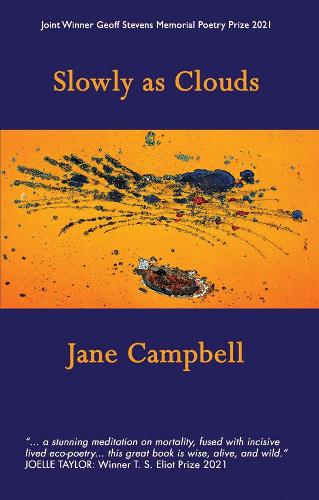
Review by Gary Day of "Slowly as Clouds" by Jane Campbell


Jane Campbell’s poetry has edge: it glints rather than glows. ‘Degrading’ is one such example in this raw, uncompromising but strangely beautiful collection. The poem recounts a group of girls surrounding the young poet demanding she prove the arrival of her first period. The ending brilliantly transforms this humiliation into a triumph: ‘recasting them / in perpetuity / slow for their age.’ 

The theme of change or metamorphoses is present in many of the poems, particularly those to do with parents or lovers. Campbell pays tribute to the political activism of her mother whose frailty in age is a spur not to forget how she impressed her daughter ‘with the importance of rights / that once they had bite were revoked.’ But this tribute has a darker feel in ‘Fairy Tale’ where the speaker apologises for tormenting her parent. 

Campbell’s portrayal of her father follows a similar trajectory. At first he is a monumental figure, ‘an army of hands and feet’ but then we see him shrivelling in a hospital bed, while the poet envisages his evolution into a ‘butterfly, then rabbit, then antelope.’ The ending of this poem, ‘Metamorphosis,’ is not only exquisite but also a demonstration of Campbell’s knack of finding new and unusual rhymes. 

There is sober realism in the poems about love; a celebration of its joys in ‘May moaning from our mouths,’ and an acceptance of its sorrows. There is a particular poignancy in ‘Let Go’ where though desire has run its course that ‘doesn’t mean / I don’t still love us.’

Campbell is highly versatile. She can write a shocking futuristic poem like ‘Always Alice’ and a gentle, almost Hardyesque one like ‘Wishing Well’ which should be included in any future anthology of English poetry. An ever-present consciousness of mortality does not sour her sense of life’s abundance. ‘Compost Loo’ shows that even waste is a form of enrichment. 


About the reviewer
Gary Day is a retired English lecturer. He is the author or editor of a dozen books including a two volume history of modern British poetry. He had a column in the Times Higher for a number of years and has been actively involved in amateur theatre for many years.