Showing posts with label MA in Creative Writing. Show all posts

Sunday, 13 September 2026

Review by Sally Shaw of "The Longest Day" by Lisa Williams


The Longest Day is Lisa Williams's debut novella, each page holding exactly one hundred words. The one-hundred word stories are set in a tower block in Leicester: "Longhope House rises into an ecru sky with the railway station tucked at her feet. She looks tired, her concrete curves haven’t been tattooed with a fancy new mural." These words convey the status of the flats and the people that reside in each. The novella is set on 21st June 2019, the longest day of the year, and allows the residents of the tower block to speak.

The way Williams has formatted the book, each page having flat number, title and time reminded me of 253 by Geoff Ryman. As I read, I was curious to find out the relevance of the flat numbers, because Williams hasn’t set the stories in flat order: flat 204, for instance, is followed by flat 602. For me as I read, it was as though I was running up and down the stairs to each of the flats, to find their stories. I tried to hold each story in my mind's eye, searching for connections to individual residents, some of which I found, others I may have missed so fleeting were they. I liked the layout of each page: the words, page centre, enabled me to access each sentence and absorb their full impact. 

The stories within each flat are like flash cards that may show who the resident is, why they are there, their past, their sadness, age, family, work, personality, circumstance and more. Williams packs enormous detail into each sentence: "Renee is planning her funeral. She’s reading through the hymn-list again. She’s told no one about this but has detailed it all in a red notepad bought for 3/6 in Woolies. It still has the price sticker on it." In these three sentences I gain an insight into Renee’s age, that she’s a private person and holds a fear of death and her wishes not being known. As the story of each flat unfolds I find moments of humanity, conveyed by words that portray the underbelly of circumstance and uncover the predators waiting to pounce. Flat 505 "the mobile hairdresser" has a gentle beginning, and tells the story of Betty, her hair downy thin. The hairdresser sees the beauty of Betty, and doesn’t draw attention to "a peaches fuzz over a shrimp pink scalp." Betty is taken back to beehives, gossip and herself, in a story of untold truth and unfelt age. 

These stories can be read as isolated vignettes to reflect on, and yet as I mentioned earlier I searched for threads that pull them together. Flat 903 and 205 are threaded to flat 1305, the actions of whom cause harm and disappointment, demonstrating the ramifications of circumstance. Taken as a whole the stories form a collage of the lives of the people who dwell within the tower block. 

The Longest Day is a complex read, and there’s beauty to be found amongst the harshness and sometimes foul aspects of life for the inhabitants of Longhope House. I wrote down my thoughts after reading the last page. I discovered glimpses of community but in the main this had been stripped away, the post left in pigeon holes, the milk not delivered to flat doors, the demise of the caretaker. It made me consider how and why people are housed in run-down tower blocks. Are they selected because they are vulnerable, have no fight, no right to ask for better? Williams has provided an insight into the lives of those hidden away and maybe The Longest Day will bring these issues into the day light. 

The Longest Day is a book that can be read as a whole, or read story by story to be thought about, enabling you to see the individual people living in those tower blocks you pass rushing for the train.


About the reviewer
Sally has an MA Creative Writing from the University of Leicester. She gains inspiration from old photographs, history, childhood memories, and is inspired by writers Sandra Cisneros, Deborah Morgan, Liz Berry and Emily Dickinson. She has short stories and poetry published in various online publications including the Ink Pantry, AnotherNorth, Roi Faineant Press. Sally lives in the countryside. 

You can read more about The Longest Day by Lisa Williams on Creative Writing at Leicester here. 

Monday, 6 March 2023

Review by Gift Yusuf of "Purple Hibiscus" by Chimamanda Ngozi Adichie


Fifteen-year-old taciturn Kambili is raised by her strict-abusive-Catholic-fanatic father and her overbearingly meek and submissive mother. Her older brother, on the other hand, is the rebel of the family because of his ability to nonchalantly confront their father. 

We are carried on Kambili’s journey of longing and loss as a teenage girl who has a deep love for her father regardless of his inadequacies. However, she finds herself constantly seeking his approval even though, he seems to prefer her disrespectful brother because he is a boy. Later in the book she finds her longing in a man who is much older than she is, when she goes to visit her cousins on holiday. 

The book covers a range of social justice issues and the negative effects of colonial influence which is eye-opening and informative without being too exegetic. It shows that the father is also a victim—a victim of colonialism due to the presence of the Catholic missionaries in eastern Nigeria. He doesn't even realise it in many instances, such as when he makes his family speak only English, banning their native tongue, in the home. 

His religious fanaticism also leads to him isolating his family from other relatives and their native traditions because they are seen as "heathen," while he physically assaults his wife and children under false Biblical justification. 

Regardless of their father's shortcomings, we can tell that he has an unspoken love for his family by some of his subtle actions in the story—for instance, he always shares the first drink of his tea with his children. 

I was gripped from beginning to end while reading this book as it took me on a roller-coaster of emotions, particularly because it ended in such a shocking plot twist. Even with the father’s abusive nature, I found myself feeling pity for him towards the end of the novel as secrets were revealed, and it made me wonder if the mother’s "submissive" nature was disingenuous. 


About the reviewer
Gift Yusuf is a current MA Creative Writing student at the University of Leicester. She’s twenty years-old and graduated from Coventry University where she studied Law and had her first short story published in the Coventry Law journal. In her free time, she volunteers with kids and a Young Writers' organization as an Alpha reader. She also loves to read short stories and watch short films. Her favorite short film is The Neighbors' Window, an Oscar winning film which can be found on YouTube. 

Monday, 7 March 2022

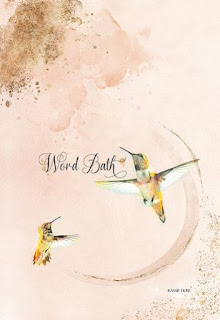
Review by Cathi Rae of "Word Bath" by Kassie Duke


Kassie Duke is an American poet and writer but is firmly linked to Leicester and the University of Leicester, having studied an MA in Creative Writing here. This is her first collection – described as “a short sweet walk through the mind of a writer,” including poems that explore “every mood but melancholy.”

Kassie uses language confidently, painting small but beautiful pictures of nature and the everyday and is particularly skilled at the short poem form – something which is far harder to achieve than might seem from first reading. These poems, often quiet on first reading, bear multiple visits and will re-pay careful attention and time. I enjoyed the micro poems and their use of language based on the natural world. 

In our current dark times, this little message of hope seemed particularly apposite: “and I will dream — not of the time I spent in winter — but of the sun coming up with the steam.”

This is a book to pop into your back pocket and dip in and out of over a coffee or when you have a few moments to reflect on the power of words.


About the reviewer
Cathi Rae is a spoken word artist and poet. Her debut collection is Your Cleaner Hates You and Other Poems (Soulful Publishing, 2019). She is currently working on an M4C-funded Creative Writing PhD at the University of Leicester on telling marginalised lives through poetry.

You can read a review of Cathi's collection on Everybody's Reviewing here. 

You can read more about Kassie Duke's Word Bath on Creative Writing at Leicester here. 

Tuesday, 20 February 2018

Review by Paul Taylor-McCartney of "Bystander" Anthology


This anthology has been created by MA Creative Writing students at Nottingham Trent University, and features writing inspired by exploring the perspective of the bystander: the one witnessing the action. This is an interesting premise, in that the reader is often cast as a text’s primary bystander, and so there are parallels drawn here between the many unheard or unregistered voices of society and those actively constructing meaning from often very sparse narrative detail. 

This is certainly an eclectic and diverse set of creative pieces: play-script, poetry and short stories sit happily alongside one another, jostling to be heard. Many of the pieces work best when read aloud, particularly the poetry and play texts, but some of the shorter narratives gain from this approach, too, with the form being used to give a platform to hitherto silent, or silenced characters. Standout pieces are those that turn economy of form to their advantage. A short poem, ‘Party Time’ by Tim Youngs, reflects on the ways in which we are all at the mercy of time itself. In ‘To stop times fall / I hold it steady / my hips don’t swing,’ there is a sense that humans are pre-disposed to oscillate between moments of private contemplation and the intoxicating draw of life itself. In another highlight, ‘Changelessness’ by Jonathan Taylor, a despairing parent tries to make sense of a home that has fallen silent, the children having ‘gone, gone’ and is brilliantly captured in a single page of prose. The hopelessness of being forced to move from active participant in one’s own life to observer of a ruined domestic scene is perfectly captured in the narrator’s ‘half-hearted imitations of real tidiness.’ 

There are other thought-provoking moments in the collection, and the anthology gains much of its power via the process of reading one piece after another, the slow accumulation of ideas and styles, which often takes the reader off in new and exciting directions. It is the mark of good editors that the anthology is sequenced to highlight talent on the MA course, both students and lecturers, as well as a wealth of other guest lecturers and writers. An engaging and thoughtful read.   


About the reviewer
Paul Taylor-McCartney is currently Head of Secondary Teacher Education at Warwick University. He has enjoyed a long and varied teaching career in the discipline of English / Theatre Studies and is following a part-time PhD in Creative Writing with Leicester University. His research interests include dystopian studies, narratology and 20th century literary criticism.