Showing posts with label The Emma Press. Show all posts

Saturday, 25 July 2026

Interview with Suyin Du Bois


Suyin Du Bois is a poet of mixed Chinese-Malaysian and Belgian heritage, living in London with her South African husband. Her poems have been published in Propel, Iamb, Stanzas, Bi+ Lines: An Anthology of Contemporary Bi+ Poets (Fourteen Publishing, 2023) and Malaysian Places and Spaces (Maya Press, 2024), amongst others. She is a member of the Southbank Centre’s New Poets Collective 2024/25. When not obsessing over word choice, Suyin spends her time building a profit-with-purpose start-up that seeks to ensure 24/7 access to nutritious, affordable food for NHS hospital staff. Eating Air is her debut pamphlet.


Interviewed by Laura Sygrove

LS: Eating Air opens with "Ode to Kaya," a poem that moves between childhood and adulthood. Why did this feel like the right poem to begin the collection?

SDB: "Ode to Kaya" was the first poem I wrote where food took such a central role, and it really opened up something in me. Suddenly I was thinking of all the different ways food could help me explore different areas of emotional interest. Since this poem acted as a gateway for me, I hoped it might do the same for my reader. Beyond that, it seeded some key context and themes for the collection which I hoped would help get the reader quickly into this world: the idea of multiple homes at distance from one another, the connective power of food, as well as tensions around identity.

LS: In poems such as this one, there is a sense that food and memory change when carried across borders. How has living in London affected your relationship to the places and traditions you write about?

SDB: Certainly, I think distance romanticises the worlds that you are apart from, and that we are more at risk of taking for granted that to which we have daily access. In my writing I am often trying to capture elements of the world that are not my day-to-day, to make my memories and momentary impressions tangible. Regarding living in London specifically, I love how culturally mixed London feels to me, how it feels like a place where I can be all the parts of myself. I do think it is a very positive influence on my writing in this sense. 

LS: Your preface connects food, poetry, and a sense of home, while many poems explore questions of identity and belonging. How has writing poetry helped you navigate the cultures, languages, and places that have shaped you? 

SDB: What a beautiful question. I love the reflective nature of writing poetry. It encourages me to ask questions of myself, to think about what I’m interested in communicating and why. There are parts of my cultural upbringing that are already bedded in, others I have consciously sought out for myself, and others I am only learning about now. I am still being shaped. It’s all a work in progress, and I think poetry has a supportive, parallel role to play in that. Beyond this, I love how poetry connects me to other people. I have some readers who have similar upbringings and background to me and others who have completely different ones. Hearing both these sets of readers highlight something I wrote that resonates with them is beautiful and fills me with a new sense of belonging. I honestly can’t get enough of it. 

LS: Much of the collection is written in prose poetry. What drew you to this form, and how do you decide when a poem needs a different structure?

SDB: Pretty much every poem for me starts as a brief note about a specific idea or memory. My Notes app is full of these! When I have time to sit down and write, I take one of these ideas and free-write to try to get down as much core and tangential detail as I can. From this free-write, I pick out the elements that I think make a poem, and then start writing toward that in a much more structured fashion. Usually this is where I start to introduce form. I'm firstly interested in making line breaks and stanzas work with my own cadence and pacing: I will always read my poems out loud throughout the editing process (a big reason why I struggle to edit in public!). Beyond that, I look at the overall shape and feel of the poem, and try to use the form to introduce some element of surprise or highlight particular words or ideas. 

For the slash poems in the collection, I still see these as line-broken poems rather than prose poems. In "Cut Scenes" this felt right at first due to the fragmentary nature of retelling memories that aren't mine, where I am inserting myself. Additionally, there was something about the poem being sliced up like steak that I rather liked! In "Every trip to Brussels must include a Sunday," again these felt like fragments of varying interconnectivity all stuck together in one big way, so the close separateness of the slash felt right to me here as well.

LS: In poems such as "Auntie Pixi’s Aga Agak," recipes become a way of preserving memory. What interested you about those moments where cultural inheritance feels both intimate and incomplete? 

SDB: While I very much embrace my two heritages, I feel a certain level of disconnectedness also for two key reasons (and perhaps others too). Firstly, I never knew any of my grandparents, they all passed away before I was born. Secondly, I can't speak any of my heritage languages fluently. As I've gotten older these things have bothered me more and I've mourned that feeling of distance, even in the context of love, with older family members who have now passed. This is a continuing area of interest for me.

LS: "Chinese New Year at Sara’s" explores the tension between inheriting traditions and reshaping them. Why was that an important theme for you to write about? 

SDB: I suspect that I or the things that I do will never be whole or authentic enough for some people, and so I'm conscious that I need to claim and celebrate these differences for myself. Knowing this and doing it, however, are not the same thing! Having said that, I actually didn’t realise that’s where this poem was going to go when I started to write it. It took me to quite a bold, declarative place all by itself. 

LS: The title Eating Air comes from Hokkien and Malay expressions connected to food, wellbeing, and travel. When did you realise it was the right title for the collection, and what does the phrase mean to you now?

SDB: I had these phrases "chiak hong" and "makan angin" noted down as a seed idea for a poem for a long time, and planned to explore how these idioms for travelling translate to "eating air," but I just never ended up writing into the idea. When I was getting my sample of ten poems together in response to The Emma Press open call for submissions, I needed to give the collection a working title in the proposal. I was struggling to find something within the sequence of poems itself and this jumped out at me when I turned to my Notes app for inspiration. It just seemed to fit perfectly with how the poems invite the reader to travel across the world with them. I also love how the title is intriguing in English as an unusual turn of phrase. I’ve had several people ask me the story behind it. Luckily, I was able to include an explanation in the preface, which unravels this for non-Malaysians.

LS: Food carries memory, grief, family history, identity, and belonging throughout the pamphlet. What does food allow you to explore in poetry that other subjects might not?

SDB: Food gives me a really concrete, sensory way into so many different subjects. I can start off free-writing about the physical experience of eating and end up somewhere completely different, abstract or even undefined, which I might otherwise struggle to get to or to articulate without the more tangible language of food. 

It felt really generative for me as well, having this theme of food to play with. I was constantly thinking of new meaningful food moments, and noting them all down. I was really conscious that I didn’t want to be writing the same poem over and over again though, so I kept pushing myself to make sure each poem took me in a new direction. 


About the interviewer
Laura Sygrove is a graduate of the MA Creative Writing programme at the University of Leicester. She is an advance reader at DartFrog Books and writes for The Publishing Post. You can read some of her poems here, here and here. You can read a review by Laura of Eating Air by Suyin Du Bois on Everybody's Reviewing here. 

Thursday, 23 July 2026

Review by Laura Sygrove of "Eating Air" by Suyin Du Bois


Suyin Du Bois’ debut poetry pamphlet is a tapestry of shared cultures, a smorgasbord of delectable delights and rough estimations; a rich blend of seasoned memories and flashes in the pan. Eating Air is complex, intimate, and oftentimes devastating; a journey into the past in an attempt to preserve the present, always just seconds out of reach.

Besides Du Bois’ poetry, I’ve thought of little else for weeks. Her work begs you to read the words aloud, to savour each syllable as the speaker savours each meal. Eating Air is a collection of flavour samples that dance on the tongue and settle in the pit of your stomach. Du Bois transports the reader across oceans to sit at low dining tables, folding meal trays at high altitude, beside hospital beds and roadside stalls, relishing the familiar taste of airline food and leftovers, sand-roasted chestnuts, French pastries, and makeshift noodle dinners.

For Du Bois, eating and writing are both acts of remembering and belonging, or of not quite belonging, and of longing itself. In her preface, she describes feeling poetry in her body in much the same way as food, where "certain combinations of words can have just the right mouthfeel." Food nourishes the body while carrying emotional and cultural memory. Poetry preserves that memory, remaking it through language: "I stir and stir like her until my spoon draws the right depths of lineage."

As a title, Eating Air feels both grounding and elusive, suggesting nourishment while gesturing towards something intangible: "store-bought surrogates," swaddled exports with their "layers thinned," family recipes spooned from jam jars for the very last time. Her work reads almost as a series of diary entries, reimagining transitory yet toothsome moments in a search for self through places, memories, and identities that resist easy definition.

Du Bois writes with complete transparency, embracing the discomfort of existing between cultures. She allows these tensions to remain unresolved, capturing the feeling of being both within and without. Her poems linger in that in-between space, searching for belonging without ever insisting upon certainty. My favourite line in the collection, "I insist we oil our bloodlines mackerel slick," is as tender as it is visceral, preserving heritage not as something fixed, but as something living and lovingly maintained. In Eating Air, nourishment is found not only in food, but in language and memory, and the act of returning to them.


About the reviewer
Laura Sygrove is a graduate of the MA Creative Writing programme at the University of Leicester. She is an advance reader at DartFrog Books and writes for The Publishing Post. You can read some of her poems here, here and here.  

You can read more about Eating Air by Suyin Du Bois on Creative Writing at Leicester here. 


Thursday, 24 April 2025

Review by Jonathan Wilkins of "Wild Boar" by Hannah Lutz, trans. Andy Turner


Ritve is looking for wild boar.

Glenn is looking for happiness.

Mia is looking after her grandfather who is suffering from Alzheimer’s.

All are living by the forests of Småland in Sweden.

The forests of this Småland are home to a growing population of wild boar that were once on the verge of extinction. Ritve is searching for them, but never seems to have any success in finding them. He sees their destructive nature and chases sightings, but to no avail. Why is something so plentiful continuously out of his reach, but seen by so many others?  

Mia wants her grandfather to remember his past, but continually fails even though she has brought him back to his childhood home. Her love and devotion towards him are clear, but it makes no difference. Age has taken its toll and it can never be reversed.

Glenn is an ordinary man with simple ideas and tastes who just want to be happy. He has found his love and his true nature. But will it be enough? His job is only a means to an end. He does not relish it, but he does seem to welcome life and wants to get more from his surroundings and relationships.

Wild Boar is narrated by three very different characters who have come from afar to the isolated community of Småland.

Wild Boar is a poetic masterpiece about animals and people and their different places in a destructively changing ecosystem. The denouement of the book is tragic and compelling as we are shown than none of us can escape the world in which we live. It will take its toll.

Written beautifully, and translated with what we can only assume is infinite care, Wild Boar looks at our past and our future, the planet's past and future and, in the end, it doesn’t appear to hold out much hope for our future.


About the reviewer
Jonathan Wilkins is 69. He is married to the gorgeous Annie with two wonderful sons. He was a teacher for twenty years, a Waterstones’ bookseller and coached women’s basketball for over thirty years before taking up writing seriously. Nowadays he takes notes for students with Special Needs at Leicester and Warwick Universities. He has had a work commissioned by the UK Arts Council and several pieces published traditionally as well as on-line. He has had poems in magazines and anthologies, art galleries, studios, museums and at Huddersfield Railway Station. He loves writing poetry. For his MA, he wrote a crime novel, Utrecht Snow. He followed it up with Utrecht Rain, and is now writing a third part. He is currently writing a crime series, Poppy Knows Best, set at the end of the Great War and into the early 1920s.

You can read more about Wild Boar by Hannah Lutz on Creative Writing at Leicester here. 

Friday, 25 October 2024

Review by Peter Raynard of "After the Rites and Sandwiches" by Kathy Pimlott


Kathy Pimlott’s heart-breaking pamphlet, After the Rites and Sandwiches, portrays the impact of her husband’s sudden death from falling down the stairs of their home. In the aftermath, the reaction and readjustment is immediate and ever-present.

In an early poem, "No shock advised," short, punchy lines put you under no illusion as to the enormity of the event.

          It’s cruel work
         To kneel down
         and hunch over
         a so-familiar body at the foot of the stairs

But even then, when the defibrillator says, "no shock advised" and it’s apparent that there is nothing to be done, "still the sweet mad hopeful brain insists it will be okay."

The pamphlet is both a portrayal of grief and biography of a marriage. Tears become the episodic outpouring of emotion, almost carrying the weight of a seizure: "It’s impossible to foretell what will provoke tears, the sort that well up and tip over while you hold onto the kitchen sink waiting for them to subside."

Grief is also full of surprises, one of which is guilt: 

         Forgive me, I’ve laughed,
         glided lightly round garden centres, sipped fizzy wine
         with friends, sorted out edge pieces of puzzles.

Grief may not have feathers, but it does have a long tail; for although her husband is gone his presence remains, in objects, memories, as well as his ashes, and knowing what to do with them. In "Death Admin I," "Your demise constitutes a quarter off council tax, removal of a vote you seldom cast." Then in "Death Admin II," when collecting his ashes, 

        It shouldn’t be a surprise, the weight, the quantity.
        Not knowing what to expect, I take a pink rucksack, 
        carry you again, all down Holborn on my back.

Pimlott beautifully crafts the poems, with a matter-of-factness laced with incisive metaphors, which detract from the possibility of being overly maudlin. 

There is also dark humour as she almost parodies self-help, in titles such as "How to be A Widow," "Death Admin I & II," and in the final poem, "Coda: Tips on avoiding the offered consolations of Religion and Therapy": "If it’s Religion, it’ll spot you, even when you’re crouched low behind the credenza," or: "Therapy requires acuter acting skills. Better pretend you’re a dog (a Dalmatian, the least intellectual)." Also in the poem, "What I do with you now you’re dead," Pimlott writes: "in a laughing panic, [I] dumped a quarter of your ashes and ran away, the illicit thrill exactly what you would have wanted."

After the Rites and Sandwiches is a stunning biography of a marriage and its aftershock, that will stay in the reader’s memory long after the book is laid to rest.


About the reviewer
Peter Raynard is an independent researcher, poet and editor of Proletarian Poetry. His three books of poetry are: Precarious (Smokestack, 2018), The Combination: a poetic coupling of the Communist Manifesto (Culture Matters,2018), Manland (Nine Arches Press, 2022). A debut pamphlet (a heroic crown of sonnets), The Harlot and the Rake: poems after William Hogarth, was published by Culture Matters in September 2024.

You can read more about After the Rites and Sandwiches by Kathy Pimlott on Creative Writing at Leicester here. 


Monday, 17 June 2024

Review by Jonathan Wilkins of "Mother Night" by Serge ♆ Neptune


Beautifully written in a myriad of forms, structures and styles, Mother Night is a difficult and disturbing read. Having said that, it should be read as it opens up an underworld that we might have missed and experiences that demand questions from us without providing obvious answers.

It takes great courage to look so deeply into the past and this must have had a cathartic effect on Neptune as they examined the events that have had such a profound effect on them. The issues raised are at times hard to come to terms with but the quality of Neptune’s writing allows us some insight into their world, uncomfortable as it is. The descriptions of their early life are so skilfully narrated that they allow us to understand something of what the narrator experienced. This was an earlier life that was tainted by abuse and pain. 

That Neptune has grown from this only does them credit and the ability to put the experiences into words so skilfully is an art in itself. Quite disturbing in their intensity, the poems delve deep into the psyche of the writer and allow us as the reader to enter their world. The past is intensely interrogated and we are invited into a life deeply impacted by extreme events. But the beauty of Neptune's poetry is compelling. They use images and scenes that intrigue us and encourage us to enter their world.

The poetry almost acts to cleanse the past and to mediate a way forward, in a way that only this art form can achieve. The words bring clarity and make sense of the past as only poetry can do. As writers we know the sense of wellbeing that we can find by putting our thoughts and feelings onto paper and Neptune must truly have felt a release as they wrote this, trying to expunge the past, and to move forward, yet allowing us to share their memories with them. 

Does the narrator want us to learn from their life tales? Is the book a warning to us or is it a celebration of the fact that they have overcome the trauma to lead their current life? Neptune’s work is outstanding, though upsetting and challenging. The world can be a problematic place and we can face challenging things. It is how we respond to this that makes us who we are. Neptune shows he has learnt from life and his experiences and been able to move forward. That is the very least we would wish for ourselves.


About the reviewer
Jonathan Wilkins is 68. He is married to the gorgeous Annie with two wonderful sons. He was a teacher for twenty years, a Waterstones’ bookseller and coached women’s basketball for over thirty years before taking up writing seriously. Nowadays he takes notes for students with Special Needs at Leicester and Warwick Universities. He has had a work commissioned by the UK Arts Council and several pieces published traditionally as well as on-line. He has had poems in magazines and anthologies, art galleries, studios, museums and at Huddersfield Railway Station. He loves writing poetry. For his MA, he wrote a crime novel, Utrecht Snow. He followed it up with Utrecht Rain, and is now writing a third part. He is currently writing a crime series, Poppy Knows Best, set at the end of the Great War and into the early 1920s.

You can read more about Mother Night by Serge ♆ Neptune on Creative Writing at Leicester here. 


Friday, 2 February 2024

Review by Cathi Rae of "Makeover" by Laurie Bolger


Laurie Bolger is an award-winning poet, performer and founder of The Creative Writing Breakfast Club. It seems that the poet Laurie Bolger and I have things in common – Irish working-class roots, an interest in writing and thinking about fashion ... and we both found and read grown-up sex books at an impressionable age.

Makeover is a collection of the domestic, the small, the lives of ordinary working-class women, the stories of mothers, daughters, grandmothers, sisters and friends, all described with film-still precision. Her descriptive language is beautiful. She’s able to conjure up that moment, that childhood in ways that evoke a time and place even if you weren’t there and her pen portraits make me feel as if I know these women:

          Aunt Teasy    all horoscopes and nails
                      cursing and coughing
          like she emptying great bags of gravel
          straight onto the coffee table 

Bolger finds beauty in the smallest things, city flowers, the go-faster powers of a frilly swim suit, and the unspoken, when women hold onto lives, make spaces for themselves and challenge society’s expectations of what a good woman is.

This is a confection of a collection – easy to read in one delicious gulp and then return to again and again, always finding a new image, a justifiable blast of anger and defiance. It’s also the only collection I’ve ever read where Sylvanian Families get a name check.


About the reviewer
Cathi Rae is in the final year of an M4C funded creative / practice-led PhD. A new pamphlet collection, Just this side of sea-worthy, will be available from Two Pigeons Press in March 2024.

You can read more about Makeover by Laurie Bolger on Creative Writing at Leicester here. 


Friday, 31 March 2023

Review by Laura Besley of "Postcard Stories" by Jan Carson


Collections of micro fiction are rare. Collections of micro fiction by novelists are rarer still. I recently read The Fire Starters by Jan Carson, and loved its surreal lyrical qualities through which the devastating reality of living in Northern Ireland was explored. A month or so later I was browsing the online catalogue of The Emma Press and saw Postcard Stories (2017), illustrated by Benjamin Phillips. The title is in reference to how the book came about: ‘Every day in 2015, Jan Carson wrote a story on the back of a postcard and mailed it to a friend.’ The book contains 52 stories, one for each week, in which ‘Carson presents a panoramic view of contemporary Belfast.’

In her book, Going Short, Nancy Stohlman writes: 'One of my favorite approaches to writing a flash fiction story is what I call the zoom lens – taking an ultra close-up shot of what’s potentially a much bigger story. It’s like narrowing the focus from a wide-angle landscape to a single flower. In flash fiction, the single flower can be the whole world.' This zoom-lens approach is often used by Carson in her stories. One example is in August’s opening story in which the main character leaves her father in Ikea because ‘he was too old to go on.’ The actual story takes place in a slither of time, but it also encompasses the difficulties which arise from having to watch the struggles of an ageing parent: ‘I could see he was glad of the rest, glad to have the expectation lifted from him.’ 

Carson’s stories don’t have titles. Instead readers are given the week in which they were written, where and to whom. The last story, written in St George’s Market, Belfast, opens with ‘every year during the month leading up to Christmas, Eleanor takes a stall at St George’s Market and sells disappointment in small, hand-made bottles.’ There is a myriad of different disappointments and ‘it is mostly locals who buy from her. The tourists tend to skip straight from the felt handbag stall on her left to the organic candles on her right.’ Tania Hershman writes that ‘the reader more willingly accepts oddities and suspends disbelief in the ‘truth’ of such worlds than with a longer piece’ (Short Circuit). Carson takes full advantage of this in many of her stories; for example, a child is born with a bird’s egg in his/her hand or in the backseat of a car is a horse and a tunnel. 

Over and over Jan Carson asserts her authority as a competent and compelling short fiction writer. Along with her astute insight, Postcard Stories is a wonderful collection of poignant and touching narratives.  


About the reviewer
Laura Besley is the author of three collections of flash & micro fiction: (Un)Natural Elements, 100neHundred and The Almost Mothers. She is also an editor for Flash Fiction Magazine. She tweets @laurabesley.


Sunday, 10 April 2022

Review by Cathi Rae of "The Fox’s Wedding," poems by Rebecca Hurst & illustrated by Reena Makwana


As a poet who recently and joyfully placed the word "bosky" into a piece and who has written on The Children of Lir, a collection located in landscape, rurality and the re-imagining of fairy tales is clearly right up my street - or should that be "breaches" (to steal from the poem “Into the Woods” in this collection). If you can imagine Angela Carter, but a reined in, hyper-controlled Carter, where every word is perfect and carries superbly judged weight and musicality – this collection is precisely that.

These are fairy stories that dig back into narratives of blood and skin and teeth, where happy endings are de-railed and deconstructed. The girl raised by wild dogs ("Teeth") returns to the pack and turns her back on “the bones of polite behaviour.” The boy who hides to watch the fox's wedding ("The Animal Bridegroom") is spared his life, but loses language – a word a day until he is “as silent as any beast and lonely.” Even The Frog Prince ( in "The Frog Prince") is "a damp squib of a boy from the wrong side of Tunbridge Wells."

The motif of pins and needles run through many of these poems – the prick of memory in quilt made by a mother – needles to ask needle sharp questions – the path of needles and the path of pins and the task of making impossible fairy tale clothing, "seven nettle shirts seven years dumb in a tree" ("Brothers").

This collection comes from The Emma Press, a Birmingham-based small press, who specialise in producing collections of poetry, short stories, children’s books and art squares where design, layout and illustration are an integral part of the reading pleasure. The illustrations in this collection, by Reena Makwana, are as perfectly executed as the poems themselves.


About the reviewer
Cathi Rae is an award-winning and widely published poet. Her collection Your Cleaner Hates You & Other Poems was published in 2019. She is currently funded by M4C to work on a large scale collection on voicing the marginalised. 

You can read a review of Your Cleaner Hates You & Other Poems on Everybody's Reviewing here. 

Friday, 11 February 2022

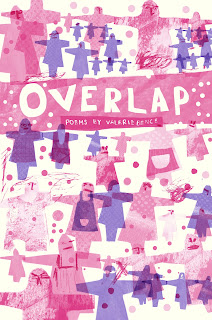
Review by Rosa Fernandez of "Overlap" by Valerie Bence


Overlap is a collection of twenty-one poems by Valerie Bence that contains many timely ideas, and the weaving together of all of them makes sense of this title. This was a book I very much enjoyed reading, and wherever Valerie is, I’m sending her a massive hug.

The journey of this book is from past into present, at first an appreciation of her two clearly much-loved grandmothers Winifred and Harriet; Winifred ‘laughed at everything’ and ‘taught me to wink’ marking her out as the cheekier. Harriet is more brooding and dutiful and ‘lived like prey’ and both suggested elements of my own mother (also a grandmother, and more of a Winifred) and my grandmother (more of a Harriet, I reckon, although she had her moments). The snippets of description of a 1960s childhood will resonate with many, the older women still carrying the drama of wartime with them. The poem ‘Not as posh as I thought we were’ I particularly enjoyed; I felt I could have been the wide-eyed confused child of that poem and it made me giggle.

The last four poems are a sucker punch, and really moved me; I know my mother would feel a solidarity with the sentiments within, having missed time with her own grandchildren. The line ‘I could hardly speak’ hit me hard, and so much of all our lives have been affected by the last two years that I am sure many readers would be similarly moved. The final poem ‘Press me in peat’ is the right poem to end on; while not necessarily a happy ending, it acts as summary from ‘melting glaciers’ to ‘like now’ where we return to the febrile present. I’m sure the grandchildren will be pleased to have this record, and I hope Nonna gets hugs again very soon. 


About
Rosa Fernandez is a slam-winning poet and sometime proofreader. She also enjoys wearing silly hats.