Showing posts with label Travel Writing. Show all posts

Monday, 24 March 2025

Review by Kim Wiltshire of "The Granite Kingdom: A Cornish Journey" by Tim Hannigan


Tim Hannigan is Cornwall born and bred and, like many of us brought up in ‘picturesque’ tourist destinations, he spent time working in the hotel sector as a chef before managing to ‘escape.’ In Hannigan’s case, this escape took him to academia and a life as a writer, living in and writing travel books about Indonesia, before he felt able to revisit his childhood home and look afresh at the whole county of Cornwall.

For me, this is definitely a settle down somewhere comfy and immerse yourself in a different world type of book. Each chapter takes us through the geological specificities of Cornwall, the historical elements that have contributed to the folklore of the area, alongside a walking travelogue that takes the reader through the county. With pictures, maps and personal anecdotes, this book has a range of elements to engage with, which bring alive this diverse and interesting area.

Starting out at Cornish poet Charles Causley’s terraced house near Launceston, Hannigan walks along the Tamar, considering the idea of borders: who sets them, on what conditions are they set, and how / why are they important? That link to literary Cornwall carries on, unsurprisingly, throughout the book, exploring the old myths and folk tales, those writers and artists who made Cornwall their home, and those who visited – often with some very strange prejudices around the ‘native’ people and the ‘beauty’ of the area, or not as some more romantic artists seem to have decided.

There are some lovely images included, but I still found myself using my map app to find some of the areas being described, especially Causley’s little cottage. Having been an occasional tourist to the area, it was great to be able to delve a little more into the area on so many different levels. This is clearly a labour of love for Hannigan and, as you read it, his generosity at sharing this area he knows and loves so well can be felt. So, as mentioned above, settle down and immerse yourself in this world of piskeys, smugglers and the actual reality of an industrial landscape where real, actual people who may not be surfers (although it seems many are) live, love and work – for, with and often despite the tourists. Oh, and if you’re lucky enough to get the hardback version, the cover is also a beautiful artwork in its own right!


About the reviewer
Kim Wiltshire is a writer and academic, Reader and Programme Leader for Creative Writing at Edge Hill University. She writes scripts, short stories and was a British Academy Innovation Fellowship researching ways of embedding arts into healthcare settings during 2022 and 2023. 

You can read more about The Granite Kingdom by Tim Hannigan on Creative Writing at Leicester here. 

Tuesday, 1 February 2022

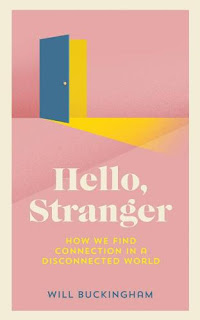
Review by Charles G. Lauder, Jr., of "Hello, Stranger: How We Find Connection in a Disconnected World," by Will Buckingham


Will Buckingham’s book Hello, Stranger: How We Find Connection in a Disconnected World defies categorization. It flows so comfortably between moving memoir, travelogue, to philosophical tract, to historical and cultural texts, that all elements flow together to create a book much greater than its parts. Whether we are grieving with Buckingham over the passing of his partner Elee or tagging along to attend a small village party in north-west Bulgaria to celebrate connections across generations, or learning the playful risks of refusing seconds from a stranger who’s invited you into their home (lest you get whacked with a cudgel), or perhaps putting prejudicial assumptions aside to dine with a Muslim family who daily invite people off the street to dine with them in order for the strangers to learn more their culture, the point is not to be afraid to step into each other’s lives to make that much-needed connection. 

Paradoxically this might be thought easy enough in today’s world of the internet and social media platforms. Yet, as Buckingham, points out, with most of us living in cities nowadays and being quite close neighbours, the loneliness, the division, the disconnect is more prevalent than ever, and thanks to the pandemic, welcoming strangers has now become harder than ever. 

Buckingham’s fluid writing style—effortlessly moving from youthful memory to Ancient Greek anecdote to mythic tale to real-life political situation of refugees and asylum seekers trying to cross the Turkish border by train—demonstrates his life spent as a world-class traveller, a vagabond eager to experience all manner of culture and people. Reading Hello, Stranger continually reminded me of the saying that the more one experiences the world and its great variety, the smaller it seems. Buckingham never mentions the word ‘agape,’ the Greek word for ‘unconditional love,’ preferring instead ‘xenophilia,’ but still he shows the importance strangers hold in his heart, for it is a hug from a stranger on the street, a campaigner for a breast cancer research (the same disease that Buckingham’s partner died from), that helped him to grieve and inspired this book. Ironically, the book comes full circle, the last chapter finishing with him enjoying a plate of food at a Bulgarian village street party while quietly admiring ‘an old lady sitting on a chair on her own, holding a stick. But she doesn’t look lonely. She stares at the crowd and she beams in happiness.’


About the reviewer
Charles G. Lauder, Jr., is an American poet who has lived in Leicestershire, UK, for over twenty years. His latest collection is The Aesthetics of Breath (V. Press, 2019).

Tuesday, 2 November 2021

A Book That Changed Me, by Katie Sone: "A Woman in the Polar Night," by Christiane Ritter


A book that changed my life is A Woman in the Polar Night by Christiane Ritter. It is her memoir of her journey and year spent in Spitsbergen (Svalbard) in 1934 with her husband. She writes of her life in a tiny bleak hut where her life is paired down to the simplest of tasks, scrubbing the cabin, chopping logs for the stove, and where a cup of rationed coffee is an event to be revered and sipped in quiet contemplation. She writes of the foreboding landscape that is bleak, dark and harsh and the pure joy she experiences when, after a long winter, the sun appears. She writes of spending months alone, surviving storms that battle with the hut, and of crawling on all fours twenty times round the hut to get her daily walk. She knows she must. On her journey to Svalbard she is told by the manager of the telegraph station: “Madam, if you want to survive the winter well you must remember three things … you must take a walk every day, even in the winter night and storms. That is as important as eating and drinking. Always good temper. Never take things seriously. Never worry. Then it will be fine.”

I read this in March 2020 when all our worlds turned upside down. I sought solace in books that would take me to distant places. I could travel without leaving the house, escaping somewhere, whilst our worlds and lives became smaller. I took comfort in Christiane’s resilience and determination, thought of the simplicity of her life and her life being stripped back to basics. It was a calming read, her words comforting and helpful. I remembered the Telegraph Station Manager's words and, even though anxious and scared of what was happening all around us, I took a walk every day and found joy in the simplest of things and revered my daily cup of coffee.


About the reviewer

Katie Sone is a writer and delivers writing for wellbeing workshops. She is also a part time librarian for Leicester Libraries. You can find out more here.


Tuesday, 23 June 2020

Review by Rebecca Reynolds of "Walking Home" by Simon Armitage


Friends sent me Simon Armitage’s Walking Home, saying they hoped this tale of walking the 256-mile Pennine Way would help ‘lift your spirits and fix your eyes on the far horizon’ during lockdown. By chance I had just read Crossing the Sands by Wilfred Thesiger, whose horizons were rather wider than Armitage’s. 

Thesiger crossed the southern Arabian desert twice with Bedu companions just after the Second World War, before cars and oil riches, when Abu Dhabi was a town of about two thousand people. They had very limited food and depended on brackish wells whose water they once had to forcibly pour down the camels’ throats since the animals would not drink it.
He reflects afterwards: ‘I would not myself have wished to cross the Empty Quarter in a car. Luckily this was impossible when I did my journeys, for to have done the journey on a camel when I could have done it in the car would have turned the venture into a stunt.’

So does that make Armitage’s journey a ‘stunt’? What’s a poor poet to do on a well-waymarked path with Mars bars, welcoming committees, and his suitcase transported to the next B&B each day? Find dramatic historical episodes, or focus on his inner landscape, or write something funny and homely?

Of these, Armitage opts for the second two. The tone is often faux or real naïf, as when he walks with geologists: ‘Rocks, I’m happy to understand, are very old and very hard, and as long as they support my weight and don’t move around too much, like they do in Iceland and other untrustworthy portions of the planet’s crust, I’m quite content with that level of ignorance.’

Crossing the Cheviots makes him feel like Hannibal, and the stickiest moment is when he gets lost on Cross Fell: ‘Because when the clouds fold in and the horizon disappears, it’s not only the internal compass that goes haywire, it’s also the altimeter, the gyroscope, the chronometer, the sextant and the inclinometer.’ In the end they get out the GPS, which works fine. (I admit I sometimes found the dangers a bit talked up). 

After the trip, he reflects that physically he was up to it, mentally not (the opposite of what he had predicted), and thanks everyone who has given him food, shelter and company, calling this a ‘validation.’

What I enjoyed most was Armitage’s ability to make ordinary things special, so his daughter’s camp bed alongside the double where he and his wife sleep is ‘like a lifeboat tethered to a yacht.’

And what about the poetry? Here’s the first stanza of 'Cotton Grass,' the final poem in the book: 

          Hand-maidens, humble courtiers
          yes-men in silver wigs,
          they stoop low at the path’s edge, bow
          to the military parade
          of boot and stick.

By contrast, Thesiger never wrote poetry. But common to both men, as they emerge from the journeys, is a love and deep appreciation for their companions, and pride in a challenge overcome.


About the reviewer
Rebecca Reynolds works as a teacher and editor and writes non-fiction. She published Curiosities from the Cabinet: Objects and Voices from Britain’s Museums in 2017. She blogs here: http://objects-ofinterest.blogspot.com/

Monday, 12 October 2015

Review by Lloyd Wright of “Street Without a Name: Childhood and Other Misadventures in Bulgaria” by Kapka Kassabova

From time to time my book collection has been significantly enlivened by obscure gems from old library stock, made available to the public for 50p or less. A few years ago I stepped out of a Leicester library clutching a copy of the wonderful Street Without a Name: Childhood and Other Misadventures in Bulgaria, by Kapka Kassabova (2008).

As Bulgaria was about to join the EU and I knew little about the place beyond its role as a cheap property magnet for some Brits, I was eager to get reading.

The author superbly combines travel and memoir with a generous sprinkling of Balkan history in a book that evokes the grim atmosphere, contradictions and absurdities of growing up under Bulgarian communism at the height of the Soviet Empire. As if in direct dialogue with the old regime, she quickly asserts: “Beauty might be more important to the ego of a country, but truth is more important to me.”

Now a successful expat writer living in Edinbourgh, Kapka travels back after a long absence to a changing country, yet brings the perspective of a sharp-eyed outsider with an insiders grap of the good, the bad and the unbearably nostalgic. Her travel companion is an English-speaking boyfriend which only adds to the feeling that she now occupies a very different world from the everyday Bulgarians they meet.

The chapters zigzag through various stages of the author’s life before emigration with vivid descriptions of Sofia life spent in a residential complex known colloquially as “Soc Bloc.” Nevertheless, as someone with professional parents, her family enjoyed occasional trips to Moscow and other foreign delights.

Indeed, one highlight of the book concerns her mother’s reaction while visiting her father in Holland on a 6 month job placement during the cold war: the “orgy of abundance” in department stores, the “supernaturally clean sheets” and the “sparkling, perfumed” toilets in a provincial Dutch town puts her on the brink of a breakdown. When a Dutch colleague and his family then visit her father in monochrome Sofia in their brand new camper van wearing “bright pastel colours,” it is a moment of real comic beauty tinged with sadness.

I have subsequently visited Bulgaria on several occasions and can honestly recommend the country as much as the book. Happy reading – and happy travelling.

About the reviewer
Lloyd Wright is an under-employed EFL teacher who values engagement with students and others from across the globe – Chile to China – and especially their quirky views about British life. He writes occasional articles for diverse outlets and was briefly on the Disney payroll while writing about the unfolding drama of the 2002 World Cup.