Showing posts with label adaptation. Show all posts

Monday, 4 July 2022

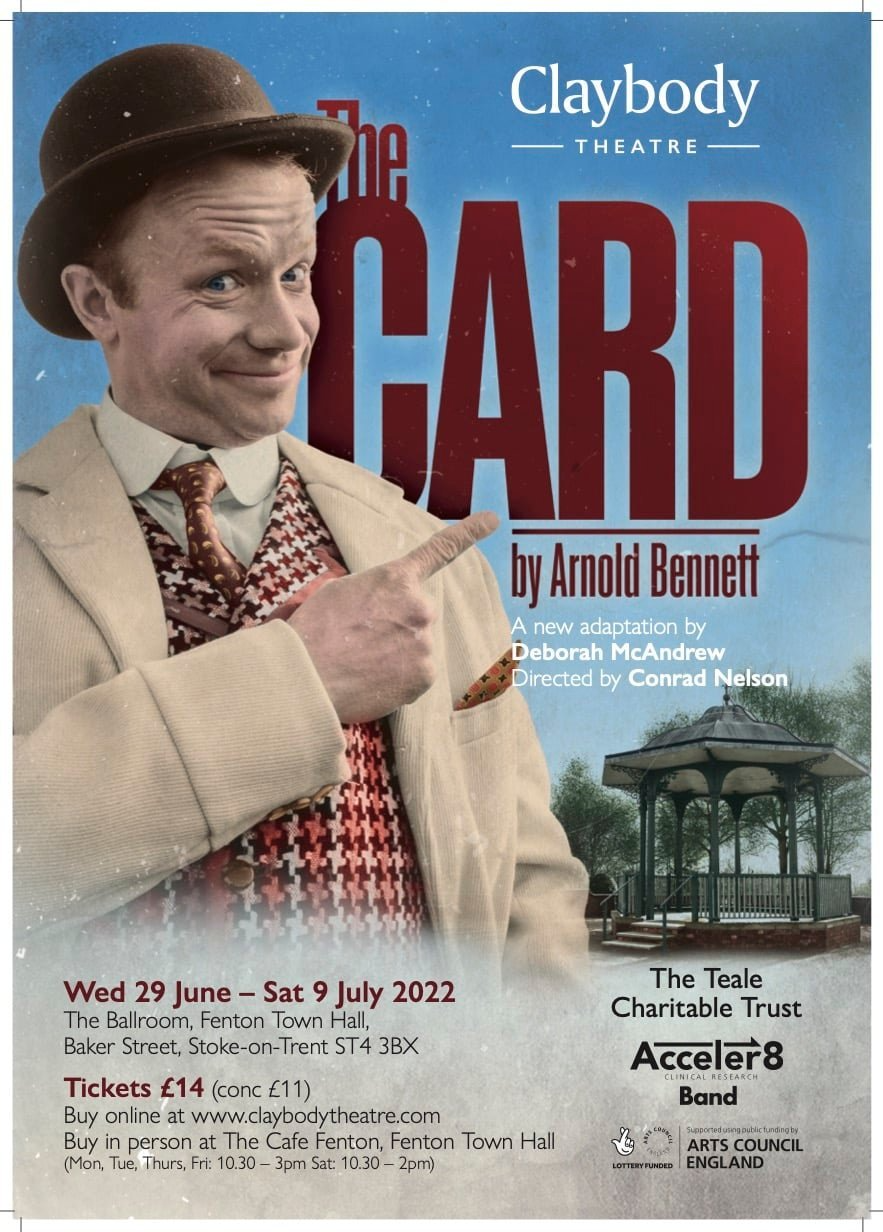
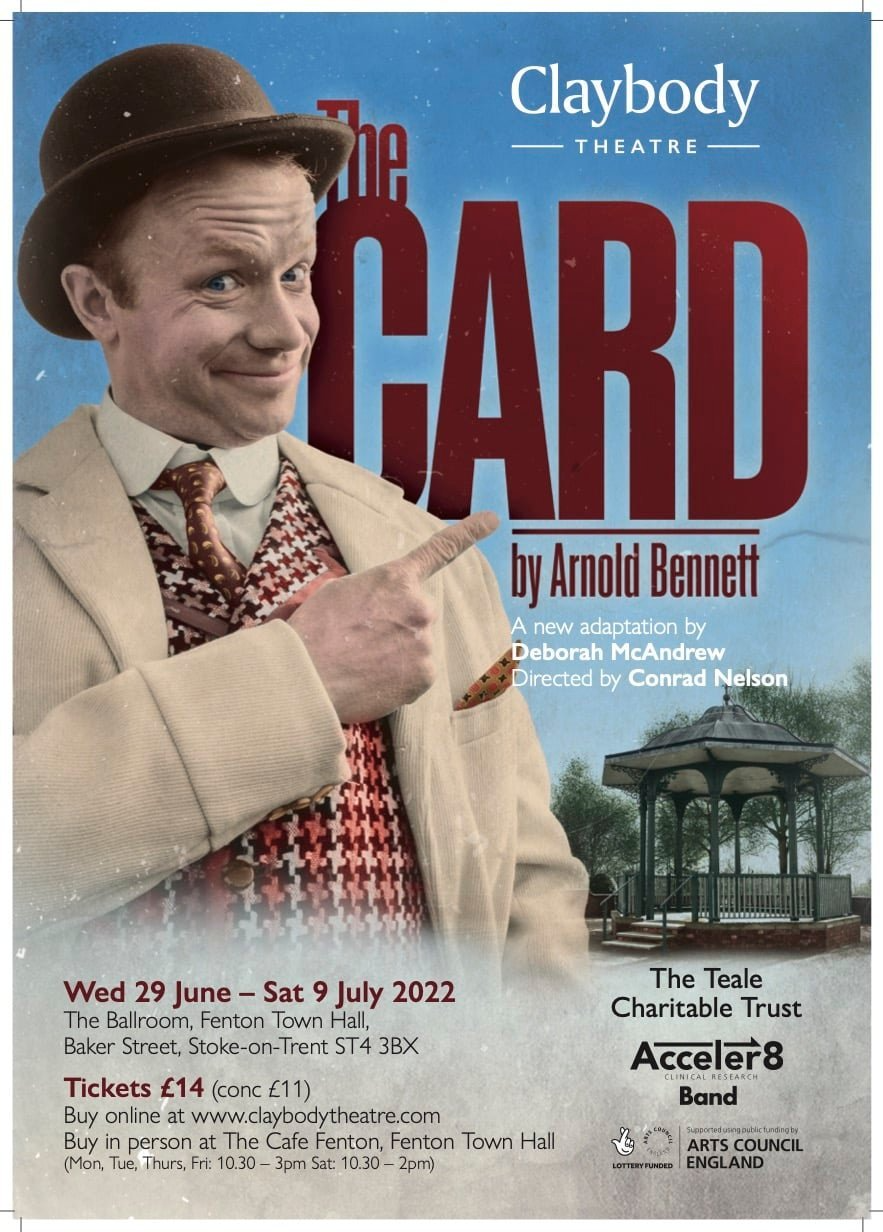
Review by Julian Salt of "The Card" by Arnold Bennett, adapted by Deborah McAndrew, with the Claybody Theatre


My wife and I have just seen a stunning adaptation of Arnold Bennett’s The Card. Claybody Theatre's Deborah McAndrew, writer, and Conrad Nelson, director, have produced an enthralling masterpiece which should not be missed. The seven professional actors / musicians with supporting brass band and the enthusiastic entourage of Claybody volunteers created a gem of a riotous romp from start to finish. The actors played multiple roles and were all accomplished singers and dancers.

Bennett’s novel showed how with ‘dash’ we can break through adversity and ;cheer up' the world. O how we need  this today! McAndrew's and Nelson’s genius warms the heart and  makes you want to unleash the Denry in us all … we loved every moment of it!

Well done especially to the supporting cast of Claybody Theatre's volunteers. On a shoestring you have produced a most memorable show, which fully deserves a wider audience.

The renovated Fenton Town Hall gave the performance authenticity and a historical canvas exuding its own vibe, which served to enhance this exquisite production.

After watching Deborah McAndrew, the writer, pick up a basket of the actors' clothes and take them away to wash them, ready for tomorrow's performance, we appreciated the work ethic she shares with the whole of her team. The way the actors gave freely of their time afterwards reflected their wholehearted approach to the project. Celebrating the Potteries and Fenton, (the missing sixth town) in Fenton Town Hall, this masterpiece was given a magical authenticity. 

Throughout, the show was a rich kaleidoscope of polkas and waltzes, shanties and folk songs, Potteries humour and dramatic irony all of which warmed our  hearts in these cold Putinized days. From shades of unscrupulous landlords to excursions to Llandudno, from love to ambition and greed, politics and intrigue, all were combined within a simple tale of a Stokie who made good.

McAndrew, originally from Leeds and Conrad from Liverpool - we salute you. Welcome to The Potteries Hall of Fame for writing and directing such a stunning show! 


About the reviewer
Julian Salt is a retired Psychologist born in Fenton, who now lives in Derbyshire and enjoys revisiting his roots.

You can read another review of this adaptation of The Card here


Friday, 1 July 2022

Review by Carolyn Ruane of "The Card" by Arnold Bennett, adapted by Deborah McAndrew, with the Claybody Theatre


I went to the opening night of this new adaptation of Arnold Bennett's novel, The Card, adapted by Deborah McAndrew, with the Claybody Theatre in Fenton Town Hall, Stoke-on-Trent.

The show is stupendous. Gareth Cassidy is amazing as Denry Machin. The part that amused me most was Howard Chadwick playing Mrs Machin; he was hilarious. 

The singing and dancing are preformed very well. It was slick. No first night nerves! The way the cast go out of one door, and then reappear through another door with a change of clothes is fabulous. 

The canal scene is done really well: you really feel worried about the water coming in. It's believable. The runaway horse is great and again you feel the action. 

The fact most of the cast play multiple parts does work really well. 


About the reviewer
Carolyn Ruane is from Stoke on Trent. She is a keen member of the Arnold Bennett Society. She enjoys plays at the theatre and is an avid reader. 


Thursday, 14 April 2016

Review by Robert Richardson of Adaptation of "Parade's End"

A Review by Robert Richardson of the DVD of Parade’s End, written by Tom Stoppard (based on the novels of Ford Madox Ford), directed by Susanna White. BBC/HBO, 2012

I did not watch the adaptation of Ford Madox Ford’s Parade’s End when it was broadcast in 2012. I wanted to read the sequence of four novels before encountering the five episodes written by Tom Stoppard for this BBC/HBO production. Having recently finished the books, I obtained the DVD and had the enjoyable experience of seeing it unfold on five consecutive evenings.

With his script for television, Stoppard stripped Ford’s Modernist complexities down to a basic narrative, and was very effective in bringing all his experience to rendering both characters and events. He was mostly faithful to the books and included just a few of his own inventions. Even so, with 800+ pages to play with I remain unconvinced they were all necessary.

Where Stoppard departed from Ford in a more radical and contentious way was with his treatment of the final novel, The Last Post. It was, in effect, to ignore it.  In this he is not alone. Graham Greene left it out when he edited an edition of Parade’s End for Bodley Head in 1962-63, arguing it was a “disaster.” Stoppard’s script imports a few aspects of The Last Post into the final episode, which otherwise is his dramatisation of the third novel, A Man Could Stand Up.  He dilutes the “rounding off” of Christopher Tietjens and Valentine Wannop living together with the completely different situation of merely meeting up again in London at the end of the First World War, albeit with a mutual acceptance of their relationship becoming more established. To me, this completed the grandeur of Parade’s End in too much of an offhand and rushed way.

The “problem” of the final novel is that the main character of the previous three, Christopher Tietjens, is largely absent. Surprisingly, his older brother, Mark, now paralysed and dumb from a stroke, is centre stage, in the form of his thoughts taking shape as stream of consciousness monologues. In the totality of the four novels, this is, I think, some of Ford’s best writing. The Last Post also shows Christopher and Valentine living in the Sussex countryside and expecting a child. I presume Stoppard considered and rejected techniques such as flash-forward sequences to this rural life. In the final episode, I just wish he had taken up the challenge and found a solution. . By adopting the Graham Greene line, Stoppard missed the opportunity of contrasting the desire for a sane and peaceful existence with the madness of the First World War.

What Stoppard does achieve is valuable: he successfully reveals Ford’s characters and the narrative they inhabit against the backdrop of such a significant moment in history as the First World War. This is combined with references to feminist politics through the suffragette Valentine Wannop, who is surely one of the nicest, most spirited and idealistic characters in twentieth-century literature.

The best drama happens when all components are strong and nothing lets the side down. This is true with Parade’s End.  As well as Stoppard’s impressive script, the directing and acting are superb, with Benedict Cumberbatch giving a subtle and perceptive performance as the buttoned-up Christopher; Rebecca Hall as his wife Sylvia, a deft portrayal of scheming cruelty fused with frivolity and frustration; and Adelaide Clemens as Valentine, showing her both earnest and emotional. The costumes and production values in general are of the same high level.

Professor Imelda Whelehan, who is a leading authority on Adaptation Studies and an academic I know and admire, once emphasised to me the importance of realising it should not matter whether or not we read a book before seeing its adaptation. Despite this, as far as Parade’s End is concerned I am pleased to have experienced the books first, because Stoppard’s editing out of the final novel would have influenced in a negative way the enjoyment of Ford’s more luxurious exposition.


About the reviewer
Robert Richardson is a visual artist and writer. His work is included in ‘Artists’ Postcards: A Compendium’ (edited by Jeremy Cooper, published by Reaktion Books, London). He is also the co-editor, with William Pratt, of ‘Homage to Imagism’ (AMS Press, New York).
www.bobzlenz.com

You can read Robert Richardson’s previous review of the four novels of Ford Madox Ford’s Parade’s End here.