Showing posts with label Granta Books. Show all posts

Thursday, 7 March 2024

Review by Tracey Foster of "Orwell’s Roses" by Rebecca Solnit


In the spring of 1936, a young author set about planting a garden in his rented cottage. Awaiting the arrival of his new wife and hoping to put behind him the experiences as a serving police officer in colonial Burma, Orwell turned to nature to heal both his lungs and calm his mind. His first attempts at recuperation saw him live in extreme poverty, which he later recorded in detail in Down and Out in Paris and London and The Road to Wigan Pier. These were places that were a source for great fiction, but it was in the little hamlet of Wallington where he decided to settle his mind.

Solnit begins with Orwell's essay from 1946, "A Good Word for the Vicar of Bray," that focused on the beauty of a mature yew tree which long outlived the vicar that planted it. After a lapse of time, all that is left of him is a comic song and a beautiful tree. From this spark of a thought, Solnit decided to track down Orwell’s cottage garden and see if his plants had also outlived the creator. He had mentioned revisiting his garden in that essay of 1946 and noted that that too had thrived in his absence. The planting of a tree, especially one of the long-living hardwood trees, is a gift which you can make to posterity at almost no cost and with almost no trouble.

Orwell was passionate about nature and the earth; he was a keen gardener and a naturalist. He took many long walks with friends who later commented on his knowledge and alluded to his fear for the future, drawing attention, with anxiety, to this shrub budding early for the time of the year. Solnit urges us to revisit and look deeper into Orwell's prose, to seek out the passages of flora and fauna and promises us that if we do, the grey portrait will turn to colour. Even in his novel 1984, deeply political and prophetic, there are moments of joy. Nature itself is immensely political, in how we imagine, interact with, and impact it. He was ahead of his time in this interpretation of our living world. 

Extolling simple manual labour with direct visible results must have appealed to Orwell, a passion that led him to further expand his small holding with animals, an orchard and a vegetable garden. Finding predictability with effort that gardening promises was a complete contrast to the uncertain life of prose. He referred to gardening in his many essays, extolling the virtues of the simple, cheap Woolworth rose, the common toad and country life. He advocates for a simple life, in tune with our surroundings. Solnit sums this up with her phrase: "Even when the agenda was bread, what spills over is roses."

This book takes us on a journey through culture and art to society and socialism to examine how roses have represented our desires, passions and goals through the centuries. Throughout these meanderings, Solnit discusses the written words of the essayist, his humour and humanity, his politics and passions to understand him better.

Orwell finally died of tuberculosis aged just 46 after suffering with bronchitis most of his adult life. His final request was for roses to be planted on his grave: "Outside my work, the thing I care for most is gardening – for like the rest of us, it’s beauty for today, hope for tomorrow."


About the reviewer
Tracey Foster started off in a long career as an Art and Design teacher but wanted to refocus her creative energies into writing poetry and prose. After helping others find inspiration in the world around us, she took an MA course in Creative Writing at Leicester University and has not looked back. She finds inspiration in the past and the events that shape us. Previous work has been published by Comma Press, Ayaskala, Alternateroute, Fish Barrel Review, Mausoleum Press, Bus Poetry Magazine, Wayward Literature and The Arts Council.  She writes on her own blog site The Small Sublime.


Tuesday, 30 January 2024

Review by Laura Besley of "Jokes for the Gunmen" by Mazen Maarouf


Jokes for the Gunmen is a short story collection by award-winning Palestinian-Icelandic writer, poet, translator and journalist, Mazen Maarouf. It was translated from the Arabic by Jonathan Wright. 

All the stories in the collection explore jokes and joking as either a means of exchange or a coping mechanism for the atrocities of living in a country at war. In the eponymous opening story, the father figure must make up jokes for the gunmen in order to avoid their wrath. ‘Of course, in front of a bunch of gunmen you have to be a good storyteller in order to win your freedom. Your story has to be convincing, enjoyable and very short, and it has to make people laugh.’ As a consequence, the withdrawn father and unruly son become closer as they both focus on the task of thinking up a new joke every day. 

In the story ‘Jokes’ there is another young boy trying to make up jokes. ‘I don’t have ready-made jokes in my head and I don’t remember any details of the few jokes I’ve heard. So I’m trying to sketch out the scenario for a joke in my head.’ On the flipside, the main character in ‘The Angel of Death’ doesn’t ‘have a sense of humour … and [doesn’t] understand why people smile.’ Throughout the story, everyone around him is trying to make him smile or laugh or giggle, but he is resolute. In fact, he gets angry when a man laughs at something he said ‘since [he] hadn’t intended to make a joke.’ In the story ‘Gramophone’ the father loses both his arms when a vacuum bomb strikes the building he was in, but jokes that it doesn’t matter; the gramophone is broken, so he doesn’t need his arms anyway. 

The sense of loss, both physical and emotional, runs throughout the collection. People lose limbs, eyes, loved ones; people are ‘pale, silent and thin’ and ‘hollowed out.’ Another theme rooted within the stories is violence, both inside and outside the home, and good use is made of the liminal line drawn between fantasy and reality.

In many ways this collection is a tough read; the depictions of war-torn families are heartbreaking. However, despite the losses these characters have to bear and somehow overcome, there are glimmers of hope on the horizon. Jokes for the Gunmen is a phenomenal collection.  


About the reviewer
Laura Besley is the author of 100neHundred and The Almost Mothers. She has been widely published in online journals, print journals and anthologies, including Best Small Fictions (2021). Having lived in the Netherlands, Germany and Hong Kong, she now lives in land-locked central England and misses the sea. She tweets @laurabesley

Tuesday, 1 February 2022

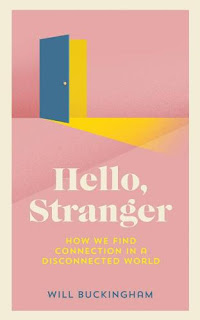
Review by Charles G. Lauder, Jr., of "Hello, Stranger: How We Find Connection in a Disconnected World," by Will Buckingham


Will Buckingham’s book Hello, Stranger: How We Find Connection in a Disconnected World defies categorization. It flows so comfortably between moving memoir, travelogue, to philosophical tract, to historical and cultural texts, that all elements flow together to create a book much greater than its parts. Whether we are grieving with Buckingham over the passing of his partner Elee or tagging along to attend a small village party in north-west Bulgaria to celebrate connections across generations, or learning the playful risks of refusing seconds from a stranger who’s invited you into their home (lest you get whacked with a cudgel), or perhaps putting prejudicial assumptions aside to dine with a Muslim family who daily invite people off the street to dine with them in order for the strangers to learn more their culture, the point is not to be afraid to step into each other’s lives to make that much-needed connection. 

Paradoxically this might be thought easy enough in today’s world of the internet and social media platforms. Yet, as Buckingham, points out, with most of us living in cities nowadays and being quite close neighbours, the loneliness, the division, the disconnect is more prevalent than ever, and thanks to the pandemic, welcoming strangers has now become harder than ever. 

Buckingham’s fluid writing style—effortlessly moving from youthful memory to Ancient Greek anecdote to mythic tale to real-life political situation of refugees and asylum seekers trying to cross the Turkish border by train—demonstrates his life spent as a world-class traveller, a vagabond eager to experience all manner of culture and people. Reading Hello, Stranger continually reminded me of the saying that the more one experiences the world and its great variety, the smaller it seems. Buckingham never mentions the word ‘agape,’ the Greek word for ‘unconditional love,’ preferring instead ‘xenophilia,’ but still he shows the importance strangers hold in his heart, for it is a hug from a stranger on the street, a campaigner for a breast cancer research (the same disease that Buckingham’s partner died from), that helped him to grieve and inspired this book. Ironically, the book comes full circle, the last chapter finishing with him enjoying a plate of food at a Bulgarian village street party while quietly admiring ‘an old lady sitting on a chair on her own, holding a stick. But she doesn’t look lonely. She stares at the crowd and she beams in happiness.’


About the reviewer
Charles G. Lauder, Jr., is an American poet who has lived in Leicestershire, UK, for over twenty years. His latest collection is The Aesthetics of Breath (V. Press, 2019).