Showing posts with label Post-Apocalyptic. Show all posts

Saturday, 22 November 2025

Review by Gus Gresham of "Maybe the Birds" by A. J. Ashworth


This short story collection by A. J. Ashworth is a rewarding read, each story like a piece of mysterious treasure from a dug-up pirates’ chest. The prose is beautiful, understated, sometimes beguiling, and full of humanity.

In the title story, we understand that we are in the midst of something apocalyptic or post-apocalyptic. Aside from hints, the details of the main "event" are left out. The focus is the effects upon the lives of survivors, upon a particular survivor, and the warm relationship between her and her dog. It’s about what we might leave behind as a legacy when the familiar world is lost, and in her case this takes the form of recreating the lost sounds of birdsong with bespoke clay pipes.

"Leather" is effectively a story about a story. It reads as a review of a story about woman’s strange "find" in a second-hand bookshop. This review approach works surprisingly well. It’s a clever, playful and enjoyable device. The story is analysed and questioned for us by a fictional narrator/reviewer who employs tantalising quotes from the story itself. Some of the descriptive language and tone-setting is particularly strong: "… the kind of curdled light that comes before a rainstorm," echoed later, in other lines like fried eggs that are "broken and bleeding yellow onto the plate."

"Mirrors" was a personal favourite. It has the sense of something apocalyptic again, like "Maybe the Birds," but "Mirrors" is even darker, more enigmatic, told in second person, and with the prose itself fractured on and across the pages. Unsettling to say the least, and rendered so beautifully.

There is scope for humour, too, in this collection. The premise of "The Monolith" can be gleaned from the following short quote as the protagonist speaks with her ex on the phone: "…thinks she sees a ripple across the monolith, as if it’s made of black liquid. ‘I’m not joking, Carl. There’s a monolith in the yard.’" There is so much to enjoy in this story. Mystery, inventiveness, the study of relationships, and of course more gorgeous prose: "A gust of wind makes the window frame crack like a bone."

"Small Feathers Falling" centres on the treatment of women by some men. There are creepiness and horror in this tale, which – among other things – stands as a stark reminder of how we should listen to our gut when the early warning bells chime in a new relationship. We dismiss sinister behaviour all too often, don’t we?, and let it slide all too often. The casually delivered, derogatory names the male antagonist calls the female protagonist become "dark moths in her head." The descriptions of the owl are wonderful, and the story’s creepiness and tension build to a point where anything could and does happen.

The book’s "Afterword" is an insightful essay which provides a more academic angle on the book’s themes. Ashworth talks of "… how female characters in postapocalyptic settings … [continue] … with preapocalyptic activities." List-making and sculpture are suggested to be the mainstay here, and indeed the title story comes back to mind with the protagonist’s careful and loving clay-hewn "syrinxes" designed to mimic the sounds of birds in a world that has lost its birds (and we has suspect lost much more).

Each story is also rich with allegory, in my view, and Maybe the Birds is a collection to be savoured.


About the Reviewer
Gus Gresham’s short stories have appeared in literary magazines and online, many of which are now collected in his latest book, Angel Reach. He is author of the novel Kyiv Trance and of the young adult novels Earthrise and Marmalade Skies. He has travelled widely and worked as a mechanical engineer, fruit picker, construction worker, environmental activist, writer, English tutor, audio-book producer, interpersonal skills facilitator, and building surveyor.

You can read more about Maybe the Birds by A. J. Ashworth on Creative Writing at Leicester here


Thursday, 26 June 2025

Review by Wiktoria Borkowska of "I Who Have Never Known Men" by Jacqueline Harpman


What does it mean to be human when you’ve never truly known another soul? Jacqueline Harpman’s I Who Have Never Known Men is a quietly devastating dystopian novel that explores freedom, identity, and survival in a world stripped of meaning.

Originally published in 1995, the novel follows an unnamed narrator—the youngest of forty women imprisoned in an underground bunker, guarded by silent men and with no knowledge of how they got there. When the cage doors unexpectedly open, the women are forced into a barren, post-apocalyptic landscape, where the narrator begins a journey marked by loss, isolation, and a quiet longing for connection.

Harpman’s sparse prose perfectly mirrors the bleakness of the setting, yet it’s the narrator’s inner world that carries the emotional weight. Her introspection and resilience draw the reader in, especially as she grapples with the desire to understand a life she’s never truly lived. A fleeting connection with a young guard—one she doesn’t fully understand—captures the human need for touch, recognition, and feeling.

At one point, the women make a harrowing discovery that challenges their understanding of their own suffering and expands the novel’s exploration of isolation, punishment, and shared fate. Rather than provide answers, Harpman leans into the ambiguity, which only deepens the existential questions the novel poses.

Despite its slow pacing, I Who Have Never Known Men is a deeply thoughtful and emotionally resonant read. The atmosphere is unsettling but never sensationalised, and the philosophical depth invites quiet reflection long after finishing the book.

I recommend this to readers who appreciate introspective, dystopian fiction that prioritises emotion and thought over action—and those drawn to stories of quiet female solidarity. It’s a novel that doesn’t shout—but it echoes.

Favourite quote: "We were not who we were because we had lost the world, but because we were lost in it."


About the reviewer
Wiktoria Borkowska is a first-year Journalism student at the University of Leicester. She enjoys reading emotionally rich fiction and writing reflective reviews on a wide range of fiction, literature, and film.

Thursday, 10 February 2022

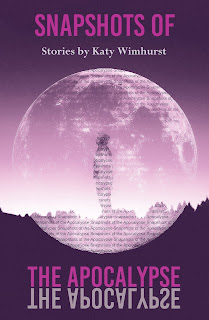
Review by Sharon Eckman of "Snapshots of the Apocalypse" by Katy Wimhurst


Katy Wimhurst’s new collection of short stories is a dark, witty look at a world at once recognisable and skewed. 

The title tells you pretty much where you’re headed, but although each story takes you in that dystopian direction, the beauty is in the detail. Wimhurst’s ideas are fabulously inventive . In the title story, a post-Apocalyptic London features rains named after former Prime Minsters – Thatcher, Blair, Rashford (if only) and ‘the worst was Johnson – deceptively lightweight but soaked you through and through.’

I particularly enjoyed ‘Haunted by Paradise,’ a sensual take on the expulsion from the Garden of Eden – this modern Eve grows an enchanted garden in her flat, stealing plants from the local park armed with a ‘surreptitious trowel and large bag.’

In ‘The Job Lottery,’ the female protagonist, who we only know as Miss Fisher, attends the malign EnCorp’s Job Lottery – billed as a Festival – to try and get herself a decent job. ‘EnCorp wishes you a Good Lottery – Seize the Moment!’ This story has echoes of Huxley’s Brave New World with its Prozac candyfloss, PsychoBliss Drops and – my favourite – the Public Penance Trampoline where you are sent to bounce up and down shouting your penance through a loudhailer for alleged crimes against the state.

All of Wimhurst’s protagonists are lost in some way, mostly living solitary, lonely lives, often with a failed relationship in the background. The stories contain a yearning for hope despite the dystopian scenarios, but, for me, some ended rather abruptly. I also found some of the parallels with our current concerns – refugees, the climate emergency - a little too on the nose, but Wimhurst creates believable characters in wild scenarios and her prose is full of drily funny one liners. Highly recommended.


About the reviewer
Sharon Eckman is an actor, singer and writer. Winner of the Time Out Travel Writer of the Year, she has been longlisted twice for the Fish Memoir Prize, shortlisted for Words & Women Prose competition and the Jerwood/Arvon Mentorship Scheme. Short fiction has appeared in Shooter Lit, Words & Women: 3, 100 Voices: An Anthology, 100 Voices for 100 Years and New Flash Fiction Review. She is currently working on a novel and has just completed her first short film. Her website is here

Wednesday, 31 March 2021

Review by Simon Elson of "The Day of the Triffids" by John Wyndham


If you haven’t read The Day of the Triffids, then firstly I envy you as you can read it for the first time, but secondly, I bet you know what a Triffid is. The book turns seventy this year and is the perfect example of the sci-fi sub-genre Post-Apocalyptic. You may have seen one of the two BBC adaptations, the first made in 1981 starring John Duttine was great, the second made in 2009 starring Eddie Izzard was mediocre at best. The 1962 film starring Howard Keel has the same name but it didn’t seem to be based on the book I’ve read!   

I digress, back to the book. It takes the form of a first-person memoir by Bill Masen and you only know what he knows; any further information is told to Bill and recounted by him. It starts with him in hospital with his eyes bandaged after a Triffid sting nearly killed him. During the previous night what was described by the news as a comet storm lit up the night sky and was a worldwide phenomenon. Bill, however, later suggests a different cause for the lights. Everyone who watched the display is now blind. You quickly learn that he has no dependents or relatives alive and is in a unique position to tell us about the origin of the strange plant.

The novel follows his adventure through London where he meets his future partner Josella Playton, an infamous novelist who had written a Fifty Shades style of book. He battles with both the Triffids and the fact that most other people are now blind. An interesting minor character is Coker, an Orator – a voice for hire, who starts off as an enemy of Bill.     

The author John Wyndham is almost prophetic in this work. The Cold War was only a few years old when he wrote it, yet he has it escalating to what it became in the sixties. The space race, satellites (Sputnik was launched seven years after it was written), a weapons defence system that sounded very much like the STAR WARS system proposed by Reagan in the eighties and genetically modified crops are all described perfectly.

A lot of classic sci-fi novels (Jules Verne and H. G. Wells etc) whilst still excellent have noticeably aged, whereas The Day of The Triffids with the exception of a couple of paragraphs (mainly describing News-reels at the cinema) could have been written yesterday 

I’ve read most of Wyndham’s other novels. The Kraken Wakes runs this book a very close second. In 2009 a ‘lost’ novel of his, Plan For Chaos, was published posthumously. It was, for me as a lifetime Wyndham fan, a disappointment. Some critics described it as almost unreadable. I’ll remember him for the almost perfect novel The Day Of the Triffids.      


About the reviewer
Simon Elson is a Freelance Features Writer. His articles  have appeared in numerous national magazines including Best of British, Derbyshire Life and Writing Magazine. He also writes for the popular cycling website Veloballs.com and has been a guest blogger on The Huffington Post.