
Showing posts with label Salmon Poetry. Show all posts

Wednesday, 9 March 2022

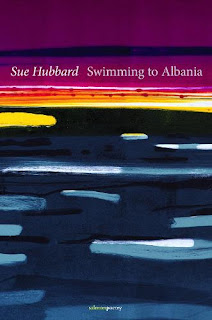
Review by Jane Simmons of "Swimming to Albania" by Sue Hubbard


Swimming to Albania is Sue Hubbard’s fourth collection of poems. The opening poem ‘Lost in Space’ teases out the preoccupations of the collection – longing, desire and loss – in its presentation of the poet as a child ‘lost’ and dreaming of ‘a boat that will take her home.’

More poems about childhood follow and the sense of being lost is reinforced in the tentative title of ‘1955, perhaps?’ and in the opening of ‘Snow’ where the poet is ‘lost in an infinity of misted mirrors.’ The words ‘loss’ and ‘lost’ reverberate through the poems in the first of the three sections of the collection, along with ‘absence’ and ‘space.’ This emptiness is a space which cannot be filled because ‘the past is another country / one I barely remember’ and ‘the dead [are] impervious to our childhood questions.’ The truth is ‘a void’ they cannot fill, leaving the poet haunted by ‘all that was never said.’ 

From here, the poet invites the reader to accompany her on a journey in poems which take her from the west coast of Ireland by way of Lisbon, Siena and Greece, to Albania. It soon becomes clear that this journeying is loaded with metaphorical significance: it is a journey into the poet’s past, a voyage of self-discovery, and an Odyssean search for an idealised home where the self is known – a safe place on the other side of grief, a state of reconciliation, redemption, and understanding.

Between the coastal places of the opening and closing poems at either end of the journey, further images of water function as metaphors of psychoanalytic exploration – as the poet dives into deep dark places of self. The Albania which the poet is swimming towards in the title of the collection, and the penultimate poem, is the once-forbidden place that even now is difficult to reach.


About the reviewer
Jane Simmons is a former teacher – and now a PhD student. She won the University of Leicester’s GS Fraser Poetry Prize in 2019, 2020 and 2021, and the Seren Christmas Poetry Prize in 2020. Her work has appeared in Ink, Sweat and Tears, The Blue Nib magazine and on the Seren blog, as well as being long-listed for the Butcher’s Dog magazine.


You can read more about Swimming to Albania by Sue Hubbard on Creative Writing at Leicester here. 

Tuesday, 16 July 2019

Review by Victoria Pickup of "At the Kinnegad Home for the Bewildered" by Jeffrey Levine


At the start of this collection, Levine’s third book of poetry, Ilya Kaminsky’s foreword focuses upon writing which keeps its secrets, evading comprehension, in order to transcend language, to explore the spaces between words and their meanings. He asks, ‘What is clarity?’ Upon reading At the Kinnegad Home for the Bewildered, the question itself becomes elusive.

Let me indulge in a metaphor of my own to explain: I began reading Levine’s poetry like walking a river. Following it with my eyes, not really understanding the course or predicting the direction it would go. In order to appreciate the poetry, I realised I had to lie down in the water, to let it flow over me. In doing so, I captured phrases I found evocative, words strung together in abstract ways, the sounds they made, the images which they created, the moments of absolute clarity washing over me and then vanished, gone. This may sound awfully la-de-dah, but Levine seems to encourage the reader to let go of the instinctive need to fully comprehend in order to enjoy, to disassociate from obvious signage and accept the lack of direction; to be open to interpretation. 

At the Kinnegad Home for the Bewildered is a mystical, cosmic, effervescent collection of verse. There is much music and romance within its poetry, from the sounds in 'Low-Hanging Orb, Smudged Green' ('With ice-cold spoon, / snap the world open to the pulp'), and the musicality of 'soft water - soft as the light, white breath of horses' in 'Egg of the Universe' - to the words of love in 'He Delivers Unto Her His Blessings': 'There is much to celebrate. She invites moments of unaccountable happiness.' 

There are many beautiful, almost hypnotic lines and a central theme of light running throughout the writings, such as in 'Other Effects': 'No light I know as light, but winter sky on ice stealing the sky’s milky hue.' The collection is heavy with prose poems like this. Emotive, imaginative, like incantations, they create a dream-world, where the reader emerges not quite sure of what made sense or how it all fit together, but left within a kind of whirlwind made up of spools of film, with each image capturing another vivid image, all rushing past and evading capture. 

In 'Although Madame Did It on the Grill,' the poet writes: 'Raking coals, straddles amid licks of flame, sparks rose up / from the earth, arced across the sky turning overhead in bright pinwheels,' and later in the same poem, 'and all that night, throughout the world, a terrible noise of sheep bleating and of bells from the church towers, of wooden houses cracking, and the cries of men and the cries of women.' It’s artistic, vivid, nightmarish - like hopping out of a Monet and into Edvard Munch. 

Indeed, Levine is often inspired by works of art. His subjects are abstract, but beauty and meaning find their way through the language. In the final poem in the book, 'Getting It Right,' Levine concludes with a lasting, entrancing couplet: 'I move the camera and your life comes out of you in colors, / I move it again, it goes back in.' It’s a beautiful image, fully in focus. 

Returning to the initial question asked by Kaminsky: 'What is clarity?,' the richness and translucence of Levine’s writing makes me wonder: Does such ambiguity make poetry more accessible? If we are not busy trying to understand it, are we liberated – free to take the words, phrases or parts which resonate with our own minds - leaving the rest for another reader to find meaning? By throwing off obvious meaning, could this create a more impactful poetry? It’s a good question. And I’m sure the answer is here … somewhere.  


About the reviewer
Victoria Pickup studied a BA in English and MA in Creative Writing at Loughborough University. A freelance writer for seven years, she continued to write creatively and in 2008 won the Café Writer’s Award with a poem inspired by travels in Bosnia: ‘The Chicken that Saved my Children.’ She was shortlisted for the Poetic Republic (MAG) poetry award in 2009 & 2010. Victoria now lives in Hampshire with her husband, three children and, of course, a pet chicken. 

Sunday, 30 April 2017

Interview with Hélène Cardona


About Hélène Cardona
Hélène Cardona’s recent books include Life in Suspension and Dreaming My Animal Selves (both from Salmon Poetry), the translations Beyond Elsewhere (Gabriel Arnou-Laujeac, White Pine Press), winner of a Hemingway Grant; Ce que nous portons (Dorianne Laux, Éditions du Cygne); The Birnam Wood by her father José Manuel Cardona (forthcoming from Salmon Poetry in 2018); and Walt Whitman’s Civil War Writings for WhitmanWeb.  
She has also translated Rimbaud, Baudelaire, René Depestre, Ernest Pépin, Aloysius Bertrand, Maram Al-Masri, Eric Sarner, Jean-Claude Renard, Nicolas Grenier, and Christiane Singer. She contributes essays to The London Magazine, co-edits Plume and Fulcrum, holds a Master’s in American Literature from the Sorbonne, received fellowships from the Goethe-Institut & Universidad Internacional de Andalucía, worked as a translator for the Canadian Embassy in Paris, and taught at Hamilton College & LMU. Publications include Washington Square Review, World Literature Today, Poetry International, Hayden’s Ferry Review, The Brooklyn Rail, Drunken Boat, Asymptote and The Warwick Review.     http://helenecardona.com


Interview with Jonathan Taylor

JT: How would you describe your own (very individualistic) poetic voice? What are your intentions in your poetry?

HC: I write as a form of self-expression, fulfilment, transcendence, healing, to transmute pain and experience into beauty. For me, poetry is a process of self-revelation, an exploration of hidden dimensions in myself, and also a way to express the profound experience of the fundamental interconnection of all in the universe. Writing is cathartic as it extends a search for peace, for serenity, rooted in a desire to transcend and reconcile the fundamental duality I see in life. Ultimately, I seek expansion of consciousness.

We are stretched to the frontiers of what we know, exploring language and the psyche. The poem is a gesture, an opening toward a greater truth or understanding. Art brings us to the edge of the incomprehensible. The poems, in their alchemy and geology, are fragments of dreams, enigmas, shafts of light, part myth, and part fable. Mysticism constitutes the experience of what transcends us while inhabiting us. Poetry, as creation, borders on it. It is metaphysical. It offers a new vision of the universe, reveals the soul’s secrets and mysteries. These lines from the poem “The Isle of Immortals” encapsulate my philosophy:

The ultimate aim is reverence for the universe.
The ultimate aim is love for life.
The ultimate aim is harmony within oneself.

What defines my writing is the sacred dimension of the poetic experience. And it is founded in very concrete reality, a reconciliation of the spiritual and the carnal. It speaks of transformation and seeks the unison of all that lives. 

JT: Clearly, your poetry is enjoyed by a wide range of different readers; but I was wondering if you have a kind of ideal reader? That is, who is the reader you imagine when you are writing?

HC: Thank you for saying that. I’m delighted to have a wide range of readers. But I don’t write for a specific kind of reader. I’m hoping my poetry leaves the reader in awe, with a renewed sense of wonder and of the sacred. 

JT: Your poetry collections Dreaming My Animal Selves and Life in Suspension are bilingual, and you write in French and English equally fluently. What are the challenges of presenting your work in this way? For example, are there things that one language can do which the other can’t, and vice versa?

HC: English has been my language of choice for a long time now. French is my mother tongue but English became the dominant language when I moved to the United States. Actually it took over even before, when I wrote my thesis on Henry James for my masters at the Sorbonne. I was already an anglophile, having lived and studied in England, and I loved writing in English. I feel as if English, even though it was my fifth language, chose me. So I write in English first and then translate into French. I love this exercise of going back and forth because it enables me to make beautiful discoveries. I’m also influenced by other languages, including Spanish, German, Italian and Latin. It’s very stimulating and enriching. I was born in Paris and grew up in Switzerland, France, Monaco, England, Wales, Germany, Greece and Spain, absorbing different cultures and ideas. 

When I wrote my first collection in English, I did not originally intend it to be a bilingual collection. It was my first publisher’s idea that I present it as a bilingual collection. This turned out to be a brilliant idea. It was fascinating because it rekindled my love of the French language and of writing in French again. The French translation absolutely informed the English version. I made discoveries with the French and it became a dance between both languages. I also felt more freedom than if I were translating someone else because it was my own text. This has been the process for all three collections.

To answer your question, there are always things one language can do which the other can’t. And so the process is a bit like that of a detective searching for clues and of a mathematician looking to solve a problem.

In my interview with John Ashbery for Le Mot Juste, which was also published on the Poetry Foundation, I commented that French leaves less room for ambiguity. It’s a very precise language. So is English but English is more fluid. Interestingly, Ashbery responded that he needs “sort of a sfumato effect to hide in or to find material in.” 

JT: How do all the languages influence you and your writing?

HC: I think they stimulate the mind in different ways. I’m naturally curious about other cultures. Having been raised in a very international environment makes me a citizen of the world. Both my parents were immigrants. My mother left Greece to move to France. My father escaped the Franco dictatorship so as not to be jailed for his writing. That’s how my parents met. I am an immigrant too. After moving to the U.S., I became an American citizen. So I’m keenly aware about not fitting into molds. I wasn’t the typical French girl growing up. At home, all my parents’ friends were foreigners. My dad worked for the United Nations in Geneva and Paris, among other places, and his colleagues were mostly from South America or Spain, but also from Iran and other countries. I literally grew up in the U.N., which is a microcosm of the world.

So very early on I would transition between languages and countries. It’s harder to be nationalistic when you’re made of several countries. It opens up your mind. When you learn new languages it creates synapses in the brain. They inform my writing, consciously, and unconsciously. All kinds of associations come to mind when I read or write.

JT: Your poetry draws heavily on dream, mythical and psychoanalytic imagery and archetypes. In this sense, I suppose it’s not really “poetry of the everyday,” perhaps.  Why are you drawn to this kind of imagery in your poetry?

HC: I like to cultivate a relationship with my inner self through dreams and love to remember them. I keep a notebook by my bed and write them down. You always dream, it’s only a matter of remembering. The day is the waking dream. When I trained with Sandra Seacat at the Actors’ Studio in New York, she introduced me to a particular form of dream work, which could be called Jungian. I have done this work for many years now. It’s very therapeutic. And it can also be used to develop a character in a play or movie. Your inner self has all the answers and will give them to you, as long as you’re meant to know what you’re asking for. 
In the dream you are connected to your inner self and to the divine. We experience the dream’s intelligence and the world psyche. Everything in the universe is connected. Dreams provide insight into the personal and archetypal dimensions of the unconscious. I’ve continued to train with different teachers and shamans. Dream work is medicine for the soul and helps us integrate our conscious and unconscious selves so we can explore our path, gain self-insight and wisdom, and fulfill ourselves. Many poems are born from dreams. It’s a wonderful gift to be given to hear a new melody or lines this way. For instance, the poem “My Mother Ceridwen” came from a dream: my mother appeared to me as the Celtic goddess Ceridwen.

JT: You’ve talked in interviews about the “transformations” of self involved in acting, costumes and performance. What are the similarities and differences, do you think, between the kinds of transformations of selves in your poetry, and those involved in, say, acting?

HC: Acting and writing are two creative outlets for me, two ways of expressing who I am. It helped me a lot when I was in drama school studying Shakespeare from a performer’s perspective that I had already read most of the plays and knew the language. The fact that I had studied so much literature made it easy for me to analyze the texts. But then you want to get out of your head as an actor. And studying the Meisner technique was very useful for that. It helps you be in the moment and react to what’s going on in the room, to be acutely aware of your surroundings, of others. It shifts the attention from you to whoever is with you. Which in turn is helpful when you read poetry. There is an audience you want to address, you can’t just be in your head. And you have to project. There isn’t always a mike. So good diction helps. I also like to hear what I write, the sounds and rhythms. If I stumble, maybe I need to change a word.

As an actor I am drawn to films that are visually beautiful and poetic. At the same time, I always pay close attention to the screenplay. It’s the backbone of the film. I was lucky to work with Lawrence Kasdan (Mumford). He writes all his screenplays, and they’re usually original screenplays. He’s a terrific writer and director. I was also lucky to work on Lasse Hallström’s Chocolat. Robert Nelson Jacobs’s screenplay was nominated for an Oscar and won the BAFTA award. It’s based on the beautiful novel by Joanne Harris. Great writing helps the actor. 

Acting and writing both raise your consciousness and in that sense, enhance one another.
On a personal level, it’s very satisfying to have more than one creative outlet. If I’m not working on an acting project, I can write. I can always use my time creatively. 

JT: Which of your many talents - acting, voice-over, poetry, etc. - do you enjoy spending time on the most?

HC: I’ve worn many hats over the years: teacher, writer, actor, translator, dancer, shaman, dream analyst. I have multiple selves. To be an actor you have to be a chameleon. The search for fulfillment is a recurrent theme in my life. It’s the title of the thesis I wrote about Henry James. Jean-Claude Renard writes that “I” by essence becomes “Other,” that is to say “someone who not only holds the power to fulfill his or her intimate self more and more intensely, but also at the same time, can turn a singular into a plural by creating a work that causes, in its strictest individuality, a charge emotionally alive and glowing with intensity.” In that sense the work’s artistry affects others and helps their own transformation. This applies to any art. I’m happy as long as I can express myself through art and I love to work. Whether writing or acting, I find myself in an exalted state of concentration and consciousness, like a meditation or trance. It’s as if time stops or expands and I’m able to touch other worlds and keep a sense of connection with what is bigger than me.    

JT: What are you working on at the moment?

HC: With my partner John, we have adapted his novel Primate into a screenplay and we’re looking to get it made into a film. 


I just co-translated, with Yves Lambrecht, Walt Whitman’s Civil War Writings for WhitmanWeb. It was commissioned by the International Writing Program at the University of Iowa. It was a ten-month long endeavor. The Civil War Writings retrace Whitman’s writing and service as a volunteer nurse during the American Civil War. We also translated the in-depth commentaries that scholars Ed Folsom and Christopher Merrill wrote for each text. The poems and texts are thus bookended with a foreword and afterword. They explore how writing and image can be used to examine war, conflict, trauma, and reconciliation in Whitman’s time and today. 


Ce que nous portons, my translation of What We Carry by Dorianne Laux, was recently published by Editions du Cygne in Paris.


I’ve been translating Franco-Syrian poet Maram Al-Masri. Several poems were published in the Plume Anthology 4, Hayden’s Ferry Review, Anastamos, and Exchanges Poetry Journal, and some are forthcoming in Drunken Boat, the new issue of Fulcrum: An Annual of Poetry and Aesthetics, and a few other journals. 

Some translations of French poet Eric Sarner were just published in The Brooklyn Rail’s InTranslation and a translation of Nicolas Grenier is forthcoming in TAB: The Journal of Poetry & Poetics. Beyond Elsewhere, my translation of Plus loin qu’ailleurs by Gabriel Arnou-Laujeac, just came out from White Pine Press. It was awarded a Hemingway Grant by the French Ministry of Culture. 


For quite some time I’ve been translating the poetry of my father José Manuel Cardona from Spanish. Salmon Poetry will publish The Birnam Wood next year. You can read some of the poems in World Literature Today, Waxwing Magazine, Taos Journal of International Poetry and Art, The American Journal of Poetry, National Translation Month, Askew Poetry Journal, Periódico de Poesía, Plume, and TAB: The Journal of Poetry & Poetics.

I’ve translated an essay from Christiane Singer’s book N’oublie pas les chevaux écumants du passé, which just came out in Asymptote.

Finally, I’m co-translating another book by Maram Al-Masri with Marc Vincenz and co-producing the documentary Pablo Neruda: The People’s Poet, with Mark Eisner.


About the interviewer
Jonathan Taylor is an author, editor, lecturer and critic. His books include the novel Melissa (Salt, 2015), the poetry collection Musicolepsy (Shoestring, 2013), and the memoir Take Me Home (Granta Books, 2007). He directs the MA in Creative Writing at the University of Leicester. His website is www.jonathanptaylor.co.uk.