Showing posts with label detective fiction. Show all posts

Thursday, 1 June 2023

Review by Lisa Williams of "The Last Dance" by Mark Billingham


The Last Dance is the first book in a new series by Mark Billingham. The story introduces his new character DS Declan Miller: he’s returned to work, some think too early, after the death of his wife. His wife also worked for the force and was his dancing partner – hence the title. 

Declan likes a joke. His new partner at work, DS Sara Xiu, is unresponsive to his humour. This antagonism bonds them nicely as characters and ensures by the end of the book the pairing feels as comfortable as a favourite pair of slippers. 

I read this on Pigeonhole. They release a few chapters a day which meant I couldn’t binge it and consequently felt every cliff-hanger. It's a tense enjoyable read and I’ll very definitely be reading the next Detective Miller novel.


About the reviewer
Lisa Williams writes short stories usually of just 100 words. You can find her online @noodleBubble


Sunday, 4 September 2022

Review by Jon Wilkins of "Come the Dark Night" by David Tregarthen


Oxford, traditional epicentre of murder and scholastic mayhem in England doesn’t want to miss out again, and in this skilfully constructed crime thriller by David Tregarthen we are introduced to a new murderer and of course a new Oxford-based detective, following in the footsteps of too many to mention. DS Kate Stewart and her partner turn to medievalist Dr Jonathan Reynolds to help them solve a grisly murder, with reference to Beowulf, the eponymous hero who fought an epic monster in Grendel.

This is a carefully crafted, sophisticated novel of suspense, that draws the reader into the dark shadows of the University town, where a relentless killer with a penchant for literature hides in the shadows. A student is found decapitated in the cupola of the Sheldonian Theatre and, with the body, is a cryptic note in a strange language. The note is finally recognised as a passage from the heroic poem Beowulf, and soon we see that the grisly murder replicates a bloody death in the work.

Then we see a second, equally grisly murder and find that the victim is Tom, a former student of Reynolds. A horrified Reynolds sees the crime’s link to another literary connection, an early English poem. We are forced to ask what is this obsession with medieval times, or is it with Dr Jonathan Reynolds himself? 

Another death suggests that a killer is working his way through the University’s English Literature syllabus, and the police and the scholar are drawn further into a hideous mystery where no one is safe. 

The novel is set in an Oxford of Morse, Gervase Fen, and Nigel Strangeways, the town of the traditional detective, but also an Oxford cowering in fear as the murders gain media coverage. DS Kate Stewart is an interesting character who bears comparisons with the aforementioned sleuths as she neatly steps towards the maniac taunting the town.

Who will be next? Who is the murderous enigma mocking the police, the public and especially the scholar Jonathan Reynolds?


About the reviewer
Jon Wilkins is 66. He is married to the gorgeous Annie with two wonderful sons. He was a teacher for twenty years, a Waterstones bookseller and coached women’s basketball for over thirty years before taking up writing seriously. Nowadays he takes notes for students with Special Needs at Leicester University. He has had a work commissioned by the UK Arts Council and several pieces published traditionally as well as on-line. He has had poems in magazines and anthologies, art galleries, studios, museums and at Huddersfield Railway Station. He loves writing poetry. For his MA, he wrote a crime novel, Utrecht Snow. He followed it up with Utrecht Rain, and is now writing a third part. He is currently writing a crime series, Poppy Knows Best, set at the end of the Great War and into the early 1920s.

You can read more about Come the Dark Night, by David Tregarthen, on Creative Writing at Leicester here

Thursday, 25 August 2022

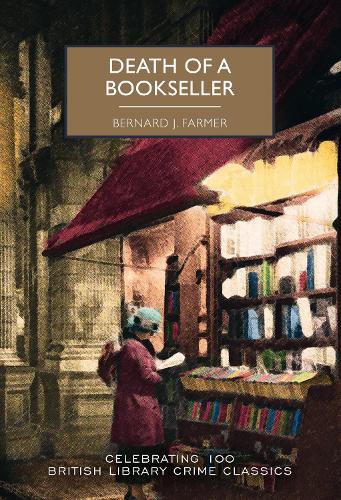
Review by Jon Wilkins of "Death of a Bookseller" by Bernard J. Farmer


If you are a crime fiction fan, you will be aware of the wonderful series published by the British Library of out of print crime classics that they have reintroduced for public consumption. The breadth of work covered is mesmerising and some have once again become best sellers.

I have just finished reading Death of a Bookseller in two sittings over coffee and cake at my favourite pub, the Royal Oak in Kirby Muxloe. It is a place highly conducive for reading crime fiction. All the usual suspects drink there!

I usually prefer the Golden Age of Crime, but this novel was written in 1956, the author unknown to me and the echoes of the period are clear even now. 

We are introduced to policeman Sergeant Jack Wigan who befriends bookseller Michael Fisk. Early in the novel the bookseller is murdered and the crime blamed on the unfortunate Fred Hampton, an unpleasant man without a friend in the world. Wigan believes him to be innocent of the crime, even when he is convicted and sentenced to death. 

He fights to clear his name and his journey is faithfully recorded here, as along with new-found friends Charlie North and Searle Connington he endeavours to do this, despite Hampton being the most unsympathetic and ignorant of clients. 

The story delves into the murky 1950s world of book selling where a slash of the razor is as regular as under-the-counter payments. We meet unscrupulous book sellers the Ferrow brothers and the sleazy Corky Edwards, the glamorous Ruth Brent and American multi-millionare Dithan Dand as well as a less than endearing Detective Inspector Saggs. There are so many characters who are described so eloquently that we struggle to discover the culprit until all is revealed. 

Books are stolen and resold, enmities cultivated and entrenched, the merest slight never forgotten. One cannot envisage the Waterstones Bookseller to behave in this manner but who knows? The denouement is blood-curdlingly fulfilling as Wigan fights to the very end to clear Hamptons name. You will enjoy this romp through the bookshops of London and might even be inclined to become a book collector yourself as the leading lights in the novel do. A gem.


About the reviewer
Jon Wilkins is 66. He is married to the gorgeous Annie with two wonderful sons. He was a teacher for twenty years, a Waterstones bookseller and coached women’s basketball for over thirty years before taking up writing seriously. Nowadays he takes notes for students with Special Needs at Leicester University. He has had a work commissioned by the UK Arts Council and several pieces published traditionally as well as on-line. He has had poems in magazines and anthologies, art galleries, studios, museums and at Huddersfield Railway Station. He loves writing poetry. For his MA, he wrote a crime novel, Utrecht Snow. He followed it up with Utrecht Rain, and is now writing a third part. He is currently writing a crime series, Poppy Knows Best, set at the end of the Great War and into the early 1920s.

Wednesday, 24 August 2022

Review by Jon Wilkins of "Detective Inspector Huss" by Helene Tursten


Following in the footsteps of Swedish crime writers, Maj Sjowall and Per Wahloo, we are invited into the world of a detective and, through them, discover what life is like in Sweden. There is so much more in the Irene Huss novels than a simple crime and discovery and that is how it should be. That is the true delight of the stories. 

In brief, to introduce the main characters, Irene Huss is around forty years of age and is a police inspector working in Göteborg with the Violent Crimes Unit. She is happily married to a chef, Krister. She has twin girls Kristina and Jenny and a dog, Sammie. Many years ago she was European champion at jujitsu. 

Work colleague Tommy Persson is her best and oldest friend. They have known each other since the police academy. Indeed, Irene feels the pull of family in the police force as she says: “We’re just like an old married couple … though she’d never said so out loud.” 

Her boss, Commissioner Sven Andersson, is actually too old for his job and should retire, but he does not want to. He regularly has high blood pressure and worries Irene. 

Jonny Blom is the most unsympathetic of her work colleagues, always on the edge with a spiteful selfish nature. He seems to represent the old fashioned machismo side of the police. Jonny Blom is a corrosive influence within the group. If this was real life, he would have been formally reprimanded for his misogynistic behaviour and I see his character as a weakness in the series. It is all well and good having a defective character, but it has to be true to life. He is an embarrassment and disciplinary proceedings would have been started against him. Blom may be married, but his womanising and drinking as well as his sexism and intolerance would not be acceptable in a modern police force. To say that his boss has old-fashioned values, so doesn’t really understand Blom’s faults, is a little naïve and he doesn’t confront him as he should. Blom is tolerated more as a dramatic device, but I feel in real life he would have been ostracised by his work colleagues, especially after his sexual assault on Birgitta, and sanctioned by his bosses for his intemperate and inappropriate behaviour.

Fredrik Stridh, Hannu Rauhala, Birgitta Moberg and Svante Malm are more sympathetic colleagues and we can warm to them all. The final main character is Professor Doctor Yvonne Stridner who is the forensics specialist. Brilliant at her job, she seems to intimidate everyone in the office, especially Andersson.

The Irene Huss series by Helen Tursten is unique in Scandinavian crime fiction in that as well as being a contemporary story about a Göteborg Detective who has made it to the top, the stories also show that she’s happily married with her two daughters and lives a normal family life as a contrast to the seedy, unpleasant, and often violent work she is involved in. It is the everyday ordinariness of Swedish life that is pivotal here and so the awful murders that do occur stand out in their savagery compared to the day-to-day actions at home.

If you start with Detective Inspector Huss, her first novel, you will be on a journey into Swedish crime and the metamorphosis of a character who should be more widely read.


About the reviewer
Jon Wilkins is 66. He is married to the gorgeous Annie with two wonderful sons. He was a teacher for twenty years, a Waterstones bookseller and coached women’s basketball for over thirty years before taking up writing seriously. Nowadays he takes notes for students with Special Needs at Leicester University. He has had a work commissioned by the UK Arts Council and several pieces published traditionally as well as on-line. He has had poems in magazines and anthologies, art galleries, studios, museums and at Huddersfield Railway Station. He loves writing poetry. For his MA, he wrote a crime novel, Utrecht Snow. He followed it up with Utrecht Rain, and is now writing a third part. He is currently writing a crime series, Poppy Knows Best, set at the end of the Great War and into the early 1920s.

You can read more about Utrecht Snow on Creative Writing at Leicester here.

Friday, 3 October 2014

I Can't Wait for Friday: Review by Liz Gray of Nicci French's "Blue Monday" Series


I first came across Nicci French in my local library: I had joined a crime reading group because I wanted to widen my circle of crime fiction and to discuss books with other readers.  At that point I had only read Ian Rankin and Val McDermid, and the crime shelves were so packed with writers that I didn't know where to begin.  But the group facilitator produced a list, and early on we picked out a Nicci French novel, Blue Monday.
 
Nicci French is in fact a pair of writers, husband Sean French and his wife Nicci Gerard: and together they write very successful crime fiction.  Blue Monday is the first of a sequence of novels featuring the psychotherapist Frieda Stark who works with the police in much the same way as Tony Hill in Val McDermid's Wire in the Blood series.  So far the sequence has got as far as Thursday and includes Tuesday's Gone, Waiting for Wednesday and Thursday's Children.

The novels are hard-hitting and often feature highly disturbing scenarios: the abduction of a small child; the murder of a popular local woman who turns out to have had a secret double life; a confused young woman trying to serve tea to a rotting corpse – these books do not pull their punches, but there is always a resolution and that is what makes them satisfying: that, and the fact that it's impossible to guess the outcome.  Nicci French is a master of narrative twists: there's always more than one plot-line and the pace rattles on, interspersed by glimpses into Klein's largely dysfunctional personal life.  She is typical of the therapist who can't sort out their own emotional life: clear-sighted and helpful with her patients, she is unable to sustain a long-term relationship herself, and in the latest book, Thursday's Children, she abruptly finishes with Sandy, the lovely, understanding man who has given up a life in America to be with her.  I'm sure this is not the end of the story; but we'll have to wait for Friday's book to find out.

Setting is very important in crime fiction, and the area of London where Frieda lives is evoked in vivid clarity, as is her basement flat which houses a number of strays passing through, such as Josef, the Polish builder who becomes her friend and confidant.  But the novels sometimes step outside London as well, to the Suffolk coast where Frieda grew up and where she is forced to return in order to investigate a case.

The appeal of the psychotherapist is that, unlike with police dramas where we see the who, the what and the where, here we are able to see something of the why.  And that is something we all surely cry out to know: when we hear of terrible murders or abductions or attacks or even senseless robberies, more than finding out whodunnit we want to know why they dunnit.  And here's where the psychotherapist scores over the policeman: though Frieda Stark is modest about her achievements, she does give us a window on the inner workings of the criminal mind; and that, to me, is more fascinating than any number of car chases.

If you haven't caught up with these stories I urge you to give them a go.  Personally, I can't wait for Friday ...

About the reviewer
Liz Gray is a well-known Leicestershire poet.  She has performed at Word!, Simon Says and more recently has featured in the Everybody's Reading event, 'Women's Words.'  She is a published writer and reviewer and has led poetry workshops at the Richard Attenborough Centre and at local libraries. Her blog can be found at: lizardyoga.wordpress.com.