Showing posts with label art. Show all posts

Tuesday, 26 May 2026

Review by Rebecca Nolten of "Female, Nude" by Rhiannon Lucy Cosslett


Female, Nude hooks its readers with the promise of a sun-soaked, escapist holiday fling, but grounds them in the relentless persistence of classism, misogyny, and power imbalances that shape our relationships with others — even our nearest and dearest.

In her tense yet deeply funny novel, Rhiannon Lucy Cosslett asks one fundamental question: is a woman ever truly able to have it all? The marriage, the dream job, the success, the baby, the artistic talent, the beauty, the virtue, and, of course, the dreamy holiday villa in Greece.

While soaking up the sea and sand with her claustrophobic circle of privileged university friends, the protagonist, Sophie, reflects on what it is that prevents her from being happy. Her boyfriend — the "lovely" Greg — is desperate to have a baby, while Sophie, an artist, sees motherhood as a hurdle standing between her and artistic success. Having grown up caring for her disabled sister, Sophie knows very well that the burden of care almost always falls to women. Her own career has stalled at a retail position in Greg’s art gallery, and she begins to question why certain doors remain closed to her while opening so easily for those belonging to the upper echelons gathered on this Grecian retreat.

When the wealthy Alessia commissions Sophie to paint a nude portrait of her, she introduces her to Kai, a local man with whom Sophie begins a hot-blooded affair doomed from the outset, as the days count down to the arrival of "the men" — Greg included. The push and pull of class, desire, and romantic tension culminates in a calamitous act of violence, prompting the reader to consider what forces led to this devastating outcome.

While the novel follows the progressive unravelling of Sophie’s life, what truly sets this book apart are the thirteen artist "tableaux" — short passages mapping Sophie’s engagement with nude self-portraiture by female and non-binary artists throughout history. These sections read almost like conversations: discussing the lack of representation of disabled bodies and miscarriage in art with Frida Kahlo, the objectification of the male gaze with Artemisia Gentileschi, and the erasure of Black bodies with Zanele Muholi. These glimpses into the lives and work of these artists serve as a methodical reminder of the socio-political forces that shape artistic production and determine what artwork is exhibited, studied, and valued.

Beautifully written, well researched, and infinitely witty, Female, Nude leaves behind a lasting impression. Cosslett masterfully uses the erotic to expose the workings of class structure, patriarchy, and ableism, culminating in a novel that feels both intellectually incisive and deeply human.


About the reviewer
Rebecca Nolten is a Modern and Medieval Languages graduate from the University of Cambridge (Girton College). She has worked across editorial, copywriting, translation, and arts publishing, with a particular focus on storytelling and visual culture. She is especially interested in translation, art history, and the ways in which stories move across languages, cultures, and media. Outside work, she enjoys illustration, reading, and visiting galleries and exhibitions.


Tuesday, 22 July 2025

Review by Tracey Foster of "Spring Cannot Be Cancelled: David Hockney in Normandy" by Martin Gayford


At least they can't cancel Spring was a refrain coined by David Hockney in 2020 when he found himself locked down in Normandy, surrounded by his newly acquired orchard.

Gayford, who is the art critic for the Spectator, had a long relationship with Hockney that went back over 45 years. Having previously written two books together, History of Pictures and Secret Knowledge, the pair were in constant communication before the outbreak of Covid-19. Sharing images, thoughts, connections via emails and post, the impact of lockdown was to become a focus during the subsequent isolation of the artist in his new studio, a converted barn. To use Hockney’s favourite word, they had a good natter. The premise of this book is to explore that period and the outpouring of landscapes that came from confinement, whilst making connections between other artworks and theories and the fragility of the human race. While we were condemned to sofa surfing, team meetings, home schooling and baking bread, Hockney and Gayford looked closely at our relationship with nature and the art of sitting still and noticing every detail about us.

We have lost touch with nature, rather foolishly as we are part of it, not outside it. This in time will be over and then what?

This chimes with the mood of the period, when we quit our confines for daily walks and began to turn to nature for relief. Finding solace in the sunsets, wellness in our woodlands, we, like Hockney, looked at the details around us. Back when the mortality of our existence was a daily bulletin, Hockney was aware of his presence and role as an observer and recorder of life. 

I've witnessed quite a few changes in the art world and you know, most artists are going to be forgotten. That's their fate. It might be mine too. 

The landscapes he drew with pencil, paintbrush and iPad were simple marks and dots of colour but conveyed the freshness of nature unfurling in a time of great immobility. The inevitably of Spring, nature's great drive to procreate and live, was a reminder of our raison d'etre when we needed it most. 

This book is a great commentary on the lockdown of 2020, seen through the eyes of two people. Their conversations and discussions traverse art, opera, food, postcards and fairy tales. This is a roundabout ride of ideas and ideology, focusing on themes close to the artist’s heart: colour, shade, time, perspective, water and nature with reference to those who influenced him most, Van Gogh, Monet, Picasso, Hokusai and Rembrandt. The book is punctuated throughout with glorious images that pay homage to the skill of the mark maker and a visual history of time, weather and viewpoints.

I last saw a Hockney retrospective in 2012 at the Royal Academy of Arts, A Bigger Picture. Although I was aware of his large portraits, California pools and Wolds landscapes, it was his pencil sketches that fascinated me most. His draftsman skills are imbued with sensitivity as he layers up marks to create texture and depth. This was at the forefront when I read this book. The Normandy iPad sketches he created with a bespoke painting app use similar marks and movement to convey the cherry blossoms, riverbeds and pathways surrounding the farm.

Hockney finally left his Normandy studio at the end of 2024 and moved back to London. Failing health in his late eighties has drawn him closer to amenities and available health care. A prolific artist who has worked every day since turning sixteen, and who painted the mantra Get up and start work straight away on his bedroom chest of drawers, is not due to stop work soon. We can only wait to see what becomes his next muse. 

Everybody's looking at the same picture, but they don't see the same thing. We see with memory. 


About the reviewer
After a long career as an Art and Design teacher, Tracey Foster wanted to refocus her creative energies into writing poetry and prose. After helping others find inspiration in the world around us, she took an MA course in Creative Writing at Leicester University and has not looked back. She finds inspiration in the past and the events that shape us. Previous work has been published by Comma Press, Ayaskala, Alternateroute, Fish Barrel Review, The Haiku Foundation, Mausoleum Press, Bus Poetry Magazine, Wayward Literature, Cold Moon Journal, Madswirl, Five Fleas, the Arts Council and she writes on her own blog site The Small Sublime found here.


Wednesday, 8 January 2025

Review by Tracey Foster of "Fewer, Better Things: The Hidden Wisdom of Objects" by Glenn Adamson


Reading this book reminded me of the adage: "Poets, we get it. Some things remind us of other things." 

All very amusing, but it doesn't explain why we have such an obsession with the objects we keep about us. While I write this, most of the human race is presently hunched over, worshiping at the altar of the flat screen, including myself.

Adamson investigates our need to accumulate and collect things and vocalize our appreciation of the world around us. He highlights the classification method used by Susan Stewart in her book, On Longing, in four categories: "The gigantic, the miniature, the collection and the souvenir." We name and claim large objects to bring them into our reach: mountains, oceans, planets and galaxies. We dissect and scrutinize our world down to the smallest cell or microbe. Then there is our need to catalogue and collect every variant until there are no gaps, and our desire to hold items once connected to our loved ones or historical figures. All these aspects make us human.

Our language is haptic-infused. Manual, manufacture, manoeuvre, we feel our way through life and have an impulse to touch objects to inherently understand them. The sixteenth-century art historian Giorgio Vasari said, "It is necessary to have the compass in the eyes and not the hand, because the hand works and the eye judges." Touch was previously thought the lesser of the senses, linked intrinsically to manual work and the lower classes. Helen Keller redefined how intrinsic our hands are to being fully cognizant of the world around us. Her book was the first to delve deeply into the importance of our fifth sense to fully see. 

Adamson spent time at the V&A museum and was director of the Arts & Design Museum in New York whilst writing this book. He is an advocate of moderation, reducing our world of stuff to just the essential or aesthetic. He explores William Morris' mantra: "Have nothing in your house that you know to be useful or believe to be beautiful." 

This book fully explores our relationship with objects, whilst maintaining a plea for living a life less cluttered. This seems a valid call following on from the excess of Christmas, the frenzy of exchanging goods and the aftermath of stuffing our homes with even more items we don’t really need. Museums are often guilty of acquiring masses of objects that spend their whole life in storage. Adamson spends one chapter exploring our multifaceted response to antiquities in museums, including paintings: "Any painting is an embodied moment of truth."

We bring our experiences and expectations when we visit museums. This can skew our reactions and temper our responses. Galleries lay out a default blank slate; cabinets are clear and clutter-free to allow us personal interaction with each object. Visitors experience a unique reaction, dependent upon race, gender, age and class, transforming everyday items into "cultural icons."

This book pleads for restraint when amassing items around us, a quick calculation of the carbon footprint we contribute to and collate in our world of stuff. Adamson is a believer of mend and reuse or, like the Japanese art of Kintsugi, the need to learn to live with the broken, as a memento of our time here on earth. The book is a call for a resurgence of material intelligence: as our stuff gets more technical, we become more removed from its creation: "Skin should be understood a site of intelligence." We should be more discerning with it. 


About the reviewer
Tracey Foster started off in a long career as an Art and Design teacher but wanted to refocus her creative energies into writing poetry and prose. After helping others find inspiration in the world around us, she took an MA course in Creative Writing at Leicester University and has not looked back. She finds inspiration in the past and the events that shape us. Previous work has been published by Comma Press, Ayaskala, Alternateroute, Fish Barrel Review, Haiku Foundation, Mausoleum Press, Bus Poetry Magazine, Wayward Literature, The Arts Council and she writes on her own blog site, The Small Sublime, found here.

Wednesday, 22 May 2024

Review by Tracey Foster of "Unravel: The Power and Politics of Textiles in Art": Exhibition at the Barbican


Textiles are vital to our lives. We are swaddled in them when we’re born, we wrap our bodies in them every day and we’re shrouded in them when we die.*

The symbiosis of text and textiles is as old as mankind itself. The allegorical text of storytelling draws from man's skill to clothe himself: the weaving of a plot, fabricating a narrative and the thread of a story, draw from fireside tales passed on while sewing and mending garments. Our ability to create both fabrics and fantasies has enabled us to record our stories in word and weaving. The current exhibition at the Barbican, Unravel: The Power and Politics of Textiles and Art, has curated a vast range of examples from different cultures and viewpoints that explore the ability of fabrics to record our narrative through touch. 

Entangled in a textile are the knowledge systems of Indigenous people, who for centuries have used thread as a means for communication - to share information, to tell stories and express themselves.

A single dyed thread of indigo cotton expresses a multitude of connotations - of empire, colonial ruling and enslaved peoples - and at one point was said to be in equal in value to the people who slaved to produce it. Textile artists have explored this tale by deconstructing dyed garments to their constituent parts and remodelling them into exhibition pieces, using stitch, applique and embellishments. The artist's mark making, like words layered upon the cloth, trace the tale of our recent histories. Stitching through time has been a subversive act, a mostly female occupation, and seen as the default setting for the demure, domestic members of the household. Young girls were taught needle work from the age of five and expected to learn contrition by being silently contemplative. The bent female head was often portrayed in paintings and tapestries throughout early periods. These females learnt to bend the rules even whilst being compliant - for example, by depicting midwives at the nativity scene despite their presence being banned by the ruling church. Defiance in diligence became a way for them to express themselves, using the power of the needle when the pen was denied to them. This act has transcended ages and has seen modern textile artists continue to express emotions and defy conservative views through fabrics.

Stitching can be a subversive act: thread can work as a language to challenge fixed ideas and voice free expressions.

Tracey Emin’s quilt, No chance, allowed her to voice her feelings as a thirteen-year-old girl in 1977, the year she was raped. Old blankets and clothing were used to express these emotions and combine home comforts with the raw truth of her experiences; the decision to pick out the powerful text in a homely blanket stitch conveys the duality of safety and violation. 

For Judy Chicago’s Birth tear/tear embroidery, she collaborated with over 150 women to share birth experiences of the mythical, the celebratory and the painful to create a visceral response to the iconoclastic images of the virgin birth. Her method of using nine needles at a time each with three threads emulates the numerical symbolism of the holy trinity and the stitching following painful childbirth. 

T. Vinoja’s Border and Bunker explores her experiences of the Sri Lankan Civil War, creating aerial maps informed by her own memories and the testimonies of others. Stitches and salvaged textiles form borders, excavation routes, tents, checkpoints, bunkers and burial sites. During the war, she and her father used clothes to craft bunkers and temporary shelters by filling used saris with earth. She has spoken of the individual stitches as reparative sutures, emulating how fabric was used as first-aid to wrap and cover wounds.

Textiles are part of our everyday routines — they are in close contact with our bodies and our homes, they are used, felt, touched and seen. As such, the material is invested with personal narratives, making it uniquely suited to communicate the intricacies and complexities of lived experience.

Not all the contributors to the exhibition are female as men also turn to fabrics to explore their feelings and express their frustrations of conforming to male stereotypes. They use a perceived feminine artform to play with expectations and social narratives.

Women, men and nonbinary artists have both resisted and reclaimed these limiting approaches to the medium, questioning gendered and value-based binaries and using the act of stitching as a radical practice.

Jeffery Gibson drew from his Choctaw-Cherokee heritage and traditional powwow ceremonies, particularly those worn by the Northern Paiute people as spiritual protection in the pacifist Ghost Dance movement, in order to explore his identity as gay man. He plays with the nonbinary gender roles found in many indigenous cultures and his garments are deliberately ungendered.

Politics and art have always been unique companions; this is demonstrated nowhere more simply than the blank wall gaps where artist work has been withdrawn because of the current war in Gaza. Exhibition, explanation and discussion have always been the point of creative artwork, to open dialogue and demand a further look at the intended focus. This exhibition allows a dialogue to be created across cultures, genders, stereotypes and societal norms. Long may the thread be an advocate for communication and understanding. Long may we see more artists using textiles to tell their individual stories.


*Italicised quotations are taken from the exhibition catalogue.


About the reviewer
Tracey Foster started off in a long career as an Art and Design teacher but wanted to refocus her creative energies into writing poetry and prose. She finds inspiration in the past and the events that shape us. Previous work has been published by Comma Press, Ayaskala, Alternateroute, Fish Barrel Review, Mausoleum Press, Bus Poetry Magazine, Wayward Literature, Zine magazine and The Arts Council and she writes her own blog, Small Sublime. Her work is currently on exhibition at the Ikon Gallery. 


Friday, 2 June 2023

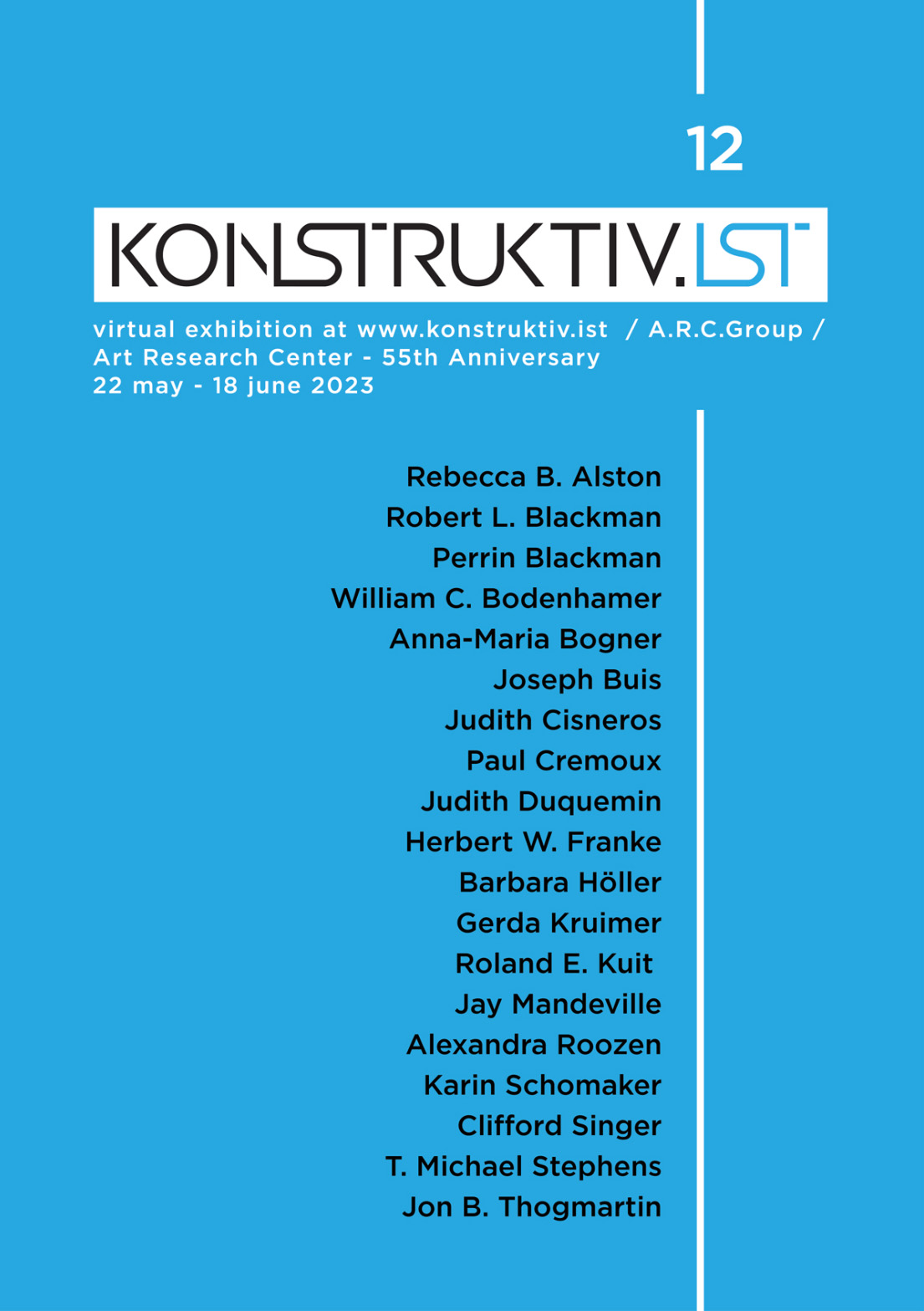
Review by Robert Richardson of "Virtual Exhibition No. 12: Art Research Center/A.R.C. Group 55th Anniversary Exhibition," 22 May - 18 June 2023


For a visual arts group to be in existence for fifty-five years is itself an achievement, and this is celebrated by the Art Research Center/A.R.C. Group with a superb online exhibition, which also becomes ‘Virtual Exhibition No. 12’ on the konstruktiv.ist website. In contrast, this website, founded by the Turkish artist Erdem KüçükköroÄŸlu, began recently, in 2020, at the outset of the pandemic and its subsequent lockdowns, which hastened a greater movement towards online exhibitions.

The artworks of these nineteen A.R.C. members give a continuing vitality to Constructivism in the 21st century, and they are entirely suitable for viewing on screens. Constructivist art has never much depended on the relief qualities of paint, with a flat surface often being the aim (it is significant that many of the painters here use acrylic). This means when they are scanned and become digital, nothing much, in this respect, is lost, and, for the most part, an emphasis on bold compositions and colours means a screen becomes an excellent alternative canvas, with its light providing vibrancy.

Within the general adherence to Constructivism, this selection has a pleasing eclecticism: the dangers of being monolithic or didactic are avoided. As well as the adept curating of T. Michael Stephens, A.R.C. Founder and Constructivist artist and designer, and Erdem KüçükköroÄŸlu, this is probably also helped by the other interests of the participants: in addition to 2D and 3D art, these include architecture, digital art, photography, poetry, collage, and sonic art. There is for sure a range of perceptual intelligence present in this exhibition. 

I am assuming the artists themselves nominated their descriptions on the virtual labels, and, in particular, find interesting that the German artist Anna-Maria Bogner chooses ‘Concrete Artist.’ This is of course a direct link back to the great Max Bill, the important school of design at Ulm, and the even more important Bauhaus. Although Constructivism originated in Russia, it was made truly international by the Bauhaus, not least because of its own diaspora, including Gropius and other leading figures moving to the United States. The A.R.C. group was founded in Kansas City, but the participants of this exhibition reflect this internationalism, coming from a number of counties: Argentina, Australia, Austria, France, Germany, Netherlands and USA.

A more common self-descriptor is ‘Systematic Painter (or Artist)’ and variants of ‘Structural.’ I am taking this to mean these artists are working with a system that is possibly adopted or of their own invention. One artist, Clifford Singer, is a mathematician, and I assume this informs his approach. What unifies is engagement with the basic Constructivist vocabulary of shape, line, colour and space. The creating of compositions in a systematic way is a sublimation of the individual in favour of the universal. Nevertheless devising (or choosing) a system and the aesthetic judgement on whether to accept or reject its outcomes means, paradoxically, that styles emerge. From encountering their art on social media, I now instantly recognise Judith Duquemin‘s own brand of using white space as an active compositional element, Joseph Buis’ scaffoldings of colour and T. Michael Stephens’  singular approach to working with constructions.

A more inclusive Constructivism overlaps with other Movements, particularly Minimalism, as with Rebecca B. Alston’s FDP RED #3 (2023). It consists of three squares: a small black one within a light red one, and both within the largest one, itself divided in halves of two darker shades of red. It is inevitable that Albers is referenced (and, for me, aspects of Enrico Castellani come to mind as well). The division of the largest square, offset against the other elements, creates a perceptual dimension all its own, and the fierce reds belie an accompanying meditative quality. Similarly, Jon B. Thogmartin’s Purple Dots & Yellow Circles (2022) is both Constructivist and Minimalist, with an emphatic rhythmic repetition.

There is of course much work that meets the Constructivism of lines, shapes and the geometric angles they make, and examples of exhibits that are “classically” Constructivist are Barbara Höller’s painting 19copy07 (2021) and William C. Bodenhamer’s assemblage Construct Aesthetics Inherent (n.d.).

The konstruktiv.ist website is an effective pairing for this exhibition, and should be congratulated for creating an online environment with admirable clarity of navigation, presentation and labelling, and congratulations to Art Research Center/A.R.C. Group for showing a Constructivism that continues to look fresh. The dates of the artworks are recent, and this highlights the group is not a tedious custodian of Constructivist purity but contemporary artists adding their own perceptions and ideas.

The full list of artists is as follows: Rebecca B. Alston, Robert L. Blackman, Perrin Blackman, William C. Bodenhamer, Anna-Maria Bogner, Joseph Buis, Judith Cisneros, Paul Cremoux, Judith Duquemin, Herbert W. Franke, Barbara Höller, Gerda Kruimer, Roland E. Kuit, Jay Mandeville, Alexandra Roozen, Karin Schomaker, Clifford Singer, T. Michael Stephens, Jon B. Thogmartin. The link to the exhibition (ending 18 June) is here. The link to the A.R.C. website is here.


About the reviewer
Robert Richardson is a visual artist, writer and lecturer. His work published by Leeds Postcards in the 1980s was distributed throughout Britain, and is now in graphic art collections of the British Museum and the Australian National Gallery. It is also included in Artists’ Postcards: A Compendium (Reaktion Books, London) and Leeds Postcards (Four Corners Books, London). In recent years he has put together an ongoing portfolio of abstract digital artworks, producing some as limited edition prints and others as NFTs. In 2022, a video artwork was selected for Digital Art Month Paris, and was viewed at various public spaces in the city. He is also the co-editor of Homage to Imagism (AMS Press, New York). His website is here.   

Monday, 12 December 2022

Review by Jon Wilkins of "Dead Drop" by F. C. Malby


I cannot recall ever reading a book with such a sensual, sense-ful, scent-ful opening. The tastes and sights and sounds enveloped me as a reader drawing me into Vienna and its streets, cafes and churches. I can smell espresso, then I can taste the Guglehupf. I feel the wind on my cheek and the bustle of people on their way to goodness knows where. It is enchantingly delightful. Malby should be asked by the Vienna tourist board to promote their city. And that is only after the first two chapters!

I haven’t even mentioned the dead body, found by our protagonist Leisl, on Stephansplatz underground steps, as if it were the most natural of things to discover. Well it was where she was told it would be. But who by? And what of the broach and the note she took from the body? Art thief by career, Liesl finds herself in a terrifying world of murder and deception in this well-researched, beautifully written thriller. She is a hero we root for, despite her criminal behaviour, as she goes on an adrenalin-running-high escapade as she seeks the truth. To Malby’s credit. I found myself in the streets and buildings of Vienna, described with the minimum of fuss, but described in such a way that I felt I was part of the city, part of the chase and totally enmeshed in the plot.

I hope this is the first in a series as there is room for so much more.


About the reviewer
Jon Wilkins is 66. He is married to the gorgeous Annie with two wonderful sons. He was a teacher for twenty years, a Waterstones bookseller and coached women’s basketball for over thirty years before taking up writing seriously. Nowadays he takes notes for students with Special Needs at Leicester University. He has had a work commissioned by the UK Arts Council and several pieces published traditionally as well as on-line. He has had poems in magazines and anthologies, art galleries, studios, museums and at Huddersfield Railway Station. He loves writing poetry. For his MA, he wrote a crime novel, Utrecht Snow. He followed it up with Utrecht Rain, and is now writing a third part. He is currently writing a crime series, Poppy Knows Best, set at the end of the Great War and into the early 1920s.


You can read more about Dead Drop by F. C. Malby on Creative Writing at Leicester here. 

Monday, 25 March 2019

Review by Azra Limbada of "The Afterlives of Doctor Gachet" by Sam Meekings


The Afterlives of Doctor Gachet by Sam Meekings is a historical fiction novel that weaves in and out of both the imagined life of Peter Gachet, as well as providing a reflective commentary on the author’s journey of discovering and writing about the subject of Van Gogh’s famous painting. 

The novel focuses primarily on exploring the sadness captured in the painting, as well as attempting to trace its unique and elusive journey through the hands of investors and art collectors. Meekings skilfully portrays the inner turmoil of a man who felt out of place and out of time, and who consequently turned to the arts for comfort and escape. As the doctor explains at one point, he chose medicine since he ‘was not talented enough to be an artist,’ and this fascination with what art achieves, or tries to, is thoroughly examined throughout. 

For Meekings, the painting is of personal significance, explaining how a chance encounter with a small print of it left him feeling like there was ‘a tiny marble rolling around the inside of my skull.’ In many ways, the novel seeks to explore the connection between art and society in a philosophical fashion, traipsing a fine line between art as representational, and art as a means of individual communication between subject and viewer. As readers, we, too, explore the afterlives of Dr. Gachet, both as a door into a somewhat imagined past, as well as finding an individual human bond between him and ourselves. 

One slight drawback to the novel is the reminder the author continuously gives us of the fact that this is a piece of historical fiction and that there are plenty of incidents that cannot be written without some creative re-imagination. When approaching historical fiction, this is a given, and can take away from the sense of suspended belief a reader is accustomed to.  Often, it feels as though the author is trying to convince us that the application of this creative licence is okay but perhaps that is not necessary at all. We are already drawn into the world of Peter from the moment he faces his biggest hurdle, after he grievously injures himself at the start of the novel. Ultimately, as readers, we are happily prepared to let the author use whatever facts are at his disposal to re-create an otherwise compelling story, and one in which a young man tries ‘to be anything but a boy cursed with a mangled ankle and a relentless shyness.’

The Afterlives of Doctor Gachet artfully captures a glimpse into the life of a man whose lined face continues to stir emotions in its modern day viewers. You may not find the answer to whatever that elusive element is in this book, but you will understand better why it is so easy to relate to Doctor Gachet’s sadness, so clearly visible through the medium of colour and oil on canvas. 


About the reviewer Azra Limbada is an English PhD student, currently providing literacy intervention at an SEN school. She enjoys reading and writing women’s fiction in her spare time.

Saturday, 16 September 2017

Review by Robert Richardson of “Seurat To Riley: The Art Of Perception” at Compton Verney Art Gallery, Warwickshire. 8 July – 1 October 2017


Degas famously stated ‘Art is not what you see, but what you make others see.’ Seurat, his contemporary, responding to colour theories of his day took more direct action. His Pointillism juxtaposed individual brush strokes of contrasting colours to create shimmering effects. In addition to paintings by Seurat, the opening room of this excellent Compton Verney exhibition has a painting by that icon of 1960s art, Bridget Riley. This sets the agenda for her pervasive presence. Although the organisation of the artworks is mostly chronological, this is occasionally broken, but always with an intelligent thematic purpose in mind.

The exhibition proposes other precursors of 60s Op Art: the mathematical compositions of M.C. Escher and dynamic responses to machine movement by the Vorticist Helen Saunders. Perhaps more significant is Josef Albers. Better known for his investigations of colour, he is also represented here with compositions based on shapes and lines, their angles and varying thicknesses producing optical illusions of depth. As a leading member of the Bauhaus, it should not be a surprise that Albers approached optics with a combination of rationality and experiment.

When I visited this exhibition, I also attended a talk by Dr Frances Follin, who co-curated it with Compton Verney’s Penny Sexton. She presented some of her fascinating research on the reception of Riley’s work in the 1960s. One of the hot debates at the time was the position of mathematics and science in relation to Op Art. There were apparently scientists eager to escape the intrusion of art into their activities, thinking its populism might swamp their more serious intentions. Riley was going in the other direction, basing her art on an aesthetic of perception and an intuition that did not have mathematics or science as its basis (no matter how much it might be possible for others to interpret it in those terms). 

Riley’s technical realisations, through drawing, painting and printing media, are superb and part of her integrity as a leading artist. Her earliest works in black and white are stunning. To stand in front of Fail (1963) and Over (1966) is to experience the wobbling of visual perception and, even more incredibly, colours not physically present can nevertheless emerge. Her work is an invitation for the viewer to experience change and transformation. As with other Op Art work, this can bring about disorientation, but reality becoming unfixed is also exhilarating.


Fall by Bridget Riley

Follin’s talk expanded on the exhibition text that cited Op Art as part of a post-1945 movement towards greater participation in the making of art. Contemporaneous with 1960s “Happenings” Op Art led back to two dimensions that involved active perceptions of the viewer. It might be argued that visual art had always done this, but it had never before achieved it in such a heightened and powerful way. 

Although Riley predominates, there are plenty of wonderful artworks by other artists, notably Victor Vasarely, equal in importance to Riley, and someone more accepting of the mathematical. The paintings of British artist Peter Sedgley were a revelation to me. They are both majestic and subtle. He deliberately presents us with an out of focus effect, and our eyes conditioned to focus are nudged into perceptual movement.  He also uses colour, which of course Riley, after her classic black and white Op Art, also has as central to her practice.

The Venezuelan artists Carlos Cruz-Diez and Jésus Rafael Soto combined Kinetic Art with Op Art, and our own bodies are the kinetic element: giving the artworks Op Art movements by walking along them. A 2008 sculpture by Liliane Lyjn actually does spin round, and in doing so lines that are part of it move vertically without moving: it is perceptual illusion. The title is Clear Red Koan, with Koan being that Zen puzzle which creates doubt and paradox as a way towards truth.

Op Art still looks fresh and also continues to have an influence on some of today’s artists, as shown in the final rooms, with impressive work by Jim Lambie and the more established Daniel Buren. The exhibition ends with Lothar Götz taking over the walls of an entire room. With Salon Diagonale (Compton Verney), he has responded with shapes and colours to the architecture of the room and the Capability Brown parkland visible from its windows.  

This exhibition has received considerable press coverage and rave reviews, and rightly so. Anecdotally, at the end of the 90s I visited an exhibition at the Tate in Liverpool: a survey of British twentieth century art. From that selection, I thought Bridget Riley was one of the standout artists. It was a suitable judgment, because Riley and Op Art are not just about perception, but affirmation too.


About the reviewer
Robert Richardson is a visual artist and writer. His work is included in Artists’ Postcards: A Compendium (edited by Jeremy Cooper, published by Reaktion Books, London). He has recently exhibited online with the Paris/Barcelona based Corridor Elephant publishing project, and is a member of the Biennale Austria association of contemporary artists. In 2014, his solo exhibition TextSpaces was exhibited at Eugen Gomringer’s Kunsthaus Rehau in Germany. He is also the co-editor, with William Pratt, of Homage to Imagism (AMS Press, New York). His website is www.bobzlenz.com