
Showing posts with label Charles G. Lauder Jr. Show all posts

Friday, 11 April 2025

Review by Peter Raynard of "Year of the Rat" by Charles G. Lauder, Jr


Dual heritage poets often explore the meaning of home, as a way of understanding their life. Lauder did this most eloquently in his debut collection, The Aesthetics of Breath. Originally from San Antonio, Texas, he now resides in the English countryside, where home and family are central to the poems in his pamphlet, The Year of the Rat.

A domestic scene is set in the opening poem (an ode to piano makers, ‘who were once all over London, names no one remembers’), as the family is getting new piano, a pre-loved baby grand, ‘as if finding a lost soul a new home.’ And there are other poems of everyday life with the accident of an elderly grand/mother, ‘your eyes and forehead red from kissing the floor,’ and the wonderful final poem, ‘In search of silence’ (yes please), with its rhyming couplets and Lauder’s skilled employment of the viscera that surrounds them:

         like a chrysalis or fox carcass,
         their creaking, crying cranes to swallow
         me within the hedges tender shadow
         layered in ash leaves and badger shit.

I guess one thing the bucolic and city environments have in common is the preponderance of rats (poor Birmingham, in the UK). Emily Dickinson referred to the rat as the ‘concisest tenant, who pays no rent.’ A bit like my adult sons. The Chinese calendar’s Year of the Rat describes the mammal as quick-witted and resourceful, and that is certainly the case with Lauder’s experience of them.

In the eponymous eight-poem sonnet sequence, we see ‘one large and one small / shield beneath gunera leaves / take turns / dashing for the tub of duck pellets.’ The comparison between city and country rat is summed up by Lauder as ‘country rats / are more genteel than their city cousins // they’re not in an alley biting through bags of rubbish.’ Their resourcefulness is evident in the ‘maze of tunnelling stretching / between the boiler house and oil tank.’ 

Having watched Lauder read at his launch, I know his poetry (and life?) is informed by Daoism. There are two touching poems from this belief system about his love for his wife and his family. ‘You are the Sun / radiating high overhead // I am Pluto / of the far, cold / surrounding edge.’

The final couplet of the pamphlet sums up this country life: ‘Here pheasants will build a nest / and wait and wait for the world to change.’

I must give a final nod to the publisher Blueprint Press. Based in the North East of England, they are a pamphlet publisher, showcasing poets between collections, and have already put out work by Fran Lock and W. N. Herbert. The pamphlets are beautifully produced in a minimalist style, so more power to them.


About the reviewer
Peter Raynard is an independent researcher, poet and editor of Proletarian Poetry. His three books of poetry are: Precarious (Smokestack, 2018), The Combination: a poetic coupling of the Communist Manifesto (Culture Matters,2018), Manland (Nine Arches Press, 2022). A debut pamphlet (a heroic crown of sonnets), The Harlot and the Rake: poems after William Hogarth, was published by Culture Matters in September 2024.

You can read more about Year of the Rat by Charles G. Lauder, Jr, on Creative Writing at Leicester here

Thursday, 15 June 2023

Review by Charles G. Lauder, Jr., of "Latch" by Rebecca Goss


A latch opens the way, allows you to move from one room to the next, as if entering a new stage of life, and in Rebecca Goss’s latest poetry collection, Latch, is all about movement, movement that leads to reflection, recollection, transformation. These poems were written following Goss’s return, with her family, to the Suffolk countryside where she grew up. Watching her daughter blossom and experience rural life makes Goss recall her own childhood, when she sought independence and freedom, while also witnessing her mother’s struggles. For the most part these eras avoid overlapping in the same poem but move in parallel: every journey backwards is reflected by a step forwards. Goss recognizes it’s her daughter’s turn to step out, yet she also knows freedom means separation and danger, though you’re full of ‘heat and blood and questions.’ As she writes in the collection’s opening poem, ‘The Hounds,’ ‘It’s as if something | calamitous is coming’:

Should I slide the thin pane,
push my upper body

into emerging light,
let them scent out my sex,

tell them
we are all afraid.

In ‘State of Being Young,’ a young girl with ‘two pairs of jeans, / rammed in a paper bag’ makes an attempt to break away, but only gets so far before her mother fetches her (‘car stuffed with siblings’):

           … Passenger door
          pushed open in surrender,
          the gesture saying
          don’t leave us now, not yet.

Yet, Goss accepts her child must do the same:

          The click of a car seat unbuckling.
         You have made your decision
         to leave this space,
         because inside the car with your mother
         you won’t see
         Brimstone butterflies,
         the seasoned ponds
         the coppiced limes’
         determined stretch towards light.

Throughout, cars are key to transformation, more than just retrieving and releasing: from their car Goss and her daughter witness (or not) a deer and three fawn as well as a pheasant; Goss uses her car to steal and bring home a childhood stream; and her father carries off a dying cat. In the very moving ‘That Afternoon, on Her Bicycle,’ Goss’s grandmother at a young age discovers her father dead in his car. Laying aside her bicycle, she drives him back home in reverse gear to a waiting birthday party.

Perhaps it’s knowing when is the time to strike out and to keep on striking, to never stop. In one of the most passionate poems in the book, ‘When It Feels Hot, That Rage Against Me,’ Goss recalls a night walking home with friends from the pub, ‘the lane knowing | how to hold us, its chorus of night creatures.’ Though time has moved on, Goss doesn’t want to extinguish that spark but to pull her friends ‘from their tumble-dried sheets’ and

         become a multitude storming under stars, sky crackling
                           at the sight of us, all the promises re-rising
                  in our throats, needing each other like fire.

A very emotionally powerful moment of action in what is mainly a ‘quiet’ but moving collection.


About the reviewer
Charles G. Lauder, Jr., is an American poet who has lived in the UK for over twenty years. He’s published two pamphlets, Bleeds (2012) and Camouflaged Beasts (2017), and a debut collection, The Aesthetics of Breath, which was published by V.Press in 2019. His website is here

Tuesday, 1 February 2022

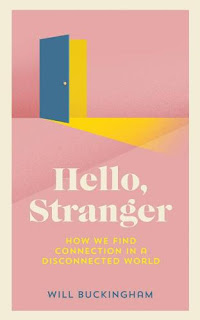
Review by Charles G. Lauder, Jr., of "Hello, Stranger: How We Find Connection in a Disconnected World," by Will Buckingham


Will Buckingham’s book Hello, Stranger: How We Find Connection in a Disconnected World defies categorization. It flows so comfortably between moving memoir, travelogue, to philosophical tract, to historical and cultural texts, that all elements flow together to create a book much greater than its parts. Whether we are grieving with Buckingham over the passing of his partner Elee or tagging along to attend a small village party in north-west Bulgaria to celebrate connections across generations, or learning the playful risks of refusing seconds from a stranger who’s invited you into their home (lest you get whacked with a cudgel), or perhaps putting prejudicial assumptions aside to dine with a Muslim family who daily invite people off the street to dine with them in order for the strangers to learn more their culture, the point is not to be afraid to step into each other’s lives to make that much-needed connection. 

Paradoxically this might be thought easy enough in today’s world of the internet and social media platforms. Yet, as Buckingham, points out, with most of us living in cities nowadays and being quite close neighbours, the loneliness, the division, the disconnect is more prevalent than ever, and thanks to the pandemic, welcoming strangers has now become harder than ever. 

Buckingham’s fluid writing style—effortlessly moving from youthful memory to Ancient Greek anecdote to mythic tale to real-life political situation of refugees and asylum seekers trying to cross the Turkish border by train—demonstrates his life spent as a world-class traveller, a vagabond eager to experience all manner of culture and people. Reading Hello, Stranger continually reminded me of the saying that the more one experiences the world and its great variety, the smaller it seems. Buckingham never mentions the word ‘agape,’ the Greek word for ‘unconditional love,’ preferring instead ‘xenophilia,’ but still he shows the importance strangers hold in his heart, for it is a hug from a stranger on the street, a campaigner for a breast cancer research (the same disease that Buckingham’s partner died from), that helped him to grieve and inspired this book. Ironically, the book comes full circle, the last chapter finishing with him enjoying a plate of food at a Bulgarian village street party while quietly admiring ‘an old lady sitting on a chair on her own, holding a stick. But she doesn’t look lonely. She stares at the crowd and she beams in happiness.’


About the reviewer
Charles G. Lauder, Jr., is an American poet who has lived in Leicestershire, UK, for over twenty years. His latest collection is The Aesthetics of Breath (V. Press, 2019).