Showing posts with label chapbook. Show all posts

Thursday, 23 July 2026

Review by Laura Sygrove of "Eating Air" by Suyin Du Bois


Suyin Du Bois’ debut poetry pamphlet is a tapestry of shared cultures, a smorgasbord of delectable delights and rough estimations; a rich blend of seasoned memories and flashes in the pan. Eating Air is complex, intimate, and oftentimes devastating; a journey into the past in an attempt to preserve the present, always just seconds out of reach.

Besides Du Bois’ poetry, I’ve thought of little else for weeks. Her work begs you to read the words aloud, to savour each syllable as the speaker savours each meal. Eating Air is a collection of flavour samples that dance on the tongue and settle in the pit of your stomach. Du Bois transports the reader across oceans to sit at low dining tables, folding meal trays at high altitude, beside hospital beds and roadside stalls, relishing the familiar taste of airline food and leftovers, sand-roasted chestnuts, French pastries, and makeshift noodle dinners.

For Du Bois, eating and writing are both acts of remembering and belonging, or of not quite belonging, and of longing itself. In her preface, she describes feeling poetry in her body in much the same way as food, where "certain combinations of words can have just the right mouthfeel." Food nourishes the body while carrying emotional and cultural memory. Poetry preserves that memory, remaking it through language: "I stir and stir like her until my spoon draws the right depths of lineage."

As a title, Eating Air feels both grounding and elusive, suggesting nourishment while gesturing towards something intangible: "store-bought surrogates," swaddled exports with their "layers thinned," family recipes spooned from jam jars for the very last time. Her work reads almost as a series of diary entries, reimagining transitory yet toothsome moments in a search for self through places, memories, and identities that resist easy definition.

Du Bois writes with complete transparency, embracing the discomfort of existing between cultures. She allows these tensions to remain unresolved, capturing the feeling of being both within and without. Her poems linger in that in-between space, searching for belonging without ever insisting upon certainty. My favourite line in the collection, "I insist we oil our bloodlines mackerel slick," is as tender as it is visceral, preserving heritage not as something fixed, but as something living and lovingly maintained. In Eating Air, nourishment is found not only in food, but in language and memory, and the act of returning to them.


About the reviewer
Laura Sygrove is a graduate of the MA Creative Writing programme at the University of Leicester. She is an advance reader at DartFrog Books and writes for The Publishing Post. You can read some of her poems herehere and here.  

You can read more about Eating Air by Suyin Du Bois on Creative Writing at Leicester here


Monday, 15 December 2025

Review by Debasish Lahiri of "Walking Away" by Martyn Crucefix


Only participles here: their ghosts fill the passing of present and present pasts in Martyn Crucefix’s latest pamphlet Walking Away. One does not need to stand in the mere of biblical lore to realize that the "end" is a process. To be witness to our parents – their touch growing cold upon the warmth of our grasp, often desperate grasp, and their memories slipping like wind through the parapet of our fingers, or sand – is to be in the arc, or archetype, of the end. Crucefix’s poetry talks as much of us who are left behind as of our parents who grow more distant, more alien, without being able to go anywhere. 

           You hear cars hiss along the road
           Cars hissing along the road

           Only present participles

In writing about his parents, and their misted lens of time, where everything is either disconcertingly different, or befuddlingly the same, Crucefix unravels the tyranny of that continuum called the Present. With the deftest of touches he paints a time, the only time where we can be partakers together, but also a cruel time with no recall or hope for a future recognition. 

           Mother of your brother and sister
           Mother of your three sons

           The same car speeding away

Reading this collection one can’t but feel that it all stands up or falls apart depending on the miraculous presence or absence of that hand or arm in the precipitate moment when the mind is afraid, limbs waver on the verge of a fumble and a silent swipe at balance comes up with aether. It isn’t merely furniture that has moved. Care-givers move through the house. A flux of children, wives and kin sweep through. The house turns out to be a Care-Home.

           Dining chair and coffee table 
           Shifted here and there

           Losing you. Your balance too

Walking Away has three shorter poems - "Video Call," "My Mother’s Care Home Room (as Cleopatra’s monument)" and "In This Quiet One-way West Country Town" – along with the eponymous long sequence of tercets, measuring the calculus of change in human life. Crucefix adapts the Japanese form of the Haiku brilliantly in his long sequence "Walking Away." This is a sense adaptation of the form, not necessarily a servile conformity to the 5-7-5 syllabic fiat, but a reinterpretation of the dynamic, emphasizing the break (after two lines or one), and corresponding to the idea of the Kireji or the divide in Japanese. Strictly speaking these are more akin to Senryu, poetry that speaks of human life rather than the natural world. 

Crucefix reminds us that living is a one-way road (not just in West Country towns). There’s no way back. Living is a walking away from the consolations of Time, an inexorable moving away of people dearest to us, our parents. His poetry stands up, unflinchingly, to this bruise.


About the reviewer  
Debasish Lahiri has nine collections of poetry to his credit, the latest being A Certain Penance of Light (2025). Lahiri is the recipient of the Prix-du Merite, Naji Naaman Literary Prize 2019.


Monday, 8 December 2025

Review by Karen Powell-Curtis of "Poems of a Nottingham Lace-Runner" by Mary Bailey


Mary Bailey published her pamphlet of thirteen poems in 1826 to raise money to support her nine children. Her poems offer an insight into the world of working-class women in the 1820s and, in particular, Mary Bailey’s life. John Goodridge’s introduction to this revised edition offers context to the poems in terms of time, place and social class.

Lace-runners were employed to embroider patterns onto lace, and in "Petition to the British Fair" Bailey writes: "How hard have we work’d, and our eyes how we’ve strain’d, / When those beautiful flowers we run." Later in the poem, we discover this work isn’t rewarded as well as it should be: 

          How pleasant’s the task, whenever we’re ask’d,
                 To work hard to beautify you;
          Then I’m sure you will own, with candour, unmask’d,
                 Good food and good clothing’s our due; 

          But the price is so low, that, sad to relate, 
                 We cannot these blessings obtain.

Bailey never views her nine children as a burden in spite of her poverty. "To a Lady who desired me to pray for the death of my youngest child" is her response to the woman who made this heartless suggestion. Her love for her children is clear in the lines "Her innocent smile shall my troubles beguile, / And make poverty light as a feather." In the final stanza she comments "lady, forbear to advise, / Till a mother’s affections you feel." In "The Author to Her Infant Twins," she expresses similar sentiments: "Welcome, dear little strangers, welcome here, / Altho’ to keen adversity you’ve come."

"The Locust" is addressed to her daughters and carries the message they should never be cruel. This poem gives us a strong sense of Bailey’s character. She is horrified to discover two young girls playing with "a poor little locust, pierc’d through with a pin." She tells them:

           To a nice school you go, where a lady doth teach,
                  And you much finer feelings should learn;
          But, I’m better than you, though my frock’s common blue,
                  While my heart doth such cruelty spurn. 

Bailey may have published her poems to meet an immediate financial need but two hundred years later they are still relevant.


About the reviewer
Karen Powell-Curtis has a PhD in Creative Writing from the University of Leicester. Her poetry has been published in various anthologies and magazines. 

Wednesday, 19 November 2025

Review by Martyn Crucefix of "Slow Burn" by Jordi Doce


The late John Burnside praised Jordi Doce as "one of the three or four living European poets whose work I most treasure." Slow Burn is a sequence of ten delicate, untitled poems of grief, finely translated by Paul O’Prey. It is not till later that the reader is told "death made its move" and Doce initially establishes an unsuspecting mood, comparing the human body to an ordinary "sunlit town square." The cafĂ© chairs, the old men’s talk, the pigeons, the bell tower, form a "simple / homeostasis," a stability yet to be struck down. Likewise ordinary language (meetings, conversations) only functions up to a point, beyond which hovers "the god / of what’s left unsaid." 

Though distanced into the third person, the fifth poem portrays the writer as he used to be: "rummaging through things, / looking for their meaning." The switch to the present as he "peers through the window" comes as a shock: "He has stopped hearing the voice of himself." Doce’s verbal strikes have an unnerving delicacy. Another poem opens "Whose certainties were these?" and the juxtaposition of certainties with the past tense does powerful lifting in characterising the devastation of loss. The writer’s business is now left in "neglect" and any talk of peace or tranquillity is "to speak a dead language" or is at best "a craving for some plausible / sense of order."

A later poem takes up the earlier suggestion of the unsuspecting ordinary and evokes the shattering effect of grief through the image of a house having lost a room: "We dropped our guard / for just a moment / and it disappeared." It is here that death makes its move, "without / any hint, without any warning. / And took the whole house." The final italicised poem looks back at the sequence preceding it from beneath a sky that is "both itself / and something strange" and affirms that the flames of loss have passed across the flesh of those remaining, for whom, beneath their skin, "embers smoulder on." It is this residual grief that constitutes the mournful "slow burn" of this moving, melancholy, restrained, and exquisitely written chapbook.


About the reviewer
Martyn Crucefix: Between a Drowning Man was published by Salt in 2023; his translations of Peter Huchel (Shearsman) won the 2020 Schlegel-Tieck Prize. A Rilke Selected Poems, Change Your Life, has been published by Pushkin Press, 2024. Martyn's blog is here


Tuesday, 18 November 2025

Review by Rennie Parker of "Poems of a Nottingham Lace-Runner" by Mary Bailey, with an Introduction by John Goodridge


How pleasant to make the acquaintance of Mary Bailey, a lace worker ("Lace Runner") from the great industrial city of Nottingham. For here is her pamphlet, her only one, since she was dead by her mid-thirties; but available at last thanks to the combined efforts of researchers plus Five Leaves Press.

Bailey is adept at ballad metre, but this should not be surprising, as mill hands and fieldworkers alike would improve their monotonous hours by singing. It’s possible that she had popular tunes in mind when composing her verse:

          You ladies of Britain, we most humbly address
               And hope you will take it in hand,
           And at once condescend on poor Runners to think,
               When dress’d at your glasses you stand.
  
There is ample evidence of the love she feels for her children, with none of that reserve which members of the upper classes were meant to show; she works hard and gets about, rebuking mean girls and enjoying the small wins of everyday life on the breadline. I like the sound of this person; the Baileys appear like the numerous and chaotic family next door but where their priorities are in the right order. 

Moreover, it’s important to know that literature was not only available to her but a realistic means of survival at the time. Literature was not an add-on or a hobby; it was part of the work she could do and where she might expect some benefits from that production, whether in sales, patronage, or as a springboard for a career. She knows what is popular at the time: there are moral instructions, appeals, an epitaph - but I find the most engaging piece is her verse letter, meant for her family in Staffordshire:

          Dear brother and sister the packet is come
          To let you both know we are safely got home:
          And, in this epistle I’m happy to say 
          My dear little Ellinor slept all the way …

The book was produced by subscription, same as the model used by today’s online publishers such as Unbounders; her patrons are listed at the back, numbering 90 in total with the vast majority of them being female - none of that idle sitting in drawing rooms for these ladies -  and it’s probably significant that Bailey’s two editions happened in the same decade as her vastly more popular compatriot, John Clare (who was only fifty miles away by stagecoach at the time).

As an insight into one woman’s life and experience, it’s beautiful; here is an authentic voice from those times, showing how a literate working woman thought and felt in the 1820s. Only the usual word of warning for any production like this: she is of course a supplicant, asking favours of the gatekeepers and upper class folk who could determine how she lived or died, or whether the literature should continue at all.


About the reviewer
Rennie Parker is a poet living in the East Midlands, and she is mostly published by Shoestring Press. Her latest collection Balloons and Stripey Trousers, a nightmare journey into the toxic workplace, came out earlier this year. She works in FE and blogs occasionally here. She is also on Twitter/X and Bluesky.


Monday, 17 November 2025

Review by Rachael Clyne of "The Postcolonial Flâneuse" by Ramisha Rafique


I am attracted by flânerie, the random wander in cityscape, and was intrigued by the postcolonial aspect. While I anticipated the gauntlet of sharp political comment, I found myself immersed in Rafique’s gentle reflections on gender, race and religion as she tours street cafes. As a Muslim woman she already disrupts the white male origins of the genre.

From lockdown in Nottingham to Paris and Marseille, from Istanbul and Syria she offers vignettes. She wants to be part of the flow, rather than a labelled stereotype: "She has become part of / the mass. She is him, and her, / and them." Rafique vividly engages our senses with "CafĂ© Soundtrack" – music, chatter, accents, clink of cups, adding visual notes – a man fiddling with his ring, a passerby’s cloud breath. 

One minute we are on a Nottingham street, the next we are in Paris where statues of past empire become sleeping places for the current homeless. "For Those Lost in The Kashmiri Diaspora" concerns her own heritage and continuing impact of a region divided by the British then recolonised by Pakistan and India. The book covers many themes: conversing with God through a foreign language, social decline in the face of climate change and the joys of girl-chat setting their world to rights over coffee and cake.  A museum visit hints at how its art treasures reflect colonial tastes and cultural plunder. 

With the poet’s light touch we are offered a smorgasbord of tastes, customs and meditations, that stimulate food for thought. She eventually takes us into her familiar comfort zones, e.g. "Arab Quarter, Marseille," where her uncovered head is disapproved of by an older woman and she is comforted by "the fusion of black tea leaves, mint, and sugar." All in all, this is a pamphlet well written and worth reading.


About the reviewer
Rachael Clyne is a retired psychotherapist. Her prizewinning first collection Singing at the Bone Tree (Indigo Dreams) concerns eco-issues. Her pamphlet, Girl Golem (4Word) and her latest collection, You’ll Never Be Anyone Else (Seren Books), explore themes of identity and otherness, including migrant heritage, LGBTQ+ and relationships.    


Sunday, 28 September 2025

Review by Éadaoín Lynch of "Exiles Across Time" by Hua Ai


"How far will hunger drive a body over borders?"

Ai’s debut chapbook is driven by an enterprising voice, and a new angle on age-old stories of birth, death, conflict and resilience. It opens with six short announcements or portents, called "Echoes," each in turn repeated in a longer-form poem – a neat example of form mirroring subject. What is remarkable about Ai’s work is her blend of contrasted conceits, political history, and mythic register, recalling elements from the work of Anna Akhmatova or Mahmoud Darwish.

Being an ESL poet, Ai’s language and syntax are reflective of the book’s thematic "exile," as the poems themselves bear the journey of translation. This journey is further contextualised in her Author’s Note, where she shares that, in her native language Mandarin, "meaning travels under the surface; readers are trusted to dive." Transposing a lyric convention from one language into another is not an easy feat, particularly where connotation and cultural context are inevitably lost in the move. Ai, however, is fearless and the confidence bears out in original, inventive poems.

The narrative focus in Exiles Across Time combines gothic and nature imagery, mythos, and symbolism in a way that rebuffs the confessional mode, or what Ai calls "English’s appetite for direct address." The chimeras of life, death and rebirth are corroborated by sweeping metaphors, such as, "History splits awake," "Ice breaks its winter silence," "Existence is a slit throat," and "In woods where history hangs itself." Here is a pastoral poetic that looks as much at destruction as creation – a fitting approach for a work that is concerned so much with exile. 

From initial mythic imaginings of maternal sacrifice and patriarchal domination to a resurgence of hope amid the hunt, Ai turns sharply in "Echo III" to a bruising account of the siege of Sarajevo, illustrating a clear reality, even in ambitious metaphors. This is followed closely in "Echo IV" by a call to action – "a million fingers pull the tyrant down" – to the final "Echoes" of self-fashioning and reawakening. Through these works, Ai charts a journey that is intergenerational, international, and grounded in political upheaval and brutality. Exiles Across Time is an auspicious debut that favours promising work to come.


About the reviewer
ÉadaoĂ­n Lynch is an Irish writer & researcher based in Edinburgh. They are one of the Typewronger Writers-in-Residence for 2025, and co-editor of Re·creation: A Queer Poetry Anthology with Alycia Pirmohamed. Their poem "Brogue" was Commended for the Magma 2024 Poetry Competition by Raymond Antrobus. Fierce Scrow, their debut poetry pamphlet, launched in 2022 with Nine Pens Press.


Tuesday, 9 September 2025

Review by Claire Cox of "Black Skies Die Starless" by Jamie Woods


Don’t be fooled by the  slightness of this pamphlet. It’s Tardis-like, DeLorean-like; it breaches time and space, sight and sound, elegy and epiphany. Step into it and you’re like likely to think you’ve been plunged into the lightless, nihilistic abyss of a dead-end youth in a dead-end town in the 1990s. And indeed you have, but such is the power of Jamie Woods’s creative and poetic energy that he crams in so much more. 

His poems, interestingly varied in form and tone, coalesce to tell the story of one person’s desperate search for drug-facilitated oblivion on one hand and love’s home-coming and validation on the other. This living paradox, openly explored by Woods in an autobiographical frame, is punchy in its rawness and honesty. The lows are emotionally crushing, as in "You and No-one Else" and "Pavement Kenickie Bedsit 99," so too, are the numerous failed pharmaceutical highs where the yearned-for acme of revelation or ascension (the poems ring with religious, Christian imagery) is never achieved. However, for me, the pamphlet’s beating heart lies in "The Opposite of Spring," a beautifully rendered moment of loss which, within the ordering of the pamphlet, might intuit a hesitant uptick in life trajectory. 

What makes this pamphlet eminently absorbing, and more than usually engaging, is its almost synaesthetic appeal to the senses. Woods, a musician and lyric writer, has included a song title for each poem, accessible via his website, and also visuals: graphically-designed poems are interspersed to strong effect, and several poems have ekphrastic origins. These intriguing, extended dynamics offer a dense web of intersensory connections within and beyond the pamphlet’s pages. Immerse yourself in the enriching and persuasive hinterlands Woods so generously offers. Rewind time. I would never have known Hole’s mind-blowing "Northern Star" without him.  


About the reviewer
Claire Cox was co-founder and Associate Editor of ignitionpress, winner of the 2021 Michael Marks Publishers’ Award. She has a PhD (Royal Holloway) on poetry and disaster. Her poems have appeared in Primers: Volume Five and other magazines and anthologies. Claire was also the winner of the 2020 Wigtown Alastair Reid Pamphlet Prize. 


Wednesday, 23 July 2025

Review by Christine Hammond of "A Dress with Deep Pockets" by Jen Feroze


Winner of the 2024 International Book and Pamphlet competition, this beautifully crafted collection is an homage to love, shared experiences and the unique joy of female friendship. You sense the purity of captured moments that become the life-defining journey markers our human psyche searches for and longs to plot, both for meaning and posterity.

In "Hare Girl" reminiscence is powerful, but never heavy or overburdened by sentiment. It is this lightness of touch that characterises much of Feroze’s work, as seen here in the last two verses moving the highly tangible real-life images to an almost ethereal disappearance at the end, likened to the swiftness of a hare through the trees. 

From this, we have some understanding of a transition from the personal qualities and actions of people that leave a short-term impression, to longer-term, deeply affecting and treasured memories. 

         We went camping in each other’s gardens.
         starchy tents and popcorn and stolen vodka.
         I found her before dawn dew-soaked,
         curled in the long grass and defiantly shivering. 

         That was years ago. Sometimes she writes me letters,
         Sends sage and rose petals, chips of crystal 
         That I line up on my desk as I think of her:
         Sleek, fleet, disappearing into the trees. 

A recurring theme, we can see it again in "Selkie." Here, another friend (Stacey) is compared to the mythical, shape-shifting creature that is a "selkie" – capable of shedding its own skin to transition between seal and human, in and out of the water. Again, the poem moves seamlessly from everyday observations to an exceptionally powerful nothingness, just a slick in the water leaving a marbled imprint "soft as a sigh."

          I’m sitting in a damp towel
          Watching Stacey shed herself in the water …

          … And Stacey is untethering,
          wetsuited in the dawn fog.
          Her recipe for spinach pancakes,
          stubby coloured pencils, the persistent ringing
          in her ears. Her Gwen Stefani impression,
          nervous driving, impulse to stroke every cat,
          the way she sits in galleries,
          magnetised. All of it slicks the water,
          A marbling soft as a sigh.

A Dress with Deep Pockets is a highly enjoyable, immersive and poetic reading experience. Events and interactions rooted in the everyday are effortlessly noted, articulated and committed to a precious memory sub-strata. Thus, their value is identified as something of lasting beauty.


About the reviewer
Christine Hammond began writing poetry whilst studying English Literature at Queen’s University, Belfast. Her early poems were published in The Gown (QUB) and Women’s News where, as one of the original members she also wrote Arts Reviews and had work published in Spare Rib. She returned to writing after a long absence and her poetry has been featured in a variety of anthologies including The Poet’s Place and Movement (Poetry in Motion – The Community Arts Partnership), The Sea (Rebel Poetry Ireland), all four editions of Washing Windows and Her Other Language (Arlen House) and literary journal The Honest Ulsterman. She has also been a reader at Purely Poetry - Open-Mic Night, Belfast. Her collection SOJOURN Moments in Poetry is now available on Amazon in both digital and paperback. 

Sunday, 20 July 2025

Review by Julie Gardner of "Skail" by Richie McCaffery


"Skail" is an old Scots word meaning a scattering or dispersal. This information is provided in the back-cover blurb, where we also learn that "the poems in this pamphlet take place in the aftermath of a pandemic, and in the dissolution of a long-term relationship."

The first two lines of the title poem – an especially strong piece – suggest the supernatural, perhaps hinting at threat: "The night before Halloween, he came to her in sleep, / called out her maiden name, with a cancerous rasp." But this ghost comes not so much in anger as exasperation: "He could wait no longer, it’d been 15 years already / of dilly-dally-hanging-onto-daddy’s dust." Her indecision is swiftly rectified. She involves "the great grandkids / he never even knew" who use "little grain scoops" to scatter her father’s ashes in plant pots and they leave out a "tot of his favourite whisky … to slake his thirst." 

"Little grain scoops" will not be enough. The third and final stanza returns us to the woman and then, as if mirroring the first stanza, to the intangible, the supernatural. Despite the apparent abandon of her actions, we see how keenly she feels the loss:

         But the bulk of his ash was left to her, and went
         headfirst into the remains of the vegetable bed.
         And though it was a wet night, the dust cloud of him
         hovered under the streetlamp, as if getting its bearings.

Perhaps "The Lucky Penny," one of the later poems in the pamphlet, is about the same extended family. It begins: "When you were wee, he brought back a lucky penny." Once washed, however, it is revealed to be a Victorian gold coin. That the finder has not recognised its worth is ironic, given his repetition of the well-worn maxim: "Find a penny, pick it up, all the day you’ll have good luck." This failure to recognise good fortune, is, we learn in the final stanza, characteristic:

         Over the years you’ve watched your mother’s profile
         change, caring for grandkids and holding the house
         together as he aged too, cursing a life of misfortune.
         He never knew he held gold in his hand. Still does.

The poems in this slim pamphlet avoid first-person narration, perhaps signifying a desire not to claim self-importance but to draw attention to the complexity of what it is to be human. It risks seeming disingenuous, however, especially in poems that seem to evoke the ending of the long-term relationship referred to in the blurb. In "Scrap," for example, we read, "Her last words to him were written, not spoken, / a paper cut severing them and their fourteen years." And in Cicatrix, "He never heard the wind changing. / Before he knew it, he was out of the frame." The distance between speaker and poet seems small, only the pronoun holding them firmly apart. All the poems feel natural and honest, though, the speaker assuming the role of an unobtrusive observer who reports what he sees with compassion and humour. 

In "Bolt," a man gets off a bus and is "dazzled by a camera flash." He wrongly assumes a group of teenagers have taken his picture and is about to confront them when he is saved from humiliation: "the ordnance of thunder blew them all / out of their skin." The poet trusts his reader to work out what has happened. The final lines of the poem roll together the teenagers, the man, the poet, and his readers:

           That’s being human
           one instant so full of self, the next
           made to feel like no-one, nothing.

This acknowledgement of vulnerability is a thread that weaves through the poems.


About the reviewer
Julie Gardner is studying towards a PhD at Nottingham Trent University, focussing on Silence and Voice in the poetry of Vicki Feaver and her contemporaries. Her poetry pamphlet Remembering was published by Five Leaves Publishers in 2024.


Friday, 18 July 2025

Review by Nina Walker of "sum of her PARTS" by Laura Besley


In sum of her PARTS, Laura Besley provides us with a beautiful series of briefly illuminated windows - vignettes that offer glimpses into the moments of intimacy that make up a life. Besley writes tiny, furious fiction concerning an increasingly fractured world. Each story acts as part mirror, part shard, as cutting as it is revealing. This sentiment is perhaps embodied best by "shattered," in which a self-hatred over physical appearance culminates in a speaker smashing a mirror and stating, "with the shards of glass / I give myself a new face." 

Besley gives a new face, not just to the nameless speaker of "shattered," but also to the presumed limitation of flash fiction. Her creative approach to the visual presentation of flash fiction gives the collection a strong visual identity, a new face. Utilising poetic lineation techniques, Besley’s work shatters and reforms our presumptions about the form.

The collection is carefully threaded together by a series of intimacies, perhaps most centrally the intimacy one must have with oneself. In the refined and precise prose that is present across all four of her published works, Besley presents the reader with moments of physicality that ripple out beyond the pieces' short word counts. Often, the body of the speaker is positioned as an object of discussion, like a museum exhibit - an object transformed by a thread of absurdism that contrasts with the collection's physicality. In one story, the speaker is transformed into a trumpet, in another, a character grows an extra arm to hide their face. Bodies in Besley’s work are central yet malleable. They are expressed through a series of familiar quirks and fault lines, "thick middles," "haggard faces," and "bruises" that can become beautiful or bizarre at a moment’s notice. When reading Besley’s work, one is left discovering, through her typical sharp and wise immediacy, a new strangeness within oneself. 

In one of my favourite stories from the collection, "fractured," Besley writes:

          the doctor says "We’re going to need to take a
             consent form." I sign. "If you could just remove your
                bruises, multiple, along the collar bone and across the patient’s back
                   home, he might be awake, be wondering why I’m not
                      there is a bed ready for you now." I don’t

Here, the body, while still central, is cut in two by the story's perspectives. The lineation is cleverly used to construct the patchwork of the patient as observer and subject. "Patient’s back" flows cleanly into "back home," as if the thoughts of the patient effectively interrupt the clinical observation. Time is clipped and stitched as the request to "remove your bruises" merges observable reality and individual desire for escape. A clashing moment of exterior reality and interior doubt culminates in the piece's final unfinished fragment, "I don’t." The final line, when read within the context of a domestic abuse victim refusing the (albeit limited) protection of the hospital, is haunting. The lack of a concluding full stop implicates all the possible moments this patient may inhabit after this one, leaving the ending of the piece jagged and frayed.

In just thirty-four pages, Besley draws us into a network of bodies, thoughts, and conversations, always, as flash necessitates, with scant context. Yet the brief nature of each piece illuminates just how interconnected we all are, each jagged edge implicating a matching edge that may yet lie beside it. The sum of the collection's parts is a moving and sharply observed portrayal of the complexities of embodied life, where one must place gentle intimacies right alongside painful metamorphosis and absurd possibilities. 


About the reviewer
Nina Walker is a first year PhD student at the University of Leicester studying the impact of digital technology on the contemporary American novel. She also co-runs the Leicester based creative writing group Amateur Hour. She enjoys writing poetry, reading speculative fiction, and pub quizzes. 


Monday, 30 June 2025

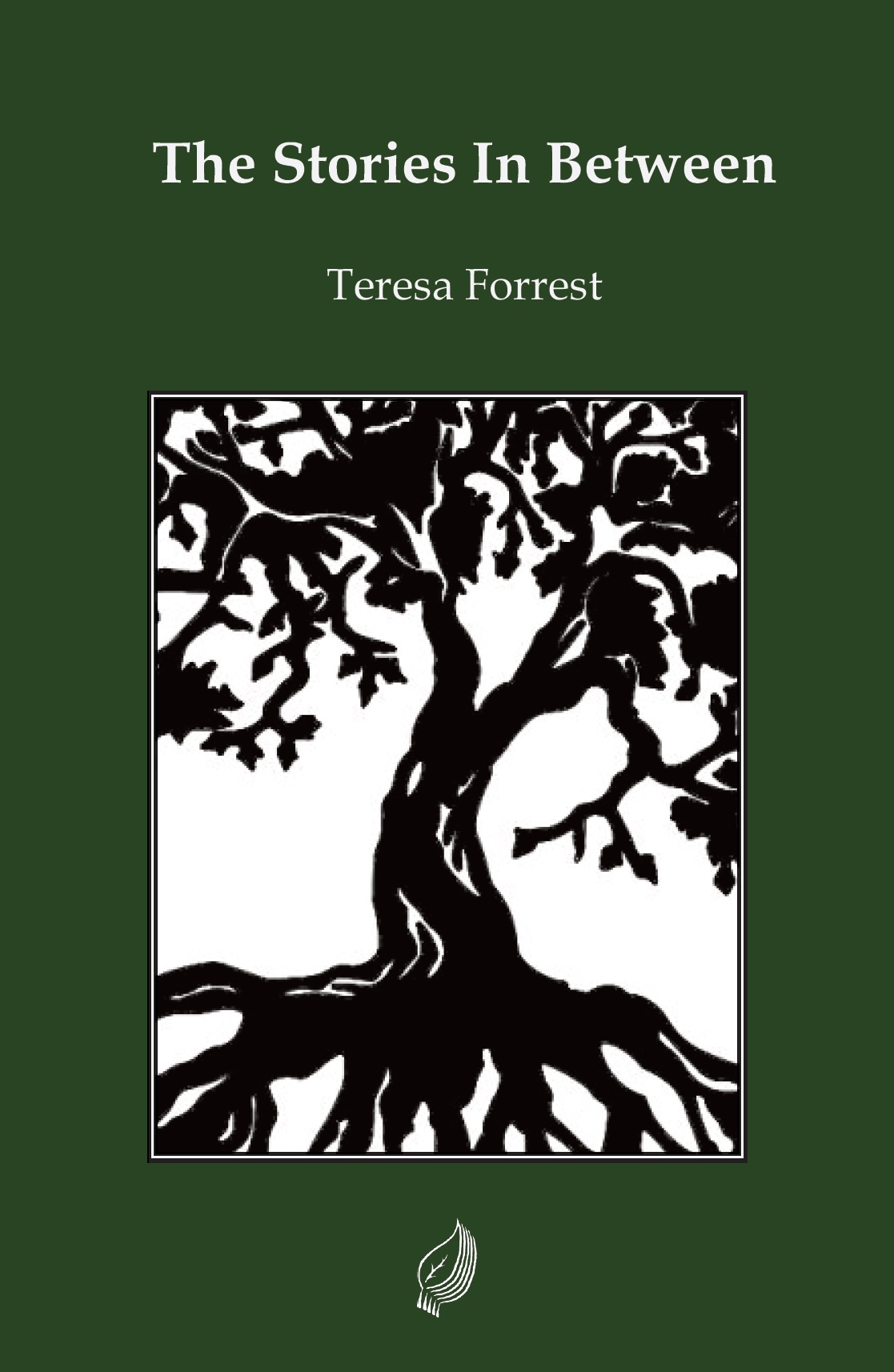
Review by Julie Gardner of "The Stories in Between" by Teresa Forrest


There are twenty-five short poems in this pamphlet; the longest is twenty-four lines. They are written in deceptively simple language - deceptive because, despite their accessibility, the poems, rooted in real people and the landscape around them, are profound and deeply moving. They reward the reader who pays close attention. 

In the first poem, "Almost Home," a mother addresses her child:

  I, your mother, am formed from folklore,
  spit and cabbage. When I made you,
  I hadn’t finished making me. I am so rough
  around the edges.

The shortest poem and one of my favourites (it is impossible to choose just one) is "In Balerin Village." The first two lines focus on a domestic appliance, "The fat-bellied range in my granny’s house" which "works hard / to warm us." But the description of the range is also suggestive of the character of its owner, "Get too close and it warns us with a scalding tongue." 

The poetic skill here is subtle – the rhyming of warm and warn, the connection between scalding and scolding. There is humour too, "Pans hiss with home grown / and, once, a cockerel that had crowed too early for her liking." The reader can be in no doubt that this grandmother is a strong and energetic character, summarized in the fifth line of this short poem which stays with the domestic imagery, "Always the kettle whistles to her tune." But the poem is not confined to the kitchen and the grandmother cannot be contained within its lines, the final two of which expand horizons, speaking volumes about the tender relationship between the narrator and her grandmother and hinting at the stories in between: "Each morning she gives me an orange, / a small globe that feels like the world."

There are other stories. "Pillow Talk" charts the gradual disintegration of a couple’s relationship from "that first moment / of easy laughter, / pillow talk between kisses." There’s the woman who lives "on the Tenth Floor of the High Rise" who has "painted her room the colours of the sun." There’s "Mrs Ritchie" who "carries her anger in a handbag, / worn-out crocodile skin, used to have matching shoes."  

The narrative voice remains consistent throughout the collection, compassionate, observant, respectful and with an Irish lilt. This is an exceptional debut pamphlet and I look forward to reading more from this talented poet.


About the reviewer
Julie Gardner is studying towards a PhD at Nottingham Trent University, focussing on Silence and Voice in the poetry of Vicki Feaver and her contemporaries. He poetry pamphlet Remembering was published by Five Leaves Publishers in 2024.

You can read a review of Remembering on Everybody's Reviewing here


Friday, 13 June 2025

Review by Sally Shaw of "The Two Keisukes" by Brian Howell


The Two Keisukes is written in the third person and printed on cream cotton rag feathered-edged paper. The elongated pages are hand sewn to form a beautiful booklet. This short story is written by Brian Howell, author of several booklets and novels that include Sight Unseen

Prior to reading this story I had no knowledge of Howell. The content description provided by the publisher inspired me to read it.

The opening paragraph intrigued me, the words clear and crisp: "He had been here before, no, not here exactly, but then, yes, that building, an old fashioned school building that could have been from almost any period before or after the war."

Howell writes with such precision and beauty. I felt the wonderment he holds for the man, Keisuke Kinoshita, whose identity is given halfway through the story.

The story takes place on an island and yet the reader is made aware of the possibility that it’s being viewed from a distance or on the margins of time. The reader is taken from the shore of the island into a wonderland of past, present and unknown. Keisuke walks through alleyways and corridors, taking in the sights and sounds filled with the forgotten waiting to be rediscovered: "Walking further to the edges of this large park-like area, he saw a very curious group of turquoise sculptures that was both painfully familiar and yet unidentifiable."

Throughout his wanderings of the island, buildings and alleyways I’m drawn to him, I like Keisuke - both of them. I form an insight as to where each Keisuke is, one on the island, the other between the island and somewhere else. Floating in the past, present and unknown, in my mind I have ideas, two to be exact. I won’t say anymore as this would spoil Howell’s story. I will say, that through reading Howell’s words I formed the opinion that Keisuke and the others named were indeed real people (I had no prior knowledge of the Japanese film industry and history), and I sensed the history and connections between them all. I visualised what was possibly happening to the two Keisukes, felt the emotions and the power of recall and realisation of life. The ending touched my heart in a non-sentimental way. 

Around the two Keisukes Howell provides a portrait of the culture and history of Japan and the enchantment of the Japanese film industry. I read this booklet over and over again, each time discovering something new. I have started to research the individuals within Howell’s story, such was the energy of the writing. This is magical storytelling of a country, people and industry I knew nothing about, but now I want to get to know them and read more of Howell’s stories.


About the reviewer
Sally Shaw has an MA Creative Writing from the University of Leicester. She gains inspiration from old photographs, history, childhood memories, and is inspired by writers Sandra Cisneros, Deborah Morgan, Liz Berry and Emily Dickinson. She has short stories and poetry published in various online publications including The Ink Pantry, AnotherNorth, Roi Faineant PressSally lives in the countryside. 

Monday, 2 June 2025

Review by Gary Day of "Sub/urban Legends" by Pam Thompson


Brilliant, disorientating, splendidly polyphonic: these poems provoke, puzzle, baffle and delight the reader. Each one bears re-reading, not least the title poem, ‘Suburban Legend.’ Its zigzags, elisions, and turbo-charged imagery are typical of the volume. Everything is happening at once and at speed. The reader is not sure of their bearings or of what’s happening. Is a cooker being dumped or being used to make a meal? Who are the characters and what is their relation? The man is ‘the scourge of our town’ but there’s clearly more to him than that. The imagery is partly cosmic ‘I identify Venus, lucid tonight’ and partly quotidian ‘just a sponge and soapy water.’ The diction is a heady brew of the earthy, the enigmatic and the arcane. How often do you hear the word ‘brumous,’ meaning foggy or wintery, these days?

‘The Keys’ should be anthologised in any future volume of British twenty-first-century poetry. It is situational, symbolic and finishes with a wonderful shift that makes the poem just soar. ‘My Life as a Bat’ has a mysterious sub-text. Revenge against a former lover? Difficult to say, but it is extremely well wrought and humorous as well as sinister. The image ‘ricocheting in a cave’ conveys both fury and despair. ‘Reading my mother’s diaries’ is one of the most poignant poems in the collection. The last line is just beautiful. 

There is a lot going on in these pages. The search for something beyond the obvious in ‘An afternoon’; the relation of art and life in ‘FĂŞte Galante’; the eerie atmosphere of ‘Explorers, Antarctica,  1901’;  and the soothing blues of ‘the evening garden.’ Throughout there is a sense of broken things that can’t quite be put back together, and the poems invite the reader’s to help join the fragments


About the reviewer
Gary Day is a retired English lecturer. He has had poems published in Vole, Ekstasis, Acumen and The Dawn Treader. His 'Anne Bronte's Grave' was highly commended in last year's Artemesia Poetry Competition.

You can read more about Pam Thompson's Sub/urban Legends on Creative Writing at Leicester here

Friday, 11 April 2025

Review by Peter Raynard of "Year of the Rat" by Charles G. Lauder, Jr


Dual heritage poets often explore the meaning of home, as a way of understanding their life. Lauder did this most eloquently in his debut collection, The Aesthetics of Breath. Originally from San Antonio, Texas, he now resides in the English countryside, where home and family are central to the poems in his pamphlet, The Year of the Rat.

A domestic scene is set in the opening poem (an ode to piano makers, ‘who were once all over London, names no one remembers’), as the family is getting new piano, a pre-loved baby grand, ‘as if finding a lost soul a new home.’ And there are other poems of everyday life with the accident of an elderly grand/mother, ‘your eyes and forehead red from kissing the floor,’ and the wonderful final poem, ‘In search of silence’ (yes please), with its rhyming couplets and Lauder’s skilled employment of the viscera that surrounds them:

         like a chrysalis or fox carcass,
         their creaking, crying cranes to swallow
         me within the hedges tender shadow
         layered in ash leaves and badger shit.

I guess one thing the bucolic and city environments have in common is the preponderance of rats (poor Birmingham, in the UK). Emily Dickinson referred to the rat as the ‘concisest tenant, who pays no rent.’ A bit like my adult sons. The Chinese calendar’s Year of the Rat describes the mammal as quick-witted and resourceful, and that is certainly the case with Lauder’s experience of them.

In the eponymous eight-poem sonnet sequence, we see ‘one large and one small / shield beneath gunera leaves / take turns / dashing for the tub of duck pellets.’ The comparison between city and country rat is summed up by Lauder as ‘country rats / are more genteel than their city cousins // they’re not in an alley biting through bags of rubbish.’ Their resourcefulness is evident in the ‘maze of tunnelling stretching / between the boiler house and oil tank.’ 

Having watched Lauder read at his launch, I know his poetry (and life?) is informed by Daoism. There are two touching poems from this belief system about his love for his wife and his family. ‘You are the Sun / radiating high overhead // I am Pluto / of the far, cold / surrounding edge.’

The final couplet of the pamphlet sums up this country life: ‘Here pheasants will build a nest / and wait and wait for the world to change.’

I must give a final nod to the publisher Blueprint Press. Based in the North East of England, they are a pamphlet publisher, showcasing poets between collections, and have already put out work by Fran Lock and W. N. Herbert. The pamphlets are beautifully produced in a minimalist style, so more power to them.


About the reviewer
Peter Raynard is an independent researcher, poet and editor of Proletarian Poetry. His three books of poetry are: Precarious (Smokestack, 2018), The Combination: a poetic coupling of the Communist Manifesto (Culture Matters,2018), Manland (Nine Arches Press, 2022). A debut pamphlet (a heroic crown of sonnets), The Harlot and the Rake: poems after William Hogarth, was published by Culture Matters in September 2024.

You can read more about Year of the Rat by Charles G. Lauder, Jr, on Creative Writing at Leicester here

Thursday, 16 January 2025

Review by Peter Raynard of "Our Fathers" by Michael Brown


In a world where on the one hand powerful men are abusing their position through predatory activity towards women, whilst on the other there are surging rates of suicide in men under the age of forty-five, it is important that we write to fill the picture with positive portrayals of men, by subverting the notion of what a "real man" is. Poetry has responded to this more recently, with books by Jack Underwood and Ray Antrobus gaining recognition.

Michael Brown’s Overton Poetry Prize-winning pamphlet Our Fathers is a welcome addition to this trend. Being both a parent (of a daughter) and a son himself, Brown’s poems convey tri-generational relations, relations with other men, and boyhood escapades.

The opening poem "In the Men’s Group" sets a sad scene of "a man whose wife told him he is a waste of space," and "a policeman sleeping on a blow up bed at his parents."

We then move to a short powerful poem "Shift" which is reminiscent of poems by Fred Voss: "The man made of shopfloor swarf put down / The battered gold and green baccy tin // The machinery in his head diminishing // At the sink his wife can sense the shift in him."

His relationship with his father is set in the family car, a place where measures of a relationship unfold. In the poem "In Late Summer, 1983" they are on the M1 taking Brown to live in another town. Looking at his father to "stare across the front passenger seat / at Watford Gap, or some other nondescript place he’d check on the map / to look at the way we’d come, how far."

There is a confidence in the variety of form and sound of each poem, such as in "Aqua Terra," with off rhymes across lines, such as skill, kill, flint, and microlith.

Finally I like the way Brown ends the pamphlet with the poem "Cot Song" about the birth of his daughter (who is now a teenager at least), subverting a linear narrative, showing the fragility of a newborn life, the responsibility of a parent, and the signalling of constant renewal:

          Little limb reaching up

         for some response
         from us, such Gods

         who kept you
         in the cosmos of your cot.

When asked what a poet should do in their writing, Louis MacNeice said "mention things." Brown mentions plenty of things in a short space of sixteen poems. He is rewriting what a man is, and what men can be, in a world where other so-called men catch the headlines for all the wrong reasons.


About the reviewer
Peter Raynard is an independent researcher, poet and editor of Proletarian Poetry. His three books of poetry are: Precarious (Smokestack, 2018), The Combination: a poetic coupling of the Communist Manifesto (Culture Matters,2018), Manland (Nine Arches Press, 2022). A debut pamphlet (a heroic crown of sonnets), The Harlot and the Rake: poems after William Hogarth, was published by Culture Matters in September 2024.

Thursday, 5 December 2024

Review by Jonathan Wilkins of "New Uses for a Wand" by Fiona Theokritoff


Fiona Theokritoff has a wonderful way with words that beguile, enchant, and beg for answers to so many questions. Science, myth and fancy intertwine in her poetic world, a world of warrior queens and sad aspiring mothers who mourn their loss, searching for an answer to their quest for motherhood. Then there are the shoes of all types and fashions, old and used, newly formed, hidden in walls, each with a fascinating tale to tell. 

A world of wonder is brought to us in perfectly curated poems in all shapes and sizes that show Fiona Theokritoff’s talent for words. From the Big Bang to Brian Cox, the pamphlet takes us on adventures in science, asking questions, demanding we investigate further as all good word-detectives should. Unknown words and phrases pique our interest, demand that we look further, her words drawing us into mysteries that we must unravel. Then there are poems of dancing, and motherhood: at last motherhood is achieved, the beauty of the child juxtaposed with the tawdriness of real life. 

We end with a mother’s death. A child was carried, a child was born, and "Cartographer" truly maps the matrilineal life of a family where the mother's flame is passed on to the new matriarch. Life goes on as it does, and words go on too, demonstrating the completeness of the family - completeness in just ninety words. In the words, we read of dreams and reality, past, present and yes, future - a future where words mean everything, where cultures clash, where dreams are dreamt and reality is faced. Indeed, the beauty of Fiona Theokritoff’s New Uses for a Wand is that her poetry allows us space as readers to magic up our own reality.

And finally: a huge shout out to Five Leaves who are introducing us to so many wonderful poets through their positive recognition of talent.


About the reviewer
Jonathan Wilkins is 68. He is married to the gorgeous Annie with two wonderful sons. He was a teacher for twenty years, a Waterstones’ bookseller and coached women’s basketball for over thirty years before taking up writing seriously. Nowadays he takes notes for students with Special Needs at Leicester and Warwick Universities. He has had a work commissioned by the UK Arts Council and several pieces published traditionally as well as on-line. He has had poems in magazines and anthologies, art galleries, studios, museums and at Huddersfield Railway Station. He loves writing poetry. For his MA, he wrote a crime novel, Utrecht Snow. He followed it up with Utrecht Rain, and is now writing a third part. He is currently writing a crime series, Poppy Knows Best, set at the end of the Great War and into the early 1920s.

You can read more about New Uses for a Wand by Fiona Theokritoff on Creative Writing at Leicester here

Wednesday, 6 November 2024

Review by James Nash of "Remembering" by Julie Gardner


This is a tender and moving collection celebrating and memorialising two lives, the poet’s mother and her own husband, but succeeding, as all good poetry does, in finding universal truths about our common humanity and shared experience of loss.

Deftly constructing a history for her mother who died at forty-seven, and recording the emptiness after her husband’s death, these are quiet but truthful poems that bind us into the ordinary, but somehow extraordinary, emotional textures of human lives, and show us how we survive in the aftermath of tragedy.

This is from ‘Moving On’:

          After the van had gone
          I mopped the kitchen floor
          then went upstairs, stood awhile,
          as empty as the house itself.

Julie Gardener is a fine poet, content to let her readers ‘join up the dots’ if you like, but also happy to acknowledge the influence of other poets like Grace Nichols and Jacob Polley. She is playful in terms of form in ‘Rondo,’ riffing on nursery rhyme (a motif which appears in several of these poems), but ultimately what we have in this fine collection is a poet using simple and gracefully chosen words to explore the territory of memory and grief. The almost Wordsworthian reliance on everyday language gives these poems an emotional reach and power that is refreshing and unusual.

This is from ‘For Arthur’:

          Widow sounds so sad and slow
          and I am neither, though I will
          forever wish you here.

The photograph on the front cover of the poet’s mother is blurred; the poems inside reclaim the misty lives of those who have gone before, mother and husband, and prove again and again that art can construct great memorials. The gift of this brilliant collection is that it allows us to connect to our own loss and mourning, our own ‘remembering’ if you like.


About the reviewer
James Nash is a poet based in Leeds. He often writes in the sonnet form and his next collection, Notes of Your Music, will be published by Valley Press.


Wednesday, 25 September 2024

Review by Elizabeth Chell of "Just This Side of Seaworthy and Other Poems" and "Rock, Paper, Scissors and Other Poems" by Cathi Rae


Cathi Rae’s collection of poems Just This Side of Seaworthy explores the complexities of ageing and mental illness and the forging of new identities in a world where expectations are unforgiving. 

Rae's style is accessible. Her words speak the truth all "women of certain age" must confront. Her poems are not maudlin. They are introspective and deliver a positive acceptance and are celebratory of the aging process. Her poems are layered; on the surface they are what they are, but the underlying emotion and evocative imagery make them extraordinarily good. 

These poems also explore death and other topics. "Single handed," a biography of her father and family dynamics, would not sit out of place on a shelf with Duffy and Heaney.

What I admire most about Cathi Rae’s poetry is her masterful structure and the subtlety with which she conveys emotion. In her poem "When Our Bodies Become as Linen," she eloquently juxtaposes the durability and fragility of linen with the ageing process. This comparison illustrates how, much like linen, we possess an inner strength that endures even as our exterior fades with time. Cathi’s poem "Wednesday night is women’s night – remembering the 1980s," with its thoughtful structure, captures the essence of a girls' night out dancing around handbags with friends, not caring which side of the bed we got out of. Rae's poetry is sometimes raw, sometimes harsh, yet remains consistently honest and exquisitely crafted.


Rae's collection Rock Paper Scissors, as Cathi explains in her introduction, had a starting point: "Tell me about your life." The poetry encapsulates the voices of individuals Cathi encountered during her PhD journey. Her poetry delves into the complexities of mental health and mental illness, addressing the numbing effects of medication. It made me laugh and cry. The beauty of her work is how she encapsulates the ordinariness of mental illness - how it can take anyone prisoner. This challenging yet vital subject, often shrouded in secrecy, is brought to light through Cathi’s work, which fosters open and candid exploration of mental health from a fresh perspective.

This collection of voices, vividly expressed through Cathi’s unique poetic style, will resonate with everyone. During the 2020 lockdown, many of us experienced anxiety, and the most vulnerable often lacked a voice. Cathi’s poetry effortlessly provides a platform for these feelings of inadequacy, addressing an ever-present issue. Mental health is a universal experience, affecting us all either directly or indirectly. We should celebrate it as an intrinsic part of being human. Cathi’s poetry makes it clear that mental health transcends age, gender, and race.

If you appreciate these latest collections of Cathi’s work, I would also highly recommend her earlier poetry collection Your Cleaner Hates You and Other Poems. 


About the reviewer
Elizabeth Chell is a full-time teacher with an MA in Creative Writing from the University of Leicester.

You can read more about Cathi Rae's Just This Side of Seaworthy and Other Poems, and Rock, Paper, Scissors and Other Poems, on Creative Writing at Leicester here


Friday, 24 May 2024

Review by Martyn Crucefix of "Mappa Mundi" by Paul O'Prey


Paul O’Prey’s beautifully designed chapbook from The Melos Press contains a mapping of the poet’s dealings with the world, though every step taken through the outer topography has a powerful resonance with the life within. The epigraph from Rilke’s Duino Elegies nudges the reader in this direction: ‘The world is nowhere, my love, if not within.’ The original Hereford Mappa Mundi was created around 1290 and is described in the opening poem with its ‘seas of fire, walls of flame,’ basilisks, and griffins. O’Prey takes these mythic elements as psychologically significant, rather than a primitive literalism: ‘More of a mirror than a map.’ These flames and strange creatures lie within.

‘South’ proposes an excellent exercise for poetry writing groups: ‘I take a pen and sketch my own mappa mundi.’ O’Prey’s own sketch straddles London, County Down, an unnamed southerly port of embarkation, tropical-sounding islands, a paradise-sounding garden. This outer journey again sustains, just bubbling underneath, its potential inner equivalent. There are several poems about the poet’s father, who ‘salvaged ships / during the war,’ and who worked and fished along the sea’s edge, absorbing it so much that ‘Last Rites’ images his last days as being subject to a ‘shipwrecked mind.’

These portrayals of English land- and sea-scapes enclose several poems at the centre of the book which look to the Mediterranean, the island of Mallorca in particular. Ramon Llull founded the hermitage of Miramar on the island a mere twenty years before the Mappa Mundi was made. The poem, ‘Miramar,’ vividly captures the island’s terraces, its stony soil, its few remaining hermit monks working the land. The ‘inner’ world here is explored in the poem’s meditation on the nature of prayer: ‘the accuracy of words / is irrelevant – intent is content.’ O’Prey’s mappings encompass the spiritual with the pun here on the content(s) of a prayer and the content(ment) it may bring to the one who prays. This is such a skilfully structured book of just sixteen poems, yet its lightness of touch belies the heights and depths of its journeying.


About the reviewer
Martyn Crucefix: Between a Drowning Man was published by Salt in 2023; his translations of Peter Huchel (Shearsman) won the 2020 Schlegel-Tieck Prize. A Rilke Selected Poems, Change Your Life, has just been published by Pushkin Press, 2024. Martyn's blog is here. You can read more about Between a Drowning Man on Creative Writing at Leicester here.