Showing posts with label Favourite Reads. Show all posts

Tuesday, 6 January 2026

Favourite Reads of 2025

At the end of every year, we ask readers to submit a micro-review of a favourite book they've read in the last twelve months. The book can be from any time or genre - the only qualification is that it has to be a book the reader found particularly memorable, striking or enjoyable. Here are the responses for 2025. Everybody's Reviewing wishes all its readers a happy 2026 - the National Year of Reading!

Kirsten Arcadio


The God of the Woods, by Liz Moore: In a "Psychological Thrillers" group on Facebook, people aren’t too sure. More a mystery than a thriller, says one member. Literary fiction, says another. A flat statement. For me, The God of the Woods by Liz Moore, was all of those things and much more: a perfect literary thriller complete with several different points of view and timelines, it tells the story of the disappearances of two siblings more than a decade apart. Beautifully written, the pace is perfect and the end does not disappoint. 

Kathleen Bell
My favourite reads this year are a tribute to public libraries that lent me the books, free of charge. And I’ve chosen three, in different categories.


Non-fiction: The Restless Republic: Britain Without a Crown, by Anna Keays, borrowed from Richmond-on Thames library service, was exciting enough for me to read in bed, even when recovering from the after-effects of my shingles jab. Covering British political history in the years 1649 to 1660, it tells the story of key individuals (including John Bradshaw, Charlotte Stanley, Anna Trapnel and William Petty) to illuminate both the political-religious struggles and the way individuals responded to the turmoils of the time. I was caught up in the history and fascinated by the people.


Fiction: Alive in the Merciful Country, by A. L. Kennedy, borrowed through Notts libraries, was hard to get hold of, though I wanted to read it ever since seeing a copy in Five Leaves Bookshop. I requested it from my local library but first listened to the audio book, which meant I heard it in sections on coach journeys, which was good but not ideal. Now I am half-way through the physical copy which is better – and it’s still engaging, disturbing and funny (sometimes all three at once). It’s set in lockdown and the period leading up to it and is concerned with the practice of kindness and the discovery of joy, even though people cause immense harm. This is a book I expect to re-read regularly, now that the library has acquired a copy.


Poetry: The Paths of  Survival, by Josephine Balmer, borrowed from The Poetry Library in London, is a terrific discovery. I’m always attracted by something that uses classical literature but these poems are different from most. They’re based on fragments from Aeschylus’ lost play The Myrmidons (about Achilles and Patroclus) and focus on different moments in which various lines or phrases are quoted, translated or possibly misunderstood. Themes include love, grief and the uncertainty of knowledge:

          letters from a lost world, seeping back

          to black, etched in breath-blown dust:
          …speak out… …dissent… …enough 

Kristy Diaz


The Trading Game, by Gary Stevenson: A propulsive, whip-smart memoir that follows Stevenson from his working-class East London roots to the trading floor at one of the world’s biggest banks. As bleakly funny as it is insightful, his story illustrates the rot at the heart of global finance and makes a compelling argument for economic equality.

Rohan Fitzpatrick


Jesus Christ Kinski, by Benjamin Myers: Jesus Christ Kinski is a mind-bendingly unique novel focusing on the infamous actor Klaus Kinski’s memorable 1971 performance, Jesus Christ Erlöser, interspliced with a semi-autobiographic tale of obsession from a Yorkshire author. I found Kinski’s perspective both loathsome and fascinating, and the speculative nature of his thoughts, which are at times hilarious and bleak, to be immensely creative and wonderful to read. Mostly, I found the specificity of this book to be inspiring – never relinquish your niche interests!

Mellissa Flowerdew-Clarke 


Murderland: Crime and Bloodlust in the Time of Serial Killers, by Caroline Fraser: Aside from the horror of their crimes, what links Ted Bundy, the Green River Killer, the I-5 Killer, the Night Stalker, the Hillside Strangler, and Charles Manson? Caroline Fraser has a theory, and it’s a compelling one. In her exceptional nonfiction thriller Murderland: Crime and Bloodlust in the Time of Serial Killers, she looks past psychology and into the landscape itself. Fraser takes readers deep into the industrial heartland of the Pacific Northwest, where lead, copper, and arsenic smelters shaped entire communities—and poisoned them. What follows is a riveting exploration of nature versus nurture, unearthing the toxic forces that spawned America’s most notorious killers.

Beth Gaylard 


Miss Benson's Beetle, by Rachel Joyce: Earlier in the year l was looking for an audiobook that was a bit different - l'd just listened to Jilly Cooper's Rivals - great fun, lusty romp, very much of its time (1980s). For my next listen, I discovered Miss Benson's Beetle, by Rachel Joyce, an unusual tale about a woman explorer and her totally unsuitable companion, also a woman. In search of a fabled beetle, rumoured to live only on one mountain in New Zealand, these two travel to the other side of the world determined to find the little beast if it exists. As they travel, their friendship develops - against all the odds, they are so mismatched. Not a romance, it's very dark in places, but it's also a very funny adventure story, pacy, well-written and moving. I defy you not to cry at the ending.

Karen Powell-Curtis


Lady Tan’s Circle of Women, by Lisa See is inspired by the true story of Tan Yunxian who was one of the few female doctors in fifteenth century China. The novel immerses the reader in Tan Yunxian’s world as a doctor practising Chinese medicine in a society with complex traditions and expectations. As the title suggests, the novel also explores the strength of female friendships, including the close bonds formed in spite of class differences.

Mithila Dutta Roy


Perfection, by Vincenzo Latronico: The aesthetic mask of consumerism mixed with the show-off circus of social media makes a cocktail so hollow for the millennials - that’s what this book is exactly about. If you find yourself adjusting the dishes in a restaurant just at the right angle to take the perfect photo for the gram, I’m afraid, dear friend, this book is for you. Seeking what seems perfect on the screen, the protagonists, Anna and Tom, run after a curated euphoria only to find they have lost themselves along the way. This book is a cry for help. 

Karen Rust


Prophet Song, by Paul Lynch: Unflinching and brutal - this 2023 Booker Prize winner is not for the faint hearted. Detailing modern-day Eire's spiral into totalitarianism from the point of view of educated, middle class working mum of four, Eilish Stack, we see how society morphs from normality to horror in such tiny increments that each seems too small to act on alone, but together they bring the point of no return ever nearer. If you can get past the lack of standard dialogue punctuation and unconventional formatting, this is a novel that will inhabit your thoughts for a very long time. By the end, I can only use the word traumatised to describe how I felt (probably as much as from my first read of Atwood's The Handmaid's Tale aged 20), but it's a must read given the times we live in. Read it, but have something light and uplifting lined up for straight after!

Jonathan Taylor


Dark Academia: How Universities Die, by Peter Fleming: Brilliant and devastating. What a relief that this book is a work of fiction, a fantastic jeu d'esprit, which bears no resemblance to reality at all. Whatsoever.

Maria Taylor


My last read of 2025 was Madonna in a Fur Coat, by Sabahattin Ali (1943). This was the story of Raif, a young Turkish man in 1920s Berlin and his relationship with a painter, Maria. It was a moving story of connection and loneliness. 

Miranda Taylor


The Secret History, by Donna Tartt follows an idiosyncratic, cult-like group of eccentric students who are slowly corrupted by hedonism and the media they consume obsessively. I found the book and its characters very engaging.

Rosalind Taylor


Detective Conan, by Gosho Aoyama: this follows the story of Kudo Shinichi who is a detective. He's forced to take a drug by a mysterious organisation which turns him into a child and has to solve cases as a child as well as try and return to his original body. I really like this series as I find the mysteries really interesting, and it's fun to try and solve the cases before Conan does. 

Paul Taylor-McCartney


What We Can Know
, by Ian McEwan
stands out as another high point in a long and distinguished career, merging rich literary elements with intriguing speculative themes. It contemplates the tenuous nature of knowledge itself and highlights the timeless influence of poetry and a nostalgic longing for the past, amidst a disappearing world. Astounding in every way - my book of the year. 

Harry Whitehead


The Trees, by Percival Everett: A serious novel about lynching, racism and US history that is also hilariously funny? Everett's revenge fantasy transcends simple description, but enough to say I found it unputdownably gripping, profound, as wildly funny as it was horrifying, and entirely unique.

Lee Wright
Here are my two favourite reads, non-fiction and fiction, of this year:


Ted Hughes: The Unauthorised Life, by Jonathan Bate: The life of Hughes read like a toxic romance. He was perhaps the nearest real-life embodiment of Heathcliff we are ever likely to see, and unlikely to see again.


The Eleventh Hour, by Salman Rushdie: In these five short stories, Rushdie delights in midnight oblivion and shows that the language of prose need not fall short of poetry.

Monday, 6 January 2025

Favourite Reads of 2024

At the end of every year, we ask readers to submit a micro-review of a favourite book they've read in the last twelve months. The book can be from any time or genre - the only qualification is that it has to be a book the reader found particularly memorable, striking or enjoyable. Here are the responses for 2024. Everybody's Reviewing wishes all its readers a happy new year of reading in 2025!


Kirsten Arcadio


John Marrs, The Family Experiment "is a dystopian thriller about a VR project that gives six lots of parents unable to have children the opportunity to bring up their own VR child for a year. A televised Big Brother-type show tracks their progress allowing viewers to vote couples out along the way until one is crowned the winner and allowed to keep their VR child forever. In a cruel twist of fate, each couple has a dark secret that knocks them out prior to the final vote, with devastating consequences. It’s a hugely entertaining and compelling read, blending dystopian virtual reality scenario with suspense using multi-layered storylines, dark secrets and tragedy, and of course, a sinister dose of dystopian societal control." 


Joe Bedford


Leo Tolstoy, War and Peace: "After over 150 years and the publication of several much longer novels, War and Peace continues to challenge us on the meaning and function of scale. Tolstoy shows us that scale is not just about size and scope but also about the complex relationship between the massive and the miniscule, between history and the individual. Ultimately, for Tolstoy, it is our tiny but powerful personal stories that make the great narratives of history mean anything at all." 


Kathleen Bell


Karen Joy Fowler, Booth: "I saw my bus pulling out of the bus station so headed for the warmth of the next-door library. Booth was on the shelf, a novel about the famous family of actors whose son assassinated Abraham Lincoln. I borrowed it on a whim, glanced at it while waiting for the next bus, read the first few pages while travelling, and couldn’t stop reading. It’s a thoughtful, subtle novel drawing on thorough historical research - and it’s sadly relevant to our times."


Laura Besley


Anna Wood, Yes Yes More More: "This short story collection sings and sparkles, shocks and delights. Some of the stories connect, but most are standalone, and all have a strong sense of place and are threaded through with a love of music. Wood's characters never compromise their uniqueness, yet also feel desperately relatable as they navigate their way through the perils of twenty-first-century living." 


Constantine


L. Frank Baum, The Wizard of Oz: "I picked up the first one having finished the Mary Poppins books and finding I wanted more - more older stories of fairylands before the greats like Tolkien and C. S. Lewis. Baum shows what great depth and majesty can be found on such a canvas and the stories are more silly and fun. I wasn't expecting to find so much fairy lore here. Nor was I expecting to find things that Tolkien must have been influenced by (the hiding of Oz from the world at the end of Book 5 may have inspired the hiding of Valinor), and Lewis seems to have (if memory serves) borrowed the one-legged hoppers for one of the islands in Voyage of the Dawn TreaderI wasn't expecting to fall in love with Baum's world as much as I have. Also the introductions addressing the children and letters from them are wonderful. Try it. Just for fun."


Laurie Cusack


Flann O'Brien, The Third Policeman: "Comedy of menace and the ultra-bizarre haunt this astonishing novel. Throw James Joyce and Samuel Beckett’s texts into a metaphorical black hole and it might spew out Flann O’Brien’s The Third Policeman. Totally original, timeless and darkly hysterical, throughout. Pure dynamite, honestly. What more do you want from 2025? Hell, on a bicycle?"


Mellissa Flowerdew-Clarke


Amanda Montell, Cultish: The Language of Fanaticism: "Cultish: The Language of Fanaticism by linguist Amanda Montell analyses the social science of cult influence. Montell examines the role language plays in the formation of controlled groups and cultish communities. Extending beyond the extremes of Heaven’s Gate and Scientology, Montell illuminates the pervasive influence cultish language has on us every day. From our Insta feeds to Lululemon leggings, #bossbabes to #beastmode, read this book and your fanaticism spidey-sense will tingle in overdrive. If you think you’d never join a cult, this book may show you that you already have..


Gus Gresham


Sue Thomas, Hello World: Travels in Virtuality: "In this fascinating travelogue / memoir, the author invites us to look upon cyberspace experiences as being as real as any other experiences, to question how we really see ourselves and others, to ask whether our identities are flexible or sacred. 'Just like our bony skulls and meaty brain matter,' she says, 'the hardware is only ever just the shell which houses a greater essence.' 


Felicity James


Kiley Reid, Such a Fun Age: "This is a reinvention, part-homage, part-subversion, of the nineteenth-century novel of manners, with Emira Tucker, Philadelphia babysitter, as central character. The novel opens with Emira accosted in an upscale supermarket with the white toddler, Briar, she's looking after, and it goes on - sometimes excruciatingly - to take apart social expectation and prejudice. It's a knowing novel about language, conversation, what it means to listen in to the stories of others. It's appropriate that I came to the book through the School of Arts book group, which was set up in Covid - we're giving it a rest now we don't rely on online conversations so much, but it's such a privilege to be a part of a community in the School and the Centre for New Writing of readers, and this is just one of many recommendations from colleagues and students I've enjoyed."


Alexandra Harris, The Rising Down: Lives in a Sussex Landscape: "This was my standout non-fiction book of the year: a beautiful, creative reinvention of local history. Focussing on a small square of Sussex, with the River Arun running through it, this is a book alive with detail and purpose. We go deep into the local record office to excavate stories and connections which run from past to present, across England and the globe. We look into the hidden lives of the anchorite, the rabbit warrener, the water bailiff and the architect; we follow William Blake as he transforms Chichester into his Holy City, farm-workers as they set off to Australia carrying their dreams of home with them, Polish settlers and Canadian soldiers. 'Everything was stranger and more full of life than I’d had the wit to imagine,' writes Harris, as the great political and social sweep of the world unfolds, in her joyful prose, from a speck of Sussex chalk." 


Tina Jay 


Susan Fletcher, Eve Green: "A beautifully written debut novel, and whilst this year wasn’t the first time I’ve read it, I wanted to include it as it is probably the most re-read book on my bookcase, and one which I would highly recommend. A story of love, loss and mystery through the eyes of a child, powerfully threaded together in a perfectly crafted style, which immediately captures the reader, through its poetic vivid prose and a need to unravel the truth. As the writer herself says, the book was signed with an agent, a publisher and a book deal within a month, and on reading it, I wasn’t surprised! Not only an engaging thrilling story, but a piece of narrative art."


Mary Ann Lund


Eleanor Parker, Winters in the World: A Journey through the Anglo-Saxon Year: "This book made me think differently about time. Parker takes the reader around the cycle of the Anglo-Saxon seasons, told through generous helpings of literature: from the 'fetters of frost' of midwinter to the summer solstice ('sunstede' in Old English) and back again. There's a beautiful, earthy rhythm to poems about greening leaves, bounteous harvests, the dying and regenerating of nature. And there's ancient wisdom in them too."


Aarini Mehta


Coco Mellors, Blue Sisters: "a beautiful story on loss and navigating through life afterwards, told from the perspective of three sisters. After reading the author's debut book, Cleopatra and Frankenstein, I knew this book would not disappoint and it is a book no one will forget for a long time after reading it."


Jennifer Lynn Barnes, The Inheritance Games: "a thrilling book about a girl whose whole life changes after being mentioned in one of America's richest men's wills. It is a book full of riddles and secrets and will keep you enthralled until after it ends." 


Sarah Moritz


Ewald Arenz, Der groĂźe Sommer: "This book is a beautifully written coming-of-age novel set in the 1970s. The story follows the thirteen-year-old narrator, who, over the course of a transformative summer, navigates friendship, family, loss and self-discovery. Arenz captures the innocence and complexity of adolescence with vivid descriptions and a nostalgic, yet thoughtful tone. The novel is both a poignant exploration of personal growth and a reflection on the quiet moments that shape our lives. Its relatable themes and tender storytelling made it a compelling and heartfelt read."


Shelby Paddison


Catriona Ward, The Last House on Needless Street: "Ted, his daughter Lauren, and their cat Olivia live in an ordinary house on an ordinary street—if you ignore the fact that the windows are all boarded up, the doors have a triple layer of security, and the reclusive daughter never seems to leave. You’ll think you know where this is going—until suddenly, you don’t. Told from the perspectives of a drunk serial killer, a stolen child, an avenging sister, and a deeply religious lesbian cat, this book had me scared, baffled, amazed, and completely invested. Nothing else I read in 2024 came close to The Last House on Needless Street in terms of depth and quality. The less you know going into it, the better."


Karen Rust


Gabrielle Zevin, Tomorrow and Tomorrow and Tomorrow: "This book took my breath away. I've never read anything that so beautifully captures the reality of a relationship over time. As the reader, we know what Sam and Sadie think about each other, but they only see what the other says and does. As miscommunication and assumptions incrementally drive them apart, you find yourself shouting at the characters, particularly Sam, to say what they mean before it's too late. Not a love story, but most definitely about love. The gaming industry setting is uber cool and adds a layer of story within story. They should absolutely make this book into a film, and I'll happily curate the soundtrack for it!"


Maisy Summers


Alexandre Dumas, The Count of Monte Cristo: "I was intrigued to read this novel after absolutely adoring the songs from the musical, and it was a wild ride indeed. While the length was quite daunting (leading me to put off the book for two years), Edmond Dantes’ quest for revenge against the wicked men responsible for his imprisonment hooked me the whole way through, as his schemes begin to tear their all-too-comfortable lives apart. I kept a nice routine reading this, so as not to forget all the details within its page count, and was greatly satisfied as all of Dantes' carefully laid plans came to fruition. 


Xiran Jay Zhao, Iron Widow: "Inspired by the history of China’s only female emperor, the novel introduces Wu Zetian, who becomes a mecha pilot to get revenge for her sister’s death. In a society where the lives of female pilots are unjustly spent in battle in conjunction with their male co-pilot’s victories, Zetian’s miraculous survival unfolds into a spiral of revolutionary events, especially once she is paired with the infamous pilot Li Shimin. This book is very thought provoking, exploring many real-world issues within is fantastical setting. I liked all of the main characters, and their interactions embodied a wide range of emotion; I am looking forward to the sequel coming out soon."


Jay Kristoff, Empire of the Vampire: "An epic journey of action, revenge, love and justice begins as Gabriel de Leon recalls his enrolment into an elite monastery of vampire hunters upon discovering himself to be a half-blood. The narrative weaves together two stories of his past, relaying his first steps into becoming a silversaint with a much later adventure surrounding the mysterious identity of a young soul he is sworn to protect. I enjoyed the character development throughout the book, and there were many twists and turns that kept me guessing throughout. I would like to read the sequel soon and see what may happen to Gabriel and the others next."


Jonathan Taylor


Ray Bradbury, Dandelion Wine "is a beautiful, disorientating book where forms and genres mix like smoke. Somehow, it manages to intermingle memoir, novel, short fiction, poetry, horror, s.f., realism, children's story and adult nostalgia, all at once. It is all these things and more. It is joyful and deeply sad and I loved it."


Miranda Taylor


Sylvia Plath, The Bell Jar: "This book takes you through a profound investigation of women's mental health. It delves deeply into identity and societal expectations. Plath's writing stayed with me for months. It's a haunting narrative." 


Rosalind Taylor


Muneyuki Kaneshiro, Blue Lock: "As Japan is only seen as mediocre in football, the JFU creates a project called Blue Lock where 300 strikers are invited, with only one who will be successful in becoming the world's greatest striker. The difference between this and a normal sports manga is that players are told to play for their own egos, and the story doesn’t depend on teamwork. I really like this series and the protagonist as it shows an unconventional perspective on football as well as being very action-based."


Paul Taylor-McCartney


Alice Winn, In Memoriam: "a searing, stylistically inventive novel about a forbidden and profoundly moving romance between two WW1 soldiers. The optimism and vigour of youth is utterly transformed by the horrors and brutality of frontline battle. A testament to lost innocence, enduring love and a timely reminder about the impact of conflicts still taking place today. Breathtaking." 


Nakisha Towers


Paul Murray, The Bee Sting: "This really is my stand-out book of the year." 


Anna Walsh


Jenny Offill, Weather: "Climate anxiety slowly adds pressure to the everyday stresses of an empathetic librarian. Offill captures the essence of everything ordinary and no words are wasted as she weaves her themes through pithy, poetic paragraphs. Wonderfully written with no fill!"


Lee Wright


Stuart Maconie, The Full English: "Following in the footsteps of J. B. Priestley, Maconie's journey is an anti-venom to the snake bite that is modern day England."


Thursday, 4 January 2024

Favourite Reads of 2023

At the end of every year, we ask readers to submit a micro-review of a favourite book they've read in the last twelve months. The book can be from any time or genre - the only qualification is that it has to be a book the reader found particularly memorable, striking or enjoyable. Here are the responses for 2023. Everybody's Reviewing wishes all its readers a happy new year of reading in 2024!


Kirsten Arcadio


The Running Grave, by Robert Galbraith: Not normally a fan of long, overly wordy novels, I've made an exception this year for Robert Galbraith's The Running Grave. This was a highly enjoyable, complex thriller with terrifying yet believable cult leaders and a damming insight into the psychological inner workings of its followers. If you think you'll never get sucked into a cult, think again. 


Joe Bedford


Local Fires, by Joshua Jones: In this collection of interconnected short stories, Jones’s treatment of his hometown (Llanelli, Wales) is by turns sensitive, evocative and ultimately mournful for a place, and a moment, which is fragile enough to vanish forever. In that sense, its resonance carries far beyond the borders of Llanelli, into those quiet parts of ourselves which know that what once was – our people and our places – can never be again.  


Kathleen Bell


Favourite non-fiction book: Dinner with Joseph Johnson: Books and Friendship in a Revolutionary Age, by Daisy Hay: I delved delightedly into Dinner with Joseph Johnson, which is centred on the remarkable career of one eighteenth-century bookseller and publisher (the two roles overlapped). Every few pages I would learn something new whether about the evolution of children’s literature, the risks of printing or selling radical pamphlets, or the tricky class status of booksellers. Many famous people knew and were published by Joseph Johnson; he employed Mary Wollstonecroft as a full-time writer while William Blake was one of his engravers. But there are numerous other characters outlined in this history who deserve to be just as well known.


Favourite fiction: Maud Martha, by Gwendolyn Brooks, was first published in 1953 but I only came across it this year. It’s the shortest novel I read this year and many of the chapters are only one or two pages long but I spun out the reading for weeks, often relishing a single chapter at a time. As might be expected, Gwendolyn Brooks has a poet’s skill with language as well as a sharp observation, here turned towards the details of African-American life. Maud Martha - perhaps drawing on Brooks’s own experience - is full of dreams, hopes and ambition even as she contends with grating humiliations from people who see her only in terms of her social class and darker skin colour. I started reading this hoping to gain insights into Brooks’s poetry, which it certainly provided, but this is a great and perceptive novel in its own right.


Laurie Cusack


The Three-Body Problem, by Cixin Liu: Cosmic Rentokil: Complete Experts in Galactic Pest Control – Distance, not a problem! Competitive … oh, yes! Gallows humour aside − Cixin Liu’s mighty doorstoppers The Three-Body Trilogy blew me away! Frenzied page turning. Unputdownable. I could hear my head squeaking. Scared? we should be ...


Sam Dawson


11.22.63, by Stephen King: Somewhere, out in the netherworld of possibility, a story exists about a time-traveller stopping the assassination of JFK on the 22nd of November 1963. Thankfully, 11.22.63 by Stephen King is a whole lot more. 11.22.63 is a time capsule, a love story, an ode to the uncanny. At over 700 pages, it somehow never outstays its welcome. Brilliant! 


Kristy Diaz


Penance, by Eliza Clark: Examining both the morally ambiguous explosion of society's fascination with true crime and the esoteric world of 2010s Tumblr culture, this ambitious novel brings you to a northern seaside town with a dark history and a horrifying murder case—a thrilling glimpse inside the mind of the 'extremely online' teenage girl. 


Rosa Fernandez


When Death Takes Something From You Give It Back: Carl's Bookby Naja Marie Aidt (translated by Denise Newman): This is a moving, poetic, tragic, beautiful text; an incredible document of the absolutely unthinkable. A masterclass in writing about grief, one you stay up to finish, it's that good. The resilience to make art out of awfulness is a real feat and this is a great demonstration of that.


Mellissa Flowerdew-Clarke


You Let Me In, by Camilla Bruce, reads like a horrific fairytale. It entwines folklore with reality, slipping between the two to create a surreal world where dark sexual awakenings, abuse, and murder flit between the real and unreal. Sinister, cruel, and totally enthralling, it encapsulates the complexity of trauma, and how the escapism we construct for ourselves can be equally as horrifying as what it is we’re trying to forget.


Neil Fulwood


Erotic Vagrancy: Everything about Richard Burton and Elizabeth Taylor, by Roger Lewis: Assiduous, acerbic, scabrous, highbrow, lowbrow and all the brows in between, Erotic Vagrancy swings from passages of blazingly passionate declamation to grumpy-old-man irascibility. It’s a work that simultaneously wants to hymn a certain period in pop culture and start a fight with the modern age. Unlike any other biography or film-related title out there, it is easily the book of the year.


Beth Gaylard


The Giver of Stars, by Jojo Moyes: Set between two world wars in the Appalachian Mountains, this is the story of how a dedication to enabling readers in remote areas leads to near disaster for Margery and Alice, two women who definitely don't fit the expected feminine mould. Together with other local misfits they form an intrepid band of librarians, travelling into the hills to deliver books to outlying homesteads, a mission that is not always well received at home. The story entwines two heartrending love stories, a childbirth scene that will have you on the edge of your seat, and a murder mystery to solve. Oh yes, and lots of horses. The horses are amazing. 


Timothy Grayson


The Black Spider, by Jeremias Gotthelf: A Faustian novella from 1842. To prevent her village from starving, a woman makes a pact with a mysterious stranger for his assistance (in exchange for something priceless), but when the village goes back on their word, something terrible awaits them all. My goodness, this was dark. Horrifying, but excellent.

And also ...


For Thy Great Pain Have Mercy On My Little Pain, by Victoria Mackenzie: A magnificent book. It brings fresh eyes and vitality to the lives of two real, medieval women of faith: Margery Kempe, and the anchoress Julian of Norwich. It is a work of fiction, but takes its inspiration from The Book of Margery Kempe (the first autobiography written in English by a man or woman) and Julian's Revelations of Divine Love (the earliest surviving book in English written by a woman). Interestingly, these women did meet in real life, and the latter part of the book deftly imagines their conversation. At times, I found myself moved beyond words, as if it was speaking to my soul. It may be classed as fiction, but the author has worked wonders here; it's almost as if she's assisted Margery and Julian in creating a new holy book. Outstanding. 


Gus Gresham


Murphy, by Samuel Beckett: I challenge anybody to best the humour and profundity of the opening line: 'The sun shone, having no alternative …' From this point on, Murphy's life is a tragedy shrouded in an absurdist daymare.


David John Griffin


The Barnum Museum, by Steven Milhauser: With its high-quality prose and the author's extraordinary imagination showing through the words, I was repeatedly blown away (and, should I be honest, slightly envious of his wonderful writing skills!).

Jack Peachey


Brave New World, by Aldous Huxley, presents a dystopia that is outwardly and inwardly repulsive in character, yet one that is shown with a verisimilitude I've scarcely seen in the genre; a naturalistic state with comprehensive worldbuilding. A challenging novel delivered with evocative prose, it far surpasses its contemporaries in creating a society that is at once alien and disconcertingly real. 


Karen Rust


Stonemouth, by Iain Banks: Set in the fictional Scottish coastal town of Stonemouth, we meet twenty-five-year-old Stu standing on the edge of what sounds like the Firth of Forth Bridge. He's back home for the first time in five years for the funeral of the patriarch of one of the towns' two gangster families - a family he was about to join, until a drunken indiscretion led to them trying to kill him, and a hasty exit on a goods train. Set over a few days, this is a masterclass in how to keep the reader hooked and drip feed the back story in until everything makes sense. Funny, cool and sometimes violent, we follow Stu as he navigates old school friends, the family who wanted him dead, and the woman he lost in his escape to London. An edgy and fun read, I could picture it in my head as a Trainspotting-style film, and have since found out it's been dramatised by the BBC, so will be checking it out on iPlayer! 


Teika Marija Smits


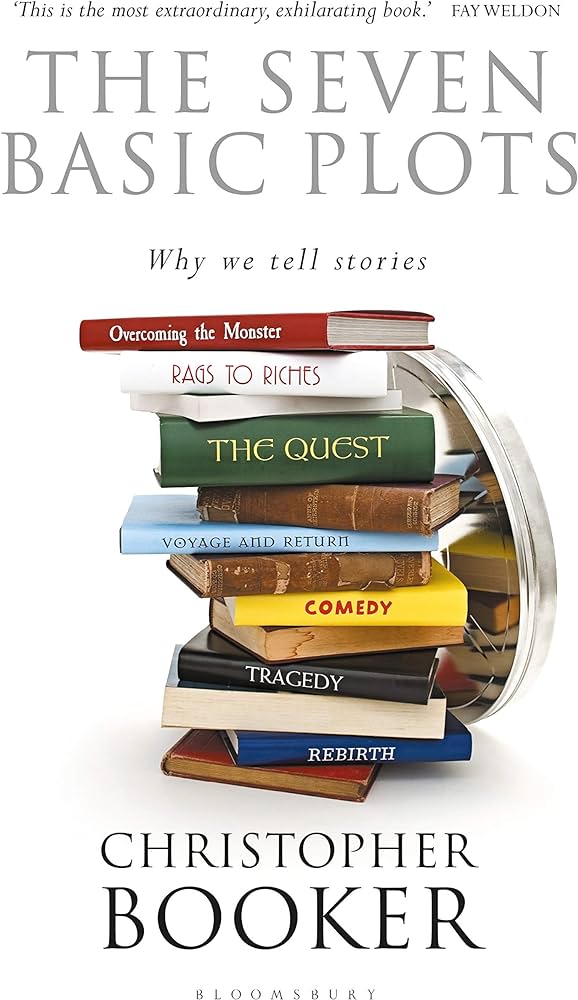
The Seven Basic Plots, by Christopher Booker: At over 700 pages long, it took me a long time to make my way through this book, but I know I’ve been profoundly changed by reading and reflecting on Booker’s theories. Not only has The Seven Basic Plots greatly enhanced my knowledge of literature, it has also deepened my understanding of how humans make sense of the world, and their lives, through stories. And as a fan of the theories of Carl Jung I appreciate the way Booker approached storytelling through a Jungian lens. To my mind, this is an essential read for everyone. After all, we are all the authors of at least one story - the story of our life.

Jonathan Taylor


What to Do Next, by Sue Dymoke: Brilliant author and educator Sue Dymoke died in 2023. This is her last collection of poems, and includes a beautiful preface by her partner, David Belbin. The book is a poignant memorial, then, but it is also a joyful celebration of life, of travel, of childhood, of science, of allotments, of what to do next.  


Maria Taylor


Half of a Yellow Sun, by Chimamanda Ngozi Adiche, is one of the best novels I’ve ever read. It’s an evocative and stirring narrative of two sisters both before and during the brutal Nigerian-Biafran war of 1967-70. The novel vividly depicts the emotional truth of their lives.


Miranda Taylor


Fruits Basket, by Natsuki Takaya, follows Honda Tohru, a young girl who has lived her life in solitude after losing her parents and her house. She encounters a family who takes care of her - however, the family is not as it seems, as they can change into animals of the zodiac. The story is a sad one yet also hopeful.


Rosalind Taylor


The Scum Villain's Self-Saving System, by Mo Xiang Tong Xiu, follows Shen Yuan, who reincarnates in a very badly-written novel as the abusive teacher of the protagonist, Shen Qingqui, whose fate is to die at the end at the hands of the protagonist. Scum Villain's Self-Saving System is very funny and enjoyable to read. I liked reading about the characters and how they change. 


Paul Taylor-McCartney


Prophet Song, by Paul Lynch: This is a visceral, heart-wrenching story of one woman's fight to keep her family together as her country descends into a totalitarian nightmare. Urgent and timely dystopian fiction that will live long in the memory.


Harry Whitehead


In the Eye of the Wild, by Nastassja Martin: In this fierce, dark and utterly unique memoir, French anthropologist Martin is attacked by (and attacks!) a huge bear in the Kamchatka wilderness, an event the shaman of the people she’s been studying had long warned her was coming. Unable to rationalise the psychological fallout from her injuries back in France, she returns to Siberia to embody the bear/human she’s become.  


Lee Wright


Ducks: Two Years in the Oil Sands, by Kate Beaton, is a graphic memoir of a young woman’s experiences working in the oil sands in Alberta. Kate Beaton grapples with the morality of the oil industry, faces harassment and sexual violence while working in an overwhelmingly male work force, reflects on environmental degradation, homesickness, loneliness, the health risks caused by the oil sands, and the destruction of the lands of the First Nations.