Showing posts with label Indigo Dreams. Show all posts

Saturday, 7 December 2024

Review by Rachael Clyne of "Janus" by Catherine Ayres


This is a thoughtful and beautifully crafted collection. Like Janus, Catherine faces both directions as she dips into memories. The months are in order, while the years skip back and forth. In her title poem, "January 2015 - a new sofa arrives":

          What might happen, never did.
          My heart’s a holloway, a healed wound
          but January’s naked on the lawn –

In February 2014, the narrator visits a Louise Bourgeois exhibition in "Spider" – a skilful villanelle circling around Bourgeois’ giant spider sculptures in her attempt to heal childhood trauma by "weaving her woman’s body into art." Ayres shifts from classic form to sharp imagery in "Ignoring Alicia":

          If I were you
          I’d have swollen eyes,
    a flick knife fringe

In March 2020 lockdown: "streetlights weep like snowdrops." Ayres delivers groceries to her mother who is gradually revealed behind the garage door, like Darth Vader wearing Sketchers. In May, she is a mother in a witty prose poem in Geordie dialect,  when her kids are berated by a neighbour for "hoying clemmies" (throwing stones). The poet then deftly shifts to June and a childhood friend in "Odbods," describing their bedrooms, "like conches, delicate and full of whispers." 

Ayres's poetry is grounded in love of landscape. September has descriptions of Gateshead’s "Dunston Staithes," and Ambleside’s "Dove Crag." October 2019 brings a recurrence of breast cancer and a second mastectomy, followed by a clifftop walk to a castle, where there is "no turning back from your wind-sucked gate, the grimace of its antlered mask." As we move through different spaces of her life, we glimpse it through Ayres' eyes. The book ends on Christmas Eve 2014 with "The single woman and the lights," as she untangles the mess of lights (and marriage breakup), then "slow dances" them round her tree. This is a book of courage, tenderness and subtlety.


About the reviewer
Rachael Clyne from Glastonbury is widely published in journals. Now retired, Rachael was a professional actor, then psychotherapist. Her prizewinning collection, Singing at the Bone Tree (Indigo Dreams 2014), concerns our lost connection with nature. Her pamphlet, Girl Golem (4word.org 2018), explores her Jewish migrant heritage. Her latest collection, You’ll Never Be Anyone Else (Seren 2023), is a journey of reconciling identity and otherness through childhood, relationships, LGBTQ and ageing. 

You can read more about Janus by Catherine Ayres on Creative Writing at Leicester here

Friday, 20 October 2023

Review by Gary Day of "The Omniscient Tooth Fairy" by Vic Pickup


First things first. This tooth fairy is not omniscient. One poem is called ‘Little did I know.’ Nor is she really - this may come as no surprise - a tooth fairy. As ‘Occupation’ shows, she is so much more: ‘a climbing frame,’ ‘a tissue,’ ‘a body guard’ - in other words, a mum. More tough fairy than tooth fairy.

The only reference to dental matter is in ‘Irretrievable.’ The speaker recalls not being able to retrieve her daughter’s tooth after dropping it down the sink where its ‘pale milkiness erod[es] slowly in the sewer dirt.’ This slight but powerful drama of maternal anxiety and lost innocence crops up again in the poignant yet stoical ‘Facts of life.’

Most poems in this delightful collection concern the ups and downs of the speaker’s many-sided domestic life: husband, babies, picking up children from school, shopping for a birthday, family outings. They are a beguiling mix of vividness and tenderness, streaked with darkness. Indeed why shouldn’t they be? Life isn’t all sunny side up. But even when things get on top of the speaker, humour is never far away, as in the dazzling ‘My New Fridge,’ whose ending packs quite a punch.

Outside the fraught but generally cosy domestic circle there are more ominous events such as the plight of refugees portrayed in ‘Jungle,’ which finishes with a devastatingly powerful image. ‘The Longing of Judith Kerr’ is the most lacerating poem in the volume. It asks the reader to imagine how the children murdered in the death camps could be coaxed back to life. There are also hints of personal tragedy and a keen awareness that not all is well in contemporary Britain.

The collection bounces along. Whimsical, profound, absurd, touching, joyous, courageous and deeply life-affirming. Buy it.


About the reviewer
Gary Day is a retired English lecturer. He is the author of several books including The Story of Drama: Tragedy, Comedy and Sacrifice from the Greeks to the Present. He has also edited a range of books including two volumes on British Poetry in the Twentieth Century. His debut poetry collection, The Glass Roof Falls Like Rain, is due to be published by Holland Press later this year. 


Monday, 23 May 2022

Review by Gary Day of "I Left My Hair in San Francisco" by Sallie Durham


Lucky the reader who stumbles on this debut collection. Here they will find balm for the spirit, succour for the soul. Sallie Durham’s poetry is wistful and gentle with tinges of melancholy and, very occasionally, a hint of the macabre. Her great achievement is to conjure a feeling for the being of things, whether it is her mother’s old cook book or sunflowers - one of her favourite subjects. In one poem they speak of themselves with pride and stoicism: ‘we, who were once goddesses- / suddenly old dames in hard hats.’ 

The connection between females and flowers is apparent in one of the best poems in the volume, ‘Iris,’ whose life cycle ‘recall[s] the lives of women / our weeping and our bleeding disguised in fine attire.’ Durham’s nature poems are quite different from the moralising Wordsworth and the melodramatic Ted Hughes in that she insists on identity and kinship, even with the humble ‘The Crane Fly’ whose stumbling dance of death proves as much a work of art as a poem, a defiant gesture against inevitable extinction: ‘slumped down on the windowsill / his last two fingers up in a V.’ 

The poems about love and family are deeply touching. ‘Ladders’ will resonate with anyone who is, or has been, in a long relationship. ‘Vigil,’ a poem about Durham’s dying father, is full of tender, piercing images and uses rhythm to great effect, repeating the same words at the beginning of the poem at the end but changing the earlier chugging sound to staccato sobs. The tonal range is impressive from the comic title poem to the slightly manic ‘Finland’ but it’s the imagery which stays in the mind. It is consistently striking and inventive: ‘The clouds continue to bank / their platinum.’ One can only hope there is more to come from this new kid on the block. 


About the reviewer
Gary Day is a retired English lecturer. He is the author or editor of a dozen books including a two volume history of modern British poetry. He had a column in the Times Higher for a number of years and has been actively involved in amateur theatre for many years.


Friday, 20 May 2022

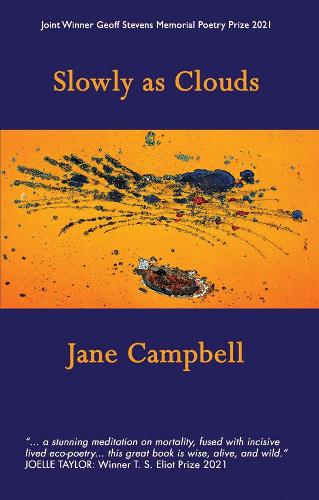
Review by Gary Day of "Slowly as Clouds" by Jane Campbell


Jane Campbell’s poetry has edge: it glints rather than glows. ‘Degrading’ is one such example in this raw, uncompromising but strangely beautiful collection. The poem recounts a group of girls surrounding the young poet demanding she prove the arrival of her first period. The ending brilliantly transforms this humiliation into a triumph: ‘recasting them / in perpetuity / slow for their age.’ 

The theme of change or metamorphoses is present in many of the poems, particularly those to do with parents or lovers. Campbell pays tribute to the political activism of her mother whose frailty in age is a spur not to forget how she impressed her daughter ‘with the importance of rights / that once they had bite were revoked.’ But this tribute has a darker feel in ‘Fairy Tale’ where the speaker apologises for tormenting her parent. 

Campbell’s portrayal of her father follows a similar trajectory. At first he is a monumental figure, ‘an army of hands and feet’ but then we see him shrivelling in a hospital bed, while the poet envisages his evolution into a ‘butterfly, then rabbit, then antelope.’ The ending of this poem, ‘Metamorphosis,’ is not only exquisite but also a demonstration of Campbell’s knack of finding new and unusual rhymes. 

There is sober realism in the poems about love; a celebration of its joys in ‘May moaning from our mouths,’ and an acceptance of its sorrows. There is a particular poignancy in ‘Let Go’ where though desire has run its course that ‘doesn’t mean / I don’t still love us.’

Campbell is highly versatile. She can write a shocking futuristic poem like ‘Always Alice’ and a gentle, almost Hardyesque one like ‘Wishing Well’ which should be included in any future anthology of English poetry. An ever-present consciousness of mortality does not sour her sense of life’s abundance. ‘Compost Loo’ shows that even waste is a form of enrichment. 


About the reviewer
Gary Day is a retired English lecturer. He is the author or editor of a dozen books including a two volume history of modern British poetry. He had a column in the Times Higher for a number of years and has been actively involved in amateur theatre for many years.

Monday, 8 February 2021

Review by Vic Pickup of "Feverfew" by Anna Saunders


So hotly anticipated was Anna Saunders’s Feverfew that I’d already bought it when a review copy landed in my inbox. I wasn’t disappointed; the cover says it all – scorching, mystical, full of powerful connections – there’s a lot to see here. 

Indeed, if it’s dazzling imagery you’re after, Feverfew is rich with bejewelled moments. The poet’s talent for gorgeous, vivid description shines throughout the collection, right from the opening poem ‘What I Learnt from the Owl’: 

          how to hunt in silken plumage
          tooled up with talons and hooks

          how to split the seam of the night
          with saw-tooth wings

          how to consume all I kill
          yet stay hungry.

Magical lines are scattered throughout all these poems, as we read of Icarus in ‘Now the Earth is an Embering Coal’: ‘when he hit the sun, the feathered sky wept.’ 

Saunders even manages to turn the darkly humorous into a thing of beauty, as in ‘Hades Justifies His Off-Roader’:

          Not the winged martyrs that collide
          with his windscreen

          turned angelic white as they are picked out
          In his headlights

          before glistening like broken berries
          When they hit the road.

Just as the poet’s description of Hades mowing down innocents in his 4x4 still manages to be both  beautiful and amusing, so does her portrayal in ‘The Ghosts of Intimacy Fuck on my Bed’:

          I am thinking how they could not get any closer
          when in a quick dart she slips into him,

          slides under his tracing-paper skin, to be subsumed
          into his heart as they soar above.

Many the poems in Feverfew are political and mythological creatures are a regular feature. What holds the body together is their boldness, rawness, at once stark and glittering. 

Saunders's work is wild and honest; as reviewer Stephanie Jane wrote, some poems seem so personal that reading them feels like 'staring into a stranger’s window.' Whether the subjects of these poems are real or imagined, the poet has delivered each one with flare, creating a collection full of stunning observations which linger in the heart and head. 


About the reviewer 
Vic Pickup is a previous winner of the CafĂ© Writers and Cupid’s Arrow Competitions, and shortlisted for the National Poetry Day #speakyourtruth prize on YouTube. Lost & Found is Vic’s debut pamphlet, published by Hedgehog Poetry Press and featuring Pushcart-nominated poem ‘Social Distancing.’ She is on Twitter @vicpickup and her website is here. You can read a review of Vic's pamphlet on Everybody's Reviewing here


Saturday, 22 February 2020

Review by Victoria Pickup of "Sharp Hills" by Chrissie Gittins


Sharp Hills shows Chrissie Gittins resurrecting ghosts of the past whilst connecting with the reader through her insightful description, vivid imagery and humour.

This collection (Gittin’s third) opens with the sequence ‘Dancing in Silchar,’ inspired by the poet’s travels in India following her father’s footsteps in WWII.

Here, Gittins weaves past imaginings with transportive descriptions of what is real and present. In ‘Prayer Flag, Nainital,’ her prayer flag is first a bedsheet, then a tea towel. Armed with her ‘father in black and white’ ('Dancing in Silchar'), the poet revisits the past whilst highlighting the pitfalls and wonders of travelling in India with her observations that ‘Six boxes of Immodium may be five boxes too many,’ followed by:

          … a party of fellow passengers 
          who embark at Rudrapur will unpack a picnic 
          and present you with a serviette, spoon, and a paper plate 

          of puri, kachori, aloo subzi and jalebi.
          ('Travelling in India') 

Gittins compares her father’s experiences, real and imagined, with her own. In ‘Operations Record Book,’ her writing is spliced with his own words:

          The heat is terrific, we are not used to it, but the boys worked like tigers.

          Still cold, I keep my coat wrapped around me
          as I forget to tick ‘terms and conditions’ to become a reader.

These combined perspectives connect us directly with her story.  By recognising the beauty of their shared, if removed, experiences, the poet reawakens her father’s memory and in doing so is more connected with him.

Gittins also draws upon the contrasts of their journeys. One of my personal favourites, ‘Frontiers,’ describes the poet surrendering her homemade gifts (intended for her hosts) at the airport: ‘Elsinore strawberries hung in their syrup / like air balloons in a red sky. / Seville orange slivers, marinated overnight … in gelatinous amber.’ The poet goes on to reflect upon what loss means in a very different situation:

          I hadn’t lost my clothes, I hadn’t lost

          my childhood in photographs,
          I hadn’t lost my country.
          And still it cut me to the quick.

Inevitably tied to the tracing of history is the experience of loss. Out of India, Sharp Hills remains rooted in the memory of loved ones, of the ghosts Gittins lives alongside. In ‘I Carry You With Me,’ she describes a trip to Spain, ‘through security where, despite you saying / weeks ago they would have to be packed in a separate / polythene bag, I have to search deep in my rucksack / for moisturizer.’ Gittins goes on to refer to ‘Your empty seat,’ acknowledging the absence, keenly felt. 

‘Where is Freya?’ shows the poet searching for a child: ‘on the red staircase, / under your mother’s blackcurrant bush … I stroke the surface of the trampoline / for the imprint of your sole.’ Later in the collection, ‘Satin Stitch’ remembers Gittins’ mother through her embroidery. The final glorious couplet, celebrates not only her creations, but their ‘Best love for ever’: 

         The serviettes come out for notable occasions,
         they feature in the art of deepest celebration.

There are also laments to an unknown sister and in ‘Sundays’ the poet compares her memories with a sibling (we presume): ‘We’re each other’s precious reference book,' highlighting the comfort which can be gained by keeping memories alive. 

A powerful penultimate poem in the collection, ‘Though June I Light a Fire,’ is dedicated to Helen Dunmore, the friend she didn’t manage to say goodbye to but who lives on in her every day, as portrayed in the touching final couplets:

          And yet you’re here – as I peel a browned petal
          from a rose, as a lime green caterpillar curls

          against the curve of pink,
          as the cold leaves are lifted by the wind.

Through her poems, Gittins’ takes her reader on a personal journey, reawakening figures of her past whilst also describing what adventure and wonder can be found when journeying through life with the spirit of a loved one in your heart. 


About the reviewer
Vic Pickup’s poetry has featured in a number of magazines and webzines. She is a previous winner of the CafĂ© Writers competition and was recently shortlisted for the National Poetry Day #speakyourtruth competition. In 2018, Vic co-founded the Inkpot Writer’s Group in the Hampshire village where she lives with her husband and three children.