Showing posts with label Gary Day. Show all posts

Monday, 11 May 2026

Review by Gary Day of "Our Weird Regiment" by Martyn Crucefix


There’s something about Martyn Crucefix’s poetry that reminds me of a theremin, an early electronic musical instrument that was played without being touched. Two antenna detected hand movements and translated them into eerie, vocal sounds. So these poems, without quite touching the substantial world, nevertheless register it in all its oddly ephemeral density. "Our Weird Regiment," the title work of the collection, recounts a visit to a stately home. It is an exquisite poem, mixing up past and present in images of quiet but devastating power. Who are "the weird regiment"? Tourists, the dead, the conformist crowd and more, all forming a splendid enigma. 

"Heal Thyself," a reference to Christ’s remark in Luke 4:23, serves as a preface to the three sections which make up the collection: "Ida Belle," "Flint" and "Homespun." The poem articulates themes of, among others, direction, displacement, timing, loss, self-disintegration and self-renewal. The imagery is a mixture of the surreal, the matter of fact, the biblical and more. Metaphysical poets were known for their startling conceits and Crucefix is part of that tradition. In an ICU "the emptying beds / cleared swiftly as a busy table service" ("Olly and Pepper Are Safe"). He is also a brilliant imagist. In the same poem we have "the dazzling fireflies of raised phones" and in "He Made This" "naked willows / will be upholstered in inches of snow." 

No contemporary poet makes more use of allusions than Crucefix. St Augustine, Bede, Easter Island statues, Breughel, Brecht, Henry de Montherlant are just a few examples. They are integral, not decorative, stitching together past and present, amplifying the value of both. Crucefix is a highly intelligent poet acutely attuned to the multiple disintegrations of our time. He offers little in the way of consolation but these poems, these oscillations, are one reason not to despair. 


About the reviewer
Gary Day is a retired English lecturer and author of several books including Literary Criticism: A New History and The Story of Drama: Tragedy Comedy and Sacrifice. He is also co-editor of The Wiley Encyclopedia of British Literature 1660-1789. His poetry has been highly commended in a number of competitions, most recently in the Write Out Loud Echoes competition. His poem "Spooky Action at a Distance" won last year's International Brilliant Poetry Competition. His work has appeared in The High Window, The Seventh Quarry, The Dawn Treader as well as various other magazines. 

Monday, 1 September 2025

Review by Gary Day of "Sojourn: Moments in Poetry" by Christine Hammond


There’s much to admire, like and treasure in Christine Hammond’s debut collection: the mystery of "Snowdrops 1963," the beauty and grief of "White Rose" and the exquisite delicacy of the haiku sequence "Little Rose Garden." For those who crave something more visceral there’s "Menopause," where tampons have the same dark tendencies as the murderers in Macbeth: "your bloody employ / to stab the childless." Then there’s "Rape," a work of such intense fury that it brands itself indelibly on the mind.

In contrast are poems of piercing tenderness. "Sandeel Bay" is a memory of a lovers' outing. The pair pick berries and watch "grey seals turn at the rocks." It is "a perfect day," and the last two lines sweep in like a wave, lifting this reader, at least, to a new level of awareness. "Perpetual Motion" is a fine expression of one of the themes of the collection: how to keep the best of the past alive in the present. It is arguably Wordsworth’s chief concern in "Intimations of Immortality" from which Hammond quotes the expression "trailing clouds of glory." In "The Twisted Key" the lines "couldn’t anybody tell her? / Did nobody know" seem to echo the Beatles' "Didn't anybody tell her? Didn't anybody see?" from "She Came in Through the Bathroom Window."

"Ritual" is another exploration, or rather evocation, of the relationship between past and present. It describes the poet's mother lighting a fire in the "immaculate hearth." The line "the glow of broadsheet rosettes / cast a news flash for the era" is only one example of Hammond's gift for fusing the personal, the poetic and the political. I hope this collection is widely read to give Hammond the audience she deserves.


About the reviewer
Gary Day is a retired English lecturer and author of several books including Literary Criticism: A New History and The Story of Drama: Tragedy Comedy and Sacrifice. He is also co-editor of The Wiley Encyclopedia of British Literature 1660-1789. His poetry has been highly commended in a number of competitions, most recently in the Write Out Loud Echoes competition. His work has appeared in The High Window, The Seventh Quarry, The Dawn Treader as well as various other magazines.


Monday, 2 June 2025

Review by Gary Day of "Sub/urban Legends" by Pam Thompson


Brilliant, disorientating, splendidly polyphonic: these poems provoke, puzzle, baffle and delight the reader. Each one bears re-reading, not least the title poem, ‘Suburban Legend.’ Its zigzags, elisions, and turbo-charged imagery are typical of the volume. Everything is happening at once and at speed. The reader is not sure of their bearings or of what’s happening. Is a cooker being dumped or being used to make a meal? Who are the characters and what is their relation? The man is ‘the scourge of our town’ but there’s clearly more to him than that. The imagery is partly cosmic ‘I identify Venus, lucid tonight’ and partly quotidian ‘just a sponge and soapy water.’ The diction is a heady brew of the earthy, the enigmatic and the arcane. How often do you hear the word ‘brumous,’ meaning foggy or wintery, these days?

‘The Keys’ should be anthologised in any future volume of British twenty-first-century poetry. It is situational, symbolic and finishes with a wonderful shift that makes the poem just soar. ‘My Life as a Bat’ has a mysterious sub-text. Revenge against a former lover? Difficult to say, but it is extremely well wrought and humorous as well as sinister. The image ‘ricocheting in a cave’ conveys both fury and despair. ‘Reading my mother’s diaries’ is one of the most poignant poems in the collection. The last line is just beautiful. 

There is a lot going on in these pages. The search for something beyond the obvious in ‘An afternoon’; the relation of art and life in ‘FĂȘte Galante’; the eerie atmosphere of ‘Explorers, Antarctica,  1901’;  and the soothing blues of ‘the evening garden.’ Throughout there is a sense of broken things that can’t quite be put back together, and the poems invite the reader’s to help join the fragments


About the reviewer
Gary Day is a retired English lecturer. He has had poems published in Vole, Ekstasis, Acumen and The Dawn Treader. His 'Anne Bronte's Grave' was highly commended in last year's Artemesia Poetry Competition.

You can read more about Pam Thompson's Sub/urban Legends on Creative Writing at Leicester here. 

Saturday, 19 April 2025

Review by Gary Day of "Nothing Louche or Bohemian" by Tina Cole and Michael W. Thomas


It’s an interesting title. One that turns its back on the sordid and the unconventional but what does its face toward? The answer is local social history. This is very much a volume of people and places that the authors have known. 

Tina Cole and Michael Thomas are too experienced to fall prey to nostalgia or sentimentality. Instead  we are treated to a series of poems that are clear-eyed, gritty and authentic. Cole's "Intoxication" acknowledges the continuing lure of the artistic world while being wise enough to know that poetry only flourishes if it remains close to its roots. Thomas achieves a similar effect in "Sally Riordan." 

Both poems exemplify how each poet riffs off each other. The result is a beautifully textured collection, full of vivid evocations of characters, scenery and a vanished way of life. An example is Thomas’ "Unmapped." A once well-known landscape has become strange to itself and those who used to walk its ways. Memory is in danger of disappearing. The language of the poem is representative of the volume in its precision and invention: "tree-tops net the seasons / in stars of summer blood / and Christmas pearl." Cole’s "Local Vagrant: Dudley 1960s" is equally arresting, the subject's frailness brilliantly and economically conveyed by the phrase "knitted shoulders" while his position on "the ledge of what is now and what / was then" could serve as an epithet for the entire selection. 

There’s an element of Lennon and McCartney in the poems of Cole and Thomas; the same eye for the telling detail and a feeling for the oddness of the ordinary. There are also strains of lyricism but these are kept in check and are felt all the more poignantly for that. The fusion of personal life and social history makes this an unmissable read.

About the reviewer
Gary Day is a retired English lecturer. He has had poems published in Vole, Ekstasis, Acumen and The Dawn Treader. His "Anne Bronte's Grave" was highly commended in last year's Artemesia Poetry Competition. 

You can read more about Nothing Louche or Bohemian by Tina Cole and Michael W. Thomas on Creative Writing at Leicester here. 


Tuesday, 26 March 2024

Review by Gary Day of "The Silence" by Gillian Clarke


Charles Simic said that ‘poetry is a translation of the silence.’ Gillian Clarke’s collection goes a step further. It is not a translation of ‘the silence,’ whatever that may be, but an evocation of soundlessness. The world was a noisy place until Covid struck and then everything seemed to go quiet for a long time. But it was only the human world that was hushed: nature’s music continued, the wind in the trees, the songs of birds, the hiss of rain, the bark of a fox. ‘Listen’ Clarke enjoins, ‘water tells its rosary.’

The linking of natural phenomena and religious ritual is central to the volume. To that extent it brings to life Blake’s dictum that ‘everything that lives is holy.’ The reader is returned to ‘Eden before the Fall.’ Along with this restoration comes a liturgical conception of time. The first section of the collection is organised according to the canonical hours, Matins, Lauds, Prime and so on. These were times of prayer but the poems are not addressed to a creator. They are an account of daily activities and observations tinged with an awareness of the devastation of Covid. ‘We settle close, / Seek sweet diversion from the day, / Its pestilence, its wars, the daily toll, the dead.’ In times of plague, small things become precious: the ‘psalm’ of an owl, ‘the turning of a page.’

Silence is not always desirable, especially if it has been imposed. But those whose voices have been suppressed, particularly in Welsh history, find some some sort of restitution in poems like ‘Llywelyn’s Daughter’ and ‘FForest.’ Finding the balance between silence and speech in the face of great events or small incidents is the shaping force of this collection. Stunning imagery - ‘chalice of gold overflows / with a cupful of snow’ - made me feel as if I were in an art gallery while the recurrence of certain phrases creates a sense of unity as well as an incantatory effect. This superb volume gets pride of place on my poetry shelf. 


About the reviewer
Gary Day is a retired English lecturer and the author of several critical works including Literary Criticism: A New History and The Story of Drama. His debut poetry collection, The Glass Roof Falls as Rain, will be published by Holland Park Press.

Wednesday, 20 March 2024

Review by Gary Day of "Selected Poems" by Hubert Moore


I do not know how I have missed the sight of Hubert Moore’s comet crossing my sky on its orbit round the poetic heavens. Thankfully I can now see what must have long been obvious to others: a poet who is acutely observant, piercingly lyrical and unwavering in his commitment to the breadth of human experience.

The Selected Poems come with a useful introduction by Lawrence Sail giving a brief outline of Moore’s life, his career as a teacher, the death of his first wife and his eventual remarriage. One of the many delights of the volume is the opportunity to trace Moore’s development as a poet. There is a whimsy about some of the earlier poems. Rabbits ‘look like / a group of friends, Romans and countrymen / lending an ear to each other.’ This fusion of direct observation and classical allusion is just one feature of Moore’s early style.

Another is an almost matter of fact description of mysterious actions such as letting down the tyres of a bicycle, apparently belonging to a complete stranger. A bicycle appears in a later poem about poverty. Moore’s social conscience is particularly marked in a number of poems about asylum seekers where he draws on his own experience of working with refugees. Poems of mid-career such as ‘At the Bottle Bank’ show a deftness in capturing the complexities of lived experience in a single image. Poems dedicated to his children and to his first wife are, at times, almost unbearably moving. Some of the more recent poems are cautiously receptive to experiences which transcend the physical.

Lovely lines abound throughout: ‘that rare gift of rhyming with oneself.’ You can do that, these poems suggest, if you can keep your feet on the ground and your eyes on the stars.


About the reviewer
Gary Day is a retired English lecturer and the author of several critical works including Literary Criticism: A New History and The Story of Drama. His debut poetry collection, The Glass Roof Falls as Rain, published by Holland Press, is due out in February.


Saturday, 20 January 2024

Review by Gary Day of "Balloons and Stripey Trousers" by Rennie Parker


Anyone who has ever worked in a corporate environment would do well to keep a copy of Balloons and Stripey Trousers in their desk draw. It could very well save their sanity. Despite being an almost autobiographical cri de couer, this volume proclaims, to all who feel their souls withering in the arid air of office culture, ‘you are not alone.’

The theme of quiet desperation is apparent from the outset with the speaker proclaiming, in ‘a warning to the curious,’ that she ‘is growing smaller and smaller as your version of me grows larger.’ Another trait that is apparent in the opening poem is the frequent nod to other writers, in this case Wordsworth and Lawrence, both of whom were appalled, in their different ways, by the plight of the self in industrial society. Judging from these poems, its condition has only got worse. At work people are expected to submit to ‘the tickbox of their little existence’ and at home they break down with terrible consequences as hinted at in ‘brand new management despair expression.’  

Parker knows that art is not going to save us but it has its little victories. Several poems show supervisors and interview panels patronising, belittling and disparaging the speaker. Her gender and class are both factors in this treatment though neither are foregrounded. The tables are turned in the poem ‘the international collective of artists say no’ where retiring managers are told, with barely suppressed glee, that they do not meet the criteria to take up painting or poetry and that ‘their rejection’ along with their ‘P45 is in the post.’

The various literary and pictorial allusions give the poems a pleasing depth and resonance. The writing itself is witty, vivid and bright. A pleasure to read.   


About the reviewer
Gary Day is a retired English lecturer and the author of several critical works including Literary Criticism: A New History and The Story of Drama. His debut poetry collection, The Glass Roof Falls as Rain, published by Holland Press, is due out in February.

You can read more about Balloons and Stripey Trousers by Rennie Parker on Creative Writing at Leicester here. 

Thursday, 21 December 2023

Review by Gary Day of "A Word with Bede" by Neil Curry


At first glance, the title suggests that the Venerable One is being taken on one side to receive advice or admonition in his shell-like. In fact it is an instance of the rich and indeed reverential language at play in this collection which is full of atmosphere, marvels and profundities. The word ‘Word’ simultaneously evokes casual conversation and the Logos itself. The pronoun ‘with’ suggests that Bede and Curry (a nomenclature that suggests a comedy duo) are on equal terms, true companions.

Among others receiving a mention in this meditation on past and present are St Ceolfrith, who looked after Bede from the age of seven, St Hilda of Whitby and Caedmon, regarded as the first English poet, his song a song of creation. Even the Vikings make a brief if bloody appearance, ‘like wolves they tore and slaughtered.’ The assonance nearly bringing those two verbs together is at variance with the frenzied dismemberment of the monks' bodies. This may seem a trivial, even pedantic point, but it touches on one of the main themes of the volume, ‘the fluidity of things,’ how everything is interlinked. This comes across strongly in ‘St Cuthbert’s Beads’ where fossils become beads on a rosary, the scientific and the spiritual meeting in a perfect circle. Another poem, ‘And with a Feather,’ is the most perfect expression of the unity at the heart of things. It is the verbal equivalent of the repeating patterns of Celtic art which have no beginning and no end.

These poems touch not just on history but something deeper, the time of solitude and silence which stretches from the desert to the edge of the expanding cosmos. Every page contains a verbal gem. It is a kind of holy book, not exactly an illuminated manuscript but a source of light nonetheless.


About the reviewer
Gary Day is a retired English lecturer and the author of several critical works including Literary Criticism: A New History and The Story of Drama. His debut poetry collection, The Glass Roof Falls as Rain, published by Holland Press, is due out in February


Friday, 20 October 2023

Review by Gary Day of "The Omniscient Tooth Fairy" by Vic Pickup


First things first. This tooth fairy is not omniscient. One poem is called ‘Little did I know.’ Nor is she really - this may come as no surprise - a tooth fairy. As ‘Occupation’ shows, she is so much more: ‘a climbing frame,’ ‘a tissue,’ ‘a body guard’ - in other words, a mum. More tough fairy than tooth fairy.

The only reference to dental matter is in ‘Irretrievable.’ The speaker recalls not being able to retrieve her daughter’s tooth after dropping it down the sink where its ‘pale milkiness erod[es] slowly in the sewer dirt.’ This slight but powerful drama of maternal anxiety and lost innocence crops up again in the poignant yet stoical ‘Facts of life.’

Most poems in this delightful collection concern the ups and downs of the speaker’s many-sided domestic life: husband, babies, picking up children from school, shopping for a birthday, family outings. They are a beguiling mix of vividness and tenderness, streaked with darkness. Indeed why shouldn’t they be? Life isn’t all sunny side up. But even when things get on top of the speaker, humour is never far away, as in the dazzling ‘My New Fridge,’ whose ending packs quite a punch.

Outside the fraught but generally cosy domestic circle there are more ominous events such as the plight of refugees portrayed in ‘Jungle,’ which finishes with a devastatingly powerful image. ‘The Longing of Judith Kerr’ is the most lacerating poem in the volume. It asks the reader to imagine how the children murdered in the death camps could be coaxed back to life. There are also hints of personal tragedy and a keen awareness that not all is well in contemporary Britain.

The collection bounces along. Whimsical, profound, absurd, touching, joyous, courageous and deeply life-affirming. Buy it.


About the reviewer
Gary Day is a retired English lecturer. He is the author of several books including The Story of Drama: Tragedy, Comedy and Sacrifice from the Greeks to the Present. He has also edited a range of books including two volumes on British Poetry in the Twentieth Century. His debut poetry collection, The Glass Roof Falls Like Rain, is due to be published by Holland Press later this year. 


Thursday, 19 October 2023

Review by Gary Day of "God's Little Artist" by Sue Hubbard


It’s not often that a poetry book comes complete with an introduction and notes but both do sterling work in providing a context for these poems about the life of the artist Gwen John whose achievements have been somewhat overshadowed by those of her more famous brother Augustus. 

Sue Hubbard brings her characteristic empathy and inventiveness to bear in telling John’s story from her life in Tenby, to her time at the Slade, to her move to Paris with Dorelia McNeill, on whom she may have had a crush, and who later lived in a mĂ©nage Ă  trois with her brother and his wife Ida Nettleship. Gwen had to model to earn money and Hubbard concisely and dramatically evokes the humiliation such work could involve: ‘insolent hands on her small breasts.’   

The majority of poems in this splendid collection concern Gwen’s fateful relationship with the sculptor Auguste Rodin who was 36 years her senior. The verse pulls no punches in its evocation of desire: at one stage I had to loosen my collar. Hubbard is no less deft when it comes to conjuring the agony of being displaced by another in the affections of the beloved. One of her many gifts is to present love in the round, how it can abase as well as elevate: ‘she wants only to button his boots.’ 

After her affair with Rodin ended, John threw herself into her work. ‘The Poetry of Things’ is one of the standout pieces in the volume where ‘clouds of spray’ become ‘strings of prayer beads / lucent as benedictions.’ Art and religion offer a way forward for the broken self ‘only paint and prayer / can offer salvation.’ 

With its wonderfully glowing imagery this is a work to be treasured. 


About the reviewer
Gary Day is a retired English lecturer. He is the author of several books including The Story of Drama: Tragedy, Comedy and Sacrifice from the Greeks to the Present. He has also edited a range of books including two volumes on British Poetry in the Twentieth Century. His debut poetry collection, The Glass Roof Falls Like Rain, is due to be published by Holland Press later this year. 

Saturday, 22 October 2022

Review by Gary Day of "The Past Is a Dangerous Driver" by Neal Mason


We live in a world which tolerates the past only as costume drama. Politicians, business people and management theorists are always urging us to ‘make it new.’ So it’s a delight to alight on a poet who understands that we can’t shake off the past as easily a dog does water. Neal Mason’s appreciation of this simple truth is one of the many riches of his collection. His poems, with their often striking images and subtle rhymes, feelingly explore the contradictory nature of the past, how it is both remote and ever present; how can it unfold like a rose or go off like a bomb.  

‘Lineage’ explores the speaker’s relationship with a man who may or may not have been his father. It is family drama, history and detective story, pulsing with conflicting emotions and packed with memorable and haunting phrases: ‘I accelerate through gaps / in history’s traffic to the cottage whose shell / lies in the future where it fell.’

‘Reflected on Water’ is a journey along the Thames with the speaker encountering key figures and events from British history. It teems with allusions and illustrates one of Mason’s themes, that a present without a past is like a world without gravity. Time travel is the subject of ‘The Stratagem,’ a poem that mixes up past and present in disturbing ways, all the more so because of its elegant setting. Sometimes Mason adopts the persona of inanimate objects such as nitrate or trees and imagines how they might view their part in history. My favourite in the collection is ‘The Museum of Lost Art,’ a witty, moving piece on what can never be retrieved: Venus’ arm, the library of Alexandria.

Mason riffs on Eliot’s Four Quartets but his focus is on the many faces of time rather than its redemptive properties.  


About the reviewer
Gary Day is a retired English lecturer. He is the author or editor of a dozen books including a two volume history of modern British poetry. He had a column in the Times Higher for a number of years and has been actively involved in amateur theatre for many years.


Monday, 23 May 2022

Review by Gary Day of "I Left My Hair in San Francisco" by Sallie Durham


Lucky the reader who stumbles on this debut collection. Here they will find balm for the spirit, succour for the soul. Sallie Durham’s poetry is wistful and gentle with tinges of melancholy and, very occasionally, a hint of the macabre. Her great achievement is to conjure a feeling for the being of things, whether it is her mother’s old cook book or sunflowers - one of her favourite subjects. In one poem they speak of themselves with pride and stoicism: ‘we, who were once goddesses- / suddenly old dames in hard hats.’ 

The connection between females and flowers is apparent in one of the best poems in the volume, ‘Iris,’ whose life cycle ‘recall[s] the lives of women / our weeping and our bleeding disguised in fine attire.’ Durham’s nature poems are quite different from the moralising Wordsworth and the melodramatic Ted Hughes in that she insists on identity and kinship, even with the humble ‘The Crane Fly’ whose stumbling dance of death proves as much a work of art as a poem, a defiant gesture against inevitable extinction: ‘slumped down on the windowsill / his last two fingers up in a V.’ 

The poems about love and family are deeply touching. ‘Ladders’ will resonate with anyone who is, or has been, in a long relationship. ‘Vigil,’ a poem about Durham’s dying father, is full of tender, piercing images and uses rhythm to great effect, repeating the same words at the beginning of the poem at the end but changing the earlier chugging sound to staccato sobs. The tonal range is impressive from the comic title poem to the slightly manic ‘Finland’ but it’s the imagery which stays in the mind. It is consistently striking and inventive: ‘The clouds continue to bank / their platinum.’ One can only hope there is more to come from this new kid on the block. 


About the reviewer
Gary Day is a retired English lecturer. He is the author or editor of a dozen books including a two volume history of modern British poetry. He had a column in the Times Higher for a number of years and has been actively involved in amateur theatre for many years.


Friday, 20 May 2022

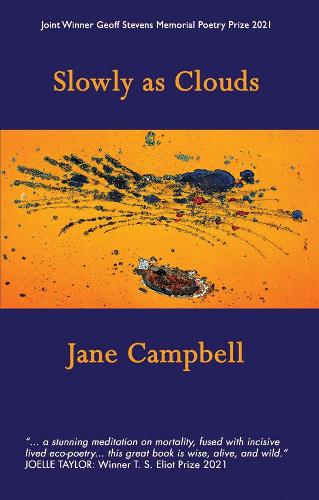
Review by Gary Day of "Slowly as Clouds" by Jane Campbell


Jane Campbell’s poetry has edge: it glints rather than glows. ‘Degrading’ is one such example in this raw, uncompromising but strangely beautiful collection. The poem recounts a group of girls surrounding the young poet demanding she prove the arrival of her first period. The ending brilliantly transforms this humiliation into a triumph: ‘recasting them / in perpetuity / slow for their age.’ 

The theme of change or metamorphoses is present in many of the poems, particularly those to do with parents or lovers. Campbell pays tribute to the political activism of her mother whose frailty in age is a spur not to forget how she impressed her daughter ‘with the importance of rights / that once they had bite were revoked.’ But this tribute has a darker feel in ‘Fairy Tale’ where the speaker apologises for tormenting her parent. 

Campbell’s portrayal of her father follows a similar trajectory. At first he is a monumental figure, ‘an army of hands and feet’ but then we see him shrivelling in a hospital bed, while the poet envisages his evolution into a ‘butterfly, then rabbit, then antelope.’ The ending of this poem, ‘Metamorphosis,’ is not only exquisite but also a demonstration of Campbell’s knack of finding new and unusual rhymes. 

There is sober realism in the poems about love; a celebration of its joys in ‘May moaning from our mouths,’ and an acceptance of its sorrows. There is a particular poignancy in ‘Let Go’ where though desire has run its course that ‘doesn’t mean / I don’t still love us.’

Campbell is highly versatile. She can write a shocking futuristic poem like ‘Always Alice’ and a gentle, almost Hardyesque one like ‘Wishing Well’ which should be included in any future anthology of English poetry. An ever-present consciousness of mortality does not sour her sense of life’s abundance. ‘Compost Loo’ shows that even waste is a form of enrichment. 


About the reviewer
Gary Day is a retired English lecturer. He is the author or editor of a dozen books including a two volume history of modern British poetry. He had a column in the Times Higher for a number of years and has been actively involved in amateur theatre for many years.

Saturday, 13 November 2021

Review by Gary Day of "Disappearances" by Kathleen Bell


Kathleen Bell’s debut volume is a thing of beauty, a joy forever, or at least until the global temperature rises beyond the point of no return. Her poems are poised, delicate and occasionally devastating. The book consists of three sections, the second concerns memory, the third magic.

The first deals with the musings of medieval spinsters on matters such as  church, childlessness, beatings and scars from harvesting the corn, a kind of earthly stigmata. These women bear their sufferings with a grim fatalism. Their incessant struggle to reconcile what they are told by the priest or the lord with their own experience is expressed in voices both lyrical and authentic. 

The final poem in this sequence, ‘La Dame Ă  la Licorne,’ is a delight. It is based on six tapestries of the same name woven in the style of ‘a thousand flowers’ at the turn of the fourteenth century. Five of the pictures represent the five senses, the sixth is something of a mystery. The brilliance of this poem lies not just in Bell’s riff on the pictures of the lady with her unicorn but also in the way she subtly relates it to the poems that have gone before, where her women are fluent in their senses but flounder in their minds.

My favourite in the collection is ‘Palais des Beaux Arts’ which revisits Auden’s magnificent ‘MusĂ©e des Beaux Arts.’ It strips the original of its calm beauty revealing the horror beneath. Wherever Auden’s landmark poem goes in future, it should be accompanied by this one. 

Each page of this well-produced book is an entrance to an exquisitely constructed little world, whether it is a painting by Vermeer or a card trick. Bell takes us down the side roads of history, showing with great tenderness and truth, what was missed.   


About the reviewer
Gary Day is a retired English lecturer. His research mainly lay in three areas, the  history of literary criticism, the workings of class in British literature and the persistence of sacrificial ritual in the development of drama. He had a column in the Times Higher for a number of years and has also edited two volumes on the history of British poetry as well as the three volume Wiley Encyclopaedia of British Literature 1660-1789. He hates management speak, has been involved in amateur theatre for over thirty years and is still trying to write poetry.

Tuesday, 22 September 2020

Review by Gary Day of "A Sense of Tiptoe and Other Articles of Faith" by Karen Hayes


This volume stand out from many collections of modern poetry in its willingness to go beyond the here and now. In some respects it is a return to the metaphysical tradition, though the poems here lack the sinuous complexity of Donne and the piercing lyricism of Herbert. But how could it be otherwise? Karen Hayes is turning her eyes skyward after nearly four centuries of spiritual atrophy. True, there have been exceptions, the visions of Blake and of course T. S. Eliot’s The Four Quartets standing solemn and monumental; but neither a vital influence on the contemporary scene. 

Larkin’s ‘Church Going’ is Hayes’ point of departure, a poem that registers the loss of faith and the need to connect to something greater than ourselves. Hayes’ ‘At the Cathedral’ captures something of Larkin’s offering, particularly in the descriptions of architecture and accoutrements, but in her account the dead do not nudge us to wisdom, they are the sharpness of pain and loss. A contrasting poem is ‘Ralph,’ for me the most moving in the volume. Here nature transmutes grief into the glory of the garden. There are historical poems like ‘The Women Who Shaped the Church,’ redeeming those who helped to make history but were then forgotten by it, and seemingly pedestrian poems, such as ‘The Twelve,’ which convincingly fuses aspects of Christianity with the workings of the judiciary. 

Hayes is extraordinarily receptive to the whispers and ripples of the great unknown. It was easy for the metaphysicals. They believed and had the rich expressions to go with that belief. Anyone today who wants to grapple with the divine is faced with the enormous task of overhauling the language, of stripping it down and retuning it to the heavens. On the evidence of this collection, Hayes has made a good start.


About the reviewer
Gary Day is a retired English lecturer. His research mainly lay in three areas, the  history of literary criticism, the workings of class in British literature and the persistence of sacrificial ritual in the development of drama. He had a column in the Times Higher for a number of years and has also edited two volumes on the history of British poetry as well as the three volume Wiley Encyclopaedia of British Literature 1660-1789. He hates management speak, has been involved in amateur theatre for over thirty years and is still trying to write poetry.

Sunday, 19 April 2020

Review by Gary Day of "The Escapologist" by Jinny Fisher


To the extent that many of the poems in this collection aim to give a picture of Jinny Fisher’s physical world, real and remembered, they succeed. In ‘Sunday Lunch’ Mother ‘works oil into the surface’ of a ‘long table’  with her ‘bleached wooden brush’; in ‘Screen Memory’ a ‘shiny red hand-pump … spurts brook water for the kettle,’ while in ‘Antiphon’ a crowd ‘almost trample / two tiny wellington boots, painted with daisies, / half buried in the mud.’ Fisher, who has undergone a series of metamorphoses from classical violinist, to psychotherapist to poet, has an eye for detail. Her descriptions are precise. The reader is treated to a series of clearly defined images, but a number are inert. The scene is set but nothing happens.

This is not true of all of these poems. ‘Half-Sister’s Lunch’ neatly captures the tensions between the two women; sharing a plate of food and tearing bread dramatically portray their closeness and rivalry and there is genuine tension in the build up to the magnificent last line. Another work that should be singled out for praise is ‘Regeneration’ which simultaneously keeps in play the shock, the relief, and the new found freedom that comes from the end of what appears to be an abusive relationship. But that’s not all. A faint air of regret hangs about the poem. As someone who has studied psychoanalysis, Fisher is all too aware of the dangerous ambiguity of human emotion.  

One of the eye-catching qualities of the collection is the layout of Fisher’s poems. Some, like the title poem, are laid out in paragraphs, others like ‘The Scarf’ follow the shape of the object they describe. All of them, whether they are about home, family relations or even her violin have something to recommend them.   


About the reviewer
Gary Day is a retired English lecturer. His research mainly lay in three areas, the  history of literary criticism, the workings of class in British literature and the persistence of sacrificial ritual in the development of drama. He had a column in the Times Higher for a number of years and has also edited two volumes on the history of British poetry as well as the three volume Wiley Encyclopaedia of British Literature 1660-1789. He hates management speak, has been involved in amateur theatre for over thirty years and is still trying to write poetry.