Showing posts with label Michael Thomas. Show all posts

Saturday, 19 April 2025

Review by Gary Day of "Nothing Louche or Bohemian" by Tina Cole and Michael W. Thomas


It’s an interesting title. One that turns its back on the sordid and the unconventional but what does its face toward? The answer is local social history. This is very much a volume of people and places that the authors have known. 

Tina Cole and Michael Thomas are too experienced to fall prey to nostalgia or sentimentality. Instead  we are treated to a series of poems that are clear-eyed, gritty and authentic. Cole's "Intoxication" acknowledges the continuing lure of the artistic world while being wise enough to know that poetry only flourishes if it remains close to its roots. Thomas achieves a similar effect in "Sally Riordan." 

Both poems exemplify how each poet riffs off each other. The result is a beautifully textured collection, full of vivid evocations of characters, scenery and a vanished way of life. An example is Thomas’ "Unmapped." A once well-known landscape has become strange to itself and those who used to walk its ways. Memory is in danger of disappearing. The language of the poem is representative of the volume in its precision and invention: "tree-tops net the seasons / in stars of summer blood / and Christmas pearl." Cole’s "Local Vagrant: Dudley 1960s" is equally arresting, the subject's frailness brilliantly and economically conveyed by the phrase "knitted shoulders" while his position on "the ledge of what is now and what / was then" could serve as an epithet for the entire selection. 

There’s an element of Lennon and McCartney in the poems of Cole and Thomas; the same eye for the telling detail and a feeling for the oddness of the ordinary. There are also strains of lyricism but these are kept in check and are felt all the more poignantly for that. The fusion of personal life and social history makes this an unmissable read.

About the reviewer
Gary Day is a retired English lecturer. He has had poems published in Vole, Ekstasis, Acumen and The Dawn Treader. His "Anne Bronte's Grave" was highly commended in last year's Artemesia Poetry Competition. 

You can read more about Nothing Louche or Bohemian by Tina Cole and Michael W. Thomas on Creative Writing at Leicester here


Thursday, 1 February 2024

Review by Sally Shaw of "The Erkeley Shadows" by Michael W. Thomas


The novel begins at the end of one character's story, but at the start of another’s, albeit unknown to him. Will, a police officer lives in a place, Saskatoon in Canada, where familiarity acts as a blindfold to change: "Through the window he could see the last stragglers being exited from the City Library. He smiled. There was Grace Popescul holding open the door as she’d done forever. The lady had a way with her, no doubt of it. When he was twelve he’d tried bribing everyone in his grade to return his overdue books. At last Dad had driven him downtown, frog-marched him into the lobby, nodded at Grace and gone to wait in the car. He’d been left with her wrath and what felt like the whole province’s population looking on. Man, she didn’t look a day older than when she’d torn those strips off him. But of course she was older and so was he and so it would go on. Except for this Cumberland Avenue guy." Thomas’s writing creates atmosphere and hints at the turmoil within Will that draws the reader into the story.

In this novel, the guy found dead intrudes into Will’s life - firstly, by the strange calm of the death scene that conveys an undercurrent of evil. This nudges its way into Will’s mind and when he observes the evidence bag from the guy's apartment left on the front desk of the station, he takes it. Inside the bag is a folder in which Jonathan has recorded the reality of his existence. Will initially thinks reading it will pass the weekend while his wife and children are away for Halloween.  

As Will begins to read the folder he’s taken to England and Jonathan's teenage years of the 1960s. He is introduced to a boy being bullied by a gang whose leader’s name is Wiznuk, who only retreats when Jonathan’s friends, Bevvo and Gordy, are around. "Inevitably, when my departure for Canada became known, Wiznuk and his apes came after me with redoubled zeal." The words of Jonathan become embedded in Will’s thoughts and start to lead him to re-consider events of his own childhood.

Will is amazed by the number of  pages Jonathan dedicated to that last summer in England and an area of land known as the Erkeley. "The Erkeley ran all around the school, almost, but was bounded on one side by a residential lane leading up to the main road. It must have been as impressive as Cannock Chase once, all ridged and hollowed." It becomes clear that the reason for there being so many pages about the Erkeley is that, as part of Jonathan's farewell, his mates arrange a last adventure there. "On the last Tuesday of term, Gordy waxed romantic: 'Hey, let’s come back here tonight, man. Mooch round the Erkeley after hours. Souvenir for you, Jon, golden memory: hanging loose, Erkeley-wise.'" During their exploration of the Erkeley the boys meet Old Tafler who was known as the Lord of Erkeley due to his having inhabited the land for years. Old Tafler is witness to a horrific event that last Tuesday evening, one that Jonathan hopes he can escape as he leaves for a new life in Canada with parents who barely register his existence, let alone sense all is not well.

Jonathan becomes a university professor. Outwardly to colleagues and friends he’s a good person. His true self hides deep in his mind, co-ordinating ways to right his wrong. "Often I felt like two people. One went into the world and did the living for the other, who was stuck in an endless moment of knowing." Jonathan’s life spirals out of control, as he is pursued by those on the Erkeley who become his "dark chaperones." They steal his present memory and dole out punishments.

The more Will reads and re-reads, he is drawn back to events of his own childhood, when his potential to harm his brother Mark is almost realised. Will becomes engulfed in the possibility of sorting Mark out. I find Thomas’s writing requires me at times to pause and uncover the different layers, before reading on. The title of the novel became clear as I witnessed the devastation caused by Jonathan’s decline into The Erkeley Shadows


About the reviewer
Sally Shaw has an MA Creative Writing from the University of Leicester. She writes short stories and is currently working on her novel based in 1950s Liverpool. She sometimes writes poetry. She gains inspiration from old photographs, history, her own childhood memories, and is inspired by writers Sandra Cisneros, Deborah Morgan, Liz Berry and Emily Dickinson. She has had short stories and poetry published in various online publications, including The Ink Pantry and AnotherNorth and in a ebook anthology Tales from Garden Street (Comma Press, 2019). Sally lives in the countryside with her partner, dog, and bantam. Twitter @SallySh24367017

You can read more about The Erkeley Shadows by Michael W. Thomas on Creative Writing at Leicester here

Monday, 14 March 2022

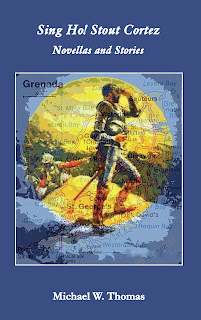
Review by Elizabeth Chell of "Sing Ho! Stout Cortez" by Michael W. Thomas


I have just finished reading Michael W. Thomas’s Collection of novellas and stories Sing Ho! High Cortez. It is a book I will want to read over and over. The central theme for this collection of stories is family life and friendships. The first novella, Esp: The Voice of Grenada, is the story of a group of boys. We journey with them as they grow from boys to men and learn the history of their country. The music they compose and play is more than the rhythm of their lives; it is their personal and Grenada’s battle for freedom. The writing is poetic and beautiful; the cultural refences to music and film resonate with one’s own journey from child to adulthood. It is witty and poignant. It is of no surprise that such a clever story, with its rich dialogue, should have been shortlisted for the UK Novella Award 2015. 

‘Tickle, Tickle,’ a harrowing survivor’s story, is exquisitely written. We are steered through the twisting path of youth and experience and the minutiae of family life. Again, the musical references resonate with one’s own adolescence. Music, like a smell, puts you in the time zone giving credence to the tale. 

‘Mister Sixth’ catalogues the of life Evan. It is reflective and insightful, examining the ghosts of the past. Using Evan’s boyhood bedroom and memories, the story unfolds, spilling the beans of sibling rivalry amidst sunny suburbia of twentieth-century family life. Finally, with the skilful use of metaphors, we learn the resolution and wisdom that comes with the rights of passage into adulthood. 

‘Never Any Sometimes’ picks apart a man’s position in a family of three adult daughters. It is an intimate story set in a restaurant. The tension ratchets up as the wine flows. 'Sing Ho! Stout Cortez' is the story of a group of colleagues preparing to party on the first ever ‘New Year’s Day’ holiday. The characters are expertly drawn, the lightest of brushstrokes painting a thousand words. We breathe with them, making the poignancy of the ending real. ‘The Maker's Mark’ explores Ian’s angst of being fourteen and at the bottom of the pecking order in the family. Ian is a people watcher and an expert in body language. It is a satisfying read; we empathise with him. 

Michael W. Thomas’s collection of stories would be a welcome addition to any bookcase; it will be well read and loved by all who read it.


About the reviewer
Elizabeth Chell is a full-time teacher and is currently studying for an MA in Creative Writing at the University of Leicester.