Showing posts with label Nine Arches Press. Show all posts

Wednesday, 4 September 2024

Review by Rennie Parker of "The Apothecary of Flight" by Jane Burn


I was glad to receive this collection for review, and it more than lives up to the promise of Burn's first collection, Be Feared, her magnificent debut in 2021. While the first gave the impression of a poet fiercely fighting her corner and stating her poetic vision, the second shows her heading into a richly pastured garden of Eden where the fruits of practice and observation are hers to gather and enjoy. Best of all, do it loud: "You must not whisper   or mutter   or skein  but stand / With your poem loud and like a beacon   in your hand." "Say it strong …"

These lines from the title poem pretty much outline the poet’s position and set up what the reader should expect over the next eighty pages or so, because Jane Burn does not exactly hold back with the talent and the fireworks. When you want language to be glorious, this is how it is -  although the poems are difficult to quote from, because the effect depends on a cumulative build and the poets’ extreme ability to become other states. She climbs inside an eighteenth-century jar, observes her horse, identifies with a bear, sees everyday miracles, wonders about clouds: she goes to the Laing Art Gallery and concludes "the sun goes down alone / and doesn’t seem to mind," with the visit becoming a reflection on loneliness and belonging. In many ways, it is the act of poetry which brings her into belonging: time and again comes the reminder that poetry has "saved" her, including a personal account of the time when "that" teacher (the Miss Moss we all needed) opened the door into verse.

Sometimes, poems which are an expression of Language veer towards word-factory fallout and the kind of experimentation which other poets have to leave in their notebooks -  for example, "metapoem / iteration (Dickinson, 568)," where a few more clues would have been helpful for the reader. But JB is a daring writer, and this is what we need in the poetry universe, even though the reader has to catch up fast. And I am not sure that the "Ocular Map" is different from other poets’ definitions of visual and concrete poems, although the Note on pp.94-96 would suggest it is so. Plenty of us out here are used to reading poems in alternative ways, Jane!

My main concern would be for the person who stands behind the poetry. I would hope that people are mindful of her development as she pours herself into the work. Why? Because the arts world is profligate in its disposal of artists who are genuinely different and/or original in some way, and she has already foregrounded her neurodiversity / class-based position from the word go. At what point does the appearance of neurodiversity in poetry travel beyond the reader and into the hall of mirrors where only the poet can find her way out? When will we concentrate on poets and poetry instead of the "class" they come from? Does it matter, as a way of pinning "work" onto a "person"? Burn writes the kind of poetry which excites critical debate, and I would hope it is for the right reasons.

I am sure The Apothecary will be on many peoples’ Books of the Year list already, and the titles alone are enough to sell it to readers -  "Pantoum to Maud’s Absolutely Brilliant Door" being just one of the titles which make me want to read it; meanwhile the lines sometimes have the shock of cold water as the poet exhorts us to "Raise your voice  Speak the clarity of ice." If your book budget is limited and you can’t buy many collections per year, make room for a Jane Burn.


About the reviewer
Rennie Parker's latest collection is Balloons and Stripey Trousers (Shoestring, 2023). She was born in Leeds but lives in south Lincolnshire, and currently works for an FE college. Blogs here, daily nonsense on Twitter @rennieparker.

You can read a review of Balloons and Stripey Trousers on Everybody's Reviewing here. 


Saturday, 3 September 2022

Review by Jon Wilkins of "There Is (Still) Love Here" by Dean Atta


Words make such a 
difference,
they have to be in the right
order
of course and need to make
sense,
but when they do simplistic
beauty
is here before us as true
art
shows itself to a wondering
world.
Dean Atta a brave and courageous
writer
wears his heart on his
sleeve,
as he constructs a world of
love
and lost love, of family ties
broken
and strained as love tries to
win 
the day. Lovers are lost as the 
lonely 
world of covid swirls about us 
distancing 
him from those he
adored,
tearing him away from the 
loves
of his life at home and
abroad. 
You can almost 
taste
his grandmother's food as the 
aroma
pervades the page,
filling
your world with Cypriot
jewels
teasing taste buds and
nostrils
with words and perfect
images.
His Greek heritage teased and 
tormented
by matters so far from his
control.
His heart strained by the relentless 
pressure 
of a modern world that tries to 
press 
upon him their own limited
version 
of life and what love should be. 
Thankfully 
Atta resists this unwholesome
pressure
and tells us, in words so
beautiful,
what his own world 
is
and why his path is the true
path
and why his love can never be 
broken
despite what our world will
say.
We learn how to deal with
death
and division, of loss and
remorse
as loved ones leave us 
And loved ones 
join 
us in relationships
new.
Black Pride enhanced with
remembered 
kisses that taste of
Marmite
and toothpaste and coffee and boyish
love.
To see two black boys in
paradise
is to see how love
should
be and how it will always
be
if we only give his
love
a chance to show its worth and
shine.
A beautiful set of poems describing
life
today and how hard it can be to 
follow 
your own desirable path to
happiness.


About the reviewer
Jon Wilkins is 66. He is married to the gorgeous Annie with two wonderful sons. He was a teacher for twenty years, a Waterstones bookseller and coached women’s basketball for over thirty years before taking up writing seriously. Nowadays he takes notes for students with Special Needs at Leicester University. He has had a work commissioned by the UK Arts Council and several pieces published traditionally as well as on-line. He has had poems in magazines and anthologies, art galleries, studios, museums and at Huddersfield Railway Station. He loves writing poetry. For his MA, he wrote a crime novel, Utrecht Snow. He followed it up with Utrecht Rain, and is now writing a third part. He is currently writing a crime series, Poppy Knows Best, set at the end of the Great War and into the early 1920s.

Tuesday, 31 May 2022

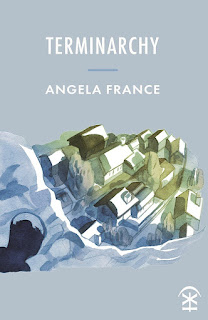
Review by Lauren M Foster of "Terminarchy" by Angela France


There are so many excellent poems in Terminarchy, I found it difficult to decide which ones  to highlight, so I will start at the beginning. The opening piece, 'Poetry Makes Nothing Happen,' reminded me of what I once heard said about Alice Munro’s short stories: 'Nothing happens but everything happens.' There can be many positives to nothing happening in our contemporary world—such as during the lockdown of 2020 when nature, at least for a short time, appeared to thrive. 'Poetry Makes Nothing Happen' ponders possibilities, the idea of each decision creating an alternate timeline – like a poetic chaos theory. The second stanza seems particularly poignant right now given the situation in Ukraine:

           Or so that a fighter sits up almost all night reading Rumi, trying
           to understand death and blood, peace and love and sleeps
           too late to be ready for the knock at the door so tells them
           he’ll follow after because he wants to hold his son and play
           with his daughter and nothing happens as he kisses his children
           because he isn’t in the car when a government missile hits it.

France seems to have a relationship with the land, to love it the way one would love a person: she writes the land’s personality, its character, and quirks. I sense a deep sadness at the destruction of nature and the march of progress, something I can sympathize with. Loss runs through the work, as to be expected in any ecopoetic collection, and it explores absences and disconnections, with regards both to nature and other people: the poems 'Fallow' and 'What Remains' made me think of the artist’s exercise of drawing a tree by observing the negative spaces in-between. Longing, too, is present, perhaps for the material in a scientific sense: tangible things, the physical world around us.

'Water Mark' is probably my favourite poem in Terminarchy; its movement follows the bends and cambers, climbs and drops of the road in the work—and like the water of the leak which lends the poem its title, it finds its path of least resistance. There is the pseudo presence of a stranger the other end of a phone-line staring at a screen as they talk, a seeming non-awareness of a world beyond the call-centre:

         She says she can’t send a crew without a postcode.
         I could tell her I know that old sycamore, leaning
         over a crumbling wall, how this bend tightens
         if you come down the hill too fast. There are houses
         backing into the hillside, hidden behind trees
         and shrubs, stately gateposts by the road
         with blurred names carved
         into lichened stone, no numbers.

Journey-ways feature prominently in Terminarchy in works such as 'Desire Path,' 'Piggy Lane' and 'Strange Road.' There are adventures of the everyday sort, the familiar seen in unfamiliar ways, small joys, open spaces, the freedom of roaming, of the frogs and sparrows you might get to know in your back yard. There is a sense of wonder present that many lose after childhood is but a distant memory.

Online life and the false sense of having done something about injustices and the climate emergency is analysed in 'Small Gods,' 'Scrolling and Blame'—and 'Missing the Blood Moon' illustrates that detachment from a true-present endless digital media can bring. The Lockdown too, is a worthy subject, in 'After,' where people ‘came out, blinking in the summer light’  while others ‘step back inside, close their doors, pull down their blinds.’

Terminarchy is observant, thoughtful and well crafted with those small details, word choices and delightful metaphors which make a difference. In 'Muscle Memory,' France writes:

          The lift of a kettle, cup, the snug of peeler
          against my thumb, the stretch of fingers
          around a winter potato. How to tong coal
          on to a new fire or draw the flame
          with newspaper held tight across the grate.
          My hands remember how to rock a crying infant,
          how to wipe a child’s face, the O of her mouth
          disappearing like a moon behind cloud.

Terminarchy is not a didactic ecopoetic collection, but instead informs and engages the reader, as good writing should. It retains a warm and largely positive outlook throughout while acknowledging the damage the human race has inflicted on the natural world. There is kindness, compassion and a down-to-earth vibe that I enjoyed greatly.


About the reviewer
Lauren M Foster is a writer and musician based in Charnwood and a graduate of the MA Creative Writing at University of Leicester.


You can read more about Terminarchy by Angela France on Creative Writing at Leicester here.


Friday, 7 January 2022

Review by Rosa Fernandez of "Terminarchy" by Angela France


The end of the year was a very appropriate time to read and savour this collection of forty-three poems by Angela France, taking us through time and change and closing with ‘Living Yule,’ and I appreciated many of the sentiments expressed throughout. Terminarchy is about the last of a species and speaks about our experience of the world as we come to terms with what feels like a precipice moment. 

The poems speak to many of our concerns about the changing climate, and we can all agree with the voice of Sparrow, whose character interjects with concerns about the unexpected mildness of the seasons: ‘we’ll pay for this’; another character called Wantwite acts as the embodiment of materialism, coming to life to then suffer the consequences.

I enjoy sinking into descriptions of the unique English countryside, so I relished descriptions like ‘flickering clutter of town’ and ‘a violet nestles in a knuckle of root’ and enjoyed the scene setting. The subtle villanelle of ‘Blame’ was particularly powerful and serves as a microcosm of the collection. 

I will say that I felt the worldly concern more readily than I felt the hope; there was a subtle sense throughout of a kind of rejection of technology and progress which I entirely understand but found less easy to read; mentions of Spotify and ‘the new build’ read a little binary (nature: good; technology: bad) and while I agree in part, I feel that our relationship with these new developments may end up being part of the solution. 

As an expression of where we are now, Terminarchy is a thoughtful assembly of poems. The positives in this changing world are hard to pinpoint; one of the things that can help us reflect on the part we have to play is this kind of collection.     


About the reviewer
Rosa Fernandez is a slam-winning poet and sometime proofreader. She also enjoys wearing silly hats. 

You can read more about Terminarchy, as well as three sample poems from the collection, on Creative Writing at Leicester here.


Wednesday, 10 February 2021

Review by Tracey Foster of "Sounds in the Grass" by Matt Nunn


As the wind whispers through the grass, what sounds does it make? According to this poetry collection by Matt Nunn it whispers a tale of anarchy, teen angst and rain plop on a crapola landscape. From his early school days with a 'right-venerable tosspot' headmaster to the two-tone reggae beat in his poem 'Coventry Calling,' this self-labelled 'dumb brummie buffoon' takes us on a roller-coaster ride of gutsy language that holds no truck with any refined sensibilities. 

‘What’s it all about big ‘ead?’: Nunn's poems evoke a Burgess-like quality with their old-school expressions, insults and in the creation of Nadsat-like words ‘the screaming Pollocky sky of angels.’ Nunn manages to capture the love for ‘this soaking beloved isle of sodden crapness’ that is both new and yet harks back to a familiar past. His poems juxtapose the everyday with the sublime, making us look at our experiences in a renewed light, like ‘God with a spray can’ attacking our insensitivities. 

‘Grubby precincts of paradises’ are populated with the bizarre and bereft, from the have-a-go-heroes and 'grot-faced nippers' to the 'prissy cagouled tourists' and 'Tudor-haired truckers.' Nunn scatters a range of characters throughout his text to share their stories with us, affectionately reminiscing on the revolting recent past of Mini Metros, cassette tapes, Vespas, Chernobyl and disco lights, taking us on a stroll down memory lane with an eye on the profane. His opening 'Prologue' sums it up:

          Come you tender violinist lovers
          and rude thumping drummers
          and you too, you strangely alluring
          but precipice-stiff
          Miss-wearing-naught-but-a-smirk
          and I’ll teach you in a boom frazzled
          in daydreams of thunderstorms.

          Come you who turn yourselves audaciously
          inside out until you are nothing
          but a bloody shredded kiss
          hanging off a borrowed skull’s humming lips.

          If you want,
          I can be all crazy flesh,
          the epitome of polite romance
          or
          as sweet and delicate as you would wish:

          not a proper man but the Sounds in the Grass …

Open your ears and visualise the scene, as Nunn transports us to an all too familiar ‘screaming landscape.’


About the reviewer
As a teacher of Art and Design for over thirty years, Tracey has channelled her imagination into getting the best creative output out of others. She is now hoping to restore her create mojo and has enrolled on the Creative Writing MA course at Leicester University. Last year, she completed the Comma Press short story course with Rebecca Burns and collectively published Tales from Garden Street. She is due to have first poem published by the Poetry Bus magazine and is currently working on a poetry collection.

Friday, 20 November 2020

Review by Colin Gardiner of "Maskwork" by Gregory Leadbetter


I read somewhere that poetry is an echo-chamber for the mind. I can’t remember who wrote that, but that idea stuck with me, and when I read or write poems I am always searching for the wave.

The poems in Maskwork by Gregory Leadbetter reverberate around the mind like tuning forks, illuminating hidden corners of the subconscious.

The instinctive nature of concealing one’s true identity is deftly revealed in the clear and direct syntax of the title poem:

          To teach the mask I make
          to tell the truth, I wear it
          as my own: feel its weight tilt

Leadbetter’s imagery is lyrical and evocative, whilst still grounded in the everyday. 

His style of magic-realism uses the effects of altered perception and the redemptive magic of music to reveal moments of self discovery and awareness that resonate with the reader:

          And then I was there: the blind road
          emptied into a field, as if
          where I stepped a sudden breath 
          had blown the earth to a sphere of glass.

I was particularly moved by the poem ‘Personal Computing’ where Leadbetter conveys the harrowing effects of dementia of a loved one through the prism of childhood memories:

          The future has come and gone.
          I am still watching the flickering screen
          waiting for all we have lost to load.

I found echoes of pure beauty and mystery in this intriguing collection of accessible poetry. I hope more readers will catch the waves too.


About the reviewer
Colin Gardiner has recently completed his MA in Creative Writing at the University of Leicester. He lives in Coventry with his husband. He writes short stories and poems and has been published by The Ekphrastic Review, Ink Pantry, The Midnight Street Press and the Creative Writing at Leicester blog. More of his work can be read here

Wednesday, 28 October 2020

Review by Vic Pickup of "What Girls Do in the Dark" by Rosie Garland


Rosie Garland’s writing is wildly imaginative; in breaking the rules of possibility, her poems are liberating and powerful. 

The space theme in What Girls do in the Dark is striking, and how the poet weaves its darkness and beauty within the mystery and humanity of her poems, masterful. The opening poem, ‘Letter of Rejection from a Black Hole’ sets the scene for the rest of her book, as she tells us: 

          You have the right to glow. 
          It’s not your duty 
          to light up anyone else’s day. 

Garland entrances and empowers her reader in much of the poetry which follows, such as in ‘Eloping with a comet’: 

          Breathless with forbidden flight, I grasp his tail, 
          hang on. Drunk on escape velocity, I boot night in the ribs, 
          ride the sky till it runs out of I told you so’s.

It’s not all space dust and sparkle; there is turmoil here, too. Darkness comes in the theme of persecution and the fragility of life, which the poet explores in varying forms. In ‘The last pangolin,’ a precious and endangered creature is stripped of its scales: 

          Only when          
          the final petal is torn away, 
          do they discover 
          there is no 
          choke, no 
          living thing, 
          no answer.

‘The correct hanging of game birds’ is also barbaric and sinister - a descriptive account of ownership and pain: ‘Permit yourself the luxury of appreciation. This bird / is yours, now … Pluck right away and you experience the thrill of / naked flesh.’

The persecution of women is a focus too - as in ‘Saint Catherine’: ‘They will kill you / for being cleverer, / worse than laughing at their dicks. / You know all of that but / won’t stop. Can’t. You didn’t read the Library of Alexandria / to bat your eyelashes and keep schtum.’ The poem concludes: ‘the truth of it: woman answers back, ends up dead.’ That said, it is the great wonder and strength in Garland’s explorations of womanhood which overpowers this darkness.  

In ‘They are an oddness,’ the poet describes a female sea creature, who is taken home by her male owner and placed in a goldfish bowl which she quickly outgrows, followed by the sink and the bath. ‘You eat, and grow. Your tentacles climb / the tiles around the tub. You pool the floor with slime … You wrap your tongue around him, squeeze till he gasps.’ This glorious and disturbing image is fantastical, and in keeping with the otherworldliness echoed throughout Garland’s work.

We venture beyond the earth in many of the poems of this collection: In ‘The dark at the end of the tunnel,’ ‘A woman walks upon the ocean floor. / Her skirt balloons around her legs / with the slow grace of a manta ray … Her stride is a keel, her chin a prow. She cleaves the thickness.’ This is one of many poems where our subject morphs into something other: ‘She no longer employs the agony of air in, air out.’ Our subject inhabits places beyond our reach, beyond her physical being, quite often disappearing, as in the final poem ‘Bowing out.’ 

In What Girls Do in the Dark we contemplate vast expanses in space and time, beyond us. There is fear but with this mystical ability to shape-shift and explore beyond what’s possible there is power and hope - summarised beautifully in ‘Biography of a comet in the body of a dog’: 

          Every time 
          I toss hope away it brings it back, drops it 
          at my feet, tongue drooling a glittering rope.

And there is also power and hope in the final sentence of ‘Personal aphelion’: ‘Permit darkness, find light.’ Garland even manages to approach grief with positivity and beauty in ‘Now that you are not-you,’ my favourite poem of the collection (I’m not exaggerating to say it moved me to tears). The infinite wonder of a spirit and the letting go of death is so beautifully explored: ‘like fireflies stopped in a jar, / and dying is the slow unscrewing of the lid.’ 

This is a collection full of opposites; vulnerable strength, persecuted freedom, imagined realities, but ultimately any darkness is dwarfed by the incredible, shimmering and unfathomable beauty of space, and our insignificance and importance within it. 


About the reviewer
Vic Pickup is a previous winner of the Café Writers and Cupid's Arrow competitions, and was recently shortlisted for the National Poetry Day #speakyourtruth contest. Her debut pamphlet Lost & Found is published by Hedgehog Press. www.vicpickup.com  

Wednesday, 23 September 2020

Review by Sarah James of "Dressing for the Afterlife" by Maria Taylor


Even just a few poems into Maria Taylor’s Dressing for the Afterlife, I realise there are many options for how to approach this collection, many themes and threads that I can trace through it.

The opening ‘Prologue’ gives us dressing for the afterlife as learning to 'breathe again,' having stepped into the moment where 'you ended a former existence / and zipped yourself into the unknown.'

The examples of possible outfits to wear hint at the poems to come, as does the opening poem ‘She Ran’ with its list of things run past, the poet having taken up running at the age of forty. This culminates, as summer turns to autumn, with:

          I couldn’t get as far as I wanted.
          The lights changed. My ribs, my flaming heart
          and my tired, tired body burned.

In many ways, the following similarly beautifully pared, moving (and also at times humorous) poems enact and extend this opening, taking the reader through personal past experiences. Some read like the poet’s own; others feature advice, adopted voices and celebrity lives. The book closes with a counterpart to the opening poem ‘Woman Running Alone.’

Afterlife here is not what happens after death but the afterlives within this life, especially women as they age. 

          In summer I was a night-blooming flower.
          By autumn I was a hangover. Winter made me
          a Wall-Street Crash.

I used the word ‘personal’ earlier but this collection is personal in a universal sense, borrowing others’ clothes (experiences) and drawing out wider similarities and significances. This poem, 'I Began the Twenty-Twenties as a Silent Film Goddess,' is a film star talking (in industry terms), but it’s the continuing experience too of many other women now.

For me, Dressing for the Afterlife is also about finding, or reinventing, an individual’s sense of ‘self’ against this and many other backgrounds.

          I trespassed.
          At night I found myself ice-skating
          into someone else’s life.

I can read this poem ('Awake in His Castle') in a Bluebeard sense, but I feel it also chimes at a real life level – in trying to establish and make sense of individual identity, power dynamics and dangers at play all around us.

Another reading of the collection, not unconnected to that above and completely fitting with running, is the sense of everything in continuous flow. Water is a recurring image. 

‘The Floating Woman’ is a memorial to Lauren Stephen, half-sister of Virginia Woolf. The poignant Ophelia-like imagery has death / suicide as a sense of ‘returning’ to water, and life as rivers poured over the narrator. Everything feels fluid, form-changing, transient. This also applies to language: 'how every word / turned into water.'

Meanwhile, in 'The Fields,' 'rain dissolves / a  landscape you thought familiar' and the poem observes 'your place in this world an ever-shifting thing.'

Flow is present too in life’s dance and our steps of learning: 'We dance to learn about a part of ourselves / books can’t teach; it’s what our parents expect' (‘Learning the Steps’). In this case, that includes the moves of old island lives and leaping like salmon (water and flow), 'trying to catch scent of home, / as music pours through speakers like flood.'

It’s also in the passing and nature of time:

         People vanish into thin air every single day,
         even ghosts fade in time ….
         You’re no different. Look, here’s your own reflection.

More than this though, it’s in the pace of the lines, the use of recurring motifs, choices of line-breaks and punctuation, including the end of ‘Mr. Alessi Cuts the Grass.’ Here, a noise like a neighbour pushing 'something larger than dreams / over concrete' expands into a whole poem that ends on the full-flow leaving open of all possibilities of 'but for a moment –'

That the final poem of the collection ends with a similar dash is even more significant in these terms, as well as inviting the reader to re-submerge themselves in the collection, re-reading for more possibilities.  

Other strong elements for me in Dressing for the Afterlife include romantic hopes and family love, and with them the sense of belonging, or not belonging (as present in some of the poems already quoted).

In ‘The Distance,’ the narrator’s family can’t get the hang of England, as lives are scattered into flats, people calling to each other from balconies instead of olive groves:

         Years later I throw open my windows to rain
         knowing my aunt’s echoes won’t travel the distance,
         I’m here, I say to water, can’t you shout any louder?

Meanwhile, in ‘Role Model,’ famous and seemingly glamorous potential role models are rejected for the woman next-door with 'a walk that says I know where I’m going.' 

And yes, all these loop back and together with the elements of water, dance steps, the essence of ‘self,’ the nature of life, society and time: 'Maybe time moves like a figure of eight, / surging forwards then back on itself' (‘Loop’).

That poetry can, maybe even has to, exist outside of time is evident hopefully in the scope of what I’ve already quoted. Imagination does too and this is inherent in many of Taylor’s poems here, including those that place deft light-hearted observations side by side with sharper emotional insights and lines.

In ‘Hypothetical,’ the 'conversational frolic' of a friend asking the narrator if they’d sleep with Daniel Craig is a wonderfully humorous poem. But it also speaks to the nature of the world we live in with its sometimes obsession with celebrity-status and lives turned into public drama.  ‘How to Survive a Disaster Movie’ is similarly deliciously light-toned yet profoundly chilling. 

These are some of the ways I have read this collection. The beauty of strong poems is that they leave space for the reader to find their own truths in them, having given the images, ideas and narratives to do this with. This sense of multiplicity of paths and routes – in life, identity and reading – is most explicit in ‘Choose Your Own Adventure,’ another poem that is simultaneously funny and heart / dream-breaking.

Reading and re-reading Dressing for the Afterlife, I’m struck by new and different striking images, lines and resonances. Each time, now matter how deep these may cut, I come away with a sense too of exhilaration, much like the woman of the closing poem:

          The rhythm fills her with flight – 
                                            and her wings,
                                                   what wings she has –                             


About the reviewer
Sarah James/Leavesley is a poet, fiction writer, journalist, photographer and editor, who also runs V. Press poetry and flash fiction imprint. Her latest project is an Arts Council England funded multimedia hypertext poetry narrative > Room. Website: www.sarah-james.co.uk.

Saturday, 11 October 2014

A Joiner Shows Us the Clues: Review by Rebecca Bird of "Melanchrini" by Maria Taylor


Maria Taylor’s debut collection Melanchrini is the music of archaeology. She digs deep trenches in the right places, uncovers the right amount of dust and earth, knows the histories and peculiarities of her subjects, yet finds inevitably that these past peoples – embedded as memories in her poetry – have been living deficient: missing something from their lives. Maria Taylor has an assured and informed grasp on this nature of absence, of departure, of death and importantly, of not-quite-yet and such excavation, we get true lyrical glimpses at the underside of normal and how the impact of ‘not-having’ resonates throughout ordinary lives.

The entire first section illuminates ‘not-having’ with family and personal memory. ‘Outside’ offers a stunning lyric about pregnancy and the expectation of birth: ‘I stroke your head through my flesh/the moon curve of you.’

‘At Her Grandmother’s Table’, almost a cold opening, references morning coffee over the years and the participants now long gone: ‘your grandfather hushed and stormless’ is a typical Taylor usage, similar to ‘unhistoried’ ('99/2000') and ‘unfathered’ ('Folk Tale') in that it implies something that is lost that can perhaps never be retrieved, or righted.

‘Par Avion’, an ode to air mail, lingers on homesickness as ‘an open wound’ and she seemingly lampshades these 'lost' themes in her work with the stanza:


Faces, half-recalled, revived by pen:
sisters getting married, fathers always busy,
babies getting born, you missing.
 
Taylor has a very self-aware, authoritative voice and it is striking to see how complete this collection is to itself. Although I cannot work out why the three sections to the book have been ordered so, there isn’t a single poem that does not belong. Put that down to a decent editor and a hard-working author.

Taylor does have a tendency to revisit ideas: ‘I keep my knees shut’ ('Thea') and ‘That I should keep my knees together’ ('Three Things I Learnt In Church') for example, but in the context of the collection as a whole, this works. It creates a fullness: too many collections of poetry turn out to be collections of poems. Not this one. Taylor creates big, beefy images, which sustain and keep you full until dinnertime.

The hit of the collection, for me, is ‘I Woke Into Birth’. It serves as the pinnacle of Taylor’s mastery of line-control and structure:


as if surgeons were washing up in the bowl of my womb
as if I were a matryoshka, exposing lathed children
as if a hunter had slit the belly of a doe to reveal butterflies’

I returned to this poem considerably during my inhalation of this book. All poets are at some point taught to not use too many images within a poem, as it leads to a kind of metaphor saturation which makes the writing inaccessible. This poem, perhaps in itself, taught me that if you have control over your structure and control over relevance, you can arrive anywhere you want to in a poem and let the reader look out the windows. It is Taylor's control within the line that means that the poem doesn't dry out from the weight of metaphor: everything that needs to be examined in a particular line is examined.

And it is this line-control that makes it the book. Pound would have it that poetry begins to atrophy when it is too far from music. I think Taylor would agree because she blends keen rhythm and timbre with informed verse and it is so akin to when good rock bands start bothering with their lyrics. She has a bass player in the walls of her writing hand.

Her poem ‘The Language of Slamming Doors’ could represent the collection, in that that she herself is a ‘joiner pointing out the scars’ of an old, empty house. She knows every bad floorboard, every secret passage. And she wants to show you.

Melanchrini is available from
Nine Arches Press.


About the reviewer
Rebecca Bird was born in 1991 and is the editor of Hinterland. She has been published in magazines including The Rialto, The Interpreter's House and Envoi. She currently lives and works in Guildford.