Showing posts with label Rosa Fernandez. Show all posts

Wednesday, 8 March 2023

Review by Rosa Fernandez of "Kerf" by Gareth Farmer


Of the many things I enjoyed about Kerf, a collection of ten poems by Gareth Farmer published by the87press, the cover was definitely one of them: a selection of retro illustrations of woodworking tools that sets the tone for this extremely interesting work.

The delivery is anything but wooden, the language here is voluminous, and from the outset we are aware that dense meaning is one of the real themes of the book. We learn from the introductory ‘excursus’ what ‘kerf’ is, and how it relates to the author and the autobiographical poems within. It is almost onomatopoeic, a chafing that stands for the whole; these poems are where the pleasures and explorations in carpentry meet the hewing of life as an individual newly aware of a complex diagnosis of ASD.

Humour and rhythm are found throughout. I particularly liked the grafting of words together, the ‘buffetiquettes’ of ‘Cognitive Loading’ just one example, followed later by the wonderful (and true) observation that ‘It is never appropriate to fondle vol-au-vents.’ This poem also works another wonderfully simple poetic trick (which I won’t spoil by revealing here).   

The density of earlier poems falls away in ‘Sssssssstiiiiimye’ that I read as a literal transcription of a unique mind caught in a seemingly simple everyday exchange; followed then by ‘Persona Non Grata’ in which I appreciated the metaphorical crafting described in lines such as ‘Leave body overnight in a cool, dry situation. Remain calm’ (an instruction I can entirely imagine printed on my own metaphorical wrapper).

The final sequence of poems, entitled ‘What’s That: Instead Of Ego,’ is the apotheosis of Kerf, taking us through the process of a project in sections (from ‘inception’ to ‘finish’) and has a more languid flow while still full of Farmer’s alliterative whimsy in lines such as ‘Why the barbs of behavioural bonhomie?’ As stated in the ‘Finish,’ ‘It began as an elliptical idea’ and ended up as a finished and well-sanded piece. The jig, as they say, is up.  


About the reviewer
Rosa Fernandez is a slam-winning poet and sometime proofreader. She also enjoys wearing silly hats. 


Thursday, 17 November 2022

Review by Rosa Fernandez of “Cracked Asphalt” by Sree Sen


From the moment I read the dedication at the beginning of Sree Sen’s collection of twenty poems (‘for all those taking up odd jobs to afford poetry’) I knew I would enjoy the contents of Cracked Asphalt. While I may never have moved whole countries to make life work, I have transplanted to other cities, and it is that sense of attempting to reorient yourself into a new environment that lines like ‘tiny weeds crack open / the asphalt of my journey’ capture beautifully.

This selection is a journey in itself, beginning simply with our protagonist having arrived and already dreaming of return, and as the poems progress we build more of a picture of this new life adventure. The second poem ‘frames’ captures this simply and effectively: ‘200 doors felt my knuckle’ perfectly summarises the slog of the door-to-door fundraising job, and the lines ‘my hand … can’t make the journey / from plate to mouth’ perfectly encapsulates the exhaustion of this kind of (almost) thankless job; having been there myself it had a real physical resonance.

The finer detail and emotional depth grows through the collection and I enjoyed the simplicity of description and piercing contrasts; from one kind of belonging in a ‘Mumbai apartment’ to Dublin where it is ‘easier to love’ free from expectation and constraints. The simple brief elegance of ‘pray’ and ‘love’ as two tiny emotional flashes to the longer thoughtfulness of ‘parable of the lost cause’ which travels from the mundane daily actions out to the edges of the universe.

The warmth of these poems is perhaps best summed up in the final poem ‘Kala Ghoda’ and the ‘tripwires of nostalgia’; we end with ‘bellies warm & full of rum,’ a delicious description for this enjoyable and moving collection.


About the reviewer
Rosa Fernandez is a slam-winning poet and sometime proofreader. She also enjoys wearing silly hats. 
  

Friday, 17 June 2022

Review by Rosa Fernandez of "Delusions of Grandeur" by David Parkin


I was delighted to discover that the cover of Delusions of Grandeur referred to Blackadder, because that’s what I immediately thought of when I saw it. I was then pleased to discover on reading that David Parkin’s tribute went further, but I won’t spoil that for anyone yet to read this fascinating book.

Having experienced somewhat debilitating mental health problems myself in the past, I was interested to read Parkin’s account of his experiences being sectioned, and the book moves between his own recalled account, his notes during his time on the wards, and the doctors’ notes about him during the whole episode. This combination of sources gives us a fuller appreciation of the events and allows us to enjoy contrasts which make for a lot of the humour in the work.

Parkin refers to himself as a ‘genius,’ ‘mentally positive’ and ‘clever and hilarious,’ all of which is briskly undercut by the notes that state that he ‘continue[s] to overvalue self’; while problematic mental health is clearly nothing to joke about, it’s clear that Parkin wants us to be entertained by the daftness of his predicament. I find it hard to believe he’d have committed much of this to page had he not thought it would be entertaining.

That being said, and perhaps inevitably, the tale takes a darker turn and things get serious. Parkin takes us into his gloom and we await the outcome, although like many stories we know that there will be a happy ending because he lives to tell the tale, as it were. Even the observations about him take on a new softness, and the two disparate views converge at last. The note that ends the book is a joyous message of hope; you’ll need to read the book to find it out.  


About
Rosa Fernandez is a slam-winning poet and sometime proofreader. She also enjoys wearing silly hats. 


Tuesday, 7 June 2022

Review by Rosa Fernandez of "Spillway: New and Selected Poems" by Ian Pople


I confess I was unaware of Ian Pople’s work prior to reading Spillway, but in many ways that has allowed me to get to know the full range of his work with this collection, one that includes selections from his previous publications with the addition of some new poems. As this suggests, it is a large and engrossing series, and one I enjoyed gently meandering through. 

The first selection, from The Glass Enclosure, takes us all the way back to 1996, and from then to the present there are clear themes that return consistently. Nature and weather and place are all important in Pople’s writing and many of my favourite mentions were of trees, often named specifically as in ‘guava trees’ or ‘silver birches.’ Water flows in and throughout, hence the ‘spillway’ of the title, and you can definitely see the influence of Pople’s interest in American poetry with the wide landscapes that he describes.

Pople’s poems often explore and reference faith, with winter described as a ‘sacrament’ and numerous references to church, the Easter story, verses and lambs; in so doing the poems seem to take on a timeless quality. This, combined with the beautifully described bleaker landscapes, put me in mind of R. S. Thomas at times, although a sprinkling of names throughout indicate plentiful inspiration from others, particularly jazz musicians as in the poem ‘William Matthews’ about Charles Mingus.

Pople is well travelled, and Spillway begins with poems about Manchester and the Sudan and ends on the Khao San Road in Bangkok, visiting many other places in between; ‘Athens’ and ‘Giverny’ get their own poems. A life well lived and comprehensively documented, Spillway is a collection for all weathers, all places, and many appreciative readers.


About the reviewer
Rosa Fernandez is a slam-winning poet and sometime proofreader. She also enjoys wearing silly hats. 

You can read more about Spillway by Ian Pople on Creative Writing at Leicester here


Friday, 11 February 2022

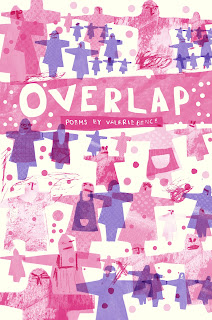
Review by Rosa Fernandez of "Overlap" by Valerie Bence


Overlap is a collection of twenty-one poems by Valerie Bence that contains many timely ideas, and the weaving together of all of them makes sense of this title. This was a book I very much enjoyed reading, and wherever Valerie is, I’m sending her a massive hug.

The journey of this book is from past into present, at first an appreciation of her two clearly much-loved grandmothers Winifred and Harriet; Winifred ‘laughed at everything’ and ‘taught me to wink’ marking her out as the cheekier. Harriet is more brooding and dutiful and ‘lived like prey’ and both suggested elements of my own mother (also a grandmother, and more of a Winifred) and my grandmother (more of a Harriet, I reckon, although she had her moments). The snippets of description of a 1960s childhood will resonate with many, the older women still carrying the drama of wartime with them. The poem ‘Not as posh as I thought we were’ I particularly enjoyed; I felt I could have been the wide-eyed confused child of that poem and it made me giggle.

The last four poems are a sucker punch, and really moved me; I know my mother would feel a solidarity with the sentiments within, having missed time with her own grandchildren. The line ‘I could hardly speak’ hit me hard, and so much of all our lives have been affected by the last two years that I am sure many readers would be similarly moved. The final poem ‘Press me in peat’ is the right poem to end on; while not necessarily a happy ending, it acts as summary from ‘melting glaciers’ to ‘like now’ where we return to the febrile present. I’m sure the grandchildren will be pleased to have this record, and I hope Nonna gets hugs again very soon. 


About
Rosa Fernandez is a slam-winning poet and sometime proofreader. She also enjoys wearing silly hats. 
Friday, 7 January 2022

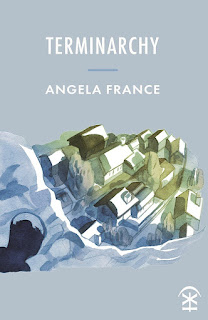
Review by Rosa Fernandez of "Terminarchy" by Angela France


The end of the year was a very appropriate time to read and savour this collection of forty-three poems by Angela France, taking us through time and change and closing with ‘Living Yule,’ and I appreciated many of the sentiments expressed throughout. Terminarchy is about the last of a species and speaks about our experience of the world as we come to terms with what feels like a precipice moment. 

The poems speak to many of our concerns about the changing climate, and we can all agree with the voice of Sparrow, whose character interjects with concerns about the unexpected mildness of the seasons: ‘we’ll pay for this’; another character called Wantwite acts as the embodiment of materialism, coming to life to then suffer the consequences.

I enjoy sinking into descriptions of the unique English countryside, so I relished descriptions like ‘flickering clutter of town’ and ‘a violet nestles in a knuckle of root’ and enjoyed the scene setting. The subtle villanelle of ‘Blame’ was particularly powerful and serves as a microcosm of the collection. 

I will say that I felt the worldly concern more readily than I felt the hope; there was a subtle sense throughout of a kind of rejection of technology and progress which I entirely understand but found less easy to read; mentions of Spotify and ‘the new build’ read a little binary (nature: good; technology: bad) and while I agree in part, I feel that our relationship with these new developments may end up being part of the solution. 

As an expression of where we are now, Terminarchy is a thoughtful assembly of poems. The positives in this changing world are hard to pinpoint; one of the things that can help us reflect on the part we have to play is this kind of collection.     


About the reviewer
Rosa Fernandez is a slam-winning poet and sometime proofreader. She also enjoys wearing silly hats. 
You can read more about Terminarchy, as well as three sample poems from the collection, on Creative Writing at Leicester here.


Friday, 5 November 2021

Review by Rosa Fernandez of "The Mask" by Elisabeth Horan


‘A celebration and [a] tribute’ is how the author describes The Mask, a collection of nineteen poems directly inspired by the paintings of Frida Kahlo (and a guide to which ones is helpfully included). The mask of the title itself refers to a specific painting and one that sums up the whole concept of the collection: a self portrait where Kahlo’s face is hidden and yet still full of emotion. 

The poems in this collection are all spoken by the imagined voice of Kahlo and have a flow to them that feels like the brush in her hand, sweeping her feelings onto canvas. The voice is direct and powerful and peppered appropriately with Spanish, ‘somehow separada’ and ‘into the rear of el restaurante’ where we can understand more than we think about Kahlo’s world in the writing. You don’t need to see the paintings to get the imagery; in ‘Nectar of the Gods and a Woman’s Throat,’ the animals, her face and the thorns are all described and weighted with meaning.

I really enjoyed the knowingness and humour of this imagined Kahlo, and the witty double meaning of ‘stanza’ in ‘The Mask, Vol. 1’ was a wonderful poetic highlight: ‘I’ve told Eli to make a new stanza,’ the poem ending with the spectacular line ‘Come and f*** me in my mind.’ The respect that the author has for the artist is evident and this poetic tribute is eloquent and sensual throughout, without shying away from Kahlo’s pain or rage.

Sensitive readers may query the fearless language throughout, but Kahlo was a unique individual with an unflinching perspective on the world, and it feels authentic. This collection is as colourful and vivid as its inspiration and can be enjoyed as both enjoyable poetry and as a companion to some fascinating paintings. 


About the reviewer
Rosa Fernandez is a slam-winning poet and sometime proofreader. She also enjoys wearing silly hats. 


Tuesday, 15 June 2021

Review by Rosa Fernandez of "How Not to Multitask" by Jo Weston


Aware when I received How Not to Multitask that it would refer to the author Jo Weston’s experiences with her cancer diagnosis, I was prepared to be moved. I approached her pamphlet wondering how best to interpret the title (one I enjoy very much, given that I’m not a multi-tasker by nature) and how that would reflect on the fourteen poems within, poems I am pleased to say I very much enjoyed reading.

The opening poem, ‘Neighbourhood Watch,’ is a great introductory piece as it paints vivid sensations in a few brief words and yet ends on an unsettling pair of closing lines, acting as a cliff-hanger for what is to follow: a range of poems that for the most part brings the familiar to life simply but carefully, realising sometimes huge swathes of emotion in clever little turns. 

‘Chronic’ and ‘Results’ really captured the fear, acceptance, and stiflingly still yet charged moments of treatment. I felt they conveyed that sense of the inexplicable, the trying to find a way to explain the unexplainable. ‘Rain slid down the leaves / of the remaining trees’ is a simple and yet (in context) extremely moving metaphorical image. 

‘Gran’ is a very straightforward poem, but still very enjoyable and one I think would resonate with many readers; for its proliferation of adjectives my least favourite would be ‘Moving meditation,’ although it does describe a keen wet dog beautifully. 

How Not to Multitask is a pamphlet full of feeling; for me, the title suggests that sometimes the only task is to recover, and to appreciate tiny precious moments of existence (like listening to the strangers on the bus) undistracted. The optimism of the closing poem ‘Too young for this’ really brings the collection ‘home’ and neatly completes a brave and heartfelt selection.


About the reviewer
Rosa Fernandez is a slam-winning poet and sometime proofreader. She also enjoys wearing silly hats. 


Wednesday, 2 June 2021

A Book That Changed Me, by Rosa Fernandez: "If on a winter's night a traveller," by Italo Calvino


I first read If on a winter’s night a traveller in the summer break between the second and third years of my English degree as a way of getting ahead on my reading list. It was a hot summer and I curled up in a sunny window for hours while I devoured this absolute gem of magic realism. It was the first book I had ever read to be written in the second person. It completely absorbs the reader in the act of reading, narrating itself as page after page of starts of novels make up a puzzle only solved by reading on. Attention is drawn to the act of reading, and writing, and to all the things that we expect novels to do. Even the ending is a remark on what we ‘expect’ from a story, and it helps that there are also plenty of jokes.

This novel is like no other book I had read before or since and completely blew apart my idea of what a novel could do. It also, in a very real way, actually changed my life a few years later. At a job interview at a magazine, I was asked a final question by one of my two interviewers: who is your hero? I took a minute and answered that it was Italo Calvino, because he was responsible for this enigmatic novel. I left after the interview and they called me later to tell me the job was mine. Only a month in and the man who had asked me the question told me that it was that answer that got me the job, because most people say cliched things like ‘my mum’ or ‘my dad’. I should have said ‘my mum,’ of course, but then she would probably have said ‘Dickens.’


About the reviewer

Rosa Fernandez is a slam-winning poet and sometime proofreader. She also enjoys wearing silly hats.