Showing posts with label Sue Hubbard. Show all posts

Thursday, 19 October 2023

Review by Gary Day of "God's Little Artist" by Sue Hubbard


It’s not often that a poetry book comes complete with an introduction and notes but both do sterling work in providing a context for these poems about the life of the artist Gwen John whose achievements have been somewhat overshadowed by those of her more famous brother Augustus. 

Sue Hubbard brings her characteristic empathy and inventiveness to bear in telling John’s story from her life in Tenby, to her time at the Slade, to her move to Paris with Dorelia McNeill, on whom she may have had a crush, and who later lived in a ménage à trois with her brother and his wife Ida Nettleship. Gwen had to model to earn money and Hubbard concisely and dramatically evokes the humiliation such work could involve: ‘insolent hands on her small breasts.’   

The majority of poems in this splendid collection concern Gwen’s fateful relationship with the sculptor Auguste Rodin who was 36 years her senior. The verse pulls no punches in its evocation of desire: at one stage I had to loosen my collar. Hubbard is no less deft when it comes to conjuring the agony of being displaced by another in the affections of the beloved. One of her many gifts is to present love in the round, how it can abase as well as elevate: ‘she wants only to button his boots.’ 

After her affair with Rodin ended, John threw herself into her work. ‘The Poetry of Things’ is one of the standout pieces in the volume where ‘clouds of spray’ become ‘strings of prayer beads / lucent as benedictions.’ Art and religion offer a way forward for the broken self ‘only paint and prayer / can offer salvation.’ 

With its wonderfully glowing imagery this is a work to be treasured. 


About the reviewer
Gary Day is a retired English lecturer. He is the author of several books including The Story of Drama: Tragedy, Comedy and Sacrifice from the Greeks to the Present. He has also edited a range of books including two volumes on British Poetry in the Twentieth Century. His debut poetry collection, The Glass Roof Falls Like Rain, is due to be published by Holland Press later this year. 

Friday, 22 September 2023

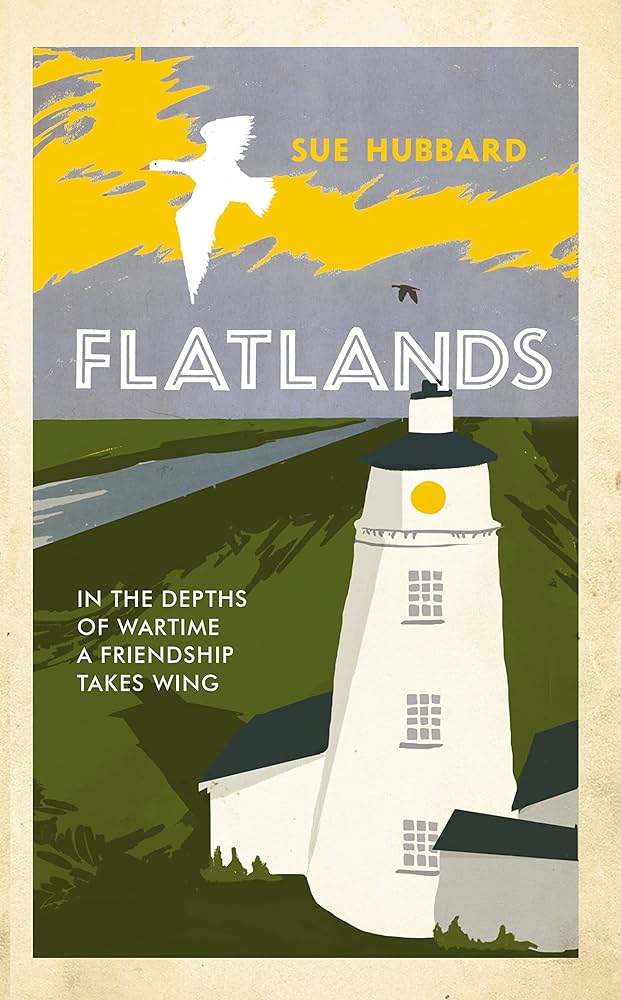
Review by Lisa Williams of "Flatlands" by Sue Hubbard


Flatlands by Sue Hubbard retells Gallico’s The Snow Goose but to an adult audience. Two souls that don’t belong, Freda and Philip, are bonded by the welfare of an injured bird: wounds and the wounded feature heavily in this wartime story. We are still evacuated with Freda but the desolation of the Snow Goose’s stretching mudflats are shifted up the coast to a “place between somewhere and nowhere” on the shores of the Wash. Hubbard’s skilled scene setting places us in both the wilderness and the time perfectly.

On “a hot day, the sort of day for a picnic, not a war” we’re transported with Freda on a train full of sad, scared evacuees to a new home “far away from love.” We’re immersed immediately in the “melancholy of the place.” This landscape, we learn as the story unfolds, matches the aching loneliness felt by both Freda and Philip. Freda remembers paisley eiderdowns and parma violets – Hubbard treats all our senses as she juxtaposes home comforts against the relentlessly barren East coast landscape.

Throughout the book the feeling of threat and uncertainty that war brings looms large but the actual menace is revealed to be lurking within the farmhouse. It is in the very place that Freda is put for safety that the full horrors of war are first exposed. She finds sanctuary at Philip’s lighthouse and they form what Philip describes as “a strange little friendship.”

An elderly Freda is telling us the story as a documentary about Dunkirk is about to be shown at her care home. Those nursed on the The Snow Goose will know Dunkirk’s poignant part in the story. I’m paddling carefully here not to avoid mines, but spoilers. During the depths of Dunkirk’s horrors in Flatlands oddly it was the addition of a dog in the water that made me catch my breath. His fate lingers long after the page has been turned.

As I read a book I make a note of sentences that I like. There was a point early on in this book that I thought I might never finish reading it because I was writing so many down. It’s a slow-paced read but with some delightful lines.


About the reviewer
Lisa Williams is a creative soul from Leicester. She has a Masters in Creative Writing from Leicester University, and lately tends to write mostly short fiction. She likes the challenge of a word limit – usually one hundred words. Her work has been published in numerous anthologies. Lisa has a weekly story slot on local community radio. She helps out a bit at Friday Flash Fiction and Blink Ink Journal. Lisa also paints and makes jewellery selling online as noodleBubble.

Wednesday, 9 March 2022

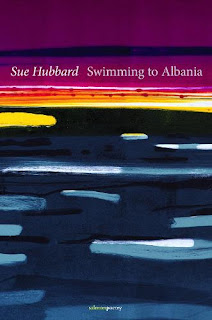
Review by Jane Simmons of "Swimming to Albania" by Sue Hubbard


Swimming to Albania is Sue Hubbard’s fourth collection of poems. The opening poem ‘Lost in Space’ teases out the preoccupations of the collection – longing, desire and loss – in its presentation of the poet as a child ‘lost’ and dreaming of ‘a boat that will take her home.’

More poems about childhood follow and the sense of being lost is reinforced in the tentative title of ‘1955, perhaps?’ and in the opening of ‘Snow’ where the poet is ‘lost in an infinity of misted mirrors.’ The words ‘loss’ and ‘lost’ reverberate through the poems in the first of the three sections of the collection, along with ‘absence’ and ‘space.’ This emptiness is a space which cannot be filled because ‘the past is another country / one I barely remember’ and ‘the dead [are] impervious to our childhood questions.’ The truth is ‘a void’ they cannot fill, leaving the poet haunted by ‘all that was never said.’ 

From here, the poet invites the reader to accompany her on a journey in poems which take her from the west coast of Ireland by way of Lisbon, Siena and Greece, to Albania. It soon becomes clear that this journeying is loaded with metaphorical significance: it is a journey into the poet’s past, a voyage of self-discovery, and an Odyssean search for an idealised home where the self is known – a safe place on the other side of grief, a state of reconciliation, redemption, and understanding.

Between the coastal places of the opening and closing poems at either end of the journey, further images of water function as metaphors of psychoanalytic exploration – as the poet dives into deep dark places of self. The Albania which the poet is swimming towards in the title of the collection, and the penultimate poem, is the once-forbidden place that even now is difficult to reach.


About the reviewer
Jane Simmons is a former teacher – and now a PhD student. She won the University of Leicester’s GS Fraser Poetry Prize in 2019, 2020 and 2021, and the Seren Christmas Poetry Prize in 2020. Her work has appeared in Ink, Sweat and Tears, The Blue Nib magazine and on the Seren blog, as well as being long-listed for the Butcher’s Dog magazine.


You can read more about Swimming to Albania by Sue Hubbard on Creative Writing at Leicester here