Showing posts with label Jane Simmons. Show all posts

Sunday, 7 April 2024

Review by Jane Simmons of "The Strongbox" by Sasha Dugdale


In her new collection The Strongbox, Sasha Dugdale draws on elements of Greek mythology and classical epic literature, exploring and reinventing narratives and characters from Homer’s Iliad and Ovid’s Metamorphoses and incorporating distorted fragments of Heraclitus, to create fourteen new, long poems which come together as a cry of distress for the modern world. 

The dialogue within and between these powerful poems shapes our understanding of our troubled times, the conflicts between states, between political and religious ideologies, and between male power and female strength. In "I. Anatomy of an Abduction," Dugdale presents the reader with an unnamed girl who has somehow been abducted or persuaded to leave behind her country, family and childhood to travel to a war-zone.

          It began with the sun
          appearing over the plane wing
          supernatural orange
                                          but no light

It is impossible to read on without thinking of the London schoolgirls travelling to join Isis in Syria. Then, when Helen - the wife of King Menelaus of Sparta - is introduced, "trapped behind the walls of Ilium" and "plagued by dreams about the coming war," the familiar Homeric narrative of the Trojan War makes clear the parallels of lured brides, political conflicts in the Middle East, and the Russian invasion of Ukraine. These connections are ready to be explored in poems which offer the reader a lens through which to analyse both love and war.

The title of the collection, The Strongbox, is a good introduction to Sasha Dugdale’s use of the recurring metaphor, a technique which is key to an understanding of the collection. In one sense, this example serves as a metaphor for poetic form: the sonnet form is often described as a "box" and, although the poems are not sonnets - and some of the pieces are prose or drama-script - there are fourteen pieces here for the reader to unpack. These experiments with genre, along with the intertextuality, are part of Dugdale’s distinctive poetics.

If a strongbox is a secure place for storing valuable goods or valuable stolen goods, then it can be read as a metaphor for the abducted or lured brides, a judgement of male-female relationships, and of political and ideological conflicts as is made clear by the further metaphor of "a golden crown" for the city. Helen herself was famously born from an egg, the result of the rape of Leda by Zeus in the form of a swan. In "XI: Gods & Men," a precious egg is stored in a locket kept inside the secret drawer of a campaign chest, in a Greek king’s gold-painted canvas tent in the encampment on the Trojan plain. Then in "XIV: The Ticket Booth," Dugdale reworks the story of Europa whose beauty attracted the attentions of Zeus who then approached her in the form of a white bull and abducted her. "The Rape of Europa" is also a term used to refer to the fate of European art and treasures in the Third Reich and the Second World War. In the poem, the lines "[I] found no words / And little hope" invite the reader to consider the strongbox and its contents as a possible representation of Pandora’s box, containing all the troubles of the world - and finally a small hope. Perhaps language – the power of words – offers that hope. 


About the reviewer
Jane Simmons is a PhD student at the University of Leicester where she has won the G. S. Fraser poetry prize. Her poems have appeared in various magazines, won the Seren Christmas poetry prize (2020), been long-listed in the Mslexia poetry competition and The National Poetry Competition (2022), shortlisted for a Candlestick Press prize (2023) and placed third in the Mslexia poetry competition (2023).


Monday, 24 April 2023

Review by Jane Simmons of "Kitchen Music" by Lesley Harrison


Lesley Harrison has published six collections of poetry, and now, in her first Carcanet collection, she turns her attention to the north and to the sea in poems which focus on northern lands and waters – to the Orkneys, and Iceland, their histories and stories, their flora and fauna, to northern seas, wild weather, whale-hunts.

In a foreword to the collection, Kirsty Gunn gives a powerful account of her own repeated and deepening encounters and engagements with these poems and tells the reader to expect "A book of poems, a book of voices. A book that is also a map, an almanac, a report – of histories, of stories, of lands and waters. A book of poems made and arranged in such a way as to create harbours and enclosures: the contained order of narrative brought to a wild scattering of events; a careful arrangement of whale bones on a gallery floor to tell the tale of that great singing creature now stilled to silence."

It is a book of poems which engage with other books, texts, poems – think Icelandic rune poems, sagas and folk-tales, the lives of Northumbrian saints, the personal diaries of sea-captains on whaling ships, glossaries of northern dialects. However, it is a book which also engages with music – with gaelic psalm, hymnals, and even the work of composer John Cage. There are poems which are songs – written in numbered parts, part songs – and the reader’s attention always being drawn to the musicality of even the smallest fragments of text. Sometimes, poems combine the two, books and music, to resemble the appearance and musicality of Anglo-Saxon verse – as illustrated in the opening poem:

Wou as in Wound 

WOU    as in wound
   HU    as in hunt
    AH    as in raft 
     LL   as in fall
      E    as in breech
 
WOU   as in bow
   HU    as in tump
    AH   as in slight
     LL   as in blink
      E    as in swell
 
WOU   as in fluke
   HU    as in tongue
    AH   as in ebb
     LL   as in oil
      E    as in jaw

WOU    as in run
   HU    as in calf
    AH   as in eye
     LL   as in blow
      E    as in breath 

WOU    as in sound
   HU     as in hull
    AH    as in wash
     LL    as in shelve
      E     as in dive

This is a collection to sit with.


About the reviewer
Jane Simmons is a former teacher now PhD student. She won the University of Leicester’s G. S. Fraser poetry prize in 2019, 2020 and 2021, and the Seren Christmas poetry prize in 2020. Her work has appeared in Ink, Sweat and Tears, The Blue Nib magazine and on the Seren blog, as well as being long-listed for both the Mslexia Poetry Prize and The National Poetry Competition in 2022.

Thursday, 23 March 2023

Review by Jane Simmons of "The Fourth Sister" by Laura Scott


The poems in Laura Scott’s new collection are populated by a richly assorted cast: lovers and sisters, but also parents and children, the living and the dead, birds and trees, painters, playwrights and their characters, Tolstoy, a godfather who married the wrong man and a godmother who was surely a spy.

The title alludes to Chekhov’s ‘Three Sisters,’ and references to the writer, his life and work are woven through the collection in poems such as ‘The First Sister’ which balances the title of the collection, ‘The Fourth Sister’, and ‘To Be One of Them,’ written after seeing a production of the play which describes being drawn into it to become one of the sisters. 'Why Are You Silent?' is a poem made up of extracts from letters between the playwright and the actress Olga Knipper who became his wife. 

This last is a poem which the poet describes as ‘an anti-autobiography poem,’ a description which introduces the playfulness evident in the collection. Poems also play with ‘the tyranny of stories’ – the fourth sister is ‘the one who slips the story’s collar,’ while ‘Why Are You Silent?’ plays with dialogue, with ideas of volubility or the ‘sprawl of talk,’ its long lines changing  direction as they snake down the page. ‘Cover Photo’ – a late addition to the collection - was written to guarantee the use of picture which was Scott’s choice for cover.

I was struck by how questions are used in these poems, how they pose questions and set out to answer them. ‘The Fourth Sister,’ for example, begins with a series of questions and opens up a dialogue with the other ‘sister’ poems. However, Scott knows better than to overwork the technique: in ‘The Bored Cowboy,’ one of a sequence of poems on boredom which explores how it slows down time so that you feel the ‘thickness’ of ‘slow, clogged time,’ she begins with one of those questions:

          and what about the blackbird
          Singing his big strong song
          From the heart of the tree?

only this time she denies the reader an answer by the ‘-‘  at the end of the poem.

At the Carcanet book launch for ‘The Fourth Sister,’ Scott spoke of how she is fascinated by our inability to remember, of wanting the poem to free something and then encountering the resistance of the subject. This is how her poems come to be held between ‘telling and withholding’ – like the people in Chekhov’s plays – and how the reader is invited into the space of the poem to participate in the action and the dialogue.


About the reviewer
Jane Simmons is a former teacher now PhD student. She won the University of Leicester’s G. S. Fraser poetry prize in 2019, 2020 and 2021, and the Seren Christmas poetry prize in 2020. Her work has appeared in Ink, Sweat and Tears, The Blue Nib magazine and on the Seren blog, as well as being long-listed for the Mslexia Poetry Prize 2022.


Friday, 21 October 2022

Review by Jane Simmons of "Standing Up with Blake" by Philip Dunn


Philip Dunn’s work has already won him many local admirers, and now his keenly-awaited first collection introduces his work and his poetic voice to a wider audience, beyond the place where ‘the alchemy of dyke and drain / make liquid silver of the leaden skies.’

The opening poems explode into life, taking the reader from the Trump presidency by way of Blake and his visions of angels to the impoverishment of language through the removal of words from the dictionary, the extinction of lambs and lions, and the coming of a world which ‘will henceforth only ever home whatever never takes a breath.’ 

The political and the personal cross paths throughout the collection: it is only ever a small step from internet trolling to political violence, and from the evils of social media to the i-phone literate seven year-old who does not know his own surname or family address.

Dunn knows the value of approaching his subject ‘slant’ – using the song of a blackbird to plunge the reader into WW1 trenches, or skilfully exploiting intertextuality, such as when he uses the title ‘Cant and Culpability’ to make pointed comment on current politics or employs a reference to Jenny Joseph in an example of the wry or self-deprecating humour which is another characteristic of his work.

These poems do not just resonate with concerns about past and current political situations and about social change. Elsewhere, there are poems of considerable tenderness: for the awkward boy, uprooted from his familiar surroundings and hearing ‘the unmistakeable voice of exile’; for first love, ‘the boy on the green bench / burning like a grazed knee’; for relatives becoming increasingly frail in old age; and for a friend struggling with a dementia diagnosis.

Altogether, this is a collection which was well worth the wait.


About the reviewer
Jane Simmons is a former teacher – and now a PhD student. She won the University of Leicester’s G. S. Fraser poetry prize in 2019, 2020 and 2021, and the Seren Christmas poetry prize in 2020. Her work has appeared in Ink, Sweat and Tears, The Blue Nib Magazine and on the Seren blog, as well as being long-listed for the Butcher’s Dog Magazine.

Tuesday, 18 October 2022

Review by Jane Simmons of "Scenes from Life on Earth," by Kathryn Simmonds


Scenes from Life on Earth is the third collection of poems from Kathryn Simmonds, the follow-up to her 2008 Forward Prize-winning debut collection Sunday at the Skin Launderette (Seren) and her second collection Visitations (Seren 2013).

The new collection addresses the loss of the poet’s mother, how we grieve, and how we remember those we love; it also explores the related themes of motherhood, of life and death, and how to live in the modern world.

These are big themes, but Simmonds is not afraid to visit them or to explore their mysteries through the prism of her religious faith. That is not to say that the poems themselves are religious poems, or that faith dominates the collection: although there are references to Christ and poems which reference familiar Biblical narratives such as the story of Jonah and the whale, the poet is just as likely to address her big questions or arrive at her celebration of the living or the dead through perceptive observations of the natural world. The meetings of the physical and metaphysical worlds are also sign-posted in the titles of several of the poems which reference tipping points in the week, the months, and the year: 'Wednesday Morning,' 'April,' 'November,' 'Solstice,' 'Equinox.'

Lessons are taught by children, who are presented in ways which might remind the reader of Blake or Wordsworth, but also by plants, birds, insects or even garden weeds and pests such as dandelions or slugs. The war on weeds in 'Dandelion' is mistaken – the plants should be celebrated for their joyous enthusiasm for 'more life.' Elsewhere, the poet asserts that it is better to be a leaf 

          than 
          walk about all day, 
          tormented by a brain

The messages from nature are asserted once more in the closing lines of the final poem which provides the title for the collection:

          I loved the trees because
          they had redemption down, 
          oh God be glorified, I loved the trees! 
          The way they ate their old regrets 
                                                   and made them into leaves.


About the reviewer
Jane Simmons is a former teacher – and now a PhD student. She won the University of Leicester’s G. S. Fraser poetry prize in 2019, 2020 and 2021, and the Seren Christmas poetry prize in 2020. Her work has appeared in Ink, Sweat and Tears, The Blue Nib Magazine and on the Seren blog, as well as being long-listed for the Butcher’s Dog Magazine.

Wednesday, 9 March 2022

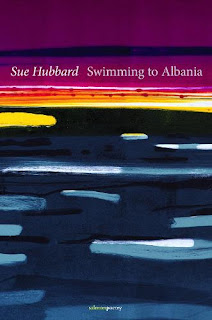
Review by Jane Simmons of "Swimming to Albania" by Sue Hubbard


Swimming to Albania is Sue Hubbard’s fourth collection of poems. The opening poem ‘Lost in Space’ teases out the preoccupations of the collection – longing, desire and loss – in its presentation of the poet as a child ‘lost’ and dreaming of ‘a boat that will take her home.’

More poems about childhood follow and the sense of being lost is reinforced in the tentative title of ‘1955, perhaps?’ and in the opening of ‘Snow’ where the poet is ‘lost in an infinity of misted mirrors.’ The words ‘loss’ and ‘lost’ reverberate through the poems in the first of the three sections of the collection, along with ‘absence’ and ‘space.’ This emptiness is a space which cannot be filled because ‘the past is another country / one I barely remember’ and ‘the dead [are] impervious to our childhood questions.’ The truth is ‘a void’ they cannot fill, leaving the poet haunted by ‘all that was never said.’ 

From here, the poet invites the reader to accompany her on a journey in poems which take her from the west coast of Ireland by way of Lisbon, Siena and Greece, to Albania. It soon becomes clear that this journeying is loaded with metaphorical significance: it is a journey into the poet’s past, a voyage of self-discovery, and an Odyssean search for an idealised home where the self is known – a safe place on the other side of grief, a state of reconciliation, redemption, and understanding.

Between the coastal places of the opening and closing poems at either end of the journey, further images of water function as metaphors of psychoanalytic exploration – as the poet dives into deep dark places of self. The Albania which the poet is swimming towards in the title of the collection, and the penultimate poem, is the once-forbidden place that even now is difficult to reach.


About the reviewer
Jane Simmons is a former teacher – and now a PhD student. She won the University of Leicester’s GS Fraser Poetry Prize in 2019, 2020 and 2021, and the Seren Christmas Poetry Prize in 2020. Her work has appeared in Ink, Sweat and Tears, The Blue Nib magazine and on the Seren blog, as well as being long-listed for the Butcher’s Dog magazine.


You can read more about Swimming to Albania by Sue Hubbard on Creative Writing at Leicester here

Monday, 24 August 2020

Review by Jane Simmons of "I, Ursula" by Ruth Stacey


At an online literary festival earlier this year, I heard poet Ruth Stacey speaking about writing imagined memoirs - and the techniques which she uses to create an authentic sounding voice for historical characters. In I, Ursula, her second full-length collection of poems, she presents the reader with a wide range of voices for female characters both real and imagined. 

The poems about the imagined characters take us back into the worlds of fairy-tale, legend and folk-history – to Rose Red, to Beauty and the Beast, to mermaids and witches. These poems take us into familiar Angela Carter territory – magical, subversive, feminist - and they are often entertaining in their exploration of paradoxes of female experience. ‘Bears are not good fuck-buddies’ begins the poem ‘Rose Red’ – and though the speaker goes on to list her bear’s many faults which lead her to throw him out because she ‘just can’t stand him any more,’ the poem ends, ‘I hope he comes back / I miss the warmth of the bear in my bed.’

The poems which I find the most powerful are those where the poet explores the experience of the female muse and the male artist in both art and literature. This major theme is introduced in the wittily titled poem ‘Averse Muse’ which opens the collection, and it is easy to spot in other titles such as ‘Muses.’ There is a strong feminist agenda behind the  presentation of the muse in many of these poems, and it is perhaps most striking or shocking in the eponymously titled poems such as ‘I, Ursula,’ ‘Camille  Claudel,’ ‘Jeanne Hebuterne,’ ‘Emilie Floge.’ This is where the personal becomes political: the male artists are known, but not the names of their female muses – not even when they were talented artists in their own right. The poor ‘I’ even goes unnamed in the golden shovel ‘Decorative’ and the later poem ‘Lady of a Portrait’ - no wonder that these women rebel. These poems – like so many others in the collection – explore relationships between artist and muse, men and women, the tensions between life and art, and the creation and appreciation of various forms of art, in terms of power and powerlessness.


About the reviewer 

Jane Simmons is a former teacher/lecturer who has recently completed an MA in Creative Writing at the University of Lincoln. She is now a PhD student at the University of Leicester. As a reviewer for The Blue Nib literary magazine, Jane has built a significant publication history of writing about contemporary women’s poetry. A selection of her own poems appeared in the March 2019 edition of the magazine. Her pamphlet From Darkness into Light - poems inspired by the Book of Kells was published in 2018. Further poems have appeared in The View from the Steep, an anthology published by Pimento Press in 2019.