
Showing posts with label literary criticism. Show all posts

Monday, 21 February 2022

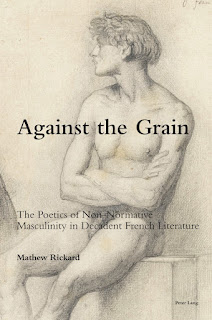
Review by Elle Morgan of "Against the Grain: The Poetics of Non-Normative Masculinity in Decadent French Literature" by Mathew Rickard


This book opened my eyes further than before, to gender-based issues experienced during the French Decadent movement, in the late 1800s. This is not an area I will pretend to know a lot about from a critical perspective, but I found that it introduced the topic in an engaging way. It is an insightful and urgent exploration of queerness, best read accompanied by a glass of white wine on a rainy Sunday. 

I came away from the book reflecting on how it addressed a gap in research I hadn’t known of. What could be an integral section of gender studies is posed as a new and daring answer to a question not often asked: is it really a man’s world? This is discussed using masculinity as a literary concept, as well as exploring how being literate has long raised important discussions regarding privilege. 

Originally written as a doctoral research thesis by a then-emerging scholar in the field of French Studies, the finished book is a wonderful appraisal of masculinity, sexuality, and the specific challenges gender-based discrimination poses. Readers will enjoy being introduced to new knowledge on the concept of the ‘dandy,’ as well as analyses of French literature from the nineteenth century. 

With a backdrop of advances in science, mass industrialisation and modernism, France at the turn of the century has always been a crucial site for understanding intersections of identity. This text is rich with these explorations, and it is an enjoyable read written by a pioneering scholar. It was the joint winner of a Peter Lang prize in 2019, and has been received well by many scholars in the field of Decadent Studies and beyond. It will certainly aid any scholar’s research in gender studies, and nineteenth century literature too.  


About the reviewer
Elle Morgan is primarily a writer but has held many jobs! Currently, Elle is studying a mix of practice-based Creative Writing and French Studies, and enjoys writing after lots of walking (but not in the current storms buffeting the UK). Elle’s website is here.

Thursday, 19 November 2020

Review by James Holden of "Paris Bride" by John Schad


A woman, a bride even, or at least a ‘supposed bride,’ walks through the bustling streets of London on her way to see a doctor. Then, another day, this same woman walks into a bustling court room and, a short while later, walks out a bride no longer, neither supposed nor legally. The woman who walked in as Marie Schad walks out as Marie Wheeler, born again as the person she had once been.

At the same time, this Marie walks out of history. In Paris Bride, our author, John Schad, walks behind her, following her or finding her as she progresses through literary history – in the pages of works by Woolf, Kafka, Mallarmé and more. He finds her back in Paris, only a Paris that has become a ‘manuscript of a city,’ a modernist space in which identities are rewritten, so that our Marie becomes, amongst others, Marie, the wife of Ferdinand de Saussure, one of Mallarme’s four Maries, and a thinker of the words of Dr Marie Stopes. She is spotted by surrealists and wanders by Walter Benjamin. Here, for John Schad, to quote one of his major intellectual preoccupations, the philosopher Jacques Derrida, ‘there is nothing outside of the text.’ Or, rather, Schad works under the same assumption as that most Parisian of modernists, albeit one not mentioned in Paris Bride, Marcel Proust, which is to say he seems to believe that ‘real life, life finally uncovered … is literature.’ The real life of Marie Schad, née Wheeler, was, for John Schad, lived in literature, and can be uncovered, and perhaps even finally regained, amongst its pages.

Paris Bride asks throughout the question of legitimacy: the legitimacy of Johannes and Marie Schad’s marriage; the legitimacy of Johannes's ‘second’ marriage to the other Marie, and, by extension, the children that issued from it; and, more broadly, the legitimacy of literary criticism. Here, via Kafka, the university is shown to be a court. But more, Paris Bride puts university scholars in court, and watches as they prosecute themselves. John Schad says of himself that he is a ‘bad’ scholar. Not for him what Benjamin calls the ‘conventional scholarly attitude.’ Instead, Schad is, he declares, in possession of ‘useless papers … found somewhere toward the broken back of a broken drawer’ and is ‘guilty of misreading.’

And yet, to read Paris Bride and its author in this way is to misread them. This book asks not for ‘an impromptu or hasty reading’ but for something altogether more ‘exquisite.’ For what ‘Scholar Schad’ offers here, with consummate skill, is a legitimate and sophisticated marriage of scholarship and storytelling.


About the reviewer
James Holden is an independent academic and writer. He is a Lisztian, a Proustian, and a proud nerd. The author of In Search of Vinteuil: Music, Literature and a Self Regained, his recent work has focused on the piano playing and aesthetics of the Romantics. His website is: https://www.culturalwriter.co.uk/

Monday, 24 February 2020

Interview with John Schad


John Schad is Professor of Modern Literature at University of Lancaster.  His books include Victorians in Theory (Manchester, 1999), Queer Fish: Christian Unreason from Darwin to Derrida (Sussex, 2004), a memoir, Someone Called Derrida (Sussex, 2007), a novel The Late Walter Benjamin (Bloomsbury, 2012), an experimental biography called Paris Bride (Punctum, 2020), and (with Fred Dalmasso) Derrida | Benjamin. Two Plays (Palgrave Macmillan, 2021).  He has also had two retrospectives published - Hostage of the Word, 1993-2013 (2013) and John Schad in Conversation (2015). He has read his work on BBC Radio 3’s ‘The Verb’ and at various literary festivals, and his plays have been performed at The Oxford Playhouse, Duke’s Theatre Lancaster, Watford Palace Theatre, HowTheLight GetsIn (Hay-on-Wye), and the Sheldonian Theatre Oxford.


Interviewed by Jonathan Taylor

JT: How would you describe the genre you work in? Is it literary criticism, philosophy, creative writing, creative-criticism, life writing, theology, literary theory, or a mixture of some or all these things? 

JS: Guilty of all the above, plus: slapstick, pantomime, and circus. So, yes, I guess I do mix things up; or, rather, I am mixed up. I am particularly mixed up about the difference between reading and writing, which I shall never grasp. It’s why I am always writing out of reading, always writing in the shadow, or shelter, of a prior text, in the margins, or between the lines. On a good day this works, and I'm off, running away to the circus, off to the far side of Literature. On a bad day, Bad.

JT: How would you describe your style or voice? 

JS: Dull. Which is why I'm always trying to lose my voice, or to throw it, throw it away, and find another one, a voice that can do more with less - less effort (being lazy, you see). It never seems to happen though.

JT: You write for the theatre, as well as for the page. How do the two forms relate to each other in your work? 

JS: Ah, yes, the theatrical antics, they emerged out of the prose. It just happened one day. (Pause). You know, sometimes I am persuaded that all writing, in the end, aspires to the condition of theatre, of voices or bodies performing before a darkened auditorium in which there may, or may not, be an audience. There was, of course, theatre long before ever there was writing. 

JT: Do you find there are things you can do in one form that you can't in the other?

JS: Yes. Theatre lets you get away with not describing boring things like the weather and faces; you can just do the voices and leave the rest to the actors. An almighty relief. And when I can’t find any actors I simply write a book which suddenly, or for a while, becomes a play – it’s cheaper. 

JT: How would you describe the parts played by philosophy or religion in your writing? 

JS: You know, I have recently begun to imagine that I'm writing books which think or pray by themselves. To put that another way, I imagine that the book is a thinking machine – that if I could but wire it up sufficiently, build enough connections both within the text and with the world beyond, that the book will start to think all on its own. I have in mind Alain Badiou’s wonderful question, ‘What does the poem think?’ The answer to this question may, of course, be ‘Not much,’ but that may be where the prayer begins - with stupidity.   

JT: Who (do you think) is your intended reader? Who do you write for?

JS: I’m never quite sure if there is a reader – and not just because I am so very dull.  You see, I suspect that the reader might not really exist at all, or is at best a kind of ghost. I am, then, used to talking to no one, or the air. Like now. Mind you, sometimes I dream that the reader does exist and that s/he might yet redeem the book, make nothing of it.

JT: Much of your writing is heavily intertextual. Do you think the reader needs to have read the explicit intertexts to which you allude (by Jacques Derrida, Samuel Beckett, Emily Dickinson, Katherine Mansfield, Dickens, Walter Benjamin, et al) to understand your work? 

JS: No. You see, these damned texts just turn up, unannounced, out of the blue, much like any other character or voice - walk right in they do, quite unexplained and strange, as fresh as they day they were first coughed up.  


JT: Can you tell us a bit more about your new book, Paris Bride: A Modernist Life - its origin, the premise, its aim? 

JS: In 1905, in a Baptist church in Paris, a young woman called Marie Wheeler married (or thought she had married) someone called Johannes Schad, a clerk from Basel. Marie and Johannes then lived together in suburban London until one day, in 1924, they went to the High Court in the Strand, and the marriage there ended, or was declared never to have been. The stated reason for what happened in the High Court was, and is, hard to credit. Marie, nevertheless, disappeared, returning alone to Paris. And that is all the official records revealed. 

One day, however, I received a message from an angel in Paris called Jacques, who said his great-grandmother knew Marie, and that her diary revealed quite another version of events. The angel also sent me a photo of the young Marie, a few of her letters, and one or two details of her life and death.  

So, clutching said fragments, I fell head-first into a whole pile of books written by giants like Wilde, Kafka, Woolf, and Mansfield. And there, time and again, I swear that I glimpsed the face or the back or the shadow of Marie. And that’s the book, Paris Bride - it thinks that it reads Marie back into existence. Mad.  


About the interviewer
Jonathan Taylor is the director of Everybody's Reviewing. His books include the novel Melissa (Salt, 2015), the poetry collection Cassandra Complex and the memoir Take Me Home (Granta, 2007). He directs the MA in Creative Writing at the University of Leicester. Many thousands of years ago, he was John Schad's PhD student. 


Monday, 29 May 2017

Review by Paul Taylor-McCartney of "Deaths of the Poets" by Paul Farley and Michael Symmons Roberts


A recent Radio 4 Book of the Week, Deaths of the Poets by Paul Farley and Michael Symmons Roberts (Jonathan Cape), is a thought-provoking and wildly amusing literary journey. The authors explore the legacies left by some the world’s most-notable poets, largely by visiting the geographical places associated with each poet’s final moments – taking in Britain, Europe and America. Opening with the death of young Chatterton, then exploring the tragic figures of Keats, Thomas, Plath and Sexton, to name but a few, the authors, employing an unusual first person plural in terms of voice, attempt to address the notion that poets – as opposed to novelists, say – are a unique breed of creative, in that they often carry a self-destructive urge to bow out of life when it proves too much to bear, or by enjoying the more visceral aspects of experience and often cutting their lives short. 

I came to this as an avid fan of several poets within the selection, and it made me feel better knowing the same voyeuristic, ‘net-twitching’ need to peer beyond the curtains of pure, biographical fact was felt by other writers out there, too. Treading the ground of more familiar stories leads to some genuinely illuminating discoveries, including the works of Rosemary Lightband and Frank O’Hara, which I did not know prior to reading this study.

 Where the writing is consistently high-quality, the structural design is less successful. Ironically, most sections would have benefitted from including more poetry, showing the connection between economy of form and a life short-lived, perhaps. The first half is also edited with a sharper eye: poets are grouped according to theme with some genuinely stand-out observations made by the authors.  ‘We know London had something to do with it. Indeed, a monochrome, peeling, puddly, just off-rationing country seems bound up with Plath’s suicide.’ Yet, the second half of the book is more meandering. A fatigue sets in for both writers and reader, as we take in yet another tragedy – outcomes of contractual commitments appearing to being played out, rather than the authors trying to prove an over-arching hypothesis. So that by the final poet, Farley and Symmons Roberts take their collective foot of the gas, reducing some of the impact of the study, overall. 

That said, this is not meant to be construed as high literary criticism – it is more about two poets essentially wondering if their own works will be canonised if they remain with us much longer, and the ways in which art is commodified for consumers. Vain enterprise, indeed, to be human. Or, as Keats states more helpfully in 'Ode to a Nightingale': ‘Thou was not born for death, immortal bird! / No hungry generations tread thee down.’ 


About the reviewer
Paul Taylor-McCartney is currently Head of Secondary Teacher Education at Warwick University. He has enjoyed a long and varied teaching career in the disciplines of English/Theatre Studies and is following a part-time PhD in Creative Writing with Leicester University. His research interests include dystopian studies, narratology and 20th century literary criticism.