Thursday, 29 September 2016

Review by Diana Voinea of “The Little Prince” by Antoine de Saint-Exupéry


“I ask children to forgive me for dedicating this book to a grown-up. I have a serious excuse: this grown-up is the best friend I have in the world. I have another excuse: this grown-up can understand everything, even books for children. I have a third excuse: he lives in France where he is hungry and cold. He needs to be comforted. If all these excuses are not enough then I want to dedicate this book to the child whom this grown-up once was. All grown-ups were children first. (But few of them remember it.) So I correct my dedication:
To Leon Werth,
When he was a little boy”


“It is only with the heart that one can see rightly; what is essential is invisible to the eye.”


Come on, I cannot quote all the book, you have to read it! And not because is one of the best-selling books ever published and the fourth most-translated book in the world, but because it will wake up the inner child which is maybe hidden in many of us.


The Little Prince will take you in a magical journey about life and human nature. It is a story that can be read more than once in different stages of your life and every time you’ll discover more about you, about the little things that you have forgotten, about simplicity of life, and it’s meanings. Presenting several characters through the eyes of a child, the author builds up a touching allegory about life, friendship, interior peace and love.


Even if it seems to be a book for children, I truly recommend it to all the adults and I’m pretty sure that if more people would understand the message of it, then the world could be a better place. Thank you, Antoine de Saint-Exupéry!


About the reviewer
Diana Voinea is a Romanian who started a new life, at the age of 44, in the UK and is having a lot of fun running a coffee shop where she meets many people and listens to their stories, and that’s just like reading a book every day. In her spare time she loves to travel, climb mountains, run on a snowboard and enjoy every second of her life.

Wednesday, 28 September 2016

Review by Robert Richardson of “Symposium” by Muriel Spark


Muriel Spark’s novel Symposium begins with a dinner party organised at the London home of the wealthy Chris Donovan and her companion Hurley Reed, a successful painter. The guests, four couples, are well heeled, and include an EU Commissioner, which will contribute, post Brexit, to making this novel something of a period piece.

This initial setting is followed by earlier events showing connections between some of the characters. In the final pages, we are returned to the dinner party. The pleasure Chris and Hurley derive from their meticulous planning of the evening might be seen as echoing Spark’s careful structuring of the novel.

Eventually, the story of one of the guests, the recently married Margaret, becomes central. As readers, we are taken from London to Scotland (the native country of both Margaret and Spark) to meet Margaret’s eccentric family, including the grotesque and insane uncle Magnus. On those days he is permitted to leave the asylum, Magnus is treated by Margaret’s gullible father as a sage, and she has a particular affinity with him. Although innocent, she has been associated with more than one murder, and her own family look on her with suspicion.  Prompted by uncle Magnus, she decides to begin acting duplicitously and in ways that would make the suspicion justified.

Spark is very much a stylist, and her control of expression and tone is impressive, although her short sentences, even in a brief novel such as this, can at times be monotonous. Nevertheless they suit her forensic satire.

The entertainment leaves plenty of room for serious reflections, and at the end we are confronted with planned violence superseded by violence existing spontaneously. Spark shows the fault line of mortality cannot be avoided by privilege and the complacency it assumes.

Spark was a Catholic convert, and there is a tendency to trace those beliefs in her novels. They are no doubt lurking behind all her work, but her lightness of touch means she only occasionally seems to crowbar in Catholicism, and less so than those other converts, Evelyn Waugh and Graham Greene.
           
Published in 1990, in a milieu contemporary to that time, Symposium is a world not too far away from our own, but in an important way it now appears distant, since the same characters today, or at least some of them, would, I suspect, be searching each other on Google, tweeting and posting on Facebook. If Spark were still alive, I think she might be having a lot of fun with the many absurdities of social media.


About the reviewer
Robert Richardson is a visual artist and writer. His work is included in Artists’ Postcards: A Compendium (edited by Jeremy Cooper, published by Reaktion Books, London), and he is a member of the Biennale Austria artists’ association. He is also the co-editor, with William Pratt, of Homage to Imagism (AMS Press, New York). In 2014, his solo exhibition TextSpaces was exhibited at Eugen Gomringer’s Kunsthaus Rehau in Germany.

Tuesday, 27 September 2016

Review by Sebastian Sfat of “Acid House” by Irvine Welsh


Fans of the classic Trainspotting will be delighted with this one, as Welsh’s consecrated style is extremely potent in the collection of stories that make up Acid House. The book will strive to get you through your full spectrum of emotions, as the heartfelt and refreshing style will have you ending up appreciating and sometimes even identifying with the most unlikely characters.


Although the main themes are still the moral decadence, nihilism and selfishness of the proletarian, drug-addicted Scottish youngsters specific to Welsh’s universe, somehow, the dark humour, unexpected plot twists and elements of social satire give it a new depth altogether. From professors who decide to settle a lifelong philosophical argument by means of a fistfight to a youngster wasting away his talents to such a degree that an angry God turns him into a fly, the randomness with tangencies in both the banal and grotesque will challenge you to hold an ever-changing perspective about this book and, why not, life itself. Extrapolating this work, one could argue that life is a series of bizarre, often unrelated events which you can sometimes only observe and learn from. Or laugh at. Or empathise. It would be a great injustice to attribute little literary value to Acid House simply due to the visceral style, crude language and uncomfortable flow of events.

                                                                                                                                  
There is something in this book for everyone, if only just a change of style and tempo. I would recommend it as a light read. Having no narrative flow it can be picked up and gone through in small, infrequent bits without losing any of its value.


About the reviewer

Sebastian Sfat was born in Arad, Romania. Currently working as a Service Desk Analyst at the University of Leicester, which he graduated from with a degree in Management and Economics, he likes what he calls random literature. He will often pick the first book that catches his eye in the store for no obvious reason. It seems to work so far.

Review by rob mclennan of "departures" by Dennis Cooley


because it does not hum where it turns
because it does not ring like glass
because it does not sound in diapason
because it does not want to let things stray
because it tries to bind all things
because it wants to gather them to music
because it blinds all creatures into believing
they might for a wisp of light slow the protein


it is not love but proportion
holds them together
keeps them from flying
             apart keeps them
             from having
                                 to leave


yet of attraction what are we to speak
if it were not for repulsion
we would pass through empty space
pass right through one another
it is only repulsion lets us near


With his latest collection of poetry, departures (Winnipeg MN: Turnstone Press, 2016), Winnipeg poet, editor and critic Dennis Cooley explores “his own mortality” following a health crisis. As the online catalogue copy for the book reads: “Recovering in hospital after a burst appendix, plagued by hallucinations and poisonous mistrust, Dennis Cooley retreats to memories of ancestors and of his rural Saskatchewan roots, in departures, his 20th book of poetry.” As the collection opens: “then, Winnipeg, hospital, / the Victoria, jumbled, / didn’t know / where or when.”


Regular readers of Cooley’s work have long been aware of his expansive book-length projects, each constructed around a set of specific ideas, themes or subjects, composed as collaged-manuscripts that stitch and weave their punning and playful ways, whether writing on the foundations of civilization against his prairie in the stones (Winnipeg MB: Turnstone Press, 2013), his late mother in Irene (Turnstone Press, 2000), vampire lore, literature and legend in Seeing Red (Turnstone Press, 2003), the alphabet-play of abecedarium (University of Alberta Press, 2014) or the histories and legends of Manitoba outlaw John Krafchenko in Bloody Jack (Turnstone Press, 1984; Edmonton AB: University of Alberta Press, 2002). What becomes curious, the further Cooley releases poetry collections, is the subtle evolution of his book constructions, as each collection of poems is held together through structure, theme and ideas, some of which are quite clear, and others, far more subtle. While earlier collections might have functioned more as collaged or quilted sequences, departures manages to exist as, deliberately, a more fragmented (and even, seemingly random) suite of predominantly-untitled poems, sketches and reports, as well as being held very close together through his ongoing meditations and inquiries, medical reports and retellings, and tweaks and quirks of language only Cooley could construct. He writes: “They enact procedures. Reduce bandages, extract tubes. Ease / the hooks, unflesh lures and barbs. Cut off the brightness, / little by little lift him off. un-net him onto water. Leave the / knife by his side.” Further, playing off the abbreviation “DNA” against “Canada,” writing a lovely, only-Cooley riff that even references, ever slightly and slyly, the work of another:


                                                          and Megan
                                                          and Diane
                                                          and Dana
                                        so also an an
                                        a nada under
                                        can ada among
                                        the canaanites
known also as phoenicians
who found themselves lost
at sea at a loss for words


In an interview with Jonathan Ball (dated 2003; posted 2010), Cooley talks of some of the construction of his poetry collections:


Ball: "Most, if not all, of your collections are organized around a theme, concept, or semi-narrative, though you delight in diverting yourself from this loose 'topic.' What is it that you find attractive about these conceptual threads, and why do you indulge yourself in digressing to such a great degree in the published work?"


Cooley: "For me, it’s a way of generating texts. It gives me a site to research, to see what the possibilities are; there’s a kind of focus in thinking about a terrain, saying, 'what can be done in this area.' I find it really generative, and because it works so well for me I always recommend it to others. Find a site, and then play off it to see what the possibilities of it might be. If you write a balloon poem, well, maybe you’re interested in doing a series, and maybe this extends into a notion of flying things, or rubber things, or symbols of innocence, or whatever—you often find all sorts of things by accident. I got into the Dracula poems because I was writing a series of fairy tale poems, some of which became Goldfinger, and as I was reading and working there I thought, okay, well, what else might I write? and I thought of Dracula and how he was sort of a fantasy figure, and I wrote a Dracula poem, which I don’t think is in the collection now because I willfully pulled it, because there’s just so much stuff to draw from. So I wrote that and I found myself writing a bunch of Dracula pieces, they just went on and on and on, I started about 1989 I think."


departures is a collection of, as the copy says, “hallucinations and poisonous mistrust,” but also a meditative exploration of big ideas attached to a health crisis, setting his thematic boundaries and then routinely crossing them, writing his health and his history, and multiple points both aside and between. “It is not fibrous,” he writes, “there are no veins or threads. It is smooth but it is not shiny or slick. It glows it seems with its own light, light green to yellow, shape of a rootless molar. A gumdrop.” He continues:
 
                 A phosphorescent gland, green and golden very deep he follows down, a bit slough in Saskatchewan seven or eight feet deep. He can feel it pulse. He can almost see through it.
                 Another time an old computer, hot and smelling, in oil and huzz. It contains occult lore, formulae, health records.


Towards the end of the collection, he writes: “Cooley re-enters / the coiled and calling world / carries with him / a slashed and bulging stomach. […] his appendix / has up & left him / he will not miss it / one little bit.” In Cooley’s hands, books can percolate and expand for years before seeing print, with some earlier fragments of the collection appearing in his sunfall: new and selected poems 1980-1996 (Toronto ON: Anansi, 1996). Just how long ago did his appendix actually burst?


Look. There’s the man in the moon.
His dad holds him up in his right arm.
Do you see the man in the moon?
No, he said, the small boy said, disappointed.
He could not see him.
He tried hard but he could not
see the man in the moon.


About the reviewer
Born in Ottawa, Canada’s glorious capital city, rob mclennan currently lives in Ottawa. The author of nearly thirty trade books of poetry, fiction and non-fiction, he won the John Newlove Poetry Award in 2010, the Council for the Arts in Ottawa Mid-Career Award in 2014, and was longlisted for the CBC Poetry Prize in 2012. In March 2016, he was inducted into the VERSe Ottawa Hall of Honour. His most recent titles include notes and dispatches: essays (Insomniac press, 2014), The Uncertainty Principle: stories (Chaudiere Books, 2014) and the poetry collection If suppose we are a fragment (BuschekBooks, 2014). An editor and publisher, he runs above/ground press, Chaudiere Books, The Garneau Review (ottawater.com/garneaureview), seventeen seconds: a journal of poetry and poetics (ottawater.com/seventeenseconds), Touch the Donkey (touchthedonkey.blogspot.com) and the Ottawa poetry pdf annual ottawater (ottawater.com). In fall 2015, he was named “Interviews Editor” at Queen Mob’s Teahouse. He spent the 2007-8 academic year in Edmonton as writer-in-residence at the University of Alberta, and regularly posts reviews, essays, interviews and other notices at robmclennan.blogspot.com


Thursday, 4 August 2016

Review by Kitty Horsfall of "The Rotters' Club" by Jonathan Coe


This, quite simply, was a book I couldn’t put down. A coming of age novel set to the social backdrop of Birmingham in the 1970s, the book follows a group of teenagers and their families as they navigate adolescence, trade unions, girls and politics. Split into three sections, The Chick and the Hairy Guy, The Very Maws of Doom, and Green Coaster, each segment tells a different story of a different cultural era, whilst tracking the teenage boys’ progression into men. As the book progresses, their political awareness becomes more prominent, and the ending ties in with the election of Margaret Thatcher, and ‘the death of the socialist dream’. Jonathan Coe’s writing holds such a perceptive quality that it makes the characters almost tangible.

The main character, Benjamin Trotter, is a sensitive, confused boy, struggling with the muddle of emotions characteristic of youth – a romantic musician and experimenting writer (the last chapter of the book written from his perspective is all one sentence, comprised of 13955 words, and holds the record for the longest sentence in English literature), he is a thinker who finds God after finding a pair of swimming trunks in a locker; the punishment for forgetting them in P.E at King Edward’s School is swimming nude. His seemingly hopeless pursuit after the beautiful Cicely makes for a touching but relatable section of the plot, and serves as the perfect antidote to the heart-breaking effects of his best friend’s, Doug, father’s affair with the older sister of Claire, the girl his son is pining over.

My personal favourite character, Benjamin’s younger brother, Paul, is hilariously Conservative to the point of ridicule, with an iconic scene where he rides behind his older brother and his friends, fully aware he isn’t wanted, singing ‘Anarchy in the UK’ by the Sex Pistols in a choir-boy’s piercing voice, peddling furtively along on a child’s bike. The comedy in the book is not only side-splitting, but relatable, making for both an addictive read and a trigger for poignant thoughts. There are several twists along the way, one of which provoked an audible exclamation from me – it is very rare for a book to have such a lasting effect on someone, and I thoroughly recommend this book to anyone looking for guidance through their school days, or for anyone wishing to reflect upon the tangle and lessons of youth.


About the reviewer
Kitty Horsfall is 17 and studying for A-Levels in English Literature, History and Geography. 

Saturday, 16 July 2016

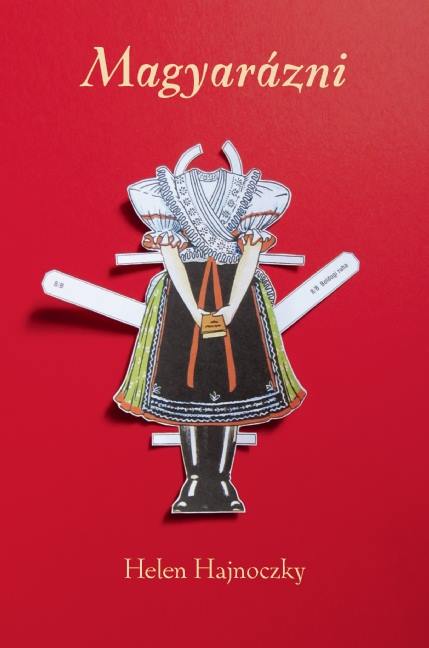
Review by rob mclennan of "Magyarazni" by Helen Hajnoczky


Nem

No, Hungarian is not a gendered language,
but no, you do not want to play Joseph in the
goddamned Christmas play again this year!

No, you’re not jealous that no on asks her which
bathroom key she wants, even though
you’ve been asked this while wearing a skirt.

No, no long hair, no stockings,
no heels, no tailored shirts. No way to indicate
them, no not them, not her, not him, just them.

No, she always gets to play Mary, and no,
you do not want to play a goddamned
shepherd either!

Just no.


In an interview posted over at Touch the Donkey, Calgary poet (recently returned to the city after an extended period schooling in Montreal) Helen Hajnoczky discusses her second trade poetry collection, Magyarázni (Toronto ON: Coach House Books, 2016):


Q: I’m curious about the Magyarázni poems: you speak of a difficulty in part, that came from writing out your relationship with your cultural background and community. What prompted you to begin this project, and what were your models, if any? I think of Andrew Suknaski writing out his Ukrainian and Russian backgrounds, for example, of even Erín Moure exploring the language and culture of the Galicians. And might Bloom and Martyr have progresses so quickly, perhaps, due to it being a kind of palate cleanser? 

A: Magyarazni germinated for a long time. There’s a wood chest in my parent’s house that my dad carved, and the tulips in his design are what inspired my project originally, particularly the visual poetry in the book. I started doodling tulips in the margins of my school notes with letters at their centre, with the accents used as stamen, long before I had really been introduced to visual poetry. The moment that sparked the project, though, was one night when my dad and I were up late chatting about when he, his sisters, and his mother left Hungary after the ’56 revolution and I thought “I should really write this down.” So, I went and typed up everything he’d said and made a little chapbook of it for him. I wanted to do something more on the topic though, and was fortunate to get a grant for the visual and written poetry book and to travel around Western Canada interviewing people who’d come during or after ’56, or whose family had done so. Originally I’d thought of including the interviews and poems in one book, but the interviews are numerous, long, and detailed and really deserved to be their own thing (which I’m still slowly working on). Though I didn’t use anything from the interviews in this book the people who so generously told me their stories definitely influenced me and the writing of Magyarázni. For more poetic influences though, Oana Avasilichioaei’s book Abandon, and the way she deals with cultural identity and nostalgia had a huge influence on me. The way Fred Wah’s writes about cultural identity, how that’s tied up with family, and the way he sets all this against the backdrop of the prairie all strongly informed the way I approached writing this book too—there’s a lot of Calgary in Magyarázni. Additionally, in 2007 Erín Moure and Oana Avasilichioaei spoke at the UofC for Translating Translating Montréal, and I have this fuzzy memory of them discussing translating words based on a feeling of the word or based on a word in a third language that the word in the source text reminds you of (I can’t remember precisely what they said and I don’t want to misquote them or misrepresent their ideas, but I believe the discussion was something along these lines), and this idea was key in the writing of Magyarázni. For example, the poem “Belváros”—the word translates into English as “inner city” (so, downtown), but I always hear it as ‘beautiful city,’ because in French ‘belle’ means beautiful. I went to a French immersion elementary school and I started hearing the word that way as a little kid, and I still hear it that way, not as inner city but as beautiful city. Because the project struggles to answer the question of how much one person’s experience of a language or culture can be representative of a community as a whole, I thought it was important to include these little hyper-personal feelings about words in the manuscript.


The author of numerous chapbooks, Hajnoczky’s first trade collection appeared as Poets and Killers: A Life in Advertising (Montreal QC: Snare/Invisible, 2010) and a portion of her manuscript “Bloom and Martyr” was selected for the 2015 John Lent Poetry-Prose Award, to be published as a chapbook by Kalamalka Press “in spring 2016.” 

As the press release for Magyarázni informs us: “The word ‘magyarázni’ (pronounced MAUDE-yar-az-knee) means ‘to explain’ in Hungarian, but translates literally as ‘make it Hungarian.’ This faux-Hungarian language primer, written in direct address, invites readers to experience what it’s like to be ‘made Hungarian’ by growing up with a parent who immigrated to North America as a refugee.” Bookended by the poems “Pronounciation Guide” and the prose poem “Learning Activities,” Magyarázni is composed as a stunning, lush and lively abecedarian, and each poem appears with a corresponding visual poem in resounding red and black. There is an element of “coming-of-age” to this collection, as the author/narrator works to reconcile the past with the present (and future), from a childhood built by Hungarian language and culture (from her parents’ own stories to her own engagements with cultural heritage), and how such foundations now require translation and explanation, even as she attempts to reclaim those same histories. Magyarázni writes her childhood home, her parent’s homeland and her time spent in Montreal (as in the poem “Zibbad,” as she writes: “You’ve been here longer now / than you were ever there and then some”), writing embroidery, linen, memory and grief.


Cukorka

Your reflection
      splintered in foil
these solemn treats

this bitter history
sugary sweet

unhooked from the tree
you melt

a plastic angel dipped
in flames, blurred
      and bubbling

you unwrap
the old world
          you chew
    and smile

        you don’t swallow
until they look away.


The poems are composed as someone caught between two poles, still navigating the blend of culture and cadence of language, family and belonging. The extended paragraph-poem “Learning Activities,” a poem that closes the collection, ends with: “Please note that W is not a true Hungarian letter. Please note that X is not a true Hungarian letter. Please note that Y is not a true Hungarian letter. Cut the sickle and hammer out of a communist-era Hungarian flag. Tell me, do you miss speaking Hungarian? That is, do you miss your father?”


About the reviewer
Born in Ottawa, Canada’s glorious capital city, rob mclennan currently lives in Ottawa. The author of nearly thirty trade books of poetry, fiction and non-fiction, he won the John Newlove Poetry Award in 2010, the Council for the Arts in Ottawa Mid-Career Award in 2014, and was longlisted for the CBC Poetry Prize in 2012. In March 2016, he was inducted into the VERSe Ottawa Hall of Honour. His most recent titles include notes and dispatches: essays (Insomniac press, 2014), The Uncertainty Principle: stories (Chaudiere Books, 2014) and the poetry collection If suppose we are a fragment (BuschekBooks, 2014). An editor and publisher, he runs above/ground press, Chaudiere Books, The Garneau Review (ottawater.com/garneaureview), seventeen seconds: a journal of poetry and poetics (ottawater.com/seventeenseconds), Touch the Donkey (touchthedonkey.blogspot.com) and the Ottawa poetry pdf annual ottawater (ottawater.com). In fall 2015, he was named “Interviews Editor” at Queen Mob’s Teahouse. He spent the 2007-8 academic year in Edmonton as writer-in-residence at the University of Alberta, and regularly posts reviews, essays, interviews and other notices at robmclennan.blogspot.com.


Wednesday, 8 June 2016

Review by rob mclennan of "Conjugation" by Phil Hall

 
 "Orange chair    blue porch    white Stetson
am re-reading      Cold Mountain   translated by Red Pine


  woke to fog    a cremation dream    it is garbage day


Olson:     words made to taste    like accuracy    pincers
  the king birds are back    an osprey shrieks


in the wooded swamp    ice reigns yet    first the school bus


  no motor    no drive   passes    only one child so far    up front
then the Trueloves    would it hurt them to signal    bastards

 
   despair is elitist    do not count pages   forget    the work


w & k    both built   from 2 Vs   or 3   end up with only    or  deface the cartoon    until the joke    is fearful"


Perth, Ontario poet Phil Hall’s latest collection is Conjugation (Toronto ON: BookThug, 2016), a complex, engaged and expansive collection that continue his meditative explorations into the lyric fragment, collage, poetics and the deep self. “Conjugation,” according to one online source, is “the modification of a verb from its basic form,” and Hall’s poetry manages a deep and serious play in the way words are constructed, pulling apart the mechanics of language and how it interacts with ideas (a play that has, it would appear, deeply influenced the work of Ottawa poet Pearl Pirie). As he writes: “but there’s a fee / a fee that sees    & hears wonky // fe-ces   we’re were   subtler/fugues   etc.” Similar to Dennis Cooley, Hall engages the mis-heard word, the mis-step, and runs with it, managing to make connections where there otherwise might not have been.


Over the past few poetry collections, Hall has shifted from his more overt engagements with Ontario gothic/rural, including his own childhood and history of abuse, to a more overt engagement of multiples—poetics, “the prison of metaphor,” pulling apart the minutiae of language, personal history, direct observations and his immediate environment (including the Ontario wilds of his Perth homestead)—each holding similar weight throughout, woven together as a precise, dense and thorough series of ongoing threads.
 
Constructed out of an opening poem, seven suite-sections and a coda, the short poem-fragments in Conjugation follow a similar tone and structure set in a number of Hall’s poetry collections, and, as with much of his work, the poems within could be presented in a variety of orders. It becomes curious how an order built so carefully, with such precision, is also constructed to be opened at any page, and read in either direction. His poems are less narratives than a series of accumulations, and the order in which you interact with them might even bring you to an entirely different conclusion.


Hall has become known for his shuffling, reworking and reprising his work, giving the sense that his poems might be less “finished” than simply set in a particular way for a particular temporal, whether temporary or permanent, reason, including poems shuffled and re-set for the sake of a chapbook, a public performance or a trade collection. “Early versions,” as Hall himself writes in the acknowledgments, of elements of the first section, “Gap & Hum,” appear previously in his X (Thee Hellbox Press, 2013) and My Banjo & Tiny Drawings (Flat Singles Press, 2015). The fifth section, “Essay on Legend,” was originally produced as a 2014 chapbook through Mark Goldstein’s Beautiful Outlaw Press (Goldstein is also designer of this current volume, as well as many of Hall’s recent trade collections). Cobbled and stitched together from a variety of threads, found and salvaged lines and objects, his “Essay on Legend” begins with an anecdote about a dog, utilizing such as a starting-point for a sequence of observations on poetry, anecdote and violence, each circling around the very idea of “legend.” The chapbook version was produced in an edition of 52 copies “in commemoration of the second annual Purdy Picnic at the A-frame, Roblin Lake, Ameliasburgh, July 26, 2014,” acknowledging the late poet Al Purdy as one of Phil Hall’s long-standing touchstones. At the Ottawa launch of the chapbook in 2014, Hall spoke of starting out as a good Ontario “son of Al Purdy” poet that slowly began shifting towards Louis Zukofsky’s 80 Flowers (1978); from stories and the anecdote to “that purse sound of the vowel.”


About the reviewer
Born in Ottawa, Canada’s glorious capital city, rob mclennan currently lives in Ottawa. The author of nearly thirty trade books of poetry, fiction and non-fiction, he won the John Newlove Poetry Award in 2010, the Council for the Arts in Ottawa Mid-Career Award in 2014, and was longlisted for the CBC Poetry Prize in 2012. In March 2016, he was inducted into the VERSe Ottawa Hall of Honour. His most recent titles include notes and dispatches: essays (Insomniac press, 2014), The Uncertainty Principle: stories, (Chaudiere Books, 2014) and the poetry collection If suppose we are a fragment (BuschekBooks, 2014). An editor and publisher, he runs above/ground press, Chaudiere Books, The Garneau Review (ottawater.com/garneaureview), seventeen seconds: a journal of poetry and poetics (ottawater.com/seventeenseconds), Touch the Donkey (touchthedonkey.blogspot.com) and the Ottawa poetry pdf annual ottawater (ottawater.com). In fall 2015, he was named “Interviews Editor” at Queen Mob’s Teahouse. He spent the 2007-8 academic year in Edmonton as writer-in-residence at the University of Alberta, and regularly posts reviews, essays, interviews and other notices at robmclennan.blogspot.com