Showing posts with label Alison Moore. Show all posts

Wednesday, 7 June 2023

Review by Louise Brown of "Eastmouth and Other Stories" by Alison Moore


Alison Moore’s Eastmouth and Other Stories is a beguiling read. Her ability to build the world she transports you to, together with her themes of domestic confinement and calamity are gripping. 

In “Eastmouth,” the entrapment of the main character in the gloomy confines of a boyfriends’ claustrophobic family and seaside town is told in such an understated way that the sense of claustrophobia is heightened. A local tells her "You are the Webster girl," and while she denies this, she sees a crowd of locals advancing towards her, who are described as "an army in beige and lilac."

The atmosphere of the characters being trapped or even killed by the places they inhabit grows in each story, and nature colludes too. In “Winter Closing,” the story opens with a sentence that foreshadows the calamity contained in an old house inhabited by Derek. She tells us, "The garden path, on which there was black ice this morning, has been salted to prevent the fracturing of wrists, the breaking of hips, the shattering of pelvises." The malevolence of the house, and the path that leads to it, is placed in the forefront of our minds.

In “Seabound,” a doomed love affair is entrenched in a forlorn house and surrounding landscape. The main character, May, lives in the clifftop house, and is trapped in a hopeless shrine to a teenage lover. As her life passes, the sea is described as "clawing its way towards the foundations of that clifftop house." Despite the risk of it falling into the sea, May ignores her daughters’ exhortations to leave the doomed house. The sea is also somehow calling to her, and in her dreams, she tells us that, "Vast and cold, the sea climbed her bare legs. It was rough but she stood her ground. Sometimes, when she woke from these dreams, the sea was so loud it could have been right there in her room."  Only when her dead lover, "a man made of water," and "the seaman," visits her in her dreams, does she answer the call of the sea and she is finally released by one final act of homage to her beloved.

Moore’s powerful depiction of buildings, nature, and the doomed choices of her characters, results in a potent weft of inevitability, calamity, and tragedy, with writing and characters that stay with you long after you have put away her compelling vignettes. 


About the reviewer
Louise has an MA in Creative Writing from the University of Leicester. She is an Employment Judge and is also working on her first novel.

You can read more about Eastmouth and Other Stories on Creative Writing at Leicester here

Thursday, 30 December 2021

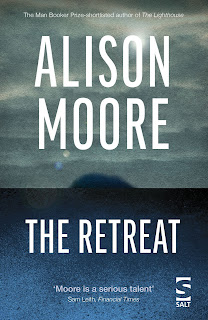
Review by Sally Evans of "The Retreat" by Alison Moore


A well-written novel evocative of the imaginary Mediterranean island at its core, I found the story a little difficult to unpack, in that there are two parallel narratives of two different young women visiting the tiny island, one to attend an artists’ retreat, the other to write a novel. The first one introduced is Sandra, whose reality pervades the main story. She is a dithering would-be artist and photographer who pursues a lone quest among the other people on the retreat, who gang up against her and ostracise her, none of them appearing very capable in their own work. Scenes show squabbling over the food, music and entertainment in the house of an evening, while Sandra makes solitary expeditions round the island in daylight. The house has a ghost which never fully reveals itself, as nothing is fully revealed. There's a transience to this story, as Sandra futilely tries to fit in where she cannot.

Carol, the other protagonist, is going to write a novel. I at first guessed that Sandra’s story was the novel Carol was writing, set on the same island to which she was returning, with more of the history of the island and a smaller offshore isle, which Sandra, at the end of her story, tries to reach. There has been a death, we assume Sandra’s, when Carol arrives at the smaller island at the end of the book. 

The novel is about the attraction of place and the desire to record its beauty, whether in writing or art, and about the incompleteness of short associations with place. The boatman, who takes supplies and post to the island, although shadowy, is the only character truly connected to the place. 

I ended with the feeling I ought to know more about Carol. She is introduced in the future tense narrative, telling where she is going, and what she wants to do, then she is shown gradually approaching the island. Both story strands are mainly told in the present tense, apparently simultaneous until Carol reaches the smaller island at the end of Sandra’s adventure. There’s a lot of atmosphere, detail and almost teasing about the plot, a not-quite-stated ghost narrative about a silent film star, who once lived there.  It’s a novel where the work of reaching conclusions is left to the reader. Sandra is beaten; Carol departs in haste, but the long-gone film star remains silent.


About the reviewer
Sally Evans is a bookseller and poet. Her books include The Bees (2008) and Poetic Adventures in Scotland (2014), both from Diehard publishers. She edited Poetry Scotland for 20 years, and is currently studying for a PhD at Lancaster University. Her novel Wildgoose: A Tale of Two Poets was published by Red Squirrel Press in 2021. You can read a review of it on Everybody's Reviewing here


Tuesday, 15 January 2019

Review by Jon Wilkins of "High Spirits: A Round of Drinking Stories," ed. Karen Stevens and Jonathan Taylor


I have seen High Spirits advertised on social media for months and had always thought its sub title was A Round of Drinking SongsA bit bold I thought, but I do enjoy a good song. So without reading the blurb, I assumed there would be plenty to choose from! Then when I received my copy, I realised it was Drinking StoriesSucking up the disappointment I began to read them.

So Drinking Stories: would this be an uplifting, joyous approach to the theme of having a carousing time and the benefits of being let loose through alcohol? No. What I did learn is that, on a very basic level, drinking is not that good for your body, your mind or your soul. Just some of the outcomes in the short stories here include death through drinking too much, suicide, and a woman scarred when she is burnt, who loses an eye after excess consumption. There is an emboldened paedophile. There are catastrophes that follow people's divorce and the estrangement from their children. Another character is lost in an underground labyrinth, and presumed dead. We also see intoxication resulting in cheating on a dead husband with his brother, then infidelity with new neighbours. 

Though sometimes depressing, the stories are all very well written and surprising in every sense. If you did want to be uplifted, this is not the right book; if you want to read clever description and subtle depictions of relationships under pressure then this is the right book for you. We go deep into characters who, though under the spell of alcohol or alcoholics, are able to show life in a clear, even visceral way.

There is such variety. No two stories have the same theme: drink may be the cause of problems and is never the solution, but we see this in every which way. We see how children are affected. In "The Ballad of Barefoot Bob" by David Swann, it is not enough for young Bobby to have an alcoholic father; he also has to suffer his own mental torments. In "May Day" by Alison Moore, we see Gareth trying to do right by his daughter now living with his estranged wife and her new partner, battling the bottle and also his jealousy of the new man. He sinks into his own metaphorical and literal maze and we are left asking: does he survive or not? For me, the most evocative tale, "Bones" by Hannah Stevens, concerns Henry, who sees his drunken partner Bethan topple from his bedroom window to her death. It underlines the futility of drinking to oblivion.

This collection is a vibrant, thought-provoking set of stories. A collection that makes us think, makes us confront a way of life that is so self-destructive, yet so attractive until events take over and control is lost. You may not be singing along at the end of reading this book, but the stories will remain with you and are accessible in a way that that begs us to challenge and to discuss the outcomes. The editors have done a fine job in bringing these carefully crafted stories to us.


About the reviewer
Jon Wilkins is sixty-three. He has a gorgeous wife Annie and two beautiful sons, and loves to write. He is a retired teacher, lapsed Waterstone's bookseller and former Basketball Coach. He taught PE and English for twenty years and coached women’s basketball for over thirty years.  He has always loved books and reading.

Friday, 7 December 2018

Review by Lee Wright of "Sunny and the Ghosts" by Alison Moore


It is said that a good writer can turn their hand to any genre, and with her debut children’s book, Alison Moore has put that to the test. There has always been a child-like innocence to many of the protagonists in Moore’s adult novels. This time, however, she has come full-circle, making the protagonist a child in a child’s story. 

Sunny and the Ghosts tells the story of eight-year-old Sunny, whose parents buy an antique shop in Devon, and move into the flat above. 

Sunny’s father likes old things. He plays old songs when driving around because it “Makes the van feel happier.” His mother likes the butterflies which are preserved in frames, while Sunny helps around the shop, polishing the antique furniture - one of which, a blanket box, has a stowaway ghost inside (the first of six), named Herbert. 

Of course, Sunny’s parents don’t believe him, even when the Victorian piano begins playing by itself during the night. We swiftly meet Walter, Violet, the sisters Mary and Elise, and finally Peregrine. 

Moore keeps the story ticking over (quite literally in the episode with the antique cuckoo clocks), always conscious of her readership. Along the way, strange things happen, like an invasion of stray cats into the shop, “First it was ghosts,” says Sunny’s friend. “And now it’s cats.” 

Sunny also attempts a day trip to the seaside for the dead, all accompanied by the illustrations of Ross Collins, who adds a George Adamson style quality to the story.    
And Moore’s literary influences are sprinkled throughout this book. Herbert the ghost’s favourite novel is Wuthering Heights for instance. Macbeth and Hamlet are mentioned, so too A Christmas Carol. And one of Sunny’s new ghostly friends gets trapped in the stationery cupboard while looking for notepaper to fulfil her beyond the grave ambition of writing a book. An encounter which leads to one of the funniest lines:

“Can’t you walk through doors?” asked Sunny. 

“No,” said Violet. “Can you?” 

A further influence can be found in the creation of the infuriating Mr Ramsbottom (and what seven-year-old wouldn’t titter at that choice of name?) who comes across as a combination of Mr Gruber and Mr Curry from Michael Bond’s Paddington Bear series. 

This book also draws on Moore’s last two adult novels. Death and the Seaside and The Missing both explore that place where the real and fictional worlds meet. And since being propelled into the spotlight in 2012 when she made the Man Booker Prize shortlist, alongside well-known heavyweights like Will Self, Deborah Levy and eventual winner Hilary Mantel, Moore has developed an almost cult fan-base that’ll surely buy her work, whether children’s fiction or not.   

And even though this is Moore’s first foray into children’s literature, it certainly won’t be her last. A follow-up book, also to be published by Salt Publishing and titled Sunny and the Hotel Splendid is already in the works. A tidy stream of adult novels and children’s books looks set to continue from the prolific former Man Booker Prize short-listed author.      

  
About the reviewer
Lee Wright was born in Nuneaton, Warwickshire in 1980 and has been writing both fiction and non-fiction since 2008. He is taking an MA in Creative Writing at the University of Leicester.   

Tuesday, 17 April 2018

Interview with Alison Moore


Alison Moore's first novel, The Lighthouse, was shortlisted for the Man Booker Prize and the National Book Awards (New Writer of the Year), winning the McKitterick Prize. Both The Lighthouse and her second novel, He Wants, were Observer Books of the Year. Her short fiction has been included in Best British Short Stories and Best British Horror anthologies, broadcast on BBC Radio 4 Extra and collected in The Pre-War House and Other Stories. She published her third novel, Death and the Seaside in 2016 and latest novel, Missing, will be published on the 15th May 2018. Born in Manchester in 1971, she lives near Nottingham with her husband Dan and son Arthur.


Interviewed by Lee Wright

In April 2016 I enrolled on a five-week course titled "Elements of Fiction," taught by the 2012 Man-Booker Prize short-listed author Alison Moore. It was the first time I had ever been in a creative writing environment, and Alison was the first “real” writer I had met. 

I was in a state of awe for the first two weeks. I read her two novels, The Lighthouse and He Wants, back-to-back. I couldn’t read them fast enough. Then, by the third week, I began to calm down. I listened, I took in every element, style and approach Alison spoke to us about. 

One week she asked us to write a short story, gave everyone the same starting point, and expected us to read the piece out the following week. At this time, I had never tried the short story form, but with the challenge thrown down, I bought a copy of Raymond Carver’s What We Talk About, When We Talk About Love

So, I wrote my story with Alison’s advice and Carver’s clipped style rolling around in my head. I read it out that next week (I had never read my work out aloud to anyone before, and for those reading this who find themselves in a similar position now, I can only sympathise). From what I remember, the story was heavy and far from perfect, but the comments that followed acted as a springboard. I went home and wrote another one, and another, and another. 

Eventually I began to have a small slice of success, and my fiction continues to be published. There is no doubt that Alison Moore’s course was the turning point for me. Those five weeks in 2016 I won’t forget.          


LW: You made the leap from writing short stories to novels with The Lighthouse in 2012. What difficulties (if any) did you encounter during the process of working on a longer project?

AM: In between the short stories and The Lighthouse, I wrote a 12,000-word story, which went on to win a novella competition and became the title story in my collection The Pre-War House and Other Stories but which was a struggle to write. That’s partly because I was writing due to having an unexpected free month (in between working full-time and having a baby) as opposed to having a specific story I was keen to write, but also because I was tackling a story that went beyond the kind of size I could see all at once, so I was navigating the story with no sense of what was coming. Now, that’s the best bit: writing into the darkness, not knowing what I might find.

LW: Do you find the short novel form more agreeable?

AM: I naturally seem to write short novels, all under 50,000 words so far, which might be due to my short-story writing background. Perhaps whatever draws me to writing short stories, and indeed that novelette/novella length which I love, also makes short novels sit well with me as a writer. As a reader, I enjoy plenty of long novels too – right now I’m reading the 900-page Blonde by Joyce Carol Oates.

LW: You’ve published a contemporary novel every two-years since 2012. Yet you don’t write to a formula (like authors in genres such as crime). How have you stayed so prolific?

AM: That time frame feels about right to me – if I gave myself too much longer I think I’d start to doubt and unpick the whole thing. So, I aim to draft a novel in about a year, and once I start it I live with it, so I avoid the difficulty of coming back to a project that’s cooled off since I last looked at it. I work with one eye on that two-year cycle which seems to work but which is entirely flexible if necessary.

LW: Have you matured as a writer?

AM: I’ve certainly developed better habits. Many moons ago I would merrily jot down a story idea on a slip of paper and then just stash it, never developing it; I had dozens of these slips of paper which never became stories. I also had to get better at reading and editing my own work. It’s second nature now, to take that starting point and just write, to see where it leads me, and then, when I have a first draft, to edit the hell out of it.

LW: Do you need a title before you begin a work of fiction?

AM: Yes, I like to have a title as I begin a piece of work, knowing that I can always change it later, once I know the story better.

LW: Since its publication, The Lighthouse has been translated into many different languages.   Did you work with the various translators and how has the experience been for you?   

AM: It’s been very interesting to see how different translators work. Sometimes I’m sent queries throughout a translation, sometimes I get a list of questions at the end of the process, and sometimes there is no communication at all. It’s quite odd knowing that I’ll never know quite how a translation reads. In fact, my new novel Missing is concerned with a translator and the importance of the language we choose.


LW: This November also brings the publication of your debut children’s book, Sunny and the Ghosts. What made you decide to try your hand at children’s fiction?  

AM: Just as reading fiction when I was growing up made me want to write, so reading fiction with my son made me want to write something for his age range, which was 7 at the time. Having started to think along those lines, the basic idea came along quite quickly, and once I’d drafted the story I read it to my son, who gave me really useful feedback.


LW: What was the genesis for your new novel Missing?  

AM: I have a very early note along the lines that someone suddenly, quietly, almost in passing, slips out of life "e.g. going through ice." The specific has changed but that sense of quick and quiet loss is a key element in the finished novel. I was also more generally interested in boundaries, borders, crossing from one place to another, and whether someone who has left will or can come back.

LW: Which one book (from any author or genre) would you recommend for the aspiring writer to learn something from?

AM: I’ve usually got a novel, a short story collection and a non-fiction book on the go, and my current non-fiction is John Yorke’s Into the Woods which discusses the nature of a wide range of works of fiction. I nose my way through my novels without planning, and when I came across Yorke’s idea of the midpoint ("Occurring almost exactly halfway through any successful story, the midpoint is the moment something profoundly significant occurs ... there can be no return to how life was before ... Do writers who are entirely unaware of story theory write them subconsciously?"). I took a look at my novels and found that at the midpoint of The Lighthouse, Futh "has passed the midpoint of his circular walk" and is heading back to Hellhaus; and, immediately afterwards, we have the scene on the cliffs in which his mother says she’s leaving, which is essentially the catalyst for everything that follows. I’ve found similar midpoints in all my other novels too. For someone who has never formally studied creative writing, it’s a fascinating read.


About the interviewer

Lee Wright was born in Nuneaton, Warwickshire in 1980 and has been writing both fiction and non-fiction since 2008. He is taking an MA in Creative Writing at the University of Leicester.

Saturday, 16 September 2017

Review by Lee Wright of "Death and the Seaside" by Alison Moore


Alison Moore’s novels feature no demons or monsters. Yet behind every closed door she makes you hear unsettling noises. Those noises are made by people. And hell is other people.    

A closeness to the real, day-to-day, small desperate lives filled with nothing moments. Characters who take unfulfilled, uncomfortable breaths. Her first two novels, The Lighthouse and He Wants, are close to the Southern Gothic tune of Carson McCullers. Like the girl from Georgia, Moore takes alienated individuals, and plunges them into unnatural societies, where they are experimented on by the shadier side of humanity. 

Her main protagonist in The Lighthouse, Futh, bares resemblance to McCullers’ deaf-mute, John Singer in McCullers’ stand out work of fiction, The Heart is a Lonely Hunter. Both men are isolated from within and longing for something they cannot get back. Both await lonely ends. Moore has made sure that the quarrelling tick has bitten and embedded itself in each character she invents. 

For her most recently published novel, Death and the Seaside, we discover the story of the milk skinned, failed writer that is Bonnie Falls (with Moore, there is always something in a name). Hers is a life left unfinished in every sense. Abandoned degree, missed chances, and underwhelming, overbearing parents. A would-be writer whose time is taken up by a disparaging cleaning job at a pharmaceutical building. Until the day she becomes involved with her scrutinising landlady, Sylvia Slythe. Then, Bonnie’s timid existence begins to collapse like a sandcastle beneath the tide. 

All of Moore’s novels are short and they linger like a vivid nightmare. At times, Death and the Seaside can appear like an interrogation of other novels (Irving’s The World According to Garp, Camus’ The Outsider, and Iris Murdoch’s The Sea, The Sea among others are given a direct mention). 

And the ocean, or at least the appeal of it, is a recurring theme throughout Moore’s work (John Irving has his bears). In The Lighthouse, Futh crosses it. Lewis Sullivan in He Wants longs for it. And Bonnie Falls visits it.   

By the time Bonnie drives away from the encroaching sea, we are left with the slow burning pay off, questions are answered and our protagonist’s future far from certain.

In a time when most novels rely on formula, and great authors such as John Fowles, Raymond Carver and Carson McCullers are rarely talked about (outside of the wider read), Alison Moore, like DBC Pierre (Breakfast with the Borgias), represents a breed of writer who succeeds in painting a portrait of the inept and naïve side of human nature. Do not get too close to this kind of author, for they leave permanent scars. 

And long may they reign.  


About the reviewer 
Lee Wright was born in Nuneaton, Warwickshire in 1980 and has been writing both fiction and non-fiction since 2008. He is taking an MA in Creative Writing at the University of Leicester in 2017.