Showing posts with label Lee Wright. Show all posts

Friday, 24 July 2026

Review by Lee Wright of "New & Collected Poems" by Jeffrey Wainwright


Forty-eight years in the making, Jeffrey Wainwright’s New & Collected Poems takes us back. It begins in 1978 with his collection Heart’s Desire – a maiden voyage to bring love and war to the page, giving the reader every ounce of life’s frustration and elation. Wainwright allows the poems to spill from his pen like a gardener shaking earth from a bulb of garlic. 

In Selected Poems (1985), his verses are often as cold as sealskin, but it’s a cold we all must face, to understand what it is to feel human. Even the subject of love in Selected Poems barely moves grass. Love, like poetry, is present, but it doesn’t change the world. Wainwright remains tightly focused on the human mind. The poems wind around the reader like vines. He avoids happiness and instead writes of Thomas Müntzer, the deteriorating mental health of George III and dead sweethearts. What is in Wainwright’s mind cannot be touched. 

The Red-Headed Pupil (1994) is a gentle reminder that as the world changes, so we change. We are, as Wainwright points out, plasticine men, shaped by our surroundings. He asks the reader tenderly if they are content among the paving stones. 

The poems stretch from 1999 to the present day, and it is these newer poems that feel deeply personal. "Did you just give up and go" is a line I’ll never get over or forget. In another line he asks, "O my soul, where are you?" which is one of those questions we collect like scars on the body as we age. Is it possible to avoid becoming world-weary as we hold on to the years? Throughout New & Collected Poems, Wainwright is concerned with this question. And who will replace us when we’re gone? That too is something the collection left me asking.  

To borrow Wainwright’s line, "the fish in cold preserve their flesh," just as the ageing poet preserves his reputation in this collected works. 


About the reviewer
Dr Lee Wright holds a PhD from the University of Leicester in Creative Non-Fiction and has had numerous pieces of short fiction and non-fiction published. 

Saturday, 13 December 2025

Review by Lee Wright of "Common" by Nikolai Duffy


With Common, his first novel, Nikolai Duffy explores transcendentalism in a search for the sacred within the everyday. The narrator, Robert, returns to his childhood home in Hampshire to settle the affairs of his late aunt's estate. But it soon becomes clear that Robert is seeking something far deeper, a spiritual awakening beyond the duties of an executor. A walk across the local common leads him to construct a simple hut, and he retreats into it for a week of introspection. 

Sometimes the only way for a writer to tackle the big questions is by starting with the small ones, and all portraits are, to a large degree, self-portraits. Robert admits to being happy to be among the folds and shadows of the heathland, and it is impossible not to see Duffy himself, enclosed within the books, drafts, and notes of the writing room; both the author and his narrator are surrounded by the things that nurture creativity.

Robert’s thoughts sail over many mundane seas - patches of sunlight filter through unwashed windows as he defrosts bread for his breakfast, he drinks coffee, he texts GIFs to his wife, Claire, and his two children. But a novel can show you what a character is thinking, and then show you what they are saying, and Duffy achieves that distance between the two. The author elevates otherwise simple acts into symbolic enactments; themes of fate, guilt, responsibility, and transformation are repeated throughout. 

Having resolved to construct his makeshift hut, Robert describes heading out to the common "under the weight of what I was carrying. The posts were cumbersome, and I struggled to hold them." 

The echo is clear: this is Robert’s Way of the Cross. If we dismiss the Simon of Cyrene narrative, then Robert, like Jesus of Nazareth, carries his cross himself. For Robert, this is a test, a moment of spiritual reckoning. He will not be the man he was when he left. With the common alive with croaks and scurries after dark, Robert experiences a fierce exhilaration in forging his own Walden-like retreat. Yet the issue of claiming ownership cannot be overlooked. Robert believed that his devoted aunt considered him a work in progress, a project to nurture and cultivate, and in building his hut on the common, he is equally complicit in treating a space as something to shape for himself.

Duffy’s expertise in literature and creative writing is evident in the intellectual richness of Common, yet the novel’s pacing is occasionally hindered by the persistent influence of his academic background. But if Socrates was right that the unexamined life is not worth living, then Duffy demonstrates a remarkable capacity to see the world anew and to deepen our understanding of it. 


About the reviewer
Lee Wright is a fiction and non-fiction writer currently undertaking a research degree at the University of Leicester, where his thesis focuses life-writing informed by horror cinema.  


Sunday, 29 June 2025

Review by Lee Wright of "On Agoraphobia" by Graham Caveney


Memoirs rarely make deliberate use of space on the page, but the large areas of emptiness in Graham Caveney’s On Agoraphobia (2022) evoke a sense of unease that mirrors the author’s fear of open spaces, motorways, and crowds. As someone intimately familiar with the vulnerability of vast, public environments, Caveney conveys in his second memoir a sense of being throttled by a thousand invisible hands, each chapter strengthening the grip. The narrative is a belt tightening around the chest, each notch drawing one step closer to madness. 

There is a fraught relationship between the writer and the agoraphobic. Caveney recalls Shirley Jackson—once cruelly dubbed Virginia Werewolf—and her anxiety attack in a New York shopping mall: "She stayed inside. Something new and unpleasant had begun to happen every time she tried to leave the house." 

Art and agoraphobia demand a retreat from the world. Art is created out of a desire to fix, reinterpret, or reimagine the world. The more the world is fixed on the page or canvas, the more jarring and unpleasant the real world may feel to the artist upon stepping outside. Caveney has been battling his condition for thirty-plus years, calling it "a neurotic two-step." His agoraphobia began at the University of Warwick. Mine started while waiting for a bus outside a college in a Warwickshire town. 

He quotes Elizabeth Bowen: "Inside everyone, is there an anxious person who stands to hesitate in an empty room?" I have been that person, and I know others who carry that presence within them. But never before has there been such a deeply personal journey into the empty room as in Caveney’s account. 

To proceed, he has to turn back: "I grew up with a whole mythology of nerves. They had their own poetics. Bad with his nerves, a bundle of nerves, a nervous wreck. Nerves were a site of catastrophe." This anxious life, marked by more than its fair share of catastrophe, has provided Caveney with the material to write books that deeply resonate with readers. We can only hope that Shirley Jackson was right when she closed her diary with the repeated phrase: "laughter is possible laughter is possible laughter is possible." 


About the reviewer
Lee Wright is currently pursuing a PhD. His subjects are memoir, people and place. His work has been published in Fairlight Books, époque press, and Cigarette Fire Literary Magazine. 


Wednesday, 9 April 2025

Review by Lee Wright of "On Writers and Writing" by Henry James


The essays featured in On Writers and Writing span fifty years and include Henry James’ short reviews, obituaries, reflections on the works of other writers, and a few personal statements of principle. In these writings, he offers insights on both how to write and how to read. Edited and introduced by Pulitzer Prize finalist Michael Gorra, this collection reveals how James honed his skills as a critic long before establishing himself as a novelist. The essays underscore the importance of criticism in shaping a writer’s craft. James critiqued the mistakes of his predecessors, hoping that by learning from them, he might one day get it right himself. 

In the opening essay of the book, "The Art of Fiction," Henry James uses English novelist Walter Besant’s lecture of the same name as a starting point for his own reflections on the art of fiction and argues that literature should either instruct or amuse. He does not mention Shakespeare, though, who challenged and delighted in equal measure, albeit not in novel form. There is an essay included on The Tempest in the latter stages of the book, though it stands out as one of the drier pieces in the collection. A more engaging piece is his review of Charles Dickens’ Our Mutual Friend, in which James describes it as a work "lacking in inspiration" and remarks, "For the past ten years, it has seemed to us that Mr. Dickens has been unmistakably forcing himself. Bleak House was forced, Little Dorrit was labored, and this current work feels as though it has been dug out with a spade and pickaxe." 

With the same metaphorical pickaxe, the then 22-year-old James continues, "It were, in our opinion, an offence against humanity to place Mr. Dickens among the greatest novelists. For, to repeat what we have already intimated, he has created nothing but figure. He has added nothing to our understanding of human character. He is master of but two alternatives: he reconciles us to what is commonplace, and he reconciles us to what is odd. The value of the former service is questionable; and the manner in which Mr. Dickens performs it sometimes conveys a certain impression of charlatanism."

The harshness of James’ language and the sweeping nature of his criticism are like the sting of a hornet. He doesn’t simply critique Dickens’ work; he almost entirely dismisses it as lacking genuine literary depth. He also calls George Eliot’s Middlemarch "One of the strongest and one of the weakest of English Novels," going on to argue that Eliot’s ambition is commendable but ultimately flawed: "The author wishes to say too many things, and to say them too well; to recommend herself to a scientific audience.” In 1885, George Eliot’s husband, John Walter Cross, published a semi-autobiographical work using extracts from her letters and journals, which Henry James later reviewed. James movingly notes that the letters and journals "are only a partial expression of her spirit." Another comment, though, seems to view womanhood primarily as a biological or physical condition, disappointingly implying that female authors, in general, may have inherent limitations or constraints due to their biology. 

Nevertheless, each piece evokes the sensation of sitting by the fire with James—a man shaped by his own greatest creation—breathless, just as his unnamed narrator is in the prologue of The Turn of the Screw. Not a word is spoken until the storyteller finishes reading the manuscript. At that point, we can choose to agree or disagree with the master.


About the reviewer
Lee Wright holds an MA in Creative Writing and is currently pursuing a PhD. His fiction and nonfiction have been published in Fairlight Books, Headstuff.org, époque press, and Cigarette Fire Literary Magazine.


Monday, 17 March 2025

Review by Lee Wright of "Father's Father's Father" by Dane Holt


Father’s Father’s Father, the debut poetry collection from Dane Holt, explores the shaping and eventual disillusionment of masculinity, as well as the lingering effects of tragedy. The opening poem, titled "John Cena," delves into the predictable patterns of professional wrestling, where audiences anticipate the familiar rise-and-fall of matches that provide the structure and comfort many of us craved as adolescents. Cena represents a scripted form of heroism—akin to figures like Superman or John Rambo. But what if we looked beyond that manufactured persona? Could the image of the all-American hero have become stale? Is Holt suggesting that Cena’s image is tied to a version of America that overlooks its own complexities and contradictions? Rather than a "fallen" hero, perhaps Cena is one who’s now on his knees, wrestling not just with opponents, but with his own myth. 

Holt belongs to a dynamic new wave of Northern Irish poets, and the collection gives the impression of him wandering, collecting fragments, and observing what causes them to bend or break. In the poem "Humphrey Bogart," the speaker begins by recounting tales passed down by his grandfather, describing a time when men were characterised by a rugged, almost invincible self-sufficiency. Holt uses an image of a man striking a match with his thumb, waking up to a lit cigarette, and performing daily tasks with a cigarette in hand, evoking an idealised version of masculinity—one that is calm, composed. The grandfather’s memories of the past are a source of nostalgia, and The African Queen (the film referred to in the poem) fills the absence of verbal confirmation as part of their understanding of love. There’s also an image of birds filling the sky, a striking conclusion to the poem, which suggests an omnipresence of the departed, both in film and in life. All the poems contemplate a form of sadness (though not without comedy). They look at the consequences of a life that doesn’t get the chance to be redeemed, expendable people of deep emptiness, those who struggle to pick up their lives. As Holt writes in the poem, "Seven Esenin Versions": 

         I cannot deceive myself: something 
         heavy troubles my heart.   

This reader feels it too: poetry is where attention to the tender and the brittle began. 


About the reviewer
Lee Wright holds an MA in Creative Writing and is currently pursuing a PhD, focusing on the coming-of-age memoir and film analysis. His fiction and nonfiction have been published in Fairlight Books, Headstuff.com, époque press, and Cigarette Fire Literary Magazine.


Wednesday, 26 February 2025

Review by Lee Wright of "The Viaduct" by David Wheldon


The Viaduct, David Wheldon’s first novel, published in 1983, was well received at the time. Following his death in 2022, it was rereleased by Valancourt Books. The story begins with Alexander – more commonly referred to as A., since Wheldon wanted to save time during the writing process (he had originally planned to add the full name later, but A. carried thematic weight in what became a Kafkaesque story). The protagonist being reduced to a mere letter also reflects his loss of personal identity after being released from prison where he served time for writing a seditious book that purported to expose the secrets of the city’s governmental workings. 

Soon, however, he is confronted with new, unspecified charges and escapes his pursuers by fleeing down a stretch of abandoned railway tracks – taken over by nature – built on a viaduct that dominates the city. The viaduct, now blending seamlessly with the landscape, appears as though it were not crafted by human hands, but instead formed by a bizarre upheaval of the earth itself. 

A. is dressed for travel – heavy boots, sturdy canvas trousers, and a pack on his back, which he later exchanges for a worn suit, confusing those he encounters and causing them to believe he is a lawyer. What A. is journeying toward remains unclear; there is no hint of a paradise at the end of the tracks, only more towns and villages. When asked, “Where are you going?” He simply replies, “I’m going on.” 

His journey starts at the terminus, hoping to catch a train, only to find that the railway had been shut down a decade earlier. At the beginning of the novel, beneath the viaduct, several church bells toll, like the sound of a race starting gun. We learn that A.’s cell window overlooked the viaduct, and he would often gaze up at it. Such repeated, obsessive focus on something distant and unreachable might suggest themes of escapism or wistful dreaming.

There is a sense that the narrative may not just be a straightforward recounting of events, but rather a reflection of the character’s inner world – much like Bobby Western in Cormac McCarthy’s The Passenger, which also gives off a dreamlike atmosphere. We know nothing of those who pursue him. They are blunt-featured men of practised patience, like Stasi agents. Some of them pursue him on horseback; the most deadly possess a fixed stare that can make a man faint. A. gets beyond the “boundary,” and the city disappears as swiftly as it was created. 

This is where the novel loses its early tension and switches from a slow-burning thriller to a book about everything and nothing. A. meets fellow travellers and villagers who have established small communities, where one man can serve as pastor, mayor, and magistrate. A. and his companions are regarded as directionless and superstitious. The novel portrays life as a constant search for comfort or stability, but this desire for security is ultimately unattainable, illusory. Someone remarks about A. “You were a dissatisfied young man.” This kind of dissatisfaction could lead to a man’s downfall. The story is surreal, and the characters feel more like mere vessels for the author’s voice than fully developed individuals. However, The Viaduct would fit perfectly on the shelf next to works by McCarthy, DeLillo, or Kafka.


About the reviewer
Lee Wright has an MA in Creative Writing and is currently working towards a PhD researching memoir and film. His fiction and poetry have been published with Fairlight Books, époque press and Burning House Press.


Tuesday, 14 January 2025

Review by Lee Wright of "Two Sisters" by Blake Morrison


Blake Morrison’s younger sister, Gill, passed away at 67 from complications related to alcoholism. His latest memoir, Two Sisters, recounts Gill’s heartbreaking decline into severe alcohol addiction, worsened by the additional burden of losing her eyesight. Though Morrison cannot directly live through Gill’s specific challenges, he empathises with the physical, and psychological toll of such a loss. 

Morrison’s half-sister, Josie – the result of their father’s affair with a family friend – is the second sister featured in the memoir. Her paternity was confirmed through a DNA test just eight months before she tragically took her own life. 

Another interpretation of the title is that it reflects two versions of Gill: one sober, the other intoxicated. As a young girl, Gill was bullied at boarding school, and ultimately died alone, curled up on a strip of carpet between a bed and a radiator. Two Sisters is more experimental than Morrison’s earlier memoirs, blending excerpts from his diary with chapters that explore real-life brother-sister relationships, such as those between Charles and Mary Lamb and Dorothy and William Wordsworth. This elevates Two Sisters from a straightforward memoir into a broader, more reflective examination of familial dynamics and the complexities of sibling relationships. By weaving in these external examples, Morrison invites readers to compare his own experiences with those of historical and literary figures, prompting questions about the ties that bind. Many argue that those who are stronger have a responsibility to help the weaker. On the other hand, there are opposing views that emphasise individual responsibility, suggesting that it may not be the duty of the strong to help the weak if it infringes upon personal freedom. Morrison maintains that ‘It’s what happens with addicts. They kill your compassion. For a time Gill’s drinking killed mine.’ 

Whether it should be a brother’s responsibility to look out for his sister depends on individual values, and the specifics of the relationship between siblings. Do siblings have a moral obligation to support and care for each other? In the end, each familial relationship is unique. ‘Sisters do go missing,’ writes Morrison. ‘They go missing in horrible ways, abducted, murdered, forcibly married, disappeared for causing trouble to the powers that be. And sometimes they go missing by choice, to escape their families or – as we’ll discover later in this story – because they’ve fallen out of love with life.’ Morrison’s decision to write about his sisters is driven by a desire to make sense of their lives and to reconcile with the past. Two Sisters is infused with a profound sense of sadness as Morrison also processes his own emotions and commemorates his lost siblings as if their spirits were peering over his shoulder, watching him type and reading his words. After finishing the memoir, the final few lines of enslaved poet, Phillis Wheatley Peters’ 1773 poem, 'To a Gentleman and Lady on the Death of the Lady's Brother and Sister, and a Child of the Name Avis, Aged One Year,' came to mind: 

          Methinks I hear her in the realms above,
          And leaning forward with a filial love,
          Invite you there to share immortal bliss
          Unknown, untasted in a state like this.
          With tow'ring hopes, and growing grace arise,
          And seek beatitude beyond the skies.


About the reviewer
Lee Wright has an MA in Creative Writing and is currently working towards a PhD researching memoir and film. His fiction and poetry have been published with Fairlight Books, époque press and Burning House Press.

Friday, 5 July 2024

Review by Lee Wright of "Our Island Stories: Country Walks Through Colonial Britain" by Corinne Fowler


American philosopher John Dewey said, “Time and memory are true artists; they remould reality nearer to the heart's desire.”

The British countryside has long captured that heart's desire, with its poetic allure, rolling hills, meandering lanes, and quaint villages with their listed buildings, evoking a sense of tranquillity and wonder, and wealth. But in Our Island Stories: Country Walks through Colonial Britain, historian Corinne Fowler (joined by various companions) takes us back through time on ten fascinating walks through Britain’s rural landscape, and sets out to discover the unique colonial connections of the places through which she passes.  

From the Cotswolds to East Lancashire, Hampshire to the Inner Hebrides, to Dolgellau and Norfolk, Fowler is propelled by a personal desire to give us the facts in an era when our elected (and often unelected) politicians choose to remould reality, preferring fiction over fact. This book isn't afraid to tie a piece of string around the base of the sensitive rural tooth, and the other end to the colonial doorknob, then slam the door. History may be complicated, but it should not be reshaped. As the author says in the book's preface, “Knowledge is not something to be weaponized but to be shared.” 

Fowler's finely crafted book shows us why it is essential we explore imperialism. Each walk taken is accessible so others, if they so wish, can follow in the author's footsteps. Slavery was a vast system and the author's task is equally vast. As she continues to shine new light on Britain's past, some in Westminster and most of the right-wing press are fighting her all the way. Fowler encourages her readers to look at rural Britain differently. History has much to show us, and this book, and her walks, follow where the history leads. 


About the reviewer
Lee Wright has an MA in Creative Writing from the University of Leicester and is currently working towards a PhD researching memoir and film. His fiction and poetry have been published with Fairlight Books, époque press and Burning House Press.

You can read more about Our Island Stories by Corinne Fowler on Creative Writing at Leicester here


Monday, 8 April 2024

Review by Lee Wright of "The Observable Universe" by Heather McCalden


Following the death of both her parents from AIDS in the 1990s, Heather McCalden was left an orphan at the age ten, to be raised by her grandmother. Convinced she could solve the mystery of why this happened and who her father really was, she became consumed by thoughts of AIDS and the internet developing on parallel timelines – 1982 was the year the terms Acquired Immune Deficiency Syndrome (AIDS) and Internet with a capital I were first used. 

Years of searching for deeper understanding eventually led her to becoming an artist and writer, clearly needing to fulfil a desire to create, and fill that part of her which life had destroyed. 

The publishing world isn't short on grief memoirs, but McCalden has been innovative with her subject, imparting historical knowledge and personal intimacy like spoonsful of cough syrup. The experience of reading The Observable Universe may sometimes taste bitter, but it is easily digestible. 

Viral infection and the internet are both constructed on shifting sands and so the author is constantly moving. The book feels like a Russian doll, or scrapbook. Or, as McCalden explains on the opening page: "This book is an album about grief. Every fragment is like a track on a record."

Every vignette, whether on Facebook, desire, curiosity, Netflix, human longing, Wikipedia, useless private detectives, or Holocaust deniers, carries with it both the serious and the satirical. The dormant menace of AIDS erupted around her as she grew up in Los Angeles, and then years later, another menace – that of a family secret - caused more heartache. 

McCalden’s thoughts are everywhere but given only in glimpses. There are also episodes of – whisper it – flash fiction, in the form of retold conversations in hotel bars or rent a car offices. Like a virus, there are many directions this memoir could go, and like the internet, you have to filter through the pages to get to the real story. 


About the reviewer
Lee Wright has an MA in Creative Writing and is currently working towards a PhD researching memoir and film. His fiction and poetry have been published with Fairlight Books, époque press and Burning House Press.

Thursday, 16 November 2023

Review by Lee Wright of "The Mirror and the Road" by William Boyd and Alistair Owen


Alistair Owen’s extensive conversations with William Boyd that took place over a two-year period are not just for smitten Boyd fans. Whether you’re an aspirant writer or a seasoned writer, whatever your chosen field – fiction, non-fiction, novel, short story, or screenplay – The Mirror and the Road makes for a fascinating interrogation into the mind of one of Britain’s best writers. The book is structured chronologically, covering Boyd’s seventeen novels, five short story collections, twelve film screenplays, five television screenplays, and three stage plays. Boyd talks about the vim and vigour of writing, about his unpublished, semi-autobiographical novels, of how his first, A Good Man in Africa, came to be written in three months flat. But what this collection of interviews does best is to show us the process and the torments that come with being a writer, digging deep into the craft and the ingredients that has produced a staggering body of work. It is a 330-page writing masterclass, full of advice about what works for Boyd, his methods and modus operandi, how his plots evolve, how he chooses what he wants to write next, the research stage before writing, the importance of finding the right title for a project, the unimportance of writing sympathetic characters and the deliberate echoes of his many literary influences – Kingsley Amis, Evelyn Waugh, Graham Greene, Ernest Hemingway, F. Scott Fitzgerald and Anton Chekhov – underlining the importance of reading. And Boyd isn’t afraid to borrow from genre fiction to power his narrative, as he did in the case of his 1993 novel, The Blue Afternoon

The book explores Boyd’s preoccupations, seeing how they interact and interconnect and how he brings these different fixations together in his novels and short stories: “Short stories are like a laboratory for me,” Boyd says. He also stresses the importance of trusting the imagination: “I’ve often written about places I’ve never been to,” he says, writing about Los Angeles before he ever went there. “I wanted to see if I could inhabit the place vicariously through my imagination.” 

It sent me back to my time studying for an MA in Creative Writing and the recommended reading list we were given. Other than David Morley’s Cambridge Introduction to Creative Writing, no other book on the list offered the kind of embarrassment of riches (with regards to fiction writing) that comes with these interviews. It should be on the shelf of every university library to be discovered and show what can be done with narrative and how a writer can get there.      


About the reviewer
Lee Wright has an MA in Creative Writing and is currently working towards a PhD researching memoir and film. His fiction and poetry have been published with Fairlight Books, époque press and Burning House Press.


Wednesday, 22 February 2023

Review by Lee Wright of "The Book of Niall" by Barry Jones


Niall Adams is a Hollywood actor who seemingly has it all. The career, the good looks, the gorgeous girl, the apartment in LA. 

In this sense, he isn’t too far removed from Bret Easton Ellis’ Patrick Bateman. And like the narrator of American Psycho (1991), Niall Adams is finding out that success, and indeed reality, isn’t all that it used to be, as his grip on the real world is beginning to slip in frequent and alarming ways. 

Niall often feels like he is watching a television, that those around him aren’t real people. Is his entire life nothing more than a pre-written script? Will the director call cut in time to save Niall from himself? 

With surrealist echoes of David Lynch’s Inland Empire (2006) and Spike Jones’ Being John Malkovich (1999), author Barry Jones addresses the difficult conversation of the three Ds, (depression, depersonalisation, and derealisation) in a richly narrated and multi-layered debut graphic novel that occasionally dares to break the fourth wall, and which Jones achieved by teaching himself to draw (a demonstration of extraordinary effort). 

The Book of Niall is a novel which requires some investment. It is at times seductive and deep, and at other times boarding on heady surrealism that some readers might find too impenetrable, though it pays to stay with it. There are many unexpected happenings; turns that takes the story slyly in the direction of horror, then backflips into comedy, leaving the reader upside-down, forcing them to reassess everything they thought and felt about mental health, as Niall teeters on the delicate edge of infinite regression, witnessing himself crumble and reform over the endless cycle of days.  

Reading The Book of Niall is an uncompromising experience, but it does have an important urgency that deserves further thought, and a bigger conversation. 


About the reviewer
Lee Wright has an MA in Creative Writing and is currently working towards a PhD which merges film summary with personal memoir. His short fiction has been published by Fairlight Books, and époque press. He is also writing a novel set in 1950s New Mexico. 


You can read more about The Book of Niall by Barry Jones on Creative Writing at Leicester here


Wednesday, 6 April 2022

Review by Lee Wright of Howard Jacobson at Literary Leicester Festival


The return of Literary Leicester offered an exciting line-up of well-known authors, but, for me, none more so than Howard Jacobson.  

To date, he has published sixteen novels, been nominated for the Booker Prize on no less than four occasions, twice making the short-list, and winning the prize in 2010 for The Finkler Question. Howard has twice won the Bollinger Everyman Wodehouse Prize for his novels The Mighty Walzer and Zoo Time; and his 2014 novel, J was also short-listed for the Goldsmiths Prize. Along the way, Jacobson has also published six works of non-fiction, his latest being Mother’s Boy, the memoir that he was in Leicester to talk about.

This latest book is something of a departure for him. Talking on the night to Professor and author David Brauner, Jacobson told those in attendance that the origin of his memoir was a collection of reminisces of bad things that he had done throughout his life -  to have, as Jacobson said, “An honest conversation with myself, a moral accounting.” 

Mother’s Boy: A Writer’s Beginnings is, among many things, a water-damaged love letter to both his parents and the early literary influences of F. R. Leavis, Charles Dickens, Jane Austen, George Eliot and D. H. Lawrence; influences that both inspired and haunted him for a long time. Indeed, though harbouring ambitions to become a novelist from a young age, Jacobson was forty-years-old before his first novel, Coming from Behind, was published in 1983. His new memoir is a fascinating re-telling of the upbringing and circumstances that led to his breakthrough. 

On the night, Jacobson talked of the many reasons for not writing. His own name, Jacobson was just one - the reason being that he could not envisage his name down the spine of a book, sitting on a shelf alongside those of Ernest Hemingway and F. Scott Fitzgerald. As he told David, “I was a ridiculous mess of self-doubt.”  

Though it is a memoir for all, it is an especially poignant one for writers. By Jacobson’s own admission, he spent a large part of his youth not knowing who he was. And if anyone is questioning the reasons to write fiction in the first place, to find out who you are is surely as good an answer as any. It was only by writing as Howard Jacobson, and not as George Eliot or D. H. Lawrence, that he finally became the thing that had long eluded him: a novelist.                 


About the reviewer
Lee Wright is currently writing a novel as part of a PhD at the University of Leicester, where he also studied on the MA in Creative Writing. His short stories and poetry have been published with Burning House Press, Fairlight Books and epoque press.   

Wednesday, 18 December 2019

Review by Lee Wright of "Freedom of Movement" by Reuben Lane


London, 2018 and uncertainty is everywhere. As Theresa May announces her Brexit plan, Reuben Lane walks the streets, from Clapham Common to Brixton, living an apprehensive existence. Freedom of Movement is a curious self-published book, part micro-memoir, part everyday diary. It would probably find a home somewhere between Laurie Lee’s As I Walked Out One Midsummer Morning, Elizabeth Smart’s By Grand Central Station I Sat Down and Wept, and Will Self’s Walking to Hollywood

Able to be read in a single sitting, it begins in the National Theatre foyer, as a security guard’s walkie talkie crackles, vacuum cleaners hum and people argue over the proper way to dispose of ice-cream cartons. The author moves all across the capital, an undertone of trauma following him from a canteen in Russell Square, to the streets around Millwall football stadium. There are inner battles being fought alongside everyday observations, like a Romanian plasterer arguing on his mobile phone while the author eats a deluxe vegetable burger at a McDonalds. At times the prose dips into (poet) Charles Boyle territory: “My cotton tote bag that I have stuffed with some dirty underwear; a couple of carrots, a root of ginger; a towel; a paperback.” 

And there are even entries into flights of fancy, such as when Donald Trump sits on the edge of his hotel bed, masturbating at the sight of Stormy Daniels on his television screen.  
“He pumps his pumpkin-hued penis.” 

There are tales of DIY mishaps in West Dulwich and morally polluted thoughts like artistic cannibalism. An old man calls a black girl “bitch,” while she shouts back, “Old man, you should be ashamed of yourself.” At times, the book reads like an overheard conversation you wish you hadn’t heard. Yet there are still glimpses that this could have been a fidgety mini-epic, perhaps with a little more time. If this book leaves you with the sense that Reuben Lane’s story is unfinished, perhaps that’s because it is.                                


About the reviewer
Lee Wright was born in Nuneaton, Warwickshire in 1980 and has been writing both fiction and non-fiction since 2008. He has an MA in Creative Writing from the University of Leicester.

Monday, 11 November 2019

Review by Lee Wright of "An Attempt at Exhausting a Place in Leicester" ed. Jon Wilkins


In 1975 the French novelist and filmmaker Georges Perec spent three days recording the everyday events he witnessed through different café windows in the Saint-Sulpice Square.  The result of this became the much-loved An Attempt at Exhausting a Place in Paris, a short collection of observations that has since been held up as an example of good writing. It is an eerie, fascinating read, turning the somewhat innocent act of people watching into something more surreal and sinister. The short book takes the reader on a journey of secrecy, privacy and voyeurism. So much so, that Perec’s piece deserves to be on the bookshelf next to the best collections of Raymond Carver, who in turn was fascinated by and wrote about similar subjects.  

Inspired by Perec’s work, writer Jon Wilkins has published and contributed to his own attempt at exhausting a place. His new anthology An Attempt at Exhausting a Place in Leicester brings together seventy-three separate pieces comprising stories, poetry and monologues by a whole host of writers in an attempt to wring out everything that makes up the city of Leicester. And there is some rich material to exploit. Authors such as Colin Wilson, Sue Townsend, Joe Orton and Julian Barnes were all born of the city. In recent times there has been the exhumation and reburial of Richard III and of course Leicester City’s Premier league win of 2016. But it is the little things written about the city that hold the most pleasure. Poet and musician Lauren M Foster’s poem, 'Bus Stop, Woodhouse Eaves,' opens with the lines:

It’s late.
I wait
some more.

And goes on to describe two separate conversations which end with the poet graffitiing the bus stop timetable whilst waiting for the bus that never arrives. This short poem best captures the inconsequential moments that Perec was striving for when he wrote his Paris project. So too does Lisa Williams’s flash fiction piece, 'Community,' which captures a ripple-effect moment in Victoria Park that is as beautiful as it is satirical. There are also reminisces of being bought apples from Leicester market and political poems of belonging. But the best parts of this anthology are the ones which read like a water-damaged love letter to the small moments as they happen in the city - which Perec’s An Attempt at Exhausting a Place in Paris was all about. 


About the reviewer
Lee Wright was born in Nuneaton, Warwickshire in 1980 and has been writing both fiction and non-fiction since 2008. He has just completed an MA in Creative Writing at the University of Leicester.
            

Tuesday, 11 June 2019

Review by Lee Wright of "Fighters, Losers" by Declan Ryan


In one of the most important scenes from 1976’s Rocky, Sylvester Stallone stands in the centre of the ring the night before his fight against Carl Weathers’ Apollo Creed. As he looks up at the giant poster of himself, wearing red shorts with a white stripe, the boxing promoter walks down the aisle of seats towards him:
  
'The poster’s wrong,' says Rocky. 
'What do you mean?' asks the promoter. 
'I’m going to be wearing white pants with a red strip.' 
The promoter looks up at the poster, smiles and takes a puff on his cigar.
'Doesn’t really matter, does it?'    

It sounds stupid to compare a gritty 70’s Hollywood drama with a newly published poetry pamphlet - Fighters, Losers, by Declan Ryan -  but both are about the same thing: boxing. In each you can feel the delicious anger of what it means to be both a fighter and a loser in the same breath.

Every punch Ryan throws in this spit bucket of poetry hits the reader square on the jaw. Written in a reportage style, he takes on some of the key fights in the history of boxing, such as the 1986 WBC Heavyweight title fight between champion Trevor Berbick and Mike Tyson. 

Ryan counts down Tyson’s age in years, months and days, like the minutes in a round. Tyson is said to be trying to punch Berbick’s nose bone into his brain. But the poem, 'The Young God of The Catskills I,' is not so much about Tyson as it is about the doomed Trevor Berbick: the boy from Port Antonio who became a world champion, who lost only eleven from his sixty-one professional fights, and who died at the hands of his twenty-year-old nephew, bludgeoned and left to die alone in a churchyard.  

This collection also concerns the fight of race. On a February night in Miami Beach, Sonny (The Big Bear) Liston fought underdog, Cassius (Muhammed Ali) Clay. With Malcolm X at ringside and the spectre of the Black Muslims on his shoulder, Clay danced around Liston, who is rumoured to have been drinking heavily the night before. Here, Ryan uses facts to beautifully capture the electricity of the time:

At the weigh-in, Clay’s pulse 
was 120 beats per minute. 
The doctor said ‘he’s scared to death.' 

And about Liston: 

One commentator’s written ‘Liston used to be a hoodlum; 
now he is our cop;
he is the big Negro we pay to keep sassy Negroes in line.'
  
Ryan does not pull any punches when examining racial and religious attitudes. There is even the echo of the late William Melvin Kelly about the language and something slightly absurdist about a man who hurts others for money while sporting a tattoo of Christ the Redeemer on his back. But the nine poems that make up Fighters, Losers are not only for those who follow the world of boxing. They are a combination of descriptive, moving and, at times, darkly humorous narratives of men whose only real strategy was to survive.      


About the reviewer
Lee Wright was born in Nuneaton, Warwickshire in 1980 and has been writing both fiction and non-fiction since 2008. He is taking an MA in Creative Writing at the University of Leicester.

Friday, 7 December 2018

Review by Lee Wright of "Some Kind of Ghost" by Mike Barlow


You don’t necessarily need to be a champion of poetry in order to appreciate this new collection by Mike Barlow. To a certain extent there are a lot of false hang-ups linked to poetry. Some readers can feel beaten before they have reached the second page. Where Mike Barlow is concerned, however, and this collection in particular, there is no “beating around the bush.” He is good at describing what he sees with minimum fuss. In his latest collection from New Walk Editions, Barlow slows everything down into basic language and everyday emotions. 

A former winner of The National Poetry Competition, Barlow's poems have staying power: 

Ella who finally left home at sixteen with nothing 
but a pocketful of change and the rag doll of her childhood. 
May she find the latchkey in her purse one day 
and courage enough to use it.

Poems that are about the most honest of moments:     

With my scars,
tattoos and broken teeth
I’d have been a son my mother feared for. 

For some, writing poetry is a form of therapy. Not so with Barlow. With these poems, it is as though we are all family members, gathered around a death bed, only this will be a New Orleans jazz funeral, with trumpets and dancing and multi-coloured parasols and handkerchiefs twirled in the air.  Barlow’s gifts are on full display here, as he cuts the body loose:

So I slow down, tip-toe the long hall to the scullery. 
And there’s Aunt Dora washing plums. I knock 
on the old plank door and hold my breath. 
She’d always ignore me when she knew 
I was making things up but this time she turns, 
hands me a bowl of glistening Victorias to stone. 

Barlow does a good job of showing us what others are thinking: 

Les, fitter who didn’t fit, chucked the factory job, his mates, 
the lies and moved away where he could be 
Lesley. Shaven legs, coiffed hair, skirt and blouse, 
the bare truth of lipstick and mascara. 
A shout for her, a shout for her.    

All the poems here (even the ones that shouldn’t work, like "There’s that scene in One Flew Over The Cuckoo’s Nest where McMurphy first realises the deaf and dumb Chief Bromden can hear and speak") have a deceptive ease about them. They can be at times sombre, yet they still leave you itching to read them again. 

It is true that all poems should make you think. And that is something which resurfaces again and again over the nineteen poems. On a deeper level, the pamphlet could be seen as a meditation on what life is like for the people left behind after the death of a loved one, squeezed between ordinary observations like in the poem "Encounter," which opens with a quote from a plaque on a bench in Drinishader, on the east coast of Harris, in the Outer Hebrides: "On this bench 22nd October 2008 Angus Forbes proposed to Athlone Findlay in the rain." What follows is a masterful poem about sweethearts, that was fuelled by a chance encounter while walking through a park. 

But what is the trick to good poetry? Barlow himself tells us the trick in one poem: "The trick? The trick’s to keep it simple." And by sticking to that rule, he has fashioned a collection that will leave any aspirant poet wishing that they too might be able to achieve similar with mere words.          
  

About the reviewer
Lee Wright was born in Nuneaton, Warwickshire in 1980 and has been writing both fiction and non-fiction since 2008. He is taking an MA in Creative Writing at the University of Leicester.

Review by Lee Wright of "Sunny and the Ghosts" by Alison Moore


It is said that a good writer can turn their hand to any genre, and with her debut children’s book, Alison Moore has put that to the test. There has always been a child-like innocence to many of the protagonists in Moore’s adult novels. This time, however, she has come full-circle, making the protagonist a child in a child’s story. 

Sunny and the Ghosts tells the story of eight-year-old Sunny, whose parents buy an antique shop in Devon, and move into the flat above. 

Sunny’s father likes old things. He plays old songs when driving around because it “Makes the van feel happier.” His mother likes the butterflies which are preserved in frames, while Sunny helps around the shop, polishing the antique furniture - one of which, a blanket box, has a stowaway ghost inside (the first of six), named Herbert. 

Of course, Sunny’s parents don’t believe him, even when the Victorian piano begins playing by itself during the night. We swiftly meet Walter, Violet, the sisters Mary and Elise, and finally Peregrine. 

Moore keeps the story ticking over (quite literally in the episode with the antique cuckoo clocks), always conscious of her readership. Along the way, strange things happen, like an invasion of stray cats into the shop, “First it was ghosts,” says Sunny’s friend. “And now it’s cats.” 

Sunny also attempts a day trip to the seaside for the dead, all accompanied by the illustrations of Ross Collins, who adds a George Adamson style quality to the story.    
And Moore’s literary influences are sprinkled throughout this book. Herbert the ghost’s favourite novel is Wuthering Heights for instance. Macbeth and Hamlet are mentioned, so too A Christmas Carol. And one of Sunny’s new ghostly friends gets trapped in the stationery cupboard while looking for notepaper to fulfil her beyond the grave ambition of writing a book. An encounter which leads to one of the funniest lines:

“Can’t you walk through doors?” asked Sunny. 

“No,” said Violet. “Can you?” 

A further influence can be found in the creation of the infuriating Mr Ramsbottom (and what seven-year-old wouldn’t titter at that choice of name?) who comes across as a combination of Mr Gruber and Mr Curry from Michael Bond’s Paddington Bear series. 

This book also draws on Moore’s last two adult novels. Death and the Seaside and The Missing both explore that place where the real and fictional worlds meet. And since being propelled into the spotlight in 2012 when she made the Man Booker Prize shortlist, alongside well-known heavyweights like Will Self, Deborah Levy and eventual winner Hilary Mantel, Moore has developed an almost cult fan-base that’ll surely buy her work, whether children’s fiction or not.   

And even though this is Moore’s first foray into children’s literature, it certainly won’t be her last. A follow-up book, also to be published by Salt Publishing and titled Sunny and the Hotel Splendid is already in the works. A tidy stream of adult novels and children’s books looks set to continue from the prolific former Man Booker Prize short-listed author.      

  
About the reviewer
Lee Wright was born in Nuneaton, Warwickshire in 1980 and has been writing both fiction and non-fiction since 2008. He is taking an MA in Creative Writing at the University of Leicester.   

Tuesday, 30 October 2018

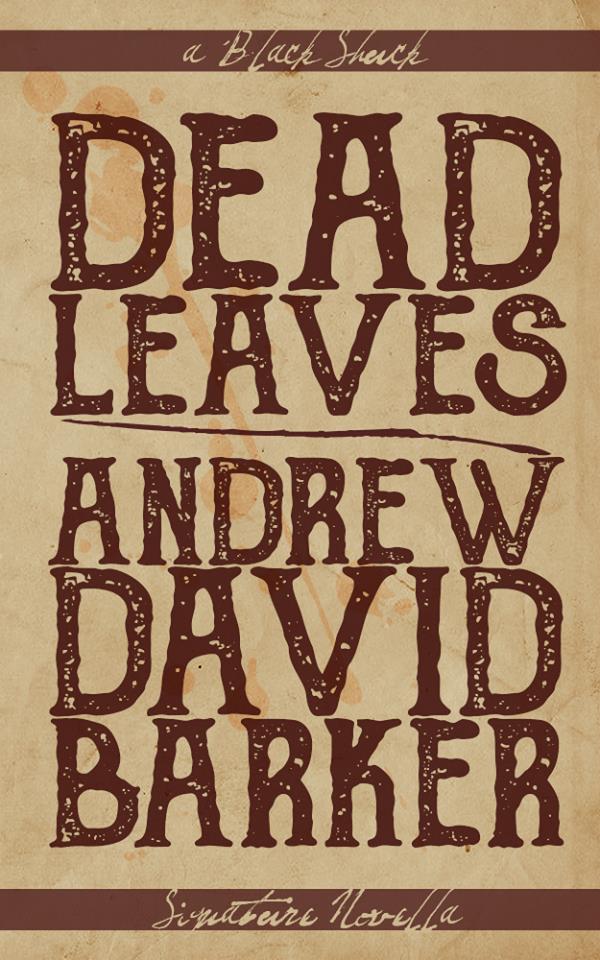
Interview with Andrew David Barker


Andrew David Barker was born in Derby, England in 1975. He is a writer and filmmaker. He is the author of The Electric and the novella Dead Leaves. As a filmmaker, he wrote and directed the cult, post-apocalyptic indie feature, A Reckoning, in 2011, and has recently made the short films, Two Old Boys and Shining Tor. He lives in Warwickshire with his wife and daughter, trying to be a grown up. His website is: http://www.andrewdavidbarker.com Twitter: @ADBarker


Interviewed by Lee Wright

LW: As a novelist and filmmaker, who has influenced you the most? 

ADB: Stephen King and Steven Spielberg, probably. They, above all others, were possibly the first creators I knew of that made me want to write and to make films. The filmmaking thing came first as well. I was born in 1975 – the summer Jaws came out – and so I am very much of the Spielberg and Lucas generation. I’m part of the last wave of Gen-Xers; I grew up with TV and movies that gave me a sense of wonder and then came of age in the '90s when we thought life was one big party – the long hangover began around 2001. 

I’m someone who is always hungry for new inspiration. Once I find out about a new author, filmmaker, songwriter, whatever, I tend to want to find out everything about that person, soak up everything they’ve done, and once I’m sated I move onto the next artist. There are mainstay artists though, people I always come back to, but really I’m always looking for something new. I’m on a big Magnus Mills kick at the moment, who I think is fast becoming my favourite English writer. I understand his world and his characters, and he’s very funny.  
I think influences are important. I’ve written a lot about fandom – about how being inspired by a film/book/band whatever can propel you to create your own art. Without those first sparks of excitement I felt watching, say, Close Encounters or reading The Stand, I wouldn’t be doing this stuff.  

LW: What’s your definition of horror?  

ADB: That’s a tough question, but I guess it’s something that horrifies, simple as that. I tend to be drawn more to tales of the supernatural, the uncanny. Maybe it’s because I’m a parent now, but if it exists in a realm that is too real for me, I can’t do it nowadays. It has to be detached from my everyday life. So, humans killing other humans doesn’t do much for me. That said, I think The Texas Chain Saw Massacre is the greatest horror film ever made. I think it’s a masterpiece. An incredible piece of filmmaking that works on so many levels. It’s very much like a Grimm Fairy Tale in many ways. It’s not a film I can watch very often, but I don’t need to because it’s never left me. 

I had a love of horror films from a very early age. The first horrors I saw were the old Universal pictures, which are just beautiful to look at. Then I saw Salem’s Lot at a ridiculously young age. Yes, Tobe Hooper again. I’m sure it’s very dated now, but the memory I have of those kids scratching at the bedroom windows frightened me very badly. Dawn of the Dead was another seminal film. I was probably about nine when I first watched that and as you can imagine at that age, it had a profound effect. In many ways actually, as that was one of the first films that got me interested in filmmaking. 

I think for horror to really work it has to tap into universal fears. We all understand a fear of what lies beneath the ocean while we swim, which is why Jaws will always work. We all understand nightmares and so we have Freddy Krueger. We all understand the fear of someone wanting to murder us – Psycho, Halloween and so on.
There is the fear of something external – the monster outside – or internal – the monster inside. That is pretty much it. The best books and movies tap into those areas and to really be scary they need to peel back the many layers of our defences and strip them away one by one.     

LW: Your novel, Dead Leaves (about the video nasty area and a group of teenagers), has just been republished by Black Shuck Books after first being published in 2015 by Boo Books. Can you tell us about your experiences of having to find a new publisher?  

ADB: The world of the small press is pretty tough. No one makes any money. These publishers – and writers – do it for the sheer love of books. I think it is a pure thing. Boo Books gave me my start. They published my first novel, The Electric, in 2014, and Dead Leaves in 2015. I thought I was on a roll. Then soon after Leaves was published, Alex Davis of Boo Books had to close its doors. There is pure love, then there’s making something that is tenable. This stuff is hard to do. 

Anyway, I’m always going to be grateful for Alex giving me a start. After Dead Leaves, though, I kind of stalled with my writing. It wasn’t a writer’s block, because I was still writing, I just didn’t finish anything. I started and abandoned two novels. But also, in that time I became a parent, which, as wonderful as that has been – and it is the greatest joy in my life – it will seriously cut into your writing time. So before I knew it three years had passed since I’d published anything. Aside from a short story called "Bank Holiday All-Dayer" anyway. 

As for Black Shuck Books. I went along to Edge Lit in Derby, as I often do, which is a great writing festival, and saw Steve Shaw, who runs Black Shuck. I’d met him a few years before and got on well with him. He’d read Dead Leaves when it first came out and had told me he really liked it. Anyway, I happened to mention that I was on the lookout for a new publisher and he immediately said that he’d be interested in reissuing Leaves. That was in June of this year and it came out in September, so it happened very fast. I hadn’t sent out Dead Leaves or The Electric to any other publishers. I really should though as I’d really like to get a new publisher for The Electric. Anyway, I hope I can do more stuff with Black Shuck Books.  


LW: Your novels and short stories tend to depict the “coming-of-age genre.” Do you fear growing up? 

ADB: Ha, yes! I’m 43, but still feel like a kid most of the time. Growing up is boring. Grown ups are boring! 

I don’t know, I like the genre. There’s something about that time of firsts that has always appealed to me. It’s an exciting time, and a universal one. We all go through it and it’s always life-shaping. Who you are going to be, what you are going to love, hate, everything is formed in those early years. Plus there is a magic to childhood that we can forget when we grow up. But I never want to forget it, and writing can bring it back in very vivid ways. 
That said, it is probably time to move on. My next projects have older protagonists. I’ll more-than-likely return to writing about kids again at some point though. 

LW: Have you ever drawn on any autobiographical content for your fiction? 

ADB: Always. You’ve got to have skin in the game. All my work is drawn from my life. Dead Leaves and the short story "Bank Holiday All-Dayer" especially. That said, I don’t so much as write what I know, more write what I feel. I’m a very instinctive writer. For novels I don’t plan, don’t outline, although I do for screenplays. But for novels I like to see where the characters will lead me and through that very process, memories, feelings, moments I’ve had with people from my life always filter in. 

Like many writers, I spent a good deal of time in my early writing trying to write like authors I admired, but it never worked. You do have to find your own path, dig deep within yourself. It will give your work the honesty that will eventually become your identity. And if that identity can then connect with readers, then you’re well away. 


LW: As well as being traditionally published, you have also self-published a couple of short stories as e-books. What advice would you give for writers thinking of going down this route? 

ADB: Do it. 

Don’t wait for anybody’s permission to do any of this stuff. Get your work out into the world any way you can and don’t apologise for it. There are snobs out there about self-publishing – a lot of them established writers, it seems – that feel it’s a cheat. But a lot of doors are closed in the so-called established world. You’ve got to forge your own path. 

What I find curious is that being independent is celebrated in other areas. If you make an independent film, raise the money yourself, or, like Kevin Smith, pay for your first film yourself, it’s celebrated. It’s also inspiring. How many filmmakers were born through watching Clerks, or any number of indie films? 

If you’re a musician and you bypass the record industry and put your music out yourself, it can be celebrated. But books, no. Yet, when an Andy Weir breaks through or someone like that, a lot is made of the unsung talent out there. And there is a lot of talent out there. There’s also a lot of crap, of course. But there’s a lot of that being put out by established channels as well.  

But anyway … the walls are being torn down to a certain extent. All media is shifting. The old paradigms are crumbling. Get your stuff out there and be the best you can be. By that I mean, treat it as if you are being professionally published. Get an editor, a book cover designer; don’t just throw it out there. Think about the marketing, reviewers you might be able to tap, quotes you might be able to get. Everything a big publisher would do, apply it to your book. You won’t be able to get in Waterstone's or get reviewed by The Guardian. You might, but you probably won’t, but in everything else give it the absolute best shot you can. 


LW: One of your e-books, The Fin, is a short story, based on a scene in a film (Jaws), that was originally based on a novel by Peter Benchley. What were your thoughts when working on that story?   

ADB: Everyone who knows me knows that I’m fairly obsessed with Jaws. Spielberg’s film anyway, I don’t think Benchley’s novel is as strong. The Fin was just a bit of fun to be honest, nothing more than that. It’s fan fiction and I was certainly writing outside of my identity, which I was speaking of earlier. Although it is still about kids I suppose. I haven’t read it in a long time and it’s probably pretty clumsy, but it was fun to write and really fun to write in that world. It’s set in the world of Spielberg’s film, not really Benchley’s novel. I did think recently about taking the story down, but then decided against it. That was where I was as a writer at that point in my life. It’s a document of my abilities at that time. Every book and story is. Every film is. So that’s fine with me. Plus, I still think it’s a fun little story, and it’s very short.  

LW: Though your interests lie in the horror genre, you are yet to write a straight-forward horror novel. Do you believe that “writing scary” is a hard thing to do?

ADB: Really hard. It’s like comedy, which is also very difficult. In fact I think comedy and horror are very similar. They both work in the build-up and pay off. Plus, what scares people and what makes people laugh are very subjective, which is why I said earlier the best ones are the ones that speak to a universal truth. 

As for my writing, I haven’t written a horror novel, although I’ve written about horror. I have, however, started work on a horror novel – a '70s set, occult horror that I hope to finish one day, and I’ve just completed a short collection of ghost stories which I hope to be published next year. But really I’m interested in all kinds of stories. 

Writers are often boxed into genres, but I admire writers who break that and write across genres. I like Michael Chabon for that. He’s seen as literary, whatever that means, but very much plays around in genre, all different kinds of genre. Paul Auster is the same. I think he’s an incredible writer. Joyce Carol Oates is the same. Stephen King, who is classed as a horror writer, has written in every kind of genre there is. In fact, I think he’s only written a handful of pure, balls-to-the-wall horror novels, the rest is across the board. 

One of the main projects I’m working on seems to be a love story, very much in a kind of Nick Hornby or David Nicholls mould. It might be a detriment to my career that I’m jumping from one thing to another – that I’m not doing any one type of novel – but I can only write what I can write, and I have ideas in all kinds of genres and areas. What I try to bring to all these things though is a great sense of me, my identity. I hope that will tie them all together. 
It’s interesting to me that film directors can work in all kinds of genres and stories, and yet writers don’t have that same amount of freedom. I don’t know why that is. 

LW: What was the last novel that scared you?  

ADB: I haven’t read many horror novels in recent years, although I did read William Peter Blatty’s The Exorcist last year and thought it was quite brilliant. There was some very unnerving stuff in that one. I’m going through a bit of a Blatty stage at the moment. 

I did recently read James Herbert’s The Rats that I had great fun with, but it didn’t scare me. It takes a lot to scare me, in fiction anyway. The real world scares me greatly. 

I love a good ghost story. Michelle Paver’s "Dark Matter" was the last really good one I read. Actually, there’s a section in Murakami’s Kafka on the Shore that really upset me. The torture and killing of cats. That was horrible. He’s an incredible writer who defies any box a publisher would try to put him in. That’s an inspiration to me. 

LW: Do you ever get disheartened with writing? 

ADB: Yes. There’s what I call the Demon Doubt. He’s an arsehole. You can be happily writing away, thrilled with what you’re creating, but you come back to it the next day and it can feel and seem completely different. It can feel like what you achieved yesterday in unbridled joy is now utter crap. That’s the Demon Doubt taking hold. 

I’ve learned to ignore him, but it is sometimes hard. Once he’s got his teeth into you, entire projects can die. Believe me, I know. 

The trick is to trick him. Leave the work for a few days, weeks even. Make him think you’ve forgotten it and then go back to the work and more often than not you’ll think, “Hey, this is pretty good” and you’re back in the game. 

Truth is though, I think it’s healthy for a writer to have doubts and fears. If I were blindly confident and thinking everything I’ve written is amazing, then I’d be really worried. That path leads to mediocre, or even crap work. 

There have been times when I couldn’t write, or just had no interest in it, but they’ve been rare. Even on bad days when the Demon Doubt is playing his merry little games with my head I’m still compelled to do the work. And I think that is the key to actually making it as a writer. Now, I haven’t made it in the West’s view of success. I haven’t made big money from my writing and I still have to have a day job, but I’ve made it in the sense that I’ve kept on going and will continue to keep on going. I need to write. It’s who I am and I think I’m a better person when I do write. That’s what my wife says anyway. 

So you have to push on through those times when it all feels pointless and you think you’ve got nothing to say. Dig deep, push through and you’ll have a piece of work that you’ll be proud of. That’s the key. Ignore the Demon Doubt and finish it.   


About the reviewer 
Lee Wright was born in Nuneaton, Warwickshire in 1980 and has been writing both fiction and non-fiction since 2008. He is taking an MA in Creative Writing at the University of Leicester in 2017.