Showing posts with label Jonathan Taylor. Show all posts

Tuesday, 21 July 2026

Review by Paul Taylor-McCartney of "High Spirits: A Round of Drinking Stories," ed. Karen Stevens and Jonathan Taylor


At first glance, High Spirits appears to be an anthology united by a simple premise: stories in which alcohol plays a central role. Yet what soon becomes apparent is that this is far less a book about drink than it is about the people who drink, and the complicated lives that unfold around them. 

Stevens' and Taylor's comprehensive introduction is a critical essay in itself and hugely informative, in which they argue that "drunkenness is itself often a story," complete with a "beginning ... a middle ... and an end." It is a perceptive observation, for throughout, alcohol is rarely the subject itself. Rather, it becomes the catalyst through which loneliness, desire, memory, grief and hope are revealed.  

The anthology brings together an impressive range of contemporary writers, including both editors, Louis de Bernières, Jenn Ashworth, Alison Moore, Bethan Roberts and Desmond Barry, each bringing a distinctive voice and treatment of the premise. Some stories are comic, others unsettling; some quietly elegiac, others darkly surreal. 

One of its greatest strengths is its refusal to moralise. Drink is neither glamourised nor condemned. Instead, it’s presented as part of ordinary experience: a celebration, a habit, an escape, often a consolation, sometimes the beginning of connection and, more pointedly, the cause of its collapse. The emotional range is striking, allowing humour to sit comfortably beside vulnerability and loss. Jenn Ashworth's "Jackie Kennedy and the Widow" offers an unflinching meditation on grief, while Michael Stewart's "Painting the Walls White" explores memory and disorientation through themes of forgetting and losing one's way. Melanie Whipman's "Tasting Notes" provides another distinctive voice, demonstrating how drink can become less a subject than a lens through which relationships and identity are examined.

What emerges is a portrait of contemporary life in all its contradictions. These are stories of imperfect lives, where moments of celebration sit uneasily alongside loneliness, regret and longing. Shared drinks become occasions for confession, confrontation and reconciliation; solitary ones speak of absence and loss. Throughout, alcohol functions not as the subject but as a catalyst, bringing into sharp relief those fragile aspects of ourselves we usually keep hidden. 

It’s easy to see why High Spirits won the 2019 Saboteur Award for Best Anthology. It matures beautifully as it unfolds. Individual stories possess their own distinct flavour, yet together they create something richer than the sum of their parts. Like a conversation that grows more candid as the evening wears on, these stories remain in the mind long after the final shot, inviting readers back for the richness of their voices and the truths they quietly reveal about what it is to be both human and fallible. Intoxicating stuff. 


About the reviewer
Dr Paul Taylor-McCartney is a writer, researcher and lecturer. His interests include dystopian literature, queer studies, children’s fiction and initial teacher education. His poetry, short fiction and academic articles have appeared in a wide range of print and electronic media, and fiction titles he recently worked on as commissioning editor have won regional readers’ and publishers’ awards. His debut novel, Sisters of the Pentacle, was published by Hermitage Press in 2022, and his first non-fiction title, Cornwall Uncharted: Mapping Cornwall’s Queer History of Concealment, Culture and Creativity was published by The History Press (June 2026), to great acclaim.


Thursday, 28 May 2026

Review by Siobhian R. Hodges of "Scablands and Other Stories" by Jonathan Taylor


Each story  in this collection was uniquely captivating, and the various lengths created an overall pace that matched the book's genre, a kaleidoscopic symphony of its very own. With such a busy life (like most of us have) and not nearly enough free time as I'd like, the book was perfect for me to dip in and out of. It may sound clichéd but Scablands and Other Stories truly was the type of book that I could not put down.  

Every night for the past week, I found myself wanting to read "just one more story" - like my daughter regularly asks me at the end of one of her Disney bedtime stories. Being an adult, however, I was able to make my own (hypocritical) decision and would continue reading Taylor's book long into the night, enjoying the fully immersive worlds and (mostly) endearing characters.

I especially loved "A Sentimental Story," "Heat Death," and of course "Scablands" - the final story that will stay with me for a long time, just as, I imagine, the memory of Mr Chandler will stay with the boy-who-is-no-longer-new.

Thank you to the author for this collection of bittersweet escapism. I'm looking forward to reading more of your work!


About the reviewer
Siobhian R. Hodges is a Leicestershire multi-genre writer, author of the supernatural thriller Killing a Dead Man and coming-of-age anthology Untitled Decade. She has an MA in Creative Writing and was shortlisted in 2021 for the Page Turner Book Awards. She lives with her graphic designer husband, their two chalk-and-cheese children, and their dog-like cat.

Wednesday, 6 May 2026

Review by Jonathan Taylor of "Walter Benjamin's Ark" by John Schad


“The Angel of History,” philosopher Walter Benjamin claims, is witness not to a “chain of events” but rather “one single catastrophe which keeps piling wreckage … in front of his feet.” No doubt this “pile of debris ... [which] grows skyward” consists mainly of human wreckage, the dead; but, as John Schad’s weird and hallucinatory new book, Walter Benjamin’s Ark, demonstrates, it also includes language, texts, the very ability of human beings to communicate. The catastrophe that is mid-twentieth-century history, in particular, reduced texts to a “huge-and-disorderly-heap-of-unsorted BOOKS, a kind of rubble,” such that “words had been muddled,” often in disastrous ways. 

Walter Benjamin’s Ark brilliantly picks its way through that rubble, trying to salvage something from the cataclysm. It pieces together an upcycled collage of historical fragments, philosophical and literary texts, impossible conversations, in order to tell the imagined story of Walter Benjamin’s son, Stefan, and his journey as a deportee from England during the Second World War. In 1940, Stefan was forced onto the HMT Dunera and deported, ultimately, to Australia – along with 2000 other “enemy aliens,” some of whom were devoted Nazis, but the majority of whom were Jewish refugees.

Herein lies the first sign of the disintegration of language: the disastrous collapse of the words “German,” “Nazi,” “enemy,” “alien,” “immigrant” and “Jew” into one another. Many other instances of linguistic collapse and miscommunication follow: a Jewish author’s unfinished novel is discovered by the British soldiers on board, and thrown into the Mersey; the letters between Stefan and his mother are lost; Stefan loses touch with his father, Walter; a manuscript Walter claims to have in his suitcase (“a manuscript more valuable than I am,” he says) disappears on his death; his final letter to his son is mysteriously destroyed; a Jewish poet, Gertrud Kolmar, is silenced – initially by being forced to work in a German munitions factory, and subsequently by deportation to Auschwitz. 

The deportation of the Jews, whether to Auschwitz or to Australia, is itself facilitated by failed communication. As Schad points out, on 8 August 1942, the World Jewish Congress sent a telegram from Geneva to New York warning about the Final Solution. “This telegram,” Schad notes, “would, initially, be dismissed as a falsehood.” As Schad suggests, miscommunication and misreading can have deadly consequences: excommunication all too easily slips into extermination. 

There is still hope, though, according to Schad: “in all its desperation,” Stefan’s situation, is “not devoid of hope.” And Schad’s quasi-biography itself represents an act of hope, in its piecing together of a new kind of language, its revelling in Joycean-Woolfian streams of consciousness, its staging of impossible dialogues,  its textual and generic contortions, its bizarre juxtapositions of slapstick with horror. After the war, Stefan became an antiquarian bookseller; and towards the end of Walter Benjamin’s Ark, he is seen straightening the books with “the gentlest touch,” as if rescuing them from the rubble, “lest they topple, fall, and crash” once more. Texts, language, communication persist, just about, and Stefan is doing his bit to restore them, saving them from the wreckage of war. 


About the reviewer
Jonathan Taylor’s most recent books are A Physical Education (Goldsmiths, 2025) and Scablands and Other Stories (Salt, 2023). He directs the MA in Creative Writing at the University of Leicester. 

You can read more about Walter Benjamin's Ark by John Schad on Creative Writing at Leicester here

Thursday, 13 March 2025

Review by Jonathan Taylor of "Wish: New & Selected Poems" by Maggie Brookes-Butt


In his ‘Ode on Melancholy,’ John Keats famously suggests that ‘Ay, in the very temple of Delight / Veil'd Melancholy has her sovran shrine.’ And perhaps it works the other way round too: in the temple of Melancholy, there’s a shrine to Delight. 

Maggie Brookes-Butt’s life-affirming collection, Wish: New & Selected Poems, encompasses both alternatives: her poems are sometimes temples of Delight which house shrines to ‘Veil’d Melancholy,’ sometimes temples of political Melancholy, which open up to reveal Delight, Joy, Beauty. As many have pointed out, contemporary poetry is – as far as it’s possible to generalise – not always on home ground when it comes to delight or happiness or joy. Joy is all-too-often left to birthday card rhymes, seen as naïve in an age of end-game capitalism, political polarisation and climate disaster. 

The poems in Wish, though, are far from naïve: this is a grown-up, fierce, brave joy that can thrive in the teeth of political realism. In the opening sequence, Brookes-Butt stages imaginary conversations with her infant granddaughter, which are both celebrations of shared love, and honest appraisals of the future the latter has been born into. In the poem ‘Realities,’ for instance, she writes:

                    The whine of chainsaws
          plagues the forests, while glaciers silently drip. Missiles
          land on another hospital, another school. And the people 
          we love go away and we never see them again …

          But let us not go there today. Better by far to hold my hand
          and look for bears in the woods, mermaids diving
          from the rocks, Father Christmas landing on the roof, 
          dance the hokey-cokey and sing “that’s what it’s all about.”

This is what Brookes-Butt’s poems do so beautifully: they dance the hokey-cokey, find the bears in the woods and mermaids on the rocks, while still facing up to the ‘realities’ of the modern world. A dawn chorus, for example, is ‘a technicolour / torrent-of-sound, reminding, insisting, in spite / of everything – there is joy in the world, / there is so much joy.’ Even in a Second World War prison camp, the downtrodden inmates find ‘unexpected peace’ in an allotment, where they ‘grow gifts / of vegetables or flowers to give on visit day.’

Like the inmates, Brookes-Butt's poems often find 'unexpected peace,' miniature utopias, in a wider context of turbulence and degeneration. Hers is not an escapist joy, though, that turns away from horror. Rather, it’s the kind of visionary and radical joy that Friedrich Schiller and Ludwig van Beethoven might have understood – a joy that challenges present and future ‘Realities.’ Even if, in that particular poem, the poet ultimately declares ‘let us not go there today’ to her grandchild, the implication is that such realities will have to be faced in the future. And the collection as a whole holds onto a radical and joyful optimism for that future, in spite of fear, in spite of melancholy, ‘in spite of everything’:

For now leave
fear about the drowning and scorching of your world
to me. I have enough for both of us. When I’m too
voiceless to protest, too old to carry a placard, 
I’ll hand it to you like a baton or perhaps a fiery
sword, and you can run in my stead. We will defy
the politicians with lies for hair, shout down
fearfulness itself with tongues of flame. 


About the reviewer
Jonathan Taylor is director of Everybody's Reviewing. His most recent book is the memoir A Physical Education: On Bullying, Discipline & Other Lessons (Goldsmiths, 2024). He teaches Creative Writing at the University of Leicester. His website is here


Sunday, 26 January 2025

Review by Jonathan Taylor of "The Moon Looks on Them All: Of Friends and Friendship" by John Lucas


Despite their reputation for egocentrism, memoirs are often – perhaps always – about relationships between a narrator and other people. As critics Sidonie Smith and Julia Watson point out, “there is a relational aspect to most life writing," and many others have claimed something similar. This “relationality” (as they call it) most commonly encompasses fathers, mothers, siblings, children; but there is a growing sub-genre of memoirs and personal essays which recognises the vital role played by friends in our lives. John Lucas’s fascinating and wide-ranging The Moon Looks on Them All is a significant and beautifully-written contribution to this sub-genre of friendship-memoirs (filikigraphy?). 

Like all the best books about friendship, what Lucas’s memoir recognises is that “relationality” does not simply mean that the story is about two (or three, or fifteen) people rather than one. No: "relationality" means that the relationships themselves become focal points, main characters, above and beyond the individuals involved. Friendships are themselves stories: friendships have narrative arcs of many different kinds, and each of the chapters in Lucas’s book is, first and foremost, a story of a key friendship in the author’s life. Of course we find out about the amazing individuals involved – poets, academics, jazz musicians, E. M. Forster, Brian Clough, Lucas’s cat – but above and beyond that, we follow the story of Lucas’s changing relationships with them over time.

The result is a life-affirming patchwork of interweaving friendships, voices, anecdotes, poems and brilliantly-drawn character portraits. At one point, Lucas admits that “sooner or later, everyone I meet, and get to know, will remind me of a character in Dickens” - and The Moon Looks on Them All is rather like a Dickens novel, teeming with memorable characters. If the cumulative effect of a Dickens novel is often that the reader feels immersed in a vibrant all-encompassing community, something similar might be said, on a microcosmic scale, of the community of friends in Lucas’s memoir. He cites E. M. Forster’s faith in “Love, the beloved Republic,” in “an aristocracy of the sensitive, the considerate, and the plucky” – and that seems to me as good a description as any of the utopian community of friends which Lucas depicts in this book. 


About the reviewer
Jonathan Taylor is an author, editor, lecturer and critic. His two most recent books are the memoir A Physical Education: On Bullying, Discipline & Other Lessons (Goldsmiths, 2024), and the short story collection Scablands and Other Stories (Salt, 2023). He directs the MA in Creative Writing at the University of Leicester. 


Sunday, 10 November 2024

Review by Sally Shaw of "A Physical Education" by Jonathan Taylor


A Physical Education: On Bullying, Discipline & Other Lessons is a book of memoir, interwoven with literary, film, drama and social sciences, by Jonathan Taylor, published in 2024 by Goldsmiths Press. 

When I started reading this book I wasn’t sure what to expect or even if I would be able to fully understand what Jonathan Taylor is discussing. As I read on and paused to consider what had been written I discovered how literature has tried to record or unveil bullying, how it has the power to aid individuals that are being bullied, and also Taylor’s skill in his examination of this subject. His writing enabled me to consider the many forms and complexities of bullying and bullies. Taylor’s bravery in sharing his at times harrowing experiences of being bullied will, I’m sure, enable others to identify bullying either of themselves or others and, in doing so, reduce it in educational and work settings, or deal with it. 

By providing literary examples, the book exposes, in a non-threatening way, the many different forms of bullying within education. For example, Taylor discusses the example of The Prime of Miss Jean Brodie, in relation to issues of classroom democracy, after he has been beaten down by the other children for standing up for the rights of a character in a drama the class are watching: "The problem, of course, with apparently individualistic behaviour is that it doesn’t come from nowhere. Individualism is never simply itself. Rather, it is made - and often made for, rather than by - the pupil or pupils at the centre of it. In The Prime of Miss Jean Brodie, the so-called individualism of the 'Brodie set' is obviously made, in part, by Miss Brodie herself, forged by her 'as the leader of the set … as Roman matron.' 'I am putting old heads on your young shoulders,' she declares, when her favourites are eleven. 'I would make you the crème de la crème.' Later, she proclaims: 'You are mine … of my stamp and cut.' Miss Brodie’s stamp and cut are what 'set them apart' from the other pupils, and ultimately, 'it was impossible to escape from the Brodie set because they were the Brodie set in the eyes of the school.' This puts them in an 'enviable’ position,' such that 'everyone thought the Brodie set had more fun than anyone else.' All too often, though, being set apart in 'the eyes of the school' is much less fun, more a matter of ostracism than envy." I think that most people can relate to a drama, novel or film and for me this book has made me aware that it is a legitimate form of support for people affected by bullying.

I can only say what I discovered by reading this book. One thing is that it can sometimes take years to realise bullying has been, or is, taking place. Reading this book I did think about my past and present. I knew I was bullied by teachers, work colleagues, and I have also started to uncover bullying from individuals close to me. And I have found the book contains further reading to enable me to explore this in greater depth. In fact, as I read on, I started to acknowledge that I think I could have been a bully at times in my earlier life, but I’m unable to recall the details. Taylor examines how the bullied have the potential to become the bully. I happened to watch the film The Joker (2019), starring Joaquin Phoenix, an extremely dark and disturbing film, that to me demonstrated a possible consequence of when the bullied become the bully. As Taylor discusses, the very term "bullying" is almost impossible to define, as it can range from teasing to domestic abuse and more. 

This book is worth reading by everybody as it is relatable to all areas of society and may lead to readers identifying bullying, so enabling greater awareness and understanding. There may not be one single method of stamping out bullying, but this book shows that greater understanding can reduce the risks for future generations. The more we can talk about it, reduce the shame, the more people will be helped.  


About the reviewer
Sally has an MA Creative Writing from the University of Leicester. She gains inspiration from old photographs, history, childhood memories, and is inspired by writers Sandra Cisneros, Deborah Morgan, Liz Berry and Emily Dickinson. She has short stories and poetry published in various online publications including The Ink Pantry, AnotherNorth, Roi Faineant Press
Sally lives in the countryside. 

You can read more about A Physical Education on Creative Writing at Leicester here

Tuesday, 23 July 2024

Interview with Louise Peterkin


Louise Peterkin is a poet and editor from Edinburgh. Her poetry has appeared in many publications including Magma, Finished Creatures, Poetry Wales, The North and One Hand Clapping. She is a recipient of a New Writers Award from the Scottish Book Trust. She is a poetry editor for The Interpreter’s House. Her first collection of poems The Night Jar was published by Salt in 2020 and she is currently working on her second. 

You can read more about The Night Jar on Creative Writing at Leicester here


Interviewed by Jonathan Taylor

JT: Your collection, The Night Jar, opens like a Pandora's box, full of "gorgeous paraphernalia." Why did you choose this opening image, and what do you think it tells the reader about the collection as a whole?

LP: The Night Jar is comprised mainly of poems that take the form of dramatic monologues. There are lots of characters in there – some based on real life or historical figures or ones already established in literature, popular culture, mythology. Some are of my own invention. I liked the idea of a poetry collection as a figurative receptacle which could be opened to unleash the stories into the imagination of the reader. I tried to focus on individual hypotheticals in the hope of investigating universal themes – love, repression, envy, desire, religion, sexuality, obsession. 

The collection starts an untitled poem from the perspective of a collector. The first line is "I open the Night Jar." The insertion of this poem was partly inspired by Anne Sexton’s Transformations, her dazzling revision of the Grimm fairy tales. That collection has a prelude poem, "The Gold Key," in which Sexton employs the voice of an archetypical "gather round the fire, our story begins" narrator. I tried to do something similar with The Night Jar – take on the introductory voice of the collector. And the nocturnal imagery within that poem indicates that the collection as a whole will have something of the dark or the numinous about it. 

A significant inspiration for me in informing the concept and to some extent the tone of The Night Jar was my fondness for compendium horror movies from the Seventies. Films like Tales from the Crypt and Dr Terror's House of Horrors which would usually consist of five macabre stories with a wraparound or run-through thread of a stranger bringing individuals together (the stranger usually turned out to be some sort of incarnation of the Grim Reaper come to round up their souls for moral transgressions). I’m also keen on The Night Gallery (probably an instinctive influence going on there with the title). This anthology TV series was the follow up to The Twilight Zone and was presented by Rod Stirling in the guise of an art gallery curator – at the start he would show these paintings which represented the creepy stories about to be broadcast. The Night Jar could be seen as a compendium, an anthology of strange and unsettling stories.

JT: Given the opening image and various recurring motifs and characters, The Night Jar is an unusually cohesive collection, which implies various overarching narratives. How did you conceive the collection? Did you write individual poems, and then common ground emerged gradually, or did you conceive it as a whole from the start?

LP: I was lucky enough to win a New Writers Award in 2016 from the Scottish Book Trust. Part of the awards package was a mentorship with Bloodaxe poet Cheryl Follon. We decided early on that my aim was to develop the poems I had written into a full collection to submit to publishers. Cheryl recommended that I should try to apply some thematic cohesion to the poems, to think about how the collection could be viewed as a whole as well as a series of individual ideas. I started to think about what the poems had in common. 

The characters in the poems are often confined – in an asylum cell, in a convent, in a boarding school, in one poem inside the belly of whale. Or else they are stuck in a circumstance they cannot get out off: domestic grind, toxic relationships, some sort of psychological malaise or monomaniacal commitment. They are looking for some form of escape or autonomy or transcendence. If the speaker of the poem is not the captive, then they are the captor – they seek to coerce and possess but end up being the architect of their own discontent. It helped me to employ a congruence and give a shape to the process. I would write a poem and think Oh that could go in The Jar. Yes, that one's for The Jar! I didn’t restrict myself to writing solely monologue, character-based poems but that was what I was drawn towards. Some things were working on a subliminal level – it was only after I read through the poems grouped together, I realised how many motifs there were throughout that implied enclosure: trunks, boxes, gates, keys.

JT: As I say, the collection is full of vivid characters, some of whom recur (such as Sister Agnieszka). Many of the poems are, in a sense, character sketches. How do you view the role of character in poetry?

LP: It probably comes down to my own personal tastes. When I was in my late teens and really getting into contemporary poetry, the ones that appealed to me the most were ones where the poet would assume the voice of another person. I loved Carol Ann Duffy’s The World’s Wife which consists of poems spoken from the perspective of wives and mistresses of real life and fictional men throughout history, or male characters inverted into female ones – "Mrs Midas," "Queen Herod," etc. I savoured Margaret Atwood’s monologue poems, especially her longer sequences like "Speeches for Dr Frankenstein" and "Half-Hanged Mary" which allowed for an abundance of luxurious and unusual description and detail. 

Early on, I had attempted to write confessionally but always felt inhibited and stifled. The poems I was writing felt a bit off - inauthentic, affected or stiff.  Discovering monologue poems by other poets helped me towards the realisation that you didn’t have to write directly about yourself or your own experience. This went a long way in unfettering my own practice. By removing the speaker’s voice from my own in the main, I felt less impeded by the uneasiness or self-consciousness tied up with issues of autobiography and identity. I could explore some dark and complex emotions and themes with a greater measure of abandon and fluidity. It’s a creative mind trick I play on myself but it works. And in turn, it helps with the enquiry of the self, that process and catharsis. Because I’m in the poems too though separate from the narrator – my anxieties, my preoccupations – they are in there.

JT: What many of my questions so far imply, I suppose, is that there's a strong relationship in your work between aspects of storytelling and poetry. Do you see yourself as a storyteller? And how do you see the relationship between what you're doing in The Night Jar and, say, fiction?

LP: I do see myself as a storyteller or, on occasion, an interpreter of existing stories. But the medium of poetry is where I feel most at home. It’s the scope for imagination and invention the art form allows coupled with its command for discipline. The sententiousness inherent in the practice forces me to refine and distil my ideas and my language. I have attempted to write short fiction in the past but I always felt it was florid and overwrought. This pained me because the fiction I enjoy the most applies an economy of language and a continence to make it compelling or imminently readable. 

Also, I just take a lot of pleasure and satisfaction from the devices in poetry which differentiate it from prose. I don’t write formal verse so it is important to me to apply the mechanisms which give my poems music - assonance, consonance, half-rhymes, and the application of metre which, without adhering to a strict form, lends an intended rhythm and movement to the free verse.

JT: Do you see yourself as a surrealist? There are definitely surrealist elements in many of the poems, and a virtuosic playfulness in the way you use language. How do you see the relationship between your poetry and surrealism?

LP: I would say probably not. The situations in my poems can be surreal or fantastical or outlandish for sure but I think that fact that they are compelled by a narrative drive pushes them more in a linear direction or grounds them in some way. I strive to convey a clear and vivid story for the most part.

Perhaps the storytelling characteristic of my poetry is at odds with Andre Breton’s assertion of "the undirected play of thought" as basis to surrealism but certainly a lot of the images I have in my poetry come from a reflexive place. I think that some of my similes could be pegged as a bit weird but I’m fine with that because in order for an image to appear to the poet there has to be a cognitive association which in turn gives it validity or a truth – those automatic allusions or visual connections the mind makes. 

I think that your term "playfulness" is perhaps more key to my writing. I really enjoy wordplay and take pleasure in the licence poetry gives you just to enjoy language. My poems tend to be quite rich so I try to temper this with humour. I enjoy cooking and I like keeping lemons to hand in the kitchen as the sharpness cuts through the unctuousness of dishes – I try to use dashes of humour in a similar way in my poetry. And the poets I admire the most usually have a certain mischief and energy, and are quite audacious in their imagery – people like Jen Hadfield and Jane Yeh spring to mind. 

JT: As well as surrealism, there's a gothic aspect to many of the poems, or perhaps an uncanny element. How do you think this element of the poems arises? Is it to do with the subject matter you choose, or the language, or something else?

LP: I think perhaps its more to do with the subject matter and this probably just comes down again to my tastes – my sheer affection for horror cinema and literature and the macabre. The supernatural, the uncanny have always held an appeal for me, anything that gives you the shivers in movies, in fiction. I’m not so interested in real-life accounts of the paranormal – maybe I’m too sceptical. I’m not sure that you have to believe entirely or even a bit in order to be fascinated by the subject in fictional representations. There is much capacity in horror cinema or literature for the study of psychological or sociological demons. 

I would probably agree that I am interested in conveying a gothic atmosphere in my poems, with their heightened energy, and in their relaying of the tropes of cinematic and literary aesthetics – the mad scientist's lab, the Victorian asylum. As a child I loved looking inside things. Whenever we went on a family trip to some heritage site and there was a lighthouse or a tower, I was always despondent if we couldn’t look inside. I loved the idea of the interiors of mansions, castles, dolls' houses, of the lairs of villains in movies and TV. This probably translates in some of the poems in The Night Jar – a concentrated interest in setting a scene with detailed description. 

JT: All of the poems in The Night Jar are fascinatingly varied in terms of form and layout. I really enjoyed this aspect of the poems, and felt that the forms really suited the varied subject matter, and different characters. How do you go about negotiating that relationship between form and content?

LP: I think that often the disposition or circumstance of the narrator is the preliminary point for me. I’ll give a few examples, citing individual poems. 

In "Sister Agnieszka runs away to the circus," I wanted to imbue the poem with a breathless quality to convey the frenetic and joyful feeling of breaking free. That poem runs in a long column of free verse with no stanza breaks. But within this I also tried to apply a rhythm and musicality that would infer the acrobatic movement of trapeze and also the rapid-fire tempo of circus music. Conversely, in "Sister Agnieszka addresses the poor and the needy" where the character is repressing licentious feelings for a gardener, the timbre is different – austere, haughty – and so it made sense for me to split it into stanzas for a more controlled effect. 

"The King who Ate Himself to Death" is essentially set out as a list of meal courses. I use anaphora – each line starts with the child-like defence of "But …" - and the poem becomes both a menu of food descriptions and a list of justifications for the narrator’s excess. 

In "The Snow Queen's factory," the musicality is deliberately subdued to create an anesthetizing effect – the lines do not run into each other and are intended to appear like something that would be chanted, perhaps even mumbled. The poem is a fable but supposed to imply real-life malaise, disconnect caused by work routine or domestic drudgery, a maternal remoteness, perhaps even a form of perinatal depression. Though there are few half rhymes throughout the poem there are references to bells, echoes, mantras – it’s like a nursery rhyme learned to be recited in parrot fashion, a mode of living to be repeated without feeling. 

I try to be true to my instincts while mindful of my craft, to use technique accordingly and consider the importance of shape and white space in poetry. The original format of "Notable Globsters," a cryptozoological poem, was laid out like a Wikipedia page with certain words highlighted in blue like hyperlinks but this wouldn’t have been feasible in a printed book. Probably just as well. I can go a bit far sometimes. 

JT: You weave stories around all sorts of real-life (and made-up) characters in The Night Jar. Who do you think are the main people (real or fictitious) who stand behind the collection? Who are your main influences?

LP: Sister Agnieszka was inspired by a story a friend from work told me. She attended a Catholic School in Poland and one of the nuns who taught her and was extremely pious and charismatic suddenly upped sticks in the middle of the night and it was all very mysterious. I sort of fill in the gaps and set her off on a series of adventures – four poems about her appear in the collection and this allows me to indulge (even though I am agnostic) a fascination with Catholic iconography. It also permits me to mitigate the themes idea of religious or patriarchal oppression with a bit of fun and sex and escapade. Interestingly, afterwards I found out that Sister Agnieszka is the name of a character in some Agatha Christie novels – I didn’t know this at the time, I was looking for a Polish name with a certain number of syllables and I chose that one. It’s quite a coincidence!

Many of the poems are inspired by characters in film or by my love of cinema - Indiana Jones, Bond movie henchmen, Hitchcock. I have a poem about Renfield, the institutionalized disciple from Dracula. I am attracted to the idea of villains probably, or those who are vilified justly or unjustly; those considered misfits or outsiders.

Some are inspired by fairy stories I loved when I was a child – The Snow Queen, Hansel and Gretel or sometimes they have a basis in mythology. The real-life figures I include were usually inspired by articles I read about them which had stayed with me for one reason or another. “The Interview with the woman who trepanned herself” was inspired by an interview in Vice magazine with an advocate of self-trepanation called Amanda Feilding. The poem assumes the voice of the interviewer but is not based directly on the Vice interviewer – I assumed the journalist's voice so the poem could explore the themes of creative frustration and writer’s block. 

I have never visited the US but I believe that some of the poems are inspired by and set in a sort of imagined Americana, one learned second hand through the landscape of cinema or American Gothic literature by Truman Capote, Carson McCullers, Shirley Jackson. And some of the characters could be viewed as a subversion or extension of the femme fatale archetype in American film noir or old Hollywood notions of the bombshell. 

I love music and growing up I always was drawn to artists that incorporated an element of conceptual performance or played with the idea of identity – David Bowie, Debbie Harry, Kate Bush. I actually think that the song writing of Kate Bush inspired my writing almost as much as other poets have because the way she would take and existing piece of art – a novel or a film as stimulus and then create something that was so entirely her own. I found that thrilling and inspiring. 

JT: What are you working on at the moment?

LP: A second poetry collection. I’m still working on the structure but I think it will be split into three parts – the last of which is a narrative sequence of poems concerning a writer recovering from a breakdown who takes on a residency in a house on the Suffolk coast. The house is haunted by the spirits of two nefarious Victorian illusionists and Vaudeville entertainers. So yeah, leaning into my eerie obsessions once more but I want the collection to examine the themes of mental illness, addiction, dysfunctional relationships and the writing process itself – its potential for healing and harm as you retreat into an inner world. 

The overall arching theme of the collection will be divergence and conflict in personal relationships and within the self – our tendency towards self-sabotage and self-destruction. Having kept the voice at the centre of my poems at a comfortable distance for so long, in my new poems I find that I am balancing the fictional projections with a somewhat more personal aspect – it’s tricky and frustrating and a bit frightening but I hope it allows me growth as a writer. It’s going at a glacial pace. I will be finished in about twenty years at this stage. I need to get some momentum going. 


About the interviewer
Jonathan Taylor is the director of Everybody's Reviewing. His recent books include the short story collection Scablands and Other Stories (Salt, 2023) and the poetry collection Cassandra Complex (Shoestring Press, 2018). He directs the MA in Creative Writing at the University of Leicester. 

Sunday, 6 August 2023

Review by Lisa Williams of "Scablands and Other Stories" by Jonathan Taylor


The Scablands are vast barren areas in the USA riddled with fissures. A scab is a person that breaks a picket line during industrial action. A scab is hard and unattractive. A scab covers an area that has been hurt, and needs time to heal. This book is not set in America.

Buckle in as we head on this lyrical journey to the Scablands: the stories vary in length, some barely a page, others develop in over thirty. The city setting has a park, shops and even a Lovers Walk. It sounds divine but we soon realise it’s a place "brimful of loneliness" packed with "affection-starved strangers." This is very much a book of "sorrowful voices." Don’t worry - you can buy a hug from a booth for £2 there if it gets a bit much.

There’s suicide, amputation, self harm and ever-unfulfilled wishes. The lonely converge here, but Taylor’s poetic use of language ensures reading is a joy not a chore. His use of humour helps too: a homeless guy talks about moving to somewhere more palatial, and "it might even have walls." There are flickering glimmers of hope for the characters: a university place or a lottery ticket may provide a way out, although the offer of a different life is not necessarily wanted. What isn’t said is important, the gaps the reader completes themselves, asfor example in the poignant line: "A girl eternally eleven."

To take a specific story without ruining the book for you - "Till Life" is a delightful puzzle of a story. It covers the working day of a shop-girl. Taylor piques our interest with titbits like a secret tea-cosy in a pocket. He prompts the reader to question what he’s telling us. We realise things aren’t straightforward when Mrs Parker is more than just a boss and manager. We unpick the peppered little clues, such as an accident, a hospital stay and the necessity of care, in order to reveal the actual story beneath. 

Many of the characters stay with you to the next story. At times, as the story finishes it actually feels like just the start of their story – particularly "A Sentimental Story." An earworm appears in three separate stories; a Dr’s name reappears later on. In my haste to review I’ve read the stories too quickly to decipher links. These characters deserve a less galloped read, which I have already begun.

The images created in these stories linger long after the book has been shut: an Andy Pandy Nightdress, a soldier digging in the mud, a girl on a till trying to pause her life and a biography completely crossed out in red pen. The stories in Scablands may be short, but Taylor’s superb word weaving skill ensures the tales last so much longer than their actual length. 


About the reviewer
Lisa Williams is a creative soul from Leicester. She has a Masters in Creative Writing from Leicester University, and lately tends to write mostly short fiction. She likes the challenge of a word limit – usually one hundred words. Her work has been published in numerous anthologies. Lisa has a weekly story slot on local community radio. She helps out a bit at Friday Flash Fiction and Blink Ink Journal. A regular stall holder at Leicester's new Art Fair, Lisa also sells online as noodleBubble.

Monday, 13 December 2021

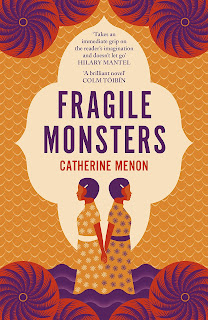
Interview with Catherine Menon


Catherine Menon is the author of Fragile Monsters, published in 2021 by Viking. Her debut short story collection, Subjunctive Moods, was published by Dahlia Publishing in 2018. She has a PhD in Pure Mathematics and an MA in Creative Writing from City University, for which she won the annual prize. She’s won or been placed in a number of competitions, including the Fish, Bridport, London Short Story, Bare Fiction, Willesden Herald, Asian Writer, Leicester Writes, Winchester Writers Festival and Short Fiction Journal awards. Her work has been published in a number of literary journals, including The Good Journal and Asian Literary Review and has been broadcast on radio.

You can read a review of Fragile Monsters on Everybody's Reviewing here. You can read more about Fragile Monsters on Creative Writing at Leicester here


Interviewed by Jonathan Taylor

JT: What was the original starting point or inspiration for writing Fragile Monsters?

CM: The inspiration for Fragile Monsters came from the bedtime stories my father used to tell me about his own childhood in Pahang. It was only as an adult that I began to understand the context of these stories. Kuala Lipis, where he grew up, was the headquarters of the Japanese army in Pahang during the occupation. 

I began to read memoirs and interviews with other people who’d lived through that time, and I was struck by the extent to which all of these speakers were taking ownership of their own narratives. They were describing what had happened to them, but with a focus on the emotional truth rather than the specific events. This was an amazing thing to realise: the sheer resilience that they had had to show in order to take back control of the past.

JT: How far and in what ways did you draw on autobiographical material in writing Fragile Monsters?

CM: Although the inspiration for Fragile Monsters came from my own family history, all the events and characters in Fragile Monsters are completely fictional. Looking more deeply, though, there are certain aspects of the character of Durga with which I feel an identity. Her desire to connect with her past and define her own interpretation of her history, her ancestors, her place in society – that’s something I can strongly relate to. So often we’re led to feel that our lives are out of our control: if we’re born into a particular society, culture or family then that will dictate who we can become. Durga struggles against that and has a fierce desire to create her own identity, even where this means moving half a world away. 

More generally Durga is, I think, a representation of some of the pressures which modern women face. She’s driven to succeed and because of her chosen career feels that she has to fiercely repudiate other ways of looking at the world, such as Mary’s more slippery approach to the truth.

JT: How important is a sense of place in your writing?

CM: This is hugely important to me when writing in general, and was particularly so for Fragile Monsters. The characters are to a certain extent defined by the place: by their history, culture and surrounding society. This was a theme I kept returning to during the writing process, particularly when intertwining the history of the characters with the stories they tell each other, which are of course grounded in myth and folklore. There’s sometimes an expectation that stories from Asian cultures will be somehow made palatable to Western understanding, that the characters will be neatly placed into their boxes: the mystic, the oppressed woman, the ambitious pauper.

The thing is, of course, that stories – and even myths – don’t fall neatly into such partitionings. Durga would have grown up with a similar fusion of stories and folklore as I did: she’d have told stories of pontianaks to terrify her friends at school, she’d have waited for Father Christmas to arrive and she’d have seen stories from the Ramayana on TV on Sundays. Myths and folklore tell us something deep and true about ourselves and the place we live in. In writing Fragile Monsters it was very important to me to acknowledge the power of these stories without falling into the trap of reductionism. 

JT: How important is a sense of history in your writing?

CM: Again, this was immensely important to me. I think that in general – particularly about WW2 – there’s a tendency for history books, education and popular media to focus on the war in Europe. Most people don’t even know that the Japanese invasion of Kota Bharu took place before the attack on Pearl Harbour. This is a shame, because it does a disservice to the unique stories of Malaysians living through the Occupation at the time, and subsumes their identities and narratives into a global, Eurocentric perspective.

When writing Fragile Monsters I spent a lot of time reading through old newspapers, letters and interviews in the British Library. It was very important to me to access primary sources and as far as possible to hear people tell their stories of that time in their own words.

JT: I loved how you threaded mathematical themes and metaphors throughout Fragile Monsters. What part do you think maths plays in the novel? Why do you think it arose as a part of the narrative?

CM: I wanted to explore the way we all tell stories about our past, the way we mythologise certain events and gloss over others until we’re no longer even sure what our real memories are. Obviously Mary does this by co-opting folklore and mythology to create a slippery, evasive history – but it was also important to me to show that this isn’t the only way we reinvent ourselves. Durga, of course, is the exact opposite. She values logic, certainty, a kind of rigorous and exacting thought process that doesn’t allow for something to be “right, instead of true,” as Mary tells her. But of course, that’s just as reductive a way of looking at the world, and misses out just as much.

JT: In a wider sense, do you think there are overlaps between maths and storytelling, or writing?

CM: For me, mathematics and writing come from the same creative well. They're both a search for the right way to express a concept that exists only in potentia and to communicate it to your readers. When we judge a mathematical proof we use words like elegance, interest, beauty - the exact words we use about a piece of writing. Pure mathematics consists of sitting very quietly, inventing abstract objects and thinking up relationships between them – then stretching those relationships, putting the objects together in different ways, looking at them from different angles … everything that you do with characters in a novel!

JT: How and why did you go about structuring Fragile Monsters around parallel, inter-generational stories?

CM: I knew that I wanted to tell both stories in parallel: Durga’s compressed few weeks when she’s discovering all these secrets, and Mary’s entire life which has given rise to them. There are also a number of deliberate points of confluence between the two narrative flows: the crises and tensions of Durga and Mary’s lives arise in similar ways and at similar points. I also very much wanted to show Mary as herself, rather than solely in terms of her relationship to Durga. We have so few representations of older women in literature, and a lot of those treat these women – these grandmothers, they’re often called in rather disparaging tones, as though they’re nothing else! – as essentially stereotypes. 

Of course, it isn’t as simple as that. Mary’s story is in fact told not by herself but by a disembodied voice identified strongly with Durga. This allowed me to suggest to readers that Mary is, perhaps, just as much a construct and product of Durga’s imagination as she is of her own. Durga is telling Mary’s story for her, both literally and metaphorically.

JT: You write short stories as well as novels, and published a brilliant collection of short stories, Subjunctive Moods, before Fragile Monsters. How did you find moving from one form to another? What do you find are the different challenges posed by the two forms?

CM: I really enjoy both forms, but they do present such different challenges. A short story feels to me like a suspended moment, like the pause before a breath. Obviously short fiction doesn’t have to be limited in time – I’ve read some wonderful short stories, such as some of those by Jhumpa Lahiri, which cover an entire life – but there still needs to be that sense of the narrative arc being pared down to a brittle sufficiency. Novels, on the other hand, feel like an immensity of riches. They require a very strong sense of balance between the events of the plot and the development of the characters, and this needs to be sustained over 80,000-odd words. For myself, I found in moving from short stories to novels I definitely needed to recalibrate my mindset; to feel that I had room to settle into the longer work and do it justice.

JT: Are you working on anything new at the moment?

CM: I’m currently working on my second novel, which explores similar themes of science, storytelling and coming-of-age. I’m immensely excited about it, and about making friends with the new characters. It’s been hard to leave Durga and Mary behind, but I’m very much looking forward to the process of creating new characters and complexities.


About the interviewer
Jonathan Taylor is the director of Everybody's Reviewing and the MA in Creative Writing at the University of Leicester. His books include the novel Melissa (Salt, 2015), and the memoir Take Me Home (Granta, 2007). 


Monday, 25 January 2021

Interview with Damian Barr


Damian Barr is an award-winning writer, columnist and broadcaster. Maggie & Me, his memoir about coming of age and coming out in Thatcher's Britain, was a BBC Radio 4 Book of the Week and Sunday Times Memoir of the Year, winning the Paddy Power Political Books 'Satire' Award and Stonewall Writer of the Year. You Will Be Safe Here is his debut novel –a BBC Radio 4 Book at Bedtime, it was shortlisted for awards by the Saltire Society, Authors’ Club and Historical Writers Association. Damian has been a columnist for the Times, Big Issue and High Life and often appears on BBC Radio 4. He presents the television series Shelf Isolation and the Big Scottish Book Club on BBC Scotland. He is creator and host of his own Literary Salon, which premieres work from established and emerging writers and sees him and his team host events online and around the world. A Fellow of the Royal Society of Literature, Damian holds a PhD in Creative Writing from Lancaster University. Damian lives in Brighton. He is on Twitter @Damian_Barr and his website is here.


Interview with Jonathan Taylor

JT: What first gave you the idea of writing Maggie & Me? How did it develop from that initial idea? 

DB: I was working as a journo at The Times and was tiring of only ever having 800-1500 words on any given subject. To begin with I wasn’t sure I could write anything longer than that. What I began with was a novel but it soon became clear that the central character ‘Darren’ had an awful lot in common with someone very close to me …. But, schooled in journalism where I was not the story and suffused with West Coast self-effacement, I couldn’t contemplate memoir. Then I went home to visit my sister and got lost driving from the train station to my childhood home—a journey I’d done many times. The road had changed because the steelworks had not just gone but been levelled—the ground itself had shifted and memory did too. So I started writing about the Ravenscraig steelworks, which lit up the sky so we had two sunsets, and that was that.

JT: What were your aims - political or personal - in writing the memoir? What did you want it to do, whether for yourself, the reader or the world?

DB: This is  generous question—thank you. Well, the personal is, of course, the political. I was working at the Times and folk there loved her (not everyone but more than I’d ever met growing up near a steel plant). Thatcher, the Maggie of the title, dominated my early life, for better and for worse (mainly worse). I remember reading the obituary in the system and thinking  about the one the Guardian had prepared---there had to be room between damnation and beatification. I wanted to find the grey area that was making me feel uncomfortable and explore that. I wanted, simply, to take the reader to there and then—a small village near a small town where once coal was mined and then steel was forged and then nothing.  To a family that was breaking down and a boy that was waking up.

JT: Do you have an intended reader in mind when you write? Or intended readers?

DB: No. I hoped my family wouldn’t read it and most of them haven’t.

JT: Maggie & Me is one of the most single-mindedly (and powerfully) immersive and 'novelistic' memoirs I have read. Unlike many memoirs, for example, there is very little retrospective musing in it - rather, it tells the story in a linear and immersive way. Was this a conscious decision on your part? Why do you think it took on this form?

DB: I started writing it in the past tense and it was dead—it was full of fully-arrived-at thoughts and neat summations—none of which I had at the time. It was also very angry and one note. This book took seven years. A good part of that was giving myself the permission to speak (and maybe be heard) and another was finding a way to connect with my voice. First person present tense made it come to life but it also made it harder emotionally. The form gained momentum and in the end I spent nearly two years editing a lot—taking stuff back, just for me.

JT: Given that it's a very novelistic memoir, how true is it? I know that's a very difficult question to answer - but how much licence did you feel you had to fictionalise what happened? 

DB: Everything that happened in the book happened to me. But, of course, other people experienced those events differently—they may disagree. That’s subjectivity. I can only seek to tell my own story. I never made someone do or say something they would not have but I did move some events in time—there are many boring months and not all events were of interest to the story. It is a story and not a diary.

JT: What ethical questions arose in writing and publishing the memoir? Did you have (for instance) any issues in terms of dramatising real people, events and places?

DB: I was terrified of what my family would think of me—many of the events in the book concern moments I’d lied about for years, particularly abuse I experienced from my mother’s partner. I was ashamed still of so much—of somehow not having stood up to my abuser, of the poverty we were plunged into after the divorce and then the steelworks closing, and there was (is always) internalised homophobia too. So I was concerned with exposing myself, yes, but more worried about others. Eventually the pain of not writing overtook the fear of publishing. I was guided by the hope that if I had read this book as a child my early life would have been very different—I’d have felt less shame and felt more seen, in a good way. I was thinking of a young scared kid reading this in a school library, if I thought of anyone. As for the ethics of legal matters, that is what legal editors are for.

JT: Did you enjoy writing Maggie & Me? What did you learn from it, or gain from it, personally? 

DB: No and also yes. The toughest scenes to read were the hardest to write—when my mother's partner almost drowns me in the bath, for example. It feel surreal even writing it now. That was not fun to revisit. But it was necessary. I learned more about what happened that night simply from writing it all down—that was therapeutics, cathartic we are supposed to say. Writing it also made me more sympathetic to the plight of my parents and especially my mum—how hard she had to work to recover form the brain haemorrhage that nearly killed her, how she had to fight so many men who wanted to control her and her kids, how she had to stretch impossibly mean benefits to feed and clothe her family.

JT: What sort of response did you have in publishing the memoir? 

DB: Well, it came out the week Thatcher died—that was uncanny. There was a year of hoopla. What I find most moving and enduring is the responses from readers—I still hear from readers at least every week. They are very different people with very different stories but they share their lives with me and that is a great honour, if sometimes also a pressure. Everybody has a story to tell and I would like everybody to feel the freedom and power that comes from being able to tell and own your own story, with all its flaws, even if you never ever publish it. Most of the benefit I got from M&M I got by the time I finished that last edit. The rest was publishing and I have been very lucky and remain very grateful.

JT: How does your memoir-writing relate to other aspects of your writing life?

DB: Writing M&M set me on the path of writing my novel—much of what I chose not to put in the memoir was spun into the feelings that fuelled You Wil Be Safe Here, another story of mothers and sons, oppression and survival. I arrived at the novel a writer with some awareness of their weaknesses and tics (a terrible overreliance on EM dashes and a tendency to warm the pot rather than crack on). I will write another memoir, I can’t not. And right now M&M is being adapted for TV by the brilliant Andrea Gibb and I am also writing on it. That will be another degree of separation between my life and me and in that gap we will what darkness and brightness can be found.


About the interviewer
Jonathan Taylor's books include the memoir Take Me Home (Granta, 2007), the novel Melissa (Salt, 2015), and the poetry collection Cassandra Complex (Shoestring, 2018). He is director of the MA in Creative Writing at the University of Leicester. His website is here

Friday, 22 January 2021

Review by Jon Wilkins of "Entertaining Strangers" by Jonathan Taylor


It’s a match made in heaven. As the blurb at the back says if you are interested in impossible relationships with a landlady, a neurotic mother, a psychotic brother, a domineering ex-wife, a dead grandfather and an ant-farm, then this book is perfect for me. Added to that another protagonist who has dreams of a great fire, a massacre and one girl's drowning in Smyrna, seventy-five years earlier, what isn’t there to like? And that’s just the back cover!

It ticks all the boxes:


About the reviewer
Jon Wilkins is sixty-five. He has a gorgeous wife Annie and two beautiful sons, and loves to write. He is a retired teacher, lapsed Waterstones’ bookseller and former Basketball Coach. He taught PE and English for twenty years and coached women’s basketball for over thirty years.  He has always loved books and reading. You can read a review of Jon's recent novel, Poppy Flowers at the Front, here. His website is here

Saturday, 31 October 2020

Review by Jonathan Taylor of "No Guiding Star" by John Mills


In Awakenings, the neurologist Oliver Sacks suggests that ‘if we are to achieve any understanding of what it is like to be Parkinsonian, of the actual nature of Parkinsonian existence (as opposed to the parameters of Parkinsonian motion), we must … meet [patients] … in a sympathetic and imaginative encounter …. They can tell us, and show us, what it is like being Parkinsonian – they can tell us, but nobody else can.’ This is precisely what John Mills succeeds in doing in his new pamphlet, No Guiding Star: he tells us, through poetry, ‘what it is like being Parkinsonian.’ In many of his poems, Mills, who has had Parkinson’s disease for some years, gives a voice to sufferers – and, in that sense at least, No Guiding Star is an important work. 

Mills captures from within what it feels like to experience Parkinsonian symptoms – the tremors, shakes, shuffles, and so on:

          and then it shook
          and then it staggered
          and then it fell …
          and then it slurred …
          and then it couldn’t write
          and then it couldn’t smile
          and then it cried
          and then it couldn’t.

The pronoun ‘it,’ used throughout this poem (‘And then’), is ambiguous: on the one hand, it refers to the illness itself; on the other, it also reflects the dehumanising objectification of the sufferer, through both his or her symptoms and others’ perceptions of those symptoms. Personified in another poem, the illness declares to the sufferer: ‘you are mine / to dispose of / as I wish’; and, to the well, the sufferer becomes an ‘it,’ a ‘thing’ to be ‘laughed at,’ to be stared at, to be ‘nod[ded] sagely’ over. As Mills makes clear in the poem ‘Conjugation,’ the sufferer’s symptomatic ‘fumbling is comical,’ so that ‘I laugh / You laugh,’ while ‘He cries.’

This is all part of what Mills calls ‘Parkinson’s progress’ – the gradual, degenerative aspect of the disease, as it progresses from one symptom ‘and then’ to the next, 'and then' to the next, and so on. ‘Conjugation,’ for example, moves from ‘the beginning,’ where ‘the verb was / Shake,’ through stares and ridicule, to the final verb ‘He cries.’ The disease is, in effect, a narrative, a story, not unlike Bunyan’s Pilgrim’s Progress, moving from symptom to symptom, episode to episode. Sacks claims that ‘we must deepen a case history to a narrative or tale,’ in order to understand neurological illness – and, again, this is exactly what Mills achieves, in miniature form, in his poetry. 

If ‘And then’ tells the story of degenerative illness in linear form, other poems capture the stops and starts, the non-linearity of Parkinson’s, as it both ‘progresses’ and loops back on itself. In ‘Nothing on my mind,’ for instance, Mills plays with the order of repeated lines in each stanza to alter their implied meanings:

          Nothing concentrates the mind
          like a serious illness
          although it is all consuming
          I have come to terms with it. 

          Like a serious illness
          time creeps up on us all
          I have come to terms with it
          let it pass

         Time creeps up on us all
         although it is all consuming
         let it pass
         nothing concentrates the mind. 

Again, the pronouns here are significant: on the one hand, Mills is speaking for himself (‘I’), but on the other, ‘time creeps up on us all’ – we are all implicated in his personal experience, all of us subject to time and its degenerative force. There is a similar implication in the poem ‘What dreams may come,’ where ‘It is not the book / that trembles in the night / but the reader.’ The reader is both Mills and ‘us,’ we who experience the tremors, the symptoms, the illness through Mills’s vivid poetry, ‘meet[ing] them,’ as Sacks says, ‘in a sympathetic and imaginative encounter.’

What Sacks emphasises above all is that doctors – and, by extension, the wider public too – need to encounter the sufferer of neurological illness as an ‘individual,’ as a ‘“who” as well as a “what,” a real person.’ The Parkinsonian is not ‘only’ a Parkinsonian for Sacks, but also an individual, whose existence is not defined entirely by illness, who has a life beyond that illness. Mills’s pamphlet once again enacts Sacks’s theory, by featuring beautiful poems about pot-holing, blackberrying, and familial grief, alongside the poems about Parkinson’s disease. Mills’s pamphlet hence not only allows the reader to share and understand that disease ‘in a sympathetic and imaginative encounter,’ but also to share and understand the person beyond the disease. Whether or not some of the experiences of the person beyond, in pot-holing, for example, have things in common with the experience of Parkinsonism – whether or not they share certain imagery with the illness and its symptoms – is left to the reader to decide. 

          There are no guiding stars
          no landmarks
          just blackness and a tunnel
          you wear like a straitjacket. 


About the reviewer
Jonathan Taylor is director of Everybody's Reviewing. His books include the memoir Take Me Home: Parkinson's, My Father, Myself (Granta, 2007). His website is www.jonathanptaylor.co.uk

Saturday, 27 June 2020

Interview with Stephen Johnson


Stephen Johnson studied at the Northern School of Music, Manchester, and composition under Alexander Goehr at Leeds University, then at Manchester University. Since then he has written regularly for The Independent and The Guardian, and was Chief Music Critic of The Scotsman (1998-9). He is the author of Bruckner Remembered (Faber 1998), and studies of Mahler and Wagner (Naxos 2006, 2007). As a BBC broadcaster he presented Radio 3’s Discovering Music for 14 years, as well as a series of 14 programmes about the symphonies of Bruckner. He is also a regular contributor to the BBC Music Magazine. Stephen radio documentary, Shostakovich: Journey into Light, was nominated for a Sony Award in 2007. And in 2009 his radio documentary Vaughan Williams: Valiant for Truth, won a Sony Gold Award. His book about music and mental health, How Shostakovich Changed My Mind (based on the Shostakovich documentary) was published in Spring 2018, followed in 2020 by a book about Mahler’s Eighth Symphony, The Eighth: Mahler and the World in 1910 (Faber). In 1997 Stephen began composing again. His orchestral work Behemoth Dances had its premiere in Moscow in April 2016, followed by its UK premiere in London in May. In January-February 2019 his Clarinet Quintet Angel’s Arc was performed by Emma Johnson and the Carducci Quartet, and an American premiere is planned for November 2020. His website is here.

Below, he talks with Jonathan Taylor about his work, and his book How Shostakovich Changed My Mind, which was published in 2018 by Notting Hill Editions


Interviewed by Jonathan Taylor

JT: Perhaps, to start with, you could talk a bit about the aims, scope and context of How Shostakovich Changed My Mind: what is it about? What impelled you to write this book?

SJ: My aim shifted as I wrote it. There was a personal agenda - I was aware of that right from the start. Like Sibelius (whose Fourth Symphony I mentioned in the book), I wanted to see if writing about my own painful experiences might help get them 'into some kind of new perspective.' Therapy had brought me to realise how traumatic had been - not only my own experience of mental illness (I’m bipolar type two) but also the experience of growing up with a very disturbed and disturbing mother and a father who could barely cope. But it has also brought out just how important music had been in my own survival - and, more recently, considerable improvement. I hoped writing the book might somehow objectify all this for me. I think it did - and, perhaps more importantly, my wife Kate thinks so too. But, having talked about this book with others before I began to write, I sensed another possibility - that I might be able to offer something affirmative and helpful to people who had been through similar, or comparable, experiences. The reaction I’ve had to it, in reviews and in private emails via my website, suggests that it really did work. I’m haunted by Nietzsche’s remark that 'without music life would be a mistake.' By looking more closely at what music - especially tragic music - can do for us, I wanted to say that life doesn’t have to be a mistake. My experience is proof of that.

 JT: What are the particular challenges, for you, of writing (in prose) about music and musical experience – of representing one art form through the medium of another? Are there things music can do that literature can’t, and vice versa?

SJ: I love reading - especially novels, poetry, history and the more readable kinds of philosophy - but I’m aware that music does something special, possibly because it doesn’t speak through clear concepts or ideas, and can therefore bypass our critical defences and engage directly with our deepest feelings. I love Ernst Bloch’s comment, ‘When we listen to music, what we really hear is ourselves’ - I quote it in the book to make it clear that, whenever I describe music, it is my reaction I’m describing, however much it may be supported by the reactions of others. Describing music using non-technical terms is very challenging, but it’s a challenge I enjoy. I’m aware of the much-quoted (and variously attributed) line that ‘writing about music is like dancing about architecture’ - yet I can’t help feeling that if I were a choreographer I would particularly enjoy the challenge of creating dance about architecture - the challenge can also be highly creative. And I think of the example of writing that have opened my ears to new aspects of music - from the musicological (Charles Rosen’s The Classical Style) to literary (Thomas Mann’s Doktor Faustus) to poetry (Osip Mandelstam on Schubert, T.S. Eliot or Ruth Padel on Beethoven). When I think about it, the writing on music that I’ve found most liberating has been  more often literary than musicological.  

JT: At one point in How Shostakovich Changed My Mind, you talk about some of the ways in which music – and particularly Shostakovich’s music – exists beyond the scope of logical contradiction: that it can seemingly hold two opposite emotions (for example) in balance at the same time. This has struck me forcibly too at times, in terms of Shostakovich’s, as well as Tchaikovsky’s, Mahler's and Berg’s music. What is it, do you think, about music that makes this possible?

SJ: This is a very interesting, and a difficult question. Shostakovich and Mahler in particular were great ironists. Tchaikovsky does it too - I’m thinking particularly of the finale of the Fifth Symphony. It can be that a mood of tragedy or comedy - or even what seems like a straightforward ‘happy ending’ - is artfully contrived to created the impression that it ‘protests too much’ - that the emphasis is overworked, or that there may be some impression of lingering doubt within the affirmation, as in the final ‘memory’ of the minor-key Scherzo just before the massively, obsessively affirmative major-key ending of Beethoven’s Fifth. Or, since you mention Berg, there’s the emergence of the Bach chorale in the finale of Berg’s Violin Concerto - is it religious consolation, or a desolate ‘if only'? Some of the best performances have left me with the sense that it’s both - or as Beethoven put it, ’Sometimes the opposite is also true.' 

JT: Why Shostakovich in particular?

SJ: My sense of involvement with Shostakovich goes back to my early teens, and some of my most vivid memories of music somehow coming to my aid in times of great personal distress centre on teenage experiences of his Fourth, Fifth and Tenth Symphonies. I’ve always had a rather odd memory - and I found I was soon able to ‘play back’ these works in my head as I went out for long walks and cycle rides in the West Pennine Moors near where I grew up. I spent a lot of time on my own - it slightly shocks me now to think back to that time and acknowledge this. I don’t know whether I’m truly solitary by nature (in fact I doubt it), but needing to entertain, and sometimes calm and reassure myself during these lonely excursions clearly forced me to develop my musical memory at an early age - with poetry and prose following close behind. I’m enormously grateful for that - but above all I feel a huge sense of gratitude to Shostakovich himself. His music, probably more than anyone else’s, seemed to reflect back to me the mental torment I felt, and to transform it. As I became increasingly drawn to Russia - through music, and through the works of Gogol, Dostoyevsky and Bulgakov - I found that Russians seemed to find this notion less surprising than most of my Western friends and colleagues. I remember one old Russian I met saying to me, 'There’s something about hearing your most painful emotions transformed into something beautiful …' He didn’t have to say any more. 

JT: Who do you think is your intended reader? Do you have one in mind while writing?

SJ: At first I wrote for myself, but as I wrote I had the growing feeling that there must be many others like me. Maybe they hadn’t had the same kind of traumatic childhood experiences that I had, but had found tragic music their most powerful comforter. I had an email from a man in the USA recently who wrote, 'You made me realise I wasn’t alone.' I’m sure you can imagine my feelings on reading that. To know that you’ve made something out of your own pain that has been a light for others - it doesn’t get better than that.

JT: I thought the book was structured beautifully – as an extended essay, split into sub-sections, rather than chapters. How did the structure of the book come about?

SJ: Several people have said the same, but this was the aspect of the book I thought about least.There was one conscious consideration. I’m aware of how difficult it is for busy modern readers to find longish periods to devote to an argument. The idea of having it in short sections made sense if I pictured someone reading it on a shortish train or average tube journey, or even reading it in bed at night - though I admit it isn’t the way I prefer to wind down before turning off the light. On the whole though it felt like having a carpet unroll under your feet as you walk. You can only see a foot or two of carpet ahead, but you keep walking and it keeps unrolling. Mind you I did have one very important bit of structural feedback. I’m particularly proud of the last two pages of the book, in which I recreate what it was like at around 16 to stride across the moors with Shostakovich Fourth thundering through my head, but this felt like a new kind of writing for me. Originally this came about two-thirds of the way through the book. I showed it to Kate, and she immediately adopted her characteristic frown of concentration. It deepened visibly whence came to that passage, and I braced myself for something difficult. Then she looked up and said, ’This is the end.’ For a moment I didn’t know what she meant (it sounded bad), but then I realised, and she was absolutely right. After that the rest of the book just flowed towards it.

JT: How difficult was it to find the right balance between personal (memoiristic) material, on the one hand, and musicological or literary material, on the other?

SJ: I’m sorry it this is frustrating, but again I didn’t give it much thought. I liked the idea of weaving all sorts of different kinds of material together. You can suggest so much - invite reflection - this way without having to spell things out. It becomes a more creative experience for the reader - or that was my hope.

JT: What do you think are the strengths, weaknesses, possibilities, constraints of the personal essay form?

SJ: Well, to quote Nietzsche again, ’There are no facts, only interpretations.’ I don’t know if I entirely agree, but it’s a very important challenging thought. There must be objective truth, but how good are our minds at identifying it? The more I read of what I was once taught was ‘objective’ musicology, the more subjective I realise it is. I prefer to be honest about this, and the personal essay seems to me a far better way of achieving this than an academic thesis. Of course it risks veering into self-indulgence, or worse pure solipsism. I was very keen indeed to have as many level-headed people read this as possible, and to listen to their strictures. If the book does manage to avoid what a friend calls ’swimming in the me pond,’ that’s more proof that we can be better people in our work than we are in everyday life!

JT: What do you think you learned, about yourself, Shostakovich, or others, in writing the book?

SJ: Plenty - too much to go into detail. But there are two things that leap to mind. First it brought home to me how astonishing was Shostakovich’s achievement in holding to what be valued in his heart in the midst of the horror and madness of Stalin’s Soviet tyranny. This was absolutely the opposite of macho Hollywood idea of heroism. Shostakovich was highly sensitive, emotionally fragile perhaps, and in later years he lacerated himself for what he considered his own weakness and capitulation. But there was something deep within him that held firm, and now it speaks to millions - look at the views on YouTube for some of his most popular works and you’ll see that’s literally true.

For me though, when I read through the book before sending if off to the publishers, I was surprised at how moved I was myself, but especially by its message of hope. As I approached the end I remember a sensation like a convulsion from within - I’m not exaggerating - and found myself repeating, ‘It’s all true. It’s all true.’ I end as I began, with a reference to Kafka’s 'Metamorphosis' - apparently a very bleak parable, yet with a glimmer of light near the end. Gregor, transformed nightmarishly into some kind of giant insect and increasingly abandoned by his family, hears a violin playing and asks himself, ‘How could he be a brute beast if music could make him feel like this?’ I remember reading that years ago and thinking, ‘One day I’ll write a book about that.’ This is it. 


About the interviewer
Jonathan Taylor is an author, editor, lecturer and critic. His books include the memoir Take Me Home (Granta, 2007), the novel Melissa (Salt, 2015), and the poetry collection Cassandra Complex (Shoestring, 2018). He directs the MA in Creative Writing at the University of Leicester. His website is www.jonathanptaylor.co.uk