Charles Bennett's Cloud River explores the restorative values of spending time in the natural landscape. The title poem contains an invite:
'Imagine stepping into, stepping onto,
a river in the sky: like a journey down a length of weather-music -
something being said without words.
Visible for a moment, then slowly blowing away,
a fusion of water and air, I make
a brief causeway across the blue.'
These are quiet moments of stillness, of being alone in nature but the focus and engagement is external.
'Flatlander's Lullaby' makes effective use of consonance and assonance to give the poem an appropriately lyrical feel:
'Cruise my little skater across the pondback
skim the dark water towards dawnlight.'
Later, a 'Fen Raft Spider' sits on the
'flimsy meniscus in a clockwork dance,
until you read a beginning
in the quiet deep. And then -
you open the page of water and do not stop
until you have found out
what happens at the end.'
It's not the only poem to make a connection between nature and writing, exploring how close observation and the freedom of space allow creativity. These poems wear their craft lightly, drawing attention towards their images and messages so readers focus on what the poem is illustrating and conveying. Although all the poems are linked by theme, they vary in their rhythm, pacing and form so avoid the trap of similarity. Cloud River shows how quiet moments in the natural world open up a writer's mind to inspiration.
About the reviewer
Emma Lee’s recent collection is Ghosts in the Desert (IDP, 2015). The Significance of a Dress is forthcoming from Arachne. She co-edited Over Land, Over Sea (Five Leaves, 2015), reviews for The Blue Nib, High Window Journal, The Journal, London Grip, Sabotage Reviews and blogs at http://emmalee1.wordpress.com.
Home Thoughts From Abroad
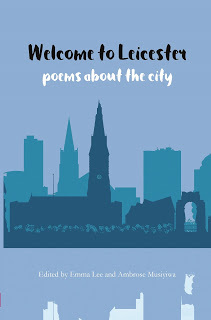
Holiday reading is important to me. It has to be a conscious choice as the pile of books by the bedside gets bigger, and the time available to read them gets smaller. So a half term break saw two choices make the cut. Springsteen's Born To Run, and Welcome to Leicester: Poems about the City.
Springsteen has produced a magnificent rollicking read, as he heads from sleeping on the beach surrounded by all of his few possessions to mega stardom. Along the way he hasn't lost his sense of humour, of irony and of who he has lost along the way. His descriptions of his battles with himself and his depression are vivid and moving.
Having engaged with The Boss, I turned my mind back to Leicester, taking myself very quickly from Asbury Park, N.J. To Spinney Hill Park, LE5. Early on in the Welcome to Leicester anthology Paul Lee recalls Spinney Hill Park, in 'her green lap', he recollects how
delighting feet sloshed through
The dew-slick flood of grass
I was hooked. I loved the evocations of places I knew as a child, and know now. The cinnamon scents washing over the Caribbean Festival, the colours and tastes of the Belgrave, THAT view of Old John from the top of London Road and late night in Granby Street. That is a scene that every police officer who has ever worked the night time economy would recognise as Julia Wood describes 'The cash-machine drunks on the pavement.'
There are two omnipresences throughout that are brought to life. The unblinking oversight of a dead King, and the inspiring tale of the fox that was an underdog. 'We've won the bloody football', writes Steve Wylie, 'while policemen laugh', before expressing guilt that he isn't exactly sure who one of the heroes adorning the lampposts in the city actually is! The sense of sport bringing together all sorts of people from all sorts of backgrounds is writ large throughout. It does capture what it felt like to be in Leicester as the impossible happened, as people danced in the street, as tears were shed, as Nessun Dorma rang out, and as one in four of the population headed for Victoria Park to sing and shout and cheer themselves hoarse. I suppose that as I write this I appear to have 'something in my eye'. The poems capture that feeling very emotively.
Overlooking all is one man. Whilst I would love that man to be the chief constable it is, of course, Richard the Third. 'A pile of bones, Both regal and diminished', a Plantagenet, a resident of York, a talisman, a commentator, a source of inspiration. In Charles G Lauder Jr's 'The City' he is the King hailed by the City one day, before his 'usurper' is festooned the next. Together with the bespectacled 'Italian alchemist' Ranieri as his Caesar, the miraculous discovery of the King in the car park runs as a driving force for a renaissance of civic pride.
For me the biggest theme is of belonging. Poets describe a search for a place to be home, where they can be themselves. Farhana Shaikh writes 'To Leicester Where We Belong', and of her grandparents arriving with just a single suitcase to their name. Some of the language and places of the past used in many poems reminded me of my own grandmother, Leicester born and bred. She would recognise the sounds of the market, the stories of those that make things, the chance to look out from the City into the county beyond. The image of Hui-Ling, Chen's 'Night Swans on the Grand Union Canal' would have resonated with her.
So what's not to like? Inevitably some of the writing grabbed me, and some didn't. In a collection of almost 100 poems and 150 pages that is unsurprising. I felt that some of the footnotes were a bit utilitarian and unnecessary; part of the joy of reading new things is finding out what is being alluded to for yourself.
What I loved most was the swirl of images and names that look like the place that I live and work in every day; the Diwali wheel, Idi Amin, The Big Issue, Windrush, suffragettes, hope, DNA, DMU, Attenborough, Watermead Park, the Haiku hike around Aylestone Meadows and even some policing. I especially loved the stately dance of Maria Ronner's 'On A Bus', as cultures meet, and the niqab and woolly hatted anorak find out a way to get along.
So, as I sat far away watching waves roll endlessly into a foreign beach, I found myself back in landlocked Leicester. Perhaps Browning should have written 'O, to be in Leicester' as he reflected on his home thoughts from abroad.
As Rob Gee shouts 'I am from Leicester, and I can do anything.' I have even got my own pen and paper, well... laptop... out and have started scribbling down some poems of my own, me ducks!
Notes:
1. Welcome to Leicester is available from Dahlia Publishing: http://www.dahliapublishing.co.uk/2016/09/welcome-to-leicester/
2. See also, Kershia Field’s review of Welcome to Leicester, http://everybodysreviewing.blogspot.co.uk/2016/10/review-by-kershia-field-of-welcome-to.html and Eliot John’s review of the anthology, http://everybodysreviewing.blogspot.co.uk/2016/10/review-by-eliot-john-of-welcome-to.html
4. See also Ambrose Musiyiwa's blog post on the anthology, http://ambrosemusiyiwa.blogspot.co.uk/2016/09/new-poetry-anthology-celebrates-city-of.html
About the reviewer
Simon Cole QPM is Chief Constable of Leicestershire Police.
[This is the second of two reviews we're running on this new anthology. You can read the first here.]
When I left Leicester after living there for three years I was utterly convinced that nobody would love it as much as I do. The new Welcome to Leicester anthology has proved me wrong. It captures the remarkable and the completely normal about the city so beautifully that I realise now that Leicester stays with each and every person who passes through it.
I thought I knew everything there is to know about Leicester, its history and its culture. Once again this collection corrected me. Reading it is a wonderful, educational experience that only makes me feel closer to the city, rooting me in its fascinating past with poems like Andrew Button's “Ratae Corieltauvorum” and “Ruins steeped in history” by Norbert Gora.
Having only left Leicester a few months ago, I’m still very much homesick for the city. This collection allowed me to fall in love again and again with each page and by the end, it’s as though I’ve been back and visited the city itself. Each poem feels like a personal connection, like it was written just for me. I can hear the Leicester market place, I am part of the hustle and bustle of shoppers in the Highcross, I can smell fireworks after the Diwali celebrations, and if I close my eyes I am walking along Julia Wood’s perfect depiction of Granby Street.
Not being a football fan myself and knowing nothing about the game, I wasn’t particularly bothered by Leicester winning the Premier League this year. What I did love, though, was that the city came alive. People came from all over to our city to celebrate the success of underdogs. It resonated with thousands and that’s something that definitely shines through in “The Art of Winning” by Jayne Stanton and also “On Leicester winning the premiership” by Rob Gee.
It’s impossible to pick a favourite from the collection and I suppose that makes sense. It’s impossible to pick one part of Leicester that I love the most. Perhaps the best thing about the collection is the sense that everyone who has taken part feels proud of the city and it’s not hard to see why. Leicester belongs to everyone from all walks of life: it’s home, it’s beautiful and now everyone can have a small piece of it to keep.
About the reviewer
Kershia Field is a twenty-one-year-old poet currently working on her first poetry collection based on Mental Health and the stigma surrounding it. She has her own blog at http://kershiadoespoems.blogspot.co.uk/
[This is the first of two reviews from different reviewers which we're running on this new anthology.]
Imagine a puzzle of Leicester… large and colourful and made up of a thousand tiny, intricate pieces. Now, imagine that you’ve just emptied out the contents of the puzzle-box. The image is scattered and broken, beautiful and diverse.
Welcome to Leicester is a Wonderland in poetry form. From the Contents you are transported on a zig-zagged journey through the city, as if you were viewing it from Willy Wonka’s Great Glass Elevator. You jump from ‘Granby Street’ to ‘Western Road’ and back to ‘Highfields’ in only a handful of titles. A few big names also stand out, Richard III is there, of course, and Shakespeare, then there’s Picasso placed nicely in the middle and obviously a number of Leicester City footie fans.
Where do I start? Let’s begin as Alice did in her Wonderland - straight down the rabbit hole. The Leicester equivalent is the notorious carpark, the resting place of an infamous king. 'King Richard of Leicester' is an incredibly witty, fast-paced poem that gives you the low down on Richard and his great discovery. Colin Cook is that teacher you had in school who made history fun and relatable. You would leave class thinking 'Mr. Cook is so strange, isn’t he?' but you’d still be laughing and quoting the poem all the way home.
Rob Gee also mentions ‘some dead bones of a dead bloke in a carpark’ in his piece 'On Leicester Winning Premiership.' This poem is like being a VIP at the Mad Hatter’s tea party, only with Vardy-bombs instead. It perfectly portrays the elation felt within the community after the grand win. It is an adrenaline-filled ode to the club. I challenge you not to tear up by the end.
Julia Wood shows us a different side to Leicester in 'Fosse Park, After Dark.' I wouldn’t dare to read this one after dark. ‘Concrete ghosts’ will haunt your dreams and leave you breathless.
You cannot help but admire Leicester after reading this anthology. It’s an odd mix of poems on history, food, scenery, ethnicity, festivals, sport and more. But hey, that’s Leicester for you.
About the reviewer
Eliot John is a poet and creative writer from Leicester who specialises in spoken word and flash fiction. Eliot regularly hosts burlesque shows in the city for The Leicester Vixens and is renowned for their witty and dark approach to life. Recurring themes that are explored in their work include loss of identity, sexuality, ethics, and the vices of modern culture.
The title of Jayne Stanton's collection comes from the opening poem, 'Grace Notes,' a journey to Ireland via ferry where the final stanza invites readers to
'Wave on your luggage, walk the only road there is
till it runs out of tarmac and the salt air draws you. Listen
for the notes between the notes. Slip beyond the tune.'
It’s an apposite title because most of the poems invite readers to look beyond the words on the page to the images and thoughts conjured within. For example in 'Suave and debonair' a girl’s pride in her father glosses over but still recognises his faults:
'Daddy’s girl, my angle’s blind
to a thinning crown, the comb-over;
a weak heart under peacock swagger – and
you’re taller, somehow, out of overalls
in slacks with knife-edge creases down
to split and polish; hands in pockets
weighing small change possibilities.
You shrug your shoulders
into a hounds tooth blazer, square
the broken checks of green and cream;
leather buttons left undone, token casual.
My formative years in toughened hands:
our lifelines grafted till you learn the art of letting go.'
The accumulation of details allows the reader to build the picture in their mind’s eye. The use of end of line enjambment hurries the reader over the suggestions of doubt; the 'weak heart' is brushed over to the emphasis on 'peacock swagger.' 'Suave and debonair' isn’t the only poem to touch on memories of growing up, but, like the others, it doesn’t dwell on sentiment. There’s an acknowledgement of things not being ideal, but no hagiographic embellishment either. 'Vintage' epitomises this with a look back to family seaside holidays, triggered by discovering an old case in the attic, with its sense of making the best of things.
'Rediscover Pac-a-Macs as beachwear,
resurrect the swing coat, tartan duffle bag;
own the promenade in red T-bar sandals.
Strike a pose in that ruched nylon swimsuit
christened in trawler oil, your profile
caught in the blink of a box Brownie’s eye.'
'Pac-a-Macs as beachwear' is a succinct description of summer on a UK beach. Swing coats are back in for Autumn/Winter 2014 but are never fashionable in summer. Fortunately the Brownie isn’t high definition enough to capture goose-bumps. It’s the telling choice of which details to record that create a solid foundation for these poems.
The tone of the tune changes too. Near the middle is a sequence of four poems, 'Some stories from the other side' which take a darker tone. In '2. Pet' an ambiguous her has learnt to reduce her world to his house:
'feigns pleasure, throaty
as his fingers find the chip
that keeps her his.
He likes her stone-bellied;
she dreams of slipped collars,
a quick way out.
Each time he sidles back. Redolent
of feral nights in back alleys, he pins her down
with stories of newborns drowned in buckets.'
There’s love too, and not just in the poem’s title, 'Love in Led Zepplin album covers'
'We pissed lyrical in pseudo-psychedelic dreams;
dawns bled tangerine, our zepplins crashed
manila skies with hummingbirds and butterflies
whose roundel-painted wings we glued
in grounded chips of china blue.
The towers on Dudley Road are long gone;
you and I, my rock, my song, still ramble on.'
The shorter 'i' vowel sounds give way to the longer 'o' sounds as youth became older and the initial urgency of romance became enduring love. 'Beyond the Tune' lives up to its apt title.
About the reviewer
Emma Lee has published two poetry collections, Mimicking a Snowdrop (Thynks Press), Yellow Torchlight and the Blues (Original Plus) and has a third, Ghosts in the Desert, forthcoming from Indigo Dreams Publishing in 2015. She blogs at http://emmalee1.wordpress.com and is a blogger-reviewer for Simon and Schuster. She also reviews for The Journal, Elsewhere and London Grip magazines.