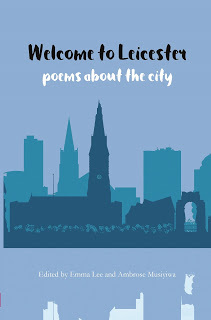
[This is the second of two reviews we're running on this new anthology. You can read the first here.]
When I left Leicester after living there for three years I was utterly convinced that nobody would love it as much as I do. The new Welcome to Leicester anthology has proved me wrong. It captures the remarkable and the completely normal about the city so beautifully that I realise now that Leicester stays with each and every person who passes through it.
I thought I knew everything there is to know about Leicester, its history and its culture. Once again this collection corrected me. Reading it is a wonderful, educational experience that only makes me feel closer to the city, rooting me in its fascinating past with poems like Andrew Button's “Ratae Corieltauvorum” and “Ruins steeped in history” by Norbert Gora.
Having only left Leicester a few months ago, I’m still very much homesick for the city. This collection allowed me to fall in love again and again with each page and by the end, it’s as though I’ve been back and visited the city itself. Each poem feels like a personal connection, like it was written just for me. I can hear the Leicester market place, I am part of the hustle and bustle of shoppers in the Highcross, I can smell fireworks after the Diwali celebrations, and if I close my eyes I am walking along Julia Wood’s perfect depiction of Granby Street.
Not being a football fan myself and knowing nothing about the game, I wasn’t particularly bothered by Leicester winning the Premier League this year. What I did love, though, was that the city came alive. People came from all over to our city to celebrate the success of underdogs. It resonated with thousands and that’s something that definitely shines through in “The Art of Winning” by Jayne Stanton and also “On Leicester winning the premiership” by Rob Gee.
It’s impossible to pick a favourite from the collection and I suppose that makes sense. It’s impossible to pick one part of Leicester that I love the most. Perhaps the best thing about the collection is the sense that everyone who has taken part feels proud of the city and it’s not hard to see why. Leicester belongs to everyone from all walks of life: it’s home, it’s beautiful and now everyone can have a small piece of it to keep.
About the reviewer
Kershia Field is a twenty-one-year-old poet currently working on her first poetry collection based on Mental Health and the stigma surrounding it. She has her own blog at http://kershiadoespoems.blogspot.co.uk/
Kershia Field is a twenty-one-year-old contemporary poet from Leicester currently working on her first poetry collection based on Mental Health and the stigma surrounding it. You can find her poems on her blog kershiadoespoems.blogspot.com. She also blogs at http://itsonlykershia.blogspot.co.uk.
JT: Why do you write poetry? What, for you, is poetry for?
KF: For me, poetry began as a way of venting my feelings in a way that I could understand. I never used to talk all that much about my feelings, it made me feel uncomfortable so poetry became my own private way of letting off steam. It was never meant to be for the public and I never considered it to be anything other than a private thing. Now it's become integrated into everything I do. I see something on the news, I write a poem. I see a stranger, they inspire a poem. It's my way of appreciating the tiny details of life that to so many people seem like nothing.
JT: When did you start writing poetry? Tell us a bit about how you got into it, and why.
KF: I started writing poetry when I was around eleven or twelve. I loved English at school and I loved reading and getting lost in the worlds of other authors. When I was eleven I was entered into a young writers competition where students had to write a 50-word story, and the best ones from the school would be sent off and published in a collection. I wrote my story about deforestation and a small girl whose best friend was a tree. I never thought I'd get in but somehow mine was one of the select few that got chosen and published. It gave me the confidence boost to keep writing. I never wrote anything again publicly for a long time, but in private I had something that I felt I was good at and that was amazing.
JT: You run two very popular blogs: a personal blog and a poetry blog. What is the relationship between the two forms of writing for you? Are they totally separate, or do they overlap in various ways?
KF: My personal blog and my poetry blog arguably do crossover in places; however, I never intended for that to be the case. My personal blog was my way of talking about issues and sharing my experiences with things like Mental Health and University AFTER I had come to terms with the experience and felt I could provide advice and support where I could. I started my poetry blog in 2015 to publish work that I did as part of my creative writing course, since it'd already been graded and if someone else said it was okay then I felt comfortable posting it. I didn't consider putting anything else on there at first, but my personal life took a turn for the worse and I found myself writing more and more poetry as a way of dealing with the change. In the same way that my personal blog was intended to reach out to people, my poetry became something people cold relate to so I took the plunge and started posting and I never looked back.
JT: Talk us through the process of writing a poem: how do you start? How do you conceive the relationship between form and content?
KF: I've never been able to just sit and write a poem about something I don't find interesting, and often the things I find interesting are things that other people wouldn't even notice. So I suppose the first thing I would do is to find something that intrigues me. I don't really have a fixed way of writing poetry, I've never been the kind of person who can sit and follow a strict set of rules when writing, which is why most of my work is free verse. If I do have an idea I jot it down and then I find that word association provides me with a grounding to work from; writing an emotional response to something also helps me get to grips with an idea. Some of my best work has been shortened from longer pieces of emotive prose that I've changed into poetry. Sometimes I'll have an image and if I can't explain it immediately I use a metaphor and that becomes the poem. People have said to me that even though my work is free verse, it still has a distinct style that makes it obvious it's mine and I can sort of see that.
JT: Which other writers and poets have most informed your notions of poetry?
KF: I was fascinated with the work of Angela Carter growing up. I loved the dark, gritty tone to her writing and have always been amazed by how quickly she captivates an audience. Whether you like her work or not, you will almost definitely be drawn in by her style and her story telling and that is something I aspire to be able to do as a writer. I also love the style of Rosemary Tonks; her collection Beduoin of the London Evening holds some of my favourite poems, and I love the way she can romanticise even the bleakest situations. I also love the work of Mitch Albom, who always a new perspective on the simplest of ideas.
JT: Given the emotive nature of your poetry, how do you understand the relationship between emotion and poetry?
KF: A lot of my poetry is based on real experiences, and the smallest of significant moments. It's a means of closure for me: turning something negative into something positive, or writing down something I'm not sure of so that I can understand it better. Everything I write is a little piece of myself that I share with people, so I think for my poetry to be successful, I have to be comfortable with my own emotions. If I'm not, it can frequently sound like jibberish. A lot of people find my work relatable, so I absolutely have to understand myself, what I'm trying to put across and why so that if I am giving mixed images or ideas then it's clear that this was deliberately done.
JT: What are your longer term aims for your poetry and writing?
KF: I'm currently working on putting together a collection of poems related to mental illness, an issue that very close to my heart. I'm hoping to get this published at some point within the next two years. I'm also hoping that one day I can write and publish a collection of poetry in an autobiographical style, sort of like a photo album of moments in my life, but with poetry instead. I'm continuing to update my poetry blog regularly in the hopes that I'll build up a bigger readership and I'm already considering starting a public website where I publish the work and reviews of other people as well as myself.
About the interviewer
Jonathan Taylor's books include the novel Melissa (Salt, 2015), and the poetry collection Musicolepsy (Shoestring, 2013). His website is www.jonathanptaylor.co.uk.
One of the things I love as a reader is finding small pieces of my own life amongst the pages of someone else's. Being relatable and connecting to the audience is for me the most important thing that you can do as an author. In Lucy-Anne Holmes' Just a Girl, Standing in Front of a Boy I found the most accurate descriptions of so many personal aspects of my life I had to go back and read chapters again, just to be sure I wasn't reading my own diary.
The story follows Jenny Taylor, a 27-year-old quirky, pink haired girl in her attempt to restart her life after a childhood full of sad memories and heartbreak. When her self-confidence plummets to a new low, her best friend Phillipa invents a manifesto of things for Jenny to do every day to help her recover. Just as Jenny begins to feel comfortable with her new life, her mother appears on her doorstep with the revelation that she has left Jenny's father, her comfortable boyfriend Matt pops the question, and she meets Joe King, aspiring musician set to change Jenny's life as she knows it.
Jenny is a hysterically funny young woman and from the first page had me in stitches. As a self depreciating woman she finds humour in the darker moments in our lives and this really resonated with me. Her life is entirely ordinary in a lot of ways, she has normal friends, a normal job and an ordinary boyfriend. When she meets the loveable and rugged Joe (whom I absolutely fell in love with!) her life does a complete 180 degree turn.
This is a modern love story full of laughs, tears and sometimes anger (I threw the book down at one point!). It's witty, charming and Holmes perfectly captures how even the most ordinary person can have an extraordinary life with music, laughter and a lot of Jagerbombs.
About the reviewer
Kershia Field is a twenteen year old English student based in Leicester, with an unhealthy love for Game of Thrones and video games. She publishes her work on her poetry blog http://kershiadoespoems.blogspot.co.uk/