Showing posts with label Dahlia Publishing. Show all posts

Monday, 30 March 2020

Review by Kathy Hoyle of "The Almost Mothers" by Laura Besley


This stunning flash fiction debut takes us on a compelling journey, with Laura Besley skilfully weaving together a variety of narratives as far removed from the familiar womb-warmth of traditional tales of motherhood that one could possibly imagine.   

This is an exploration of motherhood, in all its complexities. Besley refuses to hold back, plunging the reader into the realisation that motherhood is often stark and terrifying, with her opening story, "Mothers Anonymous." We hear from Melissa: "'I’m Melissa,’ she says in a raspy voice like she smokes a pack a day… And I hate being a mother.'" And from there, Besley drags us through each tale by the heartstrings.  

In "Everything’s Fine," we see how being a new mum means discarding one’s own self, to emerge unrecognisable, even in your own mirror: "I see a face and step back, knocking over a bin when I realize it’s me. The new me. The she who doesn’t wear make-up, have time to wash or sometimes even brush her hair." 

Then, we have moments of wry humour in "Down To Earth," a humorous story about Earth mothers, told from an alien point of view. But quickly we find ourselves hurtling downward again, with the horrifying "Wish Upon a Star," a story that takes your breath away in just three, short paragraphs. 

Besley dips into dystopian futures, with two tense and terrifying stories, "In Hiding" and "The Unmothers," and she’s also not afraid to acknowledge the non-mothers, with her uncompromising story "That Face" and with the brief, but intensely powerful, "How to Grow Your Own Baby."

The Almost Mothers is a wonderful collection of short fiction which has real depth and poignancy. Besley captures motherhood beautifully in this raw and uncompromising debut. I look forward reading much more of her work in the future.   


About the reviewer
Kathy Hoyle is an MA graduate from The University of Leicester. Her short stories and flash fiction have appeared in a variety of literary magazines such as Virtualzine, Silver Apples, Reflex Fiction and Another North.  She was shortlisted for The Exeter Short Story Prize, The Fish Memoir Prize and the Ellipsiszine Flash Fiction Collection Prize. She is currently working on her first novel. 

Thursday, 29 November 2018

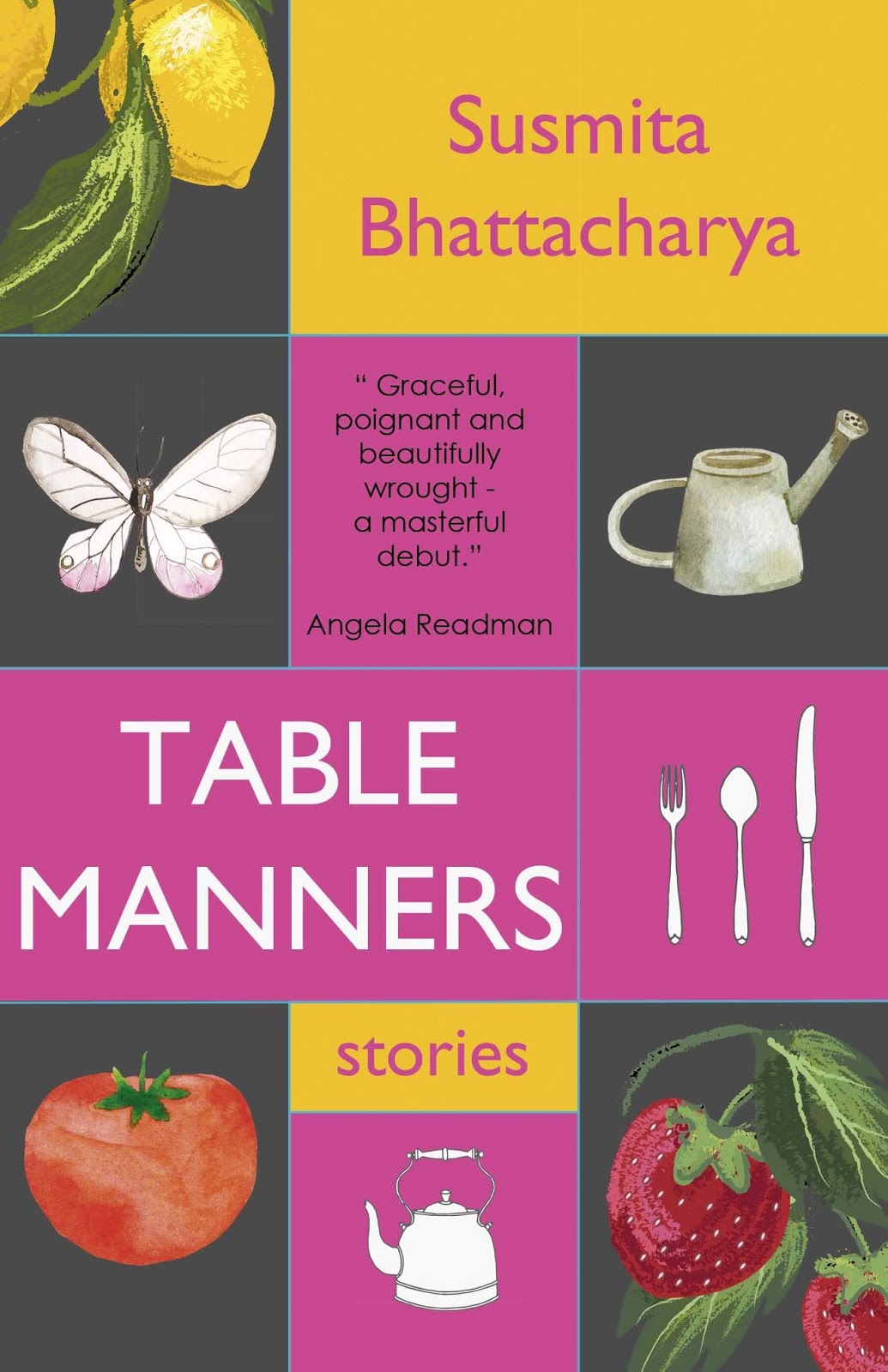
Review by Jon Wilkins of "Table Manners" by Susmita Bhattacharya


Susmita Bhattacharya is a writer and creative writing tutor. She was born in Mumbai and graduated in applied art from B.D.Somani Sophia Polytechnic. Following her marriage she sailed around the world with my husband on oil tankers. Later they moved to Cardiff, where she did her Master's in The Practice and Teaching of Creative Writing at Cardiff University. Her first novel, The Normal State of Mind, was published by Parthian in 2015. This collection of short stories, Table Manners, is published by Dahlia Publishing.

This is a beautiful book, so beautifully written. I don’t really need to expand upon that , but I will. Every story is a subtle blend of place and setting. We identify with every situation as it is always so clear as to where each story comes from. Be it India, Venice, Wales, China or England, we know almost instantly where we are and start the process of empathy with the writer. We are sad when she is sad, homesick as she misses her birthplace, jealous of others as they have what we aspire to and we feel the pain of those who are dying. All the emotions are finely wrought and we feel them all.

All the sorrow that Bhattacharya writes about tugs at our heart. We really do feel what her protagonists feel and this is due to her concise compact writing that doesn’t waste an idea or a heartbeat. Life is brought to life, in the kitchen where we can smell and taste the food being prepared, in the streets of India where we feel the heat and see the poverty, in Wales where we can measure the racism line by line.

The women, the strong women in every story are unwavering. They see all and have an undiminished power about them no matter what their situation. They are key. Bhattacharya  allows us to see into her worlds and to experience what she feels in them. We share her pain, we share the loss of her youth, we believe in her strength as she fights against what is wrong with the world.

Every story makes us think, makes us confront our own prejudices and makes us aware that though we may feel we have everything that others, even if they lack money, status or power, have more. It may be that people in Cardiff are richer than those in Mumbai, but at least the rain drops are bigger in India.


About the reviewer
Jon Wilkins is sixty-three. He has a gorgeous wife Annie and two beautiful sons, and loves to write. He is a retired teacher, lapsed Waterstones’ bookseller and former Basketball Coach. He taught PE and English for twenty years and coached women’s basketball for over thirty years.  He has always loved books and reading.

Saturday, 19 August 2017

Review by Amirah Mohiddin of "Dividing Lines," edited by Farhana Shaikh with a Foreword by C. G. Menon


Dividing Lines is an anthology of short stories dominated by themes of divisions of caste, gender and race. This lyrical and haunting collection brings to the surface a deep appreciation of life as well as a fear of the future. Frequently dealing with conflicts based on oppression and betrayal, Dividing Lines is an evocative representation of Asian experiences.

My first impression of the short stories was full of excitement. It’s rare to see such a diverse collection of short stories, and each really gave a different view of culture. It’s difficult to find media representations which break down the walls of stereotypes. The themes of belonging and division are so strong in some stories such as Ashok Patel’s ‘Ninety Days’ and Serena Patel’s ‘The Other Side of the Bridge.’ These stories offer an insight into how racism can have devastating consequences for minority communities. 

The stories are not only infected by fear but also a psychological burden that emotionally cripples the mood of the society they are set in. ‘The Other Side of the Bridge’ takes us into a bleak future while ‘Ninety Days’ tells the story of Idi Amin’s expulsion of Asians in the 1970s. Two of my favourite quotations from ‘The Other Side of the Bridge’ were: ‘I didn’t belong there and maybe I don’t belong here’ and ‘I don’t seem to be here or anywhere else anymore.’ These powerful lines in an all-round heart-wrenching story quickly became my favourites because of the pain they reflect. The scary in-between where you’re lost and can’t go back or move forwards particularly reached out to me due to my own hybridity as a British Asian continuously trying to find the balance between the expectations of British society and my deep-rooted Indian values and heritage. 

Another story I really enjoyed was ‘Under the Same Sky’ by Farhana Khalique. I could relate to the soft and comforting childhood experiences and innocence. The use of space imagery and this idea that somehow we’re all connected through the sky no matter who and where we are added to its magic. I would definitely recommend the Dividing Lines anthology. It’s one of those collections that is an all-round emotional rollercoaster, featuring relatable characters and a wide selection of writing styles. 


About the reviewer
Amirah Mohiddin, born in Birmingham, U.K., is a BA English (with Creative Writing) graduate. She is an aspiring writer, a storyteller for young children, a volunteering editor for Seeing Ear. Her latest project is about a female warrior in a fictional middle eastern war-torn kingdom.

Thursday, 20 October 2016

Review by Lerah Mae Barcenilla of "Lost and Found: Stories of Home by Leicestershire Writers," ed. Farhana Shaikh, Beth-Ann Sher and Richard Sheehan


From tales set in Swedish refugee camps, houses filled with history, travelling circuses and even in space, Lost and Found: Stories of Home by Leicestershire Writers (Dahlia Publishing, 2016) captures the diversity of voices that whisper and shout from every corner of Leicester, as they weave the threads to create a tapestry stitched with the meanings of ‘home’.

There are tales that question the essence of home, how homes may differ from one to another, yet despite it all ‘we all go home eventually’ (as in the story 'Zenith') – no matter where that may be. There are powerful stories that tug at our heartstrings, the heartache that gets lodged in our throats, ‘the searing pain of loss’. And it’s there, in the hollowness of words, the gradual healing of cracks as one finds a new home (in the story 'Not Home').


There are tales of maybes, what ifs and of possibilities ('Adrian'). Tales laced with memory. Of something fond, but fuelled by trauma amidst vivid descriptions of football stadiums – beauty in its ‘terrible simplicity’ ('Home Game'). Tales that explore the search for a lost home and its connection with our very identity: ‘I know I’ve become a stranger to them, and to myself’ ('Back Home'). While there is something raw and vulnerable, the honest helplessness in the words ‘I can’t find the way home,’ but also the strange wistfulness in finding home in music ('Zöe K.'). We see a battle between familiarity and unfamiliarity, between staying and moving on. Tales of memory and forgetting; of separation, exploration and travel. Of uncertainty, reassurance and acceptance, ‘This is home now. Just be’ ('Moving the Furniture'). Yet behind the nostalgia and hope lurk something morbid, an unexpected dark turn of events (as in 'Colour').


Then there are stories that hit too close to home. Stories reminiscing about the curiosity that comes with the first year of university, and the melancholy that the final year brings. The uncertainty and fear that haunts the future, that prowls what comes after ('Home From Home'). And lastly, there are tales painted with the inevitable passing of time, and a homesickness for something lost. The story where one forgets and another remembers, and I’m not quite sure what’s worse (as in 'Shelter').


But, perhaps, it’s just like as Hermann Hesse wrote: 'every path leads home'. In this collection of short stories, we are given the privilege to peer into the lives of others, to glimpse, even for a moment, what ‘home’ means to them. And, maybe, in doing so, we’ll discover what ‘home’ means to us.


About the reviewer
Born in Manila, Philippines, Lerah Mae Barcenilla is currently a third year English undergraduate at the University of Leicester. Her writing has been published in The Student Wordsmith, The Purple Breakfast Review, PETRie Inventory and Culturefly. In her spare time, you can find her highly-caffeinated self idly scribbling on a notebook trying to write her two-somethings every day or taking photographs of cherry blossoms. You can find more of her writing and photography at
https://leionai.wordpress.com/
 

Monday, 10 October 2016

Review by Eliot John of "Welcome to Leicester," edited by Emma Lee and Ambrose Musiyiwa


[This is the first of two reviews from different reviewers which we're running on this new anthology.]


Imagine a puzzle of Leicester… large and colourful and made up of a thousand tiny, intricate pieces. Now, imagine that you’ve just emptied out the contents of the puzzle-box. The image is scattered and broken, beautiful and diverse.


Welcome to Leicester is a Wonderland in poetry form. From the Contents you are transported on a zig-zagged journey through the city, as if you were viewing it from Willy Wonka’s Great Glass Elevator. You jump from ‘Granby Street’ to ‘Western Road’ and back to ‘Highfields’ in only a handful of titles. A few big names also stand out, Richard III is there, of course, and Shakespeare, then there’s Picasso placed nicely in the middle and obviously a number of Leicester City footie fans.

Where do I start? Let’s begin as Alice did in her Wonderland - straight down the rabbit hole. The Leicester equivalent is the notorious carpark, the resting place of an infamous king. 'King Richard of Leicester' is an incredibly witty, fast-paced poem that gives you the low down on Richard and his great discovery. Colin Cook is that teacher you had in school who made history fun and relatable. You would leave class thinking 'Mr. Cook is so strange, isn’t he?' but you’d still be laughing and quoting the poem all the way home.


Rob Gee also mentions ‘some dead bones of a dead bloke in a carpark’ in his piece 'On Leicester Winning Premiership.' This poem is like being a VIP at the Mad Hatter’s tea party, only with Vardy-bombs instead. It perfectly portrays the elation felt within the community after the grand win. It is an adrenaline-filled ode to the club. I challenge you not to tear up by the end.

Julia Wood shows us a different side to Leicester in 'Fosse Park, After Dark.' I wouldn’t dare to read this one after dark. ‘Concrete ghosts’ will haunt your dreams and leave you breathless.

You cannot help but admire Leicester after reading this anthology. It’s an odd mix of poems on history, food, scenery, ethnicity, festivals, sport and more. But hey, that’s Leicester for you.


About the reviewer
Eliot John is a poet and creative writer from Leicester who specialises in spoken word and flash fiction. Eliot regularly hosts burlesque shows in the city for The Leicester Vixens and is renowned for their witty and dark approach to life. Recurring themes that are explored in their work include loss of identity, sexuality, ethics, and the vices of modern culture.