Showing posts with label Fly on the wall press. Show all posts

Sunday, 11 January 2026

Review by Paul Taylor-McCartney of "The Subtle Art of Short Fiction" ed. Isabelle Kenyon


This is a concise, well-focused companion for creative writers who already understand the fundamentals of crafting short fiction and now want to work at the level of nuance, treating it as a form defined by compression and consequence. The emphasis is not on shortcuts or formula, but on the deliberate choices that allow a story to suggest a larger world while remaining tightly controlled.

One of the anthology’s strengths is the authority and range of its contributors. Essays and writing exercises from Daisy Johnson, Matt Wesolowski, Kerry Hadley-Pryce, Sarah Schofield, Jonathan Taylor, S. J. Bradley, Mahsuda Snaith, David Hartley and Farhana Shaikh offer a multi-perspectival account of craft (including an illuminating introduction by Paul March-Russell). The variety of approaches prevents the collection from becoming prescriptive. Instead, it reads as a series of intelligent, practice-based reflections on what short stories can achieve and how they generate their distinctive force.

The technical focus is consistently strong. Several chapters attend to subtext and micro-tension, showing how emotional pressure often gathers not through explanation, but through what remains withheld and unresolved. The discussion of sensory minimalism is equally effective, returning to the difficult question of when to render detail vividly and when to imply, allowing the reader to complete the image. Structure is treated as an area for experimentation rather than compliance, with contributors encouraging alternative narrative frameworks and more considered thinking about pacing, revelation and the placement of the final turn. 

Crucially, each chapter includes helpful writing prompts and exercises that bridge literary theory and creative practice. These are not incidental add-ons, but carefully designed invitations to test ideas on the page, and to translate conceptual discussion into specific decisions about language, scene and shape. I have recently returned to the short story form myself, so engaging with this book has been both timely and beneficial in deepening my own understanding of the genre, while also offering practical stimulus for new work.

Isabelle Kenyon’s editorial hand keeps the collection coherent while allowing each voice its own texture, and it is the gravitas and insight of those voices that gives the anthology its remarkable depth. The result is an anthology that sharpens attention, both to the craft of short fiction and to the pleasures of reading it closely. This is a thoughtful, highly engaging and genuinely useful book, and one that rewards return, particularly for writers intent on refining control, precision and resonance.


About the reviewer
Dr Paul Taylor-McCartney is a writer, post-doctoral researcher and lecturer. His academic and creative interests include dystopian literature, Queer studies, children’s fiction and initial teacher education. His poetry, short fiction and scholarly articles have appeared in a wide range of print and electronic media, and recent fiction titles he worked on as commissioning editor have won regional readers’ and publishers’ awards. His debut children’s novel, Sisters of the Pentacle, was published by Hermitage Press (2022), and his first non-fiction title, Cornwall Uncharted: Mapping Cornwall’s Queer History of Concealment, Culture and Creativity, is shortly to be published by The History Press (June 2026).

You can read more about The Subtle Art of Short Fiction on Creative Writing at Leicester here


Monday, 21 October 2024

Review by Rennie Parker of "Maps of Imaginary Towns" by SJ Bradley


I wanted to review this book because I’m particularly interested in new work which comes from my ‘home district’ in West Yorkshire. The author has evidently worked in Leeds for a time, because one of the districts is mentioned by name, and some of the cityscapes are oddly familiar. In fact the location described in her standout story ‘Discrepancy Matrix’ sounds / looks pretty much like where I grew up, and it’s a pleasure to read how the accuracy and empathy depicted throughout is at once both beautiful and empowering. 

And that’s the thing about this collection; no matter how clueless or downtrodden her citizens may be, there is always someone, somewhere or something which makes the struggle worthwhile. These characters are not being written about from the outside: they are sat along with, interacted with, and lived through. Take, for instance, the hapless council workers in ‘The Gordon Trask,’ who are having their premises and jobs wrestled away from them by costcutting bureaucrats. Everyone knows that the game is up, but they hang in there grimly until the end because they fundamentally believe in what they are doing, with ‘all of it together and nothing lost, and equipment staying where you had left it.’ Now, as someone who’s had jobs similar to the one in the story, I can tell you it is so believable and on-point that it could have been me in the office.

Bradley’s clarity of style and naturalistic dialogue hides a substantial talent in the ‘less is more’ department. She hits on the exact word for describing how a neglected child takes an apple core from a bin -  the picture is completely there in the word ‘draw,’ from the slowness, the concentration and the delicate picking motion. After all, you wouldn’t want your apple to touch the bin on its way out. Meanwhile, the entire background to Tan’s life in ‘The Stonechat’ is indicated with an admirable brevity just by mentioning his robes, the name of his former cult leader and his agricultural work. We know, by the end of three short paragraphs, that he was enticed away from a shopping centre when he was very young, but this information is delivered casually in passing, and from his point of view, as though yes this is what happens to people round here. On the surface, this lost / found young man might seem vague and unprepossessing -  but at the end of three pages I was rooting for him as he attempts to rescue a live bird being used as a prize on a fairground stall. 

The author’s vision of the near future is only a continuation of the broken-down present, according to this collection. No, it’s not a world of whizzy gadgets, flying cars and unlimited media - it’s a grungey land of unwilling house shares, allotment co-operatives and low tech, definitely post-industrial and without any competent system in charge. I expect she’s right. At times, stories might have been continued past their natural closure - ‘The Stonechat’ mentioned above being a case of this, although I can see why the lower-key ending would fit alongside others in the same collection. 

And Bradley is very good indeed when hinting at darker overtones without going all out to depress the reader. For instance, domestic violence and coercion lies behind ‘Dance Class,’ but the protagonist and her daughter find redemption and care through the escape mechanism she initiates for herself. The focus is ultimately on the happiness of the child, who can at last run free in the garden. The same theme runs through ‘Harmony Grows,’ where a seemingly impossible situation for Harmony’s Mum becomes more bearable as she discovers her wider network and reaches a point of transformation by the end. In ‘Coming Attractions,’ the would-be actor runs the risk of being ground down by his job at Cineworld, with the claustrophobic presence of his fast-tracked partner Alan being part of the problem. But no, the fella wins out, packing his bags at last and heading for uncertain lodgings in London. He’s going somewhere, unlike the similarly trapped northerner Billy Liar, who never actually leaves. Bradley gives us hope under the desperate lives. It is possible, no matter where you come from.


About the reviewer
Rennie Parker is a poet living in the East Midlands, and she is mostly published by Shoestring Press. Her latest collection Balloons and Stripey Trousers, a nightmare journey into the toxic workplace, came out earlier this year. She works in FE and blogs occasionally here. She is also on Twitter/X and Bluesky.

You can read a review of Balloons and Stripey Trousers on Everybody's Reviewing here


Friday, 6 January 2023

Review by Joe Bedford of "We Saw It All Happen" by Julian Bishop


Watching news stories about environmental catastrophe, I feel something like anger, panic, despair, and underneath that something terrible and unfamiliar that leads me to silence. Naming that feeling – that is, finding an emotional vocabulary for what we are witnesses to – may become the dominant preoccupation of poetry in the coming years. Julian Bishop’s collection We Saw It All Happen is a step towards that emotional vocabulary.

Through verse rooted in the natural world, Bishop’s poetry embraces the global and the tiny, the present and the absent. His scope is vast: agriculture, climate, ethics, extinction, plastics, pollution, technology, waste. At times, Bishop’s feelings are drawn delicately in verse that is alive with sardonic humour, lamenting with the world’s insects for his own ‘addiction to squish, for its satisfying / half-rhyme with delicious.’ Elsewhere, his frustration subverts the poetic form in the same way anger chokes our ability to talk, raging on a ‘gob of atoll / slice of paradise / diced / into scum and phlegm / coughed up by firestorm / froth of surge / churned to a fury.’ At the heart of this frustration are the human behaviours that in some ways may live at the heart of our emotional confusion. With pithy clarity, he relates that ‘to protect the world from a threatened cat / the marksman only took one shot / to protect the threatened cat from the world / we only had one shot.’

But as Bishop declares from his preface, his intent is not fatalist. Rather, it is a cry for change. This is the call that prevents our currents of contradictory emotion from lowering us into paralysis. We may find that in expressing these contradictions, as Bishop achieves in We Saw It All Happen, we create a structure of feeling wherein those emotions no longer silence us, but call us to speak.


About the reviewer
Joe Bedford is a writer from Doncaster, UK. His short stories have been published widely and are available to read here. His debut novel A Bad Decade for Good People will be published by Parthian Books in Summer 2023.


You can read more about We Saw It All Happen by Julian Bishop on Creative Writing at Leicester here

Thursday, 17 November 2022

Review by Rosa Fernandez of “Cracked Asphalt” by Sree Sen


From the moment I read the dedication at the beginning of Sree Sen’s collection of twenty poems (‘for all those taking up odd jobs to afford poetry’) I knew I would enjoy the contents of Cracked Asphalt. While I may never have moved whole countries to make life work, I have transplanted to other cities, and it is that sense of attempting to reorient yourself into a new environment that lines like ‘tiny weeds crack open / the asphalt of my journey’ capture beautifully.

This selection is a journey in itself, beginning simply with our protagonist having arrived and already dreaming of return, and as the poems progress we build more of a picture of this new life adventure. The second poem ‘frames’ captures this simply and effectively: ‘200 doors felt my knuckle’ perfectly summarises the slog of the door-to-door fundraising job, and the lines ‘my hand … can’t make the journey / from plate to mouth’ perfectly encapsulates the exhaustion of this kind of (almost) thankless job; having been there myself it had a real physical resonance.

The finer detail and emotional depth grows through the collection and I enjoyed the simplicity of description and piercing contrasts; from one kind of belonging in a ‘Mumbai apartment’ to Dublin where it is ‘easier to love’ free from expectation and constraints. The simple brief elegance of ‘pray’ and ‘love’ as two tiny emotional flashes to the longer thoughtfulness of ‘parable of the lost cause’ which travels from the mundane daily actions out to the edges of the universe.

The warmth of these poems is perhaps best summed up in the final poem ‘Kala Ghoda’ and the ‘tripwires of nostalgia’; we end with ‘bellies warm & full of rum,’ a delicious description for this enjoyable and moving collection.


About the reviewer
Rosa Fernandez is a slam-winning poet and sometime proofreader. She also enjoys wearing silly hats. 
  

Thursday, 10 February 2022

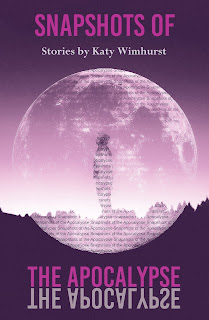
Review by Sharon Eckman of "Snapshots of the Apocalypse" by Katy Wimhurst


Katy Wimhurst’s new collection of short stories is a dark, witty look at a world at once recognisable and skewed. 

The title tells you pretty much where you’re headed, but although each story takes you in that dystopian direction, the beauty is in the detail. Wimhurst’s ideas are fabulously inventive . In the title story, a post-Apocalyptic London features rains named after former Prime Minsters – Thatcher, Blair, Rashford (if only) and ‘the worst was Johnson – deceptively lightweight but soaked you through and through.’

I particularly enjoyed ‘Haunted by Paradise,’ a sensual take on the expulsion from the Garden of Eden – this modern Eve grows an enchanted garden in her flat, stealing plants from the local park armed with a ‘surreptitious trowel and large bag.’

In ‘The Job Lottery,’ the female protagonist, who we only know as Miss Fisher, attends the malign EnCorp’s Job Lottery – billed as a Festival – to try and get herself a decent job. ‘EnCorp wishes you a Good Lottery – Seize the Moment!’ This story has echoes of Huxley’s Brave New World with its Prozac candyfloss, PsychoBliss Drops and – my favourite – the Public Penance Trampoline where you are sent to bounce up and down shouting your penance through a loudhailer for alleged crimes against the state.

All of Wimhurst’s protagonists are lost in some way, mostly living solitary, lonely lives, often with a failed relationship in the background. The stories contain a yearning for hope despite the dystopian scenarios, but, for me, some ended rather abruptly. I also found some of the parallels with our current concerns – refugees, the climate emergency - a little too on the nose, but Wimhurst creates believable characters in wild scenarios and her prose is full of drily funny one liners. Highly recommended.


About the reviewer
Sharon Eckman is an actor, singer and writer. Winner of the Time Out Travel Writer of the Year, she has been longlisted twice for the Fish Memoir Prize, shortlisted for Words & Women Prose competition and the Jerwood/Arvon Mentorship Scheme. Short fiction has appeared in Shooter Lit, Words & Women: 3, 100 Voices: An Anthology, 100 Voices for 100 Years and New Flash Fiction Review. She is currently working on a novel and has just completed her first short film. Her website is here