Showing posts with label dystopian fiction. Show all posts

Sunday, 2 February 2025

Review by Kim Wiltshire of "The University of Bliss" by Julian Stannard


The University of Bliss is a dystopian campus novel set ten years in the future and we join this terrifying new world just as new Vice-Chancellor Gladys Nirvana is about to take up her position at The University of Bliss, or UOB (pronounced YOB) as it is known to its students.

In the political climate of 2035, any academic endeavour is strongly discouraged, with the one poor scholar who managed to publish a book being demoted to Head Trolley Pusher on the university’s very own train. As the management seek higher salaries, fewer pesky academics and more bureaucracy, can the last of the humanities lecturers save higher education from itself? Focussing on Harry Blink, the poor poet who hasn’t published any poetry in years, we meet a range of Deans, Pro-Vice Chancellors and Professors whose sole aim is to disassociate higher education from any notion of learning, instead rewarding those lecturers who spend time on their Lego creativity and awaiting the visit of the Weeping Aubergine / Eggplant from the Light of Idaho. Sounds both surreal and scary? Well, it is. 

I managed to read this book in one day, which is a good thing, and at times it made me laugh out loud and other times nod in sad recognition. Yes, it is a bit broad at times perhaps, and certainly you can feel the author’s frustration with the current higher education climate, but anyone working in the Humanities will recognise the tropes that this novel satirises, such as compulsory attendance at events during Staff Wellbeing Weeks instead of doing any research, 87% of students receiving first class honours degrees and the Creative Writing programmes being viewed with deep suspicion and loathing by those in charge. 

Stannard uses to great effect the dystopian device of keeping the near future near enough for us to recognise many of the directives and initiatives but extrapolating them just far enough for the reader to think: yes, actually, that could well happen. We only have to consider the changes the last decade has seen in higher education, the way league table position and awards are trumpeted at open days whilst redundancy policies are rife, leaving a shrivelled team of lecturers to work forty or fifty hours a week to keep up. And, heaven forfend, should there be a fall in the league table, a fall in the NSS, a fall in the REF, the blame is placed firmly back at those same lecturers’ doors – why aren’t they doing more in terms of outreach, pedagogy, knowledge exchange, public visibility, reflection? The move towards obsessions over lanyards and a consideration of whether robotic dogs might do a better (and of course cheaper) job of teaching students than actual people doesn’t actually seem so ridiculous.

But I would stress that this is not just a book for those working in humanities in HEIs across the UK, this doesn’t just speak to that handful of Creative Writing academics who get asked ‘Yes, but what are you employability statisitics like?’ It is for anyone who values education, who values culture, who considers the world their children or grandchildren are going to inherit in terms of learning, philosophy, literature and art. It is a highly readable novel, biting, funny and fast paced, but at the same time, do take a pause every now and then to consider the world Stannard is creating – how close do you think we’re getting to that now?


About the reviewer
Kim Wiltshire is a writer and academic, Reader and Programme Leader for Creative Writing at Edge Hill University. She writes scripts, short stories and was a British Academy Innovation Fellowship researching ways of embedding arts into healthcare settings during 2022 and 2023. 

Wednesday, 12 June 2024

Review by Harry Whitehead of "Merchant" by Alexandra Grunberg


Grunberg’s promising debut paints a dark picture of a far future, climate-broken, quasi-fantasy Earth where the few survivors of "The Flood" eke out meagre lives on mountain tops above lethal seas. Jessica, a half-Jewish girl and the "merchant" of the title, lives in a Venice relocated to the slopes of K2 in the Himalayas. Cem is a Venetian boy slowly falling into the mindless "hiss" of the Feral who haunt the darker caves. Shinobu is a scribe to the Empress of Fuji, whose people provide algae-block food for the world’s few human survivors with their still-functioning tech.

Jessica has memorized all of Shakespeare’s plays and regularly performs them in the segregated streets of Venice. But when she pushes a Fujian sailor into the sea to be devoured by the ever-present eels, she sets off a riot that results in many of the other Fujian sailors’ deaths and the algae blocks stop. Now Jessica must travel to Fuji to persuade the empress to forgive the Venetians and not to let them starve. And Shakespeare will have final word.

There’s certainly much to enjoy in the novel, with unusual settings, and folding Shakespeare’s words intrinsically into a dystopian, fantastic world, as well as loosely using The Merchant of Venice as a story model. Some of the writing is truly unsettling and often beautifully rendered. Broken statues "wore their pain plainly, told it clearly, even in their resolute silence." Less clearly carved at times – forgivably in this the first novel by the author – is the narrative direction, the central crisis and its direct connection to the actions of the protagonists. Jessica helps inaugurate the journey to Fuji (and, of course, pushes the sailor to his death, though we do not directly see this vital inciting action). Yet then Jessica becomes often almost invisible through the novel’s second half. She is a bit-part player, a pawn for others – the Empress, the antagonist (if there is one) Dario from the cannibalistic city-state, Les Alpes. The story meanders, rather, through the second half, towards – for this reader – a somewhat abrupt conclusion.

But I don’t want overly to critique an often potently imagined fantasy eco-fiction by a debut novelist. The book is professionally produced by Goldsmiths Press (although the non-indented, double-spaced paragraphs look more like a philosophical tract of aphorisms and, at first, had me trying to read more meaning than there was into a paragraph. The work’s genre and style do not suggest such a layout). Overall, Grunberg has written a deeply imagined and passionate novel and I look forward to seeing how her work evolves.


About the reviewer
Harry Whitehead a novelist, academic and researcher on climate change and the arts at the University of Leicester, UK, where he directs the Centre for New Writing.


Monday, 8 January 2024

Review by Paul Taylor-McCartney of "Autodrive" by Jordan Crandall


Jordan Crandall’s speculative fiction, Autodrive, is a thought-provoking and highly-experimental read that imagines a world in which a new form of super-intelligence has become so embedded in our lives it has taken centre stage and relegated humans to a peripheral role. This is not entirely new ground for the genre, of course, with evident nods being made to the likes of Kurt Vonnegut and Philip K. Dick, whereby the human-machine interface has become so stifling and so much a part of everyday reality, it has transformed the very meaning of ‘collective consciousness.’ 

Structurally speaking, the novel is composed of a series of discrete, partially-connected chapters with each one focusing on a different character or scenario, onto which the author etches a fleeting scene or moment - often done with great humour and pathos - before moving onto the next vignette. This was initially disorienting, particularly as Crandall commits to a second experiment with language itself – creating a hybrid of human and machine expression. So jarring is the effect, it felt almost as if parts of the novel had been created by AI and then fashioned by the author to create a consistent voice across the whole piece. Stylistically, I was reminded of the work of Alain Robbe-Grillet, whose seminal work, Jealousy, is akin to a Cubist painting, with a single day repeated over and over from different angles. It is a testament to Crandall’s compositional skills (himself a renowned artist and media theorist) that he manages to evoke similar feelings to those I felt when encountering Robbe-Grillet for the first time all those years ago.

Autodrive is a short, intricate novel, and is for anyone who enjoys the challenge of drawing together the disparate parts an abstract, literary experiment - especially one that is centred on the highly topical theme of human over-reliance on AI and technology. Crandall’s true skill here is in employing art to help us make sense of this brave new world of technocracy, even if we are unable to navigate it without the consent of those machines we once created to serve us. 


About the reviewer
Dr. Paul Taylor-McCartney is a writer, researcher and lecturer living in Cornwall. His interests include dystopian studies, children’s literature and initial teacher education. His poetry, short fiction and academic articles have appeared in print and electronic form, including: Aesthetica, The Birmingham Journal of Language and Literature, Education in Practice & Writing in Practice (National Association of Writers in Education), Dyst: Literary Journal, Intima: A Journal of Narrative Medicine, The Crank and Bandit Fiction. His debut children’s novel, Sisters of the Pentacle, was recently published by Hermitage Press.

You can read more about Autodrive by Jordan Crandall on Creative Writing at Leicester here

Friday, 24 February 2023

Review by Isabelle Kenyon of "The Love Genes" by Eleni Cay


In her novel The Love Genes, Eleni Cay presents a thought-provoking exploration of love, relationships, and mental illness in a futuristic society set in 2039 Sweden. Through the eyes of protagonist Katie, the reader is transported to a world that is both familiar and strange, where technology has advanced to the point of ubiquitous phone use, but where societal norms and attitudes towards mental illness are still very much a work in progress.

Cay's writing is vivid and evocative, painting a detailed picture of the setting and the characters. The opening scene, in which Katie takes a train from London to Sweden, sets the stage for the novel and provides insight into the fast-paced, technologically advanced society in which it is set. The reader is immediately drawn into the world of the novel and is able to relate to Katie's struggles as she adjusts to her new life in Sweden.

One of the novel's main themes is the relationship between Katie and her boyfriend Mark, and the couple's struggles with infertility and their desire for a child. Through their conversations and interactions, the reader is able to gain a deep understanding of their characters and the complexities of their relationship. The novel also explores the impact of medical conditions, such as Katie's Multiple Sclerosis, on relationships and the difficulties of managing pain and sleep.

The novel also delves into the darker side of relationships, as Katie starts dating someone called Erik, who turns out to be violent and dangerous. This storyline raises interesting moral questions about the nature of mental illness and the effectiveness of prison as a means of rehabilitation. The novel's exploration of these themes is both nuanced and thought-provoking, and it invites the reader to consider their own attitudes and beliefs about these issues.

Overall, The Love Genes is a thought-provoking and well-written novel that explores complex themes and characters in a futuristic society. It is a novel that will resonate with readers who are interested in exploring the nuances of relationships, mental illness, and societal norms. Highly recommended.


About the reviewer
Isabelle Kenyon is a writer of prose and poetry based in Manchester with her two guinea pigs. She is the Managing Director of Fly on the Wall Press and also runs PR and editing services under Kenyon Author Services. She tweets at @kenyon_isabelle


Tuesday, 16 August 2022

Review by Paul Taylor-McCartney of "One Drop" by Peter Kalu


Having recently completed a PhD in which I creatively and critically explore the function of memory in dystopian fiction, I was very much looking forward to reviewing Peter Kalu’s own, unique, contribution to the genre, One Drop

In war-torn Britain, inseparable Black Radicals, Axel and Dune, are arrested, have SIMs implanted in their heads and are placed in a prison camp for those who defy the white supremacist government, known as the Bloods. 

At its heart, this novel is a love story about surviving against all odds. The peculiar horror here is that all prisoners have to suffer as their SIMs brainwash them with the Bloods’ evil philosophy, whilst drones constantly monitor their movements and thoughts. In order to combat this living nightmare, Axel and Dune have to take the brew called ‘maidenhair’ (and in increasingly heavy doses) as well as applying a resin to their hair in order to create a temporary shield against the drones’ memory re-writes. Most strikingly of all, Kalu’s protagonists recount some of their happiest memories from their lives before imprisonment, referred to as ‘storyfying.’ This form of resistance – of subjective memory cast in direct opposition to collective compliance – is a defined trope of the dystopian novel and is explored with masterful nuance by the author. Similarly, Offred retreats into the past, to escape her present, in Margaret Atwood’s A Handmaid’s Tale, whilst the rebels recite whole books from memory at the end of Ray Bradbury’s Fahrenheit 451. Of course, memories being wiped entirely from an individual’s mind have featured elsewhere in the genre, as evidenced in Anna Smaill’s The Chimes, Yoko Ogawa’s The Memory Police and Philip K. Dick’s We Can Remember It for You Wholesale, which later became the hit sci-fi film Total Recall. As Rafaella Baccolini (2003) argues, ‘in order to fabricate a single, true, hegemonic discourse, which citizens unquestionably follow … it may be necessary to erase memory itself.’ 

The passages where Kalu’s narrator has to observe, up close, his non-binary partner retrieve fewer and fewer of their own memories, make for some of this novel’s most memorable, albeit disturbing, scenes: 

         ‘You remember any of this?’
         ‘Nope.’
         ‘Nothing at all?’
         Maybe they heard my disappointment because they squeezed my hand and said, ‘It’s alright. I don’t need thousands of memories. I only need to hear your voice, Ax. Everything’s in your voice. I hear you and I know I’m alive.’

Overall, this is brilliant and important novel. A fast-moving, well-structured narrative moves swiftly through its scenes to reach a satisfying climax and, in keeping with the genre, Kalu leaves enough questions unanswered for the reader to speculate about what kinds of future may be waiting for those who manage to survive the many terrors of the camp. Perhaps Kalu’s greatest achievement is that he skilfully revisits and reinvents the slave narratives of the late twentieth century by other notable black authors such as Haley, Walker and Morrison, to remind us how easily the past can be resurrected when both political and populist views become, once again, about binary oppositional thinking and the rise of violent extremist ideologies. Both timely reminder and proof of Kalu’s sheer verve and originality as an author of speculative fiction, One Drop is a thought-provoking and inventive exploration of hope coming from the most hopeless of places. 


About the reviewer
Dr. Paul Taylor-McCartney is an author, researcher and lecture, with interests in dystopian studies, children’s literature and initial teacher education. His poetry, short fiction and academic articles have appeared in a range of notable UK and international publications including Aesthetica, The Birmingham Journal of Language and Literature, Writing in Practice (National Association of Writers in Education), Intima: A Journal of Narrative Medicine and Dyst: A Literary Journal. He lives and works in Cornwall. You can find out more about him and his work by visiting https://paultm.org/ 


Wednesday, 16 March 2022

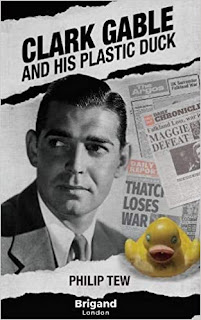
Review by Jon Wilkins of "Clark Gable and His Plastic Duck" by Philip Tew


It’s what we all need to know, Clark Gable. Plastic duck. What on earth? So in the true story-telling tradition of show not tell, I will show. Clark Gable. Plastic Duck.

It is your task to discover their relevance. Task? That makes it sound an onerous assignment. Reading this novel is far from that. It is an undiluted pleasure. It is one of those rare reads, one that you can honestly not put down. The end of each chapter tempts you into reading the next and so on until you have forgotten what day it is and where you are.

I get added pleasure from Philip Tew's books as we taught together in Leicester, way back in 1979. I hadn’t seen him since, until we met at an Everybody’s Reading event in 2018, at De Montfort University. Pre-Covid. Weren’t they the times!

Tew writes of a time I can remember, and so many of his allusions ring true to me, as I am sure they will ring true to any Leicester resident from those Thatcherite days of the 1970s through to the 1990s.

His novel takes us into an alternate world where Thatcher lost the Falklands and Alan Clark became Prime Minister. For those who remember his philandering ways, is that a stretch too far or a parallel to a shaggy-haired oaf that we all currently endure? Thatcher is rehabilitated as Secretary of State for Northern Ireland and the greatest irony is when the pariah Enoch Powell becomes Home Secretary.

Where would we be today if things had turned out like that? Is that what we deserve? Considering what we have now, would it be such a bad thing? You decide as Britain descends into a world of darkness, further hypocrisy, and our hero Bill Pugh doesn’t know who to trust and who to turn to. His world as broken as the society he finds himself in.

As Phil Tew writes: “Rebellion follows. And a new privatized security service full of thugs and villains. For me, Clark’s political broadcast ties my narrative together. Suddenly, the rebellion and riots all make full sense, especially after the Falklands (Malvinas) defeat. The narrative started to reflect very different priorities.”

This novel shows without telling. Readers will not need to be told; they will see the nuances of the narrative as a challenge and an invitation into Tew’s dark world. Fantasy or Dystopia? Alternate reality or too close to truth? Who is the hero: Clark Gable or the Duck or is it Bill Pugh?

You will decide because I won’t be telling you.


About the reviewer
Jonathan Wilkins is a Creative Writing PhD Student at Aberystwyth University, Wales, reading mostly Golden Age Crime fiction. His website is here

Thursday, 10 February 2022

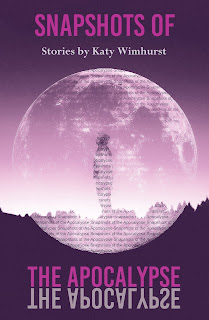
Review by Sharon Eckman of "Snapshots of the Apocalypse" by Katy Wimhurst


Katy Wimhurst’s new collection of short stories is a dark, witty look at a world at once recognisable and skewed. 

The title tells you pretty much where you’re headed, but although each story takes you in that dystopian direction, the beauty is in the detail. Wimhurst’s ideas are fabulously inventive . In the title story, a post-Apocalyptic London features rains named after former Prime Minsters – Thatcher, Blair, Rashford (if only) and ‘the worst was Johnson – deceptively lightweight but soaked you through and through.’

I particularly enjoyed ‘Haunted by Paradise,’ a sensual take on the expulsion from the Garden of Eden – this modern Eve grows an enchanted garden in her flat, stealing plants from the local park armed with a ‘surreptitious trowel and large bag.’

In ‘The Job Lottery,’ the female protagonist, who we only know as Miss Fisher, attends the malign EnCorp’s Job Lottery – billed as a Festival – to try and get herself a decent job. ‘EnCorp wishes you a Good Lottery – Seize the Moment!’ This story has echoes of Huxley’s Brave New World with its Prozac candyfloss, PsychoBliss Drops and – my favourite – the Public Penance Trampoline where you are sent to bounce up and down shouting your penance through a loudhailer for alleged crimes against the state.

All of Wimhurst’s protagonists are lost in some way, mostly living solitary, lonely lives, often with a failed relationship in the background. The stories contain a yearning for hope despite the dystopian scenarios, but, for me, some ended rather abruptly. I also found some of the parallels with our current concerns – refugees, the climate emergency - a little too on the nose, but Wimhurst creates believable characters in wild scenarios and her prose is full of drily funny one liners. Highly recommended.


About the reviewer
Sharon Eckman is an actor, singer and writer. Winner of the Time Out Travel Writer of the Year, she has been longlisted twice for the Fish Memoir Prize, shortlisted for Words & Women Prose competition and the Jerwood/Arvon Mentorship Scheme. Short fiction has appeared in Shooter Lit, Words & Women: 3, 100 Voices: An Anthology, 100 Voices for 100 Years and New Flash Fiction Review. She is currently working on a novel and has just completed her first short film. Her website is here

Thursday, 26 August 2021

Review by Simon Elson of "Fauna" by David Hartley


I didn't know that books like Fauna by David Hartley were published any more. I mean that in a positive manner. It is a collection of dystopian/sci-fi style stories. I thought books of short stories had almost stopped being published altogether, especially of the genre in this collection. I’m so glad that I was wrong. I read each story with fervour. As well as the sci-fi leaning, all the stories have an animal or insect subject matter, hence the title.

Some have a distinct ending, others are perhaps little ambiguous, prompting further thought before turning the page to read the next. The finest compliment I can offer is that although they are set in the twenty-first century (and some, the future) they reminded me of the golden age of this genre, the 1950s and 60s, and are comparable to the short stories of Phillip K Dick and John Wyndham.  

Without too many spoilers, some of the highlights for me were the ferryman of the Styx accepting an unusual passenger with an even more unusual cargo, a man hunting shadow animals - is he hunting shadow animals because all the real animals have been hunted already, or to protect the few that are living? - a fishing trawler netting a regal catch, horses in a barn as part of a time-slip, and a story about foxes that could have been written by the master of English horror, James Herbert.

For me, though, the standout story is ‘Betamorphosis.’ A young Cockroach is shunned by his family after being forced to take part in an experiment and thinks he is … now, that would be a major spoiler. Poignancy, family feuds and some laugh-out-loud moments are all crammed in to a short story about an insect.

In my opinion, this single story would be reason enough to buy the volume. I will certainly be seeking out more works by David Hartley.


About the reviewer
Simon Elson is a Freelance Features Writer. His articles  have appeared in numerous national magazines including Best of British, Derbyshire Life and Writing Magazine. He also writes for the popular cycling website Veloballs.com and has been a guest blogger on The Huffington Post


Monday, 12 July 2021

Review by Colin Gardiner of "New York 2140" by Kim Stanley Robinson


New York 2140 is the brilliant vision of a flooded metropolis struggling against capitalist greed and the ravages of climate change.

Kim Stanley Robinson weaves multiple storylines to capture the imagination. The characters are vivid and the narrative expertly paced, but the real lead character of the story is the city itself. Towering out of the flooded skyline, with its canals and submerged secrets, New York really shines in this luminous tale.

This is a great, almost-utopian novel that provides hope for these uncertain times.


About the reviewer
Colin Gardiner lives in Coventry. He writes short stories and poems and has been published by The Ekphrastic Review, Ink Pantry, The Midnight Street Press and the Creative Writing at Leicester blog. More of his work can be read here.

Friday, 21 May 2021

A Book That Changed Me, by Brian Wharton: "1984" by George Orwell


The book that changed my life is 1984, the dystopian novel by George Orwell first published in 1949. I guess a lot of people would choose this because of its far-reaching effects. I first came across the novel as an eighteen-year-old studying for an O-Level in English Literature at night school after my poor CSE grades. The book taught me about world political systems from the far right to the far left and the blurring that often exists in between. After reading it I began think about Communism and Marxism by looking at the governing bodies in Russia and China. I think of myself as a Socialist rather than a capitalist and the book offered up a critique of both.

I am fascinated by the lovers in the novel, Winston Smith and Julia, who publicly follow the ‘party’ line but break the rules until one is forced to betray the other. Mr Charrington the bookseller intrigues me, the way he entraps potential party dissenters into buying prohibited materials. The lines ‘I sold you and you sold me’ stand out clearly and bring to mind that in societies like this you can’t afford to trust anyone. I studied the novel closely at the time, even reading the appendix first which detailed the origins of the party, and its terminology, such as ‘double speak,’ which dictated that citizens should take heed of what language they use, as well as being aware of the ‘thought police’ who seek to suppress the idea of free thinking. Orwell believed that the middle classes often bring about changes in society but in 1984 he says, ‘if there is hope, it’s in the proles.’ 

I haven’t picked up the novel since the 1980s, but I am constantly aware of its politics especially with the increase of worldwide technology, the uses of surveillance equipment and the breakdown in civil liberties.


About the reviewer
Brian Wharton is a former actor, who writes drama and short stories. He also writes film and theatre criticism.

Sunday, 11 April 2021

Review by Colin Gardiner of "The City & The City" by China Miéville


The City and The City begins as a routine police investigation into the murder of a young student. Inspector Borlú, of the Extreme Crime Squad is drawn into a strange and unsettling conspiracy that compels him to navigate a perilous journey across physical and psychological borders. 

The novel is set between the East European twin cities of Besźel and Ul Qoma. Both places are inexorably separated by an invisible but harshly defined boundary. Infringement is policed by a mysterious and uncanny force and citizens live in constant fear of ‘breach.’

The setting is urban but with a hallucinatory blur, where indoctrination and paranoia form the perfect setting for dramatic tension. The characters are sharply defined with subtle and concise details.

Miéville expertly weaves the genre of police procedure and magic realism into a stunning meditation on city life and the imagined borders we create to avoid irrevocable realities. 


About the reviewer
Colin Gardiner has recently completed his MA in Creative Writing at the University of Leicester. He lives in Coventry with his husband. He writes short stories and poems and has been published by The Ekphrastic Review, Ink Pantry, The Midnight Street Press and the Creative Writing at Leicester blog. More of his work can be read here. 


Thursday, 31 December 2020

Review by Karen Rust of "City of O" by C. M. Taylor


This is an engaging and fast-paced read that sets the scene immediately. A bomb hits the factory where country boy Juan’s parents work, orphaning him. As Juan surveys the rubble, a stout man in a bowler hat rises from the embers, points at him, and heads towards the city. Four other figures appear from the devastation, dressed as colourful harlequins. They head off in the opposite direction, never acknowledging Juan. 

Juan has three choices: to stay in the village, to head to the city, or to follow the harlequins. He chooses the city and is talent-spotted by the mysterious Alex to join the Boundless, a higher echelon of city society.  

C. M. Taylor builds his world with precise strokes, never telling more than is needed. The city is full of familiar places, from the Sydney Opera House to the Louvre and Kings College Chapel. The rich can pay to have a beach, or the Alps brought into the city on a whim. City society has a strict hierarchy with Extras and Intransigents at the bottom, The Boundless (the movers and shakers) in the middle, and Shapers (trendsetters) at the top. Juan is living the life, earning big as a trader with the clothes and flat you’d expect and a non-stop round of parties, drugs, and transitory hook ups, delivered in other worldly form. 

Chapters about Juan’s life in the city alternate with those about the travelling harlequins. Whilst the city chapters are dry satire, the harlequin tales are bawdy and surreal with references that link their path to Juan’s as they journey through the desert and eventually reach the city. 

City of O is pure escapism and great fun to read. An allegory for materialism versus meaning in life, it will make you laugh, flinch, and ponder. Highly recommended. 


About the reviewer
Karen Rust has an MA in Creative Writing from the University of Leicester. Her work features in literary magazines including Mooky Chick, Ellipsiszine & Cabinet of Heed. She ghost-writes biographies for Story Terrace and runs creative writing workshops for young people through Writing East Midlands. She is currently working on a YA cli-fi thriller which she hopes to finish by Easter.

Thursday, 10 September 2020

Review by Jon Wilkins of "Wretch" by Ansgar Allen


Wretch.
A novella.
A stream of consciousness.
Bleak.
Brutal.
Visceral.
A tale set perhaps in the past, a present or a foreboding future.
Dystopian.
We don’t know when or where.
A tale of a prisoner.
The Wretch.
Why is he there?
Physically and mentally rotting away in a prison where he copies
(“A diligent copyist”) 
words.
“Producing my own words, or more exactly reproducing and reordering words I have heard!"
A world where travellers explore the unknown city.
The unknown regions.
What are they looking for?
Who threatens them?
Returning mad.
Or not at all.
What breaks their sanity?
Writing reports.
Hiding reports.
Collecting reports.
Returning reports.
On paper that rots away.
The paper mill produces
paper that disintegrates.
Another metaphor.
For what?
Hope?
Despair?
There is no hope for the Wretch.
The Wretch copies.
His writing machine breaks.
Or he destroys it.
Replaced, he copies.
This is his life compared to the travellers
with their burdens.
Reminding them of what?
Just as the Wretch carries his burden.
His machine.
Punishment for what?
Reminder or crime?
And their struggles in a frightening outside.
Why do they lose their teeth?
A novella full of metaphor but so
black and white.
Full of repetition.
Emphasising the solitary 
repetitive world of
the Wretch.
His life is repetition.
Who put the Wretch away?
Why are they threatened?
As many questions as answers.
The answers are for you to find.
They are what makes this novella unique.
Wretch by Ansgar Allen:
an experimental novella of an experiment?
You decide.
It is an ugly world inside and outside of the known city.
Discover it.


About the reviewer
Jon Wilkins is sixty-four. He has a gorgeous wife Annie and two beautiful sons, and loves to write. He is a retired teacher, lapsed Waterstones’ bookseller and former Basketball Coach. He taught PE and English for twenty years and coached women’s basketball for over thirty years.  He has always loved books and reading. You can read a review of Jon's recent novel, Poppy Flowers at the Front, here

Wednesday, 10 June 2020

Review by Siobhian R. Hodges of "Blood Red Road" by Moira Young


2011 winner of the Costa book awards, Moira Young’s Blood Red Road is a highly-rated dystopian novel – and I can see why. 

Young’s debut book is filled with action, heart, and moments of comedy. I read this book a few years ago – as a teenager, the intended YA audience – and remember fully enjoying it. Now, as an adult, I have recently had the time to revisit the dustlands that main characters Saba, Emmi, Jack, and Lugh travel through. And you know what … I still love it. Probably more than I did before.

While the story is as gripping as I remembered it, I can now fully appreciate the author’s style. The twangy accents are consistent throughout, and the unique names for certain commonplace objects (such as the “long-looker,” which is a pair of binoculars) is a satisfying aspect which adds even more depth to the world Saba lives in. What stands out the most to me, however, is that there are no speech marks (I know!). I’ll admit it was slightly confusing to read at the start, but with its being written in first person, from protagonist Saba’s perspective, the dialogue soon became easy to differentiate from narration, thoughts, and description.

I tip my hat to Young, for opening my eyes as both a reader and writer. With a compelling storyline and memorable style that adds to the already strong characterisation, Blood Red Road is a novel you will not want to put down. I am looking forward to reading the sequel, Rebel Heart (2012), and have just ordered the third instalment to The Dustlands Trilogy, Raging Star (2014).  


About the reviewer
Siobhian R. Hodges is a writer and author of the supernatural thriller, Killing a Dead Man (2019). She has a BA in Creative Writing and Film Studies, and an MA in Creative Writing. When she’s not writing, she enjoys long walks in the countryside and raiding the biscuit cupboard. Her favourite authors are Kevin Brooks and Patrick Ness.

Wednesday, 18 December 2019

Review by Elizabeth Morgan of "The Last Children of Tokyo" by Yoko Tawada


Generations after a fictional (and very vague) environmental catastrophe, Japan struggles. The elderly often outlive their grandchildren in the world of this novel, a feat of magical realism and ecocriticism. Young people have fallen sick, due to the older generation’s negligence of the natural world. In this post-Fukushima society, reflections of intergenerational suffering are astute. Guilt for his generation’s selfish actions towards the planet are present always, in the elderly protagonist. 

This is also an exquisite feat of psychological exploration that ties the past to the future. In banning the naming of foreign cities, the author not only nods to Orwell, but leads us to remember isolationist Japan during Edo times. Tawada’s imagination leaves us with painful questions. Why is the prose describing irremediable catastrophe of nuclear meltdown so arresting - and yet, the creeping effects of pollution and global warming more subtly written? Present, too, is the fear of surveillance - quite popular with dystopian authors, as the elderly protagonist writes: "He was already well into it when he realised he’d included the names of far too many foreign countries. Place names spread throughout the novel like blood vessels, dividing into ever smaller branches, then setting down roots, making it impossible to eliminate them from the text. He’d had to get rid of the manuscript for his own protection, and since burning it was too painful, he had buried it." 

Mumei, the protagonist, is introduced to us in his silk pyjamas, waking up one morning. This is a Kafkaesque opening (reminiscent of the awakening in "The Metamorphosis"), bleak; yet the author still makes room for aesthetically gentle prose. Typically Japanese literature contemplates beauty, even in the remains of horror.  We are left understanding that we must rage on for all that is withheld by the government, never relaxing our search for protecting those simple pleasures we rely upon for happiness. 


About the reviewer
Elizabeth Morgan is a twentysomething who enjoys reading Japanese literature.


Friday, 8 February 2019

Review by Paul Taylor McCartney of "Remnant" by Lania Knight


Lania Knight’s contribution to the dystopian genre, Remnant, is a worthy one. It depicts an all-too familiar world recovering from eschatological meltdown. The action takes place within the ‘Compound,’ a post-industrial hive overseen by a dying queen, Maitris, who has already extended her natural life by hundreds of years by having her team surgically transfer her personality to young female clones, each one bred to ensure genetic continuity. The author presents a world ravaged by unchecked scientific exploitation and corporate ruthlessness; but the narrative is sequenced to show how hope and hopelessness (a theory first expounded by Ernest Bloch) can happily co-exist within the dystopian novel and even provide the reader with the driving compulsion to reach its conclusion, as is the case here. 

There are some interesting flourishes in terms of form and style. Knight has a keen ear for the musicality of language, almost at word level, providing a wealth of striking imagery on almost every page: ‘Old voices chanting and singing, crying, asking why they can’t go home. The water ping ping pings something … why it is so silent is why their bodies are so dumb.’ The inventiveness in the opening chapters can seem initially disorientating for any reader trying to piece together the various fragments of this new order, but this response soon settles down. In fact, ‘Brokerns,’ ‘TaNas,’ ‘Soldjens,’ ‘Synthfeeds’ and ‘ModDNA’ help to reveal an established trope in the genre: that as a fictive world is re-born, so too must language be refigured to help describe this new reality; Knight’s achievement here is reminiscent of Margaret Atwood’s in Oryx and Crake (2003), or Cormac McCarthy’s in his post-apocalyptic novel, The Road (2009). 

Experiments in style are never enough without a novel being grounded in believable characters and our sympathies never stray too far from the young princess, Esme, whose principal task in life is to replace the current queen and rule with a very different vision and set of values. Her development from young girl to emboldened woman is one of the novel’s major achievements, allowing Knight to construct a new direction for this world - a new direction that is unexpected and a sign of her imagination as writer.  


About the reviewer
Paul Taylor McCartney is currently Head of Secondary Teacher Education at Warwick University. He has enjoyed a long and varied teaching career in the discipline of English/Theatre Studies and is following a part-time PhD in Creative Writing with Leicester University. His research interests include dystopian studies, narratology and 20th century literary criticism.