Showing posts with label Creative Writing. Show all posts

Wednesday, 8 April 2026

Interview with Annabelle Slator


Annabelle Slator
grew up writing stories in the depths of the British countryside. After achieving a degree in Creative Writing, she spent most of her twenties working with brands and start-ups in London and New York. 
Nowadays, if she isn’t spending time writing, you can almost always find her obsessing over niche internet drama, practising her fencing parry or mooching around vintage fairs and flea markets. Annabelle’s first contemporary romance novels, The Launch Date and Risky Business, were inspired by her time working in the wild world of dating apps and the tech industry. You can read more about Risky Business on Creative Writing at Leicester here. Annabelle's website is here


Interviewed by Anupriya Sisodia

Q: Tell us more about the Risky Business: what inspired you to write a modern, fast-paced romance set in the tech start-up world? 

AS: Risky Business is inspired by my experiences not only working in the tech and start-up industry, but working exclusively for women-run and female-founded companies. It admittedly is not the sexiest world to set a romance, but it was an area I felt was relatively unexplored in the romance genre and something to which I can bring a unique perspective. 

Q: Were there any scenes or moments that were especially fun or challenging to write? 

AS: The set-up and opening chapters were the most challenging to write, and were rewritten several times during the drafting process. I was trying to hit a balance between a dynamic main character with plenty of agency whilst making sure she "stumbled" into the circumstances of the story instead of actively choosing to deceive everyone from the start. The chapters I found the most fun to write were the meet-cute chapters, the first carefree, flirty night Jess spends with Oliver. I found those chapters to be incredibly cathartic for a character who had spent so long focusing on her own anxieties instead of living her life to the fullest. 

Q: What genres or topics do you enjoy writing about the most? 

AS: I love romance! First kisses and romantic tension are always the most enjoyable parts of the process, but blending self discovery and growth is the most satisfying part of writing, even if it’s not as fun as flirty banter and hijinks in the moment! 

Q: How do you approach blending humour, tension, and romance in your storytelling?

AS: I like to champion the idea that romance is inherently hilarious and should be treated as such. Having a crush makes you do and say things you never thought you would, that you would laugh at somebody else doing, and often look back at and cringe. I approach humour, tension and romance in the same way. Whether they are clashing or in sync, they often work hand in hand to create something magical on the page.  

Q: How do you handle writer's block or creative doubt?

AS: For me, writers block has never been a massive issue because I am always working on multiple projects as once. If I’m stuck on a part of a story, I will focus on another for a few days until the knot in my mind becomes untangled. I also find working on something physical, like cooking or even going for a long walk, helps immensely if I’m really stuck. Ultimately, creativity is a muscle; it can get tired and that’s okay but it needs to be exercised regularly to keep working.  

Q: Are there specific messages or feelings you hope your readers take away from your story?

AS: I hope my readers feel inspired to take their dreams seriously, but also not be too hard on themselves. In the past I have felt a lot of the feelings Jess (and Grace in The Launch Date, my previous novel) experience, and I learnt a great deal through them. I hope readers have the same experience. 

Q: Did you draw on any personal experiences or observations about gender dynamics in tech or in general while writing Jess’s journey? 

AS: Not necessarily direct personal experiences, but witnessing how female founders are treated in the space was a huge inspiration for the story. I think most women can relate to the experiences Jess has in the book, or know someone who has. In particular, Risky Business was inspired by the real-life story of two female entrepreneurs who created a fake male CEO called Keith Mann to dodge tech industry sexism. Ever since reading a news story about this in 2017 I had wondered what would happen if you took that concept further, hiring a man to be the face of a company who was nowhere near qualified. 

Q: You set the story across Rome, Paris, and Vienna. How did these locations shape the plot and the characters’ personal growth? 

AS: Originally, this story was just set in London like my first novel, The Launch Date, but with the mechanics of the story being punctuated by rounds of a tech competition, the idea of just going back to the same hotel events hall every few chapters seemed very boring. I also wanted to make the competition as expensive as possible for Jess without it seeming ridiculous. Tech is a very pricey industry to enter and often excludes people who have great ideas but no financial backing. Making these an international escapade not only made the competition more dynamic but also gave me the opportunity to have fun and flirty scenes between Jess and Oliver outside of a hotel foyer, like the aeroplane bathroom, the French countryside cafe and the Italian dive bar. 

Q: What is your favourite part of being a writer? 

AS: Apart from the obvious of fulfilling a childhood dream of being a published author, it’s amazing to have a job that is so creatively fulfilling. The personal freedom is also a huge part of being a full-time author that I did not anticipate being one of my favourite parts. It can be stressful, not always knowing what the next year will hold and waiting on publishers for feedback etc, but it’s the best job I’ve ever had. 

Q: What personal advice would you give aspiring writers?

AS: Writing to a schedule was one of the best decisions I made when I first started writing full novels. If your goal is to be published, your first book is most likely the only one you will ever write on your own schedule. When writing The Launch Date, I deliberately gave myself a year to plan, write and edit the manuscript before querying, as I knew that was the rough timeline a publisher would give me. As it turns out, I had even less time to write and edit Risky Business, so I’m really glad I had the experience of a tight turnaround before things got serious! 

Q: Finally, what are you currently working on?

AS: I can’t reveal too many specifics right now but I’m currently finishing up something a little bit spookier than The Launch Date or Risky Business, but just as exciting and tension-filled. You can follow me on instagram @annabelleslator or tiktok @annabelleslatorauthor for future updates! 


About the interviewer 
Anupriya Sisodia is a published romance fiction author, pursuing an MA in Creative Writing at the University of Leicester. She is an avid reader who loves writing stories with realistic, relatable characters who experience emotional and exciting journeys on their way to a happy ending.

Saturday, 21 February 2026

Review by Mithila Dutta Roy of "Supporting Cast" by Kit de Waal


It’s been months since I cried over a book, and short stories rarely do that to me. But Kit de Waal’s Supporting Cast made me tear up a bit on a bright Saturday afternoon. 

As the whole world is running around flaunting the idea of being the "main character" with the Pinterest-style life, glorious cafes and extravagant nightlife, there are still many who feel like the supporting cast in others’ stories. And Kit de Waal has brought their stories to life with such precision. Their losses of all kinds - time, age, love, lovers, children, sanity, legs - that form their imperfect lives are staged in a voice that is empathetic and truthful. That’s the mastery these stories needed and got.

Before starting the short story collection I didn’t know that these were the characters in the background of her earlier works. But it didn’t matter as I went from one story to another and found each character becoming a whole, with their nuances, flaws and introspection. Each story stood out as a complete piece, which was fascinating. 

It’s a book that talks about a woman who, on her divorce day, remembers her husband rescuing a boy during their honeymoon; a mother who says goodbye to her newly-wed son and starts thinking about how the bride never thanked the mother who loved him first - and then, in turn, realises that she never thanked her adopted son’s mother. It’s a book about the blind man who passes you by in a crowded street, and what he is still grateful for. It’s a story of an already grieving woman trying to form stories to make her dying father less uncomfortable.

These stories delve into deep human emotions and inner conflicts, while keeping the plot poignant. Some of the stories break what some would call the rules or conventions of short fiction, but even in breaking them there seems to be a purpose, and that is an achievement. Overall, Kit de Waal has done a wonderful job in giving the supporting cast the highlighted stories they deserve. She has given them the closure they might not have received in previous books, where they were only a part of the conversation but not the whole conversation.

Now, which one of these stories made me tear up, or was it my unbalanced hormones? You’ll have to read this book yourself to figure it out, because I’m also just another supporting cast in your story talking about a book I enjoyed.


About the reviewer
Mithila Dutta Roy is a reader and writer with a keen interest in literary fiction and stories that explore human experience. She is pursuing an MA in Creative Writing at the University of Leicester and is currently working on her first novel. She is passionate about storytelling and hopes to contribute her own voice to contemporary literature.


Sunday, 11 January 2026

Review by Paul Taylor-McCartney of "The Subtle Art of Short Fiction" ed. Isabelle Kenyon


This is a concise, well-focused companion for creative writers who already understand the fundamentals of crafting short fiction and now want to work at the level of nuance, treating it as a form defined by compression and consequence. The emphasis is not on shortcuts or formula, but on the deliberate choices that allow a story to suggest a larger world while remaining tightly controlled.

One of the anthology’s strengths is the authority and range of its contributors. Essays and writing exercises from Daisy Johnson, Matt Wesolowski, Kerry Hadley-Pryce, Sarah Schofield, Jonathan Taylor, S. J. Bradley, Mahsuda Snaith, David Hartley and Farhana Shaikh offer a multi-perspectival account of craft (including an illuminating introduction by Paul March-Russell). The variety of approaches prevents the collection from becoming prescriptive. Instead, it reads as a series of intelligent, practice-based reflections on what short stories can achieve and how they generate their distinctive force.

The technical focus is consistently strong. Several chapters attend to subtext and micro-tension, showing how emotional pressure often gathers not through explanation, but through what remains withheld and unresolved. The discussion of sensory minimalism is equally effective, returning to the difficult question of when to render detail vividly and when to imply, allowing the reader to complete the image. Structure is treated as an area for experimentation rather than compliance, with contributors encouraging alternative narrative frameworks and more considered thinking about pacing, revelation and the placement of the final turn. 

Crucially, each chapter includes helpful writing prompts and exercises that bridge literary theory and creative practice. These are not incidental add-ons, but carefully designed invitations to test ideas on the page, and to translate conceptual discussion into specific decisions about language, scene and shape. I have recently returned to the short story form myself, so engaging with this book has been both timely and beneficial in deepening my own understanding of the genre, while also offering practical stimulus for new work.

Isabelle Kenyon’s editorial hand keeps the collection coherent while allowing each voice its own texture, and it is the gravitas and insight of those voices that gives the anthology its remarkable depth. The result is an anthology that sharpens attention, both to the craft of short fiction and to the pleasures of reading it closely. This is a thoughtful, highly engaging and genuinely useful book, and one that rewards return, particularly for writers intent on refining control, precision and resonance.


About the reviewer
Dr Paul Taylor-McCartney is a writer, post-doctoral researcher and lecturer. His academic and creative interests include dystopian literature, Queer studies, children’s fiction and initial teacher education. His poetry, short fiction and scholarly articles have appeared in a wide range of print and electronic media, and recent fiction titles he worked on as commissioning editor have won regional readers’ and publishers’ awards. His debut children’s novel, Sisters of the Pentacle, was published by Hermitage Press (2022), and his first non-fiction title, Cornwall Uncharted: Mapping Cornwall’s Queer History of Concealment, Culture and Creativity, is shortly to be published by The History Press (June 2026).

You can read more about The Subtle Art of Short Fiction on Creative Writing at Leicester here


Tuesday, 16 September 2025

Review by Julie Gardner of "Football, Fighter Jets, Flowers & Everything in Between" by Ellistown Primary School's Year Six Students


As the title suggests, there is variety here. Thirty-two year-six pupils from Ellistown Primary School share their knowledge and interests. And what a knowledgeable and interesting group of individuals they seem to be! 

One piece is inspired by Shakespeare’s Macbeth, another by the award-winning short film Little Freak, by Edwin Schaap. We read a fictionalised account of Catherine of Aragon overhearing Anne Boleyn and Henry Vlll. A labelled diagram explains why the Eurofighter Typhoon is so unique, and an illustrated description of Japan Football Trials makes for a fascinating read. A Victoria sponge recipe is a lovely tribute to a nan who baked "so many different things." 

Recurring themes across the collection are ambitions for the future, the importance of friendship and hobbies. There are some spooky stories, eight poems and some impressive illustrations, including a fierce looking Aslan, a dolphin and an abstract interpretation of the school’s houses. A Lego enthusiast contributes a photograph of a model which was made with 2352 pieces and a photograph of a clay and paint model of an ice-cream cone was inspired "by hot summer days, when the SATs are over and we’re having fun." 

Credit goes to the teachers who have encouraged this creative and diverse project, to Constantine who edited the collection, and to the Coalville C.A.N. Community for making the publication possible. I suspect the children will remember this work long after their SATs results are forgotten. As the headteacher writes in the foreword, the children have been given "permission to embrace their own individuality and to find a voice they may not have known they had." 


About the reviewer
Julie Gardner is studying towards a PhD at Nottingham Trent University, focussing on Silence and Voice in the poetry of Vicki Feaver and her contemporaries. Her poetry pamphlet Remembering was published by Five Leaves Publishers in 2024.


Friday, 12 January 2024

Review by Teika Marija Smits of "The Alchemy: A Guide to Gentle Productivity for Writers" by Anna Vaught


In the ‘Welcome’ to The Alchemy, Vaught writes that: “This is a book for everyone, but with a particular eye on those who are tired and lacking in confidence; those who are disabled, chronically ill or perhaps care for a loved one who would struggle without them.” And that, in a nutshell, summarises the two major hurdles to the creative process of writing: a lack of self-confidence and enough time / energy. 

Vaught, in all honesty, explains that “I had been raised to think poorly of myself” which led to a delay in getting going with her writing. But once she did get going, the words came thick and fast. 

Refreshingly honest, Vaught, in her own unique voice – which is full of love, encouragement and some sweariness – shares her own struggles with the reader, and offers tips and suggestions for gentle productivity – an idea that I really like. For although my own two hurdles to writing are relatively small compared with the hurdles of some other writers, time is not an infinite resource for anyone. Neither is an unfailingly “zen” and positive attitude to the publishing industry, which (as Vaught says) can sometimes feel like a brutal place. By placing an emphasis on gentle productivity, Vaught reminds us that thinking is also writing; that living in and observing the world from wherever you are is also writing; and that penning any number of words is an achievement. She is also keen for writers to use any kind of small creature comfort – be it a hot chocolate, snuggly blanket or set of fancy pens – to encourage us to make progress with our writing goals. (Another idea I like very much!)

I read this book relatively quickly since the chapters are short and Vaught’s breezy, chatty style of writing is thoroughly engaging, and I found it to be an inspiring and comforting read. I am sure that many writers will find it an invaluable resource.


About the reviewer
Teika Marija Smits is a Midlands-based freelance editor and the author of the short story collections Umbilical (NewCon Press) and Waterlore (Black Shuck Books), as well as the poetry pamphlet, Russian Doll (Indigo Dreams Publishing). A fan of all things fae, she is delighted by the fact that Teika means fairy tale in Latvian.

You can read more about The Alchemy by Anna Vaught on Creative Writing at Leicester here

Thursday, 16 November 2023

Review by Lee Wright of "The Mirror and the Road" by William Boyd and Alistair Owen


Alistair Owen’s extensive conversations with William Boyd that took place over a two-year period are not just for smitten Boyd fans. Whether you’re an aspirant writer or a seasoned writer, whatever your chosen field – fiction, non-fiction, novel, short story, or screenplay – The Mirror and the Road makes for a fascinating interrogation into the mind of one of Britain’s best writers. The book is structured chronologically, covering Boyd’s seventeen novels, five short story collections, twelve film screenplays, five television screenplays, and three stage plays. Boyd talks about the vim and vigour of writing, about his unpublished, semi-autobiographical novels, of how his first, A Good Man in Africa, came to be written in three months flat. But what this collection of interviews does best is to show us the process and the torments that come with being a writer, digging deep into the craft and the ingredients that has produced a staggering body of work. It is a 330-page writing masterclass, full of advice about what works for Boyd, his methods and modus operandi, how his plots evolve, how he chooses what he wants to write next, the research stage before writing, the importance of finding the right title for a project, the unimportance of writing sympathetic characters and the deliberate echoes of his many literary influences – Kingsley Amis, Evelyn Waugh, Graham Greene, Ernest Hemingway, F. Scott Fitzgerald and Anton Chekhov – underlining the importance of reading. And Boyd isn’t afraid to borrow from genre fiction to power his narrative, as he did in the case of his 1993 novel, The Blue Afternoon

The book explores Boyd’s preoccupations, seeing how they interact and interconnect and how he brings these different fixations together in his novels and short stories: “Short stories are like a laboratory for me,” Boyd says. He also stresses the importance of trusting the imagination: “I’ve often written about places I’ve never been to,” he says, writing about Los Angeles before he ever went there. “I wanted to see if I could inhabit the place vicariously through my imagination.” 

It sent me back to my time studying for an MA in Creative Writing and the recommended reading list we were given. Other than David Morley’s Cambridge Introduction to Creative Writing, no other book on the list offered the kind of embarrassment of riches (with regards to fiction writing) that comes with these interviews. It should be on the shelf of every university library to be discovered and show what can be done with narrative and how a writer can get there.      


About the reviewer
Lee Wright has an MA in Creative Writing and is currently working towards a PhD researching memoir and film. His fiction and poetry have been published with Fairlight Books, époque press and Burning House Press.


Friday, 12 May 2023

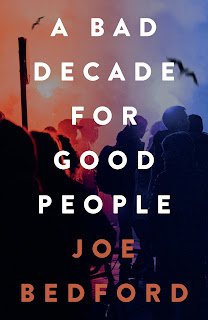
Review by Laura Besley of "A Bad Decade for Good People" by Joe Bedford


A Bad Decade for Good People – Joe Bedford’s debut novel to be published by Parthian in June 2023 – opens with an act of violence: ‘If the policeman’s baton had found Laurie half an inch lower she would be blind in one eye.’ The short prologue introduces the idea of juxtaposition, which I believe runs throughout the novel, both on a collective and individual level, for example: the police who maim and also protect; yearning to be seen by those we love, yet hiding from them. And how can we reconcile who we are with who others think we are?

Throughout the novel, nature plays a prominent role, from the ‘moon-shaped line of damage illuminated above [Laurie’s] eye’ to the various descriptions of Brighton – where a large proportion of the story is set – such as: ‘[the] shore stretches out in one long continuous line, unnaturally straight and unbroken but for the stone groynes that reach out from the shingle.’ The strong sense of place is reinforced by particular facts about the city an outsider is unlikely to know, for example the ‘tradition of leaving unwanted domestic goods out on the street – regardless of how broken they are, how difficult to move or how degradingly stained.’

George, the main character and Laurie’s younger brother, moves to Brighton to be closer to his sister, who lives there with her girlfriend. It is the summer of 2016. The summer of political turmoil: Brexit, David Cameron resigning, Theresa May becoming Prime Minister. Later in the year, Barack Obama is succeeded by Donald Trump. ‘It was all bad news or fake news or a combination of both.’ Laurie and her friends are heavily involved in the local political scene and tensions run high as the ‘decade get[s] darker and darker with no respite.’

This is also the year George meets Antonio, a Spanish naval engineer living in England with the hope of solving a family mystery from the past. It is through this central relationship that the novel continues to explore the themes mentioned above, as well as further themes of identity and belonging, both on a personal level and a communal one. How do we navigate a world not of our making, a world we no longer recognise? 

In many ways, for many people, the 21st century has not been easy. Through Antonio’s quest, we are reminded that we are not the first generation dealing with political upheaval and national frictions. In an interview in TIME Magazine, Margaret Atwood states, ‘The moment when you give up hope, that is the moment when you cease to take any actions that might be positive to get out of the doom.’ On both a macro and micro level, A Bad Decade for Good People echoes Atwood’s sentiments. Exploring timeless themes as well as the tumult of current politics makes this book a must-read for our time.  


About the reviewer
Laura Besley is the author of three collections of flash & micro fiction: (Un)Natural Elements, 100neHundred and The Almost Mothers. She is also an editor for Flash Fiction Magazine and a Creative Writing Masters student at the University of Leicester. Having lived in the Netherlands, Germany and Hong Kong, she now lives in land-locked central England and misses the sea. She tweets @laurabesley

Friday, 21 October 2022

Review by Jane Simmons of "Standing Up with Blake" by Philip Dunn


Philip Dunn’s work has already won him many local admirers, and now his keenly-awaited first collection introduces his work and his poetic voice to a wider audience, beyond the place where ‘the alchemy of dyke and drain / make liquid silver of the leaden skies.’

The opening poems explode into life, taking the reader from the Trump presidency by way of Blake and his visions of angels to the impoverishment of language through the removal of words from the dictionary, the extinction of lambs and lions, and the coming of a world which ‘will henceforth only ever home whatever never takes a breath.’ 

The political and the personal cross paths throughout the collection: it is only ever a small step from internet trolling to political violence, and from the evils of social media to the i-phone literate seven year-old who does not know his own surname or family address.

Dunn knows the value of approaching his subject ‘slant’ – using the song of a blackbird to plunge the reader into WW1 trenches, or skilfully exploiting intertextuality, such as when he uses the title ‘Cant and Culpability’ to make pointed comment on current politics or employs a reference to Jenny Joseph in an example of the wry or self-deprecating humour which is another characteristic of his work.

These poems do not just resonate with concerns about past and current political situations and about social change. Elsewhere, there are poems of considerable tenderness: for the awkward boy, uprooted from his familiar surroundings and hearing ‘the unmistakeable voice of exile’; for first love, ‘the boy on the green bench / burning like a grazed knee’; for relatives becoming increasingly frail in old age; and for a friend struggling with a dementia diagnosis.

Altogether, this is a collection which was well worth the wait.


About the reviewer
Jane Simmons is a former teacher – and now a PhD student. She won the University of Leicester’s G. S. Fraser poetry prize in 2019, 2020 and 2021, and the Seren Christmas poetry prize in 2020. Her work has appeared in Ink, Sweat and Tears, The Blue Nib Magazine and on the Seren blog, as well as being long-listed for the Butcher’s Dog Magazine.

Thursday, 29 September 2022

Review by Jon Wilkins of "The Author Is Not Dead, Merely Somewhere Else: Creative Writing Reconceived," by Michelene Wandor


Like London buses, good books come about in pairs.

Having read and reviewed Michelene Wandor’s Critical-Creative Writing: Two Sides of the Same Coin, I delved into an earlier book of hers about Creative Writing, and was at once captivated and intrigued, and it is not often that I have felt that about a non-fiction book. We can only admire Wandor’s own bibliography and in this book we can see why she has become such a successful writer. She ‘gets’ Creative Writing and this book will help the reader to ‘get’ it as well.

In The Author Is Not Dead, Merely Somewhere Else: Creative Writing Reconceived, Wandor has written the first history of Creative Writing, within it analysing the often complex relationship with English, literary studies and cultural theory. Scholarly, though not prescriptive, and challenging, her book presents us with an  inquisitive approach to Creative Writing that asks the reader, no challenges the reader, to look into their own practice and to see what they can add to the subject. 

Wandor looks at Creative Writing’s position in higher education, and what its future is and investigates and critiques the methodology of the workshop approach that we know so well, asking is this the right approach. Wandor looks for strategies for change in Creative Writing.  Should we be content with past practice or do we need something radically new in our approach as students, teachers and especially writers? This really is a ‘must read.’

There is so much in the book that we can learn from and can add to our own best Creative Writing practice. As Professor Philip Martin, former Pro Vice-Chancellor at DMU, says “A compelling, exciting read …” and its not often you can say that about an academic text!

The Author Is Not Dead, Merely Somewhere Else is an indispensable read for teachers and students, and all those who are worried about the future of Creative Writing, especially under our current government who seem to view creativity in all forms as subversive.


About the reviewer
Jon Wilkins is 66. He is married to the gorgeous Annie with two wonderful sons. He was a teacher for twenty years, a Waterstones bookseller and coached women’s basketball for over thirty years before taking up writing seriously. Nowadays he takes notes for students with Special Needs at Leicester University. He has had a work commissioned by the UK Arts Council and several pieces published traditionally as well as on-line. He has had poems in magazines and anthologies, art galleries, studios, museums and at Huddersfield Railway Station. He loves writing poetry. For his MA, he wrote a crime novel, Utrecht Snow. He followed it up with Utrecht Rain, and is now writing a third part. He is currently writing a crime series, Poppy Knows Best, set at the end of the Great War and into the early 1920s.

Monday, 9 August 2021

Review by Asha Krishna of "Inside Fictional Minds: Tips from Psychology for Creating Characters" by Dr Stephanie Carty


Writers are constantly dealing with human behaviour. Why do the characters act a certain way? What makes them work? 

Inside Fictional Minds by Dr Stephanie Carty offers answers to these questions through clinical psychology. An NHS consultant psychologist, Dr Carty has written many award-winning stories and draws on her professional experience to show how emotions and defence mechanisms can be utilised to create strong, fictional characters.

Such a book might feel a bit overwhelming as it battles the possibility of information overload. Thankfully, Inside Fictional Minds avoids that pitfall and has a clear focus on the writers’ needs. The succinct chapters allow the reader to examine and assign the different emotions and constructs. They are followed by tasks so that the writer can play with the concepts and try out the best fit for their characters.

Divided into three parts, the book has a focussed approach in how it navigates through a minefield of information. The first section, 'The Basics,' discusses how emotions, perceptions and desires shape a character’s persona. 

The second section, 'The Specifics,' explores traits like narcissism and perfectionism and their effects on character. The third section, 'Putting It All Together,' discusses the crucial element of change. The character’s main function is to change over the course of the story and this chapter is packed with useful tips to map that journey. 

The book also recognises the role of a reader while constructing a narrative. Dr Carty’s firm grip on the craft, fused with her professional experience, works well as she balances character insight and reader involvement to build a strong story.

Overall, this is a valuable tool for the advanced writer. Whether a story is plot-driven or character-led, adding dimensions to characterisation elevates the story and this book helps the author do just that. 


About the reviewer
Asha Krishna hates homeschooling but loves seeing her name in print. She is a proud mentee of the Middleway Mentoring project, a professional scheme for emerging writers, and writes short stories and flash. Her work has appeared in Flash Fiction, Leicesterwrites and In the Middle anthologies. She lives in Leicestershire and tweets as @ashkkrish. 

You can read more about Inside Fictional Minds on Creative Writing at Leicester here


Monday, 11 January 2021

Review by Asha Krishna of "Ten Things About Writing" by Joanne Harris


When Joanne Harris’ name appears on a book about the craft, it is bound to attract attention. So, how is it better or any different than the ones already out there? 

Ten Things About Writing is clearly designed for the tech-savvy contemporary learner attracted to the luxury of a well-laid-out website. The book is moulded in a similar fashion, offering writing advice in a very palatable format with its crisp short sentences. 

It is divided into ten sections, each section containing ten short chapters. Each chapter is further laid out in ten bullet points. It is so easy to dip in and out that you whizz easily through the pages and marvel at how much has been packed into those short chapters. 

Right from getting into the zone to constructing a nuanced narrative, the book covers a wide range of topics. It offers tips on basic skills of “show not tell” and foreshadowing with equal ease, making it a comprehensive writing toolkit for the novice as well as the advanced practitioner. 

Harris’s experience as a contemporary author shines through when she discusses commercial issues like readings and requests. There is a section that addresses all sort of random queries from publishing trends to handling frustration. The questions are random and yet relevant for the writer navigating their way round the writing world.

The book ends with section, “Welcome to the dark side” and this is the best part where the stern, but warm voice inspires the reader and urges them to take pride in leading the life of a writer.

For someone keen to understand the concepts, this is a great book; for someone looking to sustain the joy of writing, this is invaluable. 


About the reviewer
Writer, mum, craft-crazy, Asha Krishna was one of the mentees on the Middleway Mentoring Scheme in Leicester. Her fiction and articles have been published in print and online. She tweets as @ashkkrish


Friday, 3 January 2020

Review by Sue Mackrell of "Notes from a Swing State: Writing from Wales & America" by Zoe Brigley


‘The personal is political,’ a central tenet of the women’s movement of 1960s and 70s, is as true today as it was then, but rarely has it been expressed with such eloquence.

In the first of this collection of essays, Zoë Brigley describes finding solace in the bleak indifference of the Utah landscape after the second of four miscarriages endured in an ‘unsympathetic medical system.’ She refuses to be ‘silenced by shame.’ In a society where abortion is a political battleground she reflects ‘Somehow in writing this I have moved from the sadness I feel about the miscarriages to the right of people not to be pregnant.' She continues, ‘The way I see it though, it is all bound up because both are a source of anxiety for Western culture. What do they do with the woman who miscarries, or with the woman who chooses not to have a baby at all?’

Brigley gives illuminating insights into living in Trump’s America, in a swing state where she canvasses for the democrats. As an Assistant Professor at the Ohio State University, in an unfamiliar  classroom  she must routinely check out the exits and plan how it could be secured in the event of a violent attack. When a man drove his car into a crowd on campus, then started slashing people with a knife, she is at home watching on television as the car park she uses is being stormed by a SWAT team and familiar buildings are sealed off with tape. Afterwards  she must deal with the students’ trauma.

As the mother of two little boys she describes how children are drilled in what to do in case of an armed intruder. Outside her son’s  elementary school is a sign stating that no unauthorised firearms are allowed inside the building, and there is a camera at the door where parents can be buzzed in. She describes how there is ‘something peculiar about American Halloween’ where ghoulish fantasies are played out alongside real life violence. In Pittsburgh a man kills eleven people in a synagogue, while participants in ‘fright house’ theme parks and ‘haunted houses’ wear swastikas while they are entertained with ‘simulations of the most appalling violence.’ Brigley writes: ‘The fright house tells us that violence is an illusion, or an act, but the fright house lies. The fright house is America.'

But paradoxically this is a book of hope and courage. Zoe Brigley is ‘an activist, an educator, a creative writer and a survivor.’ She refuses to believe that violence is inevitable and works to challenge violence, hate crimes and discrimination against anyone who does not conform to a supposed ‘norm.’ She believes at the root of it all is a breakdown of communication, ‘an act of violent refusal' to recognise the humanity and to empathise with  an individual perceived as ‘different.’

She argues that writing, and the sharing of writing, is a way forward. She cites Maggie Smith’s poem ‘Good Bones,’ which ‘seeks hope in the face of bleakness’ and which went viral in the summer of 2016, as an example of the power of poetry in ‘dealing with the dark undercurrents of society that we find hard to face.’ She suggests that ‘human beings are born into uncertainty yet human culture does its best to ignore this very fact.’ But poetry ‘encourages us to embrace uncertainty,’ and to empathise with, and recognise in ourselves, frailty and vulnerability.

She draws on her own experience of an abusive relationship to help others, encouraging students to come to terms with violence through creative writing. While ‘confessional poetry has its place,’ she suggests, ‘dream language, symbols and surreal stories – as a means to talk about the difficult or troubling moments from one’s life’ can be liberating. As Emily Dickinson wrote, ’Tell all the Truth but tell it slant.’

The classroom, Brigley argues, ‘has the potential to be a life changing, transformative space for all those involved,’ and she reminds us that the #metoo movement started in a classroom setting. At a speech given at a United Nations campaign Herforshe event at the Ohio State University, March 3rd 2018, she  told the audience: ‘So this is where we have come so far, finding each other, finding empathy and a kind of collective voice, a kind of collective power.’ But, she went on, it is not enough just to empathise with ‘white celebrities,’ there must be more practical support to protect the most vulnerable in our society, such as the #timesup movement which offers financial aid to women on low incomes who seek  redress for workplace harassment or assault. For those already discriminated against, whether because of their gender, sexuality, race, or poverty, are the most likely to experience violence and the least likely to have the means to deal with it. But there is a sense of hope, ‘For we have the language now both words and images – through which to express what freedom might look like.'

As an immigrant to the United States some might tell her to ‘go home and sort her own country out.’ She is both a pioneering voice in the U.S. and a role model for young people in post industrial South Wales. She reflects on how she got here from there, considering teenage influences which include David Bowie, ‘Breakfast at Tiffanys’ and Courbet. There are tender and tragic family stories, and many sassy women. A companion to these essays is her poetry collection Hand & Skull where many themes addressed in these essays are expressed beautifully with luminous imagery, ‘dream language, symbols and surreal stories.’


About the reviewer
Since gaining an MA in Creative Writing from Loughborough University what seems like a lifetime ago, Sue Mackrell’s poetry, short fiction and reviews have appeared in locations and publications as diverse as Leicester public toilets (an Everybody’s Reading initiative!) to Agenda Poetry. She is enjoying seeing the world anew through her four grandchildren. 

Saturday, 3 March 2018

Interview with Tony Williams


Tony Williams’s All the Bananas I’ve Never Eaten won the Saboteur Award for best short story collection. His poetry includes The Corner of Arundel Lane and Charles Street and The Midlands. He lived in Sheffield for more than a decade before moving to rural Northumberland and is an academic teacher of creative writing. His debut novel, Nutcase, was published in 2017.


Interviewed by Lee Wright

LW: How do you get started on a new book? 

TW: With a great deal of confusion, false starts, procrastination, doubt and hubris. You have so many ideas, and they seem so promising (they have to, or you wouldn’t embark on them), but once you get started you see very quickly that they won’t work, or they’re not a book’s worth of idea. With poems and short stories it’s easier – an idea for a long poem or sequence boils down to a single-page poem, and that’s fine; you come to expect it. The difficulty comes when you end up with half a book, and then you have to decide whether you can build it into more or strip it back to something smaller.

With a novel (and this comes with the caveat that I’ve only published one) it’s a bigger problem – you have to write enough of it to be able to make a judgement on whether it’s going to work or not, but once it’s not going to work, you really want to abandon or fix it as soon as possible, so you’re not wasting effort. Though there’s probably no better learning process for a writer than to write a novel from start to finish, even if, maybe especially if, it’s not going to get published – that’s your prentice-work. I’ve an unfinished manuscript of 120,000 words somewhere, which will probably never see daylight, and it turns out I made all the mistakes in there so that I might not make them next time.

I think you know, once you’re a few sessions into writing something, whether it has potential. That feeling, when you’re writing, that you know where it will go. I don’t mean planning a plot, but having a sense, a vision, of what the whole thing will be. If you’ve got that, and it makes you smile, you’re probably on a good thing. I hate all that elevator pitch stuff, but you have to have a private pitch you can make to yourself, possibly wordless, a mirage, or a vision of a monument that you can show to yourself and say, ‘Let’s build that.’ And then the engineer in you comes out, and you start to look to see if it’s possible, this monument, or will it topple over in high winds.

I work in Scrivener, and I have seven or eight project files on the go. Every now and then I look through them, to re-evaluate, and think about what might be worth more work. (I also have one that I’m actively working on at the moment, trying to write a couple of hundred words a day.)

LW: What led you to the Icelandic saga of Grettir the Strong?  

TW: What got me started was reading. I picked up a saga at random a few years back and got hooked. Reading Icelandic sagas was this weird experience, where half the time I was thinking how bored I was, and yet I couldn’t put the book down. The sagas are very like novels in some ways – they’re about how people are shaped by social forces, and about how actions have consequences – and yet totally unlike them in others: their pace is relentless, and they never tell us how the characters feel and think. So, the more I read of these medieval not-quite-novels, the more I started to think about how I could learn from them. Could I write a novel in the style of a saga? 

The point was not to take on the subject matter. I didn’t want to write a novel about Vikings. It was more about writing a saga about contemporary life. So, I looked for a way to make the saga style work in a non-medieval context. At first, I thought I could just take some of the features I admired and use them in a novel: things like the pace and the external focus. But that didn’t really work. For one thing, the saga features got diluted, and I ended up with fiction that was just a bit quicker than usual; it was hard to keep up the discipline when all the other elements of the novel were tending towards a conventionally detailed, discursive approach. And I began to see that you couldn’t take one or two elements out of the saga, anyway, and expect them to play the same role, to mean the same thing. The sagas of Icelanders are an artistically mature genre, and they work the way they do because of the way they bring technical features together, not because of one or two features in isolation. 
So, I realised I needed to stick to the model much more closely, and the obvious way to do that was to choose a specific saga and adapt it into a contemporary setting, keeping the style and underlying structure. Grettir’s saga was then an obvious choice, because it’s really a very simple story, a tragedy in fact: the young man whose talent for violence makes him a hero but ultimately leads to his doom. 

Violence plays a very different role in our society from the role it played in medieval Iceland, where it was an accepted part of legal dispute resolution. But God knows violence is still something we live with. So, I turned Grettir into Aidan, a young vigilante living on a rough estate in Sheffield, and then the challenge of the book was to find out how the same story could play out convincingly in the modern context.

LW: A “hero” can be defined as a character with a singleness of purpose. Do you prefer your “hero’s” purpose to be dark or light in a story?  

TW: I’m not sure I mind, except that as we know the devil has all the best tunes. Nutcase is a tragedy in the classical sense, because Aidan’s talent for and propensity to violence is arguably what dooms him. (Or you could say he’s doomed anyway by his situation, that he has no real choices to make). The book’s got jokes, but it’s a tragedy. But some of my favourite books are comedies in that their heroes go through life almost invulnerably – picaresques like The Good Soldier Å vejk and Simplicissimus, Moll Flanders and Humphrey Clinker

But although I do think of Grettir/Aidan in this way as a tragic hero, I’m not sure the protagonist’s purpose or even trajectory is my main concern in reading or writing. I’m a bit wary of the whole bildungsroman view of the novel, that we’re there to see a character grow in some way over the course of 80,000 words. Actually, we often don’t learn, we just repeat the same mistakes (Moll Flanders, again). That’s one reason I like the sagas, I suppose – they’re about repetition and variation, rather than a narrative arc. In that sense they seem to me more realistic in the way they portray human character.

More generally I guess I do subscribe to the idea of the realist novel – not in terms of style, necessarily, but in terms of the impulse to say something about how the world is. Again, the sagas show us how feuds and behaviour are shaped by the social structure of medieval Iceland. The feuds aren’t just jolly battles between Vikings, they’re inevitable consequences of a nation without an executive arm of government. The realist novel is the novel that tries to show us how things really are (in that sense of course a fantasy novel can be realist). The more you get divorced from that, the more it becomes just about some individual hero learning something and "growing," the more it turns into meaningless escapism, a hero who is just a stand-in for the reader, having adventures. I don’t need that. I can daydream being a hero perfectly well on my own. 

LW: When writing, do you rely on your intuitions? 

TW: Always, in the first draft. I hardly plan. I make things up in the act of writing – I find myself making things up, and it goes in because it feels right. If it feels right it’s going in, and the reader will swallow it. If it doesn’t feel right, then no amount of accurate detail or rationalising will make it work. 

Even editing is a matter of feel. You do need to iron out inaccuracies, but what you’re really doing is going through and seeing if everything hangs together, and that’s a judgement you make in your gut. There’s one bit in Nutcase, one line, in particular, that bothers me, because the feeling isn’t right. I knew that, but I thought I could get away with it. And now I think about that and it bothers me, much more than typos do, because that’s the moment when the book loses confidence in itself, however briefly. I’m not telling you which bit. A reader might not notice – might think it’s iffy at other moments. But it bothers me.

LW: You lived in Sheffield for more than a decade. Is Nutcase something of a water-damaged love letter to the city? 

TW: Absolutely it is. I love Sheffield and loved living there, but also saw and experienced some darker days. Some of the time I lived in Norfolk Park and Manor, which I guess are "disadvantaged" areas in the professional jargon. We had a car written off by a passing joyrider or drunk. There was a stabbing next door but one. It was the usual stuff that you see in a city over time, depending on how unlucky you are and where you happen to live.
But it was just life, really, not subject matter. I was mainly writing poetry at the time, and although the city came into it, I wasn’t writing so much about the kinds of places and experiences that come into Nutcase. VS Naipaul’s great autobiographical novel The Enigma of Arrival talks about his arriving in London in the 1950s and wanting to be a writer, but not seeing till years later that his true subject matter was all around him. It was like that for me, in the sense that I never consciously wanted to write about Sheffield. But once I had the idea for the saga novel, the Sheffield I had known presented itself to me as a possible setting, and then in the writing I discovered that I was deeply interested in representing it. Setting became subject matter, and the original impulse, the stylistic challenge set by the sagas, became not an end in itself but a means to uncovering the difficult life of the city. So yes, a "water-damaged love letter" is a good description – it’s a love letter written with open eyes, in full knowledge of the place’s faults but also with immense affection.

LW: How much of your writing is based on personal experience? 

TW: Well, I don’t think anything in the novel actually happened. Looking at my short stories, there’s one which is fundamentally non-fiction, inasmuch as it simply narrates something that really happened. But there are others, and certain moments in the novel, which draw on personal experiences more or less obliquely. My wife can’t read the stories because she says she can just see where I got an idea from. Sometimes it’s an incident which you embellish or change, but often it’s a feel or a tone – so people I know from back then have said they recognise the atmosphere. In that sense lots of the writing is based on personal experience, but in the sense that personal experience provides a kind of imaginative hinterland which you can stare into, and that helps you make things up.


LW: What is your approach to the teaching of creative writing? 

TW: There’s (still) a lot of nonsense about whether you can teach creative writing. Of course you can – but there are limits. You can’t teach people to be brilliant novelists or to win the Nobel Prize, but then you can’t teach people to be Yehudi Menuhin either, and yet it’s obvious you can teach them to play the violin. You can teach technical skills, processes, attitudes; you can help people expand their horizons; you can help them understand themselves and the task ahead of them. It’s still up to them and their own resources to do the actual writing. 

It’s also important to understand that publication is not the only measure of success for a Creative Writing student. Many will crave that. But even the ones who achieve it will find that publication is a secondary reward of the art. The primary reward is doing it and taking delight in it. And the ones who don’t go on to publish haven’t failed. You can do a degree in marine biology and not go on to be a marine biologist. It’s about education – as a good in itself, and as a way of learning skills that you can take into the rest of your life.

In terms of my approach: I think it’s important to acknowledge ignorance. Failure and ignorance. I always say to new students, of poetry especially, who may be feeling intimidated by the whole thing, that most of what I write is rubbish. I write it and immediately put it aside. I might come back to it and salvage something, but if I don’t it doesn’t concern me. Writing is trying things out, playing around, and that’s only possible if you allow for total failure as a result that won’t deter you. 

So, I say to students, the first thing you write won’t strike you as being any good, but that’s OK. That’s how it is – you write the next thing, and then the next, and sometimes you write something you’re pleased with. One poem in ten (in a hundred, even) – that’s a good success rate. (With prose it’s different of course. You can’t keep trying out an idea and then starting again, or you’ll never finish a story. But keeping going with something that doesn’t work, just to get to the end, is madness too. To the prose writers I would counsel patience, but of course that’s the last thing anybody wants to hear).

All that’s about reducing the pressure writers put themselves under. But it’s also about eliding my own authority as a teacher. We’re conditioned to think of the people who teach us as experts, and they should be. But expertise in writing does not consist in being able to write perfectly every time. It’s not about infallibility or perfect judgement. It’s about knowing how to go about the practice of writing, and if that practice typically involves multiple, continual, soul-sapping, habitual failure – and great swathes of ignorance – then it’s important that we teach that too. And more than that – we have to acknowledge it in ourselves, or the students will think we’re patronising them. 

LW: How much do you compromise when working with an editor / publisher? 

TW: Sometimes I haven’t been asked to – they’ve taken what I’ve given them and run with it. But sometimes there are conversations – it can be difficult. Amicable, but difficult in the sense that sometimes they’re right, they make you get rid of a poem, say, and after the book’s published you see they were right to do so; but sometimes you wish you’d kept it in. I try to be pragmatic. I would walk away if I felt strongly, even if my default position is being pathetically grateful.

LW: Have you ever “hit the wall” or given up on a big writing project?  

TW: All the time. Like I say, writing is 90% failure, or it feels like it anyway. The big projects I’ve given up on are novels. (Poetry manuscripts just tend to evolve, with the failures dropping out and new poems going in until the book is finished). I’ve a 120K project, unfinished, which I don’t think will ever come together even though I still love the idea. I’ve several more or less complete novels lying about which I’ll probably not go back to. There comes a point I think when you see that a project isn’t going to work, or rather that making it work would be a bigger job than just starting something new.

It’s heart breaking to give up on something. All that investment wasted. But it gets easier. And, of course the investment isn’t really wasted, because you learn from failures most of all. The next thing will be better because this one was worse.

LW: Looking back on Nutcase, what are its strengths and weaknesses?

TW: I don’t think I can answer that! I’m too close to it still; you always rate your last book better than the rest of them. What I like about it is the variety of responses readers have had to it. Some readers read it as a comedy, and some as this bleak and brutal indictment of the times. It’s supposed to be both, of course, and I like the fact that it supports both readings. In terms of weaknesses – well, I don’t want to provide ammunition. I’m sure readers, if I’m lucky enough to have them, will point the book’s shortcomings out.


About the interviewer
Lee Wright was born in Nuneaton, Warwickshire in 1980 and has been writing both fiction and non-fiction since 2008. He is taking an MA in Creative Writing at the University of Leicester.

Saturday, 14 January 2017

Natalie Beech, interviewed by Sonia Tailor


Natalie Beech is the Associate Playwright for Written Foundations Theatre Company, with her play Collegiate making its debut at The Bread & Roses Theatre last year. Her short plays have won competitions with Sheer Height Theatre Company and Unmasked Theatre Company, going on to be performed at Arcola Theatre, The Hawth Theatre and Story City Festival. She also works with local universities to run workshops and create issue-based drama, with short plays The Island and Currents recently performed at De Montfort University.


ST: How do you explore modern issues through the use of drama?

NB: I think it’s important to examine points of view that are not yours, in order to explore an issue properly. Audiences are intelligent and it’s important that you don’t insult that, or leave them feeling you are biased or haven’t considered something properly. I personally want to use drama because I think live performance and theatre commands people’s attention in a way almost nothing else does right now. If you’re watching a film, reading a book or an article, you can easily be distracted by your phone, social media etc. With drama, there’s a human being in front of you, emotionally responding to the impact of the issue you are exploring. There’s something very intimate and powerful about that.

ST: Why is it important for you to present the perpetrator’s viewpoint in your plays?

NB: I don’t think we really get anywhere in tackling issues if we don’t explore the perpetrator’s point of view, or try to understand why they commit an act or their mentality at that time. Plus - I think it is fascinating to go into the mind of someone who is very different to you, that’s the fun of writing!

ST: What techniques do you use to create strong voices?

NB: I often use the voice of people I have met or know, to help get speech patterns accurate and realistic. I am a firm believer that character is the most important aspect of drama, so making sure you know your characters inside out will mean that they become real people in your head, and write the story themselves.

ST: How do you maintain a balance between exposition and drama?

NB: Exposition can be used interestingly, particularly with monologues. Having your characters decide what they want to tell an audience about themselves and what they want to hide is great on stage, and allows audiences to come to some of their own conclusions about your characters and story. It’s fairly obvious, but I think I would just advise not to show all of your cards at once, slowly reveal things over the course of your story, and that will create drama in itself. 

ST: How do you effectively intertwine dialogue with monologues?

NB: Monologues can be quite hard going for an audience, so it works to break it up with dialogue and vary things a bit. I tend to use monologues when I want the audience to see the drama through the perspective of a character, and dialogue when I want them to see how something is in in reality. This dictates how I intertwine them and why I decide to use dialogue or monologue.


About the interviewer

Sonia Tailor is a political writer, studying an MA in Creative Writing at the University of Leicester. She has organised vigils and demonstrations, and in 2007, she travelled to Jordan to make a documentary about Iraqi refugee children. For many years, Sonia was the Youth Page editor for Peace News (newspaper) and she currently runs a book blog on Instagram: @soniareads.

Monday, 23 November 2015

Karen Stevens, interviewed by Jonathan Taylor


Karen Stevens is a Senior Lecturer in English and Creative Writing at the University of Chichester, in West Sussex.  She has a special interest in the novel and short fiction.  Her short stories have been published in The Big Issue, Pulp Net, Panurge New Fiction, Mouth Ogres, Dreaming Beasts, Fish Publishing, Riptide, Salt Publishing.  Her edited collection of essays, Writing a First Novel, was published by Palgrave Macmillan in 2014.


Writing a First Novel is an inspiring collection of essays by a range of award-winning, established and newly published novelists. Writers generously offer their insight and advice on the joys and challenges that new authors of fiction will inevitably encounter along the way. A literary agent and a publisher add their own professional perspectives.

JT. You've edited a rather wonderful book of essays, Writing a First Novel, by many different writers. What first gave you the idea to do this? What were your aims in putting together the book, both for yourself and for readers?

KS. I’m so glad you think it’s wonderful, Jonathan. Two central aims initially prompted the idea for the book.  Firstly, as a teacher of creative writing, I spend a fair amount of time searching for illuminating words from writers on writing and was searching for some encouragement on writing a first novel. I came across much on writing fiction, but very little on the specific task of writing a first novel, which made me aware of the need for a book dedicated to this subject for both writers and teachers. Secondly, I do find that some (not all) ‘how to’ books can simplify the process of writing into a linear ‘step-by-step’ form, and I wanted aspiring writers to understand that writing – good writing – isn’t about ticking off a check list. Creation isn’t a blue print, and the writers in the collection – new, established and award winning – testify to this when they talk of the thrilling, chaotic, sometimes mystical, and often mysterious process on which they embarked.   In Hanif Kureishi’s wonderful chapter, he asserts, ‘There is a sense – there has to be a sense – in which most writers do not understand what they are doing.’ Writing a novel is the longest and loneliest journey a writer can embark upon, and I wanted the aspiring novelist to rest easy with uncertainty, to understand that this is just part of the creative process and to not lose faith, to simply keep going.

JT. What did you yourself learn from putting together Writing a First Novel?

KS. I learned so much in so many ways. I learned how hard it is to put together a collection of this type with a very limited budget.  The writers were very gracious and generous, giving up their precious time (for little payment) to demystify a process that is largely inexplicable. I learned that editing is an exacting and tough job, and I have great admiration for editors at publishing houses that spend their weeks working closely on manuscripts. As I say in my introduction to the collection, ‘Bravery’, ‘belief’, ‘confidence’ and ‘faith’ are fundamental words that run through the chapters, and I do find myself visiting the book whenever I’m riddled with self-doubt about writing. I don’t come from a literary background.  I was the first person in my family to undertake a degree. My background, I’m sure, is the root of self-consciousness, and the book has taught me that cultivating a sense of entitlement is a crucial step in writing. Jane Feaver, a contributor, says, ‘We must develop some counter-confidence that will temporarily overcome or pull the rug from whatever it is that tells you, you have no right to be there.’ Great advice.  

JT. You also write your own prose fiction, which has been widely published. How do you see the relationship between the role of editor and that of writer? What are the points of connection and differences?

KS. Having worked as writer and editor, I’ve experienced both sides of this relationship and see it as a diplomatic process in which both parties care hugely about the writing. Ideally, editing should be an organic and collaborative process. Editing is about being a good reader and understanding the writer’s vision and helping them to achieve it. The editor needs to be a diplomat, offering suggestions to editorial problems, and in doing so the writer will often come up with the right solution. For this approach to be successful, however, the writer needs to be open to having their work critiqued, and willing to engage in a dialogue about their work. In my role of editor, I’ve asked writers questions about their story and they’ve often been surprised that the information in their head wasn’t transferred to the page. As a writer, I’ve also experienced this same surprise. When writing, we’re immersed in an imaginative process that isn’t necessarily keeping tabs on the story at the macro level of such things as plot and structure. Consequently, I’m always grateful when an editor or my workshop group pulls me back from the murky depths of creativity to help me see what’s working and what isn’t.  

JT. When did you first decide to be a writer? What were the major staging posts in your development as a writer? Why write at all?

KS. Two things made a deep impression on me as a child in the 70s, and sowed the seeds of my desire to write.  The first thing happened in class at primary school, when a very clever girl read out a description she’d written of an old man. I still recall, with absolute clarity, a line she read: ‘One arm was extended.’ Wow. We were only six or seven years old at the time, and I was blown away by her sophisticated use of language and her ability to bring a person to life through only words. I can still see the old man today in his brown dishevelled rain mac and his tweed cap, his arm reaching out. A few years after this event, I secretly watched a controversial adult drama series called ‘Bouquet of Barbed Wire’ on a tiny black and white portable in my bedroom. I was captivated and shocked by the story of infidelity, violence and incest, and how it devastates a family. I felt completely lost once the series had finished, and in the playground I relived (in inappropriately graphic detail) the torrid fallout from the father’s incestuous infatuation with his daughter, only to receive confused or blank looks from my playmates. As an adult, I now see that I wanted to relive this drama because I’d discovered emotions outside of my own childish experience. This was the point when I first understood (albeit unconsciously) the power of fiction.      

Though I didn’t start writing until my late twenties on my English degree, I suppose I’ve behaved like a writer since childhood. I was always watching, listening, spying, prying, storing things in my head that I could draw on in secret stories I’d write on sheets of toilet paper. Money was very tight in my childhood (and still is). I didn’t have access to writing paper, and I suppose this is why I don’t use notebooks now for my writing. I tend to hear or see something that makes an impression on me and I store it. If it stays with me, I know it will turn into a story, or form part of a story at some point. Once I started writing on my degree, I soon realised I was writing out many things – directly and indirectly – that I’d stored since childhood. This is why I write. This is why all writers write, I think.  We need to make sense of experience. We need to express our individual take on life.   

JT. I've always loved your stories, and find them highly original, individual. How would you describe your individual style or voice in your short stories?

KS. Thank you for the compliment; it’s always nice to know that people have enjoyed the stories I’ve written, re-written, agonised over, re-written ...  How would I describe my writing style and voice?  I don’t really know; it’s difficult to say because it’s just what I do. I tend to write about characters that thirst for some sort of connection but are also aware of the fleeting nature of things, the impermanence of it all. At the end of the day, my central aim in writing is only to be as true to my characters and their situations as I can possibly be.  
   
JT. How do you conceive the relationship between short fiction and other genres (given that you've edited a book on novel writing as well, for example)?

KS. All writing explores what it is to be human and alive. Like the novel, the short story wants to give us something big but wants to do this with brevity. Frank O’Connor feels that the novel requires far more logic, and far more knowledge of circumstances, whereas the short story can have the sort of detachment from circumstances that lyric poetry has. The novel, it can be said, has an internal logic that builds, but the short story doesn’t always follow a rational pattern or allow for a moral explanation. Graham Mort argues that the reader both experiences the story as it unfolds and completes it. Not in a systematic way, in which a novel is completed, but in a speculative way that fleshes out the bones of a narrative. This is what attracts us to the short story genre, I think; its very brevity enrols our imagination.  

JT. Do you find that teaching Creative Writing helps or hinders your writing, and in what ways?

KS. Teaching Creative Writing is both a help and a hindrance. I enjoy teaching; it’s a creative act, in itself – to inspire and to stimulate creativity in others. When I see a writer finding his/her voice or getting their work published, it’s very exciting and spurs me on to keep writing too. In teaching, though, I use up a lot of creative and emotional energy because I want my students’ experience and creative work to be as good it can be. Usually, at the end of each semester, I’m exhausted and feel as if I’m stuffed full of other people’s words, and it takes a while to get back to my own words again. Reading just for pleasure helps: Richard Ford, Katherine Mansfield, Tessa Hadley and John Banville are just a few examples of writers who inspire and kick-start me back into writing.    

JT. What are your medium and long-term aims for your writing?

KS. My main aim – medium and long-term – is to simply keep on writing and meet my monthly workshop deadlines. I’m writing a collection of short stories and have some chapters of a children’s novel under my belt, and the monthly workshops help to ensure that writing remains a priority, even though I’m busy with work and children. For anyone struggling to keep a writing routine going, I’d suggest starting or joining a workshop group. Deadlines are brilliant, and it’s great to be involved with other writers who value writing.     

About the interviewer
Jonathan Taylor is an author, lecturer, critic and editor. His books include the novels Melissa (Salt, 2015), and Entertaining Strangers (Salt, 2012), and the memoir Take Me Home (Granta, 2007). His website is www.jonathanptaylor.co.uk.