Showing posts with label Play. Show all posts

Monday, 4 July 2022

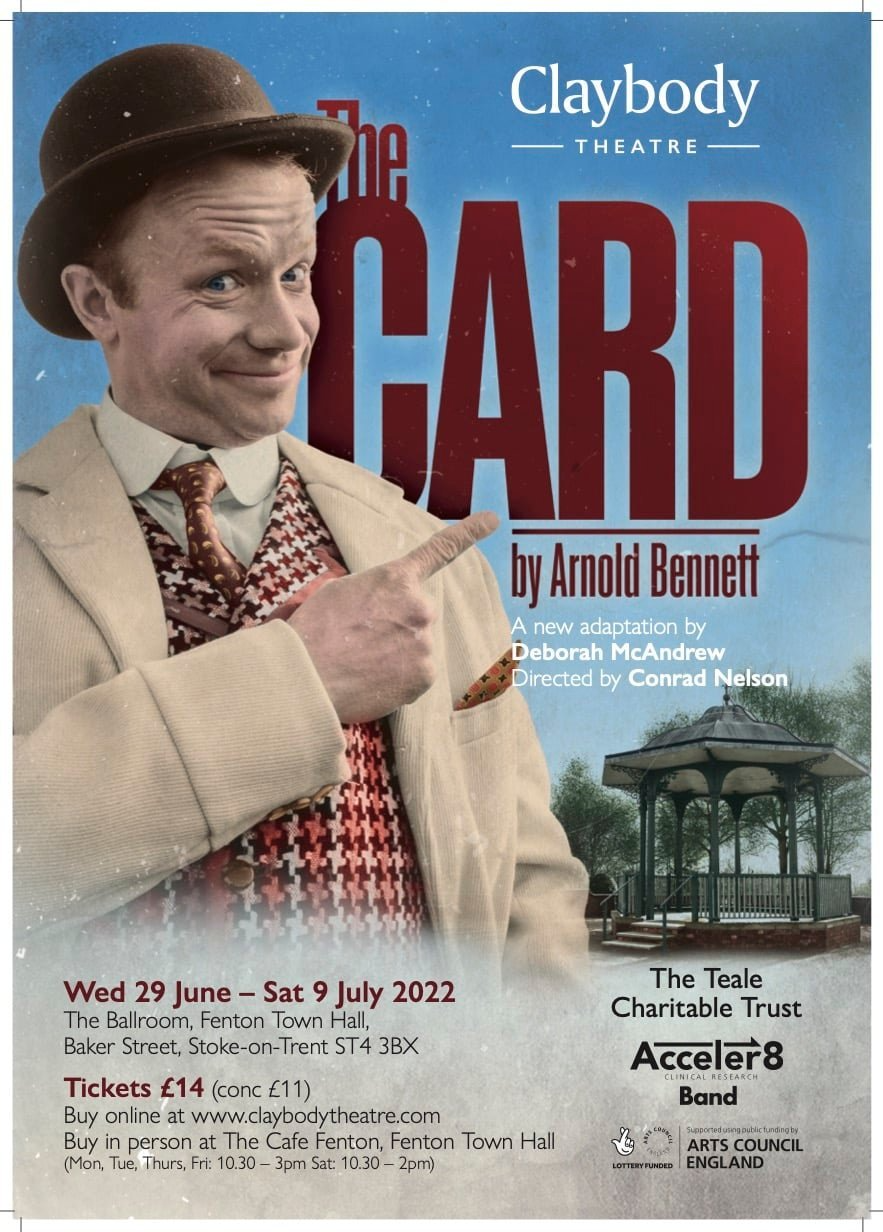
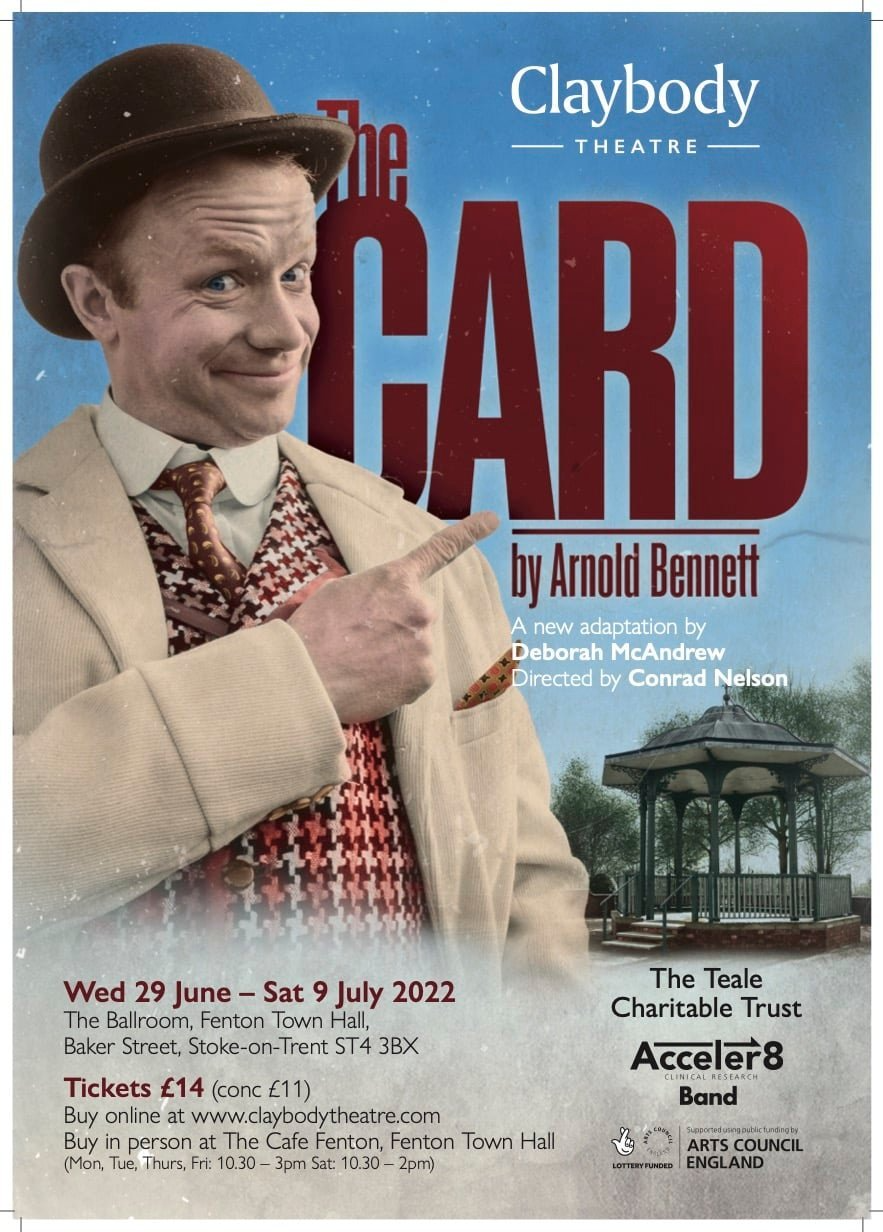
Review by Julian Salt of "The Card" by Arnold Bennett, adapted by Deborah McAndrew, with the Claybody Theatre


My wife and I have just seen a stunning adaptation of Arnold Bennett’s The Card. Claybody Theatre's Deborah McAndrew, writer, and Conrad Nelson, director, have produced an enthralling masterpiece which should not be missed. The seven professional actors / musicians with supporting brass band and the enthusiastic entourage of Claybody volunteers created a gem of a riotous romp from start to finish. The actors played multiple roles and were all accomplished singers and dancers.

Bennett’s novel showed how with ‘dash’ we can break through adversity and ;cheer up' the world. O how we need  this today! McAndrew's and Nelson’s genius warms the heart and  makes you want to unleash the Denry in us all … we loved every moment of it!

Well done especially to the supporting cast of Claybody Theatre's volunteers. On a shoestring you have produced a most memorable show, which fully deserves a wider audience.

The renovated Fenton Town Hall gave the performance authenticity and a historical canvas exuding its own vibe, which served to enhance this exquisite production.

After watching Deborah McAndrew, the writer, pick up a basket of the actors' clothes and take them away to wash them, ready for tomorrow's performance, we appreciated the work ethic she shares with the whole of her team. The way the actors gave freely of their time afterwards reflected their wholehearted approach to the project. Celebrating the Potteries and Fenton, (the missing sixth town) in Fenton Town Hall, this masterpiece was given a magical authenticity. 

Throughout, the show was a rich kaleidoscope of polkas and waltzes, shanties and folk songs, Potteries humour and dramatic irony all of which warmed our  hearts in these cold Putinized days. From shades of unscrupulous landlords to excursions to Llandudno, from love to ambition and greed, politics and intrigue, all were combined within a simple tale of a Stokie who made good.

McAndrew, originally from Leeds and Conrad from Liverpool - we salute you. Welcome to The Potteries Hall of Fame for writing and directing such a stunning show! 


About the reviewer
Julian Salt is a retired Psychologist born in Fenton, who now lives in Derbyshire and enjoys revisiting his roots.

You can read another review of this adaptation of The Card here


Friday, 1 July 2022

Review by Carolyn Ruane of "The Card" by Arnold Bennett, adapted by Deborah McAndrew, with the Claybody Theatre


I went to the opening night of this new adaptation of Arnold Bennett's novel, The Card, adapted by Deborah McAndrew, with the Claybody Theatre in Fenton Town Hall, Stoke-on-Trent.

The show is stupendous. Gareth Cassidy is amazing as Denry Machin. The part that amused me most was Howard Chadwick playing Mrs Machin; he was hilarious. 

The singing and dancing are preformed very well. It was slick. No first night nerves! The way the cast go out of one door, and then reappear through another door with a change of clothes is fabulous. 

The canal scene is done really well: you really feel worried about the water coming in. It's believable. The runaway horse is great and again you feel the action. 

The fact most of the cast play multiple parts does work really well. 


About the reviewer
Carolyn Ruane is from Stoke on Trent. She is a keen member of the Arnold Bennett Society. She enjoys plays at the theatre and is an avid reader. 


Sunday, 20 May 2018

Review by Sandra Pollock of "Something Dark" by Lemn Sissay


Lemn Sissay's play Something Dark is powerful in its ability to allow us to enter directly into the mind and experiences of a child lost in the system: a system set up to protect itself from children who don’t fit in.

If you’ve forgotten or don’t think you understand the mental state of a young person, read Something Dark and then read it again. The sense of loss, confusion, pain, loneliness and rejection are articulated with simplicity and with a profundity that gets through to your soul.

I love the mix of script, prose and poetry – yes, I know it’s a script, but Lemn combines these, pulling you into his life experiences in a way that I find unique.  I applaud Lemn for sharing his journey to find his blood family; his determination to find meaning for himself, not giving up on others, or settling for being a secret of someone else’s choosing, even though this may have been a recurring experience of his. 

Through sharing his story in Something Dark, Lemn has shown how we continually make choices. When facing rejection, we still have a choice as to whether or not to accept or reject ourselves - whether we pick up what we do have and make something else out of it, bring it into the light, the light of our own making.

To have clawed his way through the darkness of what he was given and the intermittent periods of light he has experienced, to a place of light which now serves to help so many young people today, all this sets Lemn out as an outstanding example of what we can achieve as human beings even in the face of adversity.  Something Dark also shows us that it is okay to share what has been our experience and this can be done without judgement.  Declaring the facts is not judgement.  

Something Dark is a small book, it’s easy to read and I read it twice.  It’s fast moving, emotionally challenging and thought provoking.  It may well deserve a third visit.   In the introduction to the book, Lemn says: "I needed to speak… I found my light.  And though it was a spark enveloped in the darkness it was light all the same."  Something Dark gives a powerful light. Thank you Lemn, you speak your light well. 


About the Reviewer 
Sandra Pollock loves fiction, fantasy and poetry, is passionate about Black British history.  She is currently taking an MA in Creative Writing at the University of Leicester.

Saturday, 11 February 2017

Review by Beth Gaylard of "Collegiate" by Natalie Beech, Brigitte Adela and Written Foundations Theatre Company


Collegiate is a production by Written Foundations Theatre Company, a partnership of director Brigitte Adela with playwright Natalie Beech.  Original music (by Selim Ben Rabha and Matthew Daly) and lighting were elegantly worked out to complement the drama, without distracting from it. I saw it in the Attenborough Arts Centre, Leicester.

Set on a campus in freshers’ week, Collegiate is a story about friendship and pseudo-friendship, as well as sexual politics. At the heart of the play is a rape, which is not accepted as such by any of the characters, not even at times, by Tash (played by Rebecca Tubridy) to whom it happens. The brutality of the assault (not portrayed graphically) is matched by the nastiness of Tash’s and Kev’s friends. Tash’s friends scrutinise her behaviour and withdraw their affection in the aftermath of the assault - while Kev (played by Stephen Love) is the butt of more savvy young men, whose laddism contributes to the events. It’s the laddism that is really under scrutiny here – the play effectively challenges assumptions about sexual consent.
  
The portrayal of Tash’s situation (and its consequences) avoids the ‘victim’ stereotypes associated with those who’ve suffered a sexual assault, focussing on the personal horror – the uniqueness of the experience and the isolation it brings in its wake, as onlookers decide for themselves who’s at fault. 

All this is conveyed through a fast-moving script and excellent acting. There is humour in the piece, but like the music, it complements the story and never detracts from the serious subject – and both actors convincingly portrayed the dilemmas of Tash and Kev.

This is a piece of work that deserves a wider audience – particularly of the young people it’s aimed at, so I was pleased to hear from Written Foundations hope to stage Collegiate at the Edinburgh Festival in August. Catch it if you can. And incidentally, if you happen to have any links with sixteen plus education, it would be well worth booking a performance workshop for your students, as they think about heading off for university themselves.                                     
About the reviewer
Beth Gaylard is a teacher, writer and MA  student at the University of Leicester. She lives in Leicestershire in a weird modernist house that will one day feature in a bestselling novel or film, hopefully her own.

Saturday, 14 January 2017

Natalie Beech, interviewed by Sonia Tailor


Natalie Beech is the Associate Playwright for Written Foundations Theatre Company, with her play Collegiate making its debut at The Bread & Roses Theatre last year. Her short plays have won competitions with Sheer Height Theatre Company and Unmasked Theatre Company, going on to be performed at Arcola Theatre, The Hawth Theatre and Story City Festival. She also works with local universities to run workshops and create issue-based drama, with short plays The Island and Currents recently performed at De Montfort University.


ST: How do you explore modern issues through the use of drama?

NB: I think it’s important to examine points of view that are not yours, in order to explore an issue properly. Audiences are intelligent and it’s important that you don’t insult that, or leave them feeling you are biased or haven’t considered something properly. I personally want to use drama because I think live performance and theatre commands people’s attention in a way almost nothing else does right now. If you’re watching a film, reading a book or an article, you can easily be distracted by your phone, social media etc. With drama, there’s a human being in front of you, emotionally responding to the impact of the issue you are exploring. There’s something very intimate and powerful about that.

ST: Why is it important for you to present the perpetrator’s viewpoint in your plays?

NB: I don’t think we really get anywhere in tackling issues if we don’t explore the perpetrator’s point of view, or try to understand why they commit an act or their mentality at that time. Plus - I think it is fascinating to go into the mind of someone who is very different to you, that’s the fun of writing!

ST: What techniques do you use to create strong voices?

NB: I often use the voice of people I have met or know, to help get speech patterns accurate and realistic. I am a firm believer that character is the most important aspect of drama, so making sure you know your characters inside out will mean that they become real people in your head, and write the story themselves.

ST: How do you maintain a balance between exposition and drama?

NB: Exposition can be used interestingly, particularly with monologues. Having your characters decide what they want to tell an audience about themselves and what they want to hide is great on stage, and allows audiences to come to some of their own conclusions about your characters and story. It’s fairly obvious, but I think I would just advise not to show all of your cards at once, slowly reveal things over the course of your story, and that will create drama in itself. 

ST: How do you effectively intertwine dialogue with monologues?

NB: Monologues can be quite hard going for an audience, so it works to break it up with dialogue and vary things a bit. I tend to use monologues when I want the audience to see the drama through the perspective of a character, and dialogue when I want them to see how something is in in reality. This dictates how I intertwine them and why I decide to use dialogue or monologue.


About the interviewer

Sonia Tailor is a political writer, studying an MA in Creative Writing at the University of Leicester. She has organised vigils and demonstrations, and in 2007, she travelled to Jordan to make a documentary about Iraqi refugee children. For many years, Sonia was the Youth Page editor for Peace News (newspaper) and she currently runs a book blog on Instagram: @soniareads.

Friday, 16 October 2015

Lauren Bird interviews writer and producer Alex Bliss


Lauren Bird interviews writer and producer Alex Bliss

Alex Bliss
Alex Bliss is a writer and producer. He is co-director of Original Ink, a theatre production company who have supported local writers, directors and actors by producing evenings of short plays which include: Hashtag, Mashed and The Meltdown Test. He has written plays for the 14/48 at the Y Theatre and currently works in events at Curve in Leicester. He is writing the book for a new musical soon to be performed at the Sue Townsend Theatre called Madeline and Joe, which revolves around a relationship between a young couple trying to conceive.
LB. What inspired the story between Madeline and Joe?

AB. I was writing a musical with Jed Spittle about a band. The plot revolved around the members of the band and their lives in and out of the group (think Almost Famous but set in the 80s in Ibiza). We managed to get funding from the European Regional Development Fund to stage the musical, but quickly realised that the idea was too large - especially as we wanted the actors to also play the instruments.

There were two characters in that original story who were, for me, the most interesting characters: the most complex and real; and they had the most powerful storyline in the piece. That of, trying and failing to have a baby.

LB. Why a musical?

AB. Musicals, with some notable exceptions, have a reputation for being frivolous, superficial; all jazz-hands and kick-ball changes. There are very few musicals which try and address a challenging subject, such as infertility. Then, when writers do try to change the status quo, the project fails commercially. For instance, there was a musical called Next to Normal which dealt with a mother with bipolar disorder. The show won a Pulitzer Prize, but flopped commercially. I want to try again with a musical with a serious subject matter. I believe that a good musical should have a song at a moment of high emotion (whether that's happy or sad) as the characters need to reach for more than words in that instance and that's why I felt it was important to write this as a musical.

LB. We did our undergraduate and postgraduate degrees together and have been set similar assignments during our education, which mostly involved writing alone. I want to know how it is working in close collaboration with the other people involved in this project.

AB. It is challenging! But also very rewarding. So, we have Jed Spittle and Martin Slipp who have composed the songs and Michelle Gutteridge, who has directed the show and the main problems come when everyone is looking at the idea from their own point of view; from their discipline. We're all opinionated and a big bone of contention in the writing of the piece has been about the ending. We couldn't agree on whether it not it should end in a positive way; with there being strong opinions and arguments for a happy ending and the opposite.

Eventually, I wrote a new ending and then went to visit my parents in Devon. I sent the new scenes by email and heard nothing until I met up with the group for a rehearsal. We try to be as collaborative and inclusive as possible, but everyone had either added in or taken aspects from the new ending I wrote. At first, I was annoyed! We should've spoken about it first. However, when the actors played it out, I realised it was so much better and now we have an ending we're all proud of. And it's a lovely thing to know that it was a joint effort.

LB. How tough has the research aspect of the project been? Are you all clued up on ovulation and conception now?

AB. All I know is: ovulation is extremely complicated! I try not to get too bogged down into the medical jargon and have focused more on visiting forums and websites where couples going through IVF and fertility issues talk about their experiences. Some of the lines from the musical have come from being inspired by the emotions conveyed through those blogs and forums. Such as: "£6000 down the drain and our arms are still empty."

LB. You are co-director and co-producer of a theatre production company Original Ink. As Original Ink is acting as producer of the show, how easy is it to marry both roles as writer and producer?

AB. You have to go beyond what you want to write when you're thinking as a producer. A producer is about the bottom line: what sells. And so, as I'm writing, I'm fully aware of this.

There's also the stress of trying to promote the show whilst writing it. I have to prioritise writing social media statuses over re-writing scenes sometimes and that can be a hard way to think, as a writer. I had to console myself with the fact that there's no one to throw a hissy fit at, as I'd just be throwing one at myself!

It's also very easy to lose the quality of the show; or the perspective of the quality of it. I've seen it and read it so many times I sometimes don't know what to think of it. What was invaluable was being able to workshop the piece and showcase it to family, friends and industry professionals at Curve. I think this entire project has been a learning curve in collaboration and taking on constructive feedback and just having the balls to show something you've created to a group of people and honestly asking: "How can this be better?"

About the interviewer
Lauren Bird is a writer and musician from Leicester. She has written and directed two short plays which were produced by Original Ink and performed at Upstairs at the Western. She performs in various covers and originals bands in Leicester and currently works at the University of Leicester library.

Sunday, 4 October 2015

Review by Jo Westwood of the play “More Than A Woman” by Russell Liney performed by LUTheatre

I confess that although I’ve enjoyed watching Bette Davis on film, I know very little about her, other than her reputation as a bit of a diva. So it was fascinating to watch this play based on key incidents in her career, which challenged that reputation and put it in context.

Starting with her arrival in Hollywood, supported by her strong and determined mother, Bette immediately appears as independent, ambitious, and unafraid of voicing her opinions. The studio are more interested in her looks than her ability, but this is an attitude Bette refuses to bow to, and her early career is characterised by frequent spats with producer Jack Warner. Although he attempts to sideline her by casting her in second-rate films, Bette is not to be deterred, and succeeds in becoming one of the most famous, Oscar-winning actresses of the Golden Age of film. But it’s not without pain.

The play is cleverly structured so that an older Bette, drunk after winning an Oscar, reflects on the path of her career, which is told in a series of flashbacks. Confiding in lighting engineer Bud Gabrielli, she reveals the struggles she has faced but also the strength she gained from her mother’s support, which gave her the belief and commitment necessary to succeed as a woman in a man’s world. She has indeed had to be “more than a woman”. Counterpointed by Bud’s own story of his same-sex relationship, and how he has to disguise his true self from an intolerant society, the play highlights the flipside of the Golden Age and how people adopt different strategies in order to survive and thrive. It’s moving, and still very pertinent: the film industry is still rife with sexism, and homophobia is all too prevalent, so by holding up a mirror to the past it makes you recognise the continued struggles of the present. It’s also frequently funny – the character of Miss Murgatroyd, Warner’s secretary who cheekily subverts his instructions and his rages is brilliant, and the Catholic landlady Mrs O’Leary’s tirade against the “boy and his handyman” living upstairs is just hilarious.
The actors portraying all the roles in the play are excellent; Bette’s sheer physical presence, ably played by Francesca Leone and Emily Dilworth, is spot on, really conveying the feistiness of Bette as both a performer and a person. And Bryanie Whittingham-Ball as Miss Murgatroyd and starlet Miriam Hopkins almost steals the show. Ben Crome as Jack Warner clearly thoroughly enjoyed being nasty (although bested every time by Bette!) and Alex Hatcher’s role as Bud is nicely understated, hitting just the right note of genuine in an industry of fakery.

Russell’s play is finely observed and crafted with great affection for his subject, his passion for this era of film-making shining through. He commented to me after the play’s second performance that he wanted to portray strong women, and I certainly feel that he succeeded; Bette’s story is quite inspirational, and it’s given me a new perspective on the old films that I’ve watched (and will now seek out to watch as well). This is Russell’s first play to be performed, but I hope it’s the first of many – his blog at https://russelliney.wordpress.com/ charts his creative work and the play is available to watch on YouTube at https://www.youtube.com/watch?v=ITmPCh_011Q. Well done Russell on a brilliant début!

About the reviewer
Jo Westwood is a librarian, editor, writer, gardener and geek who loves curling up with a good book. As her job as a specialist children’s librarian means she reads at least one novel per day, that’s rather fortunate, and her obsession with the novels of Phil Rickman in particular is praise indeed. She’s currently working on creating a time travel device that will allow her to fit in even more reading, as there are far too many good books and rather less time in which to read them than she would like. Jo's blogs at anniseed.com

Wednesday, 4 March 2015

Review by Nathalie Gannon of Two Destination Language's "Near Gone" at Embrace Arts, Leicester


“This is a difficult story to tell,” Katherina Radeva’s clear voice echoes around the darkened room. The set is bare, but for two long rows of white carnations framing the stage, 400 to be exact. The air is heavy with the scent of cut stems like a strange, stale garden. It is minimalistic, but it has a haunting beauty about it - funeralesque. The story is indeed a difficult one to express; delivered in a fluent and lyrical Bulgarian and juxtaposed with Alister Lownie’s stilted English translation, what is produced is a unique form of storytelling, coloured with mistranslations and pauses that reflect the limitations of language when expressing trauma and soul-wrenching emotion.

A performance that engages all the senses, Radeva and Lownie attempt to transport their audience physically and emotionally to a tragic event in which Radeva’s four-year-old sister was involved. The performance paints a vivid picture of Radeva’s family, their home in Sofia and its garden- the focal setting, through simple dialogue rhythmic with poetic repetition, and passionate yet precise physical choreography that reflects the vibrant and lively Bulgarian culture.

Initially energetic and humorous, Radeva charms the audience by insisting that the translation is rendered physically as well as verbally. She relishes in her partner’s hilariously awkward imitations of her feminine movements - his earnestness bringing a delicate intimacy to the performance and a bubble of laughter amongst the audience. As the narrative progresses it becomes labored when language fails to convey Radeva’s personal trauma as she hears of her sister’s critical condition in hospital, and is unable to do anything but wait for news.

In this performance piece of two languages, it is what is left unsaid, what is unable to be expressed, that which is without words, which Radeva wishes to convey. When words and language fail to perform their task Radeva breaks into a frenzied dance in which the neat rows of carnations are whirled and scattered haphazardly across the performance space, their broken bodies stark against the black floor reflecting emotional, mental and physical fragility.

A refreshing and honest performance that guides its audience through a full range of emotions, with a beautiful conclusion delicately framed by white carnations - the symbol of true love and good luck. An intimate yet casual setting, with the added bonus of meeting the actors after the performance, I look forward to future productions hosted by
Attenborough Arts (formerly Embrace Arts).


Two Destination Language will be performing ‘Near Gone’ in Birmingham on 14th March 2015.

About the reviewer
Nathalie Gannon is a 3rd year English student with a passion for the theatre. She spends her time costuming, writing short stories and trying desperately to get noticed.