Showing posts with label Sally Evans. Show all posts

Thursday, 30 June 2022

Review by Sally Evans of "The Last Days of Petrol" by Bridget Khursheed


This first poetry book by Bridget Khursheed, who lives in the Borders near Melrose, is full of powerful, distinctive poems, mostly about countryside phenomena, with a sense of continuity through ecological awareness and awareness of the present. Its seventy-eight pages, packed with poems, display a certainty of vocabulary, rhythm and phrase unusual in a first book of poems. There’s the same certainty about line ends in the poems, which vary from page width to a few having very short lines.

Some of these poems are essentially ‘nature’ poems, some imply family and children, a few are quietly polemic, like the poem about Helen Duncan, a well-researched and unusual take on the Scottish woman who became involved in Churchill’s war propaganda, or the title poem, about frantic car messages round the country, descending to

           empty journeys,
           fast except by speed cameras,

           and the trip to the shops
           things nobody needs packed
           by a teenager …

Whether these poems are set in her local Borders with their unknown lanes and riversides, Edinburgh’s Easter Road, Kelvingrove, the Eildons, or Darnick, Khursheed’s strong sense of place gives a background to the range of poems, in which there is always a link between the clearly pictured observations and the observer. In City wood above the bypass,

           I am walking through the machine-gun wood,
           looking for siskins.

and then we are told what she finds:

          the path is needled
          and high above the pitched notes of crossbill
          and goldcrest
          are the blown wires that tear up the sky

to the surprise conclusion:

         I am looking for siskins in the pinewood
         and instead I find only me.

All he vocabulary is precise and consistent. There are a few country words: cleavers, scroggs (perhaps the most obscure, meaning crabapples), technical words when wanted, freshly used words: 'Toys abraded  / into nightmare in the silence,' or 'Rucksacked, the baby cries for home.'  

With so many people publishing poems these days, and it’s a good feature of Scottish culture that poetry can thrive in this way, not too much is generally expected of a first book. But this one raises the game. It raises the hopes and discoveries of the poetry reader and shows us a live, properly managed, healthy, modern, country Scottish English. Not a line wrong, not a word out of place.


About the reviewer
Sally Evans edited Poetry Scotland from 1997-2018, and was awarded a PhD in Creative Writing at Lancaster University in 2022. 

You can read a review of Sally Evans's novel, Wildgoose: A Tale of Two Poets, on Everybody's Reviewing here
 

Friday, 4 February 2022

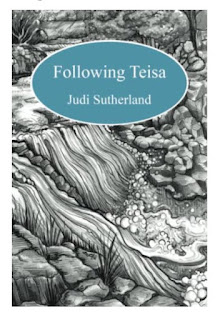
Review by Sally Evans of "Following Teisa" by Judi Sutherland


A powerful and confident poem that follows the River Tees from source in the Pennine moors to post-industrial Teesmouth on the north east coast, this is a perfect subject for Judi Sutherland’s abilities, with its exposition of largely unknown terrain, its clarity, smooth diction and scholarship. An almost unknown 1778 poem by Anne Wilson, Teisa, a descriptive poem of the River Teese, along the same lines, is its partial inspiration, acknowledged by including the original decorative title page of Teisa. Its other inspiration is the river. 

The poet’s sympathy for the river, her curiosity about its landscape. towns and foibles, give the book an objectivity which some current poetry lacks. Here’s the Roll, a wave or bore:

              A yellow wall; 
        another river, riding bareback
        on the first; like the shovel of a great digger
        ploughing branches and boughs
        and the bodies of feckless yows
        before it.

She turns history and folk history into poetry:

  At Croft, Durham loops leisurely
  south into White Rose territory
  and on this bridge, a delegation waits
  to welcome each new Prince Bishop
  taking possession of his estates,
  presenting His Grace with the Conyers Falchion
  the great sword that slew the Sockburn worm
  who lurked within the river’s next smooth turn.

On the poem runs until it reaches the sea:

This poem is ninety miles long
  and this is where it ends: the river 
  empties itself into infinite sea
….
One day these droplets will coalesce,
  slip their airy moorings
  touch the Pennines, sail the Tees again.

Judi Sutherland’s language is not northern. This adds to the freshness of discovery of this little-known part of England for some readers. Pen and ink drawings by Holly Magdalene Scott complete the presentation. It’s not just my own memories of the Tees in the quiet 1950s that attracts me to this work; there is a sense of a sympathetic intelligence following the river with a completeness only previously offered by Anne Wilson, whom Judi Sutherland honourably acknowledges.


About the reviewer
Sally Evans, retired Editor of Poetry Scotland, is in the later stages of a PhD in Creative Writing at Lancaster University. The resultant book, Wildgoose: A Tale of Two Poets, is published by Red Squirrel Press.

You can read a review of Wildgoose on Everybody's Reviewing here

Thursday, 30 December 2021

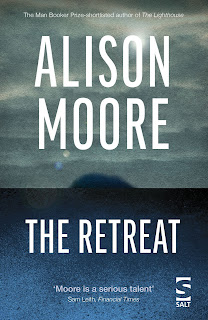
Review by Sally Evans of "The Retreat" by Alison Moore


A well-written novel evocative of the imaginary Mediterranean island at its core, I found the story a little difficult to unpack, in that there are two parallel narratives of two different young women visiting the tiny island, one to attend an artists’ retreat, the other to write a novel. The first one introduced is Sandra, whose reality pervades the main story. She is a dithering would-be artist and photographer who pursues a lone quest among the other people on the retreat, who gang up against her and ostracise her, none of them appearing very capable in their own work. Scenes show squabbling over the food, music and entertainment in the house of an evening, while Sandra makes solitary expeditions round the island in daylight. The house has a ghost which never fully reveals itself, as nothing is fully revealed. There's a transience to this story, as Sandra futilely tries to fit in where she cannot.

Carol, the other protagonist, is going to write a novel. I at first guessed that Sandra’s story was the novel Carol was writing, set on the same island to which she was returning, with more of the history of the island and a smaller offshore isle, which Sandra, at the end of her story, tries to reach. There has been a death, we assume Sandra’s, when Carol arrives at the smaller island at the end of the book. 

The novel is about the attraction of place and the desire to record its beauty, whether in writing or art, and about the incompleteness of short associations with place. The boatman, who takes supplies and post to the island, although shadowy, is the only character truly connected to the place. 

I ended with the feeling I ought to know more about Carol. She is introduced in the future tense narrative, telling where she is going, and what she wants to do, then she is shown gradually approaching the island. Both story strands are mainly told in the present tense, apparently simultaneous until Carol reaches the smaller island at the end of Sandra’s adventure. There’s a lot of atmosphere, detail and almost teasing about the plot, a not-quite-stated ghost narrative about a silent film star, who once lived there.  It’s a novel where the work of reaching conclusions is left to the reader. Sandra is beaten; Carol departs in haste, but the long-gone film star remains silent.


About the reviewer
Sally Evans is a bookseller and poet. Her books include The Bees (2008) and Poetic Adventures in Scotland (2014), both from Diehard publishers. She edited Poetry Scotland for 20 years, and is currently studying for a PhD at Lancaster University. Her novel Wildgoose: A Tale of Two Poets was published by Red Squirrel Press in 2021. You can read a review of it on Everybody's Reviewing here


Monday, 7 June 2021

Review by Jonathan Wilkins of "Wildgoose: A Tale of Two Poets" by Sally Evans


A beautifully crafted book so lyrical 
and 
heartbreakingly 
true to what is our
life.
          Relationships and jealousies.
An untold 
rivalry between two 
who could just as easily work 
as one. 
A talent
Unfulfilled?
Perhaps.
Perhaps not.
Motherhood.
                     Childhood.
Sisterhood. 
Love and loss 
a lost love?
Or rather 
                              a love always drifting 
away
just out of
                              touch. 
Contentment sadness 
loneliness challenges 
a talent unseen 
hidden or lost 
a world 
open to all
but closed to so
                    many.
An un
put
downable
book.
288 pages of wondrous poetry
and passion.
Melodic in its
word 
                              play.
A lilting account
of two
unbreakable
                              soul mates in
poetry.
Of
                    poetry.
A talent to deceive.
A talent to yearn for. 
A life so giving.
You have 
                              to read
Wildgoose
By
                              Sally
                              Evans.


About the reviewer
Jonathan Wilkins is a Creative Writing PhD Student at Aberystwyth University, Wales, reading mostly Golden Age Crime fiction. His website is here

Monday, 29 March 2021

Review by Sally Evans of "Upturned Earth" by Karen Jennings


A men’s book written by a woman, this historical novel about late-nineteenth-century mining conditions in a South African township is a thoroughly researched and detailed portrayal of a community of poverty-stricken workers dependent on mine work for a living. It cleverly keeps the workers in view, using a few middle-men with various degrees of conscience to hold the story together. 

Blindly overseeing rough justice, Hull, the new magistrate, deals with fights and spats in the corrupt society. He comes across the boy Noki whose brother has been arrested and disappears. Noki’s search for his brother holds the timeline of the story, until the inevitable mine disaster in which Noki is one of the few to survive. The incompetent Hull faces up to his shortcomings, leaving his amateur natural history studies to warn the sympathetic rich mine owner’s daughter away as she tries to intervene in a workers' strike on behalf of her absent father. Their incipient romance is torn apart as she is sent home with her jars of homemade jam intended to feed the starving. Her father, brought back from the comfort of Johannesburg, sends his daughter back to England and deals with the strike in the only way he knows, with soldiers and a massacre. There are strong male characters among both workers and controllers, but mostly the women come packaged as ‘women and children’ or are otherwise drunk and in despair. 

The acceptance of rough and ready life, dangerous sea transport, lack of education and comforts, poor communications and uncheckced wickedness, give this world a grim reality. We come to believe in the boy Noki, the Cornishman Tregowning, and the motley nature of this mining community. Sympathising with Noki and to some extent with Hull, the reader is drawn into the unfolding disastrous story to make a racy and unusual novel. 

It is always difficult to guess how individuals would respond to historical conditions. What knowledge can we have of people’s feelings in such times?  A novel such as Upturned Earth fills the gaps in historical records with imagination and informed guesswork. We are shown the responses both of the workers caught up this situation and their overseers, as these men rationalise the harsh world they are helping to maintain.

There isn’t room for more women in this book. The kindly but immature Iris – Hull uses her first name but once – is sent back to England. Jam making, and looking after her young privileged son, are all she is fit for. Was it absence of power among women that made those worlds so harsh? Was it an acceptance that mining was necessarily inhuman?

This book enlivens history, the purpose of historical fiction, and looks critically at an actual industry, which is something that can be done better in fiction than in reports. A nicely produced book and a worthwhile read. 


About the reviewer
Sally Evans is a bookseller and poet.Her books include The Bees (2008) and Poetic Adventures in Scotland (2014), both from Diehard publishers. She edited Poetry Scotland for 20 years, and is currently studying for a PhD at Lancaster University. Her novel Wildgoose: A Tale of Two Poets is due out from Red Squirrel's Postbox Press soon.