Showing posts with label Salt. Show all posts

Saturday, 18 January 2025

Review by Jonathan Wilkins of "Lie of the Land" by Kerry Hadley-Pryce


The Black Country. Dark, foreboding  gloom-ridden. Lie of the Land is exactly the same: dark, foreboding with an aura of gloom and added tension as our main protagonist, Jemma, is faced with ever-increasing anxiety as she makes major life changes that have unforeseen consequences for herself and those around her. She had what seemed the perfect life but after what she thought would be a one night stand she is sucked into a relationship which has tragic consequences and tilts her balanced lifestyle. 

After an incredibly short relationship and against all her own misgivings, Jemma moves with Rory into a dilapidated house with ‘prospects’ so she is told, and endures a shocking nightmare event which the end of the novel contends with. The event is so unbelievable that it tilts her world from its axis as she faces life-changing dramas as she is pulled from normality into a world and life not of her choosing. There are so many strands to this novel. Does Jemma fall for Catherine her neighbour? What will happen to Rory as he is seduced into the orbit of Ed her husband? What happened to Amber, is it all a dream? Will Kaitlin prove to be a friend and to whom, Jemma or Rory? Just what happened to the missing child? Who or what is the lie of the land? Will Rory’s former fiancée Sophie ever recover? Exactly why did Jemma visit her in hospital? She doesn’t seem to be one who is clouded by guilt, but the nervous tension of her relationship with Rory and her ambivalent feelings towards him seem to push her into situations that she does not want to be involved in. She is yanked, almost kicking and screaming, into a world that is everything she doesn’t want and cannot escape. Is this the lie of the land, the bleak and threatening Black Country fugue?

All these questions remain unanswered. We are kept thinking, we are involved in the story and need to make a commitment to it. Throughout the tension that builds up is tangible. We feel every emotion alongside Jemma and care about her which is no small thing as she started off as quite an unattractive character. Hadley-Pryce writes and describes her world with consummate ease as she draws us into a nightmarish domain where reality and threat merge and Jemma cannot see what is real and what is illusory. Just what is it that wakes her at night? Who or what is making the sounds that invade her mind? What is the unseen threat to her happiness? Does her guilt shape her world, her truth? This is a fine example of a story with so many layers and themes, that we are compelled to read on - a story of a woman whose mind is teetering on the edge of fracture, a story that leaves us wanting more.


About the reviewer
Jonathan Wilkins is 69. He is married to the gorgeous Annie with two wonderful sons. He was a teacher for twenty years, a Waterstones’ bookseller and coached women’s basketball for over thirty years before taking up writing seriously. Nowadays he takes notes for students with Special Needs at Leicester and Warwick Universities. He has had a work commissioned by the UK Arts Council and several pieces published traditionally as well as on-line. He has had poems in magazines and anthologies, art galleries, studios, museums and at Huddersfield Railway Station. He loves writing poetry. For his MA, he wrote a crime novel, Utrecht Snow. He followed it up with Utrecht Rain, and is now writing a third part. He is currently writing a crime series, Poppy Knows Best, set at the end of the Great War and into the early 1920s.

You can read more about Lie of the Land by Kerry Hadley-Pryce on Creative Writing at Leicester here

Sunday, 8 September 2024

Review by Omar Sabbagh of "My Hummingbird Father" by Pascale Petit


In the later 1930s Ford Madox Ford was asked by one of his writing students, Robert Lowell, what the one essential need was for an aspiring writer. Ford said: "Memory." Oscar Wilde is famed for averring that life copies art, not the other way round. Both these insights are lived-out and lived-up-to in acclaimed poet Pascale Petit’s first novel, My Hummingbird Father.  

This is the story of the main protagonist, Dominique, a painter, and a story about the value of the imagination and its glorious inheritance. A story about how art redresses and redeems the seemingly insuperable vulnerabilities of being human. Indeed, to start: Chapter 29 of this compelling, moving book is titled "Two Dominiques," and my discussion centres on this doubleness, what Dominique thinks of at one point in the novel as "double exposure." 

In the "Prologue" we start with the "forest of perpetual childhood," "painting animals none have seen." Indeed, Petit as a poet is very well-known as a writer giving life and signifying sentience to the lives of and in the natural world, the rich and feral world of her good, longstanding wilderness. In this book, though we travel, transformatively, between her heroine, Dominique’s self-professed "blank childhood," her thinking of herself as having "died at six," her "forest of sleeping birds," "memories never to be remembered," and her later reconciliation with that fraught past. For she was also the girl through these traumas with "a crayon always in her hand," with a body that as this story fleshes out, "remembers her childhood," bodily (aesthetically), a woman for whom life itself comes through her canvases, "hungry for the truth."  And "hunger" is deeply apposite, in so far as it’s used both literally and figuratively in this novel, a novel replete with a rich and kaleidoscopic array of flora and fauna that act as both vehicles and tenors for how the tale is told. In short, this story is an adventure and a homecoming. A bad wilderness (Dominique’s harsh childhood) is exchanged through the process of daring to love again with a good one: she is loved and loving again in the Amazonian wilderness of the book’s final part, its "Epilogue."    

Architectonic aside, the lifegiving doubleness of this tale is also apparent in its style, a style much like the (mythopoetic) "rites" of passage of the Pemón people she visits in Venezuela, in her visits to the Amazonian wilderness. For instance, "Juan," her Amazonian guide, future lover, and future replacement for her now-dead father, can speak of his people dubbing rain "saliva of the stars," and (one of innumerable examples) Dominique can see her dying, breathless father later in the Amazonian trees, "a forest holding in its breath." The sensibility of the heroine (and/or her narrator) of this tale is oceanic, meaning all the elements of felt life, wild and tame and in between, interpenetrate continuously in its telling. The literal riches of wildlife described and descried also stand for and inhabit different metaphorical levels in the novel. This gesture of (freely) translating at least two levels of world is enacted on nearly every page: the Pemón speak of the "sky-forest" and the plain one, the "spirit world" and the "visible" one (like left and right hands), and via flashbacks and instinctual moves of involuntary memory, Dominique and her guiding narrator shuttlecock between literal, contemporary worlds and mythic and spiritual or imaginative ones, rendering this book in toto a paean to the empowering freedom of the imagination, epiphanic, transformative.  

Though hated by her (now-dead) mother, having a fractious relationship with her sister, Vero, bullied at school, near-suicidal later, Dominique’s primary antagonist is her father, whom she visits in the last few, dying years of his life, a man who had absconded from her childhood.  The "grey" Paris (of her childhood) Dominique visits is soon to be animated with colour, though, as much as the Notre-Dame she visits (which becomes "a new zoo") repeatedly, becomes a parallel of her Venezuelan wilderness. Two poles, again, but two welded in the end as one.

Her father is her hummingbird father. Another doubleness symbolizes here, too: the hummingbirds, we read, "pierce time itself." There are the cared-for hummingbirds (37 of them, Dominique’s age) of the ornithologist Augusto Ruschi and the deadened, heartless ones she finds among her father’s remains. Her father (abused in childhood, as Dominique was herself) represents the dead-end of temporality, a vicious cycle and re-cycling of immanent abuse – Dominique’s father averring at one point (ashamed) that one cannot change the past. The better hummingbirds represent the way that art and imagination can use the past as an opportunity for the future, redressing the beeline of mortality.

The overall imaginative vision behind this rich and compelling tale is both a concrete journey of transformation and, through the riches of its lucid, dramatic, highly evocative telling, an allegory about what art is for. The wilderness of our wounds and suffering can be transcended by the loving care of the imagination – not as escape, but as the distiller and giver of the essence of flourishing human well-being.


About the reviewer
Omar Sabbagh is a widely published poet, writer and critic.  His latest books are Y Knots: Short Fictions and For Echo (Cinnamon Press 2023 & 2024). Currently he teaches at the Lebanese American University (LAU).

You can read more about My Hummingbird Father by Pascale Petit on Creative Writing at Leicester here

Saturday, 9 September 2023

Review by Christine Hammond of "The Night Jar" by Louise Peterkin


The cover art of Louise Peterkin’s The Night Jar sets the tone for a collection that is stylish and understated, yet beautifully theatrical. 

Be prepared for the poems to take you on a Carroll-esque transport of delights. Like Alice, you’ll experience a colourful cast, often led by women appearing to  inhabit the interstices of fantasy and reality. Yet somehow, no matter where the dramas are played out, they remain elegantly embedded in the relatable, ordinary script and emotional spectrum of our daily lives. Lives that include love, faith, relationship ennui, sexuality, freedom, joy, disappointment, longing, ambition, loss and escape from routine oppression. 

In a four-episode vignette we are introduced to the adventures of a recalcitrant nun in "Sister Agnieska Runs Away to the Circus." Here, the Big Top is described as a "yummy mirage" and early on the skilful use of tense and double entendre convey the poem's "fallen" theme: 

          … the twirling, the leaping and the curving
          for the love of God, the love 
          of the falling …

          … You know now balance 
          is an act of sheer faith.

"Snake" is both visceral and anthropomorphic. It articulates the ending of a relationship, carefully planned and executed:

          No one suspected I could be so snakey..
          ... I was long gone.
          My skin like hosiery on the floor

The motif is extended with "snakey" witticisms and a well-placed dramatic exclamation:

          I nudged to the East with panache …

          ... there were clues …

          sodden shirts twisting 
          round my arm like a bracelet
          the spiced tomb of the laundry basket.

The bird image in the final verse is both delicate and self-contained, with a Haiku resonance that only adds to the sensory experience: 

         How lithe I am I have wriggled free!
         I hiss like Peter Lorre. A small bird
         fizzes like seltzer inside me. 

Peterkin’s debut is a fine piece of work. Intelligent and exquisitely crafted, the poems are highly visual and immersive. Reading them will leave you satiated, yet still looking forward to the next production. 


About the reviewer
Christine Hammond began writing poetry whilst studying English at Queen’s University, Belfast. Her early poems were published in The Gown (QUB), The Female Line (NIWRM) and Women’s News where, as one of the original members, she also wrote Arts Reviews and had work published in Spare Rib. She returned to writing again after a long absence and her poetry has been featured in a variety of anthologies including The Poet’s Place and Movement (Poetry in Motion – The Community Arts Partnership), The Sea (Rebel Poetry Ireland), all three editions of Washing Windows and Her Other Language (Arlen House). She has also been a reader at Purely Poetry - Open Mic Night, Belfast.


You can read more about The Night Jar by Louise Peterkin on Creative Writing at Leicester here

Monday, 26 June 2023

Review by Paul Taylor-McCartney of "Connective Tissue" by Jane Fraser


The short story form has received a lot of renewed interest of late, with many attributing this to our shortening attention spans, the form’s capacity for allowing authors to take stylistic risks, or the fact we can more readily squeeze a short story in and around our increasingly hectic lives. Whatever the reason, it’s encouraging that publishers – including industry heavyweights and small independents alike - are investing in it like never before. 

Jane Fraser’s Connective Tissue is a moving, thoughtful and considered collection that deftly explores what it means to be connected to others, or rather, how our disconnectedness from a shared reality can lead to a greater understanding of self. At the centre of many of the stories, are individuals who are dealing with the aftermath of some personal loss, change to their circumstances or who long to assign some greater value or meaning to their lives.

In one of the collection’s highlights, ‘After a certain age you can either have good shoes or good feet,’ a widow speaks directly to her departed husband, and hence keeps the memory of him alive: ‘You place your hand on my arm. It feels icy just as I expected a spirit would.’ The couple take to the garden lawn as if it were a dancefloor, the narrator enjoying a moment of unbridled happiness, amid so much grief. Other standout stories include ‘Connective Tissue,’ ‘Anti-clockwise on the Circle Line,’ ‘Crow’ and ‘Plenty of time, Jane,’ all of which feature strong women dealing with extreme changes in their personal fortunes. Yet it is in ‘Words,’ where Fraser’s mastery of the form is most apparent: the playful first-person narrative turns more confessional and intimate, bristling with incidental and sensory detail: ‘And that’s when I saw her, looking at me from the mirror … I sat on the edge of the bed and stretched out my hands, fingertip to fingertip with the girl in the glass.’

At times, these stories seemed so tantalisingly short I wanted Fraser to develop them further; they have the type of brevity that left me wanting more as a reader. Or maybe that is the author’s point: people drift in and out of one another’s lives, and this experience is shared both by the reader and Fraser’s cast of well-drawn and recognisable characters, each of her creations edging forward into the light to impart some nugget of advice. Fraser’s skill is considerable in that she not only persuades the reader to listen with interest, but more closely.    

About the reviewer
Dr. Paul Taylor-McCartney is an author, researcher and lecturer, with interests in dystopian studies, children’s literature and initial teacher education. His poetry, short fiction and academic articles have appeared in a range of notable UK and international publications including Aesthetica, The Birmingham Journal of Language and Literature, Writing in Practice (National Association of Writers in Education), Intima: A Journal of Narrative Medicine and Dyst: A literary Journal. He lives and works in Cornwall. You can find out more about him and his work by visiting his website here

You can read more about Connective Tissue by Jane Fraser on Creative Writing at Leicester here.  


Thursday, 30 December 2021

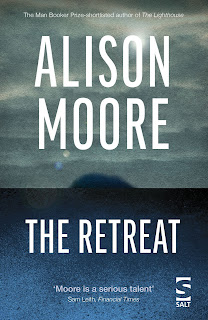
Review by Sally Evans of "The Retreat" by Alison Moore


A well-written novel evocative of the imaginary Mediterranean island at its core, I found the story a little difficult to unpack, in that there are two parallel narratives of two different young women visiting the tiny island, one to attend an artists’ retreat, the other to write a novel. The first one introduced is Sandra, whose reality pervades the main story. She is a dithering would-be artist and photographer who pursues a lone quest among the other people on the retreat, who gang up against her and ostracise her, none of them appearing very capable in their own work. Scenes show squabbling over the food, music and entertainment in the house of an evening, while Sandra makes solitary expeditions round the island in daylight. The house has a ghost which never fully reveals itself, as nothing is fully revealed. There's a transience to this story, as Sandra futilely tries to fit in where she cannot.

Carol, the other protagonist, is going to write a novel. I at first guessed that Sandra’s story was the novel Carol was writing, set on the same island to which she was returning, with more of the history of the island and a smaller offshore isle, which Sandra, at the end of her story, tries to reach. There has been a death, we assume Sandra’s, when Carol arrives at the smaller island at the end of the book. 

The novel is about the attraction of place and the desire to record its beauty, whether in writing or art, and about the incompleteness of short associations with place. The boatman, who takes supplies and post to the island, although shadowy, is the only character truly connected to the place. 

I ended with the feeling I ought to know more about Carol. She is introduced in the future tense narrative, telling where she is going, and what she wants to do, then she is shown gradually approaching the island. Both story strands are mainly told in the present tense, apparently simultaneous until Carol reaches the smaller island at the end of Sandra’s adventure. There’s a lot of atmosphere, detail and almost teasing about the plot, a not-quite-stated ghost narrative about a silent film star, who once lived there.  It’s a novel where the work of reaching conclusions is left to the reader. Sandra is beaten; Carol departs in haste, but the long-gone film star remains silent.


About the reviewer
Sally Evans is a bookseller and poet. Her books include The Bees (2008) and Poetic Adventures in Scotland (2014), both from Diehard publishers. She edited Poetry Scotland for 20 years, and is currently studying for a PhD at Lancaster University. Her novel Wildgoose: A Tale of Two Poets was published by Red Squirrel Press in 2021. You can read a review of it on Everybody's Reviewing here


Saturday, 24 July 2021

Review by Neil Fulwood of "Fox Fires" by Wyl Menmuir


Get past the title and YA-style cover design, both of which seem curiously at odds with the novel’s tone and literary aesthetic, get past a slightly awkward first chapter, and Menmuir’s sophomore outing develops into a fascinating study of the interrelationship between cityscape and mindscape through which glimpses of Iain Banks, Haruki Murakami and perhaps even an afterimage of Stefan Zweig can be discerned.

In an imaginative conceit every bit as good as that which powers China Mieville’s The City and the City, Fox Fires is set in a city-state called simply O, its borders recently opened to the outside world, where maps are forbidden and the streets unnamed (the better, apparently, to confuse would-be invaders, though how the absence of signs is a deterrent to enemy tanks or ground troops is left unexplained). Allegorically, this concept is fantastic and Menmuir is at his best when he weaves his claustrophobic world-building around it (O is subject to curfews, its citizens spy on each other, strange propagandist posters appear and disappear randomly).

When Fox Fires works, it works well - particularly in regard to its mysterious narrator - while its heroine is beautifully nuanced and as memorable a protagonist as you could want. The most effective scenes achieve the dream-like unreality of an art house movie (indeed, it would be interesting to see a director with a European sensitivity take it up as a project).

At 188 pages, it doesn’t outstay its welcome, and with the exception of a few dialogue passages which suffer from being aphoristic rather than organic the writing is controlled, evocative and intelligent. I’d certainly recommend it as an intriguing work by a developing talent, though I did wonder if it was just a couple more drafts away from being truly great.


About the reviewer

Neil Fulwood lives and works in Nottingham. He has published two full poetry collections with Shoestring Press, No Avoiding It and Can’t Take Me Anywhere; his third, Service Cancelled, will be released on 29th July 2021.

You can read more about Neil's work and his collection Can't Take Me Anywhere on Creative Writing at Leicester here

You can read more about Wyl Menmuir's Fox Fires, and listen to a special reading of the opening scene from the novel on Creative Writing at Leicester here


Friday, 19 February 2021

Review by Paul Taylor-McCartney of "Like Fado and Other Stories" by Graham Mort


Graham Mort’s latest short story collection, Like Fado, is a wonderfully engaging read. The thirteen stories are standalones, but they share thematic and textual traits that bind them into a single whole. 

'Fado' is a dance that can be traced back to Portugal of the nineteenth century, but also derives from the Latin term ‘fatum’ – fate, death or a final utterance. Both definitions apply to the stories here. At times, the prose moves with the musicality and rhythms of a dance but there is also a mournful, almost elegiac mood to each piece as the protagonists do their best to overcome various sorts of existential crises.

The photographer in the title story, 'Like Fado,' wanders the Lisbon streets, keen to put his wife’s extra-marital affair out of his mind. He is drawn to the tiny details of everyday life – that is, until he is asked by a local girl to take a picture of her mother’s final hours. 'The old woman,' Mort writes, 'was beautiful in the way that only the very old and the very young can be, her skin exquisitely creased, her irises and pupils dark, merging to the point of invisibility.' In many ways, Mort behaves like his photographer, dipping in and out of the lives of the characters he’s created. His astute eye falls on singular moments in time, then magnifies each one, with denouements masterfully executed. There are no weak entries in this incredible collection, but for this reviewer standouts include the aforementioned 'Like Fado,' 'Shoo,' 'Olivia' and 'Whitehorn' - novella-like in its scope, and a profoundly moving portrait of guilt arising from a childhood mishap. 

I was new to Mort’s work before reading this collection, and this has certainly left me wanting to read more. 


About the reviewer
Paul Taylor-McCartney is a doctoral researcher with Leicester University, following a part-time PhD in Creative Writing. His research interests include dystopian studies, narratology and initial teacher education. His poetry, short fiction and academic articles have appeared in a range of notable UK and international publications including Aesthetica, The Birmingham Journal of Language and Literature, Education in Practice (National Association of Writers in Education), Intima: A Journal of Narrative Medicine and Dyst: A Literary Journal. He lives and works in Cornwall. You can read more about him here.


Tuesday, 26 January 2021

Review by Nakisha Towers of "Astral Travel" by Elizabeth Baines


Astral Travel by Elizabeth Baines is a metafictional novel that follows Jo, a writer, who, years after his death, is hit by an unexpected urge to write about her father and the effects of his abuse during her childhood - remnants of which still continue in the lives of his adult daughters.

Framing the narrative is a familiar process of writing and storytelling. Through this process, Jo attempts to understand her father and the many mysteries surrounding his tumultuous and often troubled life. As a result, the book is a weaving together of a life through memories, vague stories and imagination – a tool Jo uses to fill in the gaps of missing or reluctantly provided information. 

Placing her father, posthumously, into the moments of her childhood that she remembers – or thinks she does - Jo tries to re-imagine or even recreate her father’s reaction; forcing him - in death - to confront the torment she experiences as a child. Instead, she is often faced with a deepening sense of the mystery she is attempting to resolve. She's unhelped by her submissive mother, who, in denial, has a stoic unwillingness to face reality.

Baines’s ability to evoke internal outrage and frustration through prose, that is sometimes brutal but always beautiful, is a skill that works so naturally on the page. With her narrator, we re-live painful and disturbing memories of childhood. We feel rage at the injustice she suffered at the hands of both parents. Readers who have had a difficult relationship with a parent may well find themselves re-living their own experiences too. Such is the power of her prose.

The story, that reads more like a fictional autobiography than a novel, is comfortable leaving loose ends; a reminder that, although Jo’s mother does eventually reveal a deep family secret which goes a little way to providing an explanation for her father’s all-consuming rage, real life cannot be tied up in a comfortable, bow-like conclusion.


About the reviewer
Nakisha Towers studied a Creative Writing Masters at the University of Leicester. In between navigating parenting and home-schooling, she likes to write poetry. She is currently re-working a collection of poetry she wrote for her MA dissertation about maternal mental health.

Friday, 22 January 2021

Review by Jon Wilkins of "Entertaining Strangers" by Jonathan Taylor


It’s a match made in heaven. As the blurb at the back says if you are interested in impossible relationships with a landlady, a neurotic mother, a psychotic brother, a domineering ex-wife, a dead grandfather and an ant-farm, then this book is perfect for me. Added to that another protagonist who has dreams of a great fire, a massacre and one girl's drowning in Smyrna, seventy-five years earlier, what isn’t there to like? And that’s just the back cover!

It ticks all the boxes:


About the reviewer
Jon Wilkins is sixty-five. He has a gorgeous wife Annie and two beautiful sons, and loves to write. He is a retired teacher, lapsed Waterstones’ bookseller and former Basketball Coach. He taught PE and English for twenty years and coached women’s basketball for over thirty years.  He has always loved books and reading. You can read a review of Jon's recent novel, Poppy Flowers at the Front, here. His website is here

Tuesday, 22 December 2020

Review by Charlie Hill of "Gamble" by Kerry Hadley-Pryce


Towards the end of Gamble, the excellent second novel from Black Country writer Kerry Hadley-Pryce, the eponymous lead character brings to mind – inaccurately – the opening line of a poem by Louis Macneice. The line is: ‘Time was away and somewhere else’ and it is this sense of temporal respite that Gamble is fondly (desperately?) imagining he can conjure from an extra-marital dalliance.

He’s wrong of course. Because there’s no respite here, temporal or otherwise, at least not until the very last line of the book (and that is less than convincing). Instead, delivered in prose that is as unsentimental and spare as it is affecting, Gamble is subjected to a relentless psychic-beat down as he scrabbles to escape the consequences of past behaviours.

It's a gripping, urgent read. Its depiction of a man left out of his depth by fatherhood and ill-health, and the distance between who he is and what he’d like to be, reminded me a little of a novel called Kids Stuff by Henry Sutton. What Hadley-Pryce does particularly well – and this is where Gamble echoes her equally accomplished debut, The Black Country – is depict the compromises and delusions of an airless marriage. That and the menace of the setting, of course. Here this includes the Stourbridge canal: 'If you look at the canal, it’s like looking at some people, you can tell there is a darkness trembling just beneath the surface there, being suppressed. There is a sense of complication. There’s nothing benign about them. Gamble, for example, fears what he does not yet know, and his anxiety escapes in wefts. He has a fair amount of insight into himself, he’ll say. Yet he’ll admit that facing the truth of it isn’t easy. It is mostly the insight that’s the issue, actually, because when you suspect, when you think you know something – some darkness or other might be shifting about inside you – but you try to ignore it, or replace it, or overlay it with other thoughts, other actions, then you’re asking for trouble, aren’t you?’


About the reviewer
Charlie Hill is a writer from Birmingham. His latest book is a memoir, I Don't Want to Go to the Taj Mahal, which is out now from Repeater Books. You can read a review of I Don't Want to Go to the Taj Mahal on Everybody's Reviewing here

Tuesday, 17 April 2018

Interview with Alison Moore


Alison Moore's first novel, The Lighthouse, was shortlisted for the Man Booker Prize and the National Book Awards (New Writer of the Year), winning the McKitterick Prize. Both The Lighthouse and her second novel, He Wants, were Observer Books of the Year. Her short fiction has been included in Best British Short Stories and Best British Horror anthologies, broadcast on BBC Radio 4 Extra and collected in The Pre-War House and Other Stories. She published her third novel, Death and the Seaside in 2016 and latest novel, Missing, will be published on the 15th May 2018. Born in Manchester in 1971, she lives near Nottingham with her husband Dan and son Arthur.


Interviewed by Lee Wright

In April 2016 I enrolled on a five-week course titled "Elements of Fiction," taught by the 2012 Man-Booker Prize short-listed author Alison Moore. It was the first time I had ever been in a creative writing environment, and Alison was the first “real” writer I had met. 

I was in a state of awe for the first two weeks. I read her two novels, The Lighthouse and He Wants, back-to-back. I couldn’t read them fast enough. Then, by the third week, I began to calm down. I listened, I took in every element, style and approach Alison spoke to us about. 

One week she asked us to write a short story, gave everyone the same starting point, and expected us to read the piece out the following week. At this time, I had never tried the short story form, but with the challenge thrown down, I bought a copy of Raymond Carver’s What We Talk About, When We Talk About Love

So, I wrote my story with Alison’s advice and Carver’s clipped style rolling around in my head. I read it out that next week (I had never read my work out aloud to anyone before, and for those reading this who find themselves in a similar position now, I can only sympathise). From what I remember, the story was heavy and far from perfect, but the comments that followed acted as a springboard. I went home and wrote another one, and another, and another. 

Eventually I began to have a small slice of success, and my fiction continues to be published. There is no doubt that Alison Moore’s course was the turning point for me. Those five weeks in 2016 I won’t forget.          


LW: You made the leap from writing short stories to novels with The Lighthouse in 2012. What difficulties (if any) did you encounter during the process of working on a longer project?

AM: In between the short stories and The Lighthouse, I wrote a 12,000-word story, which went on to win a novella competition and became the title story in my collection The Pre-War House and Other Stories but which was a struggle to write. That’s partly because I was writing due to having an unexpected free month (in between working full-time and having a baby) as opposed to having a specific story I was keen to write, but also because I was tackling a story that went beyond the kind of size I could see all at once, so I was navigating the story with no sense of what was coming. Now, that’s the best bit: writing into the darkness, not knowing what I might find.

LW: Do you find the short novel form more agreeable?

AM: I naturally seem to write short novels, all under 50,000 words so far, which might be due to my short-story writing background. Perhaps whatever draws me to writing short stories, and indeed that novelette/novella length which I love, also makes short novels sit well with me as a writer. As a reader, I enjoy plenty of long novels too – right now I’m reading the 900-page Blonde by Joyce Carol Oates.

LW: You’ve published a contemporary novel every two-years since 2012. Yet you don’t write to a formula (like authors in genres such as crime). How have you stayed so prolific?

AM: That time frame feels about right to me – if I gave myself too much longer I think I’d start to doubt and unpick the whole thing. So, I aim to draft a novel in about a year, and once I start it I live with it, so I avoid the difficulty of coming back to a project that’s cooled off since I last looked at it. I work with one eye on that two-year cycle which seems to work but which is entirely flexible if necessary.

LW: Have you matured as a writer?

AM: I’ve certainly developed better habits. Many moons ago I would merrily jot down a story idea on a slip of paper and then just stash it, never developing it; I had dozens of these slips of paper which never became stories. I also had to get better at reading and editing my own work. It’s second nature now, to take that starting point and just write, to see where it leads me, and then, when I have a first draft, to edit the hell out of it.

LW: Do you need a title before you begin a work of fiction?

AM: Yes, I like to have a title as I begin a piece of work, knowing that I can always change it later, once I know the story better.

LW: Since its publication, The Lighthouse has been translated into many different languages.   Did you work with the various translators and how has the experience been for you?   

AM: It’s been very interesting to see how different translators work. Sometimes I’m sent queries throughout a translation, sometimes I get a list of questions at the end of the process, and sometimes there is no communication at all. It’s quite odd knowing that I’ll never know quite how a translation reads. In fact, my new novel Missing is concerned with a translator and the importance of the language we choose.


LW: This November also brings the publication of your debut children’s book, Sunny and the Ghosts. What made you decide to try your hand at children’s fiction?  

AM: Just as reading fiction when I was growing up made me want to write, so reading fiction with my son made me want to write something for his age range, which was 7 at the time. Having started to think along those lines, the basic idea came along quite quickly, and once I’d drafted the story I read it to my son, who gave me really useful feedback.


LW: What was the genesis for your new novel Missing?  

AM: I have a very early note along the lines that someone suddenly, quietly, almost in passing, slips out of life "e.g. going through ice." The specific has changed but that sense of quick and quiet loss is a key element in the finished novel. I was also more generally interested in boundaries, borders, crossing from one place to another, and whether someone who has left will or can come back.

LW: Which one book (from any author or genre) would you recommend for the aspiring writer to learn something from?

AM: I’ve usually got a novel, a short story collection and a non-fiction book on the go, and my current non-fiction is John Yorke’s Into the Woods which discusses the nature of a wide range of works of fiction. I nose my way through my novels without planning, and when I came across Yorke’s idea of the midpoint ("Occurring almost exactly halfway through any successful story, the midpoint is the moment something profoundly significant occurs ... there can be no return to how life was before ... Do writers who are entirely unaware of story theory write them subconsciously?"). I took a look at my novels and found that at the midpoint of The Lighthouse, Futh "has passed the midpoint of his circular walk" and is heading back to Hellhaus; and, immediately afterwards, we have the scene on the cliffs in which his mother says she’s leaving, which is essentially the catalyst for everything that follows. I’ve found similar midpoints in all my other novels too. For someone who has never formally studied creative writing, it’s a fascinating read.


About the interviewer

Lee Wright was born in Nuneaton, Warwickshire in 1980 and has been writing both fiction and non-fiction since 2008. He is taking an MA in Creative Writing at the University of Leicester.

Sunday, 21 February 2016

Review by Jonathan Taylor of "The Black Country" by Kerry Hadley-Pryce


In Kerry Hadley-Pryce's disturbing and remarkable novel, The Black Country, everything is relative: all facts, all actions, all truths are relative to their observers. Everything is in the conditional tense, in quotation marks; and all the overlapping and conflicting narratives are no more than subjective testimonies, a matter of "he says" or "she says." All the characters are telling their own truths and half-truths and lies: when Maddie tries to tell her husband Harry about the past "it might have sounded true," even though there were "some bits she'd edit out"; and when Harry tries in turn to tell Maddie about his crime, "he'd got it, all of it, all the words he was ready to reveal, to uncloak. Some to hide, some to reveal." Words, explanations, narratives hide and reveal at the same time, making the novel a mass of semi-revelations and competing explanations, none of which quite explain, none of which quite uncloak the "whole" truth. All the characters involved are themselves, in a sense, pseudo-novelists, editing, reshaping, and failing to tell their stories.

Ultimately, The Black Country asks what "all this explanation on top of explanation" amounts to: "Do we really believe them?," asks the  first-person narrator towards the end. Do we really believe any of them - including the mysterious first-person narrator himself? The Black Country's answer is profound and unsettling; what the novel uncloaks above all is the terrifying darkness at the heart of relativism: layer after layer of provisional narratives are brought into question, peeled away, discarded, to reveal a still-darker narrative layer beneath. At the heart of it all this provisionality, this conditionality, this contingency is not the absolute truth that we might expect of a first-person narrator who seems to command all the other perspectives - but something terrifying, something very black indeed. 

About the reviewer
Jonathan Taylor is author of the novels Melissa (Salt, 2015), and Entertaining Strangers, and the memoir Take Me Home (Granta, 2007). His website is www.jonathanptaylor.co.uk

Saturday, 23 January 2016

Review by Tim Love of "Used to Be" by Elizabeth Baines


(This review was originally published here.)


The Mandaeans of southern Iraq had a demon called Dinanukht, half man and half book, who "sits by the waters between the worlds, reading himself". This demon could be the patron saint of Bainesland, where characters interpret symbols that seem to belong to the external world, but turn out being part of the character's past.

These 12 stories span a range of symbolic visibility. In the epistolic “A matter of light” set in May 1816, a self-proclaimed rational man dismisses strange events as interesting physical phenomena, tricks of the light worthy of investigation. Even when he entertains the possibility of ghosts, he dismisses the notion because he's lived too virtuous a life to deserve being haunted. But we learn he's a plantation owner and that his treatment of slaves wasn't perfect. The dark shadows and the “light” of the title take on racial overtones.

In “Looking for the Castle” the symbolism's more overt. A women takes a detour to visit her home town. She has problems navigating her past. Has so much really changed? Maybe the unfindable castle's really the misremembered priory. But what is she really seeking? Was her childhood a place where she felt safe, or was it a confinement that still restricts her? After all, the fence her father built is still there.

“Used To Be” includes another mindscape – two middle-aged sisters, actresses, are on their way to an amateur film-set. The journey of bridges and missed turnings becomes a metaphor ("And flashing past with the bridges are all my selves") then becomes another story to tell when they arrive late.

Further along the overtness spectrum is "Tides or How Stories Do or Don't Get Told". Fans of "show, not tell“ might balk at the 13 mentions of ”story“ or ”stories" and the discussion of narratives – e.g. "Would I mention my sense then that nothing had meaning and that my life after all was no story, or would I lie, since he recovered, and make those symbols fit a narrative arc with a happy ending?" - but to me it's like the stage magician who explains how a trick works only to surprise the audience later. What kind of story of herself does the narrator want to write?

The protagonists come in many varieties (male/female, young/old, presented in the first, second and third person), but they're all opening a debate with their past. Sometimes it's disowned - "I see her, my former self, as another person" - used as raw material to be melted down, reforged. Sometimes it illuminates the present. The settings encourage reinterpretations – film-sets, Brontë country, old haunts. Explicitly or otherwise, the characters are story-makers, reassembling their life-arc from stirred memories.

Whatever the uncertainty of the narrators, the characters are utterly believable. There's always the sensation of an underlying reality. Characters may exhibit enhanced free will once they've unshackled themselves from the past, but the real world is a given.

My favourites are “Used to be”, “Falling” and especially "Tides or How Stories Do or Don't Get Told" (which is much shorter than I recall it being). None of the stories are routine, which is no surprise given that they've all been published already in places like Carve Magazine, Unthology, Stand and Best British Short Stories. You can buy it directly from Salt.

About the reviewer
Tim Love’s publications are a poetry pamphlet Moving Parts (HappenStance, 2010) and a story collection By all means (Nine Arches Press, 2012). He lives in Cambridge, UK, teaching computing. His poetry and prose have appeared in Stand, Rialto, Oxford Poetry, Journal of Microliterature, Short Fiction, New Walk, etc. He blogs at http://litrefs.blogspot.com/.

Friday, 13 November 2015

Review by Hannah Stevens of "Used To Be" by Elizabeth Baines


Used To Be (published by Salt, 2015) is a collection packed with bursts of intense short stories, written in clean, sharp prose. The stories are immersive and gripping. I read this book in one sitting.

There is a breathlessness and urgency to the rhythms of this collection and stories are dark and full of damaged people. Most of the characters you will encounter on these pages don’t have names but in spite of this feel knowable: there are parts of me in these characters that I recognise.

The collection is punctuated with disturbing and dark description: in "Used To Be" – the title story – there is a "stomach flat as a teenage anorexic’s." In "That Turbulent Stillness" – "a hole was punched in the… day, and also her heart." In "Where The Starlings Fly" – "the sound of bickering haemorrhaged in." There is violence and wreckage in these stories but ultimately there is an undercurrent of redemption and hope: nothing in this collection is definite and, as in life, there are different and alternative endings and we can choose them.

About the reviewer
Hannah is from Leicester and is a PhD student in Creative Writing at Leicester University. She has a short story collection called Without Makeup and Other Stories (2012) and has had stories published in Crystal Voices: Ten Years of Crystal Clear Creators (2015) and The New Luciad (2015).


Wednesday, 10 December 2014

Review by Roy Marshall of "I Am a Magenta Stick" by Antony Rowland

I Am a Magenta Stick, by Antony Rowland, published by Salt, 2012.


Like his first collection The Land of Green Ginger (Salt, 2008), many of these poems are rich in culinary and gastronomic language.

Rowland has a deep understanding of how food can be used to explore themes of national, regional and class identity. He also understands the central position that food holds in all our lives, and its importance as a normalizing factor, a potential  source of refuge and comfort, as in this stanza from ‘Arras’: ‘Chocolate gift before the fighting patrol: / it feels like you are holding the whole Front / with a lost bolt. Three weeks is the average death. / Instead, have a do at this cake on the grass.’

In the opening poem, ‘Berlin,’ a sign advertising Ice Cream peeps through Eisenmann’s Memorial and the speaker feels too uncomfortable with his own tourist status amongst such landmarks to settle for ‘café patter that holds the roll/ above unguilty pleasures, bullet pocks.’

Rowland is on a mission to use words that normally only reside in dictionaries. The appearance of ‘discombobulate’ in a description of unwrapping sandwiches is perhaps a mouthful too far, but it is an example of Rowland’s ambition to fully utilise language, and not just English but a whole range of European words. I would have liked this poem and several others in the collection to have had footnote translations.

This aside, the unease of a tourist surrounded by physical reminders of horrific historical events is evoked here, and again in the deft and affecting ‘Serchio Bathing Party’ which details a tour of the house in which Holocaust survivor Primo Levi committed suicide . The tour is contrasted against later experiences the same day including the delights of a plunge pool, a gelato hatch and the Po’s ‘Olympian serenity.’

Similarly, ‘The Fuhrerhauser’ is a journey through Soviet and Nazi landmarks including Birkenau. In clipped three line stanzas, observations of the banal mix with the horrific to evoke the incongruence at being tourist among remnants which stand testament to unfathomable inhumanity. This sequence is well placed at the end of the collection where it remains likes a monument in an empty landscape.

‘Bitter’ celebrates and mocks a variety of Real Ales. Some of the beers speak for themselves in a masterful blend of overblown advertising and bawdy language. Wordy mouthfuls beg to be relished aloud, my favourite being ‘Oban’s Fair Plugged wants frottage with a Cornish.’ There is another dimension in the remembrance of a less sophisticated drinking culture ‘where Tetley glasses used to sail the air / changing the channel to random violence.’  This is Rowland at his funniest and most poignant, switching quickly from humour to grim unsentimental realities in one fluid journey.

In ‘Sausage’ we disturbingly find ‘the sausages that glitter in the Somme moonlight,’ and  ‘Arras’ contains the sort of absurdly comical anecdote that is passed down through a family by word of mouth: ‘Someone shot the brigadier’s dog in no-man’s land: / no password.’ And: ‘Your keys to the door arrive in a trench / with two birthday cards in bits: birthdays / would gift the enemy information.

The sheer inventiveness of much of this book kept me engaged, entertained and rewarded.  If I were to be negative I would say I had too much on my plate with ‘Engrish’ (there are two poems with this title in the collection) which seemed over long.  Then there are several ‘Hotel’ poems, surreal ‘Tripadvisor’ style accounts which I found a bit too thematically and technically similar to all merit inclusion.

On the whole Rowland succeeds brilliantly in bringing a surprising mix of ingredients together in a celebration of language. This is a big book in more ways than one. Not everything here was to my taste, but there are enough exquisite and memorable dishes to make this the equivalent of a Michelin star experience.

This review was first published in the journal Critical Survey.

About the reviewer
Roy Marshall currently works in adult education. His poetry has been published by Crystal Clear (Gopagilla) and Shoestring Press (The Sun Bathers). He blogs at http://roymarshall.wordpress.com/about/


Tuesday, 7 October 2014

The Chemistry of Holding: Review by Maria Taylor of "Nitrate"

This review was first published in Under the Radar Magazine, published by Nine Arches Press.


 Nitrate by Simon Perril (Salt, 2010), reviewed by Maria Taylor

The history of cinema began with an antivivisectionist. The French physiologist E. J. Marey wanted to understand the rudiments of movement without physically tampering with the living creatures he was studying. He invented the chronophotographic gun, an instrument which didn’t hurt flesh but instead captured time and space. The gun itself was actually a camera, capable of taking twelve photos a second - a device which, rather than compromising skin, fur or feather, could only ‘graze the skin of space,’ as Simon Perril puts it in his new collection Nitrate.
 
Nitrate is a collection born out of Perril’s interest in the birth of cinema and Marey’s work. Perril himself has described the collection as ‘idiosyncratic’; he does not write of actors or Hollywood glamour, but instead deals with the mechanics of early film and the constituents of which it was made: ‘bladders, putty, collodion.’ He is also interested in the scientific processes used to keep the image on the frame, what he calls ‘the chemistry of holding.’  In particular, Perril is intrigued by the notion of the still, as well as the moments in between these images that Marey couldn’t capture:
           
I reached The Intermission
fallen through a here-shaped hole.
The minutes pile up like snowflakes.
 
‘Here-shaped’ would be a good way of describing Nitrate; since many of his poems are concerned with the static rather than the mutable. In ‘Death by Snowflake,’ not only are there more snowflakes, but also inertia and the relentless nothingness of nothing:
           
The minutes cover a man
like snowflakes
                       
lost on impact, skin
thinks nothing
             
Marey’s experiments in the 1890s fortuitously collided with the arrival of the moving image; with his chronophotographic gun he’d inadvertently invented the ‘shot.’ Of course the term still exists and Perril pays homage to Marey in ‘The End of Portraiture.’ Here, Perril considers ‘photography’s slow thaw’ from static freeze to movement. He is concerned with the concept of that ‘thaw,’ when the still wings of a bird assume movement on the ‘lunar slither’ of photographic film. No accident perhaps then that the front cover of Nitrate features a collage by the poet himself of a camera being destroyed - or perhaps vivisected - to show the release of birds from within.
 
Which brings us to the title, Nitrate: Cellulose nitrate was the substance used as a film base in early cinema photography. It had one significant drawback in that it was highly flammable, so much so that the US Navy showed trainee film projectionists warning films of nitrate reels on fire even when they were fully submerged in water. Perril describes ‘the nitrate symphony / glinting incandescent / for an age / learning to dissolve. ‘And yet collodion was also used in early film, a substance which in liquid form was used for dressing wounds. The irony of early film having healing and destructive properties emerges as a significant theme, as evinced in ‘Succession’:
           
Each time we talk of the ‘shot’
a glass plate drops: pieces of photo, gun cotton collodion
continually dressing the wound
leaking frames.
 
There is an implicit appreciation here that the materials used to capture film have their own inherent life and purpose like the images they depict. The beauty of this poetry is its immediacy and its ability to crystallise language. The poet’s skill is in achieving directness and economy, there is nothing superfluous here: ‘flux-wrapped / wave-swept / pulse thwacked.’ Perril succeeds in balancing delicacy with punch.
 
The collection is divided into three parts: Nitrate, The Intermission and Forward. The second of these, The Intermission, is Perril’s attempt to capture ‘lost time,’ the moments in between Marey’s shots, ‘an enforced intermission in which we’re waiting for our lives to begin’. These poems are much more personal and have a ‘lived-in’ feel whilst still retaining the cinematic themes of the collection itself:
 
The idea of cinema
in the mind of a painting,
 
my daughter puts small objects to bed
they dream
 
the idea of audience
in the mind of a poem.
 
There is here a more domestic, dreamier outlook on the notion of the still, whereby inanimate objects somehow conjure themselves into life. In Perril’s hands, the poem similarly conjures itself into life:
           
The radioactive weaponry of the poem
comes to life; the fructification of nothing
 
Echoing Auden’s ‘poetry makes nothing happen,’ Nitrate could be seen as a comment on the beauty, intricacy and nothingness of art.
 
 
About the reviewer
Maria Taylor is a Leicestershire-based poet. Her debut collection, Melanchrini, was published by Nine Arches Press in Summer 2012, and was subsequently shortlisted for the Michael Murphy Memorial Prize. Her writing has been published in The North, The Guardian, The TLS, Staple and others. She blogs at http://miskinataylor.blogspot.co.uk/