Showing posts with label Salt Publishing. Show all posts

Thursday, 28 May 2026

Review by Siobhian R. Hodges of "Scablands and Other Stories" by Jonathan Taylor


Each story  in this collection was uniquely captivating, and the various lengths created an overall pace that matched the book's genre, a kaleidoscopic symphony of its very own. With such a busy life (like most of us have) and not nearly enough free time as I'd like, the book was perfect for me to dip in and out of. It may sound clichéd but Scablands and Other Stories truly was the type of book that I could not put down.  

Every night for the past week, I found myself wanting to read "just one more story" - like my daughter regularly asks me at the end of one of her Disney bedtime stories. Being an adult, however, I was able to make my own (hypocritical) decision and would continue reading Taylor's book long into the night, enjoying the fully immersive worlds and (mostly) endearing characters.

I especially loved "A Sentimental Story," "Heat Death," and of course "Scablands" - the final story that will stay with me for a long time, just as, I imagine, the memory of Mr Chandler will stay with the boy-who-is-no-longer-new.

Thank you to the author for this collection of bittersweet escapism. I'm looking forward to reading more of your work!


About the reviewer
Siobhian R. Hodges is a Leicestershire multi-genre writer, author of the supernatural thriller Killing a Dead Man and coming-of-age anthology Untitled Decade. She has an MA in Creative Writing and was shortlisted in 2021 for the Page Turner Book Awards. She lives with her graphic designer husband, their two chalk-and-cheese children, and their dog-like cat.

Friday, 14 February 2025

Review by Neil Fulwood of "New and Selected Poems" by Julian Stannard


As usual, when a new collection of poetry lands on my desk, I open it at random and sample two or three poems to get a feel for tone, content and the author’s personal style, before reading the book in sequence and mulling over my review. At random in this case turned out to be page 21 and a poem called "Speed," which concerns itself with a volume of Rupi Kaur, a waste-paper basket and the peregrination of the one toward the other. Grinning devilishly, I flipped toward a hundred and some pages and alighted on "Closed," a wry state-of-the-nation piece which ends with a memorable redefinition of "Protestant Work Ethic." I stuck the kettle on, settled back and started at the beginning. I ripped through the book’s 247 pages in two sittings.

Let’s be honest: a lot of poetry can be po-faced. Overly serious, with humour regarded as the province of light verse, and light verse regarded as something of a pejorative. Hallelujah, then, for Julian Stannard, who gives us the best of both worlds: poetry that blends intellectual rigour, sterling craftsmanship and sly wit in a seemingly effortless manner. 

There’s a mordant Englishman abroad aesthetic in poems like "The Blessing of the Octopus at Lerici," "Piazza Della Posta Vecchia" and the magnificently titled "The Road to Bastardo," but mainly he achieves the kind of loose-limbed informality that was the trademark of the New York school (only without the attendant self-indulgence or tendency to the verbose). Not that Stannard aligns himself with any particular movement or trend. Simply, he doesn’t need to. And speaking of magnificent titles, wait till you experience the pure delirious joy of "The Gargantuan Muffin Beauty Contest." Or "Well-Regulated Dumplings." It takes some skill to fashion poems that live up to titles like these.

Flipping through the book once again - already it’s proving one of those handful of titles in my collection that I find myself instinctively drawn back to - I looked for something succinct, something I could quote in full, that would give the reader a flavour of the Julian Stannard experience. Almost immediately, "What Did I Find on Bogliasco Beach" presented itself:

         Bottle-tops, bottle-tops, bottle-tops
         grey stones and some smaller red ones too

         desiccated seaweed, stuff mostly
         and something that once hung from a tree.

         And oh yes I found a pair of lips.

To use a cliché more suited to film reviews, Stannard’s New & Selected is a wild ride. Do yourself a favour: buy a ticket; take the trip.


About the reviewer 
Neil Fulwood lives and works in Nottingham. He has published four full poetry collections with Shoestring Press, No Avoiding It, Can’t Take Me Anywhere, Service Cancelled, and The Point of the Stick, and a volume of political satires, Mad Parade, with Smokestack Books.

You can read more about New and Selected Poems by Julian Stannard on Creative Writing at Leicester here


Saturday, 18 January 2025

Review by Jonathan Wilkins of "Lie of the Land" by Kerry Hadley-Pryce


The Black Country. Dark, foreboding  gloom-ridden. Lie of the Land is exactly the same: dark, foreboding with an aura of gloom and added tension as our main protagonist, Jemma, is faced with ever-increasing anxiety as she makes major life changes that have unforeseen consequences for herself and those around her. She had what seemed the perfect life but after what she thought would be a one night stand she is sucked into a relationship which has tragic consequences and tilts her balanced lifestyle. 

After an incredibly short relationship and against all her own misgivings, Jemma moves with Rory into a dilapidated house with ‘prospects’ so she is told, and endures a shocking nightmare event which the end of the novel contends with. The event is so unbelievable that it tilts her world from its axis as she faces life-changing dramas as she is pulled from normality into a world and life not of her choosing. There are so many strands to this novel. Does Jemma fall for Catherine her neighbour? What will happen to Rory as he is seduced into the orbit of Ed her husband? What happened to Amber, is it all a dream? Will Kaitlin prove to be a friend and to whom, Jemma or Rory? Just what happened to the missing child? Who or what is the lie of the land? Will Rory’s former fiancée Sophie ever recover? Exactly why did Jemma visit her in hospital? She doesn’t seem to be one who is clouded by guilt, but the nervous tension of her relationship with Rory and her ambivalent feelings towards him seem to push her into situations that she does not want to be involved in. She is yanked, almost kicking and screaming, into a world that is everything she doesn’t want and cannot escape. Is this the lie of the land, the bleak and threatening Black Country fugue?

All these questions remain unanswered. We are kept thinking, we are involved in the story and need to make a commitment to it. Throughout the tension that builds up is tangible. We feel every emotion alongside Jemma and care about her which is no small thing as she started off as quite an unattractive character. Hadley-Pryce writes and describes her world with consummate ease as she draws us into a nightmarish domain where reality and threat merge and Jemma cannot see what is real and what is illusory. Just what is it that wakes her at night? Who or what is making the sounds that invade her mind? What is the unseen threat to her happiness? Does her guilt shape her world, her truth? This is a fine example of a story with so many layers and themes, that we are compelled to read on - a story of a woman whose mind is teetering on the edge of fracture, a story that leaves us wanting more.


About the reviewer
Jonathan Wilkins is 69. He is married to the gorgeous Annie with two wonderful sons. He was a teacher for twenty years, a Waterstones’ bookseller and coached women’s basketball for over thirty years before taking up writing seriously. Nowadays he takes notes for students with Special Needs at Leicester and Warwick Universities. He has had a work commissioned by the UK Arts Council and several pieces published traditionally as well as on-line. He has had poems in magazines and anthologies, art galleries, studios, museums and at Huddersfield Railway Station. He loves writing poetry. For his MA, he wrote a crime novel, Utrecht Snow. He followed it up with Utrecht Rain, and is now writing a third part. He is currently writing a crime series, Poppy Knows Best, set at the end of the Great War and into the early 1920s.

You can read more about Lie of the Land by Kerry Hadley-Pryce on Creative Writing at Leicester here

Sunday, 15 September 2024

Review by Shanta Acharya of "Between A Drowning Man" by Martyn Crucefix


The ‘Invitation’ ‘to talk / about difference/ with its ambiguous / double birth’ at the beginning of two thought provoking sequences of poems, Works and Days (forty-nine poems) and O, at the Edge of the Gorge (fourteen poems) reflecting on ‘the world’s complexity,’ that makes us ‘other’ everything,’ is not the only reason that invited me to read these poems that resist definition. ‘Why make it a god,’ Crucefix asks. ‘Instead say something / something of difference / with its sudden / sometimes shocking riches / an othering/  to hone attention / not dull it.’ We have the experience, but miss the meaning. Like gods, the poems do not easily yield their meaning. 

The title of the book, Between A Drowning Man, its incompleteness, was a hook, inviting me to read the title poem first. However, ‘between a drowning man’ does not provide any simple answers even when the line is completed. On the contrary, it serves as a warning that navigating one’s path is not going to be straightforward, not unlike life. We face the unsettling juxtaposition of an unknown stranger’s mortal struggle and the intimacy of the writer’s ‘child’s skinny dipping.’ The rest of the poem does not offer any definite answers, not about the fate of the ‘drowning man’ or the child. Instead, we are reminded of the ways in which things fall apart: ‘between brother / and estranged younger brother / between mother and one of her six children / between the kissing gate / and the coffin route between cup and lip,’ and so it goes on to conclude ‘with its improbable cost / with its “always and forever” critical burden / words scrawled on a scrap of paper by someone / by the old gods of rumour / all the bridges are falling down.’ 

The image of a world in discord, with echoes of Yeats’ ‘The Second Coming,’ reaffirms itself as you begin at the beginning ‘like crimes woven into the weft of a tee-shirt / waiting on the reduced rail // … like envy buried long years in the black heart / of expressed admiration’. That ‘othering’ prompts the poet to see difference in a way that makes it open to interpretations. And ‘so it is—in and around and over and above –’ because ‘all the bridges are down.’ Broken bridges offer a metaphor for alienation, if not collision and confrontation, as a default landscape of our increasingly broken and fractured times. The reference to Louis MacNeice’s Autumn Journal on the front cover, the deep sense of loss, ‘the pathos of old things passing away and no things coming’ the great past crumbling down, breaking down, is palpable in the refrain: all the bridges are falling down.  

The poems in Works and Days, ‘written over a period of years, are responses to a series of historical moments in a progressively more disunited kingdom.’ They draw on two other texts: Hesiod’s Works and Days, probably the oldest poem in the Western canon, driven in part by a dispute between brothers, and vacanna poems that originated in the bhakti religious protest movements in 10th-12th century India that also ‘expressed a great deal of personal anger, puzzlement, even despair about the human condition.’ This forensic unfolding of two landscapes – contemporary Britain post-2016 and the countryside of the Marche in central, eastern Italy’ - represents complex parallel journeys. The leitmotif which runs through the first section of ‘all the bridges falling down’ and the epigraph to section two, a quotation from Canto 16 of Dante’s Paradiso in which cities pass out of existence through warfare or disease etc., offer hope. One must destroy in order to recreate, and even Time is not exempt from this process of regeneration.  

In a poem titled ‘can you imagine’ (for my children), the reader is invited to imagine a world in which ‘you carry me safely because the truth is / I’m no burden in your rucksack,’ no longer sharing the companionship of others, because ‘you find the bridges between us fallen down / and you mourn but you can imagine.’ The recurring metaphor of the fallen bridges, the disconnection and isolation in our lives portrayed less than a decade after Brexit are meant to disturb, hurt, confuse. We are no longer children and cannot create a world of our own. In our adult, increasingly global world, with technology that is meant to connect us, the world no longer makes sense. 

A poet, translator, reviewer and poetry blogger, Martyn Crucefix has won prizes for his poetry and translation. As a translator of Rilke’s Duino Elegies, The Sonnets to Orpheus, Laozi’s Daodejing, Huchel’s These Numbered Days, among others, Crucefix has been building bridges for those who want to cross the divide between cultures, countries, ways of seeing the world and each other. Words are bridges, language itself a bridge – yet we inhabit an increasingly complex world where loneliness and isolation are on the rise. In ‘fifteen kilometres of traffic’ an acceptance of this isolation is disconcerting: ‘you make a choice you go your own way … / because all the bridges are down.’ His understanding of the central role language plays in our lives, that creation of bridges between humans, is a fundamental aspect of his work.

The poems are packed with layers of meaning and references. If you get one reference, you many miss another. I had to look up ‘you make a choice you go your own way – / this has been better said before of course— / you cannot take the other way.’ To encounter references to Fleetwood Mac and Robert Frost in the space of three lines is not something familiar to me. Perhaps the unexpectedness of the juxtaposition is the key to our lives. Having grown up with English and American literature, I got the reference to Frost. Not that it matters if you get all the references as we are constantly reminded ‘all the bridges are down.’ The important thing is to enjoy the poems. Thankfully, not all the bridges are down all the time. ‘fifteen miles of traffic’ is also a brief meditation on the art of decision making in a world of AI and technology, where satnavs offer shortcuts which are nothing till they can be proven. 

The second section of poems, O, at the Edge of the Gorge, is a revised text of a sequence of fourteen linked sonnets, originally published in 2017. The sequence begins and ends with ‘carpenter bees,’ whose significance is not clear. Carpenter bees are traditionally considered solitary bees, though some species have simple social nests in which mothers, sisters, daughters may cohabit. I am not sure if their solitary character ultimately matters as ‘each lone speck’ vanishes ‘into the gorge as if headed home.’ 

In the final sonnet, the hawk’s resting place in the ‘shivering of poplars’ where he sways so that he is neither falling nor at ease with ‘these whisperings that cradle him on a whim’ is a powerful image of the transitory, even precarious aspect of life, including that of nations and civilizations. In the middle of all this, one encounters moments of realisation ‘in sharpening gusts along the valley floor / the little twister birthed from a scrap of air / whirling inches above a littered drain / in a back street of some hilltop town // like Urbisaglia or some place that has seen / and has survived change of use / from sacred temple to church to slaughterhouse / and no gully nor hill can stop it.’ In this uncertain, shifting world ‘great swathes of air’ gather strength to flex ‘all things to a scurrying to keep up / and the truth is some will and some will fail.’ In this inexorable move towards extinction, ‘perhaps he can build something on that–. But ‘it occurs to him the terrible shortness of time / remaining unless its vision involves / the hawk how soon the creature dies.’ These poems, offering no resolution, are powerful, understated, affecting. What emerges is an intense realisation of the fragility of our human condition. 


About the reviewer
Shanta Acharya’s recent poetry collections are What Survives Is The Singing (2020), Imagine: New and Selected Poems (2017) and Dreams That Spell The Light (2010). Her doctoral study, The Influence of Indian Thought on Ralph Waldo Emerson, was published in 2001 and her novel, A World Elsewhere, in 2015. Her eighth collection of poems is forthcoming in 2025. The author of twelve books, her poems, articles, and reviews have featured in various publications. Her website is here

You can read more about Between A Drowning Man by Martyn Crucefix on Creative Writing at Leicester here.

Sunday, 8 September 2024

Review by Omar Sabbagh of "My Hummingbird Father" by Pascale Petit


In the later 1930s Ford Madox Ford was asked by one of his writing students, Robert Lowell, what the one essential need was for an aspiring writer. Ford said: "Memory." Oscar Wilde is famed for averring that life copies art, not the other way round. Both these insights are lived-out and lived-up-to in acclaimed poet Pascale Petit’s first novel, My Hummingbird Father.  

This is the story of the main protagonist, Dominique, a painter, and a story about the value of the imagination and its glorious inheritance. A story about how art redresses and redeems the seemingly insuperable vulnerabilities of being human. Indeed, to start: Chapter 29 of this compelling, moving book is titled "Two Dominiques," and my discussion centres on this doubleness, what Dominique thinks of at one point in the novel as "double exposure." 

In the "Prologue" we start with the "forest of perpetual childhood," "painting animals none have seen." Indeed, Petit as a poet is very well-known as a writer giving life and signifying sentience to the lives of and in the natural world, the rich and feral world of her good, longstanding wilderness. In this book, though we travel, transformatively, between her heroine, Dominique’s self-professed "blank childhood," her thinking of herself as having "died at six," her "forest of sleeping birds," "memories never to be remembered," and her later reconciliation with that fraught past. For she was also the girl through these traumas with "a crayon always in her hand," with a body that as this story fleshes out, "remembers her childhood," bodily (aesthetically), a woman for whom life itself comes through her canvases, "hungry for the truth."  And "hunger" is deeply apposite, in so far as it’s used both literally and figuratively in this novel, a novel replete with a rich and kaleidoscopic array of flora and fauna that act as both vehicles and tenors for how the tale is told. In short, this story is an adventure and a homecoming. A bad wilderness (Dominique’s harsh childhood) is exchanged through the process of daring to love again with a good one: she is loved and loving again in the Amazonian wilderness of the book’s final part, its "Epilogue."    

Architectonic aside, the lifegiving doubleness of this tale is also apparent in its style, a style much like the (mythopoetic) "rites" of passage of the Pemón people she visits in Venezuela, in her visits to the Amazonian wilderness. For instance, "Juan," her Amazonian guide, future lover, and future replacement for her now-dead father, can speak of his people dubbing rain "saliva of the stars," and (one of innumerable examples) Dominique can see her dying, breathless father later in the Amazonian trees, "a forest holding in its breath." The sensibility of the heroine (and/or her narrator) of this tale is oceanic, meaning all the elements of felt life, wild and tame and in between, interpenetrate continuously in its telling. The literal riches of wildlife described and descried also stand for and inhabit different metaphorical levels in the novel. This gesture of (freely) translating at least two levels of world is enacted on nearly every page: the Pemón speak of the "sky-forest" and the plain one, the "spirit world" and the "visible" one (like left and right hands), and via flashbacks and instinctual moves of involuntary memory, Dominique and her guiding narrator shuttlecock between literal, contemporary worlds and mythic and spiritual or imaginative ones, rendering this book in toto a paean to the empowering freedom of the imagination, epiphanic, transformative.  

Though hated by her (now-dead) mother, having a fractious relationship with her sister, Vero, bullied at school, near-suicidal later, Dominique’s primary antagonist is her father, whom she visits in the last few, dying years of his life, a man who had absconded from her childhood.  The "grey" Paris (of her childhood) Dominique visits is soon to be animated with colour, though, as much as the Notre-Dame she visits (which becomes "a new zoo") repeatedly, becomes a parallel of her Venezuelan wilderness. Two poles, again, but two welded in the end as one.

Her father is her hummingbird father. Another doubleness symbolizes here, too: the hummingbirds, we read, "pierce time itself." There are the cared-for hummingbirds (37 of them, Dominique’s age) of the ornithologist Augusto Ruschi and the deadened, heartless ones she finds among her father’s remains. Her father (abused in childhood, as Dominique was herself) represents the dead-end of temporality, a vicious cycle and re-cycling of immanent abuse – Dominique’s father averring at one point (ashamed) that one cannot change the past. The better hummingbirds represent the way that art and imagination can use the past as an opportunity for the future, redressing the beeline of mortality.

The overall imaginative vision behind this rich and compelling tale is both a concrete journey of transformation and, through the riches of its lucid, dramatic, highly evocative telling, an allegory about what art is for. The wilderness of our wounds and suffering can be transcended by the loving care of the imagination – not as escape, but as the distiller and giver of the essence of flourishing human well-being.


About the reviewer
Omar Sabbagh is a widely published poet, writer and critic.  His latest books are Y Knots: Short Fictions and For Echo (Cinnamon Press 2023 & 2024). Currently he teaches at the Lebanese American University (LAU).

You can read more about My Hummingbird Father by Pascale Petit on Creative Writing at Leicester here

Tuesday, 23 July 2024

Interview with Louise Peterkin


Louise Peterkin is a poet and editor from Edinburgh. Her poetry has appeared in many publications including Magma, Finished Creatures, Poetry Wales, The North and One Hand Clapping. She is a recipient of a New Writers Award from the Scottish Book Trust. She is a poetry editor for The Interpreter’s House. Her first collection of poems The Night Jar was published by Salt in 2020 and she is currently working on her second. 

You can read more about The Night Jar on Creative Writing at Leicester here


Interviewed by Jonathan Taylor

JT: Your collection, The Night Jar, opens like a Pandora's box, full of "gorgeous paraphernalia." Why did you choose this opening image, and what do you think it tells the reader about the collection as a whole?

LP: The Night Jar is comprised mainly of poems that take the form of dramatic monologues. There are lots of characters in there – some based on real life or historical figures or ones already established in literature, popular culture, mythology. Some are of my own invention. I liked the idea of a poetry collection as a figurative receptacle which could be opened to unleash the stories into the imagination of the reader. I tried to focus on individual hypotheticals in the hope of investigating universal themes – love, repression, envy, desire, religion, sexuality, obsession. 

The collection starts an untitled poem from the perspective of a collector. The first line is "I open the Night Jar." The insertion of this poem was partly inspired by Anne Sexton’s Transformations, her dazzling revision of the Grimm fairy tales. That collection has a prelude poem, "The Gold Key," in which Sexton employs the voice of an archetypical "gather round the fire, our story begins" narrator. I tried to do something similar with The Night Jar – take on the introductory voice of the collector. And the nocturnal imagery within that poem indicates that the collection as a whole will have something of the dark or the numinous about it. 

A significant inspiration for me in informing the concept and to some extent the tone of The Night Jar was my fondness for compendium horror movies from the Seventies. Films like Tales from the Crypt and Dr Terror's House of Horrors which would usually consist of five macabre stories with a wraparound or run-through thread of a stranger bringing individuals together (the stranger usually turned out to be some sort of incarnation of the Grim Reaper come to round up their souls for moral transgressions). I’m also keen on The Night Gallery (probably an instinctive influence going on there with the title). This anthology TV series was the follow up to The Twilight Zone and was presented by Rod Stirling in the guise of an art gallery curator – at the start he would show these paintings which represented the creepy stories about to be broadcast. The Night Jar could be seen as a compendium, an anthology of strange and unsettling stories.

JT: Given the opening image and various recurring motifs and characters, The Night Jar is an unusually cohesive collection, which implies various overarching narratives. How did you conceive the collection? Did you write individual poems, and then common ground emerged gradually, or did you conceive it as a whole from the start?

LP: I was lucky enough to win a New Writers Award in 2016 from the Scottish Book Trust. Part of the awards package was a mentorship with Bloodaxe poet Cheryl Follon. We decided early on that my aim was to develop the poems I had written into a full collection to submit to publishers. Cheryl recommended that I should try to apply some thematic cohesion to the poems, to think about how the collection could be viewed as a whole as well as a series of individual ideas. I started to think about what the poems had in common. 

The characters in the poems are often confined – in an asylum cell, in a convent, in a boarding school, in one poem inside the belly of whale. Or else they are stuck in a circumstance they cannot get out off: domestic grind, toxic relationships, some sort of psychological malaise or monomaniacal commitment. They are looking for some form of escape or autonomy or transcendence. If the speaker of the poem is not the captive, then they are the captor – they seek to coerce and possess but end up being the architect of their own discontent. It helped me to employ a congruence and give a shape to the process. I would write a poem and think Oh that could go in The Jar. Yes, that one's for The Jar! I didn’t restrict myself to writing solely monologue, character-based poems but that was what I was drawn towards. Some things were working on a subliminal level – it was only after I read through the poems grouped together, I realised how many motifs there were throughout that implied enclosure: trunks, boxes, gates, keys.

JT: As I say, the collection is full of vivid characters, some of whom recur (such as Sister Agnieszka). Many of the poems are, in a sense, character sketches. How do you view the role of character in poetry?

LP: It probably comes down to my own personal tastes. When I was in my late teens and really getting into contemporary poetry, the ones that appealed to me the most were ones where the poet would assume the voice of another person. I loved Carol Ann Duffy’s The World’s Wife which consists of poems spoken from the perspective of wives and mistresses of real life and fictional men throughout history, or male characters inverted into female ones – "Mrs Midas," "Queen Herod," etc. I savoured Margaret Atwood’s monologue poems, especially her longer sequences like "Speeches for Dr Frankenstein" and "Half-Hanged Mary" which allowed for an abundance of luxurious and unusual description and detail. 

Early on, I had attempted to write confessionally but always felt inhibited and stifled. The poems I was writing felt a bit off - inauthentic, affected or stiff.  Discovering monologue poems by other poets helped me towards the realisation that you didn’t have to write directly about yourself or your own experience. This went a long way in unfettering my own practice. By removing the speaker’s voice from my own in the main, I felt less impeded by the uneasiness or self-consciousness tied up with issues of autobiography and identity. I could explore some dark and complex emotions and themes with a greater measure of abandon and fluidity. It’s a creative mind trick I play on myself but it works. And in turn, it helps with the enquiry of the self, that process and catharsis. Because I’m in the poems too though separate from the narrator – my anxieties, my preoccupations – they are in there.

JT: What many of my questions so far imply, I suppose, is that there's a strong relationship in your work between aspects of storytelling and poetry. Do you see yourself as a storyteller? And how do you see the relationship between what you're doing in The Night Jar and, say, fiction?

LP: I do see myself as a storyteller or, on occasion, an interpreter of existing stories. But the medium of poetry is where I feel most at home. It’s the scope for imagination and invention the art form allows coupled with its command for discipline. The sententiousness inherent in the practice forces me to refine and distil my ideas and my language. I have attempted to write short fiction in the past but I always felt it was florid and overwrought. This pained me because the fiction I enjoy the most applies an economy of language and a continence to make it compelling or imminently readable. 

Also, I just take a lot of pleasure and satisfaction from the devices in poetry which differentiate it from prose. I don’t write formal verse so it is important to me to apply the mechanisms which give my poems music - assonance, consonance, half-rhymes, and the application of metre which, without adhering to a strict form, lends an intended rhythm and movement to the free verse.

JT: Do you see yourself as a surrealist? There are definitely surrealist elements in many of the poems, and a virtuosic playfulness in the way you use language. How do you see the relationship between your poetry and surrealism?

LP: I would say probably not. The situations in my poems can be surreal or fantastical or outlandish for sure but I think that fact that they are compelled by a narrative drive pushes them more in a linear direction or grounds them in some way. I strive to convey a clear and vivid story for the most part.

Perhaps the storytelling characteristic of my poetry is at odds with Andre Breton’s assertion of "the undirected play of thought" as basis to surrealism but certainly a lot of the images I have in my poetry come from a reflexive place. I think that some of my similes could be pegged as a bit weird but I’m fine with that because in order for an image to appear to the poet there has to be a cognitive association which in turn gives it validity or a truth – those automatic allusions or visual connections the mind makes. 

I think that your term "playfulness" is perhaps more key to my writing. I really enjoy wordplay and take pleasure in the licence poetry gives you just to enjoy language. My poems tend to be quite rich so I try to temper this with humour. I enjoy cooking and I like keeping lemons to hand in the kitchen as the sharpness cuts through the unctuousness of dishes – I try to use dashes of humour in a similar way in my poetry. And the poets I admire the most usually have a certain mischief and energy, and are quite audacious in their imagery – people like Jen Hadfield and Jane Yeh spring to mind. 

JT: As well as surrealism, there's a gothic aspect to many of the poems, or perhaps an uncanny element. How do you think this element of the poems arises? Is it to do with the subject matter you choose, or the language, or something else?

LP: I think perhaps its more to do with the subject matter and this probably just comes down again to my tastes – my sheer affection for horror cinema and literature and the macabre. The supernatural, the uncanny have always held an appeal for me, anything that gives you the shivers in movies, in fiction. I’m not so interested in real-life accounts of the paranormal – maybe I’m too sceptical. I’m not sure that you have to believe entirely or even a bit in order to be fascinated by the subject in fictional representations. There is much capacity in horror cinema or literature for the study of psychological or sociological demons. 

I would probably agree that I am interested in conveying a gothic atmosphere in my poems, with their heightened energy, and in their relaying of the tropes of cinematic and literary aesthetics – the mad scientist's lab, the Victorian asylum. As a child I loved looking inside things. Whenever we went on a family trip to some heritage site and there was a lighthouse or a tower, I was always despondent if we couldn’t look inside. I loved the idea of the interiors of mansions, castles, dolls' houses, of the lairs of villains in movies and TV. This probably translates in some of the poems in The Night Jar – a concentrated interest in setting a scene with detailed description. 

JT: All of the poems in The Night Jar are fascinatingly varied in terms of form and layout. I really enjoyed this aspect of the poems, and felt that the forms really suited the varied subject matter, and different characters. How do you go about negotiating that relationship between form and content?

LP: I think that often the disposition or circumstance of the narrator is the preliminary point for me. I’ll give a few examples, citing individual poems. 

In "Sister Agnieszka runs away to the circus," I wanted to imbue the poem with a breathless quality to convey the frenetic and joyful feeling of breaking free. That poem runs in a long column of free verse with no stanza breaks. But within this I also tried to apply a rhythm and musicality that would infer the acrobatic movement of trapeze and also the rapid-fire tempo of circus music. Conversely, in "Sister Agnieszka addresses the poor and the needy" where the character is repressing licentious feelings for a gardener, the timbre is different – austere, haughty – and so it made sense for me to split it into stanzas for a more controlled effect. 

"The King who Ate Himself to Death" is essentially set out as a list of meal courses. I use anaphora – each line starts with the child-like defence of "But …" - and the poem becomes both a menu of food descriptions and a list of justifications for the narrator’s excess. 

In "The Snow Queen's factory," the musicality is deliberately subdued to create an anesthetizing effect – the lines do not run into each other and are intended to appear like something that would be chanted, perhaps even mumbled. The poem is a fable but supposed to imply real-life malaise, disconnect caused by work routine or domestic drudgery, a maternal remoteness, perhaps even a form of perinatal depression. Though there are few half rhymes throughout the poem there are references to bells, echoes, mantras – it’s like a nursery rhyme learned to be recited in parrot fashion, a mode of living to be repeated without feeling. 

I try to be true to my instincts while mindful of my craft, to use technique accordingly and consider the importance of shape and white space in poetry. The original format of "Notable Globsters," a cryptozoological poem, was laid out like a Wikipedia page with certain words highlighted in blue like hyperlinks but this wouldn’t have been feasible in a printed book. Probably just as well. I can go a bit far sometimes. 

JT: You weave stories around all sorts of real-life (and made-up) characters in The Night Jar. Who do you think are the main people (real or fictitious) who stand behind the collection? Who are your main influences?

LP: Sister Agnieszka was inspired by a story a friend from work told me. She attended a Catholic School in Poland and one of the nuns who taught her and was extremely pious and charismatic suddenly upped sticks in the middle of the night and it was all very mysterious. I sort of fill in the gaps and set her off on a series of adventures – four poems about her appear in the collection and this allows me to indulge (even though I am agnostic) a fascination with Catholic iconography. It also permits me to mitigate the themes idea of religious or patriarchal oppression with a bit of fun and sex and escapade. Interestingly, afterwards I found out that Sister Agnieszka is the name of a character in some Agatha Christie novels – I didn’t know this at the time, I was looking for a Polish name with a certain number of syllables and I chose that one. It’s quite a coincidence!

Many of the poems are inspired by characters in film or by my love of cinema - Indiana Jones, Bond movie henchmen, Hitchcock. I have a poem about Renfield, the institutionalized disciple from Dracula. I am attracted to the idea of villains probably, or those who are vilified justly or unjustly; those considered misfits or outsiders.

Some are inspired by fairy stories I loved when I was a child – The Snow Queen, Hansel and Gretel or sometimes they have a basis in mythology. The real-life figures I include were usually inspired by articles I read about them which had stayed with me for one reason or another. “The Interview with the woman who trepanned herself” was inspired by an interview in Vice magazine with an advocate of self-trepanation called Amanda Feilding. The poem assumes the voice of the interviewer but is not based directly on the Vice interviewer – I assumed the journalist's voice so the poem could explore the themes of creative frustration and writer’s block. 

I have never visited the US but I believe that some of the poems are inspired by and set in a sort of imagined Americana, one learned second hand through the landscape of cinema or American Gothic literature by Truman Capote, Carson McCullers, Shirley Jackson. And some of the characters could be viewed as a subversion or extension of the femme fatale archetype in American film noir or old Hollywood notions of the bombshell. 

I love music and growing up I always was drawn to artists that incorporated an element of conceptual performance or played with the idea of identity – David Bowie, Debbie Harry, Kate Bush. I actually think that the song writing of Kate Bush inspired my writing almost as much as other poets have because the way she would take and existing piece of art – a novel or a film as stimulus and then create something that was so entirely her own. I found that thrilling and inspiring. 

JT: What are you working on at the moment?

LP: A second poetry collection. I’m still working on the structure but I think it will be split into three parts – the last of which is a narrative sequence of poems concerning a writer recovering from a breakdown who takes on a residency in a house on the Suffolk coast. The house is haunted by the spirits of two nefarious Victorian illusionists and Vaudeville entertainers. So yeah, leaning into my eerie obsessions once more but I want the collection to examine the themes of mental illness, addiction, dysfunctional relationships and the writing process itself – its potential for healing and harm as you retreat into an inner world. 

The overall arching theme of the collection will be divergence and conflict in personal relationships and within the self – our tendency towards self-sabotage and self-destruction. Having kept the voice at the centre of my poems at a comfortable distance for so long, in my new poems I find that I am balancing the fictional projections with a somewhat more personal aspect – it’s tricky and frustrating and a bit frightening but I hope it allows me growth as a writer. It’s going at a glacial pace. I will be finished in about twenty years at this stage. I need to get some momentum going. 


About the interviewer
Jonathan Taylor is the director of Everybody's Reviewing. His recent books include the short story collection Scablands and Other Stories (Salt, 2023) and the poetry collection Cassandra Complex (Shoestring Press, 2018). He directs the MA in Creative Writing at the University of Leicester. 


Wednesday, 28 February 2024

Review by Beth Gaylard of "God's Country" by Kerry Hadley-Pryce


‘Landscape is a cauldron for Kerry Hadley-Pryce’s intensely creepy and evocative writing’ (Georgina Bruce, Black Static). This blurb on the front cover of God’s Country should act as a warning, not just about the nature of the book, but the character of the setting – her own setting, the Black Country. Of the book, she says: ‘I think it contains part of my own DNA …  It’s the paths I have walked.’ Of the landscape, she writes ‘there was more than just a smell about this place, there was a proper feel of it that she hadn’t expected. There was a stillness of air inside there that seemed to hold something primitive.’

If you are expecting that this ‘cauldron,’ a rural farm, will produce a novel resembling a wholesome soup or a nourishing stew, think again, because before you know it you are drawn (through the protagonist, Alison) into a family nightmare that you desperately, fervently want to end well, if only it can. Alison has just undergone a traumatic event which she cannot share, for the moment at least, and the whole book is told from her unsettled point of view. Her physical pain and discomfort – she is beset by a migraine all the way through the book, almost a character in its own right, and the weirdness of the migraine experience mirrors the disjointed personalities of other characters that she meets.

The family is not hers but her boyfriend Guy’s, and they are making their way to the Black Country farm where he grew up with his twin brother Ivan, who has finally died after a long illness. Their father, known only as Flood, is the God of God’s Country, an implacably cruel man who has somehow managed to destroy all his family as well as the farm. As soon as they reach their destination it is obvious that Guy hasn’t told Alison all the secrets it holds. 

The narrative unfolds in a convoluted version of the conditional tense which addresses the reader directly, allowing an omniscient point of view and implying that some kind of interview with Alison will take place at a point in the future, after the end of the story. This stylistic device works surprisingly well, allowing the reader to see beyond the end of the story and enabling the unknown narrator to address the reader directly and at a distance: ‘She’ll say she wants to tell you this story, and in the act of telling it, she knows she’ll probably leave some gaps, but in the act of you reading it, you’ll give it shape.’

God’s Country is an important contribution to those strands of literature that bring landscape to life, but it is also compelling and unpredictable, as it unfolds past secrets which continue to affect a family in thrall to its most powerful member. One of the best reads this year.


About the reviewer
Beth Gaylard is a PhD student of Creative Writing, currently in her write-up period. Her topic is solastalgia in rural England. She has a self-published speculative fiction novel, Firebrands, on Kindle. She lives in Leicestershire.

You can read more about God's Country by Kerry Hadley-Pryce on Creative Writing at Leicester here

Tuesday, 19 December 2023

Review by Kim Wiltshire of "Best British Short Stories 2023" ed. Nicholas Royle


In this form since 2011, Best British Short Stories 2023 is the thirteenth volume and yet again delivers an anthology that includes a range of styles and subjects to suit any reader. This is the joy of the short story collection or anthology, there is always a completely different tale awaiting you a few pages on, a different world to explore and new characters to meet. 

This edition includes work from twenty different writers from across Britain, telling a range of stories from the lyrical (A K Blakemore’s ‘Bonsoir’) to the dark and weirdly dystopian (Gareth E Rees’ ‘The Slime Factory’) alongside the more character-based literary stories, ranging from the quite short, for example Lydia Gill’s ‘The Lowing’ at only four pages, through to the longer short story, such as the final one in the collection ‘Tinhead’ by Gabriel Flynn.

The collection is thoughtfully curated by Royle, a task which is always difficult, but when you’re presenting ‘the best’ stories then the journey the editor takes the reader on has to ensure there are no bumps or potholes in the road, although a sharp turn now and then can be quite exhilarating. Royle does a grand job as editor here, juxtaposing the stories that lean towards magic realism with the more down to earth, life-lived-as-it-is type of story. It has been carefully thought through for the reader, which in turn showcases the talent of all the writers in the best possible way. Yes, I had my favourites, but they will be completely different to your favourites, which in turn will be different again to the next person’s. There are clear themes that run through the collection: concerns about the world we live in, and where it is heading, alongside the loneliness of life for so many. Some stories make you laugh out loud, other make you think, and one did bring a tear to my eye. 

Royle’s introduction is also a journey through the short story alphabet with many good tips for those writers starting out in the genre. I’ve always enjoyed reading these yearly collections, and this (lucky?) thirteenth is no different - I hope they continue for many years more.


About the reviewer
Dr Kim Wiltshire is a playwright and writer whose research involves theatre/writing for social change and arts for health. She is a British Academy Innovation Fellow and is a Reader and Programme Leader for Creative Writing at Edge Hill University. 


Saturday, 9 September 2023

Review by Christine Hammond of "The Night Jar" by Louise Peterkin


The cover art of Louise Peterkin’s The Night Jar sets the tone for a collection that is stylish and understated, yet beautifully theatrical. 

Be prepared for the poems to take you on a Carroll-esque transport of delights. Like Alice, you’ll experience a colourful cast, often led by women appearing to  inhabit the interstices of fantasy and reality. Yet somehow, no matter where the dramas are played out, they remain elegantly embedded in the relatable, ordinary script and emotional spectrum of our daily lives. Lives that include love, faith, relationship ennui, sexuality, freedom, joy, disappointment, longing, ambition, loss and escape from routine oppression. 

In a four-episode vignette we are introduced to the adventures of a recalcitrant nun in "Sister Agnieska Runs Away to the Circus." Here, the Big Top is described as a "yummy mirage" and early on the skilful use of tense and double entendre convey the poem's "fallen" theme: 

          … the twirling, the leaping and the curving
          for the love of God, the love 
          of the falling …

          … You know now balance 
          is an act of sheer faith.

"Snake" is both visceral and anthropomorphic. It articulates the ending of a relationship, carefully planned and executed:

          No one suspected I could be so snakey..
          ... I was long gone.
          My skin like hosiery on the floor

The motif is extended with "snakey" witticisms and a well-placed dramatic exclamation:

          I nudged to the East with panache …

          ... there were clues …

          sodden shirts twisting 
          round my arm like a bracelet
          the spiced tomb of the laundry basket.

The bird image in the final verse is both delicate and self-contained, with a Haiku resonance that only adds to the sensory experience: 

         How lithe I am I have wriggled free!
         I hiss like Peter Lorre. A small bird
         fizzes like seltzer inside me. 

Peterkin’s debut is a fine piece of work. Intelligent and exquisitely crafted, the poems are highly visual and immersive. Reading them will leave you satiated, yet still looking forward to the next production. 


About the reviewer
Christine Hammond began writing poetry whilst studying English at Queen’s University, Belfast. Her early poems were published in The Gown (QUB), The Female Line (NIWRM) and Women’s News where, as one of the original members, she also wrote Arts Reviews and had work published in Spare Rib. She returned to writing again after a long absence and her poetry has been featured in a variety of anthologies including The Poet’s Place and Movement (Poetry in Motion – The Community Arts Partnership), The Sea (Rebel Poetry Ireland), all three editions of Washing Windows and Her Other Language (Arlen House). She has also been a reader at Purely Poetry - Open Mic Night, Belfast.


You can read more about The Night Jar by Louise Peterkin on Creative Writing at Leicester here

Sunday, 6 August 2023

Review by Lisa Williams of "Scablands and Other Stories" by Jonathan Taylor


The Scablands are vast barren areas in the USA riddled with fissures. A scab is a person that breaks a picket line during industrial action. A scab is hard and unattractive. A scab covers an area that has been hurt, and needs time to heal. This book is not set in America.

Buckle in as we head on this lyrical journey to the Scablands: the stories vary in length, some barely a page, others develop in over thirty. The city setting has a park, shops and even a Lovers Walk. It sounds divine but we soon realise it’s a place "brimful of loneliness" packed with "affection-starved strangers." This is very much a book of "sorrowful voices." Don’t worry - you can buy a hug from a booth for £2 there if it gets a bit much.

There’s suicide, amputation, self harm and ever-unfulfilled wishes. The lonely converge here, but Taylor’s poetic use of language ensures reading is a joy not a chore. His use of humour helps too: a homeless guy talks about moving to somewhere more palatial, and "it might even have walls." There are flickering glimmers of hope for the characters: a university place or a lottery ticket may provide a way out, although the offer of a different life is not necessarily wanted. What isn’t said is important, the gaps the reader completes themselves, asfor example in the poignant line: "A girl eternally eleven."

To take a specific story without ruining the book for you - "Till Life" is a delightful puzzle of a story. It covers the working day of a shop-girl. Taylor piques our interest with titbits like a secret tea-cosy in a pocket. He prompts the reader to question what he’s telling us. We realise things aren’t straightforward when Mrs Parker is more than just a boss and manager. We unpick the peppered little clues, such as an accident, a hospital stay and the necessity of care, in order to reveal the actual story beneath. 

Many of the characters stay with you to the next story. At times, as the story finishes it actually feels like just the start of their story – particularly "A Sentimental Story." An earworm appears in three separate stories; a Dr’s name reappears later on. In my haste to review I’ve read the stories too quickly to decipher links. These characters deserve a less galloped read, which I have already begun.

The images created in these stories linger long after the book has been shut: an Andy Pandy Nightdress, a soldier digging in the mud, a girl on a till trying to pause her life and a biography completely crossed out in red pen. The stories in Scablands may be short, but Taylor’s superb word weaving skill ensures the tales last so much longer than their actual length. 


About the reviewer
Lisa Williams is a creative soul from Leicester. She has a Masters in Creative Writing from Leicester University, and lately tends to write mostly short fiction. She likes the challenge of a word limit – usually one hundred words. Her work has been published in numerous anthologies. Lisa has a weekly story slot on local community radio. She helps out a bit at Friday Flash Fiction and Blink Ink Journal. A regular stall holder at Leicester's new Art Fair, Lisa also sells online as noodleBubble.

Monday, 26 June 2023

Review by Paul Taylor-McCartney of "Connective Tissue" by Jane Fraser


The short story form has received a lot of renewed interest of late, with many attributing this to our shortening attention spans, the form’s capacity for allowing authors to take stylistic risks, or the fact we can more readily squeeze a short story in and around our increasingly hectic lives. Whatever the reason, it’s encouraging that publishers – including industry heavyweights and small independents alike - are investing in it like never before. 

Jane Fraser’s Connective Tissue is a moving, thoughtful and considered collection that deftly explores what it means to be connected to others, or rather, how our disconnectedness from a shared reality can lead to a greater understanding of self. At the centre of many of the stories, are individuals who are dealing with the aftermath of some personal loss, change to their circumstances or who long to assign some greater value or meaning to their lives.

In one of the collection’s highlights, ‘After a certain age you can either have good shoes or good feet,’ a widow speaks directly to her departed husband, and hence keeps the memory of him alive: ‘You place your hand on my arm. It feels icy just as I expected a spirit would.’ The couple take to the garden lawn as if it were a dancefloor, the narrator enjoying a moment of unbridled happiness, amid so much grief. Other standout stories include ‘Connective Tissue,’ ‘Anti-clockwise on the Circle Line,’ ‘Crow’ and ‘Plenty of time, Jane,’ all of which feature strong women dealing with extreme changes in their personal fortunes. Yet it is in ‘Words,’ where Fraser’s mastery of the form is most apparent: the playful first-person narrative turns more confessional and intimate, bristling with incidental and sensory detail: ‘And that’s when I saw her, looking at me from the mirror … I sat on the edge of the bed and stretched out my hands, fingertip to fingertip with the girl in the glass.’

At times, these stories seemed so tantalisingly short I wanted Fraser to develop them further; they have the type of brevity that left me wanting more as a reader. Or maybe that is the author’s point: people drift in and out of one another’s lives, and this experience is shared both by the reader and Fraser’s cast of well-drawn and recognisable characters, each of her creations edging forward into the light to impart some nugget of advice. Fraser’s skill is considerable in that she not only persuades the reader to listen with interest, but more closely.    

About the reviewer
Dr. Paul Taylor-McCartney is an author, researcher and lecturer, with interests in dystopian studies, children’s literature and initial teacher education. His poetry, short fiction and academic articles have appeared in a range of notable UK and international publications including Aesthetica, The Birmingham Journal of Language and Literature, Writing in Practice (National Association of Writers in Education), Intima: A Journal of Narrative Medicine and Dyst: A literary Journal. He lives and works in Cornwall. You can find out more about him and his work by visiting his website here

You can read more about Connective Tissue by Jane Fraser on Creative Writing at Leicester here.  


Wednesday, 7 June 2023

Review by Louise Brown of "Eastmouth and Other Stories" by Alison Moore


Alison Moore’s Eastmouth and Other Stories is a beguiling read. Her ability to build the world she transports you to, together with her themes of domestic confinement and calamity are gripping. 

In “Eastmouth,” the entrapment of the main character in the gloomy confines of a boyfriends’ claustrophobic family and seaside town is told in such an understated way that the sense of claustrophobia is heightened. A local tells her "You are the Webster girl," and while she denies this, she sees a crowd of locals advancing towards her, who are described as "an army in beige and lilac."

The atmosphere of the characters being trapped or even killed by the places they inhabit grows in each story, and nature colludes too. In “Winter Closing,” the story opens with a sentence that foreshadows the calamity contained in an old house inhabited by Derek. She tells us, "The garden path, on which there was black ice this morning, has been salted to prevent the fracturing of wrists, the breaking of hips, the shattering of pelvises." The malevolence of the house, and the path that leads to it, is placed in the forefront of our minds.

In “Seabound,” a doomed love affair is entrenched in a forlorn house and surrounding landscape. The main character, May, lives in the clifftop house, and is trapped in a hopeless shrine to a teenage lover. As her life passes, the sea is described as "clawing its way towards the foundations of that clifftop house." Despite the risk of it falling into the sea, May ignores her daughters’ exhortations to leave the doomed house. The sea is also somehow calling to her, and in her dreams, she tells us that, "Vast and cold, the sea climbed her bare legs. It was rough but she stood her ground. Sometimes, when she woke from these dreams, the sea was so loud it could have been right there in her room."  Only when her dead lover, "a man made of water," and "the seaman," visits her in her dreams, does she answer the call of the sea and she is finally released by one final act of homage to her beloved.

Moore’s powerful depiction of buildings, nature, and the doomed choices of her characters, results in a potent weft of inevitability, calamity, and tragedy, with writing and characters that stay with you long after you have put away her compelling vignettes. 


About the reviewer
Louise has an MA in Creative Writing from the University of Leicester. She is an Employment Judge and is also working on her first novel.

You can read more about Eastmouth and Other Stories on Creative Writing at Leicester here

Sunday, 12 March 2023

Review by Laura Besley of "The Man Who Loved Kuras and Other Stories" by Brian Howell


Brian Howell’s latest collection of short stories, The Man Who Loved Kuras and Other Stories (Salt, 2022), is wonderfully weird. What can be done in a short story, which is much harder to sustain over the length of an entire novel, is to explore feelings and situations that are off-kilter, at odds with the norm. These are narratives that push the boundaries of acceptance and conjure feelings of uneasiness, sometimes even repulsion, but that also challenge views on how people choose, or are forced, to live. 

Lucie McKnight Hardy writes: ‘Sensations brought about by the manifestation of the Uncanny – dread, unease, that inescapable sensation that something is not quite right – have been said to derive from that which is familiar (homely) becoming unfamiliar (unhomely)’ (Writing the Uncanny, pp.9-10). Some of Howell’s stories start out innocent enough, like the opening of ‘Green to Blue’ or ‘The Shore’ wherein a young girl asks the main character which book he is reading. Whereas others drop more quickly into a world that is not quite as it should be. The opening line of the titular story – ‘As Ishii started out on one of his daily walks past the local daycare centre, the screams of the children sounded out’ – could’ve been a man merely taking a stroll, but for a singular word: screams. This word can, of course, be read in various ways, but to me it was immediately unsettling. 

Howell makes great use of silence and space between the characters to heighten their sense of disjointedness which in turn enhances the sense of unease in the reader. One example is from ‘The Folding Man’: ‘[Pippa] seemed not to be looking so much at her mother as into a pocket of space between them’ until a ‘chasm opened up, a resentment that cannot be filled with cheery conversation, it seemed.’ Another is a one-sided conversation in ‘The Shore’ between an American man and a young Asian girl. 

In his essay ‘What My Gland Wants,’ Adam Marek states that ‘the short story reader has the ability to suspend their disbelief to a far greater degree’ (Short Circuit, p.147). This is true in many of the stories within Howell’s collection, not least ‘The Folding Man’ wherein the main character’s skin is peeled back to reveal his organs and ‘wonderfully, no blood spilled anywhere.’

Some argue that short fiction doesn’t need any description; it is only a distraction and readers are able to imagine characters for themselves. Tobias Hill, on the other hand, likens physical character description to ‘having the salt beside you when you are cooking. You don’t need a lot of it … But it is necessary to have just enough’ (Short Circuit, p.108). This singular description of Mandy in ‘Family Tree’ is not only concise, but also serves as foreshadowing for what will later unfold: ‘She seemed concerned over little else but the doll she dragged along in the dirt. I thought how much it resembled her, with its Belisha-beacon orange hair, its staring, unseeing eyes, its fixed, reprimanding expression.’ 

Bearing in mind these elements, I feel The Man Who Loved Kuras and Other Stories, although not for everyone, is not only wonderfully weird, but also weirdly wonderful.  


About the reviewer
Laura Besley is the author of three collections of flash & micro fiction: (Un)Natural Elements, 100neHundred and The Almost Mothers. She is also an editor for Flash Fiction Magazine. She tweets @laurabesley.


You can read more about The Man Who Loved Kuras and Other Stories on Creative Writing at Leicester here

Friday, 20 January 2023

Review by Jon Wilkins of "Sing me down from the dark" by Alexandra Corrin-Tachibana


How do you describe a ten-year stay in Japan, including two marriages, then a homecoming, and all the problems that cross-cultural relationships can bring? You write a poetry collection called Sing me down from the dark and this is just what Alexandra Corrin-Tachibana has done in an original and beautiful way.

This, however, is more than a mere collection of random thoughts and feelings. It is a complex series of emotions remembered in various poetic forms, each caught to highlight the poet's innermost thoughts and share them with us by laying herself bare to us, the reader. She exposes her own raw emotions and draws us into a period of her life that she has to share, to make sure none of it is forgotten and that every incident had a meaning, had a point in the schematic of her world.

It is a love story in all its forms, as wife, as mother, as woman. The banality of Japanese communal life is shared, with the expectations that come with it and we see how Corrin-Tachibana yearns to conform yet escape the life she finds herself in. What exactly does her life mean? Should she settle for what she has or should she take flight and find freedom from the suffocation she feels? The different forms her poems take seem to show this feeling that she is cornered, at bay, trapped between different cultures. Which should she choose? She tries each form, searching for an answer and by the end of the collection does she actually find what she wants?

There is a clash between East and the West, as Japanese and European cultures clash and merge as all the issues of daily life confront us. We are unsettled by the notion of being at home, and away from home, in love - finding true love in the birth of her son, but is this as totally fulfilling as it should be?

This is a wonderful collection. My eyes were opened to the Japanese culture and the way Corrin-Tachibana has tried to become part of it, while also resisting it as a way of staying true to herself. Enjoy the poems. You won't find anything like them for a long time. The poetic vision is perfect, we can all learn so much if we open up to her words and to her world. Corrin-Tachibana shows we are all the same, but all different. We can search for love but where do we find it? Can we ever find it?


About the reviewer
Jon Wilkins is 67. He is married to the gorgeous Annie with two wonderful sons. He was a teacher for twenty years, a Waterstones bookseller and coached women’s basketball for over thirty years before taking up writing seriously. Nowadays he takes notes for students with Special Needs at Leicester University. He has had a work commissioned by the UK Arts Council and several pieces published traditionally as well as on-line. He has had poems in magazines and anthologies, art galleries, studios, museums and at Huddersfield Railway Station. He loves writing poetry. For his MA, he wrote a crime novel, Utrecht Snow. He followed it up with Utrecht Rain, and is now writing a third part. He is currently writing a crime series, Poppy Knows Best, set at the end of the Great War and into the early 1920s. Next year he takes up the UEA Crime Fiction Creative Writing MA. The game's afoot!


You can read more about Sing me down from the dark by Alexandra Corrin-Tachibana on Creative Writing at Leicester here

Monday, 14 November 2022

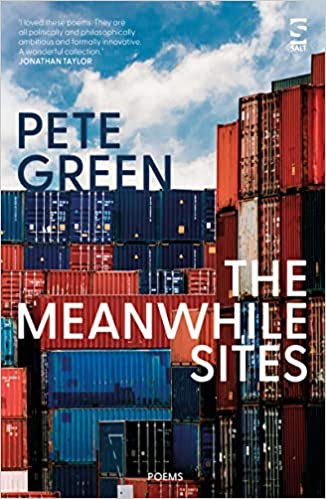
Review by Jon Wilkins of "The Meanwhile Sites" by Pete Green


The Meanwhile Sites is a term, according to Google Books, "used increasingly by urban planners to refer to locations that are earmarked for future development, it is a book about places like this, and situations like this, and their relationships with people, and the oppositions of marginality against mainstream, renewability against finitude, utility against intangible value, and the changing forms of physical, cultural and psychological landscapes in a post-industrial age.” Quite a mouthful and perhaps the beauty of Pete Green’s work is that you don’t actually need the definition to understand their work as it is an obvious howl into the air about an increasingly globalised world that is attacking everything that Everyman would have stood for.

I admire Green's reminiscences of a life well spent, of a world abused, of a time when life was simpler, because the world was more simple. Their use of metaphor is stunning and in every poem we can unpick meaning and streams of consciousness as they remind us of what once was and of what now has become - the rewards for letting the developer march over us, the trader destroy our banks, the politicians who betray their promises.

These are very political poems that sweep over continents in their journey to show us what has happened through neglect and tolerance of the various political and economic processes put in place. "I am the king of Belgium" delivers us to exactly the world we have created, the world we have inherited - a world that we perhaps will never recapture as we seem to have gone too far. "The Money Tree" shows us what has been taken away, what society has lost and what can again never be recovered.

I love the experimentalism of Green's works; they give us diverse ways of promoting or pursuing a point. Not for Green a simple way - their work jumps out from the page lightly and dark, as nuanced and creative, their talent obvious and deep. Complex language, historical and literary references abound. Green shows that they understand what they are writing about. The reader can feel their anger, feel their regret.

The notes at the back of the book are useful as they show what inspired Green, though to see the finished article from the few words of inspiration is often a wonderfully mystic journey with a surprise at the end of each line, of each verse or stanza. Green challenges us. They demand that we think about their words. Their words implore us to think about the world we live in, a world that is gradually being taken away from us, a world that Green references from neolithic times to the present - a world where there is still some hope, but is there still time?


About the reviewer
Jon Wilkins is 66. He is married to the gorgeous Annie with two wonderful sons. He was a teacher for twenty years, a Waterstones bookseller and coached women’s basketball for over thirty years before taking up writing seriously. Nowadays he takes notes for students with Special Needs at Leicester University. He has had a work commissioned by the UK Arts Council and several pieces published traditionally as well as on-line. He has had poems in magazines and anthologies, art galleries, studios, museums and at Huddersfield Railway Station. He loves writing poetry. For his MA, he wrote a crime novel, Utrecht Snow. He followed it up with Utrecht Rain, and is now writing a third part. He is currently writing a crime series, Poppy Knows Best, set at the end of the Great War and into the early 1920s.


Sunday, 13 November 2022

Review by Jon Wilkins of "Scenes from Life on Earth" by Kathryn Simmonds


Saying that someone or something is clever is often seen as an insult, and a rather patronising one at that. But in this case, when I say that the poems of Kathryn Simmonds are clever, I mean it in the broadest possible sense. 

Kathryn Simmonds persuades us with her use of language and rhythm, appearance and tone, that her world is a world that we should enter. She draws us in with the simplicity of her writing, that disguises so many ideas and displays of talent.

We see the depth of her feelings for her mother. She mourns and we mourn with her as her pain surrounds us, dragging us into her words. These are words that envelop and create another world that we can co-exist in; a world that recognises bereavement, that shows us what loss can do, far beyond the immediate numbness and anger, but at least a measure of closure. Memories are combined with stories and images from her childhood that reflect so easily her love for her mother. Light touches shine in each poem as a remembrance is shared and happiness recalled. We see that one can move on towards, if not acceptance, a future that can keep the good things close to heart. Her poems are a celebration of life, a festival of death and an awareness of memory and how it is so important once a loved one has gone.

Some of her phrases are visceral. Others as delicate as silk. But they stick in our minds. Simmonds finds humour where we least expect it, beauty when we are looking into shadows. She observes life and death for us, as her imagination flies about her world - a world that becomes ours.

Life could be so complicated as could death, but Simmonds simplifies it and welcomes us with open arms. Witty and charming. Her good grace, her good humour overcomes sadness. The humour draws us in and wraps its arms about us. Her poem "Equinox" sums it all up so easily, so perfectly, and we can feel precisely what she means.

Kathryn Simmonds is so clever.


About the reviewer
Jon Wilkins is 66. He is married to the gorgeous Annie with two wonderful sons. He was a teacher for twenty years, a Waterstones bookseller and coached women’s basketball for over thirty years before taking up writing seriously. Nowadays he takes notes for students with Special Needs at Leicester University. He has had a work commissioned by the UK Arts Council and several pieces published traditionally as well as on-line. He has had poems in magazines and anthologies, art galleries, studios, museums and at Huddersfield Railway Station. He loves writing poetry. For his MA, he wrote a crime novel, Utrecht Snow. He followed it up with Utrecht Rain, and is now writing a third part. He is currently writing a crime series, Poppy Knows Best, set at the end of the Great War and into the early 1920s.


You can read another review by Jane Simmons of Scenes from Life on Earth, by Kathryn Simmonds, on Everybody's Reviewing here