Showing posts with label short fiction. Show all posts

Monday, 21 September 2026

Review by Jonathan Wilkins of "Neon Steel" by Jennifer Maritza McCauley


I will start at the beginning with the "Episodes" as McCauley calls them - and what’s not to love, they entice you into the book and once there, you cannot escape. They are: 

Online

The Girl in the Bomba Dress

Afro Otaku

For August Wilson and Romare Bearden

The Text Message

OAV: Neon Steel

Viper/Sweet

Smoke Break

Romeo Must Die (Again)

Batman in Pittsburgh

The Con

Commercial Break: Writing Fiction

OAV: The Vampires of Pittsburgh

Commercial Break: The Day the Salt Ran Out in the City

Respect the Chair

Epilogue: Eat N’ Park

Neon Steel is an energetic, genre-melding collection that feels at once like a teenager's mixtape, a manga, and a missive to Pittsburgh. Jennifer Maritza McCauley blends magical realism, pop culture, and sharp storytelling in a book that vibrates with life.

All the "Episodes" are linked, despite their odd names. Neon Steel is a glorious celebration of the often-overlooked Black "nerd culture," Afro-Latina identity, and the process of growing up in Pittsburgh in the 1990s and early 2000s. It follows anime fans, vampires, indie rappers, robots, and pleasure-mongers as they move through their neighbourhoods, their friendships, and the bewitching otherworld reverberating beneath real-world stuff.

What makes Neon Steel remarkable is each Episode's fluidity. We are introduced to a secret coven of vampires hiding out in steel mills; we see an explosion into fireballs when a character’s rage becomes supernatural. These shifts cleverly show how fandom, imagination, and cultural hybridity shape our identity. McCauley moves fluently between realism and fantasy, often within one paragraph, creating stories that are dynamic and always unpredictable.

Neon Steel is bold and inventive, and it evokes a genuine, deeply felt response in the reader. It doesn’t fit with any one genre. The book uses magical realism and pop-culture tropes to chart the coming-of-age journey involving its central protagonist, Adrienne, alongside a cast of outsiders seeking identity and connection.

We discover the underground world of Afro Otaku, and we see a reinterpretation of The Terminator as a manga narrative featuring a purple-haired robot. The characters determine the core of the book: young people negotiating in-betweenness, racial, cultural, social, or personal. McCauley’s central figures are lifelike, intense and often flawed; they are real people searching for something. Themselves? Another world? Otherness? Pittsburgh is always there as a backdrop, yet also as a character: uncompromising, neon-lit, of course, and full of secret places and other worlds.

What makes the collection uniquely compelling is its clear structural framing. McCauley models the narrative after a season of classic Japanese anime, organizing the linked stories like television episodes complete with commercial breaks, interstitial sketches, and standalone OVA-style interludes.

At its core, Neon Steel analyses the intersection of Black, Afro-Latina and Asian pop-culture influences, delving deeply into the subcultures of youth who find community in spaces where they are historically underrepresented: anime fandoms, manga, cosplay, comic books, and arcades. Underneath the vibrant pop-culture parodies and speculative elements lies a tender portrait of youth, alienation, and the emotional safety found in chosen families. It’s a celebration of fandom, identity, and the communities we build when the world doesn’t quite know what to do with us. For readers who love hybrid fiction, magical realism, or stories that centre Black and Afro Latina nerd culture, this is an exceptional work from one of today's most exciting writers. McCauley has captured the nostalgia of night-time anime blocks and dial-up internet with a distinct, unapologetic voice. Ultimately, Neon Steel acts as an energetic, intensely personal, and stylish celebration of individual discovery for anyone who has ever felt like an outsider.


About the reviewer
Jonathan Wilkins is 69. He is married to the gorgeous Annie with two wonderful sons. He was a teacher for twenty years, a Waterstones’ bookseller and coached women’s basketball for over thirty years before taking up writing seriously. Nowadays he takes notes for students with Special Needs at Leicester and Warwick Universities. He has had a work commissioned by the UK Arts Council and several pieces published traditionally as well as on-line. He has had poems in magazines and anthologies, art galleries, studios, museums and at Huddersfield Railway Station. He loves writing poetry. For his MA, he wrote a crime novel, Utrecht Snow. He followed it up with Utrecht Rain, and is now writing a third part. He is currently writing a crime series, Poppy Knows Best, set at the end of the Great War and into the early 1920s.

You can read more about Neon Steel by Jennifer Maritza McCauley on Creative Writing at Leicester here. 


Tuesday, 28 July 2026

Review by Sally Shaw of "Perfect Circle," ed. Rob Redman, illustrated by Lucy Scott


Perfect Circle, an illustrated anthology, is volume two in the Uncertain Stories series. The stories tell how life, happenings, folklore, beliefs and society move in cycles that may or may not form complete circles.

"Swineside" by David Frankel opens with "I have two mementos of my visit to Swineside: a photograph and a tape recording." Immediately I want to know what or who was in the photograph and on the recording. The photograph shows Mathew, Anne and Clara at Swineside. The protagonist is looking back on a significant time in his life. Frankel enabled me to visualise and feel the bleakness of Swineside. Mathew is wrestling with his younger-self: was he right to question the mental stability of his girlfriend Anne, due to the circumstances of her grandmother’s death? Should he have believed what was recorded on the tape or accepted what Clara said she heard? This is a story of the power of hindsight and maturity although it may not always have the answers.

"Triptych" by Eva Carson tells the story of an artist whose life’s work depicts the mountainous landscape of Scotland so much so it appears that she is possessed as her paintings always follow the same format, as if she’s trapped in a reoccurring nightmare. There’s a darkness to the paintings: something is lurking within the crevices of the rocks, "I will say that viewers almost always have the same reaction: fear, even a kind of disgust." Following the death of her mother, her daughter visits her mother’s biographer, Robert. When Robert dies six weeks later his documentation of interviews with her mother describe the place where she first encountered the mountainous landscape and a mysterious event from which she never truly escaped. Carson writes in a way that enables the reader to experience the chill of the uncanny happenings, and provides unexpected outcomes and twists. The closing line is fabulous. 

"Dead Man’s Hollow" by Kathy Hoyle is the longest of the stories and its placing within the book is perfect. "They built a skate park over Dead Man’s Hollow. We were dead chuffed. Nobody needed a reminder of the past, the councilmen said, not in this day and age." Whatever happened must have been long ago if adults were talking about it; it was as though by putting a skate park on top of the hollow it would keep the children safe. I sensed the threat of history repeating itself, and as the story is told the tension builds in this ordinary working-class community with an unspoken knowing. Hoyle has three main voices, The Boy, The Witch and The Worm. I like the way Hoyle titled each, they formed vignettes which provide clarity and heightened my anxiety with each ending, like scenes from a play. Hoyle’s microstructure provides a rhythmic flow, and at the climax I felt the panic of The Boy’s parents and aunt running towards him, while being chased. The terror was palpable. What I thought was going to happen didn’t, and an unexpected hero is burdened with a gift. I appreciated the use of local dialect, its authenticity and how it amplified the voice of The Worm. 

"The Watchkeeper" by Lauren O’Donoghue I read twice. Writing from the protagonist's viewpoint, O’Donoghue causes the reader to believe all is normal, at first glance, and then the reader sees the reality of what's happened. 

The narrator of "Date Night" by Lynsey May is a woman who opposes the eternal generational cycle of society’s opinion of what’s right for a woman. The woman is complex, her thoughts and actions projecting a feeling of the supernatural and danger. 

The book ends with "Perfect Circle" by Jo Gatford. I absolutely loved this story of knowing deep down the fragility of life and the cruelty of that one in a million chance. This is a wonderful and atmospheric human story. 

Perfect Circle was a joy to read, bringing to my mind that maybe sometimes acceptance of uncertainty will bring a sense of peace.


About the reviewer
Sally has an MA Creative Writing from the University of Leicester. She gains inspiration from old photographs, history, childhood memories, and is inspired by writers Sandra Cisneros, Deborah Morgan, Liz Berry and Emily Dickinson. She has short stories and poetry published in various online publications including the Ink Pantry, AnotherNorth, Roi Faineant Press. Sally lives in the countryside. 

Wednesday, 22 July 2026

Review by Saleh Razzouk of "Strangers" by Rebecca Ruth Gould


Strangers is a collection of short stories by Rebecca Ruth Gould, some of which first appeared in an earlier version under the longer title Strangers in Love. This new edition retains most of the original stories, with significant additions. As Gould writes in her prefatory note, these are stories of "lost bonds, fleeting connections, and relationships formed at a distance." While the first set of stories explored civilizational tensions—particularly encounters across East/West divides, often mediated through encounters that occasionally evolve into fleeting love affairs with inevitable dead ends—the new edition expands the thematic scope in two key directions.  

The first is the treatment of the cities the narrator visits, ranging from snow-covered English towns to the layered cityscapes of Tbilisi and Damascus, and finally to the scorching heat of Abu Dhabi. Between these climatic and cultural poles, Gould introduces readers to foreign lands through both direct experience and deep scholarship. 

In one particularly striking story, "Hands," Tehran emerges as a dystopian space, where the private and the political collapse into one another: "Strange how acts of affection, expressions of love, can be made into crimes." The story’s atmosphere is reminiscent of the surveilled worlds of Orwell’s 1984 and We, the prophetic novel by Russian dissident Yevgeny Zamyatin. 

This symbolic geography reaches its emotional peak in "When You Are Old," where Gould expresses deep affection for Tbilisi while sharply criticising the forces that have historically drained it of vitality. The narrative casts Tbilisi as a wounded yet dignified space, caught between imperial appetites and regional violence. The Tbilisi setting  grounds this historical imagination in architecture: "The blue and gold tiles covering the Blue Bath’s walls belonged to an age of peaceful exchanges between peoples of different faiths, languages, and ethnicities." The narrator’s voice here is not merely descriptive but accusatory, blending historical grievance with personal reverence.  

This shift does not mean that love has disappeared from the stories; rather, the love plots are increasingly shaped by questions of cultural translation, especially by the ways Arab and Middle Eastern cultures are represented, refracted, and sometimes misrecognised in English-language fiction. In "Speaking in Tongues," for example, intimacy itself becomes linguistic invention: "With time, they cultivated a language that only made sense to the two of them." The stories resist a superficial language of hybridity, in which East and West are folded too easily into coexistence, and instead insist on the  weight of historical and cultural difference. The story "Goodbye, Home" similarly underscores how the histories of peoples struggling under imperial appetites shape their present. 

The surface of travel and urban encounter, loosely bundled with love, politics, and culture, does not become documentary prose in the manner of Belarusian writer Svetlana Alexievich. Instead, it moves closer to the autobiographical and politically observant fiction of Egyptian novelist Sonallah Ibrahim, particularly his late novel Amricanly (2003), giving the autobiographical dimension greater informational density and archival texture.

A second dimension that sets this book apart  is its pedagogical impulse, which situates the individual within a longer cross-generational history. Gould’s characters are shaped by national histories, and guided not only by personal desire but also by conscience and civic duty. Her portrayal of the Middle East works through symbolic and affective registers. But the exile’s struggle to survive is often rendered through gestures such as a walk in the rain (as in "When You Are Old"), a few exchanged letters, or scripts written in what the story calls a "sleeping language." In these stories, languages do not simply die. They transform slowly, like energy, which neither disappears nor emerges from nothing.  

In this way, Strangers embodies both the outsider’s gaze and the passionate witness of a writer intent on preserving memory and dignity for oppressed peoples who have borne centuries of injustice.  


About the reviewer
Saleh Razzouk is a Syrian fiction writer, translator, and Associate Professor at the University of Aleppo. Born in Aleppo province in 1959, he was educated at Aleppo University and Gliwice Polytechnic in Poland, and also studied at Bolton Institute and the University of Nottingham in the UK. His first book was published by the Union of Arabic Writers in 1980, and his translations of contemporary poetry and literary criticism have appeared in Poetry International, Poetry London, The Bitter Oleander, and The Laurel Review.


Wednesday, 1 July 2026

Review by Jonathan Wilkins of "Monstrum" by Lottie Mills


I read Lottie Mills’ debut collection Monstrum in a couple of sittings. The stories are that good! They explore what is monstrous, and what we may perceive as otherness. They challenge the reader and society to re-examine all of our deep rooted assumptions. Every single beautifully crafted story is an eerie, gripping and alluring message to our world. And each is unequivocally strong in its own right, unique but connected through the theme of disability and the monstrous, because Mills shows us that being different doesn’t mean we are worse than what might be perceived as the norm. It might be that Monstrum isn’t for every reader, but it is worth every reader having a go. 

"The Mirror" shows a young girl doing the shopping for her supposedly monstrous mistress. Through her small acts of kindness, she makes the relationship work and rejects this conception of monstrosity. There is an implied sexual relationship in the story, and a poignant ending. 

"The Changeling," the opening story, sticks with the reader long after they finish and we can see why it was a prize winner. It’s a sublime, ethereal tale about deformity and physical change, and asks what are our expectations of what we see as normal. The writing is evocative and clear. 

In "The Cuckoo," as the title implies, we are confronted by a strange child who infiltrates a household, and removes the protagonist from her own life with weird ease. This is psychological horror story demonstrating the terror of being replaced, unseen, unprotected. 

"The Body" features a particularly belligerent attitude towards disability. It is set in a world where you can ask for, or purchase a new body. The main character in this story finds it difficult to let go of her old body and struggles to cope with the physical changes that come with a new non-disabled body. When she uses her old wheelchair, it is a particularly discordant moment. She finds that her new, whole body no longer has the muscle memory her original one had, and she is forced to relearn much of what used to be  habitual, her own "normal." Mills never takes the easy way out. She examines how this is not an easy solution and the myriad struggles that it brings with it. The main character is confronted when others find out about her original disabled body, and the complex relationship she now has with the new body.

Mills has shown the reader a world where inhumanity often comes from the ordinary, and where we can see kindness and warmth in those that we have been taught to fear. The result is a beautifully strong collection of stories that are heartbreaking at times as well as being intellectually rigorous, and written in prose that is so pure that it is almost perfection. Monstrum is a critical, politically sensitive piece of disability literature disguised as gothic nightmare, grotesque theatre. Mills invites us into her darkness, and we cannot escape, demanding we see the beauty, potential, power and provocation flourishing there. It is a dazzling, remarkable debut.


About the reviewer
Jonathan Wilkins is 69. He is married to the gorgeous Annie with two wonderful sons. He was a teacher for twenty years, a Waterstones’ bookseller and coached women’s basketball for over thirty years before taking up writing seriously. Nowadays he takes notes for students with Special Needs at Leicester and Warwick Universities. He has had a work commissioned by the UK Arts Council and several pieces published traditionally as well as on-line. He has had poems in magazines and anthologies, art galleries, studios, museums and at Huddersfield Railway Station. He loves writing poetry. For his MA, he wrote a crime novel, Utrecht Snow. He followed it up with Utrecht Rain, and is now writing a third part. He is currently writing a crime series, Poppy Knows Best, set at the end of the Great War and into the early 1920s.


Wednesday, 17 June 2026

Review by Jonathan Wilkins of "Salt & Stone" ed. Adriana Ciontea, Maella Cottin and Sam Stone


This is a collection of emotive short stories by Cornish writers. Salt & Stone is a beautifully textured anthology that masterfully captures the rugged, dualistic spirit of Cornwall. This striking compilation explores the profound tension between the region’s shifting maritime elements, salt, and its immovable, ancient heritage, stone. It is a perfect evocation of Cornwall and its magical, mystery world that has been woven into contemporary Cornish life. We see how Cornwall breathes. We see the intoxicating beauty of the coastline and inland, working men and women at sea and at leisure, newcomers and residents who have endured over time.

Salt & Stone flourishes with its vivid description of place. This is all important and is pre-eminent in all the stories. All the writers examine the daily realities of Cornwall’s landscape and history. The "salt" of the collection is real and we can almost taste the invigorating Atlantic winds and rain as they drench the earth; we live amongst the fishing communities, and can imagine through the writer’s creative process the exhilarating beauty of the shoreline. In contrast, the "stone" elements anchor the book in Cornwall’s granite permanence, exploring the enduring legacy of old tin mine workings, megaliths, and the deep-rooted identity of the people who work the land.

What makes Salt & Stone particularly compelling is its stylistic diversity. Seamlessly transitioning between contemporary realism and folklore-infused lyrical prose, the collection ensures that every turn of the page offers a new perspective on Cornish life. The anthology excels at capturing subtle nuances, the balance between traditional heritage and modern regional challenges, the power of the landscape, the charm of the villages, all making it a deeply resonant read for both locals and outsiders.

I adored the way in "Lamorna Glass," I was drawn into the writer's world immediately and with such ease. The prose is perfect, seamlessly inviting us to take part. "Saltwater Grounding" is beautifully written: so sad yet eventually with a renewed purpose, we meet a recent widow reflecting on her life. "The Shifting of the Bar" begins with an expressive description of the local pub before delving into the mystical world Cornwall is famed for. This is an excellent modern-day fairy-tale in every sense.

It was a shame that some of the sublimely written passages were rather shorter than one would have hoped, leaving the reader wanting more. But maybe that is a good thing; we can search for these writers' other works online or at the library. Salt & Stone is a poignant, sensory tribute to Cornwall. It is a highly recommended read for anyone wishing to experience the true, unyielding pulse of the austere southwestern coast and the exhilarating inland scenery through the authentic voices who know it best. 

When you next visit, take it with you.


About the reviewer
Jonathan Wilkins is 69. He is married to the gorgeous Annie with two wonderful sons. He was a teacher for twenty years, a Waterstones’ bookseller and coached women’s basketball for over thirty years before taking up writing seriously. Nowadays he takes notes for students with Special Needs at Leicester and Warwick Universities. He has had a work commissioned by the UK Arts Council and several pieces published traditionally as well as on-line. He has had poems in magazines and anthologies, art galleries, studios, museums and at Huddersfield Railway Station. He loves writing poetry. For his MA, he wrote a crime novel, Utrecht Snow. He followed it up with Utrecht Rain, and is now writing a third part. He is currently writing a crime series, Poppy Knows Best, set at the end of the Great War and into the early 1920s.

Thursday, 28 May 2026

Review by Siobhian R. Hodges of "Scablands and Other Stories" by Jonathan Taylor


Each story  in this collection was uniquely captivating, and the various lengths created an overall pace that matched the book's genre, a kaleidoscopic symphony of its very own. With such a busy life (like most of us have) and not nearly enough free time as I'd like, the book was perfect for me to dip in and out of. It may sound clichéd but Scablands and Other Stories truly was the type of book that I could not put down.  

Every night for the past week, I found myself wanting to read "just one more story" - like my daughter regularly asks me at the end of one of her Disney bedtime stories. Being an adult, however, I was able to make my own (hypocritical) decision and would continue reading Taylor's book long into the night, enjoying the fully immersive worlds and (mostly) endearing characters.

I especially loved "A Sentimental Story," "Heat Death," and of course "Scablands" - the final story that will stay with me for a long time, just as, I imagine, the memory of Mr Chandler will stay with the boy-who-is-no-longer-new.

Thank you to the author for this collection of bittersweet escapism. I'm looking forward to reading more of your work!


About the reviewer
Siobhian R. Hodges is a Leicestershire multi-genre writer, author of the supernatural thriller Killing a Dead Man and coming-of-age anthology Untitled Decade. She has an MA in Creative Writing and was shortlisted in 2021 for the Page Turner Book Awards. She lives with her graphic designer husband, their two chalk-and-cheese children, and their dog-like cat.

Saturday, 21 February 2026

Review by Mithila Dutta Roy of "Supporting Cast" by Kit de Waal


It’s been months since I cried over a book, and short stories rarely do that to me. But Kit de Waal’s Supporting Cast made me tear up a bit on a bright Saturday afternoon. 

As the whole world is running around flaunting the idea of being the "main character" with the Pinterest-style life, glorious cafes and extravagant nightlife, there are still many who feel like the supporting cast in others’ stories. And Kit de Waal has brought their stories to life with such precision. Their losses of all kinds - time, age, love, lovers, children, sanity, legs - that form their imperfect lives are staged in a voice that is empathetic and truthful. That’s the mastery these stories needed and got.

Before starting the short story collection I didn’t know that these were the characters in the background of her earlier works. But it didn’t matter as I went from one story to another and found each character becoming a whole, with their nuances, flaws and introspection. Each story stood out as a complete piece, which was fascinating. 

It’s a book that talks about a woman who, on her divorce day, remembers her husband rescuing a boy during their honeymoon; a mother who says goodbye to her newly-wed son and starts thinking about how the bride never thanked the mother who loved him first - and then, in turn, realises that she never thanked her adopted son’s mother. It’s a book about the blind man who passes you by in a crowded street, and what he is still grateful for. It’s a story of an already grieving woman trying to form stories to make her dying father less uncomfortable.

These stories delve into deep human emotions and inner conflicts, while keeping the plot poignant. Some of the stories break what some would call the rules or conventions of short fiction, but even in breaking them there seems to be a purpose, and that is an achievement. Overall, Kit de Waal has done a wonderful job in giving the supporting cast the highlighted stories they deserve. She has given them the closure they might not have received in previous books, where they were only a part of the conversation but not the whole conversation.

Now, which one of these stories made me tear up, or was it my unbalanced hormones? You’ll have to read this book yourself to figure it out, because I’m also just another supporting cast in your story talking about a book I enjoyed.


About the reviewer
Mithila Dutta Roy is a reader and writer with a keen interest in literary fiction and stories that explore human experience. She is pursuing an MA in Creative Writing at the University of Leicester and is currently working on her first novel. She is passionate about storytelling and hopes to contribute her own voice to contemporary literature.


Wednesday, 14 January 2026

Review by Karen Stevens of "The Collected Stories" by Katherine Mansfield


I’ve been unable to read fiction for a few months now due to burnout. When that happens, I eventually re-energise by returning to The Collected Stories of Katherine Mansfield (Penguin, 1981 – my very battered copy). Every time I revisit her work, I’m staggered by her ability to capture the inner lives of people and the revelations that arise from the most trivial or seemingly ordinary moments. One such moment occurs in her perfectly crafted short story "At the Bay" - my favourite story of all time.

Linda Burnell, one of Mansfield’s most beautifully drawn characters, is alone with her baby boy in the garden of their seaside holiday home. It’s a rare moment of solitude; her life is almost entirely given over to her family. Here, she reflects on her real grudge against life: "She was broken, made weak, her courage was gone, through child-bearing … she did not love her children. It was useless pretending."

But then the baby turns over and beams at Linda, instantly testing and eroding her resolve: "'Why do you keep on smiling?' she said severely. 'If you knew what I was thinking about, you wouldn’t.' But he only squeezed up his eyes slyly and rolled his head on the pillow. He didn’t believe a word she said. 'We know all about that!' smiled the boy. Linda was so astonished at the confidence of this little creature … Ah no, be sincere. That was not what she felt; it was something far different, something so new, so … The tears danced in her eyes; she breathed in a small whisper to the boy, 'Hallo, my funny!'" 

In that exchange, Mansfield enables us to experience the sweetness and anguish that shape the pattern of all our lives – the essence of good - no, great fiction. 


About the reviewer
Karen Stevens is Senior Lecturer in Creative Writing at the University of Chichester and lives in West Sussex. She is an editor, critic and writes short fiction. Her debut collection of short stories Brilliant Blue was published by Barbican press in 2025. 

You can read more about Brilliant Blue on Creative Writing at Leicester here.

Wednesday, 10 December 2025

Review by Rhiannon Buckley of "Angel Reach" by Gus Gresham


Characters feel unflinchingly imperfect and real in this collection of short stories by Gus Gresham. For me, the author writes in a way which is unapologetic to the human experience and calls on you to see through another’s eyes. When the character stumbles upon a question, often seemingly unanswerable, I found myself asking the same thing.

Not all books are easy for me to visualise but the stories Angel Reach flowed beautifully and played out like a movie in my mind. None more so than "Woofers and Tweeters" - I love the way the characters here intertwine, adding layers as you read. I really do look forward to reading more short stories from Gus Gresham. Excellent stuff!


About the reviewer
Rhiannon Buckley is an East Midlands based author, actor and communication skills educator. Her first book A Mind Blown was published in 2025. 

You can read more about Angel Reach by Gus Gresham on Creative Writing at Leicester here. 

Saturday, 19 July 2025

Review by Paul Taylor-McCartney of "Brilliant Blue" by Karen Stevens


Karen Stevens’s debut collection transports the reader straight into her fictional world with a tag line that sounds both like a warning and an invitation: "Welcome to the infamous Duncock Estate." In nine tightly structured and beautifully written stories, she conjures a coastal council estate that hums with life: chip-shop queues, neon-slick pavements, gossip passed over fences like contraband. The world is so sharply etched that you feel the salt sting off the Channel each time you turn a page.

What makes these stories sing is the way Stevens pairs raw circumstance with a fierce, steady compassion. Her people have worries that could crush them, yet they keep reaching for connection, however fleeting. The prose itself flashes, but there’s precision beneath the sparkle. Sentences are lean, images exact; a chipped sink or a scrawl of graffiti serves as both social backdrop and inner weather report. You sense the author’s quiet fascination with ephemera: half-heard remarks or slivers of stored memories resurfacing in adulthood. Each becomes a seed that flowers briefly on the page before drifting off, leaving ripples in the reader’s mind. In "Where You’re Heading," the narrator remarks, "Thing is, Owen, since the dream I can only imagine you in space, and that’s how I want to keep you – hanging in blackness and ready to sing for me."

Running through the collection is a clear conviction that short fiction can do something uniquely powerful with brevity. Stevens trusts her readers to make imaginative leaps, to stand in the little gaps she leaves and feel the full weight of what isn’t said. The result is exhilarating: every story closes like a camera shutter, but the after-image lingers. In another moving story, "The Vigil," Stevens’ precise handling of atmosphere, setting and character is evident: "Already, the impression made by the old man’s body would be less distinct as snow fell soundlessly on snow."

Brilliant Blue is, above all, generous. It insists that hope can survive even the toughest postcode; that humour finds its way into the room, uninvited, whenever people gather; that ordinary lives are anything but. Step onto the Duncock Estate and you’ll leave painted the brightest, most unforgettable shade of blue.


About the reviewer
Dr. Paul Taylor-McCartney is a writer, researcher and lecturer living in Cornwall. His interests include dystopian studies, children’s literature and initial teacher education. His poetry, short fiction and academic articles have appeared in a wide range of print and electronic form. His debut children’s novel, Sisters of the Pentacle, was published by Hermitage Press (2022) and fiction titles he has recently worked on as commissioning editor have won multiple regional readers’ and publishers’ awards.

You can read more about Brilliant Blue by Karen Stevens on Creative Writing at Leicester here. 

Friday, 13 June 2025

Review by Sally Shaw of "The Two Keisukes" by Brian Howell


The Two Keisukes is written in the third person and printed on cream cotton rag feathered-edged paper. The elongated pages are hand sewn to form a beautiful booklet. This short story is written by Brian Howell, author of several booklets and novels that include Sight Unseen. 

Prior to reading this story I had no knowledge of Howell. The content description provided by the publisher inspired me to read it.

The opening paragraph intrigued me, the words clear and crisp: "He had been here before, no, not here exactly, but then, yes, that building, an old fashioned school building that could have been from almost any period before or after the war."

Howell writes with such precision and beauty. I felt the wonderment he holds for the man, Keisuke Kinoshita, whose identity is given halfway through the story.

The story takes place on an island and yet the reader is made aware of the possibility that it’s being viewed from a distance or on the margins of time. The reader is taken from the shore of the island into a wonderland of past, present and unknown. Keisuke walks through alleyways and corridors, taking in the sights and sounds filled with the forgotten waiting to be rediscovered: "Walking further to the edges of this large park-like area, he saw a very curious group of turquoise sculptures that was both painfully familiar and yet unidentifiable."

Throughout his wanderings of the island, buildings and alleyways I’m drawn to him, I like Keisuke - both of them. I form an insight as to where each Keisuke is, one on the island, the other between the island and somewhere else. Floating in the past, present and unknown, in my mind I have ideas, two to be exact. I won’t say anymore as this would spoil Howell’s story. I will say, that through reading Howell’s words I formed the opinion that Keisuke and the others named were indeed real people (I had no prior knowledge of the Japanese film industry and history), and I sensed the history and connections between them all. I visualised what was possibly happening to the two Keisukes, felt the emotions and the power of recall and realisation of life. The ending touched my heart in a non-sentimental way. 

Around the two Keisukes Howell provides a portrait of the culture and history of Japan and the enchantment of the Japanese film industry. I read this booklet over and over again, each time discovering something new. I have started to research the individuals within Howell’s story, such was the energy of the writing. This is magical storytelling of a country, people and industry I knew nothing about, but now I want to get to know them and read more of Howell’s stories.


About the reviewer
Sally Shaw has an MA Creative Writing from the University of Leicester. She gains inspiration from old photographs, history, childhood memories, and is inspired by writers Sandra Cisneros, Deborah Morgan, Liz Berry and Emily Dickinson. She has short stories and poetry published in various online publications including The Ink Pantry, AnotherNorth, Roi Faineant Press. Sally lives in the countryside. 

Saturday, 15 February 2025

Review by Alan McCormick of "Precipitation" by Ailsa Cox, with illustrations by Patricia Farrell


Precipitation is the fifth in a series of small, illustrated story collections from the independent Manchester based publisher Confingo. Precipitation has three stories of frail characters from the city, faltering in alluring yet foreboding settings. There are echoes of David Constantine’s stories in the nuanced, empathetic characterisations and subtle lyrical handling of dramatic natural elements, the incessant rain falling through the ravines and scarred slopes of West Yorkshire and North Wales. 

In the first story, ‘Heavy Showers and Thunder,’ I was initially resistant to the seemingly novelistic back and forth cast of divergent characters, the multi-layered use of shifting time and back story. Within a few pages I was hooked. Luke seeks shelter on a desperate drenched cycle ride in the Calderdale hills with his ex-in-laws George and Barbara. He is escaping his new family home in the city. Middle-class and urban, he is an outsider in the rural landscape, in his ex-in-laws’ small village home. Tightly wrought grievances, social and political differences, and unquenched grief permeate their night together. Their daughter, Cass, Luke’s first wife, had died in a climbing accident years before and Barbara blames Luke. George and Barbara’s teenage granddaughter rarely contacts them anymore, and life hasn’t healed or moved on for them. Fuelled by a few drinks, George conveys Barbara’s resentment and blaming to Luke, who bridles, then retreats to the emotional ‘time-warp’ of Cass’s old moth-infested bedroom. 

Ailsa Cox is unafraid of putting a writer centre stage – the frustrated novelist Jason in ‘The Empty Quarter’ and the poet Fleur in ‘Stan’s House.’ Fleur came from Manchester with her partner (outsiders again) to live in Bethel Street, the same fictional Calderdale setting for ‘Heavy Showers and Thunder.’ Initially full of naïve optimism and excitement, the elements and surroundings soon close in and get the better of her. She encounters a malevolent old woman Yvonne, who she christens Miss Havisham. The old lady casts a spell, picking at her vulnerabilities, her aloneness. Initially repelled, Fleur becomes obsessed, her antennae piqued when learning that Yvonne once had a brother, a wild drunken poet called Stan – giving name to ‘Stan’s House.’ Fleur ends up as Yvonne had predicted, alone, when her partner moves out, the two women left somehow invisibly drawn together despite themselves. Stan and Fleur, two failing poets floundering in the exposing elements, also suggested Sylvia Plath’s grave in Calderdale’s Heptonstall, Ted Hughes’ family farm home nestled a mile away amongst the brooding escarpments.      

In ‘The Empty Quarter’ a hollowed-out novelist, Jason, can only think to escape his disappointing life and fulfil a long-held longing to reinvoke Wilfred Thesiger’s Arabian journeys, not by visiting there, but by imagining it from the lonely outpost of his writer friend’s neglected Welsh cottage. He loses himself in the mix, the incessant rain and isolation, a backdrop to his imaginary breakouts into the desert.

I was reminded of Tessa Hadley and Alice Munro (and then discovered Ailsa Cox has written a book about Munro) in the psychological depth of her stories that extend well beyond the page, so you think about the characters long after reading about them. So much is left unsaid, shadows creeping in from the past, from complex painful family dynamics. Life and feeling are brought naturally, three-dimensionally into the present, in these fragile characters’ thwarted attempts to maintain relationships, fulfil longings and escape disappointing lives. 

Shadowy pasts and character’s yearnings are skilfully invoked by Patricia Farrell’s accompanying black and white illustrations. It’s a wonderful mix and a great collection that left me enthralled and wanting more.


About the reviewer
Alan McCormick lives in Wicklow. He writes fiction and memoir. Recent writing has appeared in The Stinging Fly, Banshee, The Lonely Crowd, Exacting Clam, Southword and Culture Matters. His website is here.

You can read more about Precipitation on Creative Writing at Leicester here. 

Friday, 15 November 2024

Review by Mike O'Driscoll of "The Study of Sleep and Other Stories" by Brian Howell


What a pleasant surprise to find that Brian Howell is still writing and publishing fiction. I first came across him years ago in UK literary journal Panurge, and he had at least one story in The 3rd Alternative. We both appeared in Nicholas Royle’s two-volume anthology Darklands, as well as in a best of Elastic Press anthology. That story, ‘The Tower,’ was the last time I encountered his fiction. His latest collection is a timely reminder of just how unique and obsessive—in a good way—a writer he is.

The title story, a novella, is the intricate and elliptical four-part portrait of Martin, a performance artist and aspiring writer, told from the perspective of Philip, a childhood friend, Martin himself, and Lenka, the latter’s former wife, but filtered through the narrative perspective of Julie, Philip’s wife, and herself possibly a former lover of Martin’s. The competing stories, as in Kurosawa’s film, Rashomon, both overlap and contradict each other, so that our take on Martin remains ephemeral and incomplete. This is the case even in his own narrative, where seven photographs of his abused lover, Chiara, at different stages of her life, also seem to offer an oblique commentary on his previous relationship with Lenka, which story unfolds in the novel’s third section, ‘The Decay,’ and which is itself Julie’s written interpretation of their marriage. In other hands, such intertextuality might appear an exercise in cold formalism, but Howell never loses sight of his characters, and in particular of their foibles. It’s the desire to learn the truth behind their yearnings and vanities that keeps us enthralled.

The intertextual play between the The Study of Sleep’s four parts is echoed in the remaining five tales, all of which, in their preoccupation with visual art—in particular the paintings of Vermeer, but also with cinema and the means of visual representation—seem to be engaged in a dialogue with each other. Some of them, particularly ‘The Vanishing Point,’ share the same unsettling mood as Martin’s self narrated tale in the title novella, and like it, lean more toward the macabre. Others—‘The Window’ and ‘New York Movie’—explore the extent to which art suffuses memory, how what we remember of specific works not only colours our memories, but shapes the narratives we create about our own lives. The final story, ‘The Counterfeit Smile,’ tells of Vermeer’s life, and of his search for the elusive face that has haunted him throughout his life, and of how it came to appear in one of his most famous works, ‘The Music Lesson.’ Not only is the story full of fascinating technical and biographical detail, but it offers a powerful and heartfelt representation of the artist’s motivations and desires. Just as Marquand, the protagonist of ‘Dutch Interior,’ finds himself falling into the rooms depicted in a mysterious viewing box, Howell’s elegant prose pulls us deep into the worlds of his characters and their obsessions.


About the reviewer
Mike O’Driscoll is a writer living in Swansea. His work has appeared in Black Static, Interzone, the Magazine of Fantasy & Science Fiction, and numerous anthologies. His story ‘Sounds Like’ was adapted for a TV movie by Brad Anderson, as part of the Masters of Horror series. Mike blogs on different aspects of genre writing and film here.

Saturday, 27 July 2024

Review by Jonathan Wilkins of "The Calamity of Desire and Other Stories" by Judith Dancoff


I read this book in one sitting.

No, I tell a lie, part way through I had to email the author to tell her what a wonderful work she had produced. I’ve never done that before, but if you read this collection of amazing short stories you will understand.

This is a truly beautiful collection of stories, most of them part-inspired by artists and works of art. The one outlier is a tale surrounding Annie Oakley, re-imagining her life on a trip to Paris where we are able to discover the vulnerabilities of a woman who dragged herself from the gutter to being the world-famous markswoman of lore. This story delves deep into her upbringing and lifestyle while commenting on the morals of the time with criticisms of well-known contemporary artists. This re-imagining is so clever and takes a real talent - a talent that is replicated through the collection.

Many of the stories play on the emotions of the reader and allow us a vision that we would not have imagined. We play a part in the characters' lives and stories. We discover another life that Dancoff imagines, and who are we to tell reality from fiction? 

The way Dancoff can draw out the allusions and images she makes is nonpareil. She writes about the life of the Infanta, the subject of the artist Klimt, the work of Louise Moillon, a sitter for Renoir during the Dreyfus affair, a curator at a museum, and a Vermeer inspired artist searching for love. Each tale made me research the artists and artworks that inspired Dancoff, hence introducing me to another layer of interest. 

This window into another world is just one of the benefits of reading the stories. They are delightful. Poignant and revealing, in some cases enchanting. There is a wistfulness to many and diverse historical perspectives are showcased. A great deal of research has obviously gone into each story as each is grounded on fact. I thoroughly enjoyed The Calamity of Desire and wholeheartedly recommend it.


About the reviewer
Jonathan Wilkins is 68. He is married to the gorgeous Annie with two wonderful sons. He was a teacher for twenty years, a Waterstones’ bookseller and coached women’s basketball for over thirty years before taking up writing seriously. Nowadays he takes notes for students with Special Needs at Leicester and Warwick Universities. He has had a work commissioned by the UK Arts Council and several pieces published traditionally as well as on-line. He has had poems in magazines and anthologies, art galleries, studios, museums and at Huddersfield Railway Station. He loves writing poetry. For his MA, he wrote a crime novel, Utrecht Snow. He followed it up with Utrecht Rain, and is now writing a third part. He is currently writing a crime series, Poppy Knows Best, set at the end of the Great War and into the early 1920s.

Friday, 16 February 2024

Review by Paul Taylor-McCartney of "Hollow Daughter" by Katherine Hetzel


Readers already familiar with Hetzel’s previous output as author of children’s fantasy fiction, including the epic The Chronicles of Issraya series of books, will find much to enjoy in this collection of short stories that are aimed at adult readers but also draw their inspiration from the fantastical. 

The title of the collection, Hollow Daughter, is not only the story that opens proceedings, but also provides a unifying theme for the eclectic array of flash fiction and longer pieces that follow, chiefly, girls and women who face extraordinary situations that either serve to empower them or leave them at the mercy of more powerful forces. 

The collection contains a dizzying array of characters, settings and narrative styles, many of which offer the reader a mere glimpse of an alternative universe. Hetzel’s trademark economy of form is able to relay both an entire society and a turning point in a character’s much larger story. There are the familiar shades of Atwood’s Gilead in the title story, "Hollow Daughter," whereby a parent seeks the help of Mother Alish when her daughter fails to menstruate. "'We need your help, Mother.'” The Mother indicated the daughter. 'If her situation continues, there will be accusations laid against her, that she’s preventing her own fruitfulness.'" Hetzel leads the reader to many a satisfying cliff-hanger, shown to devastating effect in the title story, but also elsewhere in the affecting "The Pink Feather Boa Incident," "The Memory of Amelia Maybelove" and "Red Moon Rising." The last of these, along with the stunning "Miss Aveline’s Summerhouse," are so convincing and well-executed they hint at a potential future direction for Hetzel to pursue – the full-length ghost story.

I thoroughly recommend this collection. Hetzel’s stories surprise and delight in equal measure but are sure to leave readers reflecting on the nature of female identity and power, in its myriad forms. I look forward to seeing where Hetzel takes her readers next as she develops her skills as a writer of quality adult fantasy fiction. Any number of universes, as presented in this dazzling collection, would prove ripe for exploration. 


About the reviewer
Dr. Paul Taylor-McCartney is a writer, researcher and lecturer living in Cornwall. His interests include dystopian studies, children’s literature and initial teacher education. His poetry, short fiction and academic articles have appeared in print and electronic form, including: Aesthetica, The Birmingham Journal of Language and Literature, Education in Practice & Writing in Practice (National Association of Writers in Education), Dyst: Literary Journal, Intima: A Journal of Narrative Medicine, The Crank and Bandit Fiction. His debut children’s novel, Sisters of the Pentacle, was recently published by Hermitage Press.

Tuesday, 9 January 2024

Review by Laurie Cusack of "Encounters with Everyday Madness" by Charlie Hill


Charlie Hill’s fascinating collection is a tidy reminder that we are all on the mental health spectrum. Every day one sees madness or experiences it in one form or another, as we go about in the world − I know I do!

Opening these splendid off-kilter stories is ‘A walk by the river’ that’s written in the second-person perspective, which grabs the reader’s attention straight away. Hill magnifies a family outing with a nod to the film Deliverance. I have to confess that the frenetic ‘Duelling Banjos’ twanged in my head when I perused this passage: ‘The fish wriggles in the father’s hand and, holding it by its tail, he smashes its head against a stone and tosses its unwanted body into the water. The boy laughs. It is not a pleasant laugh.’ What should be a halcyon walk turns into a brooding ordeal for our detached protagonist and kicks Hill’s collection off, majestically.

In Hill’s captivating ‘Stuff,’ existential angst and anxiety disorder are tackled with humour and aplomb. The nullifying grind of the everyday is deftly realised in elegant style. Hill’s Kafkaesque protagonist gets a dose of inner-city blues over seven days. I loved the hilarious interior monologue conducted whilst he’s walking to the shops on Monday, concerning the fascist household on his route: ‘I think there must be all manner of social-anthropological connections between garden centres and fascism.’ Moreover, Hill’s authentic portrayal of anxiety disorder is spot-on, too. It is well defined and captures someone in mental freefall, exquisitely. In this respect, Hill’s text reminded me of an Akira Kurosawa’s quote: 'In a mad world, only the mad are sane.'

There are no weak narratives within Hill’s collection. Whether flash fiction or short story, all hold the reader throughout. I found this collection, with its superb West Midland detailing, very compelling. ‘The man in the churchyard’ exemplifies this: ‘Through Highgate and into Balsall Heath there is an Islamic Centre and the Moseley Road baths – Men First and Second Class; Listed, with Victoria in its bricks – and a carpet warehouse and shuttered curry houses and then fruit and veg shops with shopkeepers arranging plastic bowls of fruit out front like a market, oranges and tomatoes and mooli and chard. Then there is Zaffs.’  

Hill’s urban sensibility inhabits every inch of Encounters with Everyday Madness and this is truly standout writing, which deserves an audience. Highly recommended.


About the reviewer
Laurie Cusack (PhD) studied Creative Writing at Leicester University. He writes from the gut − from the underground − about the underdog. His collection of short stories The Mad Road was published in September 2023. He is now an actor-simulator, writer and community advocate.

You can read more about Encounters with Everyday Madness by Charlie Hill on Creative Writing at Leicester here. 

Tuesday, 19 December 2023

Review by Kim Wiltshire of "Best British Short Stories 2023" ed. Nicholas Royle


In this form since 2011, Best British Short Stories 2023 is the thirteenth volume and yet again delivers an anthology that includes a range of styles and subjects to suit any reader. This is the joy of the short story collection or anthology, there is always a completely different tale awaiting you a few pages on, a different world to explore and new characters to meet. 

This edition includes work from twenty different writers from across Britain, telling a range of stories from the lyrical (A K Blakemore’s ‘Bonsoir’) to the dark and weirdly dystopian (Gareth E Rees’ ‘The Slime Factory’) alongside the more character-based literary stories, ranging from the quite short, for example Lydia Gill’s ‘The Lowing’ at only four pages, through to the longer short story, such as the final one in the collection ‘Tinhead’ by Gabriel Flynn.

The collection is thoughtfully curated by Royle, a task which is always difficult, but when you’re presenting ‘the best’ stories then the journey the editor takes the reader on has to ensure there are no bumps or potholes in the road, although a sharp turn now and then can be quite exhilarating. Royle does a grand job as editor here, juxtaposing the stories that lean towards magic realism with the more down to earth, life-lived-as-it-is type of story. It has been carefully thought through for the reader, which in turn showcases the talent of all the writers in the best possible way. Yes, I had my favourites, but they will be completely different to your favourites, which in turn will be different again to the next person’s. There are clear themes that run through the collection: concerns about the world we live in, and where it is heading, alongside the loneliness of life for so many. Some stories make you laugh out loud, other make you think, and one did bring a tear to my eye. 

Royle’s introduction is also a journey through the short story alphabet with many good tips for those writers starting out in the genre. I’ve always enjoyed reading these yearly collections, and this (lucky?) thirteenth is no different - I hope they continue for many years more.


About the reviewer
Dr Kim Wiltshire is a playwright and writer whose research involves theatre/writing for social change and arts for health. She is a British Academy Innovation Fellow and is a Reader and Programme Leader for Creative Writing at Edge Hill University. 


Sunday, 6 August 2023

Review by Lisa Williams of "Scablands and Other Stories" by Jonathan Taylor


The Scablands are vast barren areas in the USA riddled with fissures. A scab is a person that breaks a picket line during industrial action. A scab is hard and unattractive. A scab covers an area that has been hurt, and needs time to heal. This book is not set in America.

Buckle in as we head on this lyrical journey to the Scablands: the stories vary in length, some barely a page, others develop in over thirty. The city setting has a park, shops and even a Lovers Walk. It sounds divine but we soon realise it’s a place "brimful of loneliness" packed with "affection-starved strangers." This is very much a book of "sorrowful voices." Don’t worry - you can buy a hug from a booth for £2 there if it gets a bit much.

There’s suicide, amputation, self harm and ever-unfulfilled wishes. The lonely converge here, but Taylor’s poetic use of language ensures reading is a joy not a chore. His use of humour helps too: a homeless guy talks about moving to somewhere more palatial, and "it might even have walls." There are flickering glimmers of hope for the characters: a university place or a lottery ticket may provide a way out, although the offer of a different life is not necessarily wanted. What isn’t said is important, the gaps the reader completes themselves, asfor example in the poignant line: "A girl eternally eleven."

To take a specific story without ruining the book for you - "Till Life" is a delightful puzzle of a story. It covers the working day of a shop-girl. Taylor piques our interest with titbits like a secret tea-cosy in a pocket. He prompts the reader to question what he’s telling us. We realise things aren’t straightforward when Mrs Parker is more than just a boss and manager. We unpick the peppered little clues, such as an accident, a hospital stay and the necessity of care, in order to reveal the actual story beneath. 

Many of the characters stay with you to the next story. At times, as the story finishes it actually feels like just the start of their story – particularly "A Sentimental Story." An earworm appears in three separate stories; a Dr’s name reappears later on. In my haste to review I’ve read the stories too quickly to decipher links. These characters deserve a less galloped read, which I have already begun.

The images created in these stories linger long after the book has been shut: an Andy Pandy Nightdress, a soldier digging in the mud, a girl on a till trying to pause her life and a biography completely crossed out in red pen. The stories in Scablands may be short, but Taylor’s superb word weaving skill ensures the tales last so much longer than their actual length. 


About the reviewer
Lisa Williams is a creative soul from Leicester. She has a Masters in Creative Writing from Leicester University, and lately tends to write mostly short fiction. She likes the challenge of a word limit – usually one hundred words. Her work has been published in numerous anthologies. Lisa has a weekly story slot on local community radio. She helps out a bit at Friday Flash Fiction and Blink Ink Journal. A regular stall holder at Leicester's new Art Fair, Lisa also sells online as noodleBubble.

Tuesday, 28 March 2023

Review by Lisa Williams of "How to Pronounce Knife" by Souvankham Thammavongsa


How to Pronounce Knife is a hard-hitting short story compilation. The author was born in the Lao refugee camp in Thailand before being raised in Toronto. The stories focus on Laos immigrants, with an overarching theme of people being in places where they don’t feel they belong. 

Often told from the viewpoint of a younger person, the book features a collection of disparate characters. These are small stories about vast issues. Each one lands like a slap across the face and leaves a sting that stays with you long after you’ve finished reading. 

Her debut work of fiction, I’m eagerly awaiting Thammavongsa's next!


About the reviewer
Lisa has an MA in Creative Writing from the University of Leicester. She writes word-limited flash fiction, mostly drabbles - stories of exactly one hundred words. You can find her online @noodleBubble 


Tuesday, 29 November 2022

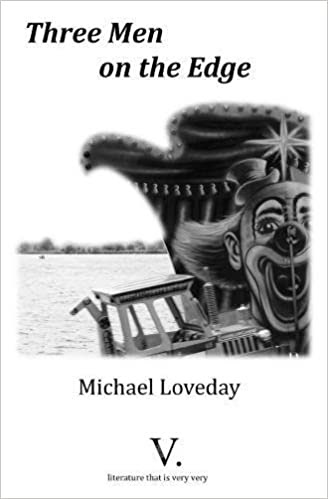
Review by Laura Besley of "Three Men on the Edge" by Michael Loveday


Three Men on the Edge by Michael Loveday is a novella-length book comprised of three short novellas-in-flash, the stories of three men: Denholm, Gus and Martyn – all struggling with life. 

The first story, ‘Cause for Alarm,’ explores the marriage of Denholm and his wife, Joan. Through the use of swans – birds which are renowned to mate for life – Loveday gives us some insights into the relationship. When Denholm’s friend shows him ‘an image of a swan pair, necks wound tight round each other,’ Denholm doesn’t see romance, but instead shrugs and says, ‘“Could be the blur … but it looks to me like they’re suffocating each other.”’ Later on he muses that ‘if he’d known, really known, how much marriage is one drowning person trying to push another under, he might not have risked it.’ 

In the second story – ‘The Invisible World’ – there are twelve micro fictions, one for each month in a year of Gus’ life following the loss of his wife whose absence he still feels acutely. He is stuck in a quagmire of grief he cannot, or does not want, to find a way to move on from. ‘There’s a veil between him and the world that will not lift, and to tear it down seems a betrayal. Why is it still not consolation – witnessing these swans, these shadows, this sky?’

The final and longest novella-in-flash is ‘Chewing Glass’ wherein Martyn navigates relationships with Anja and Rob. ‘[W]ith every relationship, the miniature sculptor works her hammer and chisel on the stone lump of your heart. If you’re really lucky, Martyn thinks, a man survives well enough to be left in the end with something recognisable.’

Throughout the book, Loveday supplements the starkness of these men’s lives with the stark beauty of nature. This adds, I feel, to the presence of a certain level of resignation, but also resilience. Because life is brutal, and all you can do is live it. 


About the reviewer
Laura Besley is the author of three collections of flash & micro fiction: (Un)Natural Elements, 100neHundred and The Almost Mothers. Having lived in the Netherlands, Germany and Hong Kong, she now lives in land-locked central England and misses the sea.