Showing posts with label The Poetry Business. Show all posts

Wednesday, 23 July 2025

Review by Christine Hammond of "A Dress with Deep Pockets" by Jen Feroze


Winner of the 2024 International Book and Pamphlet competition, this beautifully crafted collection is an homage to love, shared experiences and the unique joy of female friendship. You sense the purity of captured moments that become the life-defining journey markers our human psyche searches for and longs to plot, both for meaning and posterity.

In "Hare Girl" reminiscence is powerful, but never heavy or overburdened by sentiment. It is this lightness of touch that characterises much of Feroze’s work, as seen here in the last two verses moving the highly tangible real-life images to an almost ethereal disappearance at the end, likened to the swiftness of a hare through the trees. 

From this, we have some understanding of a transition from the personal qualities and actions of people that leave a short-term impression, to longer-term, deeply affecting and treasured memories. 

         We went camping in each other’s gardens.
         starchy tents and popcorn and stolen vodka.
         I found her before dawn dew-soaked,
         curled in the long grass and defiantly shivering. 

         That was years ago. Sometimes she writes me letters,
         Sends sage and rose petals, chips of crystal 
         That I line up on my desk as I think of her:
         Sleek, fleet, disappearing into the trees. 

A recurring theme, we can see it again in "Selkie." Here, another friend (Stacey) is compared to the mythical, shape-shifting creature that is a "selkie" – capable of shedding its own skin to transition between seal and human, in and out of the water. Again, the poem moves seamlessly from everyday observations to an exceptionally powerful nothingness, just a slick in the water leaving a marbled imprint "soft as a sigh."

          I’m sitting in a damp towel
          Watching Stacey shed herself in the water …

          … And Stacey is untethering,
          wetsuited in the dawn fog.
          Her recipe for spinach pancakes,
          stubby coloured pencils, the persistent ringing
          in her ears. Her Gwen Stefani impression,
          nervous driving, impulse to stroke every cat,
          the way she sits in galleries,
          magnetised. All of it slicks the water,
          A marbling soft as a sigh.

A Dress with Deep Pockets is a highly enjoyable, immersive and poetic reading experience. Events and interactions rooted in the everyday are effortlessly noted, articulated and committed to a precious memory sub-strata. Thus, their value is identified as something of lasting beauty.


About the reviewer
Christine Hammond began writing poetry whilst studying English Literature at Queen’s University, Belfast. Her early poems were published in The Gown (QUB) and Women’s News where, as one of the original members she also wrote Arts Reviews and had work published in Spare Rib. She returned to writing after a long absence and her poetry has been featured in a variety of anthologies including The Poet’s Place and Movement (Poetry in Motion – The Community Arts Partnership), The Sea (Rebel Poetry Ireland), all four editions of Washing Windows and Her Other Language (Arlen House) and literary journal The Honest Ulsterman. She has also been a reader at Purely Poetry - Open-Mic Night, Belfast. Her collection SOJOURN Moments in Poetry is now available on Amazon in both digital and paperback. 

Tuesday, 5 September 2023

Review by Colin Dardis of "Sensitive to Temperature" by Serena Alagappan


Sensitive to Temperature is one of the latest releases from New Poets List, an imprint of The Poetry Business which fosters new poetry by writers between the ages of 17 and 24. Within, Alagappan finds correlations between our landscapes and ourselves, using the fragility of both the human body and human relationships to highlight environmental concerns. We see wind erosion as a stand-in for human contact ("will you make time for me? || the steep lee of those aeolian landforms") and a skyscape reimagined as part of the digestive, respiratory and circulatory systems:

           expels birds like a throat swallows stones,
           like a stomach stills a swarm of butterflies.
           The sky wheezes with its wind, loses its
           breath, belches thunder, hearts beats shocks
           of electricity

The imagery and metaphors go beyond mere anthropomorphism, to suggest that really humanity and earth need to be thought of as one. In "Aurora," a laceration and the resulting blood flow is compared to a sunrise ("a gash in the sky"). "White Bows" transforms wind turbines into "waving hands ... white bows in cerulean hair." "The Body Keeps the Score" compels the reader to "Stick a fist in the || earth and find dust on your palms." Just as a landscape leaves an impression on the mind, and exploring it takes a physical toil on the body, humanity leaves indelible impressions on the earth too. All these juxtapositions and parallels help remind us that we are undivorcable from the world, that one is dependent on the other.

We are, however, reminded that life persists: "how after nuclear disaster, mushrooms grow on reactor walls" ("After the Mushroom at the End of the World"). The poem goes on to tell us of "a kind of love" that is "unequal between two parties," guiltily condemning us for being guilty perhaps of not loving the world enough. We also have the idea of a mushroom cloud like air waltzing with "open legs and a rising skirt." Alagapan peppers the poems with these delightful curios of contrast: how a grab machine full of prizes can be "like Christmas morning,"  the source of the River Thames as "a mountain crush into liquid matter" or a tornado "tastes cars then hurls them back," reminiscent of the sky belching thunder from earlier.

Elsewhere, we are met with Alagappan's reverence for the world: "Holy" lists instances of awe-inspiring natural occurrences, from the growth of a potato to a volcano, balancing the tricky dual reality of nature as destroyer as well as creator. We find intertextuality in the use of negative space in architecture ("Nostalgia Architects") and the space in an empty lunch box ("Tiffin"), but also in the in the space between humanity and God in "Red Moon," addressed in an ill-fitting metaphor of a hand across the eyes. The poem speaks of "your pain" and "when your heart | broke," odd abstracts that stand out against a collection that is usual exact and original in its language.

As with any eco-poems, or indeed any poems with a strong message, the danger is that the poetry with take second place behind the arguments. However, there is plenty on offer here to assure us that Alagappan is a thoughtful and skilled poet, never slipping into diatribe or grandstanding, and conjuring up original situations and contexts in which to explore her intentions.


About the Reviewer
Colin Dardis is a neurodivergent writer, editor and sound artist from Northern Ireland. His most recent book is What We Look Like in the Future (Red Wolf Editions, 2023). His work, largely influenced by his experiences with depression and Asperger's, has been published widely throughout Ireland, the UK and USA. 

Friday, 7 October 2022

Review by Robert Hamberger of "What the Trumpet Taught Me" by Kim Moore


Kim Moore’s What the Trumpet Taught Me is an exciting, innovative experiment with the memoir form. It uses precise vignettes of a girl and woman’s experiences with music (specifically, learning to play a cornet and trumpet over the years). These snapshots are short pieces of prose or prose-poetry – often barely longer than a page – which link chronologically to explore themes of family, education, class, gender, sexism, creativity, community, work, desire, bereavement, performance, power and self-empowerment. One of the book's joys is the skilful way that Moore explores these major issues through the prisms of a trumpet and one woman’s life and reflections. 

Given her expertise as a poet, Moore consistently plays a poet’s notes: observation and imagery, rhythm and atmosphere. The writing is absorbing throughout, virtually always in the present tense, which helps to retain its visceral immediacy. I learned too about the history of the cornet and trumpet, technical terms like single tonguing and triple tonguing, the first, second and third valve slide. It’s packed with stunning, painful insights. Here’s one: ‘I think back to all the men I’ve been taught by and my relief when they only do their job, my gratitude.’ 

Just over halfway through the book there’s a chilling depiction of an abusive relationship. The narrative trembles from its after-effects, and the reader wants the narrator to reclaim herself, feels relieved when she does so. Her trumpet remains a positive presence, companion and instrument of ultimate triumph. What the Trumpet Taught Me gives us music as stirring as any brass or soul band. It’s an engrossing and moving achievement. 


About the reviewer
Robert Hamberger’s fourth poetry collection Blue Wallpaper (Waterloo Press) was shortlisted for the 2020 Polari prize. His prose memoir with poems A Length of Road: Finding Myself in the Footsteps of John Clare was published by John Murray in 2021.  


You can read more about What the Trumpet Taught Me by Kim Moore on Creative Writing at Leicester here

Thursday, 20 January 2022

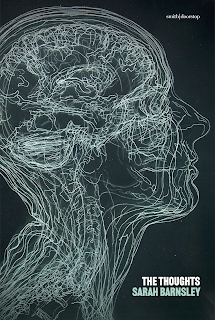
Review by Peter Raynard of "The Thoughts" by Sarah Barnsley


Sarah Barnsley’s debut collection The Thoughts is a wondrous and vital book that pushes the boundaries of what a poetry book can do and the subject it takes on - in this case, the mind (said to be medical science’s final frontier).

Divided into eight sections, (Ruminations, Compulsions, Avoidances, Magical Thinking, Thought-Action-Fusion, Formulation, Treatment, and epilogue) the book follows a coherent narrative arc, which is somewhat ironic given the chaotic experience of compulsive thinking.

Such thinking goes beyond excessive worrying or extended bouts of rumination. ‘The Next Poem’ shows this starkly: ‘I would have to touch everything in my box room in a specified order … and if I got it wrong I had to start over.’ Then in ‘The Thoughts,’ the poem is set out as a table of text with a list of examples (‘grabbing money from naked strangers in bank’) with a box to measure distress levels. In ‘The Horse,’ the metaphorical equine mind is anxious about choking on an apple: ‘and the more the horse tried / to swat the thought away / the more the apple grew.’ 

The approach taken by Barnsley perfectly fits the subject at hand. The poems come in many forms, from your expected black-on-white lineation to the downright surreal - as a questionnaire, a puzzle, funding proposal, and PhD Viva that draws on Barnsley’s experience as an academic. This makes the subject of intrusive and uncontrollable thoughts all the more direct by putting them in everyday examples.

The penultimate poem, ‘Examples,’ was, to my mind, the most moving, as it shows how common compulsive thoughts are in society: ‘We are pilots, lorry drivers, lawyers, firefighters, artists, opticians,’ as well as the types of thoughts they have: ‘an office worker who thought he’d blow up the building / if he switched on the lights.’ Exposure and challenging thoughts are two of the main strategies in treating compulsive thinking. 

This is a superb collection, smattered with humour, that shows a condition many experience but is rarely talked about - one of the many invisible disabilities, and one which Barnsley bravely makes visible.


About the reviewer
Peter Raynard’s two books of poetry are Precarious (Smokestack Books, 2018) and The Combination: A Poetic Coupling of the Communist Manifesto (Culture Matters, 2018). His third book Manland will be published by Nine Arches Press in June 2022.

Thursday, 13 January 2022

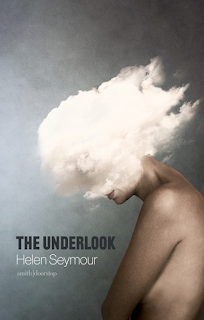
Review by Peter Raynard of "The Underlook" by Helen Seymour


In Helen Seymour’s fantastic debut collection, the poems fizz with controlled anger, satire, and surreal examples of how we navigate a society that constantly dehumanises disabled people.

A lot of the poems echoed my own experience as a disabled person: ending up in A&E and being asked your level of pain from nought to ten: "you have to say nine; if you say ten they think you’re being over-dramatic." Or, feeling disembodied when your condition is being described by a health professional, as Seymour describes in a sequence of short prose poems, "24 Hours in A&E": "Before they clean the blood off, they lever out the driftwood," and in the list poem "Spinal Fusion," where each line begins "the patient will …"

There is a central sequence, "Where is Hugo," about an abduction of a pig by a vegan, with a stand-out sestina "Chase the Forest," which like a number of the poems leaves you breathless with its pace and message. In "My Time in the Hospital," Seymour subverts the idea of passivity, with short lines and direct tense: "Mate, mate - / honestly - / I’m breathing with three lungs."

The most shocking poems are where Seymour rearranges the words of official reports, which further demonstrates the alienation of disabled people. In "Case dismissed of Slaying of Deformed Baby," a baby with a cleft palate was thrown to the floor at birth, and the perpetrator unpunished. The jolting juxtaposition of the words reflects society’s cognitive dissonance and lack of accountability: "Slammed one. Slammed seven. Bring in a realizing. Murder appealed the murder. Sustain."

Seymour utilises the surreal and satire to face up to such injustices and there is much arresting imagery; "I’m sucking in the air of a bouncy castle / breathing in the bumps." Not only is this an impressive debut, it is an impressive and urgent collection, full stop.


About the reviewer
Peter Raynard’s two books of poetry are Precarious (Smokestack Books, 2018) and The Combination: A Poetic Coupling of the Communist Manifesto (Culture Matters, 2018). His third book Manland will be published by Nine Arches Press in June 2022.


Friday, 16 July 2021

Review by Vic Pickup of "Have a nice weekend I think you're interesting" by Lucy Holt


This pamphlet is eclectic and captivating. Described by Ella Frears as ‘sharp, surprising and very funny,’ its pointed couplets present a myriad of observations – from eyelash curlers and windsocks to Coronation Street – appealing to the reader to revisit these poems and see what else they can find in this box filled with random treasures. 

The poet writes in short phrases or sentences, with focused images or ideas which are often tenuously tied together. Holt avoids punctuation, using line breaks to give just enough clarity for ideas or images to be interpreted and threaded together by the reader. 

In ‘Blue light, morning,’ Holt concludes: ‘knowing things named for revenge / rarely bring it.’ It’s this kind of philosophy-in-passing which demands more than a moment’s consideration, and which allows these poems the space they need to resonate. 

One of my favourite couplets features in ‘Timperley’: ‘I have loved men from the coast who cannot swim / I am always seeking a challenge.’ The irony here is marvellous, the phrasing deadpan. Is it the challenge of teaching these men how to swim, or the question hovering over the character of someone who lives by the sea but is not sufficiently equipped to enter it? 

Black humour is also present in ‘COS woman’: 

          a windsock woman
          I am capacious and shakeable

          … serious like wearing lead clogs
          to breakfast

These two images stuck with me (I doubt I’ll again see a windsock without empathising with it). Holt is brilliant at capturing this dry wit on the page, but she’s also highly eloquent in her descriptions, which are every bit as precise, as in ‘Entertaining’: 

         on the drive home
         I push my palms to the sunroof
         feeling for weak points

The title poem’s interlinking couplets present a rather shocking image, which says a great deal about a relationship, self-worth and perhaps even abuse: 

          I am face blind apart from 
          you sometimes

          and at night you roll me
          across the wet grass

          to a gentle stop
          outside my mother’s porch

Ultimately, I loved Holt’s gift for concise imagery and her sharp wit which resonates throughout this pamphlet. I admire the control the poet displays, knowing how to piece seemingly conflicting ideas together and, in doing so, invite the reader to fill the gaps. 

What really won me over is that, above all, I found this pamphlet personal and relatable. See ‘Lessons in gifting’:

         What does it mean to be a woman today
         reading the slogan lingerie for women who don’t do lingerie
             wondering to what extent you do?

         I have owned the same pyjama bottoms for a decade
         there never was a shirt

The poet thinks of themselves as an oddity, with things not quite fitting. This is consolidated in ‘Birds as consolation,’ as Holt explores this sense of alienation further:

           I’m jealous of stupid birds who are sincere
          and can murmurate – yes – murmurate
          without knowing
          how embarrassing it is to lean in

Yes, there is awkwardness here, but there is also intelligence and truth – as in ‘There is no word for this in German’:

          In the third decade of the twenty-first century
          it is illegal to be bored
          of your most persistent self

          In the third decade of the twenty-first century
          you have stopped shopping for clothes
          there is a group chat for all mankind you are admin

This poet has to no reason to be jealous of birds for their direction or natural instincts – she possesses both in the careful, measured craft of her poems, which say so much about herself, the world, and indeed, our place within it all. 


About the reviewer
Vic Pickup is a previous winner of the Café Writers and Cupid’s Arrow Competitions, and shortlisted for the National Poetry Day #speakyourtruth prize on YouTube. Lost & Found is Vic’s debut pamphlet, published by Hedgehog Poetry Press and featuring Pushcart-nominated poem ‘Social Distancing.’ @vicpickup / www.vicpickup.com

You can read a review of Lost & Found on Everybody's Reviewing here.


Monday, 5 July 2021

Review by Vic Pickup of "Ugly Bird" by Lauren Hollingsworth-Smith


There are no ‘fillers’ in Ugly Bird – each poem exists as its own chapter, singing in a different voice, to a new tune. Together, this pamphlet is filled with wit, gorgeous imagery and stark honesty that’s raw, personal, universal.

Hollingsworth-Smith tackles a myriad of issues in this collection. In ‘Cappuccinos,’ she addresses the difficulties faced by a family attempting to deal with a suicide attempt:

          We don’t talk about the night I howled
          like someone had shoved a skewer through my earhole.
          Or about how Mum, unable to escape my crying,
          made me a cup of tea and threw it at the wall.

Using just the right measure of shock-invoking lines to impact the reader, in amongst the refrain: ‘We don’t talk about,’ she follows in the third stanza with:

          ... the packets of paracetamols, about how my sister
          slapped me and stuck her fingers down my throat.
          How I buckled like a breaking wave, retching

This is powerful writing, and one of many serious subjects addressed in the pamphlet. Vulnerability and female empowerment are her themes in ‘It’s Okay to Break’:

         So break down, fall apart, crumble.
         Let the shoots push through.
         Let the wolf leap out. 

In a similar vein, the poet gives her support to the underdog in ‘Ruben’s Grin’ with a brilliantly observed depiction of a school outcast, and how he finds escapism by sharing a world of his own creation. Hollingsworth-Smith handles subjects with carefully judged sensitivity and boldness, judging the impact upon a reader perfectly. Following a beautiful poem about ‘Painting People,’ she skips to ‘Meritocracy’ – a belter of a poem about the disturbing privileges afforded to those undeserving. Everything here matters.

That said, what I love most about this collection is how the poet weaves such poems together with others more sensitive, subtle and humorous, but all still profound in their own way. ‘Dunnock’ is an excellent example, with the discovery of the bird’s polyamorous nature making a mockery of the Victorian priests, who referred to the Dunnock as a model for working-class behaviour ‘because of its dull, quiet and conservative nature’: ‘He winks, that Jack the Lad, chirps out a friendly fuck you – / I am the dunnock and I like to screw.’

This poet even had me genuinely contemplating the world through the eyes of a toilet in ‘I’ve seen it all.’ (Trust me, you will too.)  

At such a young age, it’s remarkable that this poet can see the world with such introspection and empathy – and has the skill to express herself to great effect. Hollingsworth-Smith is clearly a bright star in the next generation of poets.


About the reviewer
Vic Pickup is a previous winner of the Café Writers and Cupid’s Arrow Competitions, and shortlisted for the National Poetry Day #speakyourtruth prize on YouTube. Lost & Found is Vic’s debut pamphlet, published by Hedgehog Poetry Press and featuring Pushcart-nominated poem ‘Social Distancing.’ @vicpickup / www.vicpickup.com

You can read a review of Lost & Found on Everybody's Reviewing here.

Monday, 1 March 2021

Review by Neil Fulwood of "The Last Dinosaur in Doncaster" by Sarah Wimbush


When a pamphlet wins a major competition adjudicated by such luminaries as Imtiaz Dharker and Ian McMillan - and when a number of the poems within that pamphlet have been placed in or won the Mslexia, Red Shed, Live Cannon International and Bread & Roses Poetry Competitions (and others: the acknowledgements page does some heavy lifting) - it’s a safe guess that the reader is in for some good poetry.

The Last Dinosaur in Doncaster isn’t just good; it’s as good as it gets. As a second salvo following the Seren pamphlet Bloodlines (2019), which explored the poet’s Traveller heritage, it doubles down on that work’s statement of intent, that establishes Wimbush as a major new talent, a distinctive voice, in British poetry. 

Broadly, The Last Dinosaur in Doncaster explores geography, class, recent history (key poems take the 1984-85 miners’ strike as a backdrop), heritage and landscapes, both internal and external. There is arguably more going on in its 35 pages than many a full-length collection achieves. I could easily write a couple of thousand words by way of review, studded with any number of eminently quotable excerpts, but for reasons of brevity, ‘The Lost’ serves as an exemplar of the pamphlet’s aesthetic. A social history linking people to jobs and places, it unspools through two pages, moving from nostalgia 

          Elsie’s grand-kiddies scrubbed up nice
          on Saturdays at Greyfriars Baths,
          changing them in poolside cubicles,
          all their worldly goods in one wire basket

to the starker realities of those times:

          the seven lads who never came back
          ...
          while the filthy rich lorded it in NCB’s Coal House
          and Plant

to the socio-economic changes that bring the poem up to date:

          ... the factories turned call centres,
          the schoolyards, the ginnels, the smokeless chimneys
          and beneath them, beneath all that, those lost men,
          and all that blackness still down there.

This is muscular poetry, wrought with precision and loaded with experience. Mordant humour runs through it. Wimbush has a keen eye for human foibles, and heart and talent big enough to transform them into art.


About the reviewer
Neil Fulwood was born in Nottingham, where he still lives and works. He is the author of two poetry collections with Shoestring Press, No Avoiding It and Can’t Take Me Anywhere, with a third forthcoming in June 2021.