Showing posts with label Theatre. Show all posts

Monday, 2 December 2024

Interview with Louise Powell


Dr Louise Powell is an award-winning working-class writer from Middlesbrough. She is the winner of the Sid Chaplin Northern Writer’s Award 2023 for her novel-in-progress and was jointly awarded the Peter Lathan Prize for New Playwriting 2022 for a one-act play. Louise is the author of the Coal Face collections of verbatim poetry, published by Redhills in 2023 and 2024. Her scripts have been broadcast on BBC Radio 4 Extra and performed at nine theatres, including Live Theatre, The Customs House and The Tristan Bates Theatre. She has written short films and podcasts and her memoir essay was published in Kit De Waal’s acclaimed Common People anthology. Louise has a PhD in English from Sheffield Hallam University, and her research is widely published in journals and educational magazines. She also holds a Professional Greyhound Trainers Licence from the Greyhound Board of Great Britain.

Louise’s latest podcast project can be found hereAnd you can find out more about Louise and her forthcoming projects by visiting her website here


Interviewed by Kathy Hoyle

KH: Hi Louise. It’s a real pleasure to speak with you today. You describe yourself as a working-class writer. Although I also describe myself as such, I often find it quite a tricky thing to define. What does the term ‘working-class writing’ mean to you? 

LP: It’s a real pleasure to speak to you too, Kathy; thank you for having me! 

That’s such an interesting opening question. When I was on the Common People Professional Development Programme, Kit de Waal gave a talk about her writing and class identity. She said, ‘I’m working class, I feel it in my bones’ – and for me, the same sentiment applies to working-class writing. It’s writing which speaks to my life, whether through the characters, the turns of phrase or the setting. It’s writing with a truth to it; writing which doesn’t exoticise or denigrate the subjects. Writing which could be about characters who are in work or out of it; picking up a wage or receiving long-term benefits due to ill health.

I know that some writers, who grew up as I did in a family in receipt of benefits, like to use the term ‘benefits class.’ While I understand and respect that decision, I don’t use that term about myself because I strongly believe that class identity is about more than work. It’s also about values, communities; solidarity in the funniest and the grimmest of times. 

It’s about that feeling in the bones.

KH: Your work is fascinating, and it spans almost every genre, poetry, fiction, playwriting, podcasting and filmmaking. Do you have a preference for a particular creative outlet?

LP: I think it’s not so much a question of which form I prefer, but rather which form best fits the story to be told. If I’m working with a community, then I’ll think about forms such as verbatim poetry or audio, which foreground their voices and render me much less visible. If it’s a story which needs to be encountered in real time, I’ll think about theatre. More complex stories lend themselves to prose, while strongly visual stories need to be filmed. 

There’s so much to learn from working across different forms in terms of craft and audience. I like to have multiple projects in different forms on the go at any given time. I enjoy the variety and find that if one project gets stuck, immersing myself in a different projects in a different form really helps me to find the solution to it.

KH: My own research delves into oral history and regional dialect. I use oral histories to ‘capture’ authentic dialogue and use it in my work. You’ve also been involved in several oral history projects. Tell us about those. 

LP: I’ve recently worked on two substantial Arts Council-funded oral history projects: Dogpeople and Coal Face. Dogpeople uses oral histories to build a social history of flapping (greyhound racing at independent tracks) in County Durham. I grew up racing dogs at those tracks with my family, and the world has inspired a lot of creative work, including a novel which I’ll discuss later. Yet I wanted to carry out a project which allowed other people from within the community to tell their stories about the tracks. I worked the raw oral histories into an 8 x 20” podcast series. I also developed a Project Blog with Guest Writers, held a Community Exhibition at Wheatley Hill Heritage Centre and hosted Listening Parties, where participants could come together and listen to the podcasts.

Coal Face, meanwhile, uses oral histories to preserve the stories of coalfield communities in the words of the people are part of them. I take the raw interviews and weave them into a series of verbatim poems. Some of the poems tell an individual’s story, while others bring together all of the interviewees in order to present a wider narrative about such themes as the development of Washington New Town, the 84-85 Miners’ Strike, or what it felt like to work down the pit. These pieces have then been published by Redhills CIO in two books, in which my poetry sits alongside Sunderland photographer Andy Martin’s stunning portraiture. The writing and images have also been exhibited at Washington F-Pit Museum, and we’re due to exhibit new work at Sunderland Museum and Winter Gardens from 1 February – 15 March. Redhills will also publish a third book of writing and photography in time for the exhibition, and there will be a 6 x 20” series of podcasts featuring some of the oral histories, as well as a programme of community events.

One of the loveliest things about working with oral histories is getting to speak to such a wide variety of people. Each participant has a different – but equally fascinating – story to tell, and it’s a privilege to give them the space and the time to tell it. It’s also incredibly rewarding to see their enthusiasm for the finished outcome, be that a podcast, event or poem. There’s a great deal of trust involved in working with oral histories, and that’s something I’m always conscious of honouring when writing with them. 

KH: How important is a regional ‘voice’ to you and do you think publishers / theatre practitioners are becoming more open to dialect and regional narrative voices in stories?

LP: I’m certain that if I’d had access to regional voices growing up, I’d have found a much more direct path to being a writer myself. Pretty much everything I encountered was Standard English and middle-class, which meant that I didn’t know that someone from my background could be a writer until I was in my very late 20s. Even though I now work as a professional writer, I still struggle hugely with believing that I deserve to be in this space. So much of my energy has to go into battling anxieties about not belonging and not being good enough, and that’s energy that would be much better spent on creativity. I share this because lack of regional voices has a deep and long-lasting impact, especially when it intersects with other forms of under-represented identities.

My 70,000+ word dialect novel has only been out on sub to editors for a week, so it’s too early for me to comment on publishing. In terms of theatre, I think that practitioners are becoming more open to telling stories in the voices or dialects of communities, especially in co-created work. I do still see an imbalance of representation within my home region of the North East, though. There’s definitely a preference for Newcastle-based stories, with much less interest in plays from places like the Tees Valley. Part of this is down to the fact that there are no Tees Valley producing theatres (theatres which can fund and commission new writing) for adult work, but it’s also down to a perception that Tees Valley stories are somehow of lesser value. 

t's a point which was being made to me again and again while I carried out my research for a project called ‘First Stage.’ I spoke to writers, theatremakers and other cultural professionals in order to explore the consequences of a lack of new writing and talent development in the Tees Valley. Going back to my earlier point about the deep impact of a lack of regional voices, my research found that Tees Valley creatives took longer to find out that they could have creative careers, and experienced significant geographic barriers as they tried to build those careers. I put forward a series of recommendations to address the issues and am hopeful that at least some of them will be implemented. 

KH: You hold a Professional Greyhound Trainer’s Licence and Greyhound Racing is the theme of your novel-in-progress. Tell us a little about the novel and why it’s so important to you to tell this story.  

LP: My novel is a work of literary fiction which tells the folk legend of a former miner who’s a big name at the ‘flapping’ or independent greyhound racing track of Easington. It’s set in the late 90s and written totally in the East Durham dialect. The opening 6,000 words won the Sid Chaplin Northern Writers’ Award 2023, which led to representation by my lovely agent Elise Middleton at YMU Literary, and on 13th November 2024 we sent it out on submission to editors. I can’t go into too much detail about the content at the moment, but it’s a celebration of community and family, as well as an exploration of post-industrial masculinity.

I’m incredibly nervous about the book going on submission because I’ve worked on it for almost six years, constantly experimenting, drafting and redrafting in an attempt to improve my craft. This novel also means a lot to me because I was born into the flapping community, but there’s only one track left in all of the UK now – Thornton in Scotland. The loss of our independent tracks has been devastating for our community, and I wanted to write a book which is worthy of the brilliant people who were part of it. I’ve had so much encouragement from people within my community, as well as my immediate family and organisations like New Writing North, and I really, really hope I can repay that by getting the book published.    

KH: You work closely with a variety of both regional and national groups to support emerging working-class writers and have been incredibly successful yourself to have received funding and support for several of your projects. What advice can you give to emerging writers about where to find support, both financially and creatively?

LP: That’s an incredibly kind thing to say; thank you. In terms of financial support, I’d advise emerging writers to keep an eye out for small pots of funding, often known as ‘seed commissions,’ which can give you the opportunity to try out an idea. If you get the funding and find that the idea doesn’t have legs, that’s absolutely fine, but you may find that the seed commission can be expanded into a bigger project, which may be eligible for a larger funding pot. A seed commission can also be a good opportunity for you to try out working in a new form (e.g. audio rather than flash fiction), or to test a collaboration with another writer or creative which may then bear fruit in a longer-form project. 

In terms of creative support, I’ve found X (which is still ‘Twitter’ in my mind) to be a really useful platform to connect with other writers. Networks formed through professional development opportunities or creative writing groups can also be incredibly helpful, as you’ll often find writers at a similar career stage to you. Emerging writers should also look towards their regional literature development agency as a means through which to find support, whether that’s through career advice, workshops or opportunities to meet other writers. I feel very, very lucky to live within the area which New Writing North covers, as I wouldn’t have a creative career without the brilliant team there. That said, all of the literature development agencies are doing brilliant work to support writers in a difficult climate. 

I also think it’s really important for emerging writers to know that there’s a huge disparity between the ways that organisations and institutions behave towards you when you’re commissioned or funded. Some organisations are absolutely brilliant, paying you on time and treating you like the professional that you are, while others pay you late and make you feel much less valued. I don’t say this to be negative, but because when I was starting out, I didn’t know about this disparity – so when I was treated unprofessionally, I thought it was ‘just me.’ It wasn’t until I spoke to other emerging creatives that I realised it’s sadly all too common to be undervalued and to go unpaid. 

It's a horrible situation for any writer, but particularly for one who is part of an underrepresented group. We struggle to feel like we belong to the creative industries at the best of times, and when our time and roles are undermined, it magnifies those feelings of impostor syndrome and low self-esteem which so many of us struggle with. It also puts working-class writers, many of whom are already in precarious financial positions, into real jeopardy with regards to paying the bills or covering living expenses. All of this has a knock-on effect on our mental health, our ability to create our best work and advance our careers – but often, we’re so grateful to be given any opportunity in a competitive industry that we don’t dare to say anything. I know I didn’t, for a long time.

Until I realised that by speaking up against unprofessional practices, I wasn’t just advocating for myself, but for other writers from under-represented backgrounds. If I’m unhappy with the way that I’m being treated while working under commission or receiving funding, I’ll now explain why, and work with the organisation not just to resolve the issue, but to ensure it doesn’t happen again. So my best advice for emerging writers who find themselves funded or commissioned is not to be so grateful for the work that you’ll put up with being treated badly. You – and your craft - are worth so, so much more than that.

KH: Finally, could you tell us about some of the regional writers who inspire you.

When I was sixteen, I read D. H. Lawrence’s Sons and Lovers, and it was like a match had been struck to light a fire inside of me that I didn’t know was ready to burn. It was the first time that I’d ever read a book which chronicled that fierce familial love which has underpinned my experience of working-class life, and did it in a way which was both poetic and prosaic. 

I saw something of my soul and my vocation in the first half of that novel, but I never caught another glimpse of it through A-Levels or all my seven years of University. While I studied modules on literature from the Renaissance until the present day, I was never set a text which showed the realities of working-class life that I could recognise. I’m absolutely certain that if I’d had a module which looked specifically at class, or even been made aware that such books existed, I would have found that spark before last year.

That fire was relit when I started reading the novels of Sid Chaplin. There’s such a mixture of strength and delicacy, of warmth and horror, in Chaplin’s writing, and his sense of voice is utterly remarkable. There’s a swagger and directness to the narration of The Day of the Sardine, and yet there’s a passage towards the end which is so raw and affecting that it gave me chills. I love how The Watchers and the Watched plays with the reader’s expectations of where the story will go, and I also love Chaplin’s short stories. They’re like sitting at the kitchen table, listening to an old friend tell a tale – and with oral storytelling being such an important part of my life and craft, that’s one of the highest compliments I could pay a writer.

Some of my other favourite regional books include Walter Greenwood’s Love on the Dole, as it’s one of the very few books that emotionally nails what it means to live below the poverty line, and you can tell that Greenwood was writing for his life. I’ve also enjoyed Jack Common’s Kiddar’s Luck and Thomas Callaghan’s A Lang Way to the Pawnshop, which remind me of stories I’ve heard growing up. I really admire Catherine Cookson’s The Gambling Man for how it plays with expectations of class and gender, and deeply appreciate how the dialect infuses TV adaptations of Cookson’s works. 

In terms of contemporary regional writers, I admire Benjamin Myers, whose novel Pig Iron made me realise that it was possible to tell stories in County Durham dialect. I also loved his book Cuddy not only for its stylistic ambition, but for the warmth and love which underpinned the whole work. I also love Kit de Waal’s beautiful, lucid, pinpoint-accurate prose, and deeply admire her for everything that she has done to help me and other working-class writers to develop. When Kit selected my memoir essay for publication in Common People, she set in motion a chain of events which has led to the development of my creative career, and I’d love to be able to one day pay that forward for other working-class writers.


About the interviewer
Kathy Hoyle’s work is published in literary magazines such as Northern Gravy, The Forge, Lunate, Emerge Literary Journal, New Flash Fiction Review, South Florida Poetry Journal and Fictive Dream. She has won a variety of competitions including The Bath Flash Fiction Award, The Hammond House Origins Competition and The Retreat West Flash Fiction Competition. She was recently longlisted for The Wigleaf Top 50 and her work has been nominated for Best Small Fictions, Best Microfictions and The Pushcart Prize. She is currently studying for a PhD in Creative Writing at the University of Leicester.


Monday, 4 July 2022

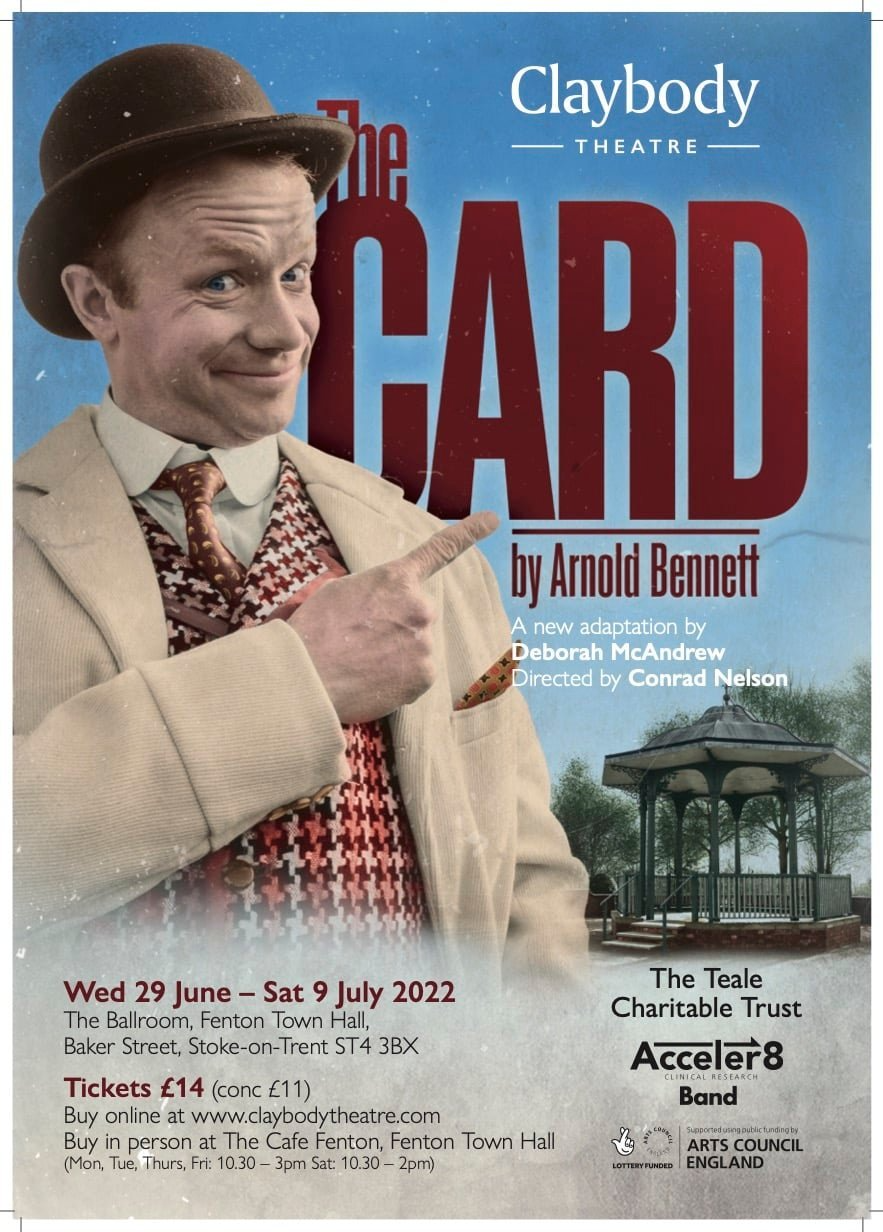
Review by Julian Salt of "The Card" by Arnold Bennett, adapted by Deborah McAndrew, with the Claybody Theatre


My wife and I have just seen a stunning adaptation of Arnold Bennett’s The Card. Claybody Theatre's Deborah McAndrew, writer, and Conrad Nelson, director, have produced an enthralling masterpiece which should not be missed. The seven professional actors / musicians with supporting brass band and the enthusiastic entourage of Claybody volunteers created a gem of a riotous romp from start to finish. The actors played multiple roles and were all accomplished singers and dancers.

Bennett’s novel showed how with ‘dash’ we can break through adversity and ;cheer up' the world. O how we need  this today! McAndrew's and Nelson’s genius warms the heart and  makes you want to unleash the Denry in us all … we loved every moment of it!

Well done especially to the supporting cast of Claybody Theatre's volunteers. On a shoestring you have produced a most memorable show, which fully deserves a wider audience.

The renovated Fenton Town Hall gave the performance authenticity and a historical canvas exuding its own vibe, which served to enhance this exquisite production.

After watching Deborah McAndrew, the writer, pick up a basket of the actors' clothes and take them away to wash them, ready for tomorrow's performance, we appreciated the work ethic she shares with the whole of her team. The way the actors gave freely of their time afterwards reflected their wholehearted approach to the project. Celebrating the Potteries and Fenton, (the missing sixth town) in Fenton Town Hall, this masterpiece was given a magical authenticity. 

Throughout, the show was a rich kaleidoscope of polkas and waltzes, shanties and folk songs, Potteries humour and dramatic irony all of which warmed our  hearts in these cold Putinized days. From shades of unscrupulous landlords to excursions to Llandudno, from love to ambition and greed, politics and intrigue, all were combined within a simple tale of a Stokie who made good.

McAndrew, originally from Leeds and Conrad from Liverpool - we salute you. Welcome to The Potteries Hall of Fame for writing and directing such a stunning show! 


About the reviewer
Julian Salt is a retired Psychologist born in Fenton, who now lives in Derbyshire and enjoys revisiting his roots.

You can read another review of this adaptation of The Card here


Friday, 1 July 2022

Review by Carolyn Ruane of "The Card" by Arnold Bennett, adapted by Deborah McAndrew, with the Claybody Theatre


I went to the opening night of this new adaptation of Arnold Bennett's novel, The Card, adapted by Deborah McAndrew, with the Claybody Theatre in Fenton Town Hall, Stoke-on-Trent.

The show is stupendous. Gareth Cassidy is amazing as Denry Machin. The part that amused me most was Howard Chadwick playing Mrs Machin; he was hilarious. 

The singing and dancing are preformed very well. It was slick. No first night nerves! The way the cast go out of one door, and then reappear through another door with a change of clothes is fabulous. 

The canal scene is done really well: you really feel worried about the water coming in. It's believable. The runaway horse is great and again you feel the action. 

The fact most of the cast play multiple parts does work really well. 


About the reviewer
Carolyn Ruane is from Stoke on Trent. She is a keen member of the Arnold Bennett Society. She enjoys plays at the theatre and is an avid reader. 


Tuesday, 25 August 2020

Review by Robert Richardson of "Hamlet" starring Nicol Williamson and dir. Tony Richardson, Movie and Theatre Production at the Roundhouse, London, 1969


It was London in 1969. The fashion-led and pop music-centred frivolity of Swinging London (after The Beatles moved from Liverpool to the capital) had to some extent been supplanted by an “underground” influenced by the counterculture of San Francisco, but with its own distinctive twists of psychedelia and left wing or anarchist politics.

A production of Hamlet at the Roundhouse in Chalk Farm began with considerable media attention, and this was focused on Marianne Faithfull playing Ophelia. She had scored several pop hits, the first, As Tears Go By, was written by Mick Jagger and Keith Richards, and she was now in a relationship with Jagger: they were the popular culture power-couple of late 60s Britain.

The media frenzy continued, but the narrative changed. When the reviews began appearing, the big story was Nicol Williamson’s performance as Hamlet. It became clear this was very special and might be considered as one of the twentieth century’s most important interpretations of the role, ranking alongside Gielgud and Olivier.

Being described as sensational, it was, for sure, a hot ticket, and the details of how I came to see it are now somewhat vague. From the year, I think this is the explanation: at that time I was living very close to London and studying at a further education college, where I was also a member of an evening drama group. Our leader was George, a young English and Drama lecturer and recent Cambridge graduate. I am fairly sure it was George who acquired some tickets and took a small group of us to the Roundhouse. More certain is the impression made by Nicol Williamson’s incredible acting. Over fifty years later, it is something that remains with me.

I had already seen Laurence Olivier’s Oscar winning film of Hamlet, and the enduring and most iconic scene was for me, and I suspect for many others, the ‘To Be or Not to Be’ soliloquy, shot as a powerful Romantic pose accompanied by a dream like voice-over, luxurious in a poetry of indecision. If Olivier’s performance might be seen as one kind of measure, then Williamson took that measure and wilfully smashed it to pieces. Where Olivier was reflective, Williamson was dynamic. His performance, though, was beyond the merely energetic, it was manic. As a broad outline, I often describe it as playing Hamlet as a nervous wreck. Hamlet’s vacillations were not philosophical musing, but a living reality of frustration and rage. There was a ratcheting up of his desire to exact the cruellest possible revenge on Claudius. Williamson realised that with Shakespeare the poetry can be trusted to take care of itself, and he traded a carefully enunciated rendering for the power of a singular performance. His nasal voice at times modulated into one extremely suitable for expressing an aggressive bitterness. He eschewed declamation in favour of a more conversational tone and moments of cutting cynicism and sarcasm. 

The other role Williamson is most remembered for is Bill Maitland in John Osborne’s Inadmissible Evidence, performed, earlier in his career, to much acclaim in both London and New York, and it was also filmed. The character is in despair at the state of his life, and the nervous anger Williamson presented, a frightening intensity on the brink of madness, might be seen, at least in part, as a template for his portrayal of Hamlet. 

As a person, Williamson was complex, troubled and difficult. He had a problem with alcohol and a proclivity for fast living. When playing King Lear at a small theatre in north Wales, the director cancelled the second night, knowing Williamson would party so hard after the first night that it would not be possible (the performances resumed again on what should have been the third night). He also had anger management problems, and on more than one occasion landed blows against a fellow actor or a producer. At one point in the 1970s, he walked out of The Dick Cavett Show, at the time one of America’s leading chat shows, just prior to a scheduled appearance. His own volatility was, it seems, imported into Hamlet, understanding the character partly, and inevitably, through those aspects of himself he must have considered valid for his incendiary interpretation.

Later in 1969, it was decided this production must be filmed for posterity. As with the play, the director was Tony Richardson. I did not watch the film, thinking it might subvert my memory of its theatrical origins. Until now, when I decided it would probably be a valuable addition to this piece. All of the sets were within the Roundhouse, which, as its name suggests, is a theatre-in-the-round (used as both a rock music and theatre venue). For Hamlet, it also became a film studio. The film is not just documentation, but valid as cinema, and the many close-ups do not in any way detract from Williamson’s performance, on the contrary they provide yet another cause for admiration. Stating the obvious, it is, though, a recording of Nicol Williamson playing Hamlet and not the actual Nicol Williamson I was privileged to experience in a performance now lost forever: a series of moments on a particular night, when something approaching farce occurred: Williamson’s pacey movements shifted the dagger round his waist to the middle of his back, where it dangled between his legs. In response to the phallic connotation, there were a few giggles from the audience, and I doubt if I was the only one thinking ‘if he sits down now, he will have a nasty surprise.’ He didn’t, and that part of the action soon ended. Did this detract from his performance? At that point, a little bit, since it became unintentional Brechtian alienation, and if he wasn’t aware of it, and I don’t think he was, a type of dramatic irony might also be argued. In retrospect, it emphasises a strength of theatre: it is an art form that inhabits the actual stuff of living, with all its unpredictability. In film there would have been a ‘take 2’ and I am pleased that I saw the 'real thing’ when that could not happen. Theatre also means a third dimension, and it was amazing to be close to the actual space Nicol Williamson was moving through, because movement was a crucial part of his performance. Nevertheless I would encourage people to watch the film. The DVD I received was produced for the Italian market, but it was fine and the subtitles could be switched off. There are a few extracts on YouTube, and again I would encourage tracking down everything there with Nicol Williamson, including interviews. Why? Because he was an exceptionally great actor, and there are never many of those.                                                                                        


About the reviewer

Robert Richardson is a visual artist and writer living in Leicestershire. His work is included in Artists’ Postcards: A Compendium (Reaktion Books, London) and Leeds Postcards (Four Corners Books, London). He has graphic artworks in collections of the British Museum and the Australian National Gallery. In 2018, he had a solo exhibition of photographs, Luz Brilhante, at the Museu Municipal, one of the leading museums in Faro, Portugal. In the last few years he has produced a portfolio of digital artworks, some of which are now available as limited edition prints. www.robertrichardson.art


Friday, 9 March 2018

Interview with Matthew Broughton


Matthew Broughton has written widely for TV, film, radio and theatre. His most recent work for radio includes the award-winning series Tracks, and the comedy-drama Vincent Price and the Horror of the English Blood Beast, both for BBC Radio 4.  His website is https://matthewbroughton.wordpress.com/


Interviewed by Lee Wright

LW: How did you first come to write, and what was your breakthrough moment as a writer?  


MB: I can’t remember a time when I didn’t write. It started happening at a very early age, and the writing was always drama, scenarios, characters, and dialogue. Not prose or poetry. Things have generally happened by gradations, but there have been several moments along the way that have felt like a palpable step forward. When no one else was interested, a London fringe theatre company staged a play I sent them, then made me writer in residence. From that series of plays I got representation; getting my first film and TV commissions; working with Complicite (British theatre company); getting a screenplay filmed and broadcast for the first time (it appeared on the launch night of BBC 4). Also, I came very late to audio drama, but as soon as I started writing for the radio I felt immediately at home, so that first Radio 3 drama commission was a step forward moment too.


LW: You’ve written for TV, film, radio and theatre. Could you tell us about the different genres, and which you have most enjoyed doing? 


MB: Essentially, if you’re doing it right, they’re all the same. They all concern creating interesting characters, scenarios, compelling images, dialogue, and story. The only differences between them are purely technical. I enjoy them all and wouldn’t want to choose between them, but each in its way has challenges too. Here’s what I like or find interesting about each one …


For me, film is about placing characters in a landscape/world. Less is more, and at best it can feel mythic and pure. 


TV is very immediate, detailed, and often more disposable. When a large audience engages it can be intense, thrilling, and satisfying. 


Theatre is alive and the work constantly changes and evolves over a run. The drama lives and breathes in the moment, and a play is never finished, the work never complete. 


Radio has the writer at the centre of the experience working closely with the director/producer and actors. And the relationship with the listener is very intimate. You’re whispering into ears. Writer and listener make a pact to create the images between them. Imagination meets imagination. We meet half way.


LW: Your radio drama, Vincent Price and the Horror of the English Blood Beast, was a fictionalised look behind the scenes of the movie Witchfinder General and the working relationship between the American horror actor and British director Michael Reeves. 

How long did you work on this drama for and how did you first come up with the idea?    

MB: The Witchfinder play happened very quickly. A drama that had been commissioned for the Radio 4 Saturday afternoon slot was withdrawn late in the development process, meaning a gap had opened up (which is incredibly rare – it never happens). I was asked if I had any ideas to fill the space.  I’d always loved and had an interest in the Witchfinder General, and I’d enjoyed the legendary stories surrounding its creation. The world of the British Film Industry in the 1960s was pretty fascinating too!  The relationship between Vincent Price and Michael Reeves struck me as tense and creative. A fascinating clash of culture, generation, outlook, and personality. It also seemed very funny too.  


The film that resulted from the tensions, I felt, had a kind of gamey magic. Even though it’s now a bit dated, it still transcends its genre and touches on deeper, darker fears in ways that are unexpected and provocative. There aren’t many films that achieve that alchemy. 

I thought it would be good to explore and understand how that unlikely magic was achieved and felt that, like the film itself, a drama about it could be larger than the sum of its parts.  
I’d made notes on the subject long before I knew what I might do with them, so dug these out and developed them into a brief pitching treatment for R4 commissioning. (My notebooks are filled with ideas, and half-notions for stories like this, you never know which ones are going to fly until they do).

The Radio 4 commissioner offered me the slot and, with time being tight, I researched and wrote the play in 2 or 3 drafts over a few weeks. The process included visiting the BFI library, looking through Michael Reeves’ own scrapbooks and notebooks, speaking with his friends and colleagues, including some of the actors and crew from the original film; reading every available book on the subject, and watching lots of related film material from the era. 

It was an energizing period and very enjoyable.

I’ve worked on a number of projects over the years where real-life people are the subject: Keith Moon, Oliver Reed, Charles Manson, Marvin Gaye, Frank Zappa, Salvador Dali, and others. It’s challenging, but rewarding to get under real skin, and to try to inhabit real voices and lives.


By the end the Witchfinder experience I felt I’d got a handle on "Vinny Price and Mike Reeves." Both were driven characters of great talent, and both were vulnerable, insecure, and fragile too. Reeves was so young (he died aged 25) but had such amazing focus and ambition, and was so accomplished in his filmmaking that he seemed much older. But, looking through his scrapbooks, and seeing how he’d glued in his reviews and made little notes beside them, you could see his youth, enthusiasm and aspirations shining through. It was relatable, and very touching.


So, the play grew out of a curiosity in the subject matter, the opportunity of the cancelled play, and the discoveries made during the research.


LW:  What does a “typical” writing day involve for you?


MB: Chaos. Denial. And occasional small moments of clarity.


LW: Have you ever attempted to write a novel?


MB: No. And hadn’t thought about it until recently, when I was asked if I’d consider writing Tracks, my radio series, as a novel. (I’m still undecided). I think I do have an idea for one now though, so perhaps one day …

LW: What advice would you give to someone hoping for a career in writing? 


MB: Do what you have to do.


About the interviewer
Lee Wright was born in Nuneaton, Warwickshire in 1980 and has been writing both fiction and non-fiction since 2008. He is taking an MA in Creative Writing at the University of Leicester.
Saturday, 11 February 2017

Review by Beth Gaylard of "Collegiate" by Natalie Beech, Brigitte Adela and Written Foundations Theatre Company


Collegiate is a production by Written Foundations Theatre Company, a partnership of director Brigitte Adela with playwright Natalie Beech.  Original music (by Selim Ben Rabha and Matthew Daly) and lighting were elegantly worked out to complement the drama, without distracting from it. I saw it in the Attenborough Arts Centre, Leicester.

Set on a campus in freshers’ week, Collegiate is a story about friendship and pseudo-friendship, as well as sexual politics. At the heart of the play is a rape, which is not accepted as such by any of the characters, not even at times, by Tash (played by Rebecca Tubridy) to whom it happens. The brutality of the assault (not portrayed graphically) is matched by the nastiness of Tash’s and Kev’s friends. Tash’s friends scrutinise her behaviour and withdraw their affection in the aftermath of the assault - while Kev (played by Stephen Love) is the butt of more savvy young men, whose laddism contributes to the events. It’s the laddism that is really under scrutiny here – the play effectively challenges assumptions about sexual consent.
  
The portrayal of Tash’s situation (and its consequences) avoids the ‘victim’ stereotypes associated with those who’ve suffered a sexual assault, focussing on the personal horror – the uniqueness of the experience and the isolation it brings in its wake, as onlookers decide for themselves who’s at fault. 

All this is conveyed through a fast-moving script and excellent acting. There is humour in the piece, but like the music, it complements the story and never detracts from the serious subject – and both actors convincingly portrayed the dilemmas of Tash and Kev.

This is a piece of work that deserves a wider audience – particularly of the young people it’s aimed at, so I was pleased to hear from Written Foundations hope to stage Collegiate at the Edinburgh Festival in August. Catch it if you can. And incidentally, if you happen to have any links with sixteen plus education, it would be well worth booking a performance workshop for your students, as they think about heading off for university themselves.                                     
About the reviewer
Beth Gaylard is a teacher, writer and MA  student at the University of Leicester. She lives in Leicestershire in a weird modernist house that will one day feature in a bestselling novel or film, hopefully her own.

Wednesday, 4 March 2015

Review by Nathalie Gannon of Two Destination Language's "Near Gone" at Embrace Arts, Leicester


“This is a difficult story to tell,” Katherina Radeva’s clear voice echoes around the darkened room. The set is bare, but for two long rows of white carnations framing the stage, 400 to be exact. The air is heavy with the scent of cut stems like a strange, stale garden. It is minimalistic, but it has a haunting beauty about it - funeralesque. The story is indeed a difficult one to express; delivered in a fluent and lyrical Bulgarian and juxtaposed with Alister Lownie’s stilted English translation, what is produced is a unique form of storytelling, coloured with mistranslations and pauses that reflect the limitations of language when expressing trauma and soul-wrenching emotion.

A performance that engages all the senses, Radeva and Lownie attempt to transport their audience physically and emotionally to a tragic event in which Radeva’s four-year-old sister was involved. The performance paints a vivid picture of Radeva’s family, their home in Sofia and its garden- the focal setting, through simple dialogue rhythmic with poetic repetition, and passionate yet precise physical choreography that reflects the vibrant and lively Bulgarian culture.

Initially energetic and humorous, Radeva charms the audience by insisting that the translation is rendered physically as well as verbally. She relishes in her partner’s hilariously awkward imitations of her feminine movements - his earnestness bringing a delicate intimacy to the performance and a bubble of laughter amongst the audience. As the narrative progresses it becomes labored when language fails to convey Radeva’s personal trauma as she hears of her sister’s critical condition in hospital, and is unable to do anything but wait for news.

In this performance piece of two languages, it is what is left unsaid, what is unable to be expressed, that which is without words, which Radeva wishes to convey. When words and language fail to perform their task Radeva breaks into a frenzied dance in which the neat rows of carnations are whirled and scattered haphazardly across the performance space, their broken bodies stark against the black floor reflecting emotional, mental and physical fragility.

A refreshing and honest performance that guides its audience through a full range of emotions, with a beautiful conclusion delicately framed by white carnations - the symbol of true love and good luck. An intimate yet casual setting, with the added bonus of meeting the actors after the performance, I look forward to future productions hosted by
Attenborough Arts (formerly Embrace Arts).


Two Destination Language will be performing ‘Near Gone’ in Birmingham on 14th March 2015.

About the reviewer
Nathalie Gannon is a 3rd year English student with a passion for the theatre. She spends her time costuming, writing short stories and trying desperately to get noticed.