Showing posts with label covid. Show all posts

Tuesday, 26 March 2024

Review by Gary Day of "The Silence" by Gillian Clarke


Charles Simic said that ‘poetry is a translation of the silence.’ Gillian Clarke’s collection goes a step further. It is not a translation of ‘the silence,’ whatever that may be, but an evocation of soundlessness. The world was a noisy place until Covid struck and then everything seemed to go quiet for a long time. But it was only the human world that was hushed: nature’s music continued, the wind in the trees, the songs of birds, the hiss of rain, the bark of a fox. ‘Listen’ Clarke enjoins, ‘water tells its rosary.’

The linking of natural phenomena and religious ritual is central to the volume. To that extent it brings to life Blake’s dictum that ‘everything that lives is holy.’ The reader is returned to ‘Eden before the Fall.’ Along with this restoration comes a liturgical conception of time. The first section of the collection is organised according to the canonical hours, Matins, Lauds, Prime and so on. These were times of prayer but the poems are not addressed to a creator. They are an account of daily activities and observations tinged with an awareness of the devastation of Covid. ‘We settle close, / Seek sweet diversion from the day, / Its pestilence, its wars, the daily toll, the dead.’ In times of plague, small things become precious: the ‘psalm’ of an owl, ‘the turning of a page.’

Silence is not always desirable, especially if it has been imposed. But those whose voices have been suppressed, particularly in Welsh history, find some some sort of restitution in poems like ‘Llywelyn’s Daughter’ and ‘FForest.’ Finding the balance between silence and speech in the face of great events or small incidents is the shaping force of this collection. Stunning imagery - ‘chalice of gold overflows / with a cupful of snow’ - made me feel as if I were in an art gallery while the recurrence of certain phrases creates a sense of unity as well as an incantatory effect. This superb volume gets pride of place on my poetry shelf. 


About the reviewer
Gary Day is a retired English lecturer and the author of several critical works including Literary Criticism: A New History and The Story of Drama. His debut poetry collection, The Glass Roof Falls as Rain, will be published by Holland Park Press.

Friday, 9 June 2023

Review by Colin Dardis of "Murmurations" by Clare Dwyer


The poems in Murmurations are culled from a notebook that Dwyer kept during the pandemic, written across each wave of the Coronavirus pandemic as they hit England. Forced to shield during each lockdown, cut off from the the normalities of children, grandchildren and life beyond her house, Dwyer turned to other areas of focus to dwell upon. There are three main themes at play throughout the collection: the comfort immediately found in her own garden; the wonders of space; and the sense of family, keenly missed throughout each wave. These three themes in themselves may not seem like natural bedfellows, but Dwyer balances her attention skilfully across them.

It is perhaps in the poems of the garden and of nature that Murmurations succeeds the most: not like the keen botanical slant of Michael Longley or Jean Bleakney perhaps, but more the sheer awe and childlike fascination closer to that of Mary Oliver. In the opening poem, 'Solace of a Small Bird: Wren,' the observer marks the passage of the day by the comings and goings of the bird:

           I count each one and smile,
           it is enough,
           despite these tremors
           which shake the world

This sets the mood for the book: to find solace, comfort and even entertainment in what we already have at our possession, when shut off from the rest of the world. Tickseed, acorns, birds, fern, crane flies and more are all part of Dwyer's line-up, with delight found in each.

Dwyer also takes us outside of Earth, to imagine scenes set in the allure of deep space, with reflection on meteor showers and the Hubble telescope. 'Last Letter from Mars' gives voice to the Mars Rover, close to the end of its mission: 'I am tired, my battery is low, | A storm is coming.' Here is a hint of death, and with so much of it ubiquitous on Earth, even Mars can't escape a death of sorts. Elsewhere, Dwyer conjures up the image of 'this small blue planet | caught safe within the Heliosphere' ('Star Map'), and one can't help but think that in the middle of a persistent pandemic, the use of the word 'safe' can only be ironic.

The opening of the poem 'mineshelf' neatly manages to weave the subjects of family and space together, giving a new twist to a common image seen in space exploration:

          That moment, when the module
          separates from the mothership,
          embarks on its own journey
          is akin to that moment
          when a child
          has self-recognition

Dwyer has moments of such Brautigan-esque inventiveness dotted through the book: people who 'fossilise at an early age,' the fall of post through a letterbox like 'a rapid flutter ... of sparrows,' crows picking moss off a roof to line their nests with, and using their feathers as payment. At times, however, there is an over-reliance on abstractions: the vision of meteors filled the observer with 'awe and delight,' a person and their dog return home from a walk 'curiously satisfied'; there is the insomniac's plea for sleep to 'catch my soul.'

None of these abstractions let the reader into what the speaker is really feeling, which is a shame, as Dwyer does display the ability to evoke empathy and affinity elsewhere. 'To the Other Side of Truro' charts the local landscape seen on a journey to visit family, beholding a sequence of natural marvels; and yet, when the destination is reached, granddaughters run outside in greeting 'and still, | we cannot hold each other.' The absence of a daughter is felt as 'a hard knot of loss | behind by breastbone.' Seasons change, yet Dwyer feels as if she is 'caught in amber,' absurdly preserved through the inertia of lockdowns.

 All of this takes the reader back to their own sense of longing and isolation felt through lockdown, being cut off from loved ones, and the key poem of the collection, 'The Wood-wide Web.' There is little direct address to the pandemic within Murmurations; in fact, the first mention of the C-word, 'Covid,' isn't until over thirty poems deep. But here, we see the tying together of family, togetherness distance and the impact of the pandemic in one clever extended metaphor:

           Across the woodland
           deep underground
           mycelium in intricate webs
           gossip to the trees,
           who is sick,
           who is threatened.
           The trees take care
           of their vulnerable.

Within the realm of post-pandemic literature, there is this awareness of the need for others, but there is also anger. In 'Reading Home,' there is mention of 'countless deaths | and the fall of Troy.' It doesn't take a great leap of imagination and reinvention to see 'Troy' as 'Tory.' 'A Murder of Crows' (again, the hint of death found in the collective noun) gleefully wishes for the downfall of Boris Johnson. The sense of anger though is subtle, not overwrought, and Dwyer does well not to let it distract from her main themes.

In 'Skeins,' a shrewdly constructed poem of overlapping sentences, we find the clash of escapism (the comforts of nature and family, the gazing into space) with reality: people in body-bags, overworked nurses, grief. It's a good exhibition piece for the whole of the book. Dwyer may not always push and stretch language as much as other poets, but she is comfortable in letting the subject matter speak for itself, to be that mirror held up to the world, which we all need while still reeling from the impact of Covid. And despite the lingering sense of death, there is much warmth in these poems.


About the Reviewer
Colin Dardis is a neurodivergent writer, editor and sound artist from Northern Ireland. His most recent book is Apocrypha: Collected Early Poems (Cyberwit, 2022). His work, largely influenced by his experiences with depression and Asperger's, has been published widely throughout Ireland, the UK and USA. 

You can read more about Murmurations by Clare Dwyer on Creative Writing at Leicester here


Wednesday, 2 February 2022

Review by Kate Durban of "My Name is Mercy" by Martin Figura


Martin Figura’s new collection was created as a project at Salisbury NHS foundation trust. These powerful poems offer a unique insight and perspective into the life of a hospital, and its inhabitants, during the pandemic. They convey the impact of Covid-19 on patients, families and staff in telling detail, resonant metaphors and poetic eloquence. The poems give us a moving glimpse of personal perspectives with great honesty and poignancy.

The collection opens with a poem about the journey to work in "Morning," which describes the stark emptiness of streets against the menace of the hospital chimneys. This evocation of place amplifies the collection. There is a sense of different worlds: the pettiness of people fighting over toilet rolls against the daily sacrifice of those battling Covid, patients and staff alike.

The experience of the illness itself is devastatingly captured in "Mother’s Day": "each deep breath coughed, the retching blue lit trip," and the fear brought by hallucinations in "Fever." There is death, but recovery too, reflected in the return of appetite: "delicious want, a little mash and gravy."

We see the experience of the health workers caring for the sick. In "Protection," the hot claustrophobia of PPE is a tempest, which soaks uniforms and leaves "faces run with rain." In "Night Shift," someone’s reflection is like an astronaut adrift from the world, in a universe of flickering monitors, once again conveying a sense of other worldliness. There is the raw grief of an end-of-life nurse who cuts short her maternity leave to come back to work and copes with seven deaths in a day. Everywhere there seems to be profound sickness, isolation and grief.

And yet even at the heart of the conflict, hope shines through these poems. There is a great sense of optimism and strength in the theme of teamwork. The poem "Notes Left Behind for a Newbie" offers encouragement by a team bound together like a raft. The perspective of staff in a variety of roles is important because it reminds us that doctors and nurses are not the only people who work in hospitals. We hear about the chaplain who ministers where he can in "the emptying out of anger or bedpans." There is the voice of the unseen pathologist in the lab and there is the care for a member of staff who has succumbed to the infection - "one of us," who expresses gratitude for "this family, these friends, this work." We hear of kindnesses - the holding of hands and the talk of home and the joy of online connections. And at the end there is the hope of new life in the Christmas day birth of Ethan. 

Martin Figura’s collection is a mighty accomplishment and by reading it I have been educated, moved and inspired.


About the reviewer
Kate Durban is an MA Creative Writing graduate from the University of Leicester and a part-time Cancer Wellbeing Nurse at Peterborough City Hospital. She lives in rural Northamptonshire with her husband Philip and two dogs. 


Monday, 10 January 2022

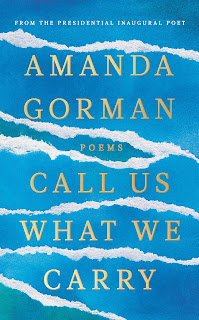
Review by Joyce Bou Charaa of "Call Us What We Carry" by Amanda Gorman


"What we carry means we survive, it is what survives us. We have survived us." These are Amanda Gorman’s words in her latest poetry collection, Call Us What We Carry. This collection is a truthful message for all who choose to carry on despite the suffering and the aching that we feel nowadays, during the ongoing global pandemic.

In her poems, Gorman reflects deeply on the emotions that everyone felt during the lockdown: the pains of sickness, the loss of the people we love, the fear and anxiety of death, and so on.

Gorman’s poems in this collection focus on all the stages that the world went through in the pandemic: from wearing masks, to the isolation at home, up till the beginning of the recovery from the virus, by seeking hope and joy amid all this misery. Accordingly, each stage has its own sequence of poems, which Gorman wrote to every person surviving this "nightmare," as she calls it.

At the end of this book, Gorman brings us hope out of poems that focus mainly on the new beginnings of tomorrow, and the blessings of the morning. She writes of hope for the future, when life will go back to normal, and when everyone will finally find peace: "For it is in loss that we truly learn to love / In this chaos, we will discover clarity."

Gorman’s words are as power for our souls, that are suffering, while hoping to live for better days ahead. Her poems help us to take a closer look into our feelings of desperation and anticipation, reflecting on one of the most dangerous diseases that has hit the entire world.


About the reviewer
Joyce Bou Charaa is a Lebanese undergraduate English student and a book reviewer, whose articles are published in The Mark Literary Review and at NewpagesShe has also studied Journalism for two years, and has an intimate knowledge of Arabic, English, and French languages.

Wednesday, 7 April 2021

Review by Neil Fulwood of "Plague Songs" by Martin Rowson


As a political cartoonist, Rowson has a distinct, immediately recognisable style. His images are exaggerated, grotesque, overblown but swimming with cruelly accurate detail: Brueghel meets Spitting Image, only funnier. 

His poetry is not dissimilar. The longest piece in Plague Songs unspools across seven pages. The majority clock in at two or three. Most poets publish individual collections of around 50-60 pages; Plague Songs runs to over 260. 

Rowson’s subject is COVID-19 by way of the first lockdown, government ineptitude, media inanity and the abject surrealism of being alive (but only just) during 2020. As he explains in the foreword, he wrote a poem more or less daily between mid May and late November, railing at anything from Matt Hancock to Death himself (several poems mourn the passing of a long-time friend), and in compiling them for Plague Songs an editorial decision was made to leave them in their original, often first, draft. Hence, the rough and ready, raw, sometimes self-indulgent, unmediated aesthetic that defines the collection. 

They are also frequently offensive. When Rowson has a target in sight, be it a senior cabinet minister or the virus itself, everything is fair game and no quarter is asked or given. Nothing is off limits. The scatological becomes merely another poetic device. The language is saltier than that of a bad-tempered sailor with Tourette’s. Plague Songs is not for the faint-hearted or the easily offended.

What it most emphatically is, however, is the most honest literary response to 2020 that has yet to hit the bookshelves. It’s often said that we don’t get the heroes we want but the heroes we need. In Martin Rowson, we have that hero. Just don’t expect a cape or PG-rated content.


About the reviewer
Neil Fulwood was born in Nottingham, where he still lives and works. He is the author of two poetry collections with Shoestring Press, No Avoiding It and Can’t Take Me Anywhere, with a third forthcoming in June 2021.

You can read more about Can't Take Me Anywhere on Creative Writing at Leicester here.


Tuesday, 9 March 2021

Review by Sue Mackrell of "Whose hand would you like to hold ..." by Patricia McCarthy


Patricia McCarthy’s poignantly titled chapbook, written during the first lockdown, invites us to ‘Draw the curtains, light the candle.’ It is ‘Time to sit as the Brontes did,’ she says, ‘Fight off the attacker’ and write. She tells us: ‘Emily will scribble – /with yours – her secrets, fast as she can.’ The predator stalking the Brontes was tuberculosis. For us, Covid 19 has forced us into introspection, to explore the ‘geography of the heart, ‘... deciphering more / about your selves than ever you knew.’ McCarthy asks us to ‘Reflect on those stolen moments / of grace; re-live them despite your skin-hunger,' to ‘think whose hand you would like / to hold one last time, then press softly to your lips.’ 

A thematic link in this cycle of poems is past epidemics, plagues, and pestilences, a seeking of causes and cures. The poet describes her own experience of polio, an evocative portrayal of a 1950s childhood watched from a sick bed, recalling images of ‘tiny faces peering, as if from Advent calendars, from communal iron lungs.’ 

The course of the lockdown in these poems is charted in the heavens; in March, Venus is ‘bright as a searchlight / over all our lives.’  In times past three ‘super-moons’ in as many months would be a sure sign of planetary maleficence; 'influenza' comes from medieval Latin, meaning ‘influence of the stars.’ Ancient Native American names for the moon are invoked, the ‘worm moon,’ when the earth is warm enough for worms to become active and begin the growth season, the ‘pink moon’ when wild ground phlox of that colour is in bloom. The poems are woven together with children’s rhymes, old country sayings, and ancient oracles. Natural phenomena are interpreted as auguries – flights of swallows, skeins of geese, oak branches offer portents of the future.

McCarthy writes of a close relationship with horses, observing how they can survive the brutality of humans, and understand death better than us. A deep connectedness to the natural world gives authenticity to the poems in this chapbook;  flowers blooming and fading mark the passing of spring into summer, from the primroses and daffodils of March, to June wedding roses ‘with no bride to wander under their perfumed roof,’  through to the first of the Michaelmas daisies. 

There is deep sympathy for those denied their solace, ‘Terrible to get the sun only by balancing / an arm or a leg on a window- ledge.’ McCarthy remembers those in care homes, ’The forgotten ones who have forgotten themselves: / see them stare out behind barred windows.’ She  writes with tenderness about her mother, 'suddenly I am you, / our bones knit together, wrapped / in all our ages in waiting rooms,'  an aunt ‘dialling random numbers like life lines,’ a sister ‘newly widowed’ in France. These are deeply personal poems but they resonate, ignite a shiver of recognition from experience or from stories heard on the radio or television, read in newspapers or on the internet. She writes, too, of domestic abuse, for which lockdown provided perfect conditions. ‘Many tales untold not for the telling / within four walls, no escape ...’ Cases of sibling abuse have escalated; the story of Cinderella is recalled: 'She never reported them, only too aware / they would have the last word ...' 

The end of lockdown is tentative, ‘See they return, one and by one they cross Westminster Bridge, not quite yet / undone by death ...’ and then ‘ the criss-cross of pollutant jet-trail tells / of a sky-spoilt world gone back on itself.’ But there is also a sense of comfort; in an earlier  poem McCarthy writes of the loss of childhood faith in Easter liturgies, of  ‘swapping naves for woodland paths,’ wondering instead if ‘his heart [is] beating in every tree ... his pulse in throats of nightingales.’ Here she writes it is ‘Best to rely on the anima mundi which has / no language, but is Love feathered with Peace.’ Its ‘Grace’ she writes ‘will not let those who died alone seem, / amongst Michaelmas daisies, to leave no trace. / All the farewells that could not be said, / are on the backs of swallows, ...Mine amongst them, for my father, spiral into a chorus of Creation psalms.’ 

In the final poem we are encouraged to ‘Draw back the curtains, snuff out the candle / and let Rilke’s angels clean misted windows / with their wings.’ But there is a warning – the angels ‘call out / Fear and Fear not. The look on their faces is terrible.’ 

Covid had not yet finished with us, still hasn’t finished with us. We are back again in March, still hunkering down, drawing strength from writing and from story-telling, as those who wrote the Decameron ‘reeled off tales / to avoid epidemics of fear in a plague.’ In the first lockdown McCarthy expressed what seemed then such a vain hope that a vaccine ‘simple as the one then found’ for polio, ‘dissolved / on a sugar cube,’ would be discovered. Miraculously, her wish has been fulfilled.  


About the reviewer
Sue Mackrell’s ‘Lockdown’ poem will shortly appear on the Words for the Wild poetry website. Her poetry has been published online and in print anthologies and journals, most recently in Agenda Poetry, Ekphrastic Review, and Bloody Amazing (Dragon Yaffle 2020). She has an MA (Distinction) in Creative Writing from Loughborough University, where she was a part-time lecturer for several years. Now retired, she has taught and facilitated Creative Writing workshops in Higher and Further Education, schools, museums, art galleries, hospitals, and with ex offenders.