
Showing posts with label masculinity. Show all posts

Monday, 17 March 2025

Review by Lee Wright of "Father's Father's Father" by Dane Holt


Father’s Father’s Father, the debut poetry collection from Dane Holt, explores the shaping and eventual disillusionment of masculinity, as well as the lingering effects of tragedy. The opening poem, titled "John Cena," delves into the predictable patterns of professional wrestling, where audiences anticipate the familiar rise-and-fall of matches that provide the structure and comfort many of us craved as adolescents. Cena represents a scripted form of heroism—akin to figures like Superman or John Rambo. But what if we looked beyond that manufactured persona? Could the image of the all-American hero have become stale? Is Holt suggesting that Cena’s image is tied to a version of America that overlooks its own complexities and contradictions? Rather than a "fallen" hero, perhaps Cena is one who’s now on his knees, wrestling not just with opponents, but with his own myth. 

Holt belongs to a dynamic new wave of Northern Irish poets, and the collection gives the impression of him wandering, collecting fragments, and observing what causes them to bend or break. In the poem "Humphrey Bogart," the speaker begins by recounting tales passed down by his grandfather, describing a time when men were characterised by a rugged, almost invincible self-sufficiency. Holt uses an image of a man striking a match with his thumb, waking up to a lit cigarette, and performing daily tasks with a cigarette in hand, evoking an idealised version of masculinity—one that is calm, composed. The grandfather’s memories of the past are a source of nostalgia, and The African Queen (the film referred to in the poem) fills the absence of verbal confirmation as part of their understanding of love. There’s also an image of birds filling the sky, a striking conclusion to the poem, which suggests an omnipresence of the departed, both in film and in life. All the poems contemplate a form of sadness (though not without comedy). They look at the consequences of a life that doesn’t get the chance to be redeemed, expendable people of deep emptiness, those who struggle to pick up their lives. As Holt writes in the poem, "Seven Esenin Versions": 

         I cannot deceive myself: something 
         heavy troubles my heart.   

This reader feels it too: poetry is where attention to the tender and the brittle began. 


About the reviewer
Lee Wright holds an MA in Creative Writing and is currently pursuing a PhD, focusing on the coming-of-age memoir and film analysis. His fiction and nonfiction have been published in Fairlight Books, Headstuff.com, époque press, and Cigarette Fire Literary Magazine.


Thursday, 16 January 2025

Review by Peter Raynard of "Our Fathers" by Michael Brown


In a world where on the one hand powerful men are abusing their position through predatory activity towards women, whilst on the other there are surging rates of suicide in men under the age of forty-five, it is important that we write to fill the picture with positive portrayals of men, by subverting the notion of what a "real man" is. Poetry has responded to this more recently, with books by Jack Underwood and Ray Antrobus gaining recognition.

Michael Brown’s Overton Poetry Prize-winning pamphlet Our Fathers is a welcome addition to this trend. Being both a parent (of a daughter) and a son himself, Brown’s poems convey tri-generational relations, relations with other men, and boyhood escapades.

The opening poem "In the Men’s Group" sets a sad scene of "a man whose wife told him he is a waste of space," and "a policeman sleeping on a blow up bed at his parents."

We then move to a short powerful poem "Shift" which is reminiscent of poems by Fred Voss: "The man made of shopfloor swarf put down / The battered gold and green baccy tin // The machinery in his head diminishing // At the sink his wife can sense the shift in him."

His relationship with his father is set in the family car, a place where measures of a relationship unfold. In the poem "In Late Summer, 1983" they are on the M1 taking Brown to live in another town. Looking at his father to "stare across the front passenger seat / at Watford Gap, or some other nondescript place he’d check on the map / to look at the way we’d come, how far."

There is a confidence in the variety of form and sound of each poem, such as in "Aqua Terra," with off rhymes across lines, such as skill, kill, flint, and microlith.

Finally I like the way Brown ends the pamphlet with the poem "Cot Song" about the birth of his daughter (who is now a teenager at least), subverting a linear narrative, showing the fragility of a newborn life, the responsibility of a parent, and the signalling of constant renewal:

          Little limb reaching up

         for some response
         from us, such Gods

         who kept you
         in the cosmos of your cot.

When asked what a poet should do in their writing, Louis MacNeice said "mention things." Brown mentions plenty of things in a short space of sixteen poems. He is rewriting what a man is, and what men can be, in a world where other so-called men catch the headlines for all the wrong reasons.


About the reviewer
Peter Raynard is an independent researcher, poet and editor of Proletarian Poetry. His three books of poetry are: Precarious (Smokestack, 2018), The Combination: a poetic coupling of the Communist Manifesto (Culture Matters,2018), Manland (Nine Arches Press, 2022). A debut pamphlet (a heroic crown of sonnets), The Harlot and the Rake: poems after William Hogarth, was published by Culture Matters in September 2024.

Monday, 21 February 2022

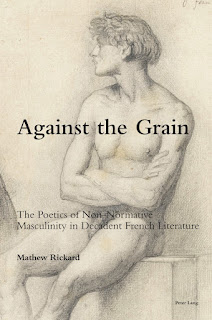
Review by Elle Morgan of "Against the Grain: The Poetics of Non-Normative Masculinity in Decadent French Literature" by Mathew Rickard


This book opened my eyes further than before, to gender-based issues experienced during the French Decadent movement, in the late 1800s. This is not an area I will pretend to know a lot about from a critical perspective, but I found that it introduced the topic in an engaging way. It is an insightful and urgent exploration of queerness, best read accompanied by a glass of white wine on a rainy Sunday. 

I came away from the book reflecting on how it addressed a gap in research I hadn’t known of. What could be an integral section of gender studies is posed as a new and daring answer to a question not often asked: is it really a man’s world? This is discussed using masculinity as a literary concept, as well as exploring how being literate has long raised important discussions regarding privilege. 

Originally written as a doctoral research thesis by a then-emerging scholar in the field of French Studies, the finished book is a wonderful appraisal of masculinity, sexuality, and the specific challenges gender-based discrimination poses. Readers will enjoy being introduced to new knowledge on the concept of the ‘dandy,’ as well as analyses of French literature from the nineteenth century. 

With a backdrop of advances in science, mass industrialisation and modernism, France at the turn of the century has always been a crucial site for understanding intersections of identity. This text is rich with these explorations, and it is an enjoyable read written by a pioneering scholar. It was the joint winner of a Peter Lang prize in 2019, and has been received well by many scholars in the field of Decadent Studies and beyond. It will certainly aid any scholar’s research in gender studies, and nineteenth century literature too.  


About the reviewer
Elle Morgan is primarily a writer but has held many jobs! Currently, Elle is studying a mix of practice-based Creative Writing and French Studies, and enjoys writing after lots of walking (but not in the current storms buffeting the UK). Elle’s website is here.