Showing posts with label thriller. Show all posts

Friday, 27 March 2026

Review by Anupriya Sisodia of "Calling Sehmat" by Harinder Singh Sikka


I still remember walking out of the theatre after watching Raazi in 2018 feeling … unsettled. My chest felt tight, my mind restless. I couldn’t stop asking myself: could someone really live like that? It stayed with me for weeks, until I finally picked up Calling Sehmat. I didn’t expect it to affect me the way it did, but it left me quieter than I was before I started reading.

Sehmat doesn’t enter the story like a hero. She feels like someone you could know, just a regular college girl from Kashmir, studying in Delhi, living an ordinary life. And maybe that’s what makes everything that follows so hard to process. There’s nothing exaggerated about her, nothing cinematic. Just a quiet strength that reveals itself slowly.

What really stayed with me was how her life changed because of her father’s last wish. Being married into a Pakistani military family, not for love, but for a mission, feels like something out of fiction, but knowing it’s rooted in reality makes it heavier. As she steps into this role during the 1971 India-Pakistani war, you can almost feel the tension settle in. Every moment of her life becomes deliberate. I think what struck me most was how different she felt from her portrayal in the film. In the book, she isn’t unsure or passive. She’s alert, thoughtful, and incredibly composed. The way she adapts to her new environment, builds trust within her in-laws’ family, and carries out her responsibilities, it all feels so controlled, so precise, that it’s almost intimidating. And yet, underneath it, you can sense the pressure she’s constantly under. One mistake could undo everything. There’s also something deeply unsettling about how normal everything around her seems. People are living their lives, forming relationships, trusting her, while she’s holding onto secrets that could destroy them. It made me think a lot about how war isn’t just fought on battlefields. Sometimes, it’s hidden in everyday spaces, in conversations, in silence.

Sikka’s writing is deceptively simple, almost like a personal conversation over tea. There’s no dramatic build-up or heavy language, but somehow that makes it hit harder. You’re not distracted by how it’s written, you’re just there, inside her world, feeling everything with her protagonist - her fear, her loneliness, the constant awareness that she can never really relax.

And then there’s the aftermath. When Sehmat returns to India, it’s not relief that defines her; it’s the profound weight of everything she’s done. You can feel how much of herself she’s lost along the way. It’s not just about what she gave up in the moment, but what she can never get back. Her life doesn’t simply go back to normal, and I think that’s what makes her story feel so real.

By the end, I didn’t feel inspired in the usual sense. I just felt … still. There’s admiration, of course, but also a kind of sadness that lingers. Sehmat gave everything without expecting anything in return, not recognition, not peace, not even a sense of closure. I think that’s what this book changed for me. It made me see patriotism differently. Not as something loud or visible, but as something deeply personal, often carried alone. Even now, thinking about it, Sehmat doesn’t feel like a character I read about. She feels like someone whose life I briefly stepped into, and couldn’t quite leave behind.

If you do pick up Calling Sehmat, don’t expect a dramatic spy story. It’s quieter than that, more reflective and deeply human. But it stays with you in a way that’s hard to explain, and even harder to forget.


About the reviewer 
Anupriya Sisodia is a published romance fiction author, pursuing an MA in Creative Writing at the University of Leicester. She is an avid reader who loves writing stories with realistic, relatable characters who experience emotional and exciting journeys on their way to a happy ending.


Saturday, 10 January 2026

Review by Sarah Gresham of "The Final Women" by Pardeep Aujla


This is a great read. It’s compelling, thrilling and unpredictable. I love the way that the main characters are a group of women survivors out to get bloody revenge on a serial killer. The author cleverly and intelligently explores the characters’ different reactions to historic trauma as well as their motivations to get even.

Throughout, the action sequences are expertly done and badass, and the dialogue is cracking and witty. As for the horror content … if it’d been a film I was watching, there were lots of moments I’d have been reaching for a cushion to cover my eyes. Descriptions are inventive, novel and full of dark humour. The Silas Crowe character is menacing, creepy, chilling. 

I saw that the author, Pardeep Aujla, is an "award-winning screenwriter and narrative designer for video games." This skill shines through so well, as evidenced in the rolling climaxes that explode across that movie-screen of the mind. Think: slasher horror. Think: oodles of gory homicide. Don’t read at bedtime!


About the reviewer
Sarah Gresham’s coffee shop, Clarendon Perk, is at 249 Clarendon Park Road, Leicester, where you will find very nice coffee and homemade cakes and food. It also has a micro bookshop, and occasional literary events featuring local writers.


Thursday, 23 October 2025

Review by Lisa Williams of "FantasticLand" by Mike Bockoven


It’s the season of mists and mellow fruitfulness so the time is ripe for getting cosy with some dark dystopian fiction. FantasticLand is a theme park and has been a mecca for fun since the 70s. A hurricane hits and floods the area; a team of predominantly college-aged employees are hired to look after the now-isolated park in the aftermath of the storm. What follows is a modern-day Lord of the Flies. The book isn’t for everyone – the violence is graphic and relentless. There’s a lovely juxtaposition though between the Disney-type theme park where "fun is guaranteed" and the grisly events that follow the storm, as society rapidly breaks down. The story is told through transcripts of interviews and eye-witness reports that give the story a real credibility. It’s reminiscent of a 1970s disaster movie, and in parts you do have to suspend your disbelief and just enjoy the ride. FantasticLand by Mike Bockoven is a gripping tale and fab for losing yourself in as the nights close in.


About the reviewer
Lisa Williams has an MA in Creative Writing from the University of Leicester. She writes word-limited flash fiction, mostly drabbles - stories of exactly one hundred words. You can find her online @noodleBubble 

Friday, 10 January 2025

Review by Jonathan Wilkins of "The Therapist's Daughter" by Megan Taylor


My usual thriller and mystery oeuvre is Nordic noir; apart from that I do love a Golden Age mystery thriller  I usually ignore British crime thrillers as I find them lazy, prosaic and trope-ridden. The alcoholic / womanising / heartbroken / secretive detective on a moral crusade is, for me, boring and a concept that it seems writers cannot avoid, so when I started reading The Therapist's Daughter I have to be honest it was with low expectations.

But the book defied my expectations. The Therapist's Daughter is an intricately woven, incredibly deceptive work that commands the reader’s attention.

My usual reading base is the cosy Royal Oak in Kirby Muxloe and on three visits I was chilled to the bone by the plot of The Therapist's Daughter. It is psychologically challenging as befits a tale about a psychotherapist's daughter. What an irony that the lead character, Caitlin, seems to be the most damaged of all the protagonists.

We are led down so many paths that at times it is hard to imagine where they lead, and that is the whole point, as through the multiple points of view and recollections of past and present, we are taken on a twisted journey to the final truth. Or is it? Even when we accept that we know the answers to the cleverly labyrinthine plot we are thrown off guard and off-kilter as a new avenue opens up.

There may have been a murder and a convicted murderer, but who is the true villain? Do we meet them at the end? Is a life-long love fulfilled or is it to be scattered into the air along with the protagonist's hopes and dreams? The misdirection is constantly bewildering, though never takes the reader away from the central plot lines. We have to discover our own truth as well as the characters'.

And there are so many characters, all so different, so roundly described and so easily shaped into the narrative. All are believable, most are easy to like, all have their challenges and faults, all make up the whole.

This truly is a "must read" book, well-written and easy to read. Challenging and welcoming, it interrogates the past and the present and as we career to the denouement, even in front of the Royal Oak's fire, we shiver and ask again. "Who was the killer?"


About the reviewer
Jonathan Wilkins is 69. He is married to the gorgeous Annie with two wonderful sons. He was a teacher for twenty years, a Waterstones’ bookseller and coached women’s basketball for over thirty years before taking up writing seriously. Nowadays he takes notes for students with Special Needs at Leicester and Warwick Universities. He has had a work commissioned by the UK Arts Council and several pieces published traditionally as well as on-line. He has had poems in magazines and anthologies, art galleries, studios, museums and at Huddersfield Railway Station. He loves writing poetry. For his MA, he wrote a crime novel, Utrecht Snow. He followed it up with Utrecht Rain, and is now writing a third part. He is currently writing a crime series, Poppy Knows Best, set at the end of the Great War and into the early 1920s.

You can read more about The Therapist's Daughter by Megan Taylor on Creative Writing at Leicester here

Wednesday, 3 April 2024

Review by Sally Shaw of "The Dark Within Them" by Isabelle Kenyon


The Dark Within Them is a novel by Isabelle Kenyon, a Manchester-based editor, writer, poet and spoken word performer. 

The novel is set in America within a Mormon community. The story is told from the viewpoint of the two main characters: Chad, well known in his home town of Lehi, and Amber, a faith-healer and visionary, who is widowed and mother to two teenagers Gilly and Ivan. Kenyon gives the reader an insight into both characters' inner thoughts and emotions. The story is fast paced, taking place from their first meeting in January 2015 to June 2015 when truths are uncovered and lessons learnt. I enjoyed the chapter lengths and access to the different mind sets of Chad and Amber. 

The story begins several months into Chad and Amber’s relationship at a Temple meeting. Chad is realising the complexity of being married and a stepfather. As a reader this chapter caused me to consider how Mormon beliefs and community could impact family live. Brett is the leader of the temple and the person Chad absolutely trusts. Chad asks for help with Gilly. "Gilly’s fifteen. Young. She’s … she’s mostly a good kid. Anything bad in her? It didn’t come from her mothering. That’s not to blame." The outcome is that Brett recommends his conversion therapy that isn’t practised at other temples. The interaction between Brett and Gilly is the catalyst to the death of Gilly. And Chad’s actions following her death are fuelled by the temple and community morals. Amber questions Chad following Gilly’s death: "'Was she possessed, Chad?' she said into his damp neck. 'Was my girl bad?'”  

Following Gilly’s death, Amber and Chad enter into a life of deceit and lies. Amber gains strength from the need to protect her son. Chad’s actions are powered by his Mormon values and devotion to Brett, while Ivan trusts no-one and his actions are perceived by Chad in a way neither he or his mother could have predicted. 

The story explores the impact on relationships of past experiences, upbringing, hidden agendas, resentment, religion, community and the unveiling of the characters' truth. Both Amber and Chad become unsure of each other and their marriage which changes the course of their lives.

The Dark Within Them is a novel that is easy to read. I enjoyed how Kenyon structured the chapters to move back in time and then back to the present, and the strength of Amber’s voice at the end of the novel. I found myself questioning Amber’s decision to actively seek out a husband. I was unsure why she choose not to have her children meet Chad in person prior to their move to his home. I did think some aspects of the plot were too far removed from reality for me. Still, the novel gives us an insight into the intricacy of relationships within a family, community and religion. It provides the reader with twists and turns and a strong ending.


About the reviewer
Sally Shaw has an MA Creative Writing from the University of Leicester. She writes short stories and is currently working on her novel based in 1950s Liverpool. She sometimes writes poetry. She gains inspiration from old photographs, history, her own childhood memories, and is inspired by writers Sandra Cisneros, Deborah Morgan, Liz Berry and Emily Dickinson. She has had short stories and poetry published in various online publications, including The Ink Pantry and AnotherNorth and in a ebook anthology Tales from Garden Street (Comma Press Short Story Course book, 2019). Sally lives in the countryside with her partner, dog, and bantam. Twitter: @SallySh24367017

You can read more about The Dark Within Them by Isabelle Kenyon on Creative Writing at Leicester here


Friday, 19 January 2024

Review by Mike Gregory of "Our Friends in Berlin" and "London, Burning" by Anthony Quinn


Our Friends in Berlin (2018) is an intriguing, pacy, at times beautifully written espionage novel set amongst spies, fifth columnists, fellow travellers and innocent (or not-so-innocent) bystanders in London during World War 2. It covers, therefore, similar territory in many ways to Agatha Christie’s N or M? (1941) and Kate Atkinson's Transcription which, weirdly, came out the same year as Our Friends in Berlin. It's not quite as accomplished, clever or surprising as Atkinson's beguiling, bewitching spy saga, nor is it as delightfully daft as the Christie, but it’s very good.    

The descriptions of war-torn London borrow some of the weariness of early T. S. Eliot but as if crumpled into a plot by Eric Ambler. The frequent switches in third-person point of view keep things fresh. You find yourself, strangely, quite liking the undercover Gestapo agent, Hoste.  Plot reveals, when they come, are not always as surprising as Quinn perhaps intended, but they satisfy nonetheless. It's only in the last quarter where the writer sacrifices subtlety and wit to the dubious demands of action.  


London, Burning (2021) was even better, I thought. Set in the late 1970s, Quinn’s urban thriller trails the lives of a journalist, a theatre impresario, an academic and a young DC as they navigate a London crumbling under public service strikes, IRA bombing campaigns, the emergence of punk rock and police corruption. The young academic at one point is giving a tutorial on the role of coincidence in the fiction of Henry James; it's a clear signal of how Quinn wants the reader to treat the tragi-comic, often violent intersections of these disparate lives.  

As the story unfolds, we move from 1977 to the eve of Thatcher's 1979 election victory. Unlike other writers anchoring their stories to specific moments in socio-cultural history, Quinn never seems to put a foot wrong. (He certainly knows his Mott the Hoople, Clash, Kate Bush and disco). He even nails the precise smell of 1970s telephone boxes.  


About the reviewer
Mike Gregory is a 59 year-old who never quite recovered from a teenage addiction to the novels of Graham Greene. He spent a quarter of a century teaching English but has also been, at various times, a support worker, petrol station attendant, cinema projectionist, librarian, barkeep, civil servant and private tutor. Any job, basically, in which one might surreptitiously read.   


Wednesday, 30 August 2023

Review by Laurie Cusack of "Kyiv Trance" by Gus Gresham


Beautifully researched − Kyiv Trance is a stone-cold classic − Brilliant in its execution − Gresham's crime thriller is truly mesmerizing  −  Utterly unputdownable − Outstanding!

Blah, blah, blah … How many times have you read over-hyped blurb like this? Too many, I know, but this text is the real deal … honest to god, cross my heart and hope to die!

For starters Gresham’s subject matter couldn’t be more topical. Everyone wants to know about Kyiv now – our sympathies go out to Ukraine in all its adversity. Moreover, there is a hunger to be better informed about its people, culture and way of life. I think we all agree there’s no better way to satisfy that hunger than racing through a sizzling page turner!

Gresham’s atmospheric opening, for instance, draws the reader right into the subterranean bowel of Kyiv: "Richard was riding the improbably long escalators again. From deep down behind him, he could still hear accordion music and the husky voice of the old busker in the strains of a Slavic folksong. It wasn’t necessary to understand Ukrainian to know that the song was about tragedy and loss."

Throughout razor-sharp Kyiv Trance you glean an understanding of Ukraine’s unique Orange Revolution, which was bloodless-civil disobedience after the fraudulent elections of 2004/2005. Gresham, skilfully, sprinkles and captures the zeitgeist moments of a nation that was on the cusp of democratic change, during that tumultuous period. 

The impressive juxtaposition of a maniac on the loose, as this political turmoil is  unfolding, reads very well. Alongside this, Gresham’s haunted protagonist Richard Farr battles to make sense of it all after falling head over heels with beautiful Nadya. There is a lot going on within Kyiv Trance but as a reader you are never lost, as the seamless flashbacks and back story are handled deftly.

They also say good writing is about how you handle detail − keeping your ear to the ground is paramount − Kyiv Trance royally delivers on that score: "Bar Zavtra’s music system was playing Ella Fitzgerald. ‘How Deep is the Ocean?’ Her voice had to compete with the shopping-centre Muzak – some soulless atrocity that sounded like a panpipe rendition of Motorhead’s ‘The Ace of Spades.’"

I was reminded of Martin Cruz Smith’s dynamic thriller Gorky Park to some extent as I read Gresham’s text − both plots are set in the east and are meditations on political power whilst examining the social fabric close-up through the lens of the crime thriller genre. Both highlight how systems work and how people strive and survive within those systems. Kyiv Trance is a blast and brilliantly observed.


About the reviewer
Laurie Cusack (PhD) studied Creative Writing at Leicester University. He writes from the gut − from the underground − about the underdog. His collection of short stories The Mad Road is out in September. He is now an actor-simulator, writer and community advocate.

You can read more about Kyiv Trance by Gus Gresham, as well as an excerpt from the novel, on Creative Writing at Leicester here


Monday, 12 December 2022

Review by Jon Wilkins of "Dead Drop" by F. C. Malby


I cannot recall ever reading a book with such a sensual, sense-ful, scent-ful opening. The tastes and sights and sounds enveloped me as a reader drawing me into Vienna and its streets, cafes and churches. I can smell espresso, then I can taste the Guglehupf. I feel the wind on my cheek and the bustle of people on their way to goodness knows where. It is enchantingly delightful. Malby should be asked by the Vienna tourist board to promote their city. And that is only after the first two chapters!

I haven’t even mentioned the dead body, found by our protagonist Leisl, on Stephansplatz underground steps, as if it were the most natural of things to discover. Well it was where she was told it would be. But who by? And what of the broach and the note she took from the body? Art thief by career, Liesl finds herself in a terrifying world of murder and deception in this well-researched, beautifully written thriller. She is a hero we root for, despite her criminal behaviour, as she goes on an adrenalin-running-high escapade as she seeks the truth. To Malby’s credit. I found myself in the streets and buildings of Vienna, described with the minimum of fuss, but described in such a way that I felt I was part of the city, part of the chase and totally enmeshed in the plot.

I hope this is the first in a series as there is room for so much more.


About the reviewer
Jon Wilkins is 66. He is married to the gorgeous Annie with two wonderful sons. He was a teacher for twenty years, a Waterstones bookseller and coached women’s basketball for over thirty years before taking up writing seriously. Nowadays he takes notes for students with Special Needs at Leicester University. He has had a work commissioned by the UK Arts Council and several pieces published traditionally as well as on-line. He has had poems in magazines and anthologies, art galleries, studios, museums and at Huddersfield Railway Station. He loves writing poetry. For his MA, he wrote a crime novel, Utrecht Snow. He followed it up with Utrecht Rain, and is now writing a third part. He is currently writing a crime series, Poppy Knows Best, set at the end of the Great War and into the early 1920s.


You can read more about Dead Drop by F. C. Malby on Creative Writing at Leicester here

Wednesday, 27 July 2022

Review by Jon Wilkins of "The Portable Nine" by Pete Mesling


I’ve steered clear of American thriller writers for a while now, but after reading this novel I can’t understand why!

Pete Mesling concocts a world of shadows and deceit as his protagonist, Davenport, fails on a mission, a mission to kill. Davenport is an assassin, known as the Mad Marksman of Malta. When the contract to kill Max Brindle misfires, and with his mission unfinished and his courage shaken, Davenport has to face the consequences and they are far reaching. 

Mistakenly thinking the contract has been fulfilled, the mastermind behind it, the Black Phantom, plans to perform a spiteful act of retribution. Davenport has no choice but to join again with a group of skilled mercenaries in an effort to exact his own revenge as he finds himself the target of the Phantom's displeasure. He needs to work again with his old compatriots. These are the Portable Nine: Davenport, Abel Hazard, Miranda Gissing, Joseph Intaglio, Mr Bonnet, Twitch Markham, The Butcher, Lovinia Dulcet and Robin Varnesse. 

They operate outside the law, but they still maintain a code of ethics. They may all be outcasts, but they are still heroes to the underclass and adversaries to society's enemies. But what is the society they try to maintain? They are the white knights to the brutal black knights, they are clever and resourceful, brave and fearless, and they will all stop at nothing to see that their brotherhood maintains the status quo.

Well written, though perhaps over the top, the novel draws the reader into the seedy cold-hearted underbelly of society. Should evil ever win or should another, different evil be allowed to succeed? The age old story of an eye for an eye is given new life by Mesling. Whose side will you find yourself on? Who are the truly evil?


About the reviewer
Jon Wilkins is 66. He is married to the gorgeous Annie with two wonderful sons. He was a teacher for twenty years, a Waterstones bookseller and coached women’s basketball for over thirty years before taking up writing seriously. Nowadays he takes notes for students with Special Needs at Leicester University. He has had a work commissioned by the UK Arts Council and several pieces published traditionally as well as on-line. He has had poems in magazines and anthologies, art galleries, studios, museums and at Huddersfield Railway Station. He loves writing poetry. For his MA, he wrote a crime novel, Utrecht Snow. He followed it up with Utrecht Rain, and is now writing a third part. He is currently writing a crime series, Poppy Knows Best, set at the end of the Great War and into the early 1920s.


Thursday, 17 February 2022

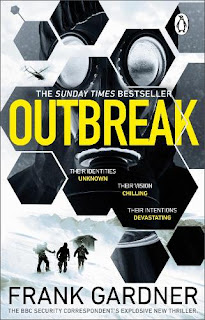
Review by Lisa Williams of "Outbreak" by Frank Gardner


You might want to pop a Kevlar vest on for this action-packed book from the BBC’s security correspondent. It’s a fast-paced read – short chapters moving between four different countries. We travel from the Arctic Circle to Porton Down and from Moscow to Lithuania.

This is the third book (I’ve not read the others) featuring the hero MI6 operative Luke Carlton. I feel this book stands alone as I only realised there were two others when I’d finished reading and there wasn’t a point when I felt I didn’t know what was going on or that I was missing something.

If you read for escapism it’s possibly not the right book at the moment.  The subject is clear from the title - the book opens with three scientists in a blizzard in the Arctic Circle searching for shelter. They find a cabin. Inside a man is slumped in the corner, his swollen body convulses. Blood, bile and mucus sprays into the air and so the contamination begins. Actually you might want to pop a little mask on as you read too ... 


About the reviewer
Lisa Williams is a shopgirl and a graduate of the MA in Creative Writing at the University of Leicester. She is on Twitter @noodleBubble 


Saturday, 27 March 2021

Review by Katy Johnson of "Love You Gone" by Louise Mullins


I love a psychological thriller involving entangled relationships and when I saw that this one was set in Bristol where I grew up, I couldn’t wait to get started!

Gemma, an 18 year-old student with her life ahead of her, has disappeared and is soon found to have been murdered. As the story unfolds, it’s clear there’s no shortage of people who’d like to have seen Gemma gone including her stepfather, real father, friend (and love rival), her tutor with whom she was having an affair, his wife, and Gemma’s angry boyfriend. I love the way the author peels back the layers of these multi-faceted characters to reveal their innermost thoughts and secrets, and reasons to hate each other as their lives intertwined.

My favourite character is the person best equipped to solve the mystery, investigative journalist Rachel – but she’s an alcoholic and has a history with one of the suspects, so is she reliable? Can she trust her own addled judgement, and can she stay safe?

I’m obviously biased when it comes to the setting but I felt it was ideal, with the iconic suspension bridge the perfect place for the dramatic climax, which would make a great TV scene. I recognised the places (right down to my local coffee shop!) which made it even easier to visualise the scenes in this suspenseful read.

Love You Gone is a fast-paced, twisty read that I devoured in one go, and highly recommend to fans of psychological suspense. 


About the reviewer
Katy Johnson is a bookworm, blogger and writer with a passion for flawed characters, dysfunctional families, old houses and dark secrets. She's a journalist, editor and author of four novels including The Suspects, and a history book, published as Katharine Johnson. When not writing or reviewing, she can generally be found drinking coffee, walking with her canine writing buddy, or patching up a small farmhouse in Italy where two of her books are set. This review was first published on her blog here.

Sunday, 7 February 2021

Interview with Tim Relf


Tim Relf is a Leicestershire-based novelist. His most recent book, What She Left, was published by Penguin under the pen-name TR Richmond and his two previous novels, Stag and Home, were published by Piatkus. His day-job is as a journalist, specialising in writing about farming and the countryside. He's also contributed to national, regional and local papers and magazines, along with BookBrunch and The BooksellerHe's a tutor for the Professional Writing Academy, and has given guest lectures on fiction and the media at Nottingham Trent University and Harper Adams University.

What She Left is a psychological thriller about the life and death of a young woman told through the digital and paper trail she leaves. As well as telling the story from multiple perspectives and in a non-linear time frame, What She Left draws on multiple mediums, including newspaper and magazine articles, diary entries, emails, blog posts, Facebook and Twitter messages, letters, police transcripts and forum posts. Pitched at the literary end of the commercial market, it’s a contemporary epistolary novel – a modern story told in a very modern way. It was published in 21 countries and turned into an audio book starring Emilia Clarke and Charles Dance (who both starred in Game of Thrones). The Daily Telegraph included it in its must-read books of the year, and it was featured as a book club choice by the Daily Mail’s You magazine.


Q: Where did the original idea come from?

TR: It was actually on Twitter. I saw a tweet by someone about what piece of music they’d like played at their funeral and it struck me how bizarre and intimate that was to read. That got me thinking, what else could I learn about this person on Twitter, and that eventually took me to the idea of reassembling, jigsaw puzzle-like, a suspense story from a young woman’s digital and paper trail.

Q: Why did you write it in this format?

TR: I wanted to write a novel that not only passed comment on the way we receive / consume news and information these days, but was actually structured in that way. Hopefully it has something interesting to say about communication, the media and our digital identities, as well as such timeless issues as love, loss, revenge and redemption. Ultimately, I’m very conscious that the internet and social media have revolutionised how people relate to each other and communicate – and it was my fascination with this that drove the idea. Fact is, more than at any point in history, each of us leaves a digital footprint nowadays and it’s from this, jigsaw puzzle-like, that I wanted to reassemble my protagonist’s story.

Q: How do you do research?

TR: The internet is essential. Plus, I always badger people I know who are the same age as a particular character to find out what their cultural reference points are. Most of the research never gets used, but it helps shape my sense of a character. Who would they vote for? What do they like eating? What do they watch on TV? It’s details such as these that help you fashion a sense of someone which, in turn, helps you understand what decisions they’d make.

Q: What or who inspired you to become an author?

TR: I’ve always been preoccupied by capturing detail – whether that was keeping a diary as a kid or taking photographs. Maybe it’s because memory is fickle, but I’ve always worried about 'losing' the past. My desire to write was born out of the same sentiment – it’s partly about helping me remember. It’s also about wanting to start a dialogue with readers. When you publish a book, you’re saying to people: ‘This is how I see the world, what do you think?’

Q: Name a book that has impacted your life significantly.

TR: Thomas Hardy’s Tess of the D’Urbervilles. I was a student doing a summer job in London when I read it. I’d got off a bus, was late for work and about 30 pages from the end, but just stood by the side of the road outside the office and carried on reading. I simply had to finish it. My boss even walked past me at one point and asked me if I was alright! If ever I need reminding of the power of books, I think of that moment.

Q: Give would-be writers one piece of advice.

TR: Have an amazing elevator pitch for your novel. If you can sum it up in a sentence, it'll massively improve its chances of getting picked up by a publisher.


Wednesday, 21 October 2020

Review by Jon Wilkins of "Lost Girl" by J. R. Summer


This is a mesmerising book. The cliché unputdownable is very apt here, but it is no cliché. I could not put his book down until I’d finished it. It intoxicates the reader as it delves into the trauma that is Bi-Polar Disorder. The condition is wrought clear to the reader as the Lost Girl of the title, Rebecca, suffers and self-harms her way through the story whilst high on recreational drugs and drink or low on her prescription drugs. Her case is extreme yes, but so relatable. Suffering under an abusive father and an alcoholic mother when her sister was taken away from her home, she has faced crisis after personal crisis, from childhood through to the current time.

She is able to hide the reality of the crisis that her life is from everyone, even her caring sister. Her whole life is a lie and we recognise this as the writing is so clever.

Her life now is tinged with violence and aggression. She metes it out but also welcomes it and she falls under the spell of an unsuitable married man where sex seems like everything, though she wants more. She follows him to Tokyo and her life spirals out of control as he rejects her, and she pursues a course with terrifying consequences.

Told in first person we really do feel her pain and live through the descriptions of the disaster that is her personal life.

My only problem is the ending, too abrupt and with too many things unresolved, though in a way that is also perfect as we can decide what happens to Rebecca after her final act of defiance.


About the reviewer
Jon Wilkins is 65. He has a gorgeous wife Annie and two beautiful sons. He is a retired teacher, lapsed Waterstones’ bookseller and former Basketball Coach. He taught PE and English for 20 years and coached girls & women’s basketball for over 30 years. He regularly teaches at Creative Writing workshops in and around Leicester. He takes notes for students with special needs at Leicester University. For his Creative Writing MA, he wrote a crime novel, Utrecht Snow. He is also writing a crime series set in the Great War and the early Twenties. The first part, Poppy Flowers at the Front was published by Brigand Press, London in March 2020. You can read a review of it here


Wednesday, 4 December 2019

Review by Colin Gardiner of “Pattern Recognition” by William Gibson


Cayce Pollard is a young American woman with a ‘sensitivity’ to corporate branding symbols. Cayce makes a living advising clients on the viability of their product. She has been hired by an eccentric, rich client to investigate the origins of a mysterious film clip that has appeared on the internet.

Gibson deftly draws the reader into a post-11 September world of espionage and intrigue.

The novel has a melancholic feel, suited to the geo-political tensions of the era.
His characters are sharply defined, in particular the protagonist, Cayce, who forms a sympathetic but sharp-eyed lead.

Gibson has a talent for describing the cultural undercurrents of the city. London, in particular comes across as a potentially lonely, but vibrant place, filled with possibility.

The novel works, both as a compelling thriller and as a curious historical time-capsule, written just before the social media boom of the mid 2000’s. Recommended for readers of science fiction, and techno-thrillers.


About the Reviewer 
Colin Gardiner lives in Coventry. He writes short stories and poems and has been published by The Ekphrastic Review, Ink Pantry, The Midnight Street Press and The Creative Writing at Leicester blog. He is currently studying a Masters in Creative Writing at Leicester University. More of his work can be read here


Monday, 16 October 2017

Review by Lee Wright of "Taffin on Balance" by Lyndon Mallet


The 1988 action thriller Taffin featured a pre-Bond Pierce Brosnan in the title role as the freelance debt-collector Mark Taffin, hired to defend a small Irish community against a group of evil developers and their band of ruthless heavies. It was Robin Hood, only with shotguns and Brylcreem.  

A few years ago, I came across a copy of the original novel on which the film was based. Rumour has it that Taffin’s author, Lyndon Mallet, was not best pleased with the casting of Brosnan. The tough County Meath man with Hollywood good looks was a far cry from the large framed, expressionless Teddy Boy on the cover of the novel. 

The novel explores vigilante justice and how far people are willing to go to protect what is dear to them. But there is a flipside to that coin. How far is too far? Taffin understands this only too well. In the novel he warns someone who comes to him for help: “If I took this job, you’d be begging me to stop within a week.” Probably the finest line from the film is when Taffin confronts those who want to hire him to rid them of the developers with no questions asked: “My help has consequences,” he says. “When you turn against me, as you surely will, you remember, I am only your weapon.”

A follow-up sequel to the first novel was commissioned by the publisher, New English Library, and Mallet wrote Taffin’s First Law within four months of the first book being published. A third instalment followed, and Ask Taffin Nicely seemed to be a fitting end to the trilogy. 

Now, after a decade away, Mallet has returned to the town of Lasherham in Taffin On Balance, where Mark Taffin has settled down and runs a business restoring and selling classic cars. All is well until someone with money and a personal grudge tries to put him out of business. Along the way he discovers a web of large-scale corruption causing issues for the locals of the town, and we find that Taffin is still very much the modern-day Robin Hood.     
As ever with Mallet, the action is punchy and realistic but not too heavy. The author also dips into meta-fiction territory as references to the Pierce Brosnan film are made throughout the book. One character asks Taffin: “That film. Fact or fantasy? Is it about you and if so, is it a true story?”

When I asked Mallet why he did this, he replied, “It’s called playing the cards you’re dealt.” 
There is nothing slow paced about Mallet’s writing. Like his main protagonist, Mallet gets on with the job at hand. It’s a technique which has shown results. Not only did he sell the film rights for Taffin, he also had success with his epistolary novel, The Hare Lane Diaries, which was later adapted for radio and broadcast in six episodes on BBC Radio 4.  
   
But the Taffin novels are not as well-known as they could be. Copies of the first two novels are now out of print (though some second-hand copies can still be picked up and all of Mallet’s novels are available in e-book form). So, to have Taffin On Balance available in paperback is a treat for both old fans, and those discovering the character for the first time.
Taffin On Balance is published by Matador Fiction and is available now.


About the reviewer

Lee Wright was born in Nuneaton, Warwickshire in 1980 and has been writing both fiction and non-fiction since 2008. He is taking an MA in Creative Writing at the University of Leicester.

Tuesday, 27 June 2017

Review by Rachel Evans of "Uprooted" by Naomi Novik

(Some spoilers!)
Much like the terrifying and sentient Wood at the centre of Naomi Novik’s Uprooted, this novel reaches out with subtle violence, wraps its tendrils around your expectations and pulls them out from under your feet, leaving you (and your beliefs about what fantasy should be) altered for good. Fortunately for you, gentle reader, Novik is happy to take you by the hand and show you the safest route, saving you from any twisted ankles – or absolute insanity.
The tense stalemate between the two warring nations of Polnya and Rosya is but an abstract threat for Agnieszka, resident of the village of Dvernik, located on the border of The Wood. The most pressing issue for Nieszka, who happens to be Dragon Born, is the almost inevitable loss of Kasia, her best friend and fellow Dragon Born; for the Dragon chooses one girl from the surrounding area, and keeps her for ten years. In return for this, he protects the towns and villages from the constant, malevolent onslaught of The Wood.
Of course, this is not what happens. In a slightly predictable (and yet effective) twist, the Dragon ends up abruptly whisking her off to his lair – uh – tower. Apologies Ann Rice fans, but this Dragon is, in actual fact, a Wizard. He abandons Nieszka at the top of his tower without so much as a word of acknowledgement, leaving her to the realisation that she is going to spend the next ten years of her life locked up with him, not Kasia.  Unfortunately (fortunately) for the Dragon, Nieszka is not one to sit quietly and take instruction. Despite, or more accurately, because of his generally terrible behaviour, it is highly satisfying to witness Nieszka’s determination to make his life as difficult as possible. Nieszka’s vibrancy and agency in a world that is constrained not only by gender, but also class (making her pretty low on the food-chain) proves that there is scope for more female-driven fantasy that does not rely on the (boring) idea that 'women can do what men can, but in heels.'
The first third of the book focuses on world building, and brings to life the living, breathing threat of The Wood. It is refreshing to have a completely different antagonist to the usual run-of-the-mill demon/necromancer/manic ruler. The Wood is a genuinely terrifying creation, filled with all manner of creatures and malice that are hell-bent on destroying humanity. Beyond The Wood are Polnya and Rosya (Poland and Russia respectively), who have been at war with each other since the Polnyan queen disappeared with the Rosyan prince (into… you guessed it, The Wood!) These combine to create a backdrop of conflict and tension that feeds into every aspect of the story.
The rest of the book moves rapidly through a complex and sometimes confusing narrative. One could argue that the story doesn’t quite work in its current form, and could benefit with either being trimmed down or expanded into a multi-book series – there is certainly a wealth of material to draw from, both within the fictional world, and the mythological corpus on which it is based. In fact, the only true criticism that I have of Uprooted is its need to be everything at once; both high fantasy, multi-series epic and punchy one-off; YA but also oh-so-adult (some of the overarching themes and scenes in The Wood are highly disturbing); action-fantasy-thriller and romance. In fact, it is the romance aspect of the story that lets it down the most, something that I found incredibly disappointing. For all of Novik’s innovation with The Wood and Nieszka’s system of magic, there is a woeful lack of imagination and diversity when it comes to l-o-v-e. Initially, I thought that there was going to be a queer relationship between Nieszka and Kasia, and I was overjoyed. Those high hopes were crushed, however, when Novik practically forces the Dragon and Nieszka into a tryst that neither of them seems to want. The resulting relationship is both awkward and lack-lustre.
Despite the issues with pacing and with character interrelationships (both of which may have been better addressed in a multi-book format?), Uprooted is still a vastly enjoyable read. Novik’s prose is both evocative and hypnotic, and the way in which she builds the world of Polnya, Rosya, and The Wood is so immersive that it is possible to forget that you are reading a novel. Finally, Nieszka is a character that would cause me much distress if we were friends in real life; which is exactly what makes her such an excellent protagonist to guide you through the deepest, darkest parts of The Wood in order to reach the other side, both changed, and yet exactly the same.
 
About the reviewer
I am a first-year PhD student exploring the connections between gender and textiles in Old Norse literature at the University of Leicester. In my spare time I like to read (mostly dystopian, speculative or fantasy novels) and knit.

Sunday, 24 January 2016

Review by Annette Hannah of "Behind Closed Doors" by B A Paris


(This was review was originally published on Sincerely Book Angels here). 

Blurb

Everyone knows a couple like Jack and Grace. He has looks and wealth, she has charm and elegance. You might not want to like them, but you do.

You’d like to get to know Grace better.

But it’s difficult, because you realise Jack and Grace are never apart.

Some might call this true love. Others might ask why Grace never answers the phone. Or how she can never meet for coffee, even though she doesn’t work. How she can cook such elaborate meals but remain so slim. And why there are bars on one of the bedroom windows.

Sometimes, the perfect marriage is the perfect lie.

Review

One word, "Wow": this is the most fast paced psychological thriller I have ever read. The narrative races along and gives you a feeling of foreboding and absolute terror at what awaits Grace and her sister Millie who has Down's syndrome.

To all their friends Grace and Jack have the perfect life, they have a beautiful house, fancy holidays and they are completely in love with each other and everyone thinks Jack is so kind for offering to let Millie live with them but what goes on behind closed doors is another matter.

Jack is in complete control of Grace's life and he has every corner covered. Grace knows that time is running out and soon her sister finishes school and comes to live with them for good and then she knows there will be no escape. New friend Esther seems suspicious of their relationship but if Grace lets anything slip then she will be punished beyond belief and so will Millie.

This book was thrilling and scary and in fact I was actually scared to go to the loo on my own and my heart was still racing for a while after I'd finished reading it. There were some lovely moments when describing the relationships between Grace and Millie. It portrayed Millie's personality very sensitively which I thought was lovely and she was a brilliant character.

A gripping thriller that will ensure you will not want to put this book down, I have never rooted so much for a murderer to come out on top. I have just watched Room which was brilliant and I think this is on a par with that.

About the reviewer
Annette Hannah is married with three children. Originally from Liverpool now living in Hertfordshire. She has been blogging for almost a year and loving it; through blogging she has managed to meet lots of her favourite authors and lots of lovely blogger people too. Her blog is Sincerely Book Angels