Showing posts with label debut. Show all posts

Wednesday, 29 July 2026

Review by Rebecca Nolten of "Yesteryear" by Caro Claire Burke


Yesteryear is unlike anything I have ever read. Rarely has a protagonist been so immediately, spectacularly unlikeable. Natalie hooks you through her sheer vanity and inflated ego, then drags you by the hair through the calamity of her life.

For you, dear reader, in picking up Yesteryear, have become one of the "angry women." As you devour this tantalising read, you become engrossed in a cocktail of disbelief, outrage, and Schadenfreude.

Natalie Heller Mills is a "tradwife" influencer who preaches about the glory days of knit-your-own-yoghurt traditionalism to her online fanbase, made up of seething "bad" modern women and envious "good" Christian wives. She does so while surrounded by her gaggle of home-schooled children and her good ol’ cowboy husband, Caleb. They live on Yesteryear Ranch — a haven of home-baked bread, organic American farming, Christian domesticity, and … a mega media machine.

Behind the scenes, there are nannies, producers, and immigrant field workers keeping this titanic ship afloat, all hidden from public view. Yesteryear Ranch’s success is accredited exclusively to Natalie, Caleb, and their supposedly secure, godly marriage – secretly marred by disappointing sex, deep-seated loathing, and an affair that threatens to destroy everything.

The Nara-Smith-of-it-all comes to a screeching halt when Natalie is inexplicably transported to the Pioneer days she so idolised.

It is 1855.

"This is my home. This is not my home" — Natalie finds herself on a ramshackle farm set against the same Idaho hills as Yesteryear Ranch. In this world, Natalie has four children: Maeve, Mary, Abel, and Noah. They are so reminiscent of her own, and yet they are not hers. "Old Caleb" completes the uncanny scene — a burly version of Natalie’s husband who works the land, breeds her "like a barnyard animal," and hits her when she disobeys him.

The novel flips back and forth between these two realities: the modern illusion of traditionalism — filtered through hate comments, internet fame, and carefully curated images — and the harsh, bare-bones existence of true traditionalism, with all its scrubbing, kneading, and inescapable boredom.

But Natalie fails to reach anagnorisis. In fact, as the novel progresses, she becomes enveloped — oddly charmed, even — by her new life. While she initially questions whether this is the work of time travel or some hellishly elaborate reality TV stunt, she eventually comes to believe that it is by Divine design that she is destined to live in this "authentic" world.

But what of the fame? The hunger for attention? The desperate need for an audience? That is the one thing that leaves Natalie wanting: to be perceived. Because if there is one thing her audience of "angry women" loves to do, it’s watch her.

Yesteryear’s sharp, bitter first-person prose tears apart the fallacies of the American dream, traditional gender roles, political messaging, the Church, and our online personas. It encompasses all of this without ever losing the reader’s attention, and as much as you may want to, you cannot tear your eyes away from the car crash that is Natalie Heller Mills.

A blisteringly funny and unnervingly perceptive debut, Yesteryear cements Caro Claire Burke as a voice to watch. I, for one, cannot wait to see what she writes next.


About the reviewer
Rebecca Nolten is a Modern and Medieval Languages graduate from the University of Cambridge (Girton College). She has worked across editorial, copywriting, translation, and arts publishing, with a particular focus on storytelling and visual culture. She is especially interested in translation, art history, and the ways in which stories move across languages, cultures, and media. Outside work, she enjoys illustration, reading, and visiting galleries and exhibitions.

Monday, 27 July 2026

Review by Hannah Kimmins of "Ordinary Saints" by Niamh Ní Mhaoileoin


"The first time I kissed a girl, my brother died": Years after her older brother Ferdia’s tragic death, Jay has moved from her hometown in Ireland and is living in London with her girlfriend, trying to live her most authentic life without religious constriction. However, when her parents inform her that there’s a campaign to canonise Ferdia, she can no longer run away from her grief. What follows is a battle between her brother’s death and her own life. 

Ordinary Saints is anything but ordinary. It is a complex, messy yet measured conversation about the role of religion in society and how it can both bring families together and tear them apart. Jay could also be described by these three words: complex, messy, yet measured. The author never lets you get too close to her, which from my perspective is purposeful - you never fully sympathise with her, or her parents, or even Ferdia. You see all of their beauty and their flaws, and the debate becomes more about the role of religion from a micro and macro lens rather than the morals of the individuals, which helps the reader form their own opinion. The humans are at the heart of the story; not God. 

This is a truly special story, and a truly accomplished debut novel from Niamh Ní Mhaoileoin. Despite the main story being about sainthood, reading it felt overwhelmingly real - like it could happen to you, or a friend, or someone in your community. It also contemplated the relationship between queerness and Catholicism, succeeding in not pitching them against each other, but instead finding where they intersect. Once again, the reader is encouraged to form their own opinions on the characters and concepts within the novel. Do not be mistaken; this novel is not neutral. It has a voice. However, the reader is encouraged to have their own voice too. 

If you’re looking for an original story that will stay with you long after you’ve turned the last page, Ordinary Saints is a modern gem that should not be missed. 


About the reviewer
Hannah Kimmins is a scouse writer and was a Waterstones bookseller for 7 years. She has been reviewing books since she was 15 years old, and continues to live and breathe books. She has a Masters degree in English and is graduating with a Masters in Psychology this year. More than anything else, she loves to learn. 


Thursday, 23 July 2026

Review by Laura Sygrove of "Eating Air" by Suyin Du Bois


Suyin Du Bois’ debut poetry pamphlet is a tapestry of shared cultures, a smorgasbord of delectable delights and rough estimations; a rich blend of seasoned memories and flashes in the pan. Eating Air is complex, intimate, and oftentimes devastating; a journey into the past in an attempt to preserve the present, always just seconds out of reach.

Besides Du Bois’ poetry, I’ve thought of little else for weeks. Her work begs you to read the words aloud, to savour each syllable as the speaker savours each meal. Eating Air is a collection of flavour samples that dance on the tongue and settle in the pit of your stomach. Du Bois transports the reader across oceans to sit at low dining tables, folding meal trays at high altitude, beside hospital beds and roadside stalls, relishing the familiar taste of airline food and leftovers, sand-roasted chestnuts, French pastries, and makeshift noodle dinners.

For Du Bois, eating and writing are both acts of remembering and belonging, or of not quite belonging, and of longing itself. In her preface, she describes feeling poetry in her body in much the same way as food, where "certain combinations of words can have just the right mouthfeel." Food nourishes the body while carrying emotional and cultural memory. Poetry preserves that memory, remaking it through language: "I stir and stir like her until my spoon draws the right depths of lineage."

As a title, Eating Air feels both grounding and elusive, suggesting nourishment while gesturing towards something intangible: "store-bought surrogates," swaddled exports with their "layers thinned," family recipes spooned from jam jars for the very last time. Her work reads almost as a series of diary entries, reimagining transitory yet toothsome moments in a search for self through places, memories, and identities that resist easy definition.

Du Bois writes with complete transparency, embracing the discomfort of existing between cultures. She allows these tensions to remain unresolved, capturing the feeling of being both within and without. Her poems linger in that in-between space, searching for belonging without ever insisting upon certainty. My favourite line in the collection, "I insist we oil our bloodlines mackerel slick," is as tender as it is visceral, preserving heritage not as something fixed, but as something living and lovingly maintained. In Eating Air, nourishment is found not only in food, but in language and memory, and the act of returning to them.


About the reviewer
Laura Sygrove is a graduate of the MA Creative Writing programme at the University of Leicester. She is an advance reader at DartFrog Books and writes for The Publishing Post. You can read some of her poems herehere and here.  

You can read more about Eating Air by Suyin Du Bois on Creative Writing at Leicester here


Wednesday, 3 June 2026

Review by Martyn Crucefix of "Ethnology: A Love Song for Connemara" by Cathy Galvin


Some poems use form and language to weave gold from the ordinary stuff of life; others take extraordinary (even extreme) topics and much of the interest may lie in their subject matter; others engage with what used to be disparagingly called "local colour" – especially of place or identity – and Cathy Galvin’s debut collection is in part of this sort. Her great grandfather built a cottage on Mason Island, Connemara, after the Great Hunger (1845-52). She remembers visiting it as a child, but it now lies in ruins. Her wish is to preserve and empathise with what it represents of landscape, nature, the people, their culture and language. Her desire is contrasted to the cold impersonality of those who once studied these peoples on the edge of Europe as an inferior species, to the extent of stealing skulls from graves for closer analysis.

Much of the interest in Ethnology lies in Galvin’s representation of these (extra)ordinary lives, in learning their language, archival research, and imagining their day-to-day existence. The opening poems are rather fragmentary and one feels the "willed" pressure of pursuing her admirable aim. "Ethnology" itself is a fine poem in which an island child, having been studied by an ethnologist, recounts the kinds of human experience that he (definitely a "he") could never be party to: "I searched for seals, their singing / making me pause." Poems about Galvin's own mother, Bridget, are replete with familial emotion and are the better for it. In "Waters Break" and "Caoineadh," a freer lyricism breaks from Galvin, giving rise to a heartfelt keening or lamentation: "I stand on the granite, a flawed empty vessel // I pull you towards me, I shelter your body."

The third section of the collection is dotted with allusions (to Hughes, Heaney, Murphy, Synge, Friel – though most are linked variously to the Connemara landscape), yet it also contains a marvellous address to the personification of the ruined cottage itself: "Crossing your threshold, time after time, / I believed your buried mouth, / its falling walls and gaping hearth, had lost its tongue" ("Belly of the House"). The personal is political here as the point is made that these "marginal" lives – this is how the educated, observing "elites" (Galvin’s word) viewed the "peasants" of Connemara – were rich in language, culture and passionate life. The same idea contributes to Galvin’s concluding keening for her own son (who died in 2021). Her grief and sense of guilt are almost unbearably painful to read. After an autopsy, she buries his heart on the ancestral island, and we sense her anger that his difficulties in life were never taken seriously enough by the "elite" authorities, such as the DWP, the medical MDT, and those administering PIP payments, the termination of which "set him free / to die alone." If the poems struggle at times to compass the flood of feelings, this remains a book rich and painful in its portraits of lives lived over a century or more.


About the reviewer
Martyn Crucefix is the author of eight original collections of poetry, most recently Our Weird Regiment (Shearsman Books, 2026). His most recent translation is of Jurgen Becker’s Foxtrot at the Erfurt Stadium (Shearsman, 2026).

You can read more about Ethnology by Cathy Galvin on Creative Writing at Leicester here
 

Friday, 27 March 2026

Review by Anupriya Sisodia of "Calling Sehmat" by Harinder Singh Sikka


I still remember walking out of the theatre after watching Raazi in 2018 feeling … unsettled. My chest felt tight, my mind restless. I couldn’t stop asking myself: could someone really live like that? It stayed with me for weeks, until I finally picked up Calling Sehmat. I didn’t expect it to affect me the way it did, but it left me quieter than I was before I started reading.

Sehmat doesn’t enter the story like a hero. She feels like someone you could know, just a regular college girl from Kashmir, studying in Delhi, living an ordinary life. And maybe that’s what makes everything that follows so hard to process. There’s nothing exaggerated about her, nothing cinematic. Just a quiet strength that reveals itself slowly.

What really stayed with me was how her life changed because of her father’s last wish. Being married into a Pakistani military family, not for love, but for a mission, feels like something out of fiction, but knowing it’s rooted in reality makes it heavier. As she steps into this role during the 1971 India-Pakistani war, you can almost feel the tension settle in. Every moment of her life becomes deliberate. I think what struck me most was how different she felt from her portrayal in the film. In the book, she isn’t unsure or passive. She’s alert, thoughtful, and incredibly composed. The way she adapts to her new environment, builds trust within her in-laws’ family, and carries out her responsibilities, it all feels so controlled, so precise, that it’s almost intimidating. And yet, underneath it, you can sense the pressure she’s constantly under. One mistake could undo everything. There’s also something deeply unsettling about how normal everything around her seems. People are living their lives, forming relationships, trusting her, while she’s holding onto secrets that could destroy them. It made me think a lot about how war isn’t just fought on battlefields. Sometimes, it’s hidden in everyday spaces, in conversations, in silence.

Sikka’s writing is deceptively simple, almost like a personal conversation over tea. There’s no dramatic build-up or heavy language, but somehow that makes it hit harder. You’re not distracted by how it’s written, you’re just there, inside her world, feeling everything with her protagonist - her fear, her loneliness, the constant awareness that she can never really relax.

And then there’s the aftermath. When Sehmat returns to India, it’s not relief that defines her; it’s the profound weight of everything she’s done. You can feel how much of herself she’s lost along the way. It’s not just about what she gave up in the moment, but what she can never get back. Her life doesn’t simply go back to normal, and I think that’s what makes her story feel so real.

By the end, I didn’t feel inspired in the usual sense. I just felt … still. There’s admiration, of course, but also a kind of sadness that lingers. Sehmat gave everything without expecting anything in return, not recognition, not peace, not even a sense of closure. I think that’s what this book changed for me. It made me see patriotism differently. Not as something loud or visible, but as something deeply personal, often carried alone. Even now, thinking about it, Sehmat doesn’t feel like a character I read about. She feels like someone whose life I briefly stepped into, and couldn’t quite leave behind.

If you do pick up Calling Sehmat, don’t expect a dramatic spy story. It’s quieter than that, more reflective and deeply human. But it stays with you in a way that’s hard to explain, and even harder to forget.


About the reviewer 
Anupriya Sisodia is a published romance fiction author, pursuing an MA in Creative Writing at the University of Leicester. She is an avid reader who loves writing stories with realistic, relatable characters who experience emotional and exciting journeys on their way to a happy ending.


Sunday, 15 February 2026

Review by Laura Besley of "Paper Sisters" by Rachel Canwell


"What you saw was a woman, bent out of shape. Pushed beyond her breaking point. Turns out we’ve all got them." Rachel Canwell’s debut novel, Paper Sisters, depicts the lives of three family members: sisters Eleanor and Lily as well as their sister-in-law, Clara. Each of these young women is isolated – by grief, by circumstances, and by the unforgiving marsh and relentless river of the fen. And looming over it all is the unstoppable march towards World War I. 

After the prologue, which depicts one of the many great sorrows that hangs over this family, Paper Sisters opens on May Day, 1914. The tension between the two sisters – Eleanor who wants change, who wishes to go out, and Lily who wants everything and everyone to stay the same – is immediately apparent: "Irritation, ancient and unchecked, rises. Eleanor’s gaze drifts back to the window, out to the never-ending sky; vast, buttressing every leaf, reed, and clump of grass. Today its cornflower blue is marked by just a wisp of early summer cloud. As always, the sky dominates, claiming her eye and this place as its very own."

Place plays a large part in the novel. The two houses in which much of the story unfolds – one overshadowed by an abandoned hospital, the other by an unstable husband – feel cramped and claustrophobic; the landscape feels vast and wild and unpredictable. It is against these places, and against this time in history, that each of the three women grapple with the difficulties of their lives. 

Their actions are, in turn, admirable and shameful – all three are both hero and villain. On their own paths, yet unable to avoid the intersections, Eleanor, Lily and Clara cannot live with each other, but nor can they live independently. As more and more tragedy is heaped upon them, the story is propelled forward to its unexpected yet inevitable conclusion. 

Rachel Canwell is the author of a flash fiction collection, Oh I Do Like to Be (2022), and a novella-in-flash, Magpie Moon (2022). Paper Sisters – compelling and immersive; full of horror, yet full of hope – is her first full-length novel. 


About the reviewer
Laura Besley enjoys exploring big stories in small spaces and has published four collections of flash/micro, most recently: Sum of her PARTS (V. Press, 2025). She is currently a Creative Writing PhD student at the University of Leicester, an editor with Flash Fiction Magazine and JMWW, and runs The NIFTY Book Club.

Sunday, 28 September 2025

Review by Éadaoín Lynch of "Exiles Across Time" by Hua Ai


"How far will hunger drive a body over borders?"

Ai’s debut chapbook is driven by an enterprising voice, and a new angle on age-old stories of birth, death, conflict and resilience. It opens with six short announcements or portents, called "Echoes," each in turn repeated in a longer-form poem – a neat example of form mirroring subject. What is remarkable about Ai’s work is her blend of contrasted conceits, political history, and mythic register, recalling elements from the work of Anna Akhmatova or Mahmoud Darwish.

Being an ESL poet, Ai’s language and syntax are reflective of the book’s thematic "exile," as the poems themselves bear the journey of translation. This journey is further contextualised in her Author’s Note, where she shares that, in her native language Mandarin, "meaning travels under the surface; readers are trusted to dive." Transposing a lyric convention from one language into another is not an easy feat, particularly where connotation and cultural context are inevitably lost in the move. Ai, however, is fearless and the confidence bears out in original, inventive poems.

The narrative focus in Exiles Across Time combines gothic and nature imagery, mythos, and symbolism in a way that rebuffs the confessional mode, or what Ai calls "English’s appetite for direct address." The chimeras of life, death and rebirth are corroborated by sweeping metaphors, such as, "History splits awake," "Ice breaks its winter silence," "Existence is a slit throat," and "In woods where history hangs itself." Here is a pastoral poetic that looks as much at destruction as creation – a fitting approach for a work that is concerned so much with exile. 

From initial mythic imaginings of maternal sacrifice and patriarchal domination to a resurgence of hope amid the hunt, Ai turns sharply in "Echo III" to a bruising account of the siege of Sarajevo, illustrating a clear reality, even in ambitious metaphors. This is followed closely in "Echo IV" by a call to action – "a million fingers pull the tyrant down" – to the final "Echoes" of self-fashioning and reawakening. Through these works, Ai charts a journey that is intergenerational, international, and grounded in political upheaval and brutality. Exiles Across Time is an auspicious debut that favours promising work to come.


About the reviewer
Éadaoín Lynch is an Irish writer & researcher based in Edinburgh. They are one of the Typewronger Writers-in-Residence for 2025, and co-editor of Re·creation: A Queer Poetry Anthology with Alycia Pirmohamed. Their poem "Brogue" was Commended for the Magma 2024 Poetry Competition by Raymond Antrobus. Fierce Scrow, their debut poetry pamphlet, launched in 2022 with Nine Pens Press.


Wednesday, 13 August 2025

Review by Lisa Williams of "The Names" by Florence Knapp


"Cora never liked the name Gordon. The way it starts with a splintering sound that makes her think of cracked boiled sweets, and then ends with a thud like slamming down a sports bag."

Billed as "the story of three names, three versions of a life," this is a heart-tugging read but written in utterly enchanting prose.

In 1987, the UK was battered by a great storm. The book begins that night: as husband, Gordon, reminds his wife to register their son’s name the next day. And so, with the simple act of a baby being named the story starts and the damage from the storm is revealed. There are three separate stories told in the book. It’s the same family but the child gets a different name and life in each of the tales.

After a couple of chapters for each of the three names the plot jumps forward seven years. This gives quite a pleasing switch in your head between the different stories - and often a lurching dread when you remember how we left the action at the end of the last segment. 

The Names is a debut novel by Florence Knapp and already I can’t wait to read her next one.


About the reviewer
Lisa Williams is a creative soul from Leicester. She has a Masters in Creative Writing from Leicester University. She writes mostly short fiction and really likes the challenge of a word limit – usually one hundred words. She publishes weekly on Substack here.


Saturday, 19 July 2025

Review by Paul Taylor-McCartney of "Brilliant Blue" by Karen Stevens


Karen Stevens’s debut collection transports the reader straight into her fictional world with a tag line that sounds both like a warning and an invitation: "Welcome to the infamous Duncock Estate." In nine tightly structured and beautifully written stories, she conjures a coastal council estate that hums with life: chip-shop queues, neon-slick pavements, gossip passed over fences like contraband. The world is so sharply etched that you feel the salt sting off the Channel each time you turn a page.

What makes these stories sing is the way Stevens pairs raw circumstance with a fierce, steady compassion. Her people have worries that could crush them, yet they keep reaching for connection, however fleeting. The prose itself flashes, but there’s precision beneath the sparkle. Sentences are lean, images exact; a chipped sink or a scrawl of graffiti serves as both social backdrop and inner weather report. You sense the author’s quiet fascination with ephemera: half-heard remarks or slivers of stored memories resurfacing in adulthood. Each becomes a seed that flowers briefly on the page before drifting off, leaving ripples in the reader’s mind. In "Where You’re Heading," the narrator remarks, "Thing is, Owen, since the dream I can only imagine you in space, and that’s how I want to keep you – hanging in blackness and ready to sing for me."

Running through the collection is a clear conviction that short fiction can do something uniquely powerful with brevity. Stevens trusts her readers to make imaginative leaps, to stand in the little gaps she leaves and feel the full weight of what isn’t said. The result is exhilarating: every story closes like a camera shutter, but the after-image lingers. In another moving story, "The Vigil," Stevens’ precise handling of atmosphere, setting and character is evident: "Already, the impression made by the old man’s body would be less distinct as snow fell soundlessly on snow."

Brilliant Blue is, above all, generous. It insists that hope can survive even the toughest postcode; that humour finds its way into the room, uninvited, whenever people gather; that ordinary lives are anything but. Step onto the Duncock Estate and you’ll leave painted the brightest, most unforgettable shade of blue.


About the reviewer
Dr. Paul Taylor-McCartney is a writer, researcher and lecturer living in Cornwall. His interests include dystopian studies, children’s literature and initial teacher education. His poetry, short fiction and academic articles have appeared in a wide range of print and electronic form. His debut children’s novel, Sisters of the Pentacle, was published by Hermitage Press (2022) and fiction titles he has recently worked on as commissioning editor have won multiple regional readers’ and publishers’ awards.

You can read more about Brilliant Blue by Karen Stevens on Creative Writing at Leicester here

Sunday, 8 September 2024

Review by Omar Sabbagh of "My Hummingbird Father" by Pascale Petit


In the later 1930s Ford Madox Ford was asked by one of his writing students, Robert Lowell, what the one essential need was for an aspiring writer. Ford said: "Memory." Oscar Wilde is famed for averring that life copies art, not the other way round. Both these insights are lived-out and lived-up-to in acclaimed poet Pascale Petit’s first novel, My Hummingbird Father.  

This is the story of the main protagonist, Dominique, a painter, and a story about the value of the imagination and its glorious inheritance. A story about how art redresses and redeems the seemingly insuperable vulnerabilities of being human. Indeed, to start: Chapter 29 of this compelling, moving book is titled "Two Dominiques," and my discussion centres on this doubleness, what Dominique thinks of at one point in the novel as "double exposure." 

In the "Prologue" we start with the "forest of perpetual childhood," "painting animals none have seen." Indeed, Petit as a poet is very well-known as a writer giving life and signifying sentience to the lives of and in the natural world, the rich and feral world of her good, longstanding wilderness. In this book, though we travel, transformatively, between her heroine, Dominique’s self-professed "blank childhood," her thinking of herself as having "died at six," her "forest of sleeping birds," "memories never to be remembered," and her later reconciliation with that fraught past. For she was also the girl through these traumas with "a crayon always in her hand," with a body that as this story fleshes out, "remembers her childhood," bodily (aesthetically), a woman for whom life itself comes through her canvases, "hungry for the truth."  And "hunger" is deeply apposite, in so far as it’s used both literally and figuratively in this novel, a novel replete with a rich and kaleidoscopic array of flora and fauna that act as both vehicles and tenors for how the tale is told. In short, this story is an adventure and a homecoming. A bad wilderness (Dominique’s harsh childhood) is exchanged through the process of daring to love again with a good one: she is loved and loving again in the Amazonian wilderness of the book’s final part, its "Epilogue."    

Architectonic aside, the lifegiving doubleness of this tale is also apparent in its style, a style much like the (mythopoetic) "rites" of passage of the Pemón people she visits in Venezuela, in her visits to the Amazonian wilderness. For instance, "Juan," her Amazonian guide, future lover, and future replacement for her now-dead father, can speak of his people dubbing rain "saliva of the stars," and (one of innumerable examples) Dominique can see her dying, breathless father later in the Amazonian trees, "a forest holding in its breath." The sensibility of the heroine (and/or her narrator) of this tale is oceanic, meaning all the elements of felt life, wild and tame and in between, interpenetrate continuously in its telling. The literal riches of wildlife described and descried also stand for and inhabit different metaphorical levels in the novel. This gesture of (freely) translating at least two levels of world is enacted on nearly every page: the Pemón speak of the "sky-forest" and the plain one, the "spirit world" and the "visible" one (like left and right hands), and via flashbacks and instinctual moves of involuntary memory, Dominique and her guiding narrator shuttlecock between literal, contemporary worlds and mythic and spiritual or imaginative ones, rendering this book in toto a paean to the empowering freedom of the imagination, epiphanic, transformative.  

Though hated by her (now-dead) mother, having a fractious relationship with her sister, Vero, bullied at school, near-suicidal later, Dominique’s primary antagonist is her father, whom she visits in the last few, dying years of his life, a man who had absconded from her childhood.  The "grey" Paris (of her childhood) Dominique visits is soon to be animated with colour, though, as much as the Notre-Dame she visits (which becomes "a new zoo") repeatedly, becomes a parallel of her Venezuelan wilderness. Two poles, again, but two welded in the end as one.

Her father is her hummingbird father. Another doubleness symbolizes here, too: the hummingbirds, we read, "pierce time itself." There are the cared-for hummingbirds (37 of them, Dominique’s age) of the ornithologist Augusto Ruschi and the deadened, heartless ones she finds among her father’s remains. Her father (abused in childhood, as Dominique was herself) represents the dead-end of temporality, a vicious cycle and re-cycling of immanent abuse – Dominique’s father averring at one point (ashamed) that one cannot change the past. The better hummingbirds represent the way that art and imagination can use the past as an opportunity for the future, redressing the beeline of mortality.

The overall imaginative vision behind this rich and compelling tale is both a concrete journey of transformation and, through the riches of its lucid, dramatic, highly evocative telling, an allegory about what art is for. The wilderness of our wounds and suffering can be transcended by the loving care of the imagination – not as escape, but as the distiller and giver of the essence of flourishing human well-being.


About the reviewer
Omar Sabbagh is a widely published poet, writer and critic.  His latest books are Y Knots: Short Fictions and For Echo (Cinnamon Press 2023 & 2024). Currently he teaches at the Lebanese American University (LAU).

You can read more about My Hummingbird Father by Pascale Petit on Creative Writing at Leicester here

Sunday, 21 January 2024

Review by Laura Besley of "Chasing the Dragon" by Kathy Hoyle


Kathy Hoyle’s debut novella-in-flash, Chasing the Dragon, is an ambitious and compelling example of the form. The novella-in-flash is an emergent new genre operating largely outside mainstream publishing. It combines the concision of flash fiction standalone stories with the space in which to develop a novella-length narrative. In order to make the stories self-contained and unique, Hoyle has made good use of flash fiction techniques, such as stories written in the form of lists, letters and reports. This creates the variety and change of pace for the reader often found in novellas-in-flash while simultaneously ensuring each story adds to the overall arc.    

Despite its brevity – Hoyle’s novella-in-flash is sixty-five pages in total – Chasing the Dragon spans across generations, continents and cultures. It is told through multiple points of view and the main thread of the story is of Americans in wartime Vietnam, the difficulties they experience there and subsequently back home after their return to the United States. There is a single story written from the point of view of Bihn, a young Vietnamese boy. To create a deeper and richer understanding of these characters and their worlds, there are also stories set in an earlier time where we learn of the characters’ childhoods and childhood traumas.   

Hoyle is extremely adept at voice. The first story, which relays a Vietnamese proverb, opens with the sentence, ‘In Vietnamese legend, Lac Long Quan, the most noble king of all dragon-kind, lived near the water of the Dong Sea,’ and continues to be told in long lyrical sentences. The following story, from the perspective of Thomas Jefferson Scott or ‘[j]ust plain old JT,’ consists of much shorter sentences and a strong dialect: ‘Jacob don’t talk of it none. He don’t like guns none either. He says he’s a pacifist. That he don’t like hurtin no one nor nothin.’ The report and letter stories are both written in a more formal register befitting their forms and the list makes excellent use of repetition; each line starts with ‘He will’ or You will’ and a singular, heartbreaking, ‘They will.’ 

Through its seventeen stories – bookended with the Vietnamese proverb: Children of Dragons, Grandchildren of GodsChasing the Dragon sheds light on a largely overlooked consequence of war, as summed up by Willy telling his mama in the eponymous story: ‘Ain’t nobody won nothing.’ Kathy Hoyle’s novella-in-flash evokes a kaleidoscope of emotions, ranging from horror and outrage to compassion and awe. Each individual story is a fantastic rendering of flash fiction, but it is in its entirety that Chasing the Dragon really demonstrates Hoyle's range and ability for both the form as well as the depiction of characters and the worlds they inhabit. This is a truly stunning debut.  


About the reviewer
Laura Besley is the author of 100neHundred and The Almost Mothers. Having lived in the Netherlands, Germany and Hong Kong, she now lives in land-locked central England and misses the sea.

You can read more about Chasing the Dragon by Kathy Hoyle on Creative Writing at Leicester here.

Thursday, 21 September 2023

Review by Katherine Gallagher of "Unmothered" by A. J. Akoto


This debut-collection from Black British poet A. J. Akoto is a book of deep feeling ‒ poetry that demands to be thought about, and read aloud. It is resonant, deep-voiced with pauses: poems that question, echo back; theatrically haunting and laced with reverberations that linger.

Akoto’s masterful and resolute poems about her unresolved arguments with her estranged mother bring to mind a line from Lavinia Greenlaw's "Prayer" "for those trapped in another’s gravity." Mother and daughter, the two are trapped, intertwined, without hope of escape. The poems, resilient, despair-biting, fiercely-knowing and uncompromising, speak with the demeaning ferocity of all the "unmothered" mother-daughter alienation that has gone before.

Images of myth, primarily Medea, tantalise and predominate, reminding the speaker of her fate. Kevin Threlfall's ominous cover design, Darkness Follows, sets the pattern, the paradox of this young woman "unmothered," "undaughtered" –  indeed, this is the way it goes:

          A return. Not of last year’s summer,
          but the sense of those simmering
          childhood hours spent reading 
          under the light of solitude.

          Cool relief of those hours free
          from the prickle
          of her shadow along the wall.
- "Return of Summer"

The protagonist imagines a wished-for escape but the "prickle / of her (mother’s) shadow along the wall" is mostly there, reinforced by a dread of "haunting" and "ghost-flames," to be reckoned with.

It is an approach-avoidance conflict writ large. In the poem, "Who is to be saved?" Akoto suggests "It’s a difficult decision, / but all the same, my mother / does what she does best: saves herself. / ... Years later, she comes back, / closing out light behind her. / A shadow crosses my heart / a spider-skitter-scattering / along the muscle of my being." One thinks of reconciliation but no, the poem continues, "She also needs my darkness. / ... When I landed in the dark, / I stayed there. Yet / she holds out her hand / and I’m hers again. Even when / she recoils at my mangling, / because some bones do not heal. / and some hurts set themselves wrong, / I’m still hers." So they hold each other "trapped."

This amazing book Unmothered continues along this pattern – with light and shade but mostly dark, an exhaustive white heat of reciprocal anger, love, recriminations and sadness. I can imagine it as a theatrical piece, perhaps as a monologue with musical backing, or a presentation of assorted moods and voices, again with music. Akoto has a powerful presence and has presented an extremely powerful range of poems where the reader is continually returning to the question: Who is to be saved?


About the reviewer
Katherine Gallagher is an Australian-born North London poet. Her sixth full collection, Acres of Light (Arc Publications, 2016) – 'a joyful rinsing of the senses,' Alison Brackenbury – follows her Carnival Edge: New & Selected Poems (also with Arc, 2010). Carol Rumens chose her 'The Year of the Tree' for The Guardian’s Poem of the Week. 

Friday, 12 May 2023

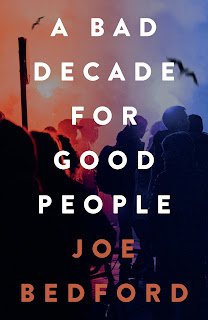
Review by Laura Besley of "A Bad Decade for Good People" by Joe Bedford


A Bad Decade for Good People – Joe Bedford’s debut novel to be published by Parthian in June 2023 – opens with an act of violence: ‘If the policeman’s baton had found Laurie half an inch lower she would be blind in one eye.’ The short prologue introduces the idea of juxtaposition, which I believe runs throughout the novel, both on a collective and individual level, for example: the police who maim and also protect; yearning to be seen by those we love, yet hiding from them. And how can we reconcile who we are with who others think we are?

Throughout the novel, nature plays a prominent role, from the ‘moon-shaped line of damage illuminated above [Laurie’s] eye’ to the various descriptions of Brighton – where a large proportion of the story is set – such as: ‘[the] shore stretches out in one long continuous line, unnaturally straight and unbroken but for the stone groynes that reach out from the shingle.’ The strong sense of place is reinforced by particular facts about the city an outsider is unlikely to know, for example the ‘tradition of leaving unwanted domestic goods out on the street – regardless of how broken they are, how difficult to move or how degradingly stained.’

George, the main character and Laurie’s younger brother, moves to Brighton to be closer to his sister, who lives there with her girlfriend. It is the summer of 2016. The summer of political turmoil: Brexit, David Cameron resigning, Theresa May becoming Prime Minister. Later in the year, Barack Obama is succeeded by Donald Trump. ‘It was all bad news or fake news or a combination of both.’ Laurie and her friends are heavily involved in the local political scene and tensions run high as the ‘decade get[s] darker and darker with no respite.’

This is also the year George meets Antonio, a Spanish naval engineer living in England with the hope of solving a family mystery from the past. It is through this central relationship that the novel continues to explore the themes mentioned above, as well as further themes of identity and belonging, both on a personal level and a communal one. How do we navigate a world not of our making, a world we no longer recognise? 

In many ways, for many people, the 21st century has not been easy. Through Antonio’s quest, we are reminded that we are not the first generation dealing with political upheaval and national frictions. In an interview in TIME Magazine, Margaret Atwood states, ‘The moment when you give up hope, that is the moment when you cease to take any actions that might be positive to get out of the doom.’ On both a macro and micro level, A Bad Decade for Good People echoes Atwood’s sentiments. Exploring timeless themes as well as the tumult of current politics makes this book a must-read for our time.  


About the reviewer
Laura Besley is the author of three collections of flash & micro fiction: (Un)Natural Elements, 100neHundred and The Almost Mothers. She is also an editor for Flash Fiction Magazine and a Creative Writing Masters student at the University of Leicester. Having lived in the Netherlands, Germany and Hong Kong, she now lives in land-locked central England and misses the sea. She tweets @laurabesley

Thursday, 30 June 2022

Review by Sally Evans of "The Last Days of Petrol" by Bridget Khursheed


This first poetry book by Bridget Khursheed, who lives in the Borders near Melrose, is full of powerful, distinctive poems, mostly about countryside phenomena, with a sense of continuity through ecological awareness and awareness of the present. Its seventy-eight pages, packed with poems, display a certainty of vocabulary, rhythm and phrase unusual in a first book of poems. There’s the same certainty about line ends in the poems, which vary from page width to a few having very short lines.

Some of these poems are essentially ‘nature’ poems, some imply family and children, a few are quietly polemic, like the poem about Helen Duncan, a well-researched and unusual take on the Scottish woman who became involved in Churchill’s war propaganda, or the title poem, about frantic car messages round the country, descending to

           empty journeys,
           fast except by speed cameras,

           and the trip to the shops
           things nobody needs packed
           by a teenager …

Whether these poems are set in her local Borders with their unknown lanes and riversides, Edinburgh’s Easter Road, Kelvingrove, the Eildons, or Darnick, Khursheed’s strong sense of place gives a background to the range of poems, in which there is always a link between the clearly pictured observations and the observer. In City wood above the bypass,

           I am walking through the machine-gun wood,
           looking for siskins.

and then we are told what she finds:

          the path is needled
          and high above the pitched notes of crossbill
          and goldcrest
          are the blown wires that tear up the sky

to the surprise conclusion:

         I am looking for siskins in the pinewood
         and instead I find only me.

All he vocabulary is precise and consistent. There are a few country words: cleavers, scroggs (perhaps the most obscure, meaning crabapples), technical words when wanted, freshly used words: 'Toys abraded  / into nightmare in the silence,' or 'Rucksacked, the baby cries for home.'  

With so many people publishing poems these days, and it’s a good feature of Scottish culture that poetry can thrive in this way, not too much is generally expected of a first book. But this one raises the game. It raises the hopes and discoveries of the poetry reader and shows us a live, properly managed, healthy, modern, country Scottish English. Not a line wrong, not a word out of place.


About the reviewer
Sally Evans edited Poetry Scotland from 1997-2018, and was awarded a PhD in Creative Writing at Lancaster University in 2022. 

You can read a review of Sally Evans's novel, Wildgoose: A Tale of Two Poets, on Everybody's Reviewing here
 

Monday, 23 May 2022

Review by Gary Day of "I Left My Hair in San Francisco" by Sallie Durham


Lucky the reader who stumbles on this debut collection. Here they will find balm for the spirit, succour for the soul. Sallie Durham’s poetry is wistful and gentle with tinges of melancholy and, very occasionally, a hint of the macabre. Her great achievement is to conjure a feeling for the being of things, whether it is her mother’s old cook book or sunflowers - one of her favourite subjects. In one poem they speak of themselves with pride and stoicism: ‘we, who were once goddesses- / suddenly old dames in hard hats.’ 

The connection between females and flowers is apparent in one of the best poems in the volume, ‘Iris,’ whose life cycle ‘recall[s] the lives of women / our weeping and our bleeding disguised in fine attire.’ Durham’s nature poems are quite different from the moralising Wordsworth and the melodramatic Ted Hughes in that she insists on identity and kinship, even with the humble ‘The Crane Fly’ whose stumbling dance of death proves as much a work of art as a poem, a defiant gesture against inevitable extinction: ‘slumped down on the windowsill / his last two fingers up in a V.’ 

The poems about love and family are deeply touching. ‘Ladders’ will resonate with anyone who is, or has been, in a long relationship. ‘Vigil,’ a poem about Durham’s dying father, is full of tender, piercing images and uses rhythm to great effect, repeating the same words at the beginning of the poem at the end but changing the earlier chugging sound to staccato sobs. The tonal range is impressive from the comic title poem to the slightly manic ‘Finland’ but it’s the imagery which stays in the mind. It is consistently striking and inventive: ‘The clouds continue to bank / their platinum.’ One can only hope there is more to come from this new kid on the block. 


About the reviewer
Gary Day is a retired English lecturer. He is the author or editor of a dozen books including a two volume history of modern British poetry. He had a column in the Times Higher for a number of years and has been actively involved in amateur theatre for many years.


Wednesday, 6 January 2021

Review by Asha Krishna of "Fragile Monsters" by Catherine Menon


Fragile Monsters is the debut of Catherine Menon, known for her excellently crafted short stories. 

The story opens with Durga, a mathematics lecturer visiting her grandmother, Mary, in rural Malaysia after ten years. It was meant to be short visit on Diwali night, but she ends up staying longer. As the women share the same roof after many years, the story sheds light on their frictional relationship and the reasons behind it.

Durga does not remember her mother Francesca, only from what Mary told her. As she begins to question her grandmother’s version, Franscesca’s story – the connection that binds the two women – comes to fore.

The story has a strong atmospheric feel as it brings alive the tropical heat days, rain splashed roofs and the swinging palm trees as well as the clinical, academic corridors of Canada where Durga had been living for the last ten years.

Swinging between the past and present, the narrative reveals the story of the family and the country as the women navigate the murky waters of the past.

It is the narrative technique that elevates the story to another level. Catherine’s strength is her ability to paint a complex world with a few strokes. As a mathematician herself, she skilfully employs the format of a theorem to the story. It is an interesting device that pairs beautifully with lines like the one Mary says to Durga: “You want it to be right and not true.” It highlights the complexity of truth depending upon who is saying it. 

Read this novel for its atmospheric feel, complex characters and a layered narrative. They work well here to create an immersive experience for the reader.


About the reviewer
Writer, Mum, Craft-crazy. Asha Krishna was one of the mentees on the Middleway Mentoring Scheme in Leicester. Her fiction and articles have been published in print and online.  She tweets as @ashkkrish.

Saturday, 12 May 2018

Review by Paul Taylor-McCartney of "May" by Naomi Krüger


This is a deftly-written and highly moving account of the effects of dementia on an elderly woman, May of the title, and those around her, including staff at the nursing home where she is resident. The story is actually centred on solving the mystery of a figure from May’s past that no-one around her can recall; and all wonder if he is merely a figment of her rapidly disassembling mind. 

Krüger uses two specific narrative devices to help convey her story and subject matter. Whole chapters are assigned to a number of unique characters - including May - each competing for our attention and wonderfully depicted. The narrative also shifts back and forth through decades, helpfully indicated by a date at the top of each chapter, which very much reflects one of the disorienting aspects of the condition: the unravelling of time itself. These alternative perspectives on May’s life allow us to see her at her worst, but also as caring wife, mother and friend, before the disease takes hold and her mental deterioration commences. Here is a central character that could be any of us; the familiar settings and landmarks of an ordinary northern town, Preston, help further ground the work in the domestic, the everyday, and give it a real authenticity.

Beyond structural experimentation, Krüger’s talent lies in the assured command of her prose. Short, rhythmic sentences relay the steady beat of conscious thought, allowing her to show subtle differences between her characters, whilst also unifying them. In May’s own chapters, the formal constraints of syntax and grammar are abandoned and prose becomes verse: “but I remember         the boy    He/runs into the trees. He doesn’t have       words.” These passages are not only beautifully written, they also contain all the clues required to assemble multiple interpretations of the novel’s conclusion. By the time it ends, the reader is very much left to reflect on the ways in which the past comes back to haunt each of us, despite our best efforts to bury it - which is especially difficult for those, like May, at the mercy of such a debilitating disease as dementia.    


About the reviewer
Paul Taylor-McCartney is currently Head of Secondary Teacher Education at Warwick University. He has enjoyed a long and varied teaching career in the discipline of English/Theatre Studies and is following a part-time PhD in Creative Writing with Leicester University. His research interests include dystopian studies, narratology and 20th century literary criticism.