
Showing posts with label war. Show all posts

Thursday, 6 June 2024

Review by Peter Raynard of "Still City: Diary of an Invasion" by Oksana Maksymchuk


There has never been a time of global peace; the nearest was the two hundred year Pax Romana (Roman Peace) at the crossover into the Common Era. Today sadly, after millennia of technological and social progress, wars still abound, whether in Sub-Saharan Africa, Myanmar, or Gaza, Syria, Yemen of the Middle East. Then there is the Russian invasion of Ukraine over two years ago and its continuation of almost WW1-like trench conflict, where unknown thousands of young men die in combat at the whim of the autocrat Putin.

The Polish American poet Czesław Miłosz criticised a vein of poetry that divorced the poet from society. Urging a poetic that was witness to history (which for him was the dehumanising effect of Soviet totalitarianism in Poland post-World War Two), he called it the Witness of Poetry, not ‘because we witness it, but because it witnesses us,’ inferring that because of his experience in Eastern Europe’s upheavals, he is both witness and citizen.

Oksana Maksymchuk is also both witness and citizen. By being so, the urgency and historicity of Still City: Diary of an Invasion (with no daily dates), punches the reader with each entry. There are many dimensions within the experience of modern warfare, for example being both a land war and a digital war.

Friends of friends have died
on the front line
locked up in cellars
buried alive
in their own beds

We mourn them online

There is a deep ricochet of disbelief in what is happening, not knowing how long it will last. Separation is a key theme throughout: ‘he sends a picture of his classroom, desks / abandoned in haste.’ The normality of the past is a haunting in the present, which changes the nature of time (another key theme): ‘was it / years or days ago / that we read our poems / in an underground gallery?’ Life becomes subterranean, so you lose sight of what is going on.

Of course death is ever present, in reality and fiction.

Some say it didn’t happen
others that it was staged
corpses from the morgue
laid out
for an exhibition

In the poem ‘Blank Pages’, she references Hegel’s ‘History is not the soil in which happiness grows. The periods of happiness in it are the blank pages of history.’ History is thus reduced to either a blank page marking peacetime, or in this case filled pages of horror and destruction.

So you cling to the idea of the old normality, when the present is trying to erase it, replacing it to the point where the invasion becomes ‘the unspeakable.’ So we must be glad that Maksymchuk, as witness and citizen, has spoken, and filled these vital pages of history.


About the Reviewer
Peter Raynard is a poet, and editor of Proletarian Poetry: Poems of Working Class Lives. His latest collection is Manland (Nine Arches Press, 2022). His debut poetry pamphlet, The Harlot and the Rake: Poems after William Hogarth, and academic essay on the poetry of Fred Voss and Martin Hayes, are both forthcoming in 2024.

Thursday, 10 November 2022

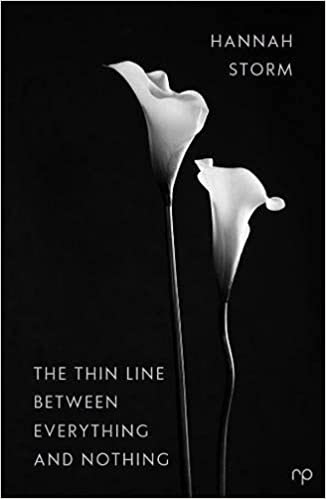
Review by Laura Besley of "The Thin Line Between Everything and Nothing" by Hannah Storm


As Russia continues to invade neighbouring Ukraine, it feels particularly poignant to be reading – or in my case rereading – Hannah Storm’s flash collection, The Thin Line Between Everything and Nothing (Reflex Press, 2021). One of its main themes is the effects of war – on individuals and what they lose as a consequence, or on a rare occasion gain, although hardly ever through choice. Further themes explored are the power struggles between men and women, and violence against women in particular, as well as the kaleidoscope of experience and emotion surrounding motherhood. 

The opening story, ‘Sarajevo Rose,’ is directly about war and the displacement Damir suffers where his name no longer means peace, but ‘scorn’ and ‘stranger’ and ‘the soiled sheets of a bedsit he [can] scarcely afford.’ Even stories not directly about war are peppered with war-like phrases, such as in the title story: ‘[h]e weapons his words’ and ‘the sound of its freedom pops like gunfire.’ Or in the case of ‘The Huntsman,’ a story about a teenager’s first French kiss, there is a distinct feeling of battle, or enemies fighting, as a ‘terrified’ Sarah locks herself in the toilet and ‘pray[s] the lock will hold.’

‘When I go to war, they loan me a flak jacket, a big blue thing designed for men’: ‘Bulletproof’ is one of several stories about women reporting on warzones, being forced to survive, and forced upon, in a world dominated by – often dominating – men, mined presumably from the author’s own journalistic experiences. 

Combining the themes of war, displacement and motherhood is the story ‘Behind the Mountains, More Mountains’ in which the main character ‘[gives] birth to a daughter, the child of men, the child of a history and country she would never really know.’

The Thin Line Between Everything and Nothing is a deep and heartfelt collection, which never shies away from the painful experiences of war, its effects, and those affected by it. 


About the reviewer
Laura Besley is the author of three collections of flash & micro fiction: (Un)Natural Elements, 100neHundred and The Almost Mothers. Having lived in the Netherlands, Germany and Hong Kong, she now lives in land-locked central England and misses the sea. 

Tuesday, 23 August 2022

Review by Jon Wilkins of "Not So Quiet" by Helen Zenna Smith


In 1930 author Evadne Price was asked by her publisher to write a spoof of All Quiet on the Western Front by Erich Maria Remarque. Instead, she wrote a serious work, based on the now-lost diaries of Winifred Young, who served in France during the war as a volunteer ambulance driver.

As Helen Zenna Smith, Price wrote a supposed semi-biographical account providing an incredible female insight to the horrors of World War I. Not So Quiet criticises nationalism and the social, physical, and psychological effects of the war upon England's youth, men and women.

Praised by the Chicago Sun-Times for its "furious, indignant power," this story offered a rare, funny, bitter, and feminist look at war. First published in London in 1930, Not So Quiet ... (On the Western Front) describes a group of British women ambulance drivers on the French front lines during World War I, surviving shell fire, cold, and their punishing commandant, "Mrs. Bitch." The novel's power comes from Smith's outrage at the senselessness of war, at her country's complacent patriotism, and her own daily contact with the suffering and the wounded.

At the heart of the novel is the juxtaposition between the families of the young women back in England, who are puffed up with pride for what their girls are doing and the visions of glory that come with it, and the realities of the women’s lives on the front. Details are not skimped here and we are plunged into the filth, the squalor, and of course the unrelenting gore of transporting the critically injured soldiers from the battlegrounds to the war hospitals. Quickly Helen becomes bitter about her mother’s constant boasting about what she is doing and, when Helen is sent home ill for a time, she is faced with repeated encouragement to get better quickly and get back out there, if not to do her duty then to make her mother proud.

One of the most compelling aspects of the book is seeing Helen gradually stop caring what her family think. In particular, there is the matter of hair. One of Helen’s new friends, Tosh, has chopped her long hair short, to the horror of some of the other volunteers. How ghastly and unfeminine! But in the filth of the situation, dealing with long hair is nothing more than another inconvenience in a life filled to the brim with them. The difference with hair is that you can do something about it. Yet, Helen is reluctant to do the same, and that reluctance comes from one place: her mother. The moment, about halfway through the novel, when she does chop her hair off, is an important symbol of her increasingly fractured relationship with her family, and more importantly, her family’s expectations.

When Helen is at home, ill, she becomes determined that she will not go back to France. She will not even get a "cushy" job in England. She is done with war, absolutely.

Helen’s sister, Trix, is also a "war girl," and comes back to England pregnant and in need of an abortion. The first thing she does is beg Helen not to tell her parents that she is in the country. Helen is against the abortion – not for moral reasons, but because it is dangerous, and girls die having them – and asks whether the man might marry her. Trix declares it could be any one of three men, and so Helen agrees to raise the money needed. There is only one thing to do. Go back to the front.

It is important that this is the reason that she goes back. She does not do it for glory, nor duty, nor to make her family proud. She does it because her beloved little sister needs her help, and because Trix also understands the horror of war. They were close anyway, but they are bound even tighter by the shared understanding that their experiences separate them from their family back at home. They have seen things that their parents and aunts will never see, and could not begin to comprehend.

This is a wonderful exposition of the crimes of the First World War. Suffering and the pointlessness of war are at the forefront of the novel. The denouement is heart-rending. It must be read.


About the reviewer
Jon Wilkins is 66. He is married to the gorgeous Annie with two wonderful sons. He was a teacher for twenty years, a Waterstones bookseller and coached women’s basketball for over thirty years before taking up writing seriously. Nowadays he takes notes for students with Special Needs at Leicester University. He has had a work commissioned by the UK Arts Council and several pieces published traditionally as well as on-line. He has had poems in magazines and anthologies, art galleries, studios, museums and at Huddersfield Railway Station. He loves writing poetry. For his MA, he wrote a crime novel, Utrecht Snow. He followed it up with Utrecht Rain, and is now writing a third part. He is currently writing a crime series, Poppy Knows Best, set at the end of the Great War and into the early 1920s.

Sunday, 15 March 2020

Review by Gus Gresham of "Poppy Flowers at the Front" by Jon Wilkins


This is a poignant, compelling story of love and desolation amid the sterling work of ambulance women during the 1914-18 World War.

As any good reader or writer knows, it is the detail that convinces and transports us to the virtual landscape of a story. Like all great novels set in the First World War (All Quiet On The Western Front; A Farewell To Arms …), Jon Wilkins’s excellent novel, Poppy Flowers At The Front, airlifts us directly into the sights and smells and sounds and mud and blood and horror and senseless waste of the trenches.

We are in safe hands, though (we hope), with the engaging narrator Poppy Loveday, who guides us through her story as surely as her ambulance negotiates the muddy rutted tracks between the field hospital and the Front, with shells exploding around her. She is diligent in her selfless efforts, but is consumed daily by the suffering of "young boys in pain, a pain they did not deserve. Boys who screamed in terror, far from home and their mothers."

Yet, amid it all, there is light-hearted relief, humour and sensitivity, especially in the jaunts to Paris, rural France and rural England. And on a visit home, there is a beautifully understated exchange as Poppy’s father quizzes her about how hard life really is on the Western Front: "'Now tell me all about France, the truth mind…' So, I did and he was very quiet and very shocked."

The main counterpoint to the horrors of trench-warfare is embodied in a wonderfully handled and sensitive love story. The reader turns the pages in anticipation of something dreadful happening to the heroine or her lover at any time … and … (no spoilers!). Recommended.


About the reviewer
Gus Gresham is an avid reader and writer. He has a Master’s degree in Creative Writing and has worked variously as a mechanical engineer, construction worker, fruit picker, community activist for Greenpeace, writer, English tutor, audio-book producer, interpersonal and communication skills facilitator, and building surveyor. He’s had short stories published in literary magazines Brittle Star and Under The Radar, and his recently published novel, EARTHRISE, is available on Amazon. You can read a review of it here