Showing posts with label Laura Besley. Show all posts

Sunday, 15 February 2026

Review by Laura Besley of "Paper Sisters" by Rachel Canwell


"What you saw was a woman, bent out of shape. Pushed beyond her breaking point. Turns out we’ve all got them." Rachel Canwell’s debut novel, Paper Sisters, depicts the lives of three family members: sisters Eleanor and Lily as well as their sister-in-law, Clara. Each of these young women is isolated – by grief, by circumstances, and by the unforgiving marsh and relentless river of the fen. And looming over it all is the unstoppable march towards World War I. 

After the prologue, which depicts one of the many great sorrows that hangs over this family, Paper Sisters opens on May Day, 1914. The tension between the two sisters – Eleanor who wants change, who wishes to go out, and Lily who wants everything and everyone to stay the same – is immediately apparent: "Irritation, ancient and unchecked, rises. Eleanor’s gaze drifts back to the window, out to the never-ending sky; vast, buttressing every leaf, reed, and clump of grass. Today its cornflower blue is marked by just a wisp of early summer cloud. As always, the sky dominates, claiming her eye and this place as its very own."

Place plays a large part in the novel. The two houses in which much of the story unfolds – one overshadowed by an abandoned hospital, the other by an unstable husband – feel cramped and claustrophobic; the landscape feels vast and wild and unpredictable. It is against these places, and against this time in history, that each of the three women grapple with the difficulties of their lives. 

Their actions are, in turn, admirable and shameful – all three are both hero and villain. On their own paths, yet unable to avoid the intersections, Eleanor, Lily and Clara cannot live with each other, but nor can they live independently. As more and more tragedy is heaped upon them, the story is propelled forward to its unexpected yet inevitable conclusion. 

Rachel Canwell is the author of a flash fiction collection, Oh I Do Like to Be (2022), and a novella-in-flash, Magpie Moon (2022). Paper Sisters – compelling and immersive; full of horror, yet full of hope – is her first full-length novel. 


About the reviewer
Laura Besley enjoys exploring big stories in small spaces and has published four collections of flash/micro, most recently: Sum of her PARTS (V. Press, 2025). She is currently a Creative Writing PhD student at the University of Leicester, an editor with Flash Fiction Magazine and JMWW, and runs The NIFTY Book Club.

Friday, 18 July 2025

Review by Nina Walker of "sum of her PARTS" by Laura Besley


In sum of her PARTS, Laura Besley provides us with a beautiful series of briefly illuminated windows - vignettes that offer glimpses into the moments of intimacy that make up a life. Besley writes tiny, furious fiction concerning an increasingly fractured world. Each story acts as part mirror, part shard, as cutting as it is revealing. This sentiment is perhaps embodied best by "shattered," in which a self-hatred over physical appearance culminates in a speaker smashing a mirror and stating, "with the shards of glass / I give myself a new face." 

Besley gives a new face, not just to the nameless speaker of "shattered," but also to the presumed limitation of flash fiction. Her creative approach to the visual presentation of flash fiction gives the collection a strong visual identity, a new face. Utilising poetic lineation techniques, Besley’s work shatters and reforms our presumptions about the form.

The collection is carefully threaded together by a series of intimacies, perhaps most centrally the intimacy one must have with oneself. In the refined and precise prose that is present across all four of her published works, Besley presents the reader with moments of physicality that ripple out beyond the pieces' short word counts. Often, the body of the speaker is positioned as an object of discussion, like a museum exhibit - an object transformed by a thread of absurdism that contrasts with the collection's physicality. In one story, the speaker is transformed into a trumpet, in another, a character grows an extra arm to hide their face. Bodies in Besley’s work are central yet malleable. They are expressed through a series of familiar quirks and fault lines, "thick middles," "haggard faces," and "bruises" that can become beautiful or bizarre at a moment’s notice. When reading Besley’s work, one is left discovering, through her typical sharp and wise immediacy, a new strangeness within oneself. 

In one of my favourite stories from the collection, "fractured," Besley writes:

          the doctor says "We’re going to need to take a
             consent form." I sign. "If you could just remove your
                bruises, multiple, along the collar bone and across the patient’s back
                   home, he might be awake, be wondering why I’m not
                      there is a bed ready for you now." I don’t

Here, the body, while still central, is cut in two by the story's perspectives. The lineation is cleverly used to construct the patchwork of the patient as observer and subject. "Patient’s back" flows cleanly into "back home," as if the thoughts of the patient effectively interrupt the clinical observation. Time is clipped and stitched as the request to "remove your bruises" merges observable reality and individual desire for escape. A clashing moment of exterior reality and interior doubt culminates in the piece's final unfinished fragment, "I don’t." The final line, when read within the context of a domestic abuse victim refusing the (albeit limited) protection of the hospital, is haunting. The lack of a concluding full stop implicates all the possible moments this patient may inhabit after this one, leaving the ending of the piece jagged and frayed.

In just thirty-four pages, Besley draws us into a network of bodies, thoughts, and conversations, always, as flash necessitates, with scant context. Yet the brief nature of each piece illuminates just how interconnected we all are, each jagged edge implicating a matching edge that may yet lie beside it. The sum of the collection's parts is a moving and sharply observed portrayal of the complexities of embodied life, where one must place gentle intimacies right alongside painful metamorphosis and absurd possibilities. 


About the reviewer
Nina Walker is a first year PhD student at the University of Leicester studying the impact of digital technology on the contemporary American novel. She also co-runs the Leicester based creative writing group Amateur Hour. She enjoys writing poetry, reading speculative fiction, and pub quizzes. 


Tuesday, 30 January 2024

Review by Laura Besley of "Jokes for the Gunmen" by Mazen Maarouf


Jokes for the Gunmen is a short story collection by award-winning Palestinian-Icelandic writer, poet, translator and journalist, Mazen Maarouf. It was translated from the Arabic by Jonathan Wright. 

All the stories in the collection explore jokes and joking as either a means of exchange or a coping mechanism for the atrocities of living in a country at war. In the eponymous opening story, the father figure must make up jokes for the gunmen in order to avoid their wrath. ‘Of course, in front of a bunch of gunmen you have to be a good storyteller in order to win your freedom. Your story has to be convincing, enjoyable and very short, and it has to make people laugh.’ As a consequence, the withdrawn father and unruly son become closer as they both focus on the task of thinking up a new joke every day. 

In the story ‘Jokes’ there is another young boy trying to make up jokes. ‘I don’t have ready-made jokes in my head and I don’t remember any details of the few jokes I’ve heard. So I’m trying to sketch out the scenario for a joke in my head.’ On the flipside, the main character in ‘The Angel of Death’ doesn’t ‘have a sense of humour … and [doesn’t] understand why people smile.’ Throughout the story, everyone around him is trying to make him smile or laugh or giggle, but he is resolute. In fact, he gets angry when a man laughs at something he said ‘since [he] hadn’t intended to make a joke.’ In the story ‘Gramophone’ the father loses both his arms when a vacuum bomb strikes the building he was in, but jokes that it doesn’t matter; the gramophone is broken, so he doesn’t need his arms anyway. 

The sense of loss, both physical and emotional, runs throughout the collection. People lose limbs, eyes, loved ones; people are ‘pale, silent and thin’ and ‘hollowed out.’ Another theme rooted within the stories is violence, both inside and outside the home, and good use is made of the liminal line drawn between fantasy and reality.

In many ways this collection is a tough read; the depictions of war-torn families are heartbreaking. However, despite the losses these characters have to bear and somehow overcome, there are glimmers of hope on the horizon. Jokes for the Gunmen is a phenomenal collection.  


About the reviewer
Laura Besley is the author of 100neHundred and The Almost Mothers. She has been widely published in online journals, print journals and anthologies, including Best Small Fictions (2021). Having lived in the Netherlands, Germany and Hong Kong, she now lives in land-locked central England and misses the sea. She tweets @laurabesley

Sunday, 21 January 2024

Review by Laura Besley of "Chasing the Dragon" by Kathy Hoyle


Kathy Hoyle’s debut novella-in-flash, Chasing the Dragon, is an ambitious and compelling example of the form. The novella-in-flash is an emergent new genre operating largely outside mainstream publishing. It combines the concision of flash fiction standalone stories with the space in which to develop a novella-length narrative. In order to make the stories self-contained and unique, Hoyle has made good use of flash fiction techniques, such as stories written in the form of lists, letters and reports. This creates the variety and change of pace for the reader often found in novellas-in-flash while simultaneously ensuring each story adds to the overall arc.    

Despite its brevity – Hoyle’s novella-in-flash is sixty-five pages in total – Chasing the Dragon spans across generations, continents and cultures. It is told through multiple points of view and the main thread of the story is of Americans in wartime Vietnam, the difficulties they experience there and subsequently back home after their return to the United States. There is a single story written from the point of view of Bihn, a young Vietnamese boy. To create a deeper and richer understanding of these characters and their worlds, there are also stories set in an earlier time where we learn of the characters’ childhoods and childhood traumas.   

Hoyle is extremely adept at voice. The first story, which relays a Vietnamese proverb, opens with the sentence, ‘In Vietnamese legend, Lac Long Quan, the most noble king of all dragon-kind, lived near the water of the Dong Sea,’ and continues to be told in long lyrical sentences. The following story, from the perspective of Thomas Jefferson Scott or ‘[j]ust plain old JT,’ consists of much shorter sentences and a strong dialect: ‘Jacob don’t talk of it none. He don’t like guns none either. He says he’s a pacifist. That he don’t like hurtin no one nor nothin.’ The report and letter stories are both written in a more formal register befitting their forms and the list makes excellent use of repetition; each line starts with ‘He will’ or You will’ and a singular, heartbreaking, ‘They will.’ 

Through its seventeen stories – bookended with the Vietnamese proverb: Children of Dragons, Grandchildren of GodsChasing the Dragon sheds light on a largely overlooked consequence of war, as summed up by Willy telling his mama in the eponymous story: ‘Ain’t nobody won nothing.’ Kathy Hoyle’s novella-in-flash evokes a kaleidoscope of emotions, ranging from horror and outrage to compassion and awe. Each individual story is a fantastic rendering of flash fiction, but it is in its entirety that Chasing the Dragon really demonstrates Hoyle's range and ability for both the form as well as the depiction of characters and the worlds they inhabit. This is a truly stunning debut.  


About the reviewer
Laura Besley is the author of 100neHundred and The Almost Mothers. Having lived in the Netherlands, Germany and Hong Kong, she now lives in land-locked central England and misses the sea.
You can read more about Chasing the Dragon by Kathy Hoyle on Creative Writing at Leicester here.

Saturday, 2 December 2023

Interview with Roppotucha Greenberg


Roppotucha Greenberg is the author of a flash and micro-fiction collection Zglevians on the Move (TwistiT Press, 2019) and four silly-but-wise doodle books for humans, Creatures Give Advice (2019), Creatures Give Advice Again and it’s warmer now (2019), Creatures Set Forth (2020) and Cooking with Humans (2022).

Roppotucha has lived in Russia, Israel and now Ireland. She speaks three languages fluently and has tried to learn six more. Arachne Press has previously published Roppotucha’s stories in the Solstice Shorts Festival anthologies, Noon and Time and Tide. She shares regular micro-fiction on X/Twitter: find her @roppotucha.

Below, she talks to Laura Besley about her new novella, Getting by in Tligolian


Interviewed by Laura Besley

LB: Firstly, congratulations on the publication of Getting by in Tligolian – it’s a fantastic novella! 

RG: Thank you so much! 

LB: Often, while I’m reading – whether it be a novel, novella or one of the various forms of short fiction – I find myself wondering what sparked the story. Was there a moment or a character or an image or something entirely different that led you to write Getting by in Tligolian

RG: It was the image of that city: those huge glass enclosures, the traffic, and the narrow streets with tired looking shops, and the river. The giant as well. His presence was almost instantly apparent in my imagination. 

LB: There are various strands to this novella, one of which being ‘language.’ In the story ‘Appendix,’ the main character states: ‘I tried to learn Tligolian so many times and forgot it just as many.’ Did you purposefully use language, or the lack of language, to disorientate her and set her up as ‘an outsider’?

RG: I think she would be an outsider regardless of the language. Apart from the physical fact of immigration, her chronic naiveté both protects her and isolates her from the world. Through learning Tligolian, which is not necessary for communication in Tligol, she attempts to ground herself in the world. Language learning makes things seem simple, especially in the beginning when one talks of girls eating apples and your mother being a teacher and things like that. Of course, this does not work, because language turns into layers of forgetting, while its difficult tenses wrap around her and make her confusion grow. 

LB: The main character describes Tligol, the fictional city in which the novella is set, as ‘so beautiful, I convinced myself that I was in charge of the perfect expression of its beauty.’ Do you feel the city functions as a character within the novella and if so, how did you go about conjuring that feeling? 

RG: Thank you for citing this line. In a way, Jenny spends the whole book chasing the city, trying to express its beauty, learn its language, find its giant, take the trains to all its time layers. The city is a character. Like other places in real life, it is alive and wonderful, but it also evades easy capture. One comes near, but only just near enough, and being in the midst of the thing you want to capture complicates matters. 

LB: Another aspect of the novella is ‘time.’ Did you layer in that complexity through multiple versions and/or edits, or was that aspect of the novella clear in your mind from the outset?

RG: That was something that became apparent very soon, in one of the early drafts. Time-travelling trains are an inherent part of the city.  Though other aspects of the city became apparent earlier – the way its spaces are not quite stable, for example, or the way living people get recorded as ‘reflections.’ 

LB: All of the chapters are short, some only a few lines. Was this a conscious choice? What is the effect of this on the reader? And what benefits do you feel you gain as a writer by learning to write/writing concisely? 

RG: Yes, this was a conscious choice, but it was motivated by the needs of the story. For me, the novella in flash works so well for fragmented narratives and stories that work with negative space - in the sense that the narrative gaps are a part of the story. Without giving away too much, I feel that the form of the text works well with its ending.  

LB: Thank you very much for taking the time to answer my questions!  

RG: Thank you for being such a generous and attentive reader. I am very grateful. 


About the interviewer
Laura Besley is the author of 100neHundred and The Almost Mothers. She has been widely published in online journals, print journals and anthologies, including Best Small Fictions (2021). Her work has been nominated for the Pushcart Prize, twice nominated for Best Micro Fiction and she has been listed by TSS Publishing as one of the top 50 British and Irish Flash Fiction writers. She is an editor with Flash Fiction Magazine and a Creative Writing MA student at the University of Leicester. Having lived in the Netherlands, Germany and Hong Kong, she now lives in land-locked central England and misses the sea. 

Friday, 12 May 2023

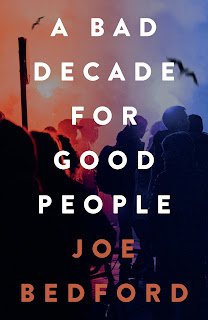
Review by Laura Besley of "A Bad Decade for Good People" by Joe Bedford


A Bad Decade for Good People – Joe Bedford’s debut novel to be published by Parthian in June 2023 – opens with an act of violence: ‘If the policeman’s baton had found Laurie half an inch lower she would be blind in one eye.’ The short prologue introduces the idea of juxtaposition, which I believe runs throughout the novel, both on a collective and individual level, for example: the police who maim and also protect; yearning to be seen by those we love, yet hiding from them. And how can we reconcile who we are with who others think we are?

Throughout the novel, nature plays a prominent role, from the ‘moon-shaped line of damage illuminated above [Laurie’s] eye’ to the various descriptions of Brighton – where a large proportion of the story is set – such as: ‘[the] shore stretches out in one long continuous line, unnaturally straight and unbroken but for the stone groynes that reach out from the shingle.’ The strong sense of place is reinforced by particular facts about the city an outsider is unlikely to know, for example the ‘tradition of leaving unwanted domestic goods out on the street – regardless of how broken they are, how difficult to move or how degradingly stained.’

George, the main character and Laurie’s younger brother, moves to Brighton to be closer to his sister, who lives there with her girlfriend. It is the summer of 2016. The summer of political turmoil: Brexit, David Cameron resigning, Theresa May becoming Prime Minister. Later in the year, Barack Obama is succeeded by Donald Trump. ‘It was all bad news or fake news or a combination of both.’ Laurie and her friends are heavily involved in the local political scene and tensions run high as the ‘decade get[s] darker and darker with no respite.’

This is also the year George meets Antonio, a Spanish naval engineer living in England with the hope of solving a family mystery from the past. It is through this central relationship that the novel continues to explore the themes mentioned above, as well as further themes of identity and belonging, both on a personal level and a communal one. How do we navigate a world not of our making, a world we no longer recognise? 

In many ways, for many people, the 21st century has not been easy. Through Antonio’s quest, we are reminded that we are not the first generation dealing with political upheaval and national frictions. In an interview in TIME Magazine, Margaret Atwood states, ‘The moment when you give up hope, that is the moment when you cease to take any actions that might be positive to get out of the doom.’ On both a macro and micro level, A Bad Decade for Good People echoes Atwood’s sentiments. Exploring timeless themes as well as the tumult of current politics makes this book a must-read for our time.  


About the reviewer
Laura Besley is the author of three collections of flash & micro fiction: (Un)Natural Elements, 100neHundred and The Almost Mothers. She is also an editor for Flash Fiction Magazine and a Creative Writing Masters student at the University of Leicester. Having lived in the Netherlands, Germany and Hong Kong, she now lives in land-locked central England and misses the sea. She tweets @laurabesley

Friday, 31 March 2023

Review by Laura Besley of "Postcard Stories" by Jan Carson


Collections of micro fiction are rare. Collections of micro fiction by novelists are rarer still. I recently read The Fire Starters by Jan Carson, and loved its surreal lyrical qualities through which the devastating reality of living in Northern Ireland was explored. A month or so later I was browsing the online catalogue of The Emma Press and saw Postcard Stories (2017), illustrated by Benjamin Phillips. The title is in reference to how the book came about: ‘Every day in 2015, Jan Carson wrote a story on the back of a postcard and mailed it to a friend.’ The book contains 52 stories, one for each week, in which ‘Carson presents a panoramic view of contemporary Belfast.’

In her book, Going Short, Nancy Stohlman writes: 'One of my favorite approaches to writing a flash fiction story is what I call the zoom lens – taking an ultra close-up shot of what’s potentially a much bigger story. It’s like narrowing the focus from a wide-angle landscape to a single flower. In flash fiction, the single flower can be the whole world.' This zoom-lens approach is often used by Carson in her stories. One example is in August’s opening story in which the main character leaves her father in Ikea because ‘he was too old to go on.’ The actual story takes place in a slither of time, but it also encompasses the difficulties which arise from having to watch the struggles of an ageing parent: ‘I could see he was glad of the rest, glad to have the expectation lifted from him.’ 

Carson’s stories don’t have titles. Instead readers are given the week in which they were written, where and to whom. The last story, written in St George’s Market, Belfast, opens with ‘every year during the month leading up to Christmas, Eleanor takes a stall at St George’s Market and sells disappointment in small, hand-made bottles.’ There is a myriad of different disappointments and ‘it is mostly locals who buy from her. The tourists tend to skip straight from the felt handbag stall on her left to the organic candles on her right.’ Tania Hershman writes that ‘the reader more willingly accepts oddities and suspends disbelief in the ‘truth’ of such worlds than with a longer piece’ (Short Circuit). Carson takes full advantage of this in many of her stories; for example, a child is born with a bird’s egg in his/her hand or in the backseat of a car is a horse and a tunnel. 

Over and over Jan Carson asserts her authority as a competent and compelling short fiction writer. Along with her astute insight, Postcard Stories is a wonderful collection of poignant and touching narratives.  


About the reviewer
Laura Besley is the author of three collections of flash & micro fiction: (Un)Natural Elements, 100neHundred and The Almost Mothers. She is also an editor for Flash Fiction Magazine. She tweets @laurabesley.


Tuesday, 21 March 2023

Review by Laura Besley of "Intimacies" by Lucy Caldwell


Lucy Caldwell’s story, ‘All the People Were Mean and Bad,’ won the BBC Short story prize in 2021. Two years earlier, ‘The Children’ was short-listed. Both are available to listen to on BBC Sounds and both are in Caldwell’s latest short story collection, Intimacies – a collection which, according to the back cover, ‘exquisitely charts the steps and missteps of young women trying to find their place in the world.’

In his introduction to the Oxford Book of Short Stories, V. S. Pritchett writes: ‘the short story tells us only one thing, and that, intensely.’ Caldwell’s winning story – told in second person present tense – is about a woman on a transatlantic flight with her 22-month old daughter and the connection she makes with the man sitting next to her. It explores, as the title of the collection suggests, an intimacy, a moment. Within the limited timeframe of the flight and the couple of hours that follow on from it, ‘All the People Were Mean and Bad’ focuses on the intensity that springs up between the main character and her fellow passenger, bringing in her thoughts on motherhood and her marriage. What do you choose to reveal about yourself? And how real can such a connection really be? 'There is an artist whose work you saw once in a Whitechapel gallery: she had stitched to a globe of the world metallic threads representing one single day’s flights, then somehow dissolved the globe, leaving just the sugar-spun mass of threads, and you think of it now, of how it made you think, how fine the threads that connect us from one person, or place, to another, and how precious, and how strong.'

‘The Children’ is, in some ways, more technically skilful. Within the story there are three separate strands woven together to form a single coherent narrative: a young mother, who finds a lump in her breast; a 19th-century writer called Caroline Norton is separated from her children and seeks to bring about a change in the law; and the children of asylum seekers being taken from their parents at the US border. It feels very modern in its form, with tweets, -and bang up-to-date politically, as well as timeless regarding its subject matter and the inclusion of poetry. 

My only reservation about Intimacies is its claim to be about young women in the modern world. Nine of the eleven stories are about motherhood, or near-motherhood, and to me it feels like the balance tips too far in that direction. Personally I am very interested in stories on modern motherhood, but I wonder if you weren’t, whether you might struggle to find what you are looking for within these stories. Having said that, there is no doubt that Caldwell, who is also a novelist and playwright, is extremely adept at writing in the short story form, and this is a heartfelt and beautiful collection. 


About the reviewer
Laura Besley is the author of three collections of flash & micro fiction: (Un)Natural Elements, 100neHundred and The Almost Mothers. She is also an editor for Flash Fiction Magazine. She tweets @laurabesley.


Sunday, 12 March 2023

Review by Laura Besley of "The Man Who Loved Kuras and Other Stories" by Brian Howell


Brian Howell’s latest collection of short stories, The Man Who Loved Kuras and Other Stories (Salt, 2022), is wonderfully weird. What can be done in a short story, which is much harder to sustain over the length of an entire novel, is to explore feelings and situations that are off-kilter, at odds with the norm. These are narratives that push the boundaries of acceptance and conjure feelings of uneasiness, sometimes even repulsion, but that also challenge views on how people choose, or are forced, to live. 

Lucie McKnight Hardy writes: ‘Sensations brought about by the manifestation of the Uncanny – dread, unease, that inescapable sensation that something is not quite right – have been said to derive from that which is familiar (homely) becoming unfamiliar (unhomely)’ (Writing the Uncanny, pp.9-10). Some of Howell’s stories start out innocent enough, like the opening of ‘Green to Blue’ or ‘The Shore’ wherein a young girl asks the main character which book he is reading. Whereas others drop more quickly into a world that is not quite as it should be. The opening line of the titular story – ‘As Ishii started out on one of his daily walks past the local daycare centre, the screams of the children sounded out’ – could’ve been a man merely taking a stroll, but for a singular word: screams. This word can, of course, be read in various ways, but to me it was immediately unsettling. 

Howell makes great use of silence and space between the characters to heighten their sense of disjointedness which in turn enhances the sense of unease in the reader. One example is from ‘The Folding Man’: ‘[Pippa] seemed not to be looking so much at her mother as into a pocket of space between them’ until a ‘chasm opened up, a resentment that cannot be filled with cheery conversation, it seemed.’ Another is a one-sided conversation in ‘The Shore’ between an American man and a young Asian girl. 

In his essay ‘What My Gland Wants,’ Adam Marek states that ‘the short story reader has the ability to suspend their disbelief to a far greater degree’ (Short Circuit, p.147). This is true in many of the stories within Howell’s collection, not least ‘The Folding Man’ wherein the main character’s skin is peeled back to reveal his organs and ‘wonderfully, no blood spilled anywhere.’

Some argue that short fiction doesn’t need any description; it is only a distraction and readers are able to imagine characters for themselves. Tobias Hill, on the other hand, likens physical character description to ‘having the salt beside you when you are cooking. You don’t need a lot of it … But it is necessary to have just enough’ (Short Circuit, p.108). This singular description of Mandy in ‘Family Tree’ is not only concise, but also serves as foreshadowing for what will later unfold: ‘She seemed concerned over little else but the doll she dragged along in the dirt. I thought how much it resembled her, with its Belisha-beacon orange hair, its staring, unseeing eyes, its fixed, reprimanding expression.’ 

Bearing in mind these elements, I feel The Man Who Loved Kuras and Other Stories, although not for everyone, is not only wonderfully weird, but also weirdly wonderful.  


About the reviewer
Laura Besley is the author of three collections of flash & micro fiction: (Un)Natural Elements, 100neHundred and The Almost Mothers. She is also an editor for Flash Fiction Magazine. She tweets @laurabesley.


You can read more about The Man Who Loved Kuras and Other Stories on Creative Writing at Leicester here

Tuesday, 29 November 2022

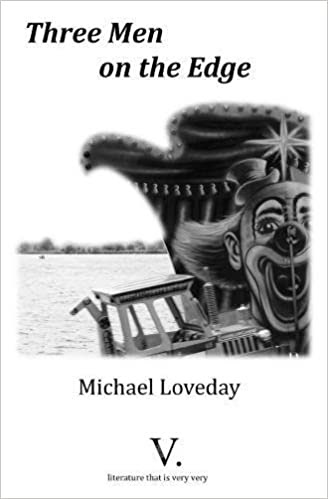
Review by Laura Besley of "Three Men on the Edge" by Michael Loveday


Three Men on the Edge by Michael Loveday is a novella-length book comprised of three short novellas-in-flash, the stories of three men: Denholm, Gus and Martyn – all struggling with life. 

The first story, ‘Cause for Alarm,’ explores the marriage of Denholm and his wife, Joan. Through the use of swans – birds which are renowned to mate for life – Loveday gives us some insights into the relationship. When Denholm’s friend shows him ‘an image of a swan pair, necks wound tight round each other,’ Denholm doesn’t see romance, but instead shrugs and says, ‘“Could be the blur … but it looks to me like they’re suffocating each other.”’ Later on he muses that ‘if he’d known, really known, how much marriage is one drowning person trying to push another under, he might not have risked it.’ 

In the second story – ‘The Invisible World’ – there are twelve micro fictions, one for each month in a year of Gus’ life following the loss of his wife whose absence he still feels acutely. He is stuck in a quagmire of grief he cannot, or does not want, to find a way to move on from. ‘There’s a veil between him and the world that will not lift, and to tear it down seems a betrayal. Why is it still not consolation – witnessing these swans, these shadows, this sky?’

The final and longest novella-in-flash is ‘Chewing Glass’ wherein Martyn navigates relationships with Anja and Rob. ‘[W]ith every relationship, the miniature sculptor works her hammer and chisel on the stone lump of your heart. If you’re really lucky, Martyn thinks, a man survives well enough to be left in the end with something recognisable.’

Throughout the book, Loveday supplements the starkness of these men’s lives with the stark beauty of nature. This adds, I feel, to the presence of a certain level of resignation, but also resilience. Because life is brutal, and all you can do is live it. 


About the reviewer
Laura Besley is the author of three collections of flash & micro fiction: (Un)Natural Elements, 100neHundred and The Almost Mothers. Having lived in the Netherlands, Germany and Hong Kong, she now lives in land-locked central England and misses the sea. 

Thursday, 10 November 2022

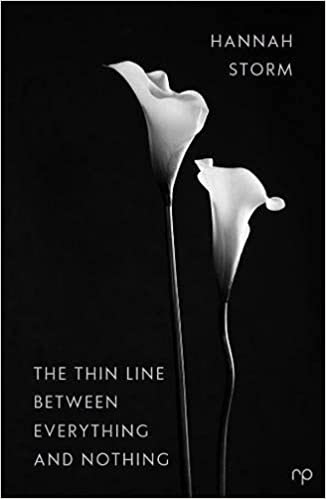
Review by Laura Besley of "The Thin Line Between Everything and Nothing" by Hannah Storm


As Russia continues to invade neighbouring Ukraine, it feels particularly poignant to be reading – or in my case rereading – Hannah Storm’s flash collection, The Thin Line Between Everything and Nothing (Reflex Press, 2021). One of its main themes is the effects of war – on individuals and what they lose as a consequence, or on a rare occasion gain, although hardly ever through choice. Further themes explored are the power struggles between men and women, and violence against women in particular, as well as the kaleidoscope of experience and emotion surrounding motherhood. 

The opening story, ‘Sarajevo Rose,’ is directly about war and the displacement Damir suffers where his name no longer means peace, but ‘scorn’ and ‘stranger’ and ‘the soiled sheets of a bedsit he [can] scarcely afford.’ Even stories not directly about war are peppered with war-like phrases, such as in the title story: ‘[h]e weapons his words’ and ‘the sound of its freedom pops like gunfire.’ Or in the case of ‘The Huntsman,’ a story about a teenager’s first French kiss, there is a distinct feeling of battle, or enemies fighting, as a ‘terrified’ Sarah locks herself in the toilet and ‘pray[s] the lock will hold.’

‘When I go to war, they loan me a flak jacket, a big blue thing designed for men’: ‘Bulletproof’ is one of several stories about women reporting on warzones, being forced to survive, and forced upon, in a world dominated by – often dominating – men, mined presumably from the author’s own journalistic experiences. 

Combining the themes of war, displacement and motherhood is the story ‘Behind the Mountains, More Mountains’ in which the main character ‘[gives] birth to a daughter, the child of men, the child of a history and country she would never really know.’

The Thin Line Between Everything and Nothing is a deep and heartfelt collection, which never shies away from the painful experiences of war, its effects, and those affected by it. 


About the reviewer
Laura Besley is the author of three collections of flash & micro fiction: (Un)Natural Elements, 100neHundred and The Almost Mothers. Having lived in the Netherlands, Germany and Hong Kong, she now lives in land-locked central England and misses the sea. 

Monday, 3 May 2021

Review by Elizabeth Chell of "100neHundred" by Laura Besley


Turning the pages of Laura Besley’s 100neHundred flash fiction stories is as delightful as being inside a huge box of chocolates. Here, bite-size stories meet with you for any and  every occasion; they will delight every literary palate. You enter stories wrapped with intrigue, or revenge, others seductive, haunting, dark, and bitter. They seem like snippets of someone’s private life, as if you have overheard someone’s thoughts as they pass you by - thoughts that you shouldn’t be eavesdropping on, but glad that you did. 

As you absorb these expertly crafted morsels you will be given an emotional workout: you will be touched by the sadness of some, captivated by the confessional nature of others, or made to shudder at true wickedness. There are stories which will leave your heart  warmed by love's first splendour and others that  will give you sheer joy with a wash of nostalgia - all of them knitted together perfectly in a hundred words. There are so many original wonderful lines, such as: 'She can’t leave because he’d find her ...' 'Leftovers of his life ...' 'Accordion wrinkles around her eyes …' 'A storm in an hour glass ...' and so on.

Each of her stories have one thing in common: you will want to read them several times as they are layered with meaning not often apparent with the first bite. Besley is such a good wordsmith not one word is out of place or wasted and what is not said is just as important as what is. These stories are like little magic spells, far from the ordinary.


About the reviewer
Elizabeth Chell is a full-time teacher, and is currently studying for an MA in Creative Writing at Leicester University.

Friday, 18 December 2020

Review by Laura Besley of "Everything Inside" by Edwidge Danticat


          On the other side of the door was the same kind of sticker, with the NOTHING
          scratched out by hand and replaced with EVERYTHING, so that the altered sticker read
          EVERYTHING INSIDE IS WORTH DYING FOR. Next to that was another black-and-
          white sticker that read YOU LOOT, WE SHOOT.
- Edwidge Danticat, Everything Inside


Everything Inside is a short story collection by prize-winning Haitian-American writer Edwidge Danticat. Each of the eight stories explores the idea of belonging and how, or if, it is possible to achieve this when no longer living in your homeland. 

Danticat is a master of the opening sentence. None is greater than this one, which in a single sentence of 24 words, sets up the entire first story, "Dosas": "Elsie was with Gaspard, her live-in renal-failure patient, when her ex-husband called to inform her that his girlfriend, Olivia, had been kidnapped in Port-au-Prince."

Each story – varying in length from 18 to 39 pages – is daring in subject matter, creating a sense of danger and ramping up the pace. And even when the situation is more every day, for example in "Sunrise, Sunset," which is about dementia and the challenges of motherhood, this supposedly normal situation within a normal family is pushed to the very outer limits of possibility. 

All the stories are about the idea of home and whether we can truly feel at home anywhere. In "Seven Stories," two childhood friends meet again as adults: “‘Home, sweet home,’ Callie said, trying to perhaps put [Kimberly] at ease.” Using this commonplace phrase to welcome her friend is underscored with the fact that this is Kimberley’s first time on Haiti, despite being of Haitian heritage, and everything feels strange and new. 

Every story in Everything Inside is deeply moving and only strengthened as being part of a collection which I would highly recommend.  


About the reviewer
Laura Besley writes short fiction in the precious moments that her children are asleep. Her fiction has appeared online, as well as in print and in various anthologies. Her flash fiction collection, The Almost Mothers, was published in March 2020. She tweets @laurabesley.

Monday, 5 October 2020

Review by Laura Besley of "Seventy Percent Water" by Jeanette Sheppard


In the title story of her debut flash fiction collection, Seventy Percent Water, Jeanette Sheppard describes how a woman’s body transforms from the usual seventy percent water to a hundred percent after a relationship ends. ‘In the sea she reformed and swam away from the storm.’ 

Sheppard has a natural flair for the obscure. In 'Trumpets,' a woman who wanted her arms to be more ‘finely tuned’ ends up with trumpets for arms. On the surface this is a piece dealing with the practical repercussions of having arms that no longer bend and are made of cold metal, but in reality it’s about the deterioration of her relationship. ‘This morning, as he left for work, I saw him glance at my brass arms and swallow a sigh.’ 

Although there is a wide variety of stories, it is in her stories about old age and all the frustrations and fears that come with that – for both the older person, and those caring for them – that Sheppard truly shines. 

In 'Mirror in the Bird Bath,' the main character puts her mirror in the bird bath because ‘the new one at physio said you had to adapt to your circumstances’ and ‘she had dementia, she knew that, but it didn’t make her a fool’; rage ignites in 'Kindling' at the main character’s brother who takes no responsibility for the care of their mother; in 'Domestic Fairy Tale,' the main character’s ‘mother lays in her hospital bed, reading over and over the two sheets of A4 … attached to the cupboard doors explaining where she is,’ as her care plan is discussed, just out of earshot; 'The Last Time I visited My Mum' hits hard when the mother produces a photo, saying ‘Look, it’s my daughter!’ 

Seventy Percent Water is an accomplished debut flash fiction collection with rich imagery and beautiful language. 


About the reviewer

Laura Besley is a full-time mum to two young boys and squeezes her writing time into the bookends of her day. She has recently been listed by TSS Publishing as one of the top 50 British and Irish Flash Fiction writers with her story ‘On Repeat’ (Reflex Fiction). Her flash fiction collection, The Almost Mothers, was published in March 2020 and her collection of micro fiction, 100neHundred, will be published in May 2021. She tweets @laurabesley


Friday, 11 September 2020

Review by Laura Besley of "This Alone Could Save Us" by Santino Prinzi


          What would be lost if the moon were to disappear, how ordinary the sky might be
          without it.
- Santino Prinzi

The moon features heavily in Santino Prinzi’s flash fiction collection, This Alone Could Save Us. Sometimes a recurring character, always a metaphor for each of the powerful stories in this collection, the moon is steady, looming large above us, but also pulling away at a pace that is imperceptible to the naked eye. It’s in these gentle shifts that Prinzi’s stories shine.   

The first and last stories of the collection act as bookends, almost mirroring each other. At the beginning of the collection, people are desperate: ‘When we realise the moon is shifting away, we beg it not to go. We vow we can change. ’ By the end, this desperation is intensified, but has turned against the moon: ‘Following the will of the people, the government decide to nuke the moon .… Some people believe the moon is the source of all their worldly problems and it’d be for the best if the moon was gone.’ Prinzi’s layered messages in 'The Moon is a Foreign Body, We Can No Longer Trust It' shine as bright as a full moon on a clear night. 

This is a fabulous collection, exploring a range of emotions and situations. There is hope for Louise and her fourth husband, Edwin, who find their way back to each other in 'It Sometimes Snows in April' and the boy who is finally freed from his mother’s snapping in 'How to Make the Magic Work'; sadness for Clyde in 'Bonsai and Clyde,' and something in between for the characters in the title story. Highly recommend. 


About the reviewer
Laura Besley writes short fiction in the precious moments that her children are asleep. Her fiction has appeared online, as well as in print and in various anthologies. Her flash fiction collection, The Almost Mothers, was published in March 2020. You can read a review of it here. She tweets @laurabesley.

Monday, 6 July 2020

Review by Laura Besley of "What Doesn’t Kill You: Fifteen Stories of Survival," edited by Elitsa Dermendzhiyska


What Doesn’t Kill You: Fifteen Stories of Survival, edited by Elitsa Dermendzhiyska, is “a hopeful book. Its hope, however, is not the cheap kind peddled by the masters of self-help. It’s the kind of hope you can only find when you let the old delusions go and learn to dance with your fears” (as Dermendzhiyska writes in the Foreword). 

The book is divided into three parts: "Struggle," "Self" and "Striving." Each essay is unique and describes an extremely different experience. Below are four that resonated for me.  

A. J. Ashworth, in her powerful essay, "Eight," describes the panic she felt as a child that she was going to die, a feeling she relives over and over as a debilitating anxiety in adulthood.
  
Kate Leaver’s essay, "A Disappearing Act," not only tackles her personal battle with an eating disorder, “I was essentially trying to kill myself in instalments,” but she explores the wider relationship people have with food and why women especially bow to this pressure: “We teach girls to diminish themselves and how we treat women’s bodies as though they’re public property.”

Rory Bremner describes ADHD (Attention Deficit Hyperactivity Disorder) in his essay, "ADHD and Me," as “[his] best friend and [his] worst enemy.” 

In his essay, "No Cure for Life," Dr. Julian Baggini debunks striving to live life as if in a fairy tale. “The goal,” he writes, “is a life well-lived” and not, necessarily, to live happily ever after for it is “only good to be happy when we are happy for good reasons.”

This is an extremely powerful collection and not always entirely comfortable to read. Personally, it made me revisit some past experiences and feelings, which wasn’t always easy, but paradoxically therein also lies its power; it made me realise that there was hope for me too. Whether or not you or a loved one is dealing with mental illness, I would highly recommend this collection. 


About the reviewer
Laura Besley writes short fiction in the precious moments that her children are asleep. Her fiction has appeared online, as well as in print and in various anthologies. Her flash fiction collection, The Almost Mothers, was published in March 2020. She tweets @laurabesley


Monday, 8 June 2020

Review by Laura Besley of "In the Sweep of the Bay" by Cath Barton


          The gulls sitting on the freshly-painted blue railings flap into the morning sky as one,  
          before peeling off on their individual journeys across the bay, riding the thermals   
          here, swooping down on abandoned chip papers there … The gulls know their
          territory. They stay within the sweep of Morcambe Bay.

- Cath Barton, In the Sweep of the Bay


In the Sweep of the Bay, a novella by Cath Barton, starts in 2009 in the village of Morecambe, Lancashire, where a statue of Eric Morcambe, the British comedian, has been erected. A retired street sweeper takes on the role of part-time cleaner. He watches people, he talks to the tourists and is happy to take their photos. He says: “People are something else; they open your eyes to things you’ve not thought of. They really do.”

At the heart of the story is a married couple, Ted and Rene. Their story starts in the '50s, where they meet at a dance, court for two years and then marry: “His mother got hold of all sorts and put on a wonderful spread, such as they hadn’t seen for years.” The language Barton uses easily conjures up the feel of a bygone era. Ted works for the family ceramics firm, first as an apprentice, but later designing beautiful hand-painted vases. Rene works until she marries, then stops to take care of her husband, the house, and later their two daughters. 

In later chapters there are threads of the story told from different characters’ points of view: Dot and Peg (the daughters), Cecily (the granddaughter), Vincenzo and Henry (who live in Italy); Barton has woven the threads of these seemingly separate stories together so they intertwine and come full circle. 

Cath Barton’s quiet style is perfectly suited to this narrative about a marriage, delicately exploring "all the sadness, and all of the love."


About the reviewer
Laura Besley writes short fiction in the precious moments that her children are asleep. Her fiction has appeared online, as well as in print and in various anthologies. Her flash fiction collection, The Almost Mothers, was published in March 2020. She tweets @laurabesley

Wednesday, 27 May 2020

Review by Laura Besley of "Scratched Enamel Heart" by Amanda Huggins


Scratched Enamel Heart is a collection of twenty-four short stories by Amanda Huggins, recent winner of the Saboteur Award for Best Poetry collection for The Collective Noun for Birds (Maytree Press, 2020). 

‘Where the Sky Starts,’ the first story in the collection, opens with a beautifully descriptive sentence: 'If you stood on the pier with your back to the sea, looked beyond the beached fishing cobbles, past the cottages, away to the south of the steelworks, you would see a bright green ribbon of land.' This sets the tone for the entire collection, which is rich in description of setting, whether it be the 'golden domes gleam[ing] under a bright autumn sky' in Russia (‘Nothing like Letter to Brezhnev’) or 'the manicured profile of each tree mirrored in the still water until a single dappled fish broke the surface' in Japan (‘A Potential Husband’).  

Themes running throughout are love and loss, often teetering on a knife’s edge between the two. In ‘Part of Sami, Part of Malik,’ Malik cares for Sami like a son even though they 'hadn’t known each other back home,' but when Sami’s mother resurfaces 'Malik began to drown in the ocean of blood pounding in his ears.' In ‘Uncanny,’ Alan has his hopes raised by a waitress in a café, only to have them dashed again. The tension between the couple in ‘Listing’ is immediately apparent, their 'smiles brittle' as they eat 'overcooked sole and yesterday’s bread.'

Interspersed with the longer stories are flash fiction stories, tight and terse, capturing pivotal moments in the characters’ lives. In two of the flash fiction stories, ‘Strong, Not Rough’ and ‘Pretty,’ the main characters are young and Huggins has captured teenage angst and inadequacy to perfection.  

Scratched Enamel Heart is a beautiful collection that will take you on a journey through time, across land and sea, and deep into the hearts of her characters. 


About the reviewer
Laura Besley writes short fiction in the precious moments that her children are asleep. Her fiction has appeared online, as well as in print and in various anthologies. Her flash fiction collection, The Almost Mothers, was published in March 2020. She tweets @laurabesley


You can read another review of Scratched Enamel Heart on Everybody's Reviewing here.

Monday, 30 March 2020

Review by Kathy Hoyle of "The Almost Mothers" by Laura Besley


This stunning flash fiction debut takes us on a compelling journey, with Laura Besley skilfully weaving together a variety of narratives as far removed from the familiar womb-warmth of traditional tales of motherhood that one could possibly imagine.   

This is an exploration of motherhood, in all its complexities. Besley refuses to hold back, plunging the reader into the realisation that motherhood is often stark and terrifying, with her opening story, "Mothers Anonymous." We hear from Melissa: "'I’m Melissa,’ she says in a raspy voice like she smokes a pack a day… And I hate being a mother.'" And from there, Besley drags us through each tale by the heartstrings.  

In "Everything’s Fine," we see how being a new mum means discarding one’s own self, to emerge unrecognisable, even in your own mirror: "I see a face and step back, knocking over a bin when I realize it’s me. The new me. The she who doesn’t wear make-up, have time to wash or sometimes even brush her hair." 

Then, we have moments of wry humour in "Down To Earth," a humorous story about Earth mothers, told from an alien point of view. But quickly we find ourselves hurtling downward again, with the horrifying "Wish Upon a Star," a story that takes your breath away in just three, short paragraphs. 

Besley dips into dystopian futures, with two tense and terrifying stories, "In Hiding" and "The Unmothers," and she’s also not afraid to acknowledge the non-mothers, with her uncompromising story "That Face" and with the brief, but intensely powerful, "How to Grow Your Own Baby."

The Almost Mothers is a wonderful collection of short fiction which has real depth and poignancy. Besley captures motherhood beautifully in this raw and uncompromising debut. I look forward reading much more of her work in the future.   


About the reviewer
Kathy Hoyle is an MA graduate from The University of Leicester. Her short stories and flash fiction have appeared in a variety of literary magazines such as Virtualzine, Silver Apples, Reflex Fiction and Another North.  She was shortlisted for The Exeter Short Story Prize, The Fish Memoir Prize and the Ellipsiszine Flash Fiction Collection Prize. She is currently working on her first novel.