Friday, 24 November 2023

Review by Gus Gresham of "The Mad Road" by Laurie Cusack


As reviewer Alexandros Plasatis says on the back cover, "The Mad Road is a hooligan of a book.” It’s easy to see why as you dive headlong into these riveting, gutsy tales. If you like your fiction cosy and fluffy and all wrapped up with a pink bow, stay clear!

In the opening story, "The Bottle and the Trowel," a man walks out along a soggy rotten board on a scaffold, falls to his near-doom and ends up on life support. "You’ve got to hear this, Gerry!" his friend says at the bedside as he begins to narrate the harrowing circumstances that plague their lives. And this story could be a metaphor for the whole collection. Reading these stories feels like walking along a dodgy scaffold, hoping that the next step you take won’t send you plummeting to the ground where unknown horrors await.

"A Doc Marten boot met the crack of Desmond O’Hara’s arse" is the opening line to "Ghost Estate" in which our anti-hero faces retribution for his exploitative dealings during the years of the Celtic Tiger economy. What will become of him? 

Whether the stories are set in Ireland itself or amid London Irish communities, Cusack serves up a smorgasbord of characters who are as contrary as the day is long. In The Mad Road, we get an up-close-and-intimate perspective on these fallible lives. Lovable smooth-tongued travellers; a young man new to London whose rites of passage bring him face to face with the menacing Zen-like character known as "The Bear"; a woman on the edge making a passionate stand against social injustice; a father who will give anything to get his girl through dancing school.

What will become of any of them? As Oscar Wilde once said, "Work is the curse of the drinking classes." So if you like your fiction gritty, turbulent and off-the-leash, this is the book for you. It has heart, it has soul, it has guts. It will mess with your head.

One thing’s for sure, I’ll probably never be able to look at a building site or a coin-operated laundrette in quite the same way again.


About the Reviewer
Gus Gresham has a Master’s degree in Creative Writing (NTU) and has worked variously as a mechanical engineer, construction worker, fruit picker, community activist for Greenpeace, writer, English tutor, audio-book producer, medical-scenario simulator and facilitator, and building surveyor. He’s had short stories published in literary magazines including Brittle Star and Under the Radar, and his most recent novel, Kyiv Trance – a dark, twisty love story and crime thriller – is available on Amazon. You can read more about Kyiv Trance on Creative Writing at Leicester here

Thursday, 16 November 2023

Review by Lee Wright of "The Mirror and the Road" by William Boyd and Alistair Owen


Alistair Owen’s extensive conversations with William Boyd that took place over a two-year period are not just for smitten Boyd fans. Whether you’re an aspirant writer or a seasoned writer, whatever your chosen field – fiction, non-fiction, novel, short story, or screenplay – The Mirror and the Road makes for a fascinating interrogation into the mind of one of Britain’s best writers. The book is structured chronologically, covering Boyd’s seventeen novels, five short story collections, twelve film screenplays, five television screenplays, and three stage plays. Boyd talks about the vim and vigour of writing, about his unpublished, semi-autobiographical novels, of how his first, A Good Man in Africa, came to be written in three months flat. But what this collection of interviews does best is to show us the process and the torments that come with being a writer, digging deep into the craft and the ingredients that has produced a staggering body of work. It is a 330-page writing masterclass, full of advice about what works for Boyd, his methods and modus operandi, how his plots evolve, how he chooses what he wants to write next, the research stage before writing, the importance of finding the right title for a project, the unimportance of writing sympathetic characters and the deliberate echoes of his many literary influences – Kingsley Amis, Evelyn Waugh, Graham Greene, Ernest Hemingway, F. Scott Fitzgerald and Anton Chekhov – underlining the importance of reading. And Boyd isn’t afraid to borrow from genre fiction to power his narrative, as he did in the case of his 1993 novel, The Blue Afternoon

The book explores Boyd’s preoccupations, seeing how they interact and interconnect and how he brings these different fixations together in his novels and short stories: “Short stories are like a laboratory for me,” Boyd says. He also stresses the importance of trusting the imagination: “I’ve often written about places I’ve never been to,” he says, writing about Los Angeles before he ever went there. “I wanted to see if I could inhabit the place vicariously through my imagination.” 

It sent me back to my time studying for an MA in Creative Writing and the recommended reading list we were given. Other than David Morley’s Cambridge Introduction to Creative Writing, no other book on the list offered the kind of embarrassment of riches (with regards to fiction writing) that comes with these interviews. It should be on the shelf of every university library to be discovered and show what can be done with narrative and how a writer can get there.      


About the reviewer
Lee Wright has an MA in Creative Writing and is currently working towards a PhD researching memoir and film. His fiction and poetry have been published with Fairlight Books, époque press and Burning House Press.


Wednesday, 1 November 2023

Review by Christine Hammond of "Revelation Freshly Erupting" by Nelly Sachs


Reading and reviewing the collected works (nine in total) of a poet originally writing in another language on Holocaust themes is challenging. This is compounded with the titanic credentials of a prolific Jewish poet (published 1947-1971), Holocaust survivor and Nobel Prize winner. 

We owe a debt of gratitude therefore to Andrew Shanks for his unique, approximate translations from Sachs’ native German. Additionally, his powerful introductory essay allows us to glimpse, briefly, the countless hours of dedication to his art since he first discovered Sachs in 1983-4 when working as a post-grad in Marburg, Germany,

What makes his approach to this important body of work unique? Shanks describes himself as "not a brilliant" linguist, who "sets out to" produce versions that, to my ear, work as poems in English. He quotes Edward FitzGerald’s famous formula: "Better a live sparrow than a stuffed eagle." More than that, as a "Christian philosophic theologian," Shanks brings important knowledge and an intuitive, spiritual understanding.

This combination complements and reveals for us the subtle, existential character of poetry that uses much in the way of classical and religious / biblical motifs and the natural world to try and make sense of the worst excesses of human depravity. 

"O die Schornsteine" ("O, The Chimneys"), the opening poem of "Habitations of Death," 1947, seems to provide an exemplar for much of what is to come. Here, some of the motifs we have come to associate with Holocaust imagery are articulated only lightly - for example, "meandering dust." They have been carefully woven in to support the heaviness of the metaphysical questions they raise: "Who contrived you? Who built ...?"  

The killings are viewed through the lens of Job’s conviction that he will see God when his skin and flesh are destroyed, which proposes to the reader an unintended, beneficial consequence of the barbarism. Thus, the objectives for murder on the grounds of religion are not only subtly ridiculed, but reduced to futility and nothingness as death has the ultimate potential to overcome and be a cause for celebration.

          "And after my skin has been thus destroyed, then without my flesh I shall see God."
          - Job 9:26

         O the chimneys
         On the artfully contrived 
         Habitations of death, as Israel’s flesh
         Floated in smoke through the air
         A star, there, received it …

         ... O the chimneys!
         Meandering dust – Jeremiah’s and Jobs’s – released –
         Who contrived you, who built, stone on stone,
         For fugitive souls, this path of smoke?

That the persecuted should not become persecutors ("Star Black-Out," 1949) is another example of the lightness of touch that is characteristic. Here, the poem uses the term "Footsteps" and contextual sound as a leitmotif throughout. Although we can readily make the association with (Jack) boots and marching, direct reference only happens in the last verse. Where the previous poem used a biblical quotation, Sachs now employs several classical allusions starting with Echo:

         Footsteps, 
         where in which of Echo’s grottoes
         are you stored,
         you rhythmic harbingers 
         of looming death?

... and ending with a poignant Pythagorean reference that beautifully ties off the whole aural theme of the poem:

         Footsteps of the killers 
         Over footsteps of the killed,
         what black-horror moon impelled
         the ticking circuit of those booted seconds?

         Where’s that leather squeak
         within the music of the spheres

Overall, the poetry uses a reductive, yet restrained, learned and gently sophisticated approach to deal with the horrific acts and consequences. This includes the preceding ideologies that initiated them. The diminution that results impresses upon us the sublimity and determination of the poems to reveal truth and beauty and thereby hope, no matter what. 


About the reviewer
Christine Hammond began writing poetry whilst studying English Literature at Queen’s University, Belfast. Her early poems were published in The Gown (QUB) and Women’s News where, as one of the original members she also wrote Arts Reviews and had work published in Spare Rib.  She returned to writing again after a long absence and her poetry has been featured in a variety of anthologies including The Poet’s Place and Movement (Poetry in Motion – The Community Arts Partnership), The Sea (Rebel Poetry Ireland), all three editions of Washing Windows and Her Other Language (Arlen House). She has also been a reader at "Purely Poetry" - Open Mic Night, Belfast.


Friday, 20 October 2023

Review by Gary Day of "The Omniscient Tooth Fairy" by Vic Pickup


First things first. This tooth fairy is not omniscient. One poem is called ‘Little did I know.’ Nor is she really - this may come as no surprise - a tooth fairy. As ‘Occupation’ shows, she is so much more: ‘a climbing frame,’ ‘a tissue,’ ‘a body guard’ - in other words, a mum. More tough fairy than tooth fairy.

The only reference to dental matter is in ‘Irretrievable.’ The speaker recalls not being able to retrieve her daughter’s tooth after dropping it down the sink where its ‘pale milkiness erod[es] slowly in the sewer dirt.’ This slight but powerful drama of maternal anxiety and lost innocence crops up again in the poignant yet stoical ‘Facts of life.’

Most poems in this delightful collection concern the ups and downs of the speaker’s many-sided domestic life: husband, babies, picking up children from school, shopping for a birthday, family outings. They are a beguiling mix of vividness and tenderness, streaked with darkness. Indeed why shouldn’t they be? Life isn’t all sunny side up. But even when things get on top of the speaker, humour is never far away, as in the dazzling ‘My New Fridge,’ whose ending packs quite a punch.

Outside the fraught but generally cosy domestic circle there are more ominous events such as the plight of refugees portrayed in ‘Jungle,’ which finishes with a devastatingly powerful image. ‘The Longing of Judith Kerr’ is the most lacerating poem in the volume. It asks the reader to imagine how the children murdered in the death camps could be coaxed back to life. There are also hints of personal tragedy and a keen awareness that not all is well in contemporary Britain.

The collection bounces along. Whimsical, profound, absurd, touching, joyous, courageous and deeply life-affirming. Buy it.


About the reviewer
Gary Day is a retired English lecturer. He is the author of several books including The Story of Drama: Tragedy, Comedy and Sacrifice from the Greeks to the Present. He has also edited a range of books including two volumes on British Poetry in the Twentieth Century. His debut poetry collection, The Glass Roof Falls Like Rain, is due to be published by Holland Press later this year. 


Thursday, 19 October 2023

Review by Gary Day of "God's Little Artist" by Sue Hubbard


It’s not often that a poetry book comes complete with an introduction and notes but both do sterling work in providing a context for these poems about the life of the artist Gwen John whose achievements have been somewhat overshadowed by those of her more famous brother Augustus. 

Sue Hubbard brings her characteristic empathy and inventiveness to bear in telling John’s story from her life in Tenby, to her time at the Slade, to her move to Paris with Dorelia McNeill, on whom she may have had a crush, and who later lived in a ménage à trois with her brother and his wife Ida Nettleship. Gwen had to model to earn money and Hubbard concisely and dramatically evokes the humiliation such work could involve: ‘insolent hands on her small breasts.’   

The majority of poems in this splendid collection concern Gwen’s fateful relationship with the sculptor Auguste Rodin who was 36 years her senior. The verse pulls no punches in its evocation of desire: at one stage I had to loosen my collar. Hubbard is no less deft when it comes to conjuring the agony of being displaced by another in the affections of the beloved. One of her many gifts is to present love in the round, how it can abase as well as elevate: ‘she wants only to button his boots.’ 

After her affair with Rodin ended, John threw herself into her work. ‘The Poetry of Things’ is one of the standout pieces in the volume where ‘clouds of spray’ become ‘strings of prayer beads / lucent as benedictions.’ Art and religion offer a way forward for the broken self ‘only paint and prayer / can offer salvation.’ 

With its wonderfully glowing imagery this is a work to be treasured. 


About the reviewer
Gary Day is a retired English lecturer. He is the author of several books including The Story of Drama: Tragedy, Comedy and Sacrifice from the Greeks to the Present. He has also edited a range of books including two volumes on British Poetry in the Twentieth Century. His debut poetry collection, The Glass Roof Falls Like Rain, is due to be published by Holland Press later this year. 

Wednesday, 18 October 2023

Review by Rebecca Reynolds of "Otherlands: A World In The Making" by Thomas Halliday


Thomas Halliday’s book is a biography of the Earth, told backwards. He starts 20,000 years ago, at the beginning of the decisive thawing of the mammoth steppe, which rings the top of the world and is home to horses, bison and the now-extinct cave lion. 

The book then travels the Earth, landing at different times and places. So there are abundant giant penguins 41 million years ago; a gorgon 253 million years ago with a painful mouth tumour and a leg which has never been the same since she fractured it hunting Bunostegos (a creature looking like a stumpy, tall crocodile); and rock-eating bacteria in the Devonian, 407 million years ago, which make the surface of the water in which they live, intolerably hot to every other lifeform, shimmer with bubbles. The climate and geological processes are given as much space as plants and animals. 

The book ends in the pre-Cambrian 550 million years ago, with no life on land, a 22-hour day before friction slows the Earth’s rotation, and the closer moon shining 15% brighter.

How does Halliday add drama and interest to processes that happen over huge timescales, mostly with no humans involved?

Firstly, he picks varied moments — differently configured landmasses and oceans, with different climates and ecosystems, for example before or after mass extinctions. Secondly, he focuses on movement. Movement of wind, waves and water and therefore of land; communities of animals migrating; individual creatures on the move. Thirdly, he mixes together disparate information — so as well as watching a short-faced bear rummaging in a mammoth carcass, we learn about Korean, Russian and European bear mythologies.

Lastly, he embraces human-centred ways of description. Literary quotations head each chapter (including Hardy’s ‘Drummer Hodge’ — ‘Yet portion of that unknown plain / Will Hodge forever be’). He chooses anthropomorphic language such as ‘cyanobacteria discovered the magic of photosynthesis,’ and is happy to translate from the academic to the literary; so the academic term ‘index fossils’ (fossils which are so abundant they can be used to date the rocks they are in) becomes ‘fossil timepieces’ later in the same paragraph. The book ends with a plea to work together to stop climate change. 

This book tells us the world will never stop being in the making, or in the unmaking.


About the reviewer
Rebecca Reynolds is an English language teacher and editor. She has just finished a Research Masters at Liverpool University looking at differences between reading, speaking and listening to poetry. She published her book Curiosities from the Cabinet: Words and Objects from Britain’s Museums in 2017. Website here. X: @rebrey. 

Friday, 6 October 2023

Review by Margaret Royall of "Rain Falling" by Sarah Leavesley


Rain Falling is a stirring long poem, a battle-cry for action from humanity. Sarah’s innovative formatting of  her urgent message is astonishing in its very complexity. It is a poem sequence formatted in the shape of capital letters which spell out the title ‘Rain Falling.’ The poems forming each letter reveal the ravages of climate change on the planet, the extinction of many species, the neglectful role that humans have played and continue to play by their systematic failure to act effectively to halt the impending doom.

This is not an easy or comfortable read, requiring the reader to decipher the various ‘codes’ which the author employs. For instance, the first poem, formatted in a capital R shape, turns into a spectral poem where the top circle of the R joins onto the /\ shape and then reads backwards, mirroring the words above, perhaps throwing our culpability back at us. 

In the final G poem, the words at the base appear to be a jumble until you realise that they are repeated higher up but with some missed out and rearranged, so the reader has to figure out how they were first used and what changes have occurred. This unravelling suggests a parallel to the unravelling of the planet. Links in the eco chain go missing and humans are not effecting a lasting repair, which results in the chaotic weather we are now experiencing and the loss of species.

The author employs stark imagery to drive home her message: striking phrases such as 'raindrops ... falling like a skipped heartbeat,' 'ice as saving Angel,' 'slick with equilibrium,' 'nothing grew from the underbelly of our thundermakers,' 'reality’s overshimmering,' etc.

Rain Falling is a highly accomplished chapbook, intelligent and convincing. If the reader were ever sceptical about climate change, this will convince him/her to think again, and more than that, to act now, before it is too late.


About the reviewer
Margaret Royall has published five books of poetry and a memoir. Her work has appeared in print, online and in anthologies and has won or been listed in competitions. Her collection Where Flora Sings (Hedgehog Press 2020) was nominated for the Laurel Prize. She leads a Nottinghamshire poetry group and co-tutors a Hebridean writing retreat. Her next collection, Toccata and Fugue (Hedgehog Press) is due out in 2023. Website: https://margaretroyall.com/ Twitter: @RoyallMargaret Instagram: @meggiepoet

Tuesday, 3 October 2023

Review by Colin Dardis of "Cockroach" by Elizabeth McGeown


The 2022 UK Slam Champion, three-time All Ulster Poetry Slam Champion, and winner of many other spoken word plaudits Elizabeth McGeown delivers up her debut full-length collection, a book version of her successful hour-long live show, Cockroach. An exploration of self-identity, from teenage awkwardness to perplexing adult encounters, we find personalities of movie stars tried on and cast off in a litmus test of affinities, the rejected cockroach character searching for answers in pop culture, in art, within seclusion and amongst perceived peers.

McGeown’s preferred style of delivery feels rapid-fire and urgent on the page; the reader is often caught up in the intensity of delivery through short lines that drive the narrative forward. Such form can threaten to become staccato, fired out like so many other spoken word performances for the sake of a neat series of rhymes. Rather, here we sense that the narrative turns against itself, the speaker questioning and analysing along the way, evoking angst and self-doubt.

Sometimes the source of such anxiety and hesitation is internal, from fibromyalgia and other medical complaints (this reviewer challenges anyone to try and find a better poem about self-applying an enema for a gastric issue), but often the sources are external; we find mention of #MeToo, and McGeown’s experiences of gatekeepers and sexism in the fields of music and the spoken word scene. We see school bullying, and the weight of expectation to conform:

          I did not pay the daily toll
          and call Angela pretty
          when the prettiest thing about her was
          the relief we felt when she left.
- "Witch"

This blends naturally with the larger search for the self that the collection is primarily concerned with, and McGeown is aware of the perverse paradox that the self is frequently defined through the company it keeps. Hence, we find various house parties, dates, the need for space and solitude conflicting with the search for meaningful company. This leads to compelling observations such as "a misfit + a misfit = a kind of sanctuary." We also see this attraction reflected in a self-deprecating style:

          A painting of a loser is vivid
          perhaps never quite so vivid
          until witnessed by another loser.
- "Villain (ix)"

Indeed, self-deprecation is something McGeown excels in, as there is enough humour, spark and playfulness to stop the poems ever descending into self-pity or despondency. Ultimately, we find an authentic voice that isn’t afraid to question or defend itself. Cockroach is postmodern mal du siècle, enjoyable and engaging from start to end, and never losing any of the energy and tension McGeown brings to her live performances.


About the reviewer
Colin Dardis is a neurodivergent writer, editor and sound artist from Northern Ireland. His most recent book is What We Look Like in the Future (Red Wolf Editions, 2023). His work, largely influenced by his experiences with depression and Asperger's, has been published widely throughout Ireland, the UK and USA.

Friday, 22 September 2023

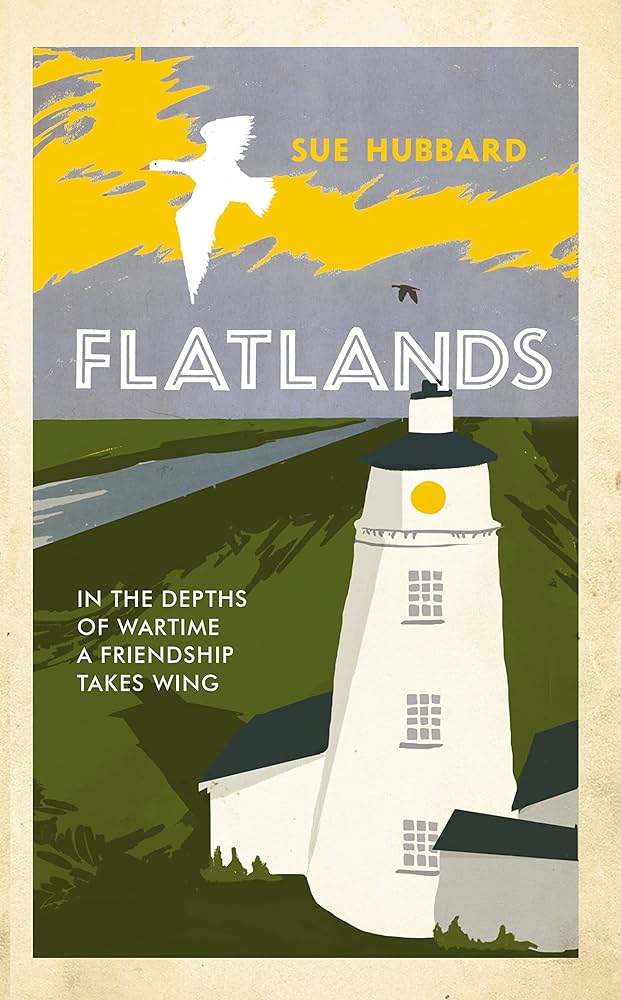
Review by Lisa Williams of "Flatlands" by Sue Hubbard


Flatlands by Sue Hubbard retells Gallico’s The Snow Goose but to an adult audience. Two souls that don’t belong, Freda and Philip, are bonded by the welfare of an injured bird: wounds and the wounded feature heavily in this wartime story. We are still evacuated with Freda but the desolation of the Snow Goose’s stretching mudflats are shifted up the coast to a “place between somewhere and nowhere” on the shores of the Wash. Hubbard’s skilled scene setting places us in both the wilderness and the time perfectly.

On “a hot day, the sort of day for a picnic, not a war” we’re transported with Freda on a train full of sad, scared evacuees to a new home “far away from love.” We’re immersed immediately in the “melancholy of the place.” This landscape, we learn as the story unfolds, matches the aching loneliness felt by both Freda and Philip. Freda remembers paisley eiderdowns and parma violets – Hubbard treats all our senses as she juxtaposes home comforts against the relentlessly barren East coast landscape.

Throughout the book the feeling of threat and uncertainty that war brings looms large but the actual menace is revealed to be lurking within the farmhouse. It is in the very place that Freda is put for safety that the full horrors of war are first exposed. She finds sanctuary at Philip’s lighthouse and they form what Philip describes as “a strange little friendship.”

An elderly Freda is telling us the story as a documentary about Dunkirk is about to be shown at her care home. Those nursed on the The Snow Goose will know Dunkirk’s poignant part in the story. I’m paddling carefully here not to avoid mines, but spoilers. During the depths of Dunkirk’s horrors in Flatlands oddly it was the addition of a dog in the water that made me catch my breath. His fate lingers long after the page has been turned.

As I read a book I make a note of sentences that I like. There was a point early on in this book that I thought I might never finish reading it because I was writing so many down. It’s a slow-paced read but with some delightful lines.


About the reviewer
Lisa Williams is a creative soul from Leicester. She has a Masters in Creative Writing from Leicester University, and lately tends to write mostly short fiction. She likes the challenge of a word limit – usually one hundred words. Her work has been published in numerous anthologies. Lisa has a weekly story slot on local community radio. She helps out a bit at Friday Flash Fiction and Blink Ink Journal. Lisa also paints and makes jewellery selling online as noodleBubble.