Wednesday, 7 June 2023

Review by Louise Brown of "Eastmouth and Other Stories" by Alison Moore


Alison Moore’s Eastmouth and Other Stories is a beguiling read. Her ability to build the world she transports you to, together with her themes of domestic confinement and calamity are gripping. 

In “Eastmouth,” the entrapment of the main character in the gloomy confines of a boyfriends’ claustrophobic family and seaside town is told in such an understated way that the sense of claustrophobia is heightened. A local tells her "You are the Webster girl," and while she denies this, she sees a crowd of locals advancing towards her, who are described as "an army in beige and lilac."

The atmosphere of the characters being trapped or even killed by the places they inhabit grows in each story, and nature colludes too. In “Winter Closing,” the story opens with a sentence that foreshadows the calamity contained in an old house inhabited by Derek. She tells us, "The garden path, on which there was black ice this morning, has been salted to prevent the fracturing of wrists, the breaking of hips, the shattering of pelvises." The malevolence of the house, and the path that leads to it, is placed in the forefront of our minds.

In “Seabound,” a doomed love affair is entrenched in a forlorn house and surrounding landscape. The main character, May, lives in the clifftop house, and is trapped in a hopeless shrine to a teenage lover. As her life passes, the sea is described as "clawing its way towards the foundations of that clifftop house." Despite the risk of it falling into the sea, May ignores her daughters’ exhortations to leave the doomed house. The sea is also somehow calling to her, and in her dreams, she tells us that, "Vast and cold, the sea climbed her bare legs. It was rough but she stood her ground. Sometimes, when she woke from these dreams, the sea was so loud it could have been right there in her room."  Only when her dead lover, "a man made of water," and "the seaman," visits her in her dreams, does she answer the call of the sea and she is finally released by one final act of homage to her beloved.

Moore’s powerful depiction of buildings, nature, and the doomed choices of her characters, results in a potent weft of inevitability, calamity, and tragedy, with writing and characters that stay with you long after you have put away her compelling vignettes. 


About the reviewer
Louise has an MA in Creative Writing from the University of Leicester. She is an Employment Judge and is also working on her first novel.

You can read more about Eastmouth and Other Stories on Creative Writing at Leicester here. 

Friday, 2 June 2023

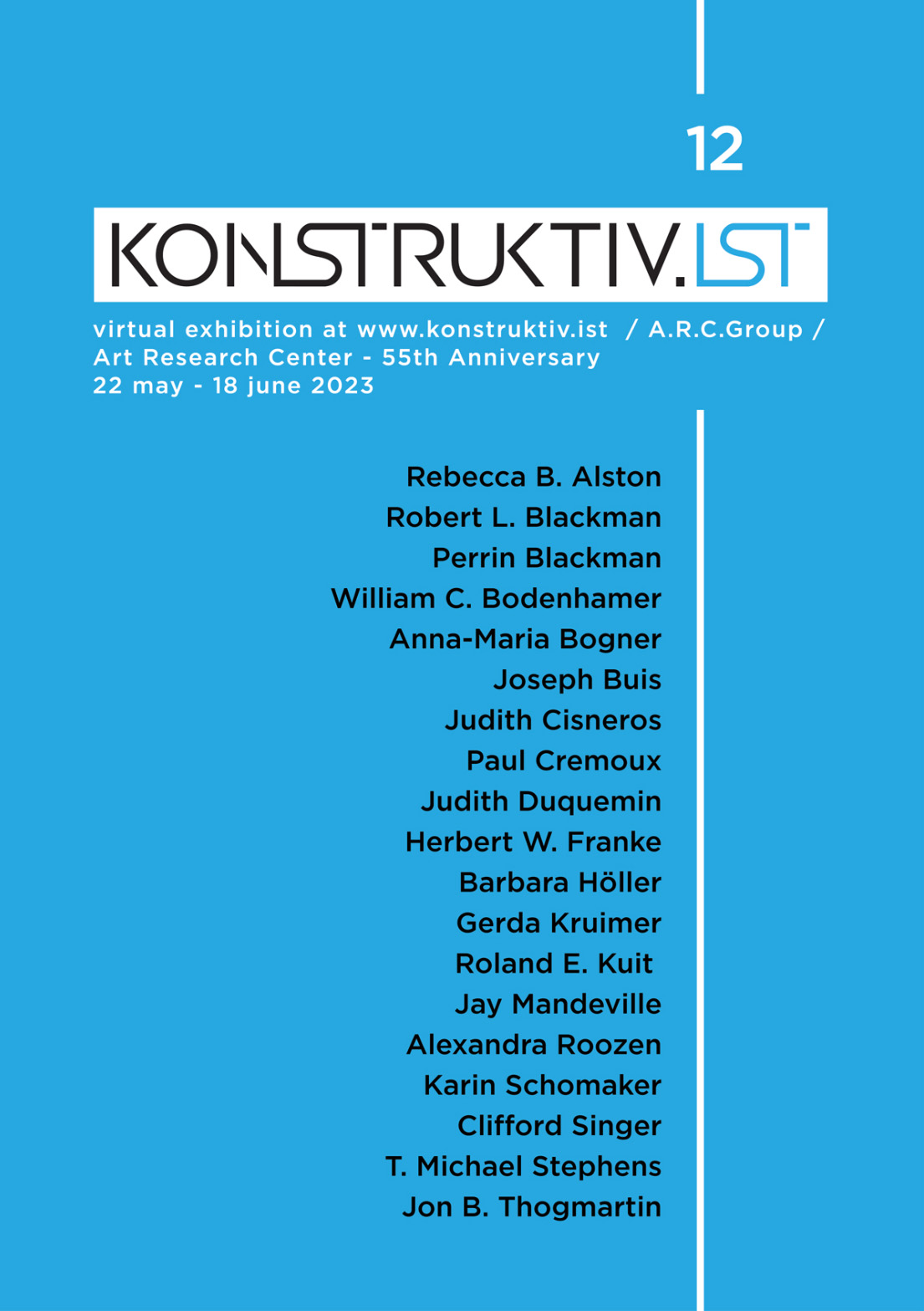
Review by Robert Richardson of "Virtual Exhibition No. 12: Art Research Center/A.R.C. Group 55th Anniversary Exhibition," 22 May - 18 June 2023


For a visual arts group to be in existence for fifty-five years is itself an achievement, and this is celebrated by the Art Research Center/A.R.C. Group with a superb online exhibition, which also becomes ‘Virtual Exhibition No. 12’ on the konstruktiv.ist website. In contrast, this website, founded by the Turkish artist Erdem Küçükköroğlu, began recently, in 2020, at the outset of the pandemic and its subsequent lockdowns, which hastened a greater movement towards online exhibitions.

The artworks of these nineteen A.R.C. members give a continuing vitality to Constructivism in the 21st century, and they are entirely suitable for viewing on screens. Constructivist art has never much depended on the relief qualities of paint, with a flat surface often being the aim (it is significant that many of the painters here use acrylic). This means when they are scanned and become digital, nothing much, in this respect, is lost, and, for the most part, an emphasis on bold compositions and colours means a screen becomes an excellent alternative canvas, with its light providing vibrancy.

Within the general adherence to Constructivism, this selection has a pleasing eclecticism: the dangers of being monolithic or didactic are avoided. As well as the adept curating of T. Michael Stephens, A.R.C. Founder and Constructivist artist and designer, and Erdem Küçükköroğlu, this is probably also helped by the other interests of the participants: in addition to 2D and 3D art, these include architecture, digital art, photography, poetry, collage, and sonic art. There is for sure a range of perceptual intelligence present in this exhibition. 

I am assuming the artists themselves nominated their descriptions on the virtual labels, and, in particular, find interesting that the German artist Anna-Maria Bogner chooses ‘Concrete Artist.’ This is of course a direct link back to the great Max Bill, the important school of design at Ulm, and the even more important Bauhaus. Although Constructivism originated in Russia, it was made truly international by the Bauhaus, not least because of its own diaspora, including Gropius and other leading figures moving to the United States. The A.R.C. group was founded in Kansas City, but the participants of this exhibition reflect this internationalism, coming from a number of counties: Argentina, Australia, Austria, France, Germany, Netherlands and USA.

A more common self-descriptor is ‘Systematic Painter (or Artist)’ and variants of ‘Structural.’ I am taking this to mean these artists are working with a system that is possibly adopted or of their own invention. One artist, Clifford Singer, is a mathematician, and I assume this informs his approach. What unifies is engagement with the basic Constructivist vocabulary of shape, line, colour and space. The creating of compositions in a systematic way is a sublimation of the individual in favour of the universal. Nevertheless devising (or choosing) a system and the aesthetic judgement on whether to accept or reject its outcomes means, paradoxically, that styles emerge. From encountering their art on social media, I now instantly recognise Judith Duquemin‘s own brand of using white space as an active compositional element, Joseph Buis’ scaffoldings of colour and T. Michael Stephens’  singular approach to working with constructions.

A more inclusive Constructivism overlaps with other Movements, particularly Minimalism, as with Rebecca B. Alston’s FDP RED #3 (2023). It consists of three squares: a small black one within a light red one, and both within the largest one, itself divided in halves of two darker shades of red. It is inevitable that Albers is referenced (and, for me, aspects of Enrico Castellani come to mind as well). The division of the largest square, offset against the other elements, creates a perceptual dimension all its own, and the fierce reds belie an accompanying meditative quality. Similarly, Jon B. Thogmartin’s Purple Dots & Yellow Circles (2022) is both Constructivist and Minimalist, with an emphatic rhythmic repetition.

There is of course much work that meets the Constructivism of lines, shapes and the geometric angles they make, and examples of exhibits that are “classically” Constructivist are Barbara Höller’s painting 19copy07 (2021) and William C. Bodenhamer’s assemblage Construct Aesthetics Inherent (n.d.).

The konstruktiv.ist website is an effective pairing for this exhibition, and should be congratulated for creating an online environment with admirable clarity of navigation, presentation and labelling, and congratulations to Art Research Center/A.R.C. Group for showing a Constructivism that continues to look fresh. The dates of the artworks are recent, and this highlights the group is not a tedious custodian of Constructivist purity but contemporary artists adding their own perceptions and ideas.

The full list of artists is as follows: Rebecca B. Alston, Robert L. Blackman, Perrin Blackman, William C. Bodenhamer, Anna-Maria Bogner, Joseph Buis, Judith Cisneros, Paul Cremoux, Judith Duquemin, Herbert W. Franke, Barbara Höller, Gerda Kruimer, Roland E. Kuit, Jay Mandeville, Alexandra Roozen, Karin Schomaker, Clifford Singer, T. Michael Stephens, Jon B. Thogmartin. The link to the exhibition (ending 18 June) is here. The link to the A.R.C. website is here.


About the reviewer
Robert Richardson is a visual artist, writer and lecturer. His work published by Leeds Postcards in the 1980s was distributed throughout Britain, and is now in graphic art collections of the British Museum and the Australian National Gallery. It is also included in Artists’ Postcards: A Compendium (Reaktion Books, London) and Leeds Postcards (Four Corners Books, London). In recent years he has put together an ongoing portfolio of abstract digital artworks, producing some as limited edition prints and others as NFTs. In 2022, a video artwork was selected for Digital Art Month Paris, and was viewed at various public spaces in the city. He is also the co-editor of Homage to Imagism (AMS Press, New York). His website is here.   

Thursday, 1 June 2023

Review by Lisa Williams of "The Last Dance" by Mark Billingham


The Last Dance is the first book in a new series by Mark Billingham. The story introduces his new character DS Declan Miller: he’s returned to work, some think too early, after the death of his wife. His wife also worked for the force and was his dancing partner – hence the title. 

Declan likes a joke. His new partner at work, DS Sara Xiu, is unresponsive to his humour. This antagonism bonds them nicely as characters and ensures by the end of the book the pairing feels as comfortable as a favourite pair of slippers. 

I read this on Pigeonhole. They release a few chapters a day which meant I couldn’t binge it and consequently felt every cliff-hanger. It's a tense enjoyable read and I’ll very definitely be reading the next Detective Miller novel.


About the reviewer
Lisa Williams writes short stories usually of just 100 words. You can find her online @noodleBubble


Friday, 12 May 2023

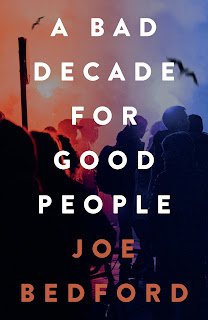
Review by Laura Besley of "A Bad Decade for Good People" by Joe Bedford


A Bad Decade for Good People – Joe Bedford’s debut novel to be published by Parthian in June 2023 – opens with an act of violence: ‘If the policeman’s baton had found Laurie half an inch lower she would be blind in one eye.’ The short prologue introduces the idea of juxtaposition, which I believe runs throughout the novel, both on a collective and individual level, for example: the police who maim and also protect; yearning to be seen by those we love, yet hiding from them. And how can we reconcile who we are with who others think we are?

Throughout the novel, nature plays a prominent role, from the ‘moon-shaped line of damage illuminated above [Laurie’s] eye’ to the various descriptions of Brighton – where a large proportion of the story is set – such as: ‘[the] shore stretches out in one long continuous line, unnaturally straight and unbroken but for the stone groynes that reach out from the shingle.’ The strong sense of place is reinforced by particular facts about the city an outsider is unlikely to know, for example the ‘tradition of leaving unwanted domestic goods out on the street – regardless of how broken they are, how difficult to move or how degradingly stained.’

George, the main character and Laurie’s younger brother, moves to Brighton to be closer to his sister, who lives there with her girlfriend. It is the summer of 2016. The summer of political turmoil: Brexit, David Cameron resigning, Theresa May becoming Prime Minister. Later in the year, Barack Obama is succeeded by Donald Trump. ‘It was all bad news or fake news or a combination of both.’ Laurie and her friends are heavily involved in the local political scene and tensions run high as the ‘decade get[s] darker and darker with no respite.’

This is also the year George meets Antonio, a Spanish naval engineer living in England with the hope of solving a family mystery from the past. It is through this central relationship that the novel continues to explore the themes mentioned above, as well as further themes of identity and belonging, both on a personal level and a communal one. How do we navigate a world not of our making, a world we no longer recognise? 

In many ways, for many people, the 21st century has not been easy. Through Antonio’s quest, we are reminded that we are not the first generation dealing with political upheaval and national frictions. In an interview in TIME Magazine, Margaret Atwood states, ‘The moment when you give up hope, that is the moment when you cease to take any actions that might be positive to get out of the doom.’ On both a macro and micro level, A Bad Decade for Good People echoes Atwood’s sentiments. Exploring timeless themes as well as the tumult of current politics makes this book a must-read for our time.  


About the reviewer
Laura Besley is the author of three collections of flash & micro fiction: (Un)Natural Elements, 100neHundred and The Almost Mothers. She is also an editor for Flash Fiction Magazine and a Creative Writing Masters student at the University of Leicester. Having lived in the Netherlands, Germany and Hong Kong, she now lives in land-locked central England and misses the sea. She tweets @laurabesley

Tuesday, 9 May 2023

Review by Asma Ali of "As Long as the Lemon Trees Grow" by Zoulfa Katouh


“Three shrivelled lemons and a plastic bag of pita bread that’s more dry than mouldy sit next to one another. That’s all this supermarket has to offer.”

Set amidst the Syrian revolution, Zoulfa Katouh’s YA novel plunges the reader straight into the bleak world of eighteen-year-old Salama. No food, bombed neighbourhoods and smashed dreams; Salama has lost everything. With her mother gone and father and brother imprisoned, she alone is left to look after her heavily pregnant sister-in-law, Layla, whilst volunteering at the hospital. Her days are filled with treating the wounded with little or no anaesthetic and she increasingly becomes torn between two choices: continue to stay and risk her life or take a chance at survival for herself, Layla and the unborn baby via a boat. But then she meets Kenan, the boy with vivid green eyes who firmly believes in fighting for his country, and the decision gets harder. 

Katouh’s writing is simple, expressive and engaging. She creates characters that stay with you long after the turning of the final page and their dilemmas throughout the novel lead readers to ponder on the complexities of human character. Her treatment of difficult themes such as guilt and refugee trauma is sensitive and well-researched. It also offers readers a brave insight into PTSD and it’s lived consequences.

Against the backdrop of pain and loss, the blossoming romance between Salama and Kenan brings an innocent and optimistic tone to the plot; their relationship is a simple reminder that life and love endures in spite of war. They also both turn to their faith for strength and guidance, which is another nod to authentic Muslim representation (one that I particularly enjoyed and found relatable as a Muslim reader) in a novel rich with culture. 

As long as the Lemon Trees Grow may be a devastating portrayal of life in Homs, but Zoulfa weaves a narrative of fierce hope and determination for a better life, which makes the book a truly beautiful read.  


About the reviewer
Asma Ali is a mum of four and current MA Creative Writing student at the University of Leicester. She has a healthy addiction to all things literary and coffee and can be found sharing her eclectic reading journey on Instagram @asma_scribendi 

Sunday, 7 May 2023

Review by Jo Dixon of "To 2040" by Jorie Graham


Jorie Graham’s latest collection, To 2040, follows close behind [To] The Last [Be] Human (2022), a tetralogy composed of four earlier collections, spanning 2002 to 2020. Both collections, published by Carcanet, immerse the reader in a world on the brink of collapse, but also a world that still holds wonder for its inhabitants. Robert Macfarlane’s introduction to [To] The Last [Be] Human suggests that the task of the poems in the tetralogy ‘are of record as well as of warning,’ a description that holds true for To 2040. 

Graham’s political / personal odes in this collection elevate the environmental crisis of the near future and the crisis of her own illness. Often, destruction and beauty co-exist within a few lines: 

         Breathe. Yes 
         the drought is everywhere out there
         but in the night

        the stems of stars mist-up
        just enough for u to recall
        when there was 
        humanity, humidity, & the stars

        dangle, sting. Ah there is
        no return 
        is there.

(‘Dusk in Drought’).

Even as the stars stir our hearts, we are stung by knowing that this is just a memory. Tellingly, there is no question mark here, our fate is sealed: ‘there is no return / is there.’ Yet this is not a collection of unrelenting gloom. The poems are invigorating in their formal inventiveness and precise use of language. The surprising lineation, extension of white space, erosion of words (you/u) and accretion of phrases have the effect of tuning us into Graham’s mind; we follow her thoughts as she wrestles with our wilful destruction of the earth, shot through with images of hope. The closing lines of the final poem, ‘Then the Rain,’ encourage us to ‘touch, touch it all,’ and in this last act of connectedness, Graham hints at a way back. 


About the reviewer
Jo Dixon’s collection, Purl, was published in 2020 by Shoestring Press. Her poetry and flash fiction appears in a range of journals and anthologies. She is Lecturer in Creative Writing at De Montfort University, Leicester, and lives in Nottingham.

Tuesday, 2 May 2023

Review by Lisa Williams of "The Scent of Flowers at Night" by Leïla Slimani


Grab a sleeping bag – we’re off to Venice with Leïla Slimani to be locked into the Punta della Dogana museum for the night. In 2016 her novel Sweet Song won the Prix Goncourt, and this year she’s one of the Booker Prize judges. In The Scent of Flowers at Night she dwells on family, oppression, and ultimately happiness. These musings are woven round her exploration of the exhibits at night. Her reflections on self, solitude and the creative process make this short autobiographical work a particular delight for writers. The time frame seems fleeting though; her neat, lucid style leaves you wanting to spend another night with her, perhaps in a different museum.  


About the reviewer
Lisa Williams has an MA in Creative Writing from the University of Leicester. She writes word-limited flash fiction, mostly drabbles - stories of exactly one hundred words. You can find her online @noodleBubble 


Monday, 24 April 2023

Review by Jane Simmons of "Kitchen Music" by Lesley Harrison


Lesley Harrison has published six collections of poetry, and now, in her first Carcanet collection, she turns her attention to the north and to the sea in poems which focus on northern lands and waters – to the Orkneys, and Iceland, their histories and stories, their flora and fauna, to northern seas, wild weather, whale-hunts.

In a foreword to the collection, Kirsty Gunn gives a powerful account of her own repeated and deepening encounters and engagements with these poems and tells the reader to expect "A book of poems, a book of voices. A book that is also a map, an almanac, a report – of histories, of stories, of lands and waters. A book of poems made and arranged in such a way as to create harbours and enclosures: the contained order of narrative brought to a wild scattering of events; a careful arrangement of whale bones on a gallery floor to tell the tale of that great singing creature now stilled to silence."

It is a book of poems which engage with other books, texts, poems – think Icelandic rune poems, sagas and folk-tales, the lives of Northumbrian saints, the personal diaries of sea-captains on whaling ships, glossaries of northern dialects. However, it is a book which also engages with music – with gaelic psalm, hymnals, and even the work of composer John Cage. There are poems which are songs – written in numbered parts, part songs – and the reader’s attention always being drawn to the musicality of even the smallest fragments of text. Sometimes, poems combine the two, books and music, to resemble the appearance and musicality of Anglo-Saxon verse – as illustrated in the opening poem:

Wou as in Wound 

WOU    as in wound
   HU    as in hunt
    AH    as in raft 
     LL   as in fall
      E    as in breech
 
WOU   as in bow
   HU    as in tump
    AH   as in slight
     LL   as in blink
      E    as in swell
 
WOU   as in fluke
   HU    as in tongue
    AH   as in ebb
     LL   as in oil
      E    as in jaw

WOU    as in run
   HU    as in calf
    AH   as in eye
     LL   as in blow
      E    as in breath 

WOU    as in sound
   HU     as in hull
    AH    as in wash
     LL    as in shelve
      E     as in dive

This is a collection to sit with.


About the reviewer
Jane Simmons is a former teacher now PhD student. She won the University of Leicester’s G. S. Fraser poetry prize in 2019, 2020 and 2021, and the Seren Christmas poetry prize in 2020. Her work has appeared in Ink, Sweat and Tears, The Blue Nib magazine and on the Seren blog, as well as being long-listed for both the Mslexia Poetry Prize and The National Poetry Competition in 2022.

Tuesday, 11 April 2023

Review by Jon Wilkins of "The House of the Interpreter" by Lisa Kelly


What is it we are interpreting and from whose house? They are legitimate questions and all becomes clear as soon as we investigate the poetry of Lisa Kelly.

Kelly has right-sided deafness which does not define her, and is a glorious poet which does.  Her work illuminates that fact through the three parts of her collection, each named with a double meaning in mind relating to hearing: Chamber is part of the ear and also a room. Oval window is self-explanatory and also a small membrane in the ear. Canal relates to the ear canal and a stream or waterway, perhaps highlighting the journey she has taken as a poet.

The poem "The House of the Interpreter" is a visceral attack on the different approaches to communication for the Deaf: Oralism, the theory, practice, or advocacy of education for the Deaf chiefly or exclusively through lipreading, training in speech production, and training of residual hearing, as opposed to Manualism, the theory or practice of education for the Deaf employing and promoting the use of sign language as the primary means of communication. Kelly has taken one and rejected the other. This is partly explained in this piece and raises questions the vast majority of us cannot answer. Indeed should we answer on behalf of others? I think not. This is their world, their body, their truth.

I find the section Oval Window most fascinating as she relates mushrooms and fungi to deafness. In a talk she gave on YouTube she tells us about this and how fungi communicate. She talks of the world wide wood and her interest in the different ways that life forms communicate. This was very important to her during lockdown and in her studies she learnt how the misunderstood fungi could talk to us and still leave us so much to learn.

"If My Deaf Ear Were a Mushroom" is perfection and the final line - "it would be valued for signing the way to alternate reality" - sums up he words perfectly as she takes on myriad adventures full of vivid colour and images to highlight her world. The mystery of the mushroom she communicates with is epitomised in "Mushroom Stones" where we see normality and mysticism unravelled and almost explained. This a fascinating approach and opens up a bright new world for us to explore and to discover. But discover what? Kelly takes us down the rabbit hole and we have to decide for ourselves.

Later in Canal we explore her journey and we read of the misogynistic world she faces and how, in "A Diptych is not a Dick Pic," she has to confront it. Not a pretty sight in anybody’s world. The colours of "Metamorphoses: Colours, Marks and Signs" contrast perceptibly with her own world. "Blue Hydrangea" epitomises this with the struggle to turn the pink flower blue, the disappointment of having a girl rather than a boy.

This collection is as varied as it is powerful, as imaginative as it is self-possessed with a strength the reader can feel in the writing of a poet secure in their place in the world and confident enough to examine the failings and successes we all have. This is an incredible piece of work and must be read for its insightfulness and its beauty.


About the reviewer
Jon Wilkins is 67. He is married to the gorgeous Annie with two wonderful sons. He was a teacher for twenty years, a Waterstones bookseller and coached women’s basketball for over thirty years before taking up writing seriously. Nowadays he takes notes for students with Special Needs at Leicester University. He has had a work commissioned by the UK Arts Council and several pieces published traditionally as well as on-line. He has had poems in magazines and anthologies, art galleries, studios, museums and at Huddersfield Railway Station. He loves writing poetry. For his MA, he wrote a crime novel, Utrecht Snow. He followed it up with Utrecht Rain, and is now writing a third part. He is currently writing a crime series, Poppy Knows Best, set at the end of the Great War and into the early 1920s. Next year he takes up the UEA Crime Fiction Creative Writing MA. The game's afoot!