Showing posts with label University of Leicester. Show all posts

Monday, 20 April 2026

Review by Anupriya Sisodia of "The Life and Times of Agatha Christie" at Literary Leicester Festival 2026


I wasn’t entirely sure what I was walking into when I signed up for Literary Leicester 2026. It was my first ever literary festival, but I knew it would be something I’d remember.  

Wednesday 18th March began with "The Life and Times of Agatha Christie" in the Attenborough Arts Centre. I remember noticing how carefully I was taking everything in. Even before it started, the room already had its own atmosphere. It was full in that warm, expectant way: people gathering in clusters, coats coming off, festival pamphlets being flicked through, that quiet pre-event energy where everyone is just waiting for it to begin. And I even saw someone dressed as Hercule Poirot, moustache and all, which made me smile before I could even stop myself. Poirot, one of my earliest literary fascinations, was the kind of character I grew up thinking of as untouchable in his brilliance, so seeing him casually walking through a modern arts centre struck me as surreal in the best way.

I’ve always had a soft spot for Agatha Christie. I started reading her books when I was around twelve or thirteen. I didn’t realize then how long they would stay with me, quietly threading themselves into how I understand narrative, suspense, and character, or that I’d end up in a different country years later, listening to someone unpack her life in front of an audience. 

Dr Mark Aldridge led the talk. The way he spoke about Christie felt grounded and engaging rather than distant or overly academic. He walked us through her life as if her story still pulsed with warmth and movement. I realized I was listening more than writing; my notes turned into scattered fragments. When I listen, my attention naturally shifts to thought, and my imagination crafts its own scenes alongside what I’m hearing.

At one point, he mentioned The Mousetrap and its extraordinarily long-running history since 1952. Immediately, my mind connected it to home: I thought of Dilwale Dulhania Le Jayenge, a popular Bollywood film that has been showing for decades at Maratha Mandir in Mumbai, India. Two very different stories, two very different worlds, yet both enduring, because people keep returning to them, generation after generation. It seemed like one of those cultural overlaps your mind makes without asking permission, where distance doesn’t matter as much as shared longevity, shared affection. I didn’t say any of it out loud, obviously. I just let the thought sit there for a moment, like a small bridge between places I carry in me.

The Q&A session carried a particular sense of meaning. People were asking questions with such care, such curiosity, as if they weren’t just seeking answers but trying to understand the texture of Christie’s legacy from different angles: her narrative arc, structure, the psychology behind her characters. There was something very communal about it, not performative, but shared. Like everyone in the room was gently adding to the same unfolding conversation.

By the time the session ended, I felt something subtle settle in. Christie’s work lives on not just because people read it, but because it is constantly re-entered and re-imagined. Each reader brings something new to it, and in doing so, keeps it moving forward. I left carrying that thought: stories don’t belong only to the past or the page. They find new rooms, over and over, just like this one.


About the reviewer
Anupriya Sisodia is a published romance fiction author, pursuing an MA in Creative Writing at the University of Leicester. She is an avid reader who loves writing stories with realistic, relatable characters who experience emotional and exciting journeys on their way to a happy ending.


Saturday, 21 February 2026

Review by Mithila Dutta Roy of "Supporting Cast" by Kit de Waal


It’s been months since I cried over a book, and short stories rarely do that to me. But Kit de Waal’s Supporting Cast made me tear up a bit on a bright Saturday afternoon. 

As the whole world is running around flaunting the idea of being the "main character" with the Pinterest-style life, glorious cafes and extravagant nightlife, there are still many who feel like the supporting cast in others’ stories. And Kit de Waal has brought their stories to life with such precision. Their losses of all kinds - time, age, love, lovers, children, sanity, legs - that form their imperfect lives are staged in a voice that is empathetic and truthful. That’s the mastery these stories needed and got.

Before starting the short story collection I didn’t know that these were the characters in the background of her earlier works. But it didn’t matter as I went from one story to another and found each character becoming a whole, with their nuances, flaws and introspection. Each story stood out as a complete piece, which was fascinating. 

It’s a book that talks about a woman who, on her divorce day, remembers her husband rescuing a boy during their honeymoon; a mother who says goodbye to her newly-wed son and starts thinking about how the bride never thanked the mother who loved him first - and then, in turn, realises that she never thanked her adopted son’s mother. It’s a book about the blind man who passes you by in a crowded street, and what he is still grateful for. It’s a story of an already grieving woman trying to form stories to make her dying father less uncomfortable.

These stories delve into deep human emotions and inner conflicts, while keeping the plot poignant. Some of the stories break what some would call the rules or conventions of short fiction, but even in breaking them there seems to be a purpose, and that is an achievement. Overall, Kit de Waal has done a wonderful job in giving the supporting cast the highlighted stories they deserve. She has given them the closure they might not have received in previous books, where they were only a part of the conversation but not the whole conversation.

Now, which one of these stories made me tear up, or was it my unbalanced hormones? You’ll have to read this book yourself to figure it out, because I’m also just another supporting cast in your story talking about a book I enjoyed.


About the reviewer
Mithila Dutta Roy is a reader and writer with a keen interest in literary fiction and stories that explore human experience. She is pursuing an MA in Creative Writing at the University of Leicester and is currently working on her first novel. She is passionate about storytelling and hopes to contribute her own voice to contemporary literature.


Thursday, 28 August 2025

Review by Paul Taylor-McCartney of "White Road" by Harry Whitehead


Harry Whitehead’s White Road is an arresting work of eco-fiction that combines the taut urgency of a thriller with the moral weight of a contemporary fable. The novel interrogates not only the limits of human endurance but also the ethical boundaries of exploitation, survival and responsibility in an age of ecological crisis.

It opens in the Canadian Arctic, a landscape at once magnificent and merciless. Into this environment comes Carrie Essler, a Scottish rescue swimmer, whose skills and resilience are tested almost immediately. A mission goes wrong and leaves her stranded on the ice with two impossible companions: a half-dead stranger and a starving polar bear. With no clear way back to safety, every decision she makes could mean life or death. Beyond Carrie, figures such as Ross, the oil rig owner mired in guilt, and Amaruq, the Inuvialuit worker torn between tradition and modern demands, create a polyphonic exploration of conscience and consequence. These intersecting narratives refuse easy resolution, instead offering a layered meditation on human ambition and fragility. 

Whitehead handles a set of complex topics and themes with a deft touch. He avoids polemic, instead allowing the characters’ experiences to illuminate questions of responsibility and consequence. And the novel is at its strongest when it lingers in ambiguity, where no choice feels wholly right, and survival itself comes at a price. Stylistically, he balances precision with lyricism and the pacing is finely calibrated: moments of breathless intensity are counterbalanced by passages of quiet introspection, allowing the novel’s thematic concerns to resonate without sacrificing narrative momentum. While stranded on the ice, Carrie encounters Bastien, a ghostly presence that delivers a sardonic, mansplaining, yet knowledgeable running commentary on the surrounding environment and Arctic lore. This eerie, sometimes-gallows-humour voice offers both guidance and unsettling commentary as she navigates the brutal landscape. It is through this supernatural element that Whitehead effectively introduces an "Ecogothic" dimension to the narrative, blending environmental consciousness with spectral intervention, and elevates the final sections of the narrative to a whole new level. 

The Arctic itself is brought to life with almost mythic presence. Whitehead’s prose renders the ice, wind and sea as more than backdrop. They emerge as sentient forces, capable of awe and terror in equal measure. The natural world becomes a crucible, exposing the weaknesses and strengths of those who enter it. "Only a vague, ambient light outlined the whitecaps breaking all around her, jagged white lines that appeared behind, ahead, and, terrifyingly, above." Some of the most haunting imagery is of nature reeling from and submitting to the horrors of leaking oil that travels upwards and outwards from the site of the disaster, set on imprinting its dreadful tattoo on the Arctic landscape and unsuspecting wildlife. "She [Carrie] switched on her torch and shone it down. Rainbow glittered back at her … she knew crude." And elsewhere, a polar bear emerges from the icy waters, its fur coated in the same oil: "It swung round, trying to bite its own flanks. Round and round like a dog chasing its tail." 

As a piece of storytelling, White Road is compelling – driven, clear-eyed and cinematic in its set pieces. Yet it can also be highly reflective, encouraging the reader to pause and consider what lies beneath the action: the fragile beauty of the natural world, the limits of human endurance and the moral compromises that underpin modern life. This is a novel that entertains while it unsettles, gripping the reader even as it asks difficult questions. Whitehead has produced a timely and resonant work that stays with you, long after the Arctic ice has closed over its final page.


About the reviewer
Dr. Paul Taylor-McCartney is a writer, researcher and lecturer living in Cornwall. His interests include dystopian studies, children’s literature and initial teacher education. His poetry, short fiction and academic articles have appeared in a wide range of print and electronic form. His debut children’s novel, Sisters of the Pentacle, was published by Hermitage Press (2022) and fiction titles he has recently worked on as commissioning editor have won multiple regional readers’ and publishers’ awards.

Friday, 18 July 2025

Review by Nina Walker of "sum of her PARTS" by Laura Besley


In sum of her PARTS, Laura Besley provides us with a beautiful series of briefly illuminated windows - vignettes that offer glimpses into the moments of intimacy that make up a life. Besley writes tiny, furious fiction concerning an increasingly fractured world. Each story acts as part mirror, part shard, as cutting as it is revealing. This sentiment is perhaps embodied best by "shattered," in which a self-hatred over physical appearance culminates in a speaker smashing a mirror and stating, "with the shards of glass / I give myself a new face." 

Besley gives a new face, not just to the nameless speaker of "shattered," but also to the presumed limitation of flash fiction. Her creative approach to the visual presentation of flash fiction gives the collection a strong visual identity, a new face. Utilising poetic lineation techniques, Besley’s work shatters and reforms our presumptions about the form.

The collection is carefully threaded together by a series of intimacies, perhaps most centrally the intimacy one must have with oneself. In the refined and precise prose that is present across all four of her published works, Besley presents the reader with moments of physicality that ripple out beyond the pieces' short word counts. Often, the body of the speaker is positioned as an object of discussion, like a museum exhibit - an object transformed by a thread of absurdism that contrasts with the collection's physicality. In one story, the speaker is transformed into a trumpet, in another, a character grows an extra arm to hide their face. Bodies in Besley’s work are central yet malleable. They are expressed through a series of familiar quirks and fault lines, "thick middles," "haggard faces," and "bruises" that can become beautiful or bizarre at a moment’s notice. When reading Besley’s work, one is left discovering, through her typical sharp and wise immediacy, a new strangeness within oneself. 

In one of my favourite stories from the collection, "fractured," Besley writes:

          the doctor says "We’re going to need to take a
             consent form." I sign. "If you could just remove your
                bruises, multiple, along the collar bone and across the patient’s back
                   home, he might be awake, be wondering why I’m not
                      there is a bed ready for you now." I don’t

Here, the body, while still central, is cut in two by the story's perspectives. The lineation is cleverly used to construct the patchwork of the patient as observer and subject. "Patient’s back" flows cleanly into "back home," as if the thoughts of the patient effectively interrupt the clinical observation. Time is clipped and stitched as the request to "remove your bruises" merges observable reality and individual desire for escape. A clashing moment of exterior reality and interior doubt culminates in the piece's final unfinished fragment, "I don’t." The final line, when read within the context of a domestic abuse victim refusing the (albeit limited) protection of the hospital, is haunting. The lack of a concluding full stop implicates all the possible moments this patient may inhabit after this one, leaving the ending of the piece jagged and frayed.

In just thirty-four pages, Besley draws us into a network of bodies, thoughts, and conversations, always, as flash necessitates, with scant context. Yet the brief nature of each piece illuminates just how interconnected we all are, each jagged edge implicating a matching edge that may yet lie beside it. The sum of the collection's parts is a moving and sharply observed portrayal of the complexities of embodied life, where one must place gentle intimacies right alongside painful metamorphosis and absurd possibilities. 


About the reviewer
Nina Walker is a first year PhD student at the University of Leicester studying the impact of digital technology on the contemporary American novel. She also co-runs the Leicester based creative writing group Amateur Hour. She enjoys writing poetry, reading speculative fiction, and pub quizzes. 


Tuesday, 6 May 2025

Review by Harry Whitehead of "Syllables of the Briny World" by Georgina Key


Georgina Key’s Syllables of the Briny World offers a poignant and vivid magical realist evocation of Hurricane Ike’s devastating rout of the Texas coastline in 2008. But the book is about more than simply the catastrophe that claimed nearly two hundred lives. It is a novel about relationships. 

Pete is an alcoholic, washed-up fisherman incapable of straightening out for long enough even to spend time with his children, his divorced wife having given up on him long ago. Izzie is eighteen, struggling to come to terms with her queer identity, an unsympathetic mother making her life miserable as she traverses the complexities of her first relationships. Agnes and Earle are retired, upright pillars of religious and moral fortitude. Clementine and her friend Dorie both lost children and are struggling to emerge from grief alongside fallible, if well-meaning, men. And Clementine can see the dead. After her boy, Finn, drowned, she wandered the shoreline trying to reclaim him from the Sea-Mother, hearing his lost voice in the wind and the waves. Now, just as the storm approaches, she sees a ‘Lost Boy’ on the beach, who leads her to her son. No one, least of all her husband, believes her. The Lost Boys, meanwhile, have their own agenda.

The novel gently charts the resilience of the people who inhabit the thin strips of land along the Gulf of (yes!) Mexico, land destined ultimately to be reclaimed by the sea. An environmental novel, then, certainly. But its green credentials are ever-so-delicately woven through the gripping interplay of the various characters' lives. We witness both tragedy and hope unfold amid the ferocious drama of the real events of Hurricane Ike. Highly recommended.


About the reviewer
Harry Whitehead is a novelist and teaches Creative Writing at the University of Leicester where he directs the annual free literature festival, Literary Leicester. His new environmental thriller, White Road, is out in September from Claret Press.


Sunday, 10 November 2024

Review by Sally Shaw of "A Physical Education" by Jonathan Taylor


A Physical Education: On Bullying, Discipline & Other Lessons is a book of memoir, interwoven with literary, film, drama and social sciences, by Jonathan Taylor, published in 2024 by Goldsmiths Press. 

When I started reading this book I wasn’t sure what to expect or even if I would be able to fully understand what Jonathan Taylor is discussing. As I read on and paused to consider what had been written I discovered how literature has tried to record or unveil bullying, how it has the power to aid individuals that are being bullied, and also Taylor’s skill in his examination of this subject. His writing enabled me to consider the many forms and complexities of bullying and bullies. Taylor’s bravery in sharing his at times harrowing experiences of being bullied will, I’m sure, enable others to identify bullying either of themselves or others and, in doing so, reduce it in educational and work settings, or deal with it. 

By providing literary examples, the book exposes, in a non-threatening way, the many different forms of bullying within education. For example, Taylor discusses the example of The Prime of Miss Jean Brodie, in relation to issues of classroom democracy, after he has been beaten down by the other children for standing up for the rights of a character in a drama the class are watching: "The problem, of course, with apparently individualistic behaviour is that it doesn’t come from nowhere. Individualism is never simply itself. Rather, it is made - and often made for, rather than by - the pupil or pupils at the centre of it. In The Prime of Miss Jean Brodie, the so-called individualism of the 'Brodie set' is obviously made, in part, by Miss Brodie herself, forged by her 'as the leader of the set … as Roman matron.' 'I am putting old heads on your young shoulders,' she declares, when her favourites are eleven. 'I would make you the crème de la crème.' Later, she proclaims: 'You are mine … of my stamp and cut.' Miss Brodie’s stamp and cut are what 'set them apart' from the other pupils, and ultimately, 'it was impossible to escape from the Brodie set because they were the Brodie set in the eyes of the school.' This puts them in an 'enviable’ position,' such that 'everyone thought the Brodie set had more fun than anyone else.' All too often, though, being set apart in 'the eyes of the school' is much less fun, more a matter of ostracism than envy." I think that most people can relate to a drama, novel or film and for me this book has made me aware that it is a legitimate form of support for people affected by bullying.

I can only say what I discovered by reading this book. One thing is that it can sometimes take years to realise bullying has been, or is, taking place. Reading this book I did think about my past and present. I knew I was bullied by teachers, work colleagues, and I have also started to uncover bullying from individuals close to me. And I have found the book contains further reading to enable me to explore this in greater depth. In fact, as I read on, I started to acknowledge that I think I could have been a bully at times in my earlier life, but I’m unable to recall the details. Taylor examines how the bullied have the potential to become the bully. I happened to watch the film The Joker (2019), starring Joaquin Phoenix, an extremely dark and disturbing film, that to me demonstrated a possible consequence of when the bullied become the bully. As Taylor discusses, the very term "bullying" is almost impossible to define, as it can range from teasing to domestic abuse and more. 

This book is worth reading by everybody as it is relatable to all areas of society and may lead to readers identifying bullying, so enabling greater awareness and understanding. There may not be one single method of stamping out bullying, but this book shows that greater understanding can reduce the risks for future generations. The more we can talk about it, reduce the shame, the more people will be helped.  


About the reviewer
Sally has an MA Creative Writing from the University of Leicester. She gains inspiration from old photographs, history, childhood memories, and is inspired by writers Sandra Cisneros, Deborah Morgan, Liz Berry and Emily Dickinson. She has short stories and poetry published in various online publications including The Ink Pantry, AnotherNorth, Roi Faineant Press
Sally lives in the countryside. 

You can read more about A Physical Education on Creative Writing at Leicester here

Friday, 5 July 2024

Review by Lee Wright of "Our Island Stories: Country Walks Through Colonial Britain" by Corinne Fowler


American philosopher John Dewey said, “Time and memory are true artists; they remould reality nearer to the heart's desire.”

The British countryside has long captured that heart's desire, with its poetic allure, rolling hills, meandering lanes, and quaint villages with their listed buildings, evoking a sense of tranquillity and wonder, and wealth. But in Our Island Stories: Country Walks through Colonial Britain, historian Corinne Fowler (joined by various companions) takes us back through time on ten fascinating walks through Britain’s rural landscape, and sets out to discover the unique colonial connections of the places through which she passes.  

From the Cotswolds to East Lancashire, Hampshire to the Inner Hebrides, to Dolgellau and Norfolk, Fowler is propelled by a personal desire to give us the facts in an era when our elected (and often unelected) politicians choose to remould reality, preferring fiction over fact. This book isn't afraid to tie a piece of string around the base of the sensitive rural tooth, and the other end to the colonial doorknob, then slam the door. History may be complicated, but it should not be reshaped. As the author says in the book's preface, “Knowledge is not something to be weaponized but to be shared.” 

Fowler's finely crafted book shows us why it is essential we explore imperialism. Each walk taken is accessible so others, if they so wish, can follow in the author's footsteps. Slavery was a vast system and the author's task is equally vast. As she continues to shine new light on Britain's past, some in Westminster and most of the right-wing press are fighting her all the way. Fowler encourages her readers to look at rural Britain differently. History has much to show us, and this book, and her walks, follow where the history leads. 


About the reviewer
Lee Wright has an MA in Creative Writing from the University of Leicester and is currently working towards a PhD researching memoir and film. His fiction and poetry have been published with Fairlight Books, époque press and Burning House Press.

You can read more about Our Island Stories by Corinne Fowler on Creative Writing at Leicester here


Monday, 1 July 2024

Review by Tracey Foster of "The Living Mountain" by Nan Shepherd


This is such a light book, wrapped in a simple white and gold jacket, so unassuming and yet what a glorious explosion of colour, sound, texture and life tucked inside it. I'd heard great things about this book, the author's name often dropped by other great nature writers, such as Robert Macfarlane, Kerry Andrews, Rebecca Solnit. This tiny gem of sublime prose written at the end of the Second World War, hidden from publication for thirty years, labelled as 'mineral memoried' by Macfarlane, is a must for the bookshelf - a gift that will keep giving every time you read it.

Anna (Nan) Shepherd was also a tiny woman, slight in stature but mighty in voice. She began, like all visitors to the Cairngorms, seeking height, conquering peeks to look down on the valleys, but she began to understand them as one whole body and spent time on this body, not subduing it: 'I knew when I'd looked for a long time, that I had hardly begun to see.'

Each chapter breaks down her experiences into the senses rather than scenery; air, water, frost and snow are exquisitely explored and lead to the final chapter on just 'being.' She fully believed that time spent with her mountains led to a life of the senses, lived so purely that 'the body may be said to think.' Each foot placed and lifted was an act of breathing. This interplay of perception and reception is unique, slowing down the pedestrian to explore the person: 'I have walked out of the body and into the mountain.'

The introduction by Macfarlane calls the mountains Shepherd's 'inland island.' Her book is a love letter to her experiences. She called her book a 'traffic of love,' and she sends love from the mountains through her words to us - using her eyes to feel. 'How can I number the ways which the eye gives me entry? - the world of light, of colour, of shape, of shadow: of mathematical precision in the snowflake, the ice formation, the quartz crystal, the patterns of stamen and petal: of rhythm in the fluid curve and plunging line of the mountain faces.'

Shepherd also understood that there are many perspectives when faced with such a wide vista. David Hockney noted that we see more than one focal point within one view. She revels in this change from moment to moment as mist and low cloud can shift the landscape at alarming speed. Often this leads to misconception as the eye is tricked by every rock, branch, or boulder. This serves to remind the walker that 'One walks among elementals, and elementals are not governable.'

War itself makes no appearance in this book as she leaves home to avoid any news of it, but she does mention the fatalities on her mountains; including the aircraft crew who misjudged the difficulty of the terrain and a party of school children who were caught by a sudden change of weather: 'Some are not rescued. A man and girl are found, months too late, far out of their path, the girl on abraded hands and knees as she crawled her way through drift. I see her living face still. (She was one of my students).'

The mountain is not always a friend but is constant and in a world of tumultuous change, it must have been a welcome diversion. In these times of difficult challenges, we all need a place to turn to that will steady us, a path to tread that will keep us moving forwards: 'I have discovered my mountain - its weathers, its airs and lights, its singing burns, its haunted dells, its pinnacles and tarns, its birds and flowers, its snows, its long blue distances.'

Read this book and you too might discover its treasures.


About the reviewer
Tracey Foster started off in a long career as an Art and Design teacher but wanted to refocus her creative energies into writing poetry and prose. After helping others find inspiration in the world around us, she took an MA in Creative Writing at Leicester University and has not looked back. She finds inspiration in the past and the events that shape us. Previous work has been published by CommaPress, Ayaskala, Alternateroute, Fish Barrel Review, Mausoleum Press, Bus Poetry Magazine, Wayward Literature, Zine magazine and The Arts Council and she writes her own blog, Small Sublime.


Thursday, 28 March 2024

Review by Megan Stafford-Adatia of "The Woman Warrior" by Maxine Hong Kingston


In her novel, The Woman Warrior, Maxine Hong Kingston shares the "talk-story" that has been passed down through generations of Chinese girls, without impairing the culture’s integrity or diminishing the painful history of womanhood that it encapsulates. In this way, Kingston unleashes the matrilineal voices that have been suppressed by society, allowing them to echo their impact on the reader long after The Woman Warrior has finished.

Silence becomes a "punishment" in the semi-autobiographical novel, one that, fortunately for us, Kingston refuses to participate in. No woman is left with their story untold. None are condemned to that historical culture of silence and erasure that Kingston presents as a reality for many Chinese women. The novel takes us through her life, the "talk-story" of her mother, her aunts (both living and dead), and even the myth of Fa Mu Lan herself—a story that has been so often distorted for Western viewers (Disney being perhaps the best-known example). The richness of the culture, the depth of the pains, the peaks of the victories—all are present in this novel along with the endurance of women who are fuelled by an independent spirit, yet concealed in a patriarchal society. Kingston not only awakens them to the light but shines a spotlight on "Warrior Women" who have been preparing to emerge from the shadows of silence for centuries. There are many different stories in this novel, both happy and heartbreaking. Yet with the glorious names of "Brave Orchid" (Kingston’s mother) and "Moon Orchid" (her aunt), Kingston demonstrates that your power does not depend on your history or life story; it depends on your strength in who you are. 

Maxine Hong Kingston refused to be forced into silence. I refuse to allow this book to fall into silence. We must, as Kingston stresses, "talk-story" about this educating piece of magnificence that establishes history in intersectional feminism.


About the reviewer
Megan Stafford-Adatia is currently a second-year undergraduate student studying an English BA at the University of Leicester. She was prompted to write a review in a Creative Writing seminar, and her passion for this novel led her here.


Sunday, 21 January 2024

Review by Laura Besley of "Chasing the Dragon" by Kathy Hoyle


Kathy Hoyle’s debut novella-in-flash, Chasing the Dragon, is an ambitious and compelling example of the form. The novella-in-flash is an emergent new genre operating largely outside mainstream publishing. It combines the concision of flash fiction standalone stories with the space in which to develop a novella-length narrative. In order to make the stories self-contained and unique, Hoyle has made good use of flash fiction techniques, such as stories written in the form of lists, letters and reports. This creates the variety and change of pace for the reader often found in novellas-in-flash while simultaneously ensuring each story adds to the overall arc.    

Despite its brevity – Hoyle’s novella-in-flash is sixty-five pages in total – Chasing the Dragon spans across generations, continents and cultures. It is told through multiple points of view and the main thread of the story is of Americans in wartime Vietnam, the difficulties they experience there and subsequently back home after their return to the United States. There is a single story written from the point of view of Bihn, a young Vietnamese boy. To create a deeper and richer understanding of these characters and their worlds, there are also stories set in an earlier time where we learn of the characters’ childhoods and childhood traumas.   

Hoyle is extremely adept at voice. The first story, which relays a Vietnamese proverb, opens with the sentence, ‘In Vietnamese legend, Lac Long Quan, the most noble king of all dragon-kind, lived near the water of the Dong Sea,’ and continues to be told in long lyrical sentences. The following story, from the perspective of Thomas Jefferson Scott or ‘[j]ust plain old JT,’ consists of much shorter sentences and a strong dialect: ‘Jacob don’t talk of it none. He don’t like guns none either. He says he’s a pacifist. That he don’t like hurtin no one nor nothin.’ The report and letter stories are both written in a more formal register befitting their forms and the list makes excellent use of repetition; each line starts with ‘He will’ or You will’ and a singular, heartbreaking, ‘They will.’ 

Through its seventeen stories – bookended with the Vietnamese proverb: Children of Dragons, Grandchildren of GodsChasing the Dragon sheds light on a largely overlooked consequence of war, as summed up by Willy telling his mama in the eponymous story: ‘Ain’t nobody won nothing.’ Kathy Hoyle’s novella-in-flash evokes a kaleidoscope of emotions, ranging from horror and outrage to compassion and awe. Each individual story is a fantastic rendering of flash fiction, but it is in its entirety that Chasing the Dragon really demonstrates Hoyle's range and ability for both the form as well as the depiction of characters and the worlds they inhabit. This is a truly stunning debut.  


About the reviewer
Laura Besley is the author of 100neHundred and The Almost Mothers. Having lived in the Netherlands, Germany and Hong Kong, she now lives in land-locked central England and misses the sea.

You can read more about Chasing the Dragon by Kathy Hoyle on Creative Writing at Leicester here.

Friday, 22 September 2023

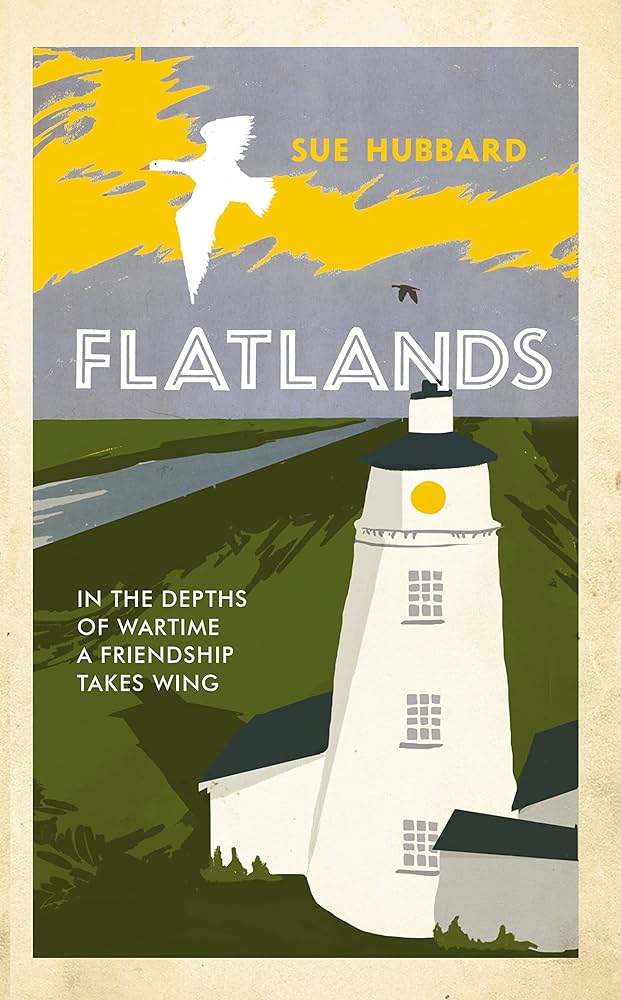
Review by Lisa Williams of "Flatlands" by Sue Hubbard


Flatlands by Sue Hubbard retells Gallico’s The Snow Goose but to an adult audience. Two souls that don’t belong, Freda and Philip, are bonded by the welfare of an injured bird: wounds and the wounded feature heavily in this wartime story. We are still evacuated with Freda but the desolation of the Snow Goose’s stretching mudflats are shifted up the coast to a “place between somewhere and nowhere” on the shores of the Wash. Hubbard’s skilled scene setting places us in both the wilderness and the time perfectly.

On “a hot day, the sort of day for a picnic, not a war” we’re transported with Freda on a train full of sad, scared evacuees to a new home “far away from love.” We’re immersed immediately in the “melancholy of the place.” This landscape, we learn as the story unfolds, matches the aching loneliness felt by both Freda and Philip. Freda remembers paisley eiderdowns and parma violets – Hubbard treats all our senses as she juxtaposes home comforts against the relentlessly barren East coast landscape.

Throughout the book the feeling of threat and uncertainty that war brings looms large but the actual menace is revealed to be lurking within the farmhouse. It is in the very place that Freda is put for safety that the full horrors of war are first exposed. She finds sanctuary at Philip’s lighthouse and they form what Philip describes as “a strange little friendship.”

An elderly Freda is telling us the story as a documentary about Dunkirk is about to be shown at her care home. Those nursed on the The Snow Goose will know Dunkirk’s poignant part in the story. I’m paddling carefully here not to avoid mines, but spoilers. During the depths of Dunkirk’s horrors in Flatlands oddly it was the addition of a dog in the water that made me catch my breath. His fate lingers long after the page has been turned.

As I read a book I make a note of sentences that I like. There was a point early on in this book that I thought I might never finish reading it because I was writing so many down. It’s a slow-paced read but with some delightful lines.


About the reviewer
Lisa Williams is a creative soul from Leicester. She has a Masters in Creative Writing from Leicester University, and lately tends to write mostly short fiction. She likes the challenge of a word limit – usually one hundred words. Her work has been published in numerous anthologies. Lisa has a weekly story slot on local community radio. She helps out a bit at Friday Flash Fiction and Blink Ink Journal. Lisa also paints and makes jewellery selling online as noodleBubble.

Friday, 12 May 2023

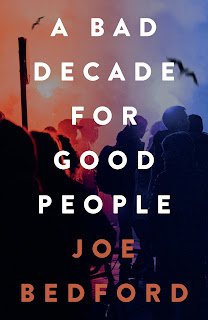
Review by Laura Besley of "A Bad Decade for Good People" by Joe Bedford


A Bad Decade for Good People – Joe Bedford’s debut novel to be published by Parthian in June 2023 – opens with an act of violence: ‘If the policeman’s baton had found Laurie half an inch lower she would be blind in one eye.’ The short prologue introduces the idea of juxtaposition, which I believe runs throughout the novel, both on a collective and individual level, for example: the police who maim and also protect; yearning to be seen by those we love, yet hiding from them. And how can we reconcile who we are with who others think we are?

Throughout the novel, nature plays a prominent role, from the ‘moon-shaped line of damage illuminated above [Laurie’s] eye’ to the various descriptions of Brighton – where a large proportion of the story is set – such as: ‘[the] shore stretches out in one long continuous line, unnaturally straight and unbroken but for the stone groynes that reach out from the shingle.’ The strong sense of place is reinforced by particular facts about the city an outsider is unlikely to know, for example the ‘tradition of leaving unwanted domestic goods out on the street – regardless of how broken they are, how difficult to move or how degradingly stained.’

George, the main character and Laurie’s younger brother, moves to Brighton to be closer to his sister, who lives there with her girlfriend. It is the summer of 2016. The summer of political turmoil: Brexit, David Cameron resigning, Theresa May becoming Prime Minister. Later in the year, Barack Obama is succeeded by Donald Trump. ‘It was all bad news or fake news or a combination of both.’ Laurie and her friends are heavily involved in the local political scene and tensions run high as the ‘decade get[s] darker and darker with no respite.’

This is also the year George meets Antonio, a Spanish naval engineer living in England with the hope of solving a family mystery from the past. It is through this central relationship that the novel continues to explore the themes mentioned above, as well as further themes of identity and belonging, both on a personal level and a communal one. How do we navigate a world not of our making, a world we no longer recognise? 

In many ways, for many people, the 21st century has not been easy. Through Antonio’s quest, we are reminded that we are not the first generation dealing with political upheaval and national frictions. In an interview in TIME Magazine, Margaret Atwood states, ‘The moment when you give up hope, that is the moment when you cease to take any actions that might be positive to get out of the doom.’ On both a macro and micro level, A Bad Decade for Good People echoes Atwood’s sentiments. Exploring timeless themes as well as the tumult of current politics makes this book a must-read for our time.  


About the reviewer
Laura Besley is the author of three collections of flash & micro fiction: (Un)Natural Elements, 100neHundred and The Almost Mothers. She is also an editor for Flash Fiction Magazine and a Creative Writing Masters student at the University of Leicester. Having lived in the Netherlands, Germany and Hong Kong, she now lives in land-locked central England and misses the sea. She tweets @laurabesley

Thursday, 23 March 2023

Review by Jane Simmons of "The Fourth Sister" by Laura Scott


The poems in Laura Scott’s new collection are populated by a richly assorted cast: lovers and sisters, but also parents and children, the living and the dead, birds and trees, painters, playwrights and their characters, Tolstoy, a godfather who married the wrong man and a godmother who was surely a spy.

The title alludes to Chekhov’s ‘Three Sisters,’ and references to the writer, his life and work are woven through the collection in poems such as ‘The First Sister’ which balances the title of the collection, ‘The Fourth Sister’, and ‘To Be One of Them,’ written after seeing a production of the play which describes being drawn into it to become one of the sisters. 'Why Are You Silent?' is a poem made up of extracts from letters between the playwright and the actress Olga Knipper who became his wife. 

This last is a poem which the poet describes as ‘an anti-autobiography poem,’ a description which introduces the playfulness evident in the collection. Poems also play with ‘the tyranny of stories’ – the fourth sister is ‘the one who slips the story’s collar,’ while ‘Why Are You Silent?’ plays with dialogue, with ideas of volubility or the ‘sprawl of talk,’ its long lines changing  direction as they snake down the page. ‘Cover Photo’ – a late addition to the collection - was written to guarantee the use of picture which was Scott’s choice for cover.

I was struck by how questions are used in these poems, how they pose questions and set out to answer them. ‘The Fourth Sister,’ for example, begins with a series of questions and opens up a dialogue with the other ‘sister’ poems. However, Scott knows better than to overwork the technique: in ‘The Bored Cowboy,’ one of a sequence of poems on boredom which explores how it slows down time so that you feel the ‘thickness’ of ‘slow, clogged time,’ she begins with one of those questions:

          and what about the blackbird
          Singing his big strong song
          From the heart of the tree?

only this time she denies the reader an answer by the ‘-‘  at the end of the poem.

At the Carcanet book launch for ‘The Fourth Sister,’ Scott spoke of how she is fascinated by our inability to remember, of wanting the poem to free something and then encountering the resistance of the subject. This is how her poems come to be held between ‘telling and withholding’ – like the people in Chekhov’s plays – and how the reader is invited into the space of the poem to participate in the action and the dialogue.


About the reviewer
Jane Simmons is a former teacher now PhD student. She won the University of Leicester’s G. S. Fraser poetry prize in 2019, 2020 and 2021, and the Seren Christmas poetry prize in 2020. Her work has appeared in Ink, Sweat and Tears, The Blue Nib magazine and on the Seren blog, as well as being long-listed for the Mslexia Poetry Prize 2022.


Monday, 6 March 2023

Review by Gift Yusuf of "Purple Hibiscus" by Chimamanda Ngozi Adichie


Fifteen-year-old taciturn Kambili is raised by her strict-abusive-Catholic-fanatic father and her overbearingly meek and submissive mother. Her older brother, on the other hand, is the rebel of the family because of his ability to nonchalantly confront their father. 

We are carried on Kambili’s journey of longing and loss as a teenage girl who has a deep love for her father regardless of his inadequacies. However, she finds herself constantly seeking his approval even though, he seems to prefer her disrespectful brother because he is a boy. Later in the book she finds her longing in a man who is much older than she is, when she goes to visit her cousins on holiday. 

The book covers a range of social justice issues and the negative effects of colonial influence which is eye-opening and informative without being too exegetic. It shows that the father is also a victim—a victim of colonialism due to the presence of the Catholic missionaries in eastern Nigeria. He doesn't even realise it in many instances, such as when he makes his family speak only English, banning their native tongue, in the home. 

His religious fanaticism also leads to him isolating his family from other relatives and their native traditions because they are seen as "heathen," while he physically assaults his wife and children under false Biblical justification. 

Regardless of their father's shortcomings, we can tell that he has an unspoken love for his family by some of his subtle actions in the story—for instance, he always shares the first drink of his tea with his children. 

I was gripped from beginning to end while reading this book as it took me on a roller-coaster of emotions, particularly because it ended in such a shocking plot twist. Even with the father’s abusive nature, I found myself feeling pity for him towards the end of the novel as secrets were revealed, and it made me wonder if the mother’s "submissive" nature was disingenuous. 


About the reviewer
Gift Yusuf is a current MA Creative Writing student at the University of Leicester. She’s twenty years-old and graduated from Coventry University where she studied Law and had her first short story published in the Coventry Law journal. In her free time, she volunteers with kids and a Young Writers' organization as an Alpha reader. She also loves to read short stories and watch short films. Her favorite short film is The Neighbors' Window, an Oscar winning film which can be found on YouTube. 

Thursday, 2 March 2023

Review by Madeleine Bell of "Bunny" by Mona Awad


“Bunny” is their communal pet-name. They move as one – a lemon-scented, cupcake-devouring Lovecraftian hivemind - four affluent young women at the prestigious New England college aptly named “Warren University.” They groom each-other’s hair, nuzzle one another’s faces in full view of the public. “Bunny, I love you,” one of them simpers, to which another replies, “I love you, Bunny.” They sit together in their writing workshops, snuggled up together on one side of a table, holding hands, petting each-other. 

On the other side of that table sits the only other student, our narrator Samantha. Attending Warren on a scholarship, she is excluded from this intriguing dynamic until an invitation appears in her school mailbox inviting her to an erotic writing workshop with the Bunnies. From here onwards, she descends into their world of miniature food, colourful cocktails, beheadings, sugar, exploding rabbits, pills, and axes. And all the while, the Bunnies are fascinated with the artistic concept of The Body. 

I read this in one sitting. With such a bizarre and enticing beginning, the novel runs the risk of losing momentum, but the plot developments kept me hooked. Samantha is influenced by those she associates with. In the company of her cynical best friend, Samantha calls the Bunnies ironic nicknames – Creepy Doll, Duchess, Vignette and Cupcake. Yet as she falls in with this group, the Bunnies become indistinguishable from one another, “I” becomes “we,” “me” becomes “us,” and all of them are “Bunny.” 

For those who enjoy the dark humour and satire of Ottessa Moshfegh’s unhinged My Year of Rest and Relaxation, Awad’s novel is sure to please. I cannot, in good conscience spoil this plot for you. It benefits from being explored blindly. The saccharine title and premise conceal an ugly, gutsy satire of privilege, high art and friendship. 


About the reviewer
Madeleine Bell is twenty-one years old. She's a Creative Writing MA student at the University of Leicester. She loves to read and write horror stories. In her spare time, she collects CDs, and takes pictures of the squirrels in Victoria Park. She can usually be found running or playing games of Dungeons & Dragons.

Saturday, 4 February 2023

Review by Nina Walker of "The This" by Adam Roberts


Social media is becoming an increasingly pervasive companion as the twenty-first century drags its mangled body onwards. The idea of engaging with the virtual world before you even get up to brush your teeth has become something of an unquestioned norm for many (myself included). It is these new abnormal norms that The This plays upon. The novel centres on ‘the this,’ a device in the roof of your mouth that allows you to tweet without lifting a finger. When I have presented this concept to friends, the response is always a slightly horrified and yet intrigued grimace. 

We are already too deeply entangled with social media and yet the allure and elegance of a hands-free interface! You have to admit it has some attraction about it. But from the first chapter we become aware that ‘the this’ aims for more than just an easier user experience. It wants to create an empathy gorge - a virtual space where you can live a million lives in the same way you might ravage a packet of Revels. ‘You are a farmer. You are a farmer. You are a farmer. You are a farmer, pressed into the army and spiked with a spear from behind on a battlefield whose name you do not know.’ We have become the product people pay to experience; our lives and traumas are just raisins in the trail mix of The This. Your life is no longer private or special. That treasured memory of your wife kissing you for the first time is now everyone’s treasured memory of your wife. 

What is so startling about Robert’s novel is not only its relevancy - it is, after all, science fiction - but how unbelievably alluring it is. To never be lonely again, to access the knowledge of your peers, and be truly useful: who could turn down an offer like that? 

Not me. 

That’s for sure. 


About the reviewer
Nina Walker is studying a Modern and Contemporary literature MA at the University of Leicester. She writes poetry on modernity, dogs, and pub men (among other things) which can be found on her blog here. Her most recent project is an extended prose piece on work culture called The Anatomy of Work. She also enjoys dystopian fiction, producing digital art and the work of e. e. cummings. She can’t swim or ride a bike so it's probably for the best that she stays inside and writes. 

You can also read one of Nina's poems on Creative Writing at Leicester here

You can read more about Adam Roberts's The This on Creative Writing at Leicester here

Thursday, 15 December 2022

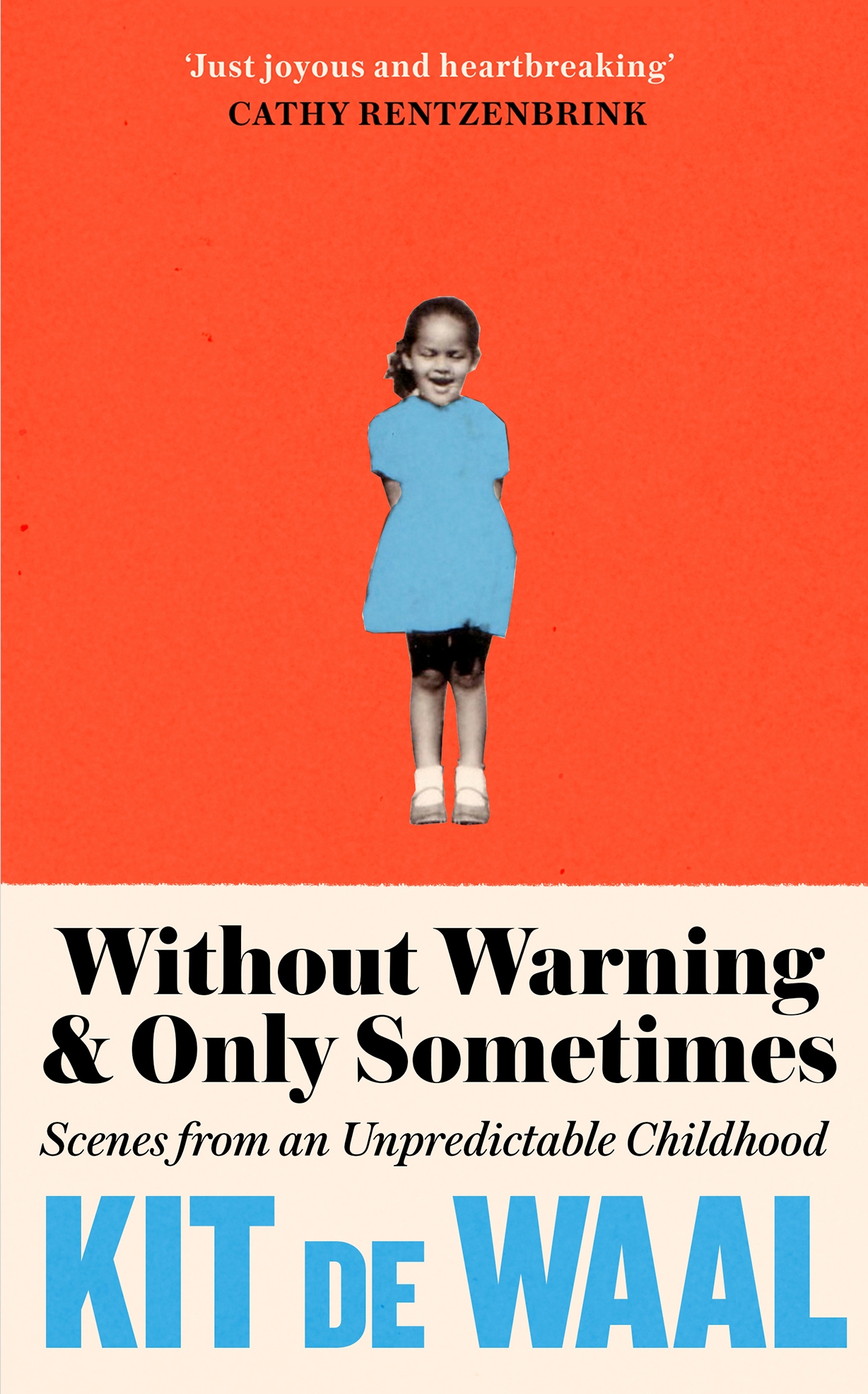
Review by Alan McCormick of "Without Warning and Only Sometimes: Scenes from an Unpredictable Childhood" by Kit de Waal


Kit De Waal’s narration is clear-eyed and unsentimental, devoid of self-pity, with an extraordinary gift of recall and eye for detail borne from a harsh childhood, where survival was often found in the shadows, dreaming, observing, trying to make sense of the goings on in an often unpredictable, joyless home, attempting to understand her family’s place in the world. 

Kit’s Mom is from Wexford and her Dad from St. Kitts. Being both Irish and Caribbean in nineteen-sixties-and-seventies Britain meant enduring endemic prejudice and everyday acts of racism – being called ‘Little Miss Fuzzy Wuzzy’ by a teacher or ‘wog’ and ‘blackie’ by a spiteful classmate – singled out in turn for being either Irish or black or mixed-race.  Even Kit’s grandmothers, Nan and Black Nana, never accept the racial partner choices made by their children, and, worse, Kit’s parents seem to distrust and reject each other’s cultures, and barely connect or show affection to each other. 

Kit’s Dad, Arthur, is mostly controlled (controlling), off-handily critical and barely present, living through cricket (he’s good), and detective and cowboy films on television. He springs momentarily to life to corral his willing kids (desperate for a bit of fun) to help bake Christmas cakes to give as gifts or make Caribbean food at weekends whilst Mom, Sheila, is at work. He puts on a good face around relatives and friends from home, fondly reminiscing a romanticised past. There is little money around and what money there is, is rarely spent on enough food and clothing for Kit and her siblings. Whilst Sheila tries to save, Arthur would rather use his money to keep up appearances by buying a smart car, good shoes for himself, sending extravagant gifts back home and building a house for his fantastical return to St Kitts. 

Sheila is overwrought and overworked (doing many jobs, cleaning, child-minding, caring, and running the home). She’s exhausted and distracted, needy and swamping when showing unexpected moments of generosity or affection (the sudden purchase of art supplies is accompanied by her manic desperation for the kids to instantly use and enjoy them), her feelings dissipated in caring for vulnerable strangers outside the home. She does rise to meet a crisis, caring in response to Kit’s dramatic childhood accidents, but becomes increasingly frustrated as time passes, saving milk bottles to throw at the outhouse wall, escaping into a forlorn, nostalgic reverie of singalong sentimental songs. 

And then there’s Jehovah which means no Christmas or birthday presents! Kit and her siblings learn to endure, and (ultimately) reject the weekly services at Kingdom Hall with their boring, guilt-tripping sermons, by making up irreverent names for the congregation. But Mom is on a mission to spread the word and in one hilarious, acutely observed scene, she again tries to lay traps (the increased frequency of natural disasters) to try and entice and convert her wily Catholic mother, who is having none of it: ‘It’s a push-me-pull-you of a dance,’ Kit observes. ‘As old as time, the child who was never the favourite, the mother who couldn’t love enough. They lock in with their clumsy footsteps, out of step to the music, each one trying to lead, stepping on toes.’

Affection and joy may arrive in the home ‘without warning and only sometimes’ for Kit and her siblings but it can also come from outside – Dad’s cousin Uncle Mike is ‘loud, gruff, rough, fun’ and the kids love being around him in his chaotic bedsit. Kit and her siblings also learn to find their own fun, to stick together to survive.

Everyone in the family wants to escape and change their lives, and, whilst Dad and Mom are thwarted, Kit finds salvation, the possibility of a better life away from home, first with friends, and then in the company of characters from books. She devours the classics recommended to her, the watcher becoming a reader, and later the writer who will let us into her life and tell her story – a multi-layered story about race and class, of hope and survival. It’s a wonderful, wise, and life-enhancing book that will stay with me for a long time.


About the reviewer
Alan McCormick lives in Wicklow. He’s a trustee with  InterAct Stroke Support who read fiction and poetry to stroke patients. Alan’s writing can be read in current issues of The Stinging Fly, Southword and Exacting Clam; and online at 3:AM Magazine, Fictive Dream, Dead Drunk Dublin, Mono, Words for the Wild and Époque Press. His story, 'Firestarter,' came second in this year’s RTÉ short story competition. For further information, see here


You can read more about Without Warning and Only Sometimes, by Kit de Waal, on Creative Writing at Leicester here

Friday, 21 October 2022

Review by Jane Simmons of "Standing Up with Blake" by Philip Dunn


Philip Dunn’s work has already won him many local admirers, and now his keenly-awaited first collection introduces his work and his poetic voice to a wider audience, beyond the place where ‘the alchemy of dyke and drain / make liquid silver of the leaden skies.’

The opening poems explode into life, taking the reader from the Trump presidency by way of Blake and his visions of angels to the impoverishment of language through the removal of words from the dictionary, the extinction of lambs and lions, and the coming of a world which ‘will henceforth only ever home whatever never takes a breath.’ 

The political and the personal cross paths throughout the collection: it is only ever a small step from internet trolling to political violence, and from the evils of social media to the i-phone literate seven year-old who does not know his own surname or family address.

Dunn knows the value of approaching his subject ‘slant’ – using the song of a blackbird to plunge the reader into WW1 trenches, or skilfully exploiting intertextuality, such as when he uses the title ‘Cant and Culpability’ to make pointed comment on current politics or employs a reference to Jenny Joseph in an example of the wry or self-deprecating humour which is another characteristic of his work.

These poems do not just resonate with concerns about past and current political situations and about social change. Elsewhere, there are poems of considerable tenderness: for the awkward boy, uprooted from his familiar surroundings and hearing ‘the unmistakeable voice of exile’; for first love, ‘the boy on the green bench / burning like a grazed knee’; for relatives becoming increasingly frail in old age; and for a friend struggling with a dementia diagnosis.

Altogether, this is a collection which was well worth the wait.


About the reviewer
Jane Simmons is a former teacher – and now a PhD student. She won the University of Leicester’s G. S. Fraser poetry prize in 2019, 2020 and 2021, and the Seren Christmas poetry prize in 2020. Her work has appeared in Ink, Sweat and Tears, The Blue Nib Magazine and on the Seren blog, as well as being long-listed for the Butcher’s Dog Magazine.

Monday, 5 September 2022

Interview with Melissa Harrison


Melissa Harrison, photograph by Brian David Stevens


Melissa Harrison is a novelist and nature writer

Melissa contributes a monthly Nature Notebook column to The Times and writes for the FT Weekend, the Guardian and the New Statesman. Her most recent novel, All Among the Barley, was the UK winner of the European Union Prize for Literature. It was a Waterstones Paperback of the Year and a Book of the Year in the Observer, the New Statesman and the Irish Times. Her previous books have been shortlisted for the Costa Novel Award and longlisted for the Women’s Prize for Fiction (At Hawthorn Time) and the Wainwright Prize (Rain). She lives in Suffolk.

Melissa is represented by Jenny Hewson at Lutyens & Rubinstein. She can be found on Twitter at @M_Z_Harrison. 


Interviewed by Joe Bedford

JB: I’d like to start by asking how you feel about the tradition of the English rural novel to which At Hawthorn Time and All Among the Barley belong. As a genre which was immensely popular especially in the interwar period, and seems to be in resurgence now (I’m thinking of writers like Tim Pears, Claire Fuller and yourself), how do you see your work speaking to that canon? Do you feel, when writing, that you are entering a dialogue with Hardy, Lawrence, the interwar writers and others?

MH: You’re absolutely right: rural novels have a long history in this country, but reached a peak of popularity in the years after the First World War, part of a wave of countryside writing that included dozens of farming memoirs like Adrian Bell’s hugely popular Corduroy trilogy, and a rash of motoring and walking guides such as Grigson’s Shell Country Alphabet. Some of these books were aimed at helping the (still relatively recent) phenomenon of ‘townies’ reconnect with their rural roots; others were a reaction against the new horrors of mechanised warfare, and a balm for the social and economic upheavals that followed. The boom in nature writing we’ve seen for the last 10–15 years has its roots in some of the same soil.

I wouldn’t personally include Lawrence as part of the interwar tradition of rural writing – his primary concerns are people and ideas rather than place, I’d say – but you’re right, it’s certainly a period I have a deep and complex relationship with. I suppose I want to interrogate the image of rural England that was conjured up in those years, or if not conjured up, buffed to a high shine. Nostalgic even at the time, I find the vision of farmland and villages and market towns captured by many of those books utterly alluring: it feels rooted inside me, part of my inner architecture, something lost that I long for in a bone-deep way, as I long for the ordered, bucolic rural landscapes drawn by Charles Tunnicliffe and Ronald Lampitt in the Ladybird books of the 1940s and 50s and elsewhere. But at the same time I’m deeply suspicious of this longing, knowing full well how reactionary, excluding, unjust and frankly unhealthy that fantasy of England was then, and still is in the wrong hands today.

My mother was born and brought up in what’s now Pakistan, in the last days of the British Raj. Her mother was Anglo-Indian, her father a British school teacher: national identity, for both women, was never clear-cut, given the prejudices and political complications of that period in that place. My five siblings were born in India; I’m the only one in my family who was born here, in commuter-belt Surrey: a place where none of us had roots. In the foothills of the Himalayas, Mum grew up speaking Urdu and hearing talk of ‘home,’ a country she’d never visited, yet when she came here she missed the country of her birth for the rest of her days. The books she loved best – and that she read to us when we were small – were stories of English rural life: Cider With Rosie, Alison Uttley’s A Country Child, Lark Rise to Candleford, the Miss Read books, Kipling’s Puck of Pook’s Hill and nature novels like Watership Down, A Black Fox Running, Tarka the Otter, Duncton Wood and BB’s The Little Grey Men books; even The Hobbit and The Lord of the Rings contributed, I think, to a reading culture which was intensely romantic (and elegiac) about the English countryside – although the rural villages and farms it described could be found nowhere around us in the Home Counties of the 1970s and 80s. My continued fascination with that kind of writing feels a bit like picking at a scab, I suppose: nostalgia for an imagined rural past is a faultline in our national psyche that also runs through mine, and I find it hard to leave its contradictions alone.

JB: Running with that theme of looking back, I’m also interested in your attitudes to nostalgia, both in your own work and elsewhere. You’ve written that ‘political and social nostalgia may be dangerous, but ecologically it’s unavoidable’ (Stubborn Light), which feels like a nuanced view on nostalgia as a potentially useful conservationist tool – something active, akin to what Svetlana Boym calls ‘reflective nostalgia.’ What are your feelings on the role nostalgia has to play in conserving our environment, and in the ways you yourself approach the natural world as a writer?

MH: If you’re at all engaged with the current crisis you’ll know that we’re facing ongoing losses and extinctions, some of which may yet be ameliorated but many of which are now unavoidable. Yet one of our greatest blind spots is to the rate of diminishment, captured by the term ‘baseline shift.’ We each take as a norm the state of nature in our childhoods, and though we may notice the losses that occur ‘on our watch’ (and many of us never do), it’s very hard for us to understand the far, far greater losses that have occurred across greater sweeps of time. And here, nature writing can prove to be invaluable. The world I grew up in was much richer in wildlife than the one I inhabit now, and I grieve for the nightly hedgehogs, lesser spotted woodpeckers, great crested newts and flocks of lapwing on the Somerset Levels that I remember from when I was a child; but in rural writing from earlier in the 20th century, and beyond, I read of creatures like corncrakes that I have never and may never see in the wild, and of abundance – flocks, swarms, shoals – I can’t even imagine. It’s impossible to read those accounts without a keen sense of nostalgia, and rightly so: we can and should use that feeling as a spur to try and restore species and landscapes not to their condition in our youth but to a carrying capacity we may never have experienced ourselves. That doesn’t, in my view, mean picking a date in the past and somehow rolling back time to try to recreate it; it means working in the here and now to great a newly rich, dynamic and resilient ecosystem that responds to the pressures but also the technologies we have today. And books are part of that toolkit: as I’ve mentioned before, stories are powerful: they can drive engagement and connection, and create change. They can also be a way for us to collectively process our grief, and can be a vital act of witness – a memorial, even – just as books written a century ago are today.

You mentioned the writer and cultural theorist Svetlana Boym. The distinction she makes between what she defines as two types of nostalgia is interesting: 'Reflective nostalgia dwells on the ambivalences of human longing and belonging and does not shy away from the contradictions of modernity. Restorative nostalgia protects the absolute truth, while reflective nostalgia calls it into doubt' (‘Nostalgia,’ in Atlas of Transformation). Going by that definition I’d agree that reflective nostalgia is central to the kind of writing I do. Certainly, I don’t believe in restoring the past intact – or in any version of ‘absolute truth.’ Any truth we can approach in our own lives is always partial, culturally inflected, temporally unstable and subjective. There is no ‘view from nowhere,’ and we’re in trouble if we believe otherwise.

JB: Tied to that theme of nostalgia, I’m interested in the tensions between place and identity that come to the fore not just in All Among the Barley, but in your non-fiction as well. You’ve written about the ‘very real dangers in tying national identity to place … because it leaves no room for change’ (Article for Foyles, 2019), but also about how ‘connecting with and defending our “home patches” is a powerful way to protect the environment’ (Stubborn Light). I wonder how you feel about the tension between these two ideas, and how that continuum from localism to nationalism (and even fascism) is handled in your work.

MH: It's crucial that we nature- and place-writers don’t fall into the trap of believing that only a certain set of people with a prolonged history of living in a place really ‘belong’ there, or can appreciate or understand it. If we do that, then any change to the social make-up of an area becomes a threat – and we cannot afford that kind of thinking in an age of climate breakdown and mass population movement. We absolutely must cultivate a way of thinking that is flexible and open and welcoming of change when we create stories and narratives about place – because, as I’ve mentioned already, stories are incredibly powerful.

You’d be forgiven for thinking that as someone bewitched by history, heritage and tradition, welcoming change would be difficult. I love nothing more than to discover an ancient dialect word for a wildflower, or a regional method for laying a hedge; I’m fascinated by folklore and the hyper-local forms of culture that have been preserved in large part by groups of people interacting in a prolonged manner with the specific geography of a place. But there’s only a conflict between caring about tradition and welcoming change if you see the past as a fixed entity, and change as a new thing. Yet we are a nation built on constant immigration: over and over we’ve folded into ourselves the gifts other cultures have brought us us, adding to, not erasing, our set of stories about these isles. All we need to do in this current moment is to keep doing what we’ve been doing for centuries, rather than believing in the (frankly ahistorical) idea of static national, regional or local identities.

When it comes to conservation, the beauty of looking after a ‘home patch’ is that anyone can do it, no matter their cultural background or how long they’ve lived in a particular spot. Whether it’s a garden, a street tree, a park with a ‘Friends’ society or a local nature reserve, everyone can find somewhere to connect to and develop a sense of custodianship for. Entering into an imaginative and emotional relationship with a ‘home patch’ – watching it grow and change, finding out what lives there and what those things need, protecting it from damage – can bring enormous benefits, both for people and for the natural world. Added up, garden by garden, tree by tree, park by park, that kind of care can utterly transform an area’s richness in wildlife, as well as its custodians’ mental, emotional, spiritual and physical health, and their feeling of belonging and rootedness, too.

JB: At the height of the pandemic, a set of posters (falsely attached to Extinction Rebellion) were circulated claiming that ‘humanity is the disease, coronavirus is the cure.’ Reflections of this kind of anti-humanist, deep ecological theory (including problematic aspects like population ethics) are something I sometimes recognise in what is otherwise very mainstream contemporary nature writing (though not, I should point out, in your own). Is this a phenomenon that you’ve noticed in nature writing, and how robust do you feel nature writing is in handling these complex feelings of blame towards the human population?

MH: Right now there’s a real danger of nature writing (and nature writers) being co-opted by both the very far left and the very far right – who, of course, are not very far apart. We can’t afford to be naïve about the potential for texts lauding pure and untouched nature and bemoaning the sullying influence of humankind being used by these groups to promote dark ideologies, often in a way that begins fairly uncontroversially (and sometimes lyrically and persuasively) but leads somewhere very unpleasant indeed.

It seems to me that if what truly exercises you right now is the ecological effect of rising population levels you should be advocating for women’s education and improved access to contraception and abortion, supporting migration into countries with falling birth rates and an ageing tax base, and working to help new citizens connect with and care for the natural world in their adopted homes (which means making access possible, but not dictating the form in which it occurs). Yet I don’t see many eco-fascists doing that work.

We all also need to think carefully about the language we use around native and non-native wildlife so that we using it much more mindfully. Many native species, such as bracken, behave invasively and are causing enormous issues; many introduced species, such as little owls, are not only unproblematic, but beloved. We need to assess species (and people) as individuals, rather than drawing damaging equivalencies between country of origin and intrinsic worth. How we talk about ring-necked parakeets or yellow-legged hornets may seem like a small matter, but frankly, I feel it’s often where we let our pants show.

Finally, you mentioned the idea of ‘blame’ towards the human population, and this, I think, is where a lot of resistance to the changes we need to make is stemming from. None of us like being blamed, so we try to shift that blame on to others, or on to species, or to rid ourselves of the discomfort we simply switch off from the entire notion of engaging with the problems we currently face. But there’s a difference between something being your fault and it being your responsibility. It’s not your fault, or mine, that we are where we are. We were born into the world as it is now, and must live in it: we are not to blame. But that doesn’t mean it’s not our responsibility to try and lessen the losses to come, while we still can.

JB: Finally I’d like to touch on something I discussed recently in my interview with the author Will Burns. In Will’s novel The Paper Lantern, our capacity for hope in the face of the degradation of the countryside is stretched to breaking point, as it is for many of us when we read about the continuing challenges our landscape faces. That said, how do you envision the future of the English countryside? Does it have a future, and if so, what do you think that future might look like?

MH: Of course: England’s villages, with all their varied, vernacular architecture, aren’t going to be pulled down, and we’re still going to need to grow food, which means the farmland we’re used to seeing will survive, too; in fact, it’s likely to become more and more important that we produce as much food as possible at home, and that requires land. For many people, those villages, set between rolling green fields (or golden ones in summer) are the epitome of rural beauty – despite the fact that although they look unchanging and bucolic, under modern agricultural systems those fields can be staggeringly empty of wildlife (not for nothing did the naturalist Chris Baines once say that if you want to make farmland more biodiverse the best thing you can do is build houses on it, as urban areas are often far richer in wildlife than intensively farmed land). So yes, in that sense, the English countryside has a future.

But I’m guessing that when you talk about hope you mean hope for a countryside that’s species-rich as well as productive, a home for hedgehogs, nightingales, turtle doves, otters, purple emperors, water voles, stag beetles, song thrushes and all the other forms of non-human life that make this country their home. And here I think it’s important to move away from the ‘hope / no hope’ binary: if we fall into that trap, we’re effectively letting ourselves off the hook by saying either that everything is going to be fine so nothing needs to be done, or that the battle is already lost so there’s no point making any effort. The truth is, everything isn’t going to be OK, but how bad things get is in large part still up to us.

I think of what’s coming down the line as a bottleneck. There are going to be more extinctions, and further falls in abundance, but how many species we get through that bottleneck depends on the work we all put in now. And it really will take all of us. Not everyone has the singlemindedness necessary to be an activist; some of us are thinkers or communicators, some are community mobilisers, some have political or public-facing skills, some have the ability to guide children in a way that benefits the world to come, to influence an employer or to flex their economic muscles to bring about change. We can’t each take on all of those roles, and that’s OK. But I think we should all be taking on at least a couple.

And there are enough good things happening to counterbalance the bad. I usually avoid the term ‘rewilding’ as I think a lot of the discourse around it has become polarised and toxic – for which the environmental movement should shoulder a lot of responsibility – but the energy that is currently being generated around restorative and regenerative forms of land use is absolutely staggering to me. From individuals to farmers to landowners and councils, there has been a dramatic and sudden sea-change in people’s understanding of what land might be for that has occurred at a deep, perceptual level and is still gathering pace. Just as much of the degradation of our countryside took years to become apparent, this shift will take decades to fully show results, and there’s very good reason to be hopeful about what those results might be.

Hand-in-hand with that ongoing process, Brexit – for all its terrible effects – has given us the opportunity to change how we pay farmers and landowners to manage land, and what we ask them to provide. We’re still kicking about in the weeds, which is causing all sorts of problems for farmers who need to be able to plan ahead, and many of the most exciting initial proposals have predictably been watered down, but I do think we’ll end up with something better for nature than we had before. And finally, the burgeoning movement for improved access to the countryside is interesting. The pandemic did what nature writers like me could only have dreamed of: connected many people with their inner need for nature, got them outdoors, looking for solace and finding it. And with that has come a growing appreciation that access isn’t always easy or equitable, and that there are barriers – economic, cultural, social, practical – for many groups when it comes to outdoor activities other people take for granted.

I’d like to see a countryside where farmers are supported to produce high-value crops on the most productive land while helping marginal land to become truly species-rich; where dozens more oases of true rewilding such as Knepp are connected to each other by thick hedges, strips of woodland and other wildlife corridors so that creatures can move across intensively farmed land; where rivers are rewiggled and beavers used to restore wetlands, locking up carbon and preventing flooding downstream (and with a sensible management system such as exists in Bavaria). I’d like to see more gardens, parks and entire villages allowed to become overgrown and ‘untidy,’ rich in insects and birds and full of decay and dynamic, changing, connected habitats; and I’d like to see people from all sorts of backgrounds finding their way into the British countryside, making rich new connections with it, and feeling welcome there.


About the interviewer
Joe Bedford is a writer from Doncaster, UK. He is currently a PhD Creative Writing student at the University of Leicester. His short stories have been published widely, including in Litro, Structo and MIR Online, and have won numerous prizes including the Leicester Writes Prize 2022. His debut novel A Bad Decade for Good People will be released by Parthian Books in Summer 2023. For more information see Joe's website here.