Showing posts with label Picador. Show all posts

Monday, 25 May 2026

Review by Anna O'Sullivan of "Open Throat" by Henry Hoke


Open Throat by Henry Hoke is a profound and experimental piece of literary fiction that will linger with you long after reading it. The novel follows an isolated, queer mountain lion living under the Hollywood sign, observing the insular, self-centred conversations between passers-by, whilst navigating the complexities of their own identity. Inspired by P22, a mountain lion who lived in Griffith Park after successfully crossing two major freeways, and monitored by researchers until his death in 2022, Hoke creates a powerful story that can be digested in one sitting. 

Hoke writes in evocative and lyrical prose, comparable to a work of poetry; the lion’s stream of consciousness is non-linear and uninterrupted by punctuation, creating a real sense that readers are experiencing the lion’s deep thoughts. The combination of humour, through the lion’s misinterpretation of words, alongside the emotional turmoil of yearning for connection, adds to the story’s emotional depth and Hoke’s literary brilliance. 

What stands out about Hoke’s novel is his ability to draw from a diverse range of social issues in contemporary society. This is not just a story about a lion losing its way. Hoke discusses the importance of "human" connection, as the lion struggles with segregation from society, and the hierarchical way in which humans regard the animal kingdom as inferior. Another important theme throughout is ecological grief, and the depressing reality of climate change and human impact on the environment; Hoke leans into real-world anxieties, integrating the terrifying destruction of the LA wildfires and the homelessness crisis. 

If you are looking for something different to read, Hoke’s novel offers a new and compelling narrative. Readers of Weird Girl Fiction, a genre expanding in popularity, may be drawn to this novel, as although it does not follow the experience of a "Girl," it has similar components of complex relationships, strong emotions and unconventional themes. Open Throat has earned its strong and unique presence in the genre of literary and contemporary fiction. It offers something new – the point of view of a complex mountain lion, viewing barriers in society through a symbolic lens. If this doesn’t entice readers, then the gripping first line of the book is sure to: ‘I’ve never eaten a person but today I might."


About the reviewer
Anna O’Sullivan is a University of Leicester graduate with a BA in English and MA in Modern and Contemporary Literature and Creative Writing. She enjoys travelling, and recently returned from five months of backpacking across Latin America. Anna’s predominant passion is books; she is an avid reader, BookToker, attendee of literature events and employee at Hachette UK. She is currently guest editor of Everybody's Reviewing. 


Sunday, 29 June 2025

Review by Lee Wright of "On Agoraphobia" by Graham Caveney


Memoirs rarely make deliberate use of space on the page, but the large areas of emptiness in Graham Caveney’s On Agoraphobia (2022) evoke a sense of unease that mirrors the author’s fear of open spaces, motorways, and crowds. As someone intimately familiar with the vulnerability of vast, public environments, Caveney conveys in his second memoir a sense of being throttled by a thousand invisible hands, each chapter strengthening the grip. The narrative is a belt tightening around the chest, each notch drawing one step closer to madness. 

There is a fraught relationship between the writer and the agoraphobic. Caveney recalls Shirley Jackson—once cruelly dubbed Virginia Werewolf—and her anxiety attack in a New York shopping mall: "She stayed inside. Something new and unpleasant had begun to happen every time she tried to leave the house." 

Art and agoraphobia demand a retreat from the world. Art is created out of a desire to fix, reinterpret, or reimagine the world. The more the world is fixed on the page or canvas, the more jarring and unpleasant the real world may feel to the artist upon stepping outside. Caveney has been battling his condition for thirty-plus years, calling it "a neurotic two-step." His agoraphobia began at the University of Warwick. Mine started while waiting for a bus outside a college in a Warwickshire town. 

He quotes Elizabeth Bowen: "Inside everyone, is there an anxious person who stands to hesitate in an empty room?" I have been that person, and I know others who carry that presence within them. But never before has there been such a deeply personal journey into the empty room as in Caveney’s account. 

To proceed, he has to turn back: "I grew up with a whole mythology of nerves. They had their own poetics. Bad with his nerves, a bundle of nerves, a nervous wreck. Nerves were a site of catastrophe." This anxious life, marked by more than its fair share of catastrophe, has provided Caveney with the material to write books that deeply resonate with readers. We can only hope that Shirley Jackson was right when she closed her diary with the repeated phrase: "laughter is possible laughter is possible laughter is possible." 


About the reviewer
Lee Wright is currently pursuing a PhD. His subjects are memoir, people and place. His work has been published in Fairlight Books, époque press, and Cigarette Fire Literary Magazine. 


Thursday, 28 March 2024

Review by Megan Stafford-Adatia of "The Woman Warrior" by Maxine Hong Kingston


In her novel, The Woman Warrior, Maxine Hong Kingston shares the "talk-story" that has been passed down through generations of Chinese girls, without impairing the culture’s integrity or diminishing the painful history of womanhood that it encapsulates. In this way, Kingston unleashes the matrilineal voices that have been suppressed by society, allowing them to echo their impact on the reader long after The Woman Warrior has finished.

Silence becomes a "punishment" in the semi-autobiographical novel, one that, fortunately for us, Kingston refuses to participate in. No woman is left with their story untold. None are condemned to that historical culture of silence and erasure that Kingston presents as a reality for many Chinese women. The novel takes us through her life, the "talk-story" of her mother, her aunts (both living and dead), and even the myth of Fa Mu Lan herself—a story that has been so often distorted for Western viewers (Disney being perhaps the best-known example). The richness of the culture, the depth of the pains, the peaks of the victories—all are present in this novel along with the endurance of women who are fuelled by an independent spirit, yet concealed in a patriarchal society. Kingston not only awakens them to the light but shines a spotlight on "Warrior Women" who have been preparing to emerge from the shadows of silence for centuries. There are many different stories in this novel, both happy and heartbreaking. Yet with the glorious names of "Brave Orchid" (Kingston’s mother) and "Moon Orchid" (her aunt), Kingston demonstrates that your power does not depend on your history or life story; it depends on your strength in who you are. 

Maxine Hong Kingston refused to be forced into silence. I refuse to allow this book to fall into silence. We must, as Kingston stresses, "talk-story" about this educating piece of magnificence that establishes history in intersectional feminism.


About the reviewer
Megan Stafford-Adatia is currently a second-year undergraduate student studying an English BA at the University of Leicester. She was prompted to write a review in a Creative Writing seminar, and her passion for this novel led her here.


Friday, 1 April 2022

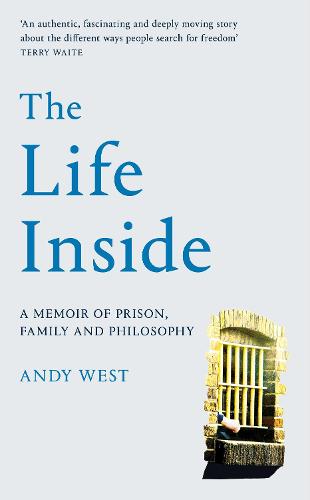
Review by Jon Wilkins of "The Life Inside: A Memoir of Prison, Family and Philosophy" by Andy West


Andy West is a teacher of philosophy in prisons. 

Whenever  Andy West steps into a jail, he is faced with a multitude of thoughts. He has diverse conversations with the people inside about their lives, their ideas and their feelings. As he listens to the men and women he works with, trying to find new ways for them to face their situation, he also comes to terms with his own world and his own guilt as we find that his father, uncle and brother all spent time in prison.

He chose a different path and has built a totally different life for himself, but he still worries that their fate will become his, as if it is a foregone conclusion that all their lives will take the same route. He asks what is prison for, to punish? To rehabilitate? Should we ever forgive a person who has done time? And what lasting impact does prison have on a person? Do they feel shame? Should we, the public forgive them? Is it in our remit to even think about doing this? What right do we have to do this? 

A fundamental question he asks is: can someone in prison ever be more free than someone outside? With this thought in mind, West goes on a journey looking for his own freedom in the wider world and wonders how these ideas reconcile with each other.

This is a beautifully written book, an intelligent exploration of life inside and outside of prison. Often amusing, often sad, it shows us all that is wrong with society, both behind bars and outside in our supposedly free world. We are what we make ourselves and this book tells us as much. This is truly an un-put-downable book, one that gives us a real insight to a series of different worlds and different lives.


About the reviewer
Jon Wilkins is sixty-six. He has a gorgeous wife Annie and two beautiful sons, and loves to write. He is a retired teacher, lapsed Waterstones’ bookseller and former Basketball Coach. He taught PE and English for twenty years and coached women’s basketball for over thirty years.  He has always loved books and reading. His website is here. 

Sunday, 11 April 2021

Review by Colin Gardiner of "The City & The City" by China Miéville


The City and The City begins as a routine police investigation into the murder of a young student. Inspector Borlú, of the Extreme Crime Squad is drawn into a strange and unsettling conspiracy that compels him to navigate a perilous journey across physical and psychological borders. 

The novel is set between the East European twin cities of Besźel and Ul Qoma. Both places are inexorably separated by an invisible but harshly defined boundary. Infringement is policed by a mysterious and uncanny force and citizens live in constant fear of ‘breach.’

The setting is urban but with a hallucinatory blur, where indoctrination and paranoia form the perfect setting for dramatic tension. The characters are sharply defined with subtle and concise details.

Miéville expertly weaves the genre of police procedure and magic realism into a stunning meditation on city life and the imagined borders we create to avoid irrevocable realities. 


About the reviewer
Colin Gardiner has recently completed his MA in Creative Writing at the University of Leicester. He lives in Coventry with his husband. He writes short stories and poems and has been published by The Ekphrastic Review, Ink Pantry, The Midnight Street Press and the Creative Writing at Leicester blog. More of his work can be read here.